Identity and catalogue
Link- Artist or attribution
- El Greco (Domenikos Theotokopoulos)
- Movement or period
- Mannerism
- Country or culture
- Spain (made in Toledo by a Cretan-born artist)
- Depicted subject
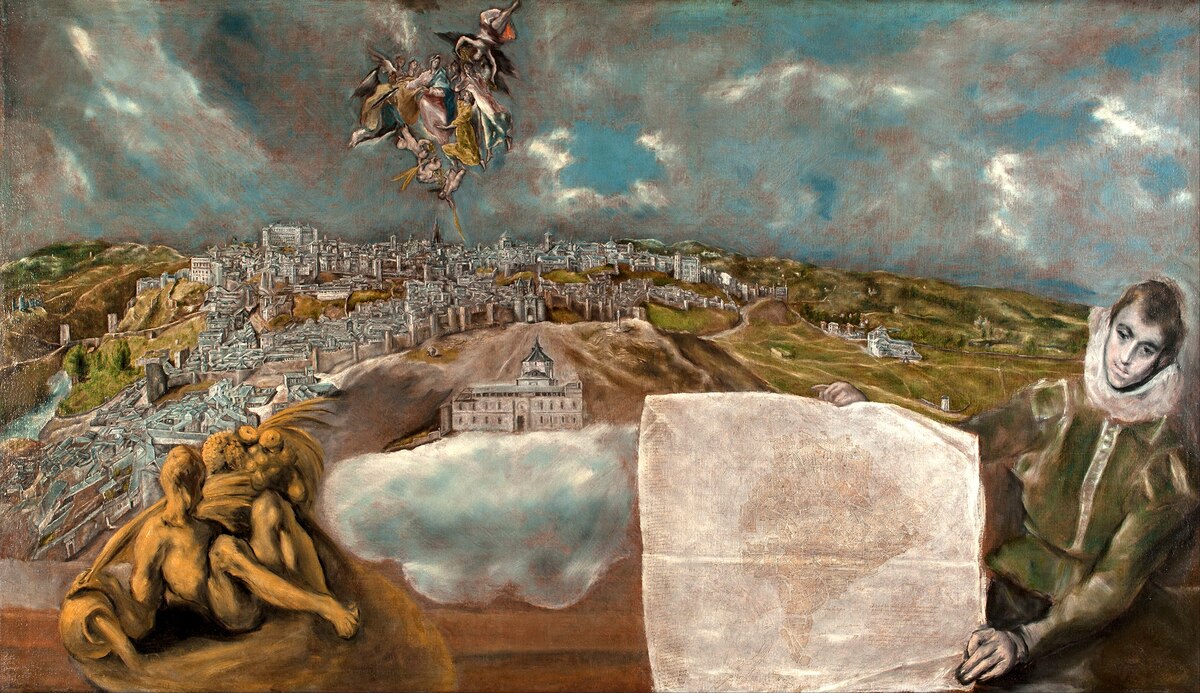
- A cityscape of Toledo that combines a general view of the city with a separate plan of Toledo. The painting features the modern buildings of the time: the Alcazar, the Puerta Nueva de Bisagra, and above all the Hospital de Tavera, which dominates the group of monuments. At the same time, El Greco passed over the Cathedral of Toledo and the Monastery of San Juan de los Reyes, the most prominent medieval buildings of the old capital of the Visigothic kingdom.(Wikimedia Commons: View of Toledo, n.d.)
- Support
- Canvas
Catalogue identity and titles
The painting carries the catalogue title View and Plan of Toledo and is attributed to El Greco. The record also preserves title variants in other languages: the Spanish Vista y plano de Toledo and the German Panoramabild und Karte von Toledo. The coexistence of these titles is not merely a translation matter; the German formulation foregrounds the two registers of the image, a panorama and a map, which the English title also names. Together these titles signal that the object is at once a prospect of a city and a diagram of it, a dual identity that recurs throughout its catalogue description.(Wikimedia Commons: View of Toledo, n.d., File information, Summary; Summary, Title)
The painting is dated between circa 1610 and circa 1614, a range that places it in the final years of El Greco's life. The artist is recorded as living from 1541 to 1614, born in Heraklion and dying in Toledo, and as having worked in Toledo, Crete, Venice, and Rome. The date range of the painting should therefore be distinguished from the dates of the artist's life and from the later dates at which the work entered catalogue literature. It is a terminal work, made in the city where El Greco spent his last decades, and its circa dating reflects the uncertainty of assigning a single year within that narrow span rather than a documented completion date.(Wikimedia Commons: View of Toledo, n.d., Summary, Date; Summary, Artist)
The Painter and the Late Toledo Work
The object belongs to a body of work made by an artist whose biography is comparatively well fixed by the supplied record. El Greco lived from 1541 to 1614 and worked in Toledo, Crete, Venice and Rome; he was born in Heraklion and died in Toledo. That itinerary matters for how his later Spanish production is read, because it places a Cretan-born, Italian-trained painter inside the civic and religious world of Castile for the last decades of his life. The painting under discussion is dated in the source to between about 1610 and about 1614, which makes it a late work, produced in the same city in which the artist died and within the final years of his life. The name by which it is known in the supplied material is View and Plan of Toledo, with the Spanish title Vista y plano de Toledo and the German title Panoramabild und Karte von Toledo recorded alongside it; it is executed in oil on canvas and measures 132 by 228 centimeters, or 51.9 by 89.7 inches.(Wikimedia Commons: View of Toledo, n.d., Summary, Artist)
The Image of Toledo: Modern Monuments and Medieval Omissions
The content of the view is not a neutral inventory of Toledo's buildings but a selection. The source states that El Greco contributed to spreading a new image of Toledo by depicting the principal modern constructions of that time: the Alcazar, the Puerta Nueva de Bisagra and, above all, the Hospital de Tavera, which predominates over the whole group of monuments. At the same time, the source records that El Greco passed over the presence of the Cathedral of Toledo and the Monastery of San Juan de los Reyes, which it describes as the most prominent medieval buildings of the old capital of the Visigothic kingdom of Toledo. The two statements belong together. The buildings that are included are identified with the modern city, and the two structures singled out as omitted are the leading monuments of the medieval city and of its earlier status as a Visigothic capital. The evidence supports the observation of this pattern of inclusion and omission; it does not supply the artist's reasons for it, and no document in the supplied material states that the omissions were intentional in the sense of a deliberate argument. Assertions that the painting advances a programmatic claim about modernity over medieval inheritance go beyond what these units establish, though the pattern itself is documented.(Wikimedia Commons: View of Toledo, n.d., Summary, Description)
Collection and Modern Institutional Setting
The painting's present institutional setting is comparatively recent when measured against the age of the object. The El Greco Museum in Toledo was established in 1911, and the source gives the El Greco Museum in Toledo, Spain as the collection holding the painting, with accession number CE00014. There is an important qualification to be preserved here: the establishment date of the museum is not a provenance date, and the supplied evidence does not state when or how the painting entered that collection, nor does it describe intermediate owners, sales or transfers between the artist's lifetime and the museum's founding. The accession number is an internal identifier of the holding institution and does not by itself date the acquisition. The museum's creation in 1911 belongs instead to the early twentieth-century institutionalization of El Greco as a figure of civic and national importance in Toledo, the same period in which Cossio's catalogue appeared, but the evidence offered does not connect the museum's founding to the picture's acquisition, and that link should not be assumed.(Wikimedia Commons: View of Toledo, n.d., Summary, Collection)
Interpretation
Taken together, the supplied units allow a qualified account of why this object holds a place in a larger history of art and material culture. It is a late work by an artist whose career ran from Crete through Venice and Rome to Toledo, it combines two pictorial genres in a format far wider than it is tall, and it presents a specific selection of Toledo's monuments in which the Alcazar, the Puerta Nueva de Bisagra and preeminently the Hospital de Tavera are shown while the Cathedral and the Monastery of San Juan de los Reyes are passed over. That combination situates the picture at the intersection of city portraiture, cartographic representation and the self-presentation of an early modern urban center, and it also situates it within the modern historiography that has catalogued and institutionalized El Greco since the early twentieth century. The limits of the evidence should travel with the account: no commission document, patron, function, original location or acquisition history is supplied, the reasons for the selection of monuments are not documented, and the catalogue raisonné literature is cited only by author and date. What remains firmly established is the artist, his dates and movements, the medium, dimensions, date range and genre of the work, its building content and omissions, its present collection and accession number, the museum's 1911 establishment, the catalogue authors and dates, and the identity and specifications of the photograph through which it is reproduced here.(Wikimedia Commons: View of Toledo, n.d., Summary, Description; Summary, Artist; Summary, Collection; Structured data, Genre; Summary, References; Summary, Source/Photographer)
El Greco contributed to spreading a new image of Toledo by depicting the principal modern constructions of that time: the Alcazar, the Puerta Nueva de Bisagra, and above all the Hospital de Tavera, which predominates over the whole group of monuments.(Wikimedia Commons: View of Toledo, n.d.)
El Greco passed over the presence of the Cathedral of Toledo and the Monastery of San Juan de los Reyes, which were the most prominent medieval buildings of the old capital of the Visigothic kingdom of Toledo.(Wikimedia Commons: View of Toledo, n.d.)
El Greco lived from 1541 to 1614 and worked in Toledo, Crete, Venice, and Rome.(Wikimedia Commons: View of Toledo, n.d.)
El Greco was born in Heraklion and died in Toledo.(Wikimedia Commons: View of Toledo, n.d.)
The El Greco Museum in Toledo was established in 1911.(Wikimedia Commons: View of Toledo, n.d.)
Materials and technique
LinkSupport, medium and scale
The primary physical facts recorded for this canvas are its medium and its measurements: it is an oil painting on canvas, and it measures 132 by 228 centimeters, that is 51.9 by 89.7 inches. The unusually wide, horizontal format follows directly from those dimensions and is consistent with a composition built around a broad prospect of a city rather than a figure group, though the recorded data establish only the medium, the support and the size, not how the canvas was prepared, stretched, primed or worked up. No ground layer, pigment, medium analysis, lining, stretcher or conservation treatment is documented in the supplied material, so the account of materials must remain at the level of oil on canvas at these dimensions.(Wikimedia Commons: View of Toledo, n.d., Summary, Medium; Summary, Dimensions)
Documentation and the limits of the record
What the surviving documentation supports about the making of the object is limited and largely circumstantial. The painting is in oil on canvas at the stated dimensions, and the image circulated by Wikimedia Commons is described as a faithful photograph of the painting, with the original file at 5,121 by 2,959 pixels and 3.68 MB, sourced from Google Cultural Institute at maximum zoom level. Those figures describe the reproduction, not the painting: they record how closely the digital surrogate resolves the surface and how much visual information about brushwork, texture and condition a viewer can reasonably expect from the file, and they do not establish pigments, layer structure, preparation or tool use in the original.(Wikimedia Commons: View of Toledo, n.d., Licensing; File information; Summary, Medium)
Interpretation
Because the evidence distinguishes documented medium and size from observation of the depicted subject, and further distinguishes both from the metadata of the photograph, the honest technical summary of this object is stratified: oil on canvas, 132 by 228 centimeters, bearing a view and a plan of Toledo, recorded in a high-resolution but non-analytical digital image. Any statement about pigments, ground, underdrawing, brushwork or later intervention would exceed the supplied units, and should not be inferred from the size of the digital file or the sharpness of the photograph. The distinction matters methodologically, since the same file that lets a viewer see the composition clearly cannot by itself function as technical examination.(Wikimedia Commons: View of Toledo, n.d., Summary, Medium; Summary, Dimensions; Summary, Description; File information)
The photographic record
Technical examination
Technical description of El Greco's View and Plan of Toledo begins with the photographic record through which the painting is most often encountered. Wikimedia Commons states that its image is a faithful photograph of the painting, and records the file as 5,121 by 2,959 pixels and 3.68 MB, with the photograph sourced from 7gGVJQ5lD6l6kw at the Google Cultural Institute, zoom level maximum. Those figures describe the reproduction rather than the panel or canvas, so they set the resolution at which surface and detail can be inspected without themselves constituting evidence about the painting's condition. What they do establish is the scale of the visual record available for study and the fact that the widely circulated image derives from a high-resolution photographic campaign.(Wikimedia Commons: View of Toledo, n.d., Licensing; File information)
Provenance and ownership
LinkDocumentary Extent of the Provenance Record
The documented provenance record for El Greco's View and Plan of Toledo, known in Spanish as Vista y plano de Toledo, is narrowly bounded in the surviving evidence. The painting is dated between circa 1610 and circa 1614, executed in oil on canvas at a size of 132 by 228 centimeters (51.9 by 89.7 inches), and it is held in the collection of the El Greco Museum in Toledo, Spain, under accession number CE00014. The museum itself was established in Toledo in 1911, which fixes a terminus for the institutional setting in which the work is now recorded. This account does not supply a chain of earlier owners, dealers, or sale dates, and no such transfer is documented here; the evidence establishes only the present institutional collection and its identifier alongside the object's date, medium, and dimensions. El Greco, born in Heraklion and active across Crete, Venice, Rome, and Toledo, lived from 1541 to 1614 and died in Toledo, so the painting falls within his final years in the city that gives the work its subject.(Wikimedia Commons: View of Toledo, n.d., Summary, Source/Photographer; Summary, Collection; Summary, Artist)
Interpretation
The photograph through which this painting is known in digital circulation is itself a source with its own identifiers. The image is described as a faithful photograph of the painting, and the source of the photograph is 7gGVJQ5lD6l6kw at the Google Cultural Institute, captured at zoom level maximum; the original file is 5,121 by 2,959 pixels and 3.68 MB. These locators belong to the reproduction rather than to the painting, and they show why provenance language has to distinguish carefully between an object's documented custodial history and the documentation history of its images. The provenance evidence supplied here records the institutional collection and photograph source, but it does not record any ownership interval, purchase, bequest, or transfer preceding the museum's holding. That silence should be read as an unrecorded interval, not as evidence of a proven change of ownership, and it is precisely the kind of gap that a catalogue raisonné or museum file would normally be expected to fill.(Wikimedia Commons: View of Toledo, n.d., Summary, Source/Photographer)
Provenance timeline
- 1911
The El Greco Museum in Toledo is established.(Wikimedia Commons: View of Toledo, n.d., Summary, Collection)
The Depicted City and Its Selection
The source describes El Greco as having contributed to spreading a new image of Toledo by depicting the principal modern constructions of that time: the Alcazar, the Puerta Nueva de Bisagra and, above all, the Hospital de Tavera, which predominates over the whole group of monuments. At the same time, El Greco passed over the presence of the Cathedral of Toledo and the Monastery of San Juan de los Reyes, which were the most prominent medieval buildings of the old capital of the Visigothic kingdom of Toledo. This combination of inclusion and omission, as reported in the source, is what gives the panorama its selective character: the modern city is foregrounded while the medieval monuments associated with Toledo's older status are left out of the picture.(Wikimedia Commons: View of Toledo, n.d., Summary, Exhibition history)
Exhibition History and Its Limits
The painting is part of the Europeana 280 exhibition history. This documented affiliation is distinct from the current display of the work in the El Greco Museum in Toledo: the source supports the exhibition-history connection but does not supply the exhibition's title, venue, dates, catalogue numbers, pages or plates, so those specifics cannot be stated here. It is also distinct from the catalogue raisonné literature, which is a body of scholarly discussion rather than an exhibition record, and from the image documentation of the painting, which derives from a photograph sourced to 7gGVJQ5lD6l6kw at the Google Cultural Institute at zoom level maximum.(Wikimedia Commons: View of Toledo, n.d., Summary, Exhibition history)
Reception and literature
LinkToward a Research Account of the View and Plan of Toledo
Visual observation
The object is a cityscape, the genre that depicts a city view, and it shows a general view of the city of Toledo, Spain, together with a plan of the city. Both registers, the panoramic view and the separate plan, belong to the same canvas, so the work asks to be read as an image that presents Toledo twice over: once as a seen skyline and once as a diagrammatic layout.(Wikimedia Commons: View of Toledo, n.d., Structured data, Genre; Summary, Description)
Cataloguing, Publication and Exhibition
The painting's scholarly reception is documented through catalogue raisonné literature by Cossio (1908), Wethey (1962), Frati (1969), and Camon Aznar (1970). These successive publications show that the work has been discussed repeatedly across the twentieth century, from the early monographic treatment of El Greco to the mid-century catalogue tradition and later Spanish-language scholarship. Each of these named authors is recorded as having discussed the painting; the evidence does not specify where their accounts agree or diverge, so their disagreements cannot be reconstructed from the supplied material. What the sequence establishes is continuous attention and repeated cataloguing rather than a single moment of discovery.(Wikimedia Commons: View of Toledo, n.d., Summary, References)
Interpretation
Taken together, the evidence traces a reception in stages: the work's place in a genre of city view, its repeated discussion in the catalogue raisonné literature of Cossio, Wethey, Frati and Camon Aznar, its inclusion in Europeana 280, its preservation in the El Greco Museum established in 1911, and its circulation through a maximum-zoom photograph from the Google Cultural Institute. These stages changed the work's meanings by moving it from a painted argument about which buildings of Toledo deserved to be seen into a documented, catalogued, exhibited and digitally reproduced object. The evidence does not establish a single dramatic event that accounts for its fame, and it supplies no dates for the Europeana inclusion or the photography beyond the named contributors and the museum's 1911 founding; attention to the painting is best described as accumulated through these documented channels of scholarship, display and reproduction.(Wikimedia Commons: View of Toledo, n.d., Structured data, Genre; Summary, References; Summary, Exhibition history; Summary, Source/Photographer; Summary, Collection)
Collection and display
LinkObject record and collections
The View and Plan of Toledo, painted in oil on canvas by El Greco between about 1610 and about 1614, is today held in the collection of the El Greco Museum in Toledo, Spain, where it carries the accession number CE00014. Its dimensions are recorded as 132 by 228 centimeters, or approximately 51.9 by 89.7 inches, making it a broad horizontal canvas, and the Spanish title Vista y plano de Toledo and the German title Panoramabild und Karte von Toledo both circulate alongside the English title. The El Greco Museum in Toledo was established in 1911, so the work's present institutional home postdates the artist by roughly three centuries; El Greco himself lived from 1541 to 1614, born in Heraklion and dying in Toledo, and worked in Toledo, Crete, Venice and Rome across his career. The painting's documented history of study includes discussion in catalogue raisonné literature by Cossio in 1908, Wethey in 1962, Frati in 1969 and Camon Aznar in 1970, and it is part of the Europeana 280 exhibition history.(Wikimedia Commons: View of Toledo, n.d., Summary, Collection; Summary, Accession number)
The two representations and the selection of monuments
The subject combines two distinct representations on a single canvas: a general view of the city of Toledo, Spain, spread across the landscape, and a separate plan of the city shown alongside the view. Read as a whole, the work belongs to the genre of the cityscape, a genre that depicts a city view. Within the painted panorama the buildings rise as a sweeping prospect rather than as a flat map, and the source describes El Greco as contributing to the spread of a new image of Toledo by depicting the principal modern constructions of his time: the Alcazar, the Puerta Nueva de Bisagra and, above all, the Hospital de Tavera, which predominates over the whole group of monuments. Set against those inclusions is a notable omission, since El Greco passed over the presence of the Cathedral of Toledo and the Monastery of San Juan de los Reyes, which were the most prominent medieval buildings of the old capital of the Visigothic kingdom of Toledo. The same source reports that the combination of a wide view and a separate plan is what gives the painting its particular argument about the city, and describes the painting as not a neutral record but a cityscape that selects, showing the modern city El Greco lived in while leaving its medieval past largely out of the picture.(Wikimedia Commons: View of Toledo, n.d., Summary, Collection; Summary, Accession number)
Interpretation
The published transcript's reading of the painting's selectivity and of the pairing of view and plan rests on the same descriptive source that supplies the object's basic facts, and the source's account of El Greco spreading a new image of Toledo through the modern constructions of his time is attributed to that source rather than established as the artist's documented intention. The evidentiary situation therefore differs by kind: the collection, accession number, medium, dimensions, dates and titling are recorded as object data, while the argument about which monuments were chosen and omitted is a reading of the canvas. The photograph through which the work is circulated is described as a faithful photograph of the painting, with an original file of 5,121 by 2,959 pixels and 3.68 MB, sourced from 7gGVJQ5lD6l6kw at the Google Cultural Institute at maximum zoom level. That reproduction record matters for research because most assessments of the monument selection and of the relation between view and plan depend on the legibility of exactly this kind of large, high-resolution image rather than on direct examination of the canvas.(Wikimedia Commons: View of Toledo, n.d., Summary, Collection; Summary, Accession number)
Documented values and qualified estimates
LinkRecorded values
Interpretation
The object's recorded values begin with identification rather than price. The Wikimedia Commons file page supplies a cluster of object facts that anchor any later valuation work: the painting is titled View and Plan of Toledo, with Spanish title Vista y plano de Toledo and German title Panoramabild und Karte von Toledo; it is attributed to El Greco, the artist born in Heraklion in 1541 who worked in Toledo, Crete, Venice and Rome and died in Toledo in 1614; it is dated between circa 1610 and circa 1614; it is oil on canvas measuring 132 by 228 centimeters, or 51.9 by 89.7 inches; and it is held at the El Greco Museum in Toledo, Spain, under accession number CE00014. The museum itself was established in 1911. These are the confirmed artwork context elements on which every subsequent working figure depends. The page records no public auction result, no appraisal, no official insurance value, and no documented acquisition price.(Wikimedia Commons: View of Toledo, n.d.)
The one value figure in the record is explicitly a working tool, not a market fact. The calculated working insurance estimate of US$50M to US$150M is dated as a working calculation generated on 2026-10-16. Its stated methodology is a conservative model-generated calculation for manual review, based only on the confirmed artwork context and the supplied Wikimedia Commons excerpts. The range reflects the scarcity of comparable late El Greco masterpieces in private or transferable contexts and the exceptional museum scale, rather than a market-tested figure, and the upper bound is deliberately capped to a broad order of magnitude for manual insurance review. It is not an official insurance value, appraisal, auction result, sale price, or documented acquisition value, and it is not based on comparable sales, private insurance records, or an institutional valuation. The recorded qualification adds that actual insurance scheduling would require a qualified appraiser, confirmed title and provenance, condition assessment, and current market evidence. The source imagery and metadata, by the same qualification, support identification and context only.(Wikimedia Commons: View of Toledo, n.d.)
What the object is affects how such a figure can be read. The work is a cityscape, a genre depicting a city view, and it shows a general view of the city of Toledo, Spain, together with a plan of the city. It is a major late work combining a cityscape and a plan of Toledo, and the file metadata record an image described as a faithful photograph of the painting, with the original file at 5,121 by 2,959 pixels and 3.68 MB, sourced from Google Cultural Institute item 7gGVJQ5lD6l6kw at maximum zoom level. That documentation underpins identification and reproduction quality, but it does not supply transferable market evidence, which is why the working range is bounded by context and scale rather than by sales.(Wikimedia Commons: View of Toledo, n.d.)
The painting's subject matter is documented through what El Greco depicted and what he passed over. The Wikimedia Commons description states that El Greco contributed to spreading a new image of Toledo by depicting the principal modern constructions of that time: the Alcazar, the Puerta Nueva de Bisagra, and above all the Hospital de Tavera, which predominates over the whole group of monuments. The same account states that El Greco passed over the presence of the Cathedral of Toledo and the Monastery of San Juan de los Reyes, which were the most prominent medieval buildings of the old capital of the Visigothic kingdom of Toledo. Read together, these two statements describe a selective image of the city, one weighted toward contemporary building rather than the medieval monuments, while the separate plan shown alongside the general view is what gives the canvas its doubled form.(Wikimedia Commons: View of Toledo, n.d.)
The object's scholarly standing is documented through catalogue raisonné literature. The Wikimedia Commons page records that the painting has been discussed in catalogue raisonné literature by Cossio (1908), Wethey (1962), Frati (1969), and Camon Aznar (1970), and that it is part of the Europeana 280 exhibition history. These citations establish a long reception in reference scholarship and exhibition programming without supplying a sale price, an appraisal, or an institutional valuation. This is the pattern the value record consistently preserves: attribution, date, medium, dimensions, collection, subject and bibliography are documented, while monetary value remains a working construct for manual review.(Wikimedia Commons: View of Toledo, n.d.)
Working estimate
Calculated working insurance estimate, not a sale price: Estimated value: US$50M to US$150M Recorded date: Working calculation, generated 2026-10-16. Methodology: This broad working range is a conservative model-generated calculation for manual review, based only on the confirmed artwork context and the supplied Wikimedia Commons excerpts. The work is attributed with high confidence to El Greco (Domenikos Theotokopoulos), dated circa 1610 to circa 1614, oil on canvas, 132 by 228 centimeters, held at the El Greco Museum, Toledo, accession number CE00014, and it depicts a major late work combining a cityscape and plan of Toledo. No public auction result, appraisal, official insurance value, or documented acquisition price was supplied. The range reflects the scarcity of comparable late El Greco masterpieces in private or transferable contexts and the exceptional museum scale, rather than a market-tested figure. The upper bound is deliberately capped to a broad order of magnitude for manual insurance review and should not be treated as an appraised or official amount. Qualification: This is a model-generated working range for manual review only and is not an official insurance value, appraisal, auction result, sale price, or documented acquisition value. It is not based on comparable sales, private insurance records, or an institutional valuation. Source imagery and metadata support identification and context only. Actual insurance scheduling requires a qualified appraiser, confirmed title and provenance, condition assessment, and current market evidence.(Wikimedia Commons: View of Toledo, n.d.)