ArchiveThe Burial of the Count of Orgaz

Artwork record / 77 of 331

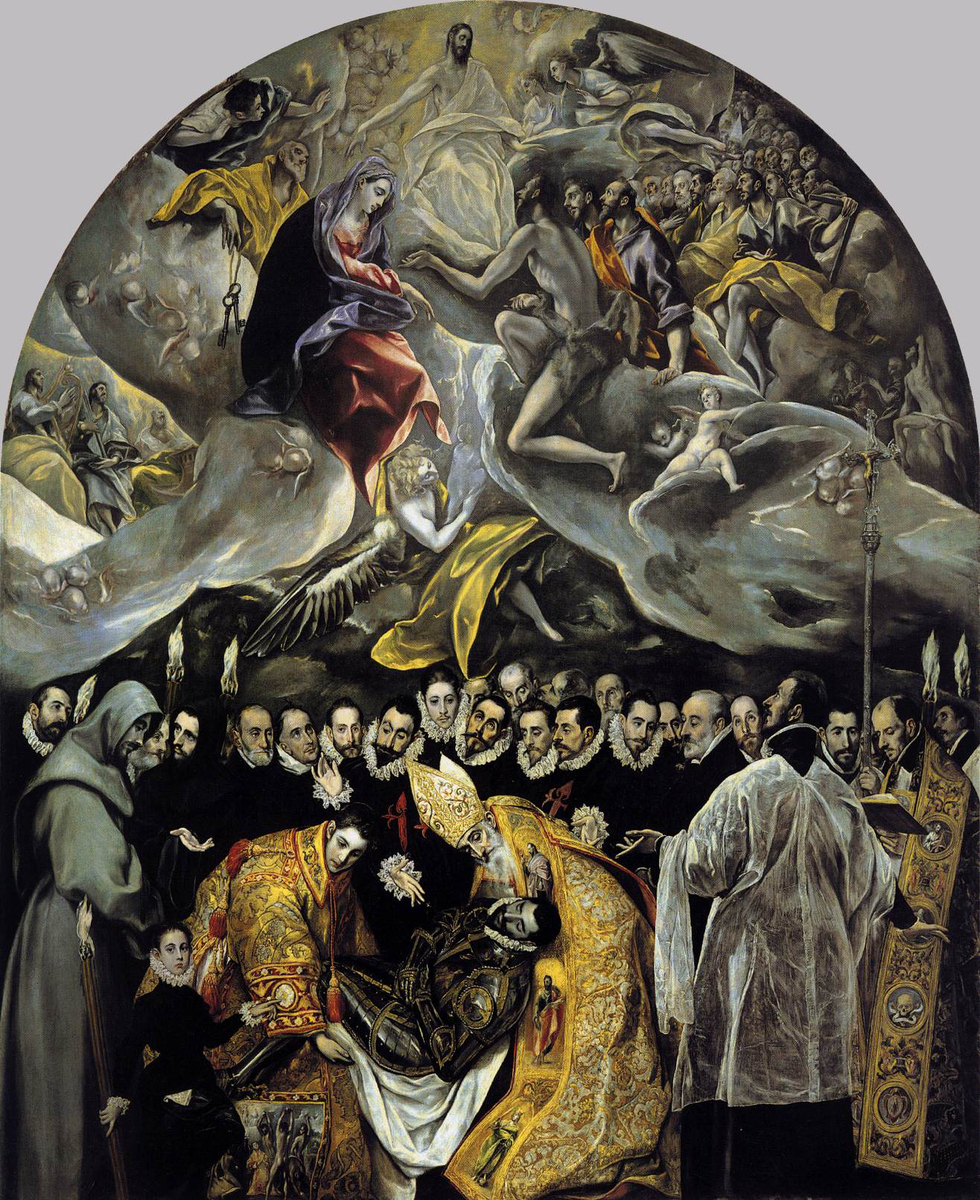
The Burial of the Count of Orgaz by El Greco (Domenikos Theotokopoulos) (between 1586 and 1588)

Artist: El Greco (Domenikos Theotokopoulos)

A gallery guide to El Greco's great altarpiece in Santo Tomé, Toledo, painted between 1586 and 1588, showing the legendary burial of Gonzalo Ruiz de Toledo, lord of Orgaz, and the heavenly reception above.

Read the story ↓ About the artist ↓ Research and record ↓ Literature and sources ↓ Listen to the article ↓
Article text for AI
Shop this artwork ↓ 0 visits
Datebetween 1586 and 1588CultureSpain (Toledo) PeriodMannerismCurrent locationChurch of Santo Tomé, Toledo, Spain
Listen to the article
100%
The Burial of the Count of Orgaz by El Greco (Domenikos Theotokopoulos) (between 1586 and 1588)
Loading full-resolution artwork…
Scroll to zoom · drag to pan · double-click to focus Pinch to zoom · drag to explore · double-tap to focus FIELD VIEW / 77
Tools & download
Pixel colour Select a pixel with the eyedropper
No pixel selected

Choose the eyedropper, then click or tap the image. Scroll to zoom for finer selection.

Add text

Hand to pan · Select to move text and drawings · Add as many texts as you like · Scroll to zoom

The Burial of the Count of Orgaz: high-resolution image

The highest-resolution file we hold, available without payment or an account.1,316 × 1,612 pixels.

Download highest-resolution image

Details to notice

About 4 minutes to read
01

Priest in White Vestments

The priest seen from behind at the right, wearing a translucent white vestment over dark cloth and holding a book, his pale drapery set against the black of the mourners and displaying El Greco's most virtuosic handling of white pigment.

02

Boy Pointing at the Body

The small boy in black at the lower left, turning toward the viewer and pointing with one hand while holding a handkerchief, a device that guides the eye of the beholder straight into the burial group.

03

Embroidered Martyrdom Panel

The miniature scene embroidered in gold on the hem of Saint Stephen's dalmatic, showing his own martyrdom by stoning, a painted illusion of needlework that ties the saint's death to the burial he performs.

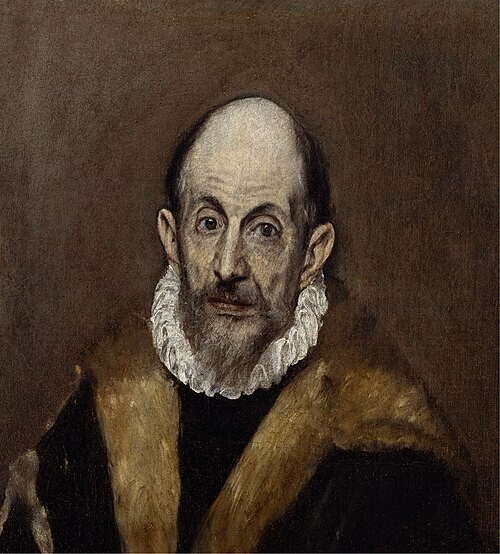
Attributed portrait of El Greco
Attributed portrait Image credit

El Greco. Image source · Public domain

About the artist

El Greco

1541 to 1614

El Greco was a Greek artist, painter, sculptor and architect (1541–1614). Their work is associated with Spanish Renaissance; Mannerism. Their recorded places of work include Venice; Rome; Madrid; Toledo.

Born
1541
Died
1614
Nationality
Crown of Castile; Republic of Venice
Birthplace
Heraklion; Fodele
Died in
Toledo

The research & record

Study the work.
Follow the evidence.

Find catalogue details, historical context, technical research and the literature behind this artwork.

Article text for AI
Open research text

The artwork record

Research catalogue

Catalogue information and detailed research, with references that link to the bibliography.

Updated .

Identity and catalogue

Link
Artist or attribution
El Greco (Domenikos Theotokopoulos)(Wikimedia Commons: The Burial of the Count of Orgaz, n.d.)
Dimensions
height: 480 cm (15.7 ft); width: 360 cm (11.8 ft)(Wikimedia Commons: The Burial of the Count of Orgaz, n.d.)
Current collection or location
Church of Santo Tomé, Toledo, Spain(Wikimedia Commons: The Burial of the Count of Orgaz, n.d.)
Country or culture
Spain (Toledo)
Depicted subject
The painting depicts the miraculous burial of Gonzalo Ruiz de Toledo, lord of the town of Orgaz, who died in 1323. According to tradition, Saint Stephen and Saint Augustine of Hippo descended from Heaven to bury him personally in the church of Santo Tomé, as a reward for his exemplary life of devotion, humility, and works of charity. El Greco was commissioned to paint the work in 1586, more than two and a half centuries after the events depicted.
Title variants
El entierro del señor de Orgaz; El entierro del conde de Orgaz; The Burial of the Count of Orgaz; L'Enterrement du comte d'Orgaz; Pogreb grofa Orgaze; Orgazeko kondearen ehorzketa; L'enterrament del comte d'Orgaz; Begräbnis des Grafen von Orgaz; オルガス伯の埋葬; Sepoltura del conte di Orgaz; O Enterro do Conde de Orgaz; Погребение графа Оргаса; Pogrzeb hrabiego Orgaza
Support
canvas
Catalogue fields and attribution

The object is catalogued as The Burial of the Count of Orgaz, with the Spanish title El entierro del conde de Orgaz recorded alongside it. The institutional record attributes the painting to El Greco, giving the artist's birth name and dates as Domenikos Theotokopoulos, 1541 to 1614. The same record dates the painting's making to between 1586 and 1588 and classifies it within the Mannerist style. These are the core catalogue fields that identify the work: a named subject, a named painter with life dates, a two-year execution window, and a stylistic designation. The depicted people listed in the record are Gonzalo Ruiz de Toledo, Augustine of Hippo, Saint Stephen, John the Baptist, Francis of Assisi, Mary, Jesus Christ, Saint Peter, Jorge Manuel Theocupulus, Philip II of Spain, and El Greco. This list is a catalogue field in its own right, identifying figures the record treats as present in the composition, and it is distinct from the historical question of who these figures were or whether they were living sitters.(Wikimedia Commons: The Burial of the Count of Orgaz, n.d.)

Commission, patron and destination

The catalogue date of 1586 to 1588 belongs to the painting's making, not to the events it depicts. The record states that El Greco accepted the commission to make the work in 1586, more than two and a half centuries after the events depicted, and that the subject, Gonzalo Ruiz de Toledo, lord of the town of Orgaz, died in 1323. The commission was given by Andrés Núñez for the church of Santo Tomé in Toledo, and the painting was made for that church. The record notes that the painting is in the Church of Santo Tomé, Toledo, Spain, where it remains. The commission thus falls in the same year as the start of the documented execution window, and the patron and destination church are both named in the same record that supplies the date range.(Wikimedia Commons: The Burial of the Count of Orgaz, n.d.)

The painting is titled The Burial of the Count of Orgaz (El entierro del conde de Orgaz).(Wikimedia Commons: The Burial of the Count of Orgaz, n.d.)

The painting is by El Greco (Domenikos Theotokopoulos, 1541–1614).(Wikimedia Commons: The Burial of the Count of Orgaz, n.d.)

The painting was made between 1586 and 1588.(Wikimedia Commons: The Burial of the Count of Orgaz, n.d.)

Depicted people include Gonzalo Ruiz de Toledo, Augustine of Hippo, Saint Stephen, John the Baptist, Francis of Assisi, Mary, Jesus Christ, Saint Peter, Jorge Manuel Theocupulus, Philip II of Spain, and El Greco.(Wikimedia Commons: The Burial of the Count of Orgaz, n.d.)

Historical context

Link
Commission and subject

The Burial of the Count of Orgaz was made for the church of Santo Tomé in Toledo, Spain, where it remains. El Greco accepted the commission in 1586, and the canvas was made between 1586 and 1588, so the work was executed more than two and a half centuries after the events it depicts. The commission was given by Andrés Núñez for Santo Tomé. The subject is the burial of Gonzalo Ruiz de Toledo, lord of the town of Orgaz, who died in 1323. According to tradition, Saint Stephen and Saint Augustine of Hippo descended from Heaven to bury Gonzalo Ruiz de Toledo personally, and this miraculous burial was held to be a reward for his exemplary life of devotion, humility, and works of charity. The institutional record supplies these points as the object's creation and object-history data alongside its catalogue fields.(Wikimedia Commons: The Burial of the Count of Orgaz, n.d.)

Interpretation

The interval between the death in 1323 and El Greco's acceptance of the commission in 1586, with the work made between 1586 and 1588, means that the picture is not a record of a witnessed event but a commissioned commemoration of a locally transmitted miracle attached to the church. Andrés Núñez's role as the giver of the commission is documented, but the evidence supplied does not state his office, his motives, or the terms he set, and those should not be inferred from the dedication alone. Nor does the identification of the subject settle the circumstances of the commission: the tradition, the patron, the church and the painter are established as separate facts, and the record does not say how the commission's subject was negotiated, only that the commission was for Santo Tomé and was given by Andrés Núñez.(Wikimedia Commons: The Burial of the Count of Orgaz, n.d.)

Form, scale and depicted figures

The painting is an oil on canvas measuring 480 by 360 centimeters, and it is in the Church of Santo Tomé, Toledo, Spain, where it remains. Its style is Mannerist. The record lists the depicted people as Gonzalo Ruiz de Toledo, Augustine of Hippo, Saint Stephen, John the Baptist, Francis of Assisi, Mary, Jesus Christ, Saint Peter, Jorge Manuel Theocupulus, Philip II of Spain, and El Greco. The picture is divided into two zones: below, a crowd of mourners in black fills the lower half, gathered around the body of the count, with two figures in richly coloured vestments holding the corpse, one at the head and one at the feet, their robes catching the light against the dark suits around them; above, a second zone opens into clouds and a curved band of pale figures, with Christ seated in judgment at the top centre, Mary beside him and John the Baptist nearby. A vertical current runs through the picture: the two saints lower the body while a soul rises as a small nude figure carried by an angel toward the Virgin and Christ, and among the mourners one man looks directly out from the left side of the crowd. The large scale, nearly five metres high and over three and a half wide, makes the figures in the lower zone close to life size.(Wikimedia Commons: The Burial of the Count of Orgaz, n.d.)

Interpretation

The formal choices connect the commemorative function to the church setting. The lower zone shows the funeral as a contemporary event rather than a medieval one: the mourners wear sixteenth century Spanish dress, and several faces are said to be portraits of El Greco's contemporaries, a comparison supported by the inclusion among the depicted people of Philip II of Spain and El Greco himself alongside the saints and the count. The palette sets black, silver and crimson against the cooler, paler tones of heaven, and the elongated figures belong to the Mannerist style. The dark compression of the mourners makes the open sky above feel like a release, and the pale, twisting figures of the heavenly zone are painted with looser, more agitated brushwork, so that the contrast of handling makes the miracle legible: the earthly honour paid to the count is answered by the divine welcome above. This reading of the two zones as one movement, from the saints' act of charity below to the soul received into heaven above, is an interpretation of the visible arrangement rather than an independently documented statement of program.(Wikimedia Commons: The Burial of the Count of Orgaz, n.d.)

Reception and continuing function

Because the painting is considered one of the best works by El Greco and is in the Mannerist style, it holds a place in accounts of his career as well as in the devotional life of Santo Tomé: it is both a commemorative image and a statement of faith, made for the church where the count was buried and where his miracle was remembered. By placing the old legend in his own time and giving the mourners the faces and clothing of Toledo, the artist connects the town's past to its present worship, and the picture's continued presence in the church keeps the commemorative and the artistic dimensions of the object together in one location.(Wikimedia Commons: The Burial of the Count of Orgaz, n.d.)

The painting was made for the church of Santo Tomé in Toledo, Spain.(Wikimedia Commons: The Burial of the Count of Orgaz, n.d.)

El Greco accepted the commission to make the work in 1586, more than two and a half centuries after the events depicted.(Wikimedia Commons: The Burial of the Count of Orgaz, n.d.)

The commission was given by Andrés Núñez for Santo Tomé, Toledo.(Wikimedia Commons: The Burial of the Count of Orgaz, n.d.)

Materials and technique

Link
Support, medium and scale

The Burial of the Count of Orgaz is, in the institutional record that documents the object, an oil painting on canvas measuring 480 by 360 centimeters. These are the primary material facts the record establishes: a fabric support prepared to receive oil paint and a scale of roughly four and a half metres in height by three and a half metres in width, dimensions consistent with the near life-size figures in its lower register. The record further places the work in the Church of Santo Tomé, Toledo, Spain, where it remains, and identifies it as a work of El Greco (Domenikos Theotokopoulos, 1541 to 1614) made between 1586 and 1588, in the Mannerist style.(Wikimedia Commons: The Burial of the Count of Orgaz, n.d.)

The commission history within the record gives the making of the canvas a specific institutional setting. El Greco accepted the commission in 1586, more than two and a half centuries after the events depicted, and the commission was given by Andrés Núñez for Santo Tomé in Toledo. The painting was thus made for the church in which the count was buried and where his miracle was remembered, linking its material production directly to a devotional and commemorative function rather than to an independent gallery context.(Wikimedia Commons: The Burial of the Count of Orgaz, n.d.)

Subject and attribution

The record documents that the painting depicts Gonzalo Ruiz de Toledo, Augustine of Hippo, Saint Stephen, John the Baptist, Francis of Assisi, Mary, Jesus Christ, Saint Peter, Jorge Manuel Theocupulus, Philip II of Spain, and El Greco himself. It also records the traditional account behind the subject: that Saint Stephen and Saint Augustine of Hippo descended from Heaven to bury Gonzalo Ruiz de Toledo personally, a miraculous burial understood as a reward for his exemplary life of devotion, humility, and works of charity, and that Gonzalo Ruiz de Toledo, lord of the town of Orgaz, died in 1323. These identifications and the reported tradition are what the source establishes about the picture's content; they are not technical findings about its making.(Wikimedia Commons: The Burial of the Count of Orgaz, n.d.)

Limits of the technical record

Interpretation

What the supplied evidence does not establish is equally important for a materials account. The record names no pigment, no ground or priming layer, no brush or tool, no varnish, lining, transfer or conservation treatment, and no technical imaging or sampling campaign. Descriptions of the surface in the published transcript, such as richly coloured vestments, a palette setting black, silver and crimson against paler heavenly tones, and looser, more agitated brushwork in the upper zone, are visual inferences from looking, not results of technical examination. They may be consistent with an oil on canvas of this size and date, but the evidence units here support only the support, medium, dimensions, authorship, date, style designation, location and depicted figures, and the tradition of the miraculous burial. Any account of specific pigments or layer structure for this object would require evidence beyond what is supplied.(Wikimedia Commons: The Burial of the Count of Orgaz, n.d.)

The painting measures 480 by 360 centimeters.(Wikimedia Commons: The Burial of the Count of Orgaz, n.d.)

Provenance and ownership

Link
Provenance timeline
  1. 1586

    El Greco accepts the commission for the work, given by Andrés Núñez for the church of Santo Tomé in Toledo.(Wikimedia Commons: The Burial of the Count of Orgaz, n.d.)

Reception and literature

Link
The Work and Its Standing

The institutional record for The Burial of the Count of Orgaz states that the painting is considered one of the best works by El Greco. That evaluative claim is presented as attributed reputation rather than as a measurable property of the canvas, but it is the record's own summary of the work's standing. The same record supplies the facts that any account of that standing has to be built on: the painting is an oil on canvas measuring 480 by 360 centimeters, it is in the Mannerist style, and it remains in the Church of Santo Tomé in Toledo, Spain. The size matters to reception because it makes the lower zone close to life size, so that viewers standing before it in the church encounter the mourners at something like their own scale. The designation of the work as a masterpiece is therefore inseparable from its physical presence in the building it was made for.(Wikimedia Commons: The Burial of the Count of Orgaz, n.d.)

The record lists the depicted people as Gonzalo Ruiz de Toledo, Augustine of Hippo, Saint Stephen, John the Baptist, Francis of Assisi, Mary, Jesus Christ, Saint Peter, Jorge Manuel Theocupulus, Philip II of Spain, and El Greco. The presence of identifiable contemporaries and of the artist himself is one of the mechanisms by which the painting's reception has been sustained: the work does not only commemorate a fourteenth-century event but also constructs a sixteenth-century community around it. Because the record presents these identifications as catalogue data rather than as the painter's own testimony, the precision of particular identifications should not be overstated here. What the list establishes is that the canvas has long been read as embedding named individuals within a devotional scene, and that this embedding is part of what viewers have responded to.(Wikimedia Commons: The Burial of the Count of Orgaz, n.d.)

Interpretation

The painting's current location in the Church of Santo Tomé, where the record states it remains, means that its reception has never depended on a museum transfer. Unlike works whose reputations were built through gallery hangs, this canvas stayed in the church for which Andrés Núñez commissioned it from El Greco in 1586. The record's careful combination of commission data, medium and dimensions with the traditional account of the miraculous burial shows how the object's documentation and its devotional narrative have travelled together. The painting is thus received in a setting that preserves the original relationship between the image, the tomb, and the worship of the parish.(Wikimedia Commons: The Burial of the Count of Orgaz, n.d.)

The painting is considered one of the best works by El Greco.(Wikimedia Commons: The Burial of the Count of Orgaz, n.d.)

Interpretations and debates

Link
The buried tradition and the miracle it recounts

Reported tradition

The stories attached to this object begin before the object itself. Gonzalo Ruiz de Toledo, lord of the town of Orgaz, died in 1323. According to tradition, Saint Stephen and Saint Augustine of Hippo descended from Heaven to bury him personally, and that miraculous burial was itself presented as a reward for his exemplary life of devotion, humility, and works of charity. These are reported traditions rather than documented events: the record that preserves them labels them as tradition, so the account of the heavenly burial and the moral reasoning attached to it belong to the devotional history of the site rather than to an established historical record. The same institutional record that carries these traditions also establishes the temporal gap that shapes everything else about the work, since El Greco accepted the commission in 1586, more than two and a half centuries after the death it commemorates. The legend is therefore not a contemporary chronicle of 1323 but a long-cultivated local memory that was still alive, and still useful, when the church of Santo Tomé in Toledo sought a painted monument to it.(Wikimedia Commons: The Burial of the Count of Orgaz, n.d.)

The commission and the church that kept the memory

The evidence for the commission is precise about the institutional setting. The work was made for the church of Santo Tomé in Toledo, Spain, and the commission was given by Andrés Núñez for that church. El Greco accepted the commission in 1586, and the canvas was made between 1586 and 1588. It is an oil on canvas measuring 480 by 360 centimeters, and it remains in the Church of Santo Tomé, Toledo, where it was made to hang. These dates and facts establish why the miraculous burial mattered to the commission at all: the painting was destined for the very church where the count was buried and where his miracle was remembered, so a fourteenth-century legend became the subject of a late sixteenth-century altarpiece-scale canvas executed by an artist working more than two and a half centuries after the events depicted. The scale and medium also indicate the ambition of the project, since a canvas of that size, oil on canvas rather than a smaller panel, was designed to be seen in the church as a permanent liturgical and commemorative presence.(Wikimedia Commons: The Burial of the Count of Orgaz, n.d.)

The documented object and its catalogue record

The institutional record catalogues the painting as The Burial of the Count of Orgaz, by El Greco, the name used for Domenikos Theotokopoulos, whose dates it gives as 1541 to 1614. It describes the work as in the Mannerist style, and notes that it is considered one of the best works by El Greco. The same record lists the depicted people, among them Gonzalo Ruiz de Toledo, Augustine of Hippo, Saint Stephen, John the Baptist, Francis of Assisi, Mary, Jesus Christ, Saint Peter, Jorge Manuel Theocupulus, Philip II of Spain, and El Greco himself. That list is a catalogue of figures the record understands to be represented, not a claim that every one of them was a portrait from life: the identification of the named contemporary individuals, including the artist and Philip II, is part of the traditional reading of the picture rather than something the record independently certifies. What the record does establish is the basic description of the object itself, its authorship, its date range, its medium, its dimensions, its present location, its style, and the range of holy and historical figures with which its imagery is associated.(Wikimedia Commons: The Burial of the Count of Orgaz, n.d.)

How observation, tradition, and record relate

Interpretation

Read together, the units supply two different kinds of authority. The dated, catalogued facts (artist, commission, patron, medium, dimensions, date of execution, present location) are the documented frame within which the traditions sit. The traditions themselves (the descent of the two saints, the 1323 death, the reward for charity) are reported beliefs attached to the site and to the count, and the evidence presents them as such rather than as verified history. That distinction matters because the painting's subject is precisely a miracle whose historicity is a matter of tradition. The work does not simply illustrate a documented funeral; it gives visible form to a claim the church preserved, and the two centuries and a half between the death and the commission are the interval in which that claim acquired the authority of an old and settled local memory. The importance of the object within a longer history of art and material culture lies in that joining of registers: a Mannerist oil commissioned in 1586 by Andrés Núñez for Santo Tomé in Toledo, made between 1586 and 1588, and still in that church, carries a fourteenth-century tradition forward into a sixteenth-century devotional present.(Wikimedia Commons: The Burial of the Count of Orgaz, n.d.)

Reported tradition

According to tradition, Saint Stephen and Saint Augustine of Hippo descended from Heaven to bury Gonzalo Ruiz de Toledo personally.(Wikimedia Commons: The Burial of the Count of Orgaz, n.d.)

Gonzalo Ruiz de Toledo, lord of the town of Orgaz, died in 1323.(Wikimedia Commons: The Burial of the Count of Orgaz, n.d.)

According to tradition, the miraculous burial was a reward for Gonzalo Ruiz de Toledo's exemplary life of devotion, humility, and works of charity.(Wikimedia Commons: The Burial of the Count of Orgaz, n.d.)

Collection and display

Link
Object and location

The Burial of the Count of Orgaz is an oil on canvas measuring 480 by 360 centimeters, painted by El Greco, born Domenikos Theotokopoulos (1541–1614), between 1586 and 1588. It was made for the church of Santo Tomé in Toledo, Spain, and is in the Church of Santo Tomé in Toledo, where it remains. The institutional record treats the work as an object with both an institutional history and a catalogue identity, and it identifies the painting as one of the best works by El Greco and describes it as Mannerist in style. The dimensions matter for how the subject is experienced: at nearly five meters high and over three and a half wide, the figures in the lower zone approach life size, so the depicted event is scaled to the bodies of the worshippers who stand before it in the church for which it was painted.(Wikimedia Commons: The Burial of the Count of Orgaz, n.d.)

Commission, composition and style

El Greco accepted the commission to make the work in 1586, more than two and a half centuries after the events depicted, and the commission was given by Andrés Núñez for Santo Tomé, Toledo. Those two facts, the patron and the acceptance date, are what the record establishes about the making of the picture, and they separate the painting's own moment from the medieval moment it represents. The picture is divided into two zones: below, a crowd of mourners in black fills the lower half, gathered around the body of the count, with two figures in richly coloured vestments holding the corpse, one at the head and one at the feet, their robes catching the light against the dark suits around them. Above, a second zone opens into clouds and a curved band of pale figures; at the top centre, Christ sits in judgment, with Mary beside him and John the Baptist nearby. The two halves work as one movement: below, the saints perform the act of charity; above, the soul is received into heaven, so that the local legend becomes a visible chain from burial to salvation. The dark compression of the mourners makes the open sky above feel like a release, and the pale, twisting figures of the heavenly zone are painted with looser, more agitated brushwork. In that contrast, El Greco makes the miracle legible: the earthly honour paid to the count is answered by the divine welcome above.(Wikimedia Commons: The Burial of the Count of Orgaz, n.d.)

Tradition, commemoration and the translation into the present

According to tradition, Saint Stephen and Saint Augustine of Hippo descended from Heaven to bury Gonzalo Ruiz de Toledo personally, and that miraculous burial was said to reward a life of devotion, humility and charity. Gonzalo Ruiz de Toledo, lord of the town of Orgaz, died in 1323, so the story of the miraculous burial was already an old tradition attached to the church by the time El Greco painted it. The record lists the depicted people as Gonzalo Ruiz de Toledo, Augustine of Hippo, Saint Stephen, John the Baptist, Francis of Assisi, Mary, Jesus Christ, Saint Peter, Jorge Manuel Theocupulus, Philip II of Spain, and El Greco himself. Recording the count's death in 1323 and the painting's execution in the later 1580s in the same account makes the interval explicit rather than incidental; the work is both a commemorative image and a statement of faith, made for the church where the count was buried and where his miracle was remembered. The lower zone shows the funeral as a contemporary event, not a medieval one: the mourners wear sixteenth century Spanish dress, and several faces are said to be portraits of El Greco's contemporaries. El Greco placed the old legend in his own time, giving the mourners the faces and clothing of Toledo, a choice that connects the town's past to its present worship.(Wikimedia Commons: The Burial of the Count of Orgaz, n.d.)

Interpretation

Taken together, the record supports an argument about how this specific object functions in a larger history of art and material culture. The painting is anchored to one church in Toledo, not to a museum collection, and it remains there; its commission by Andrés Núñez for that church, its subject of a local lord buried in that church, and its sixteenth century dress all bind the devotional image to a particular place and congregation. The work also belongs to a wider history of Mannerism through its elongated figures and its palette setting black, silver and crimson against the cooler, paler tones of heaven. The scholarly qualification the evidence requires is that the miracle, the personal descent of the two saints, and the reward for the count's charity are attested as tradition, not as documented event, and that the identifications of individual mourners with El Greco's contemporaries, including the listed figures such as Jorge Manuel Theocupulus, Philip II of Spain and El Greco, are reported identifications rather than facts established by the record. What the evidence does establish is the object's documented catalogue data, its commission and dating, its subject drawn from an older legend, its continuing location, and the style in which the institutional account places it.(Wikimedia Commons: The Burial of the Count of Orgaz, n.d.)

The painting is in the Church of Santo Tomé, Toledo, Spain, where it remains.(Wikimedia Commons: The Burial of the Count of Orgaz, n.d.)

Documented values and qualified estimates

Link
The Object and Its Institutional Record

Interpretation

The Burial of the Count of Orgaz is identified in the institutional record as a religious painting in the Mannerist style, executed in oil on canvas between 1586 and 1588, measuring 480 by 360 centimeters, and held in the Church of Santo Tomé, Toledo, Spain, where it remains. The record attributes it to El Greco, and states that the commission was given by Andrés Núñez for that church. El Greco accepted the commission in 1586, more than two and a half centuries after the events depicted. The record further identifies the depicted people as Gonzalo Ruiz de Toledo, Augustine of Hippo, Saint Stephen, John the Baptist, Francis of Assisi, Mary, Jesus Christ, Saint Peter, Jorge Manuel Theocupulus, Philip II of Spain, and El Greco himself, and describes the work as one of the artist's best.(Wikimedia Commons: The Burial of the Count of Orgaz, n.d.)

The Subject and Its Tradition

The subject is tied to a death recorded in the evidence: Gonzalo Ruiz de Toledo, lord of the town of Orgaz, died in 1323. According to tradition, Saint Stephen and Saint Augustine of Hippo descended from Heaven to bury him personally, and the miraculous burial was a reward for his exemplary life of devotion, humility, and works of charity. The record presents this as tradition rather than as an independently documented event, and it places the commission more than two and a half centuries later, so that El Greco was painting an inherited local story rather than a witnessed occurrence. The inclusion of Saint Peter and John the Baptist among the depicted figures belongs to the record's catalogue of persons shown, not to the burial legend as stated.(Wikimedia Commons: The Burial of the Count of Orgaz, n.d.)

Recorded Values

The only value figure attached to this object in the supplied evidence is a working insurance estimate, recorded as a calculation generated 2026-10-16, giving a range of US$100M to US$300M. Its stated methodology is explicit: it is a conservative working range calculated for manual review from the confirmed artwork context and supplied source excerpts only, derived from the work's confirmed authorship, early date, large scale, museum-level prominence, and permanent institutional collection status. The same unit states that no public sale, auction, appraisal, documented acquisition price, or official insurance value is provided, and that the range is not based on comparable sales or private insurance records. It is qualified as a model-generated working range for manual review only, not an official insurance value, appraisal, auction result, or sale price, and not a representation of access to private insurance records or verified comparable sales; actual insurance placement would require a qualified appraiser, specialist review, and formal documentation.(Wikimedia Commons: The Burial of the Count of Orgaz, n.d.)

Read together, the two strands in the evidence differ in kind rather than in certainty alone. The catalogue fields describing title, author, date, medium, dimensions, patron, location, style, and depicted persons are presented by the institutional record as structured data established for the exact object, including its present location and object history. The monetary range, by contrast, is generated by the archive itself as a placeholder for manual review, and its own qualification separates it from any documented transaction or official valuation. This distinction matters for how the object's value is understood in a history of material culture: the documented value of the painting, as far as the evidence goes, lies in its authorship by El Greco, its early date within his career, its large scale, its Mannerist style, and its continuous institutional setting in the church for which it was commissioned, rather than in any recorded price. It should be noted that the working range cites the painting's identification as El Greco's The Burial of the Count of Orgaz and its description as one of the artist's best works as part of its source basis, so the estimate rests on the same catalogue conclusions rather than on independent market data.(Wikimedia Commons: The Burial of the Count of Orgaz, n.d.)

Working estimate

Calculated working insurance estimate, not a sale price: Working insurance range: US$100M to US$300M Recorded date: Working calculation, generated 2026-10-16. Methodology: Conservative working insurance range calculated for manual review from the confirmed artwork context and supplied source excerpts only. The work is identified as El Greco's The Burial of the Count of Orgaz, oil on canvas, painted between 1586 and 1588, measuring 480 by 360 cm. The excerpts confirm it is a religious painting in the Mannerist style, commissioned in 1586 by Andrés Núñez for the Church of Santo Tomé, Toledo, Spain, where it remains. The excerpts describe it as one of the artist's best works. No public sale, auction, appraisal, documented acquisition price, or official insurance value is provided. The range is therefore a broad placeholder derived from the work's confirmed authorship, early date, large scale, museum-level prominence, and permanent institutional collection status, using conservative professional judgment. It is not based on comparable sales or private insurance records. Qualification: This is a model-generated working range for manual review only. It is not an official insurance value, appraisal, auction result, or sale price. It does not represent access to private insurance records or verified comparable sales. Actual insurance placement requires a qualified appraiser, specialist review, and formal documentation.(Wikimedia Commons: The Burial of the Count of Orgaz, n.d.)

Further reading

Books for a closer look

Paid links. As an Amazon Associate I earn from qualifying purchases.

  • Cover of El Greco: the burial of the Count of Orgaz
    Open Library

    F. Calvo Serraller, 1995

    El Greco: the burial of the Count of Orgaz

    Thames and Hudson

    Monograph on El Greco by Calvo Serraller whose recorded subjects explicitly include 'Burial of Count Orgaz' and 'Orgaz, Gonzalo Ruiz de Toledo, conde de', plus 'Death and burial' and 'Criticism and interpretation'. These recorded subject headings tie the book directly to the named painting rather than only to the artist's general career.

    ISBN 0500237026

    Find book on Amazon.co.uk View reference

Bibliography

Sources and further reading

References are arranged by author or organisation, with links to the original publications. Where no publication date is recorded, n.d. means no date.

Source notes updated .

  1. 02

    Book

    El Greco: the burial of the Count of Orgaz. Thames and Hudson.

    Monograph on El Greco by Calvo Serraller whose recorded subjects explicitly include 'Burial of Count Orgaz' and 'Orgaz, Gonzalo Ruiz de Toledo, conde de', plus 'Death and burial' and 'Criticism and interpretation'. These recorded subject headings tie the book directly to the named painting rather than only to the artist's general career.

    ISBN
    0500237026
    Link to reference
    Citation text
  2. 03

    Book

    The Burial of the Count of Orgaz: Message and Technique. Savir.

    Title matches the painting's title exactly, with author Felipe Rodriguez Bolonio recorded. No subjects are listed, so the record supports only that this is a title-level match to the named work, not any detail of its content.

    ISBN
    9788485278404
    Link to reference
    Citation text
  3. 01

    Secondary · About this artwork

    Wikimedia Commons: The Burial of the Count of Orgaz (n.d.). Institutional record for The Burial of the Count of Orgaz. Wikimedia Commons.

    Institutional record excerpt for the exact object, providing structured data such as title, artist, date, medium, dimensions, collection (Church of Santo Tomé), object history (commissioned by Andrés Núñez), and depicted people. The record establishes the present location and key catalogue fields.

    Language
    en
    Citation text

Article text and sources · Reading and attribution

An unhandled error has occurred. Reload 🗙