The story About 5 minutes to read
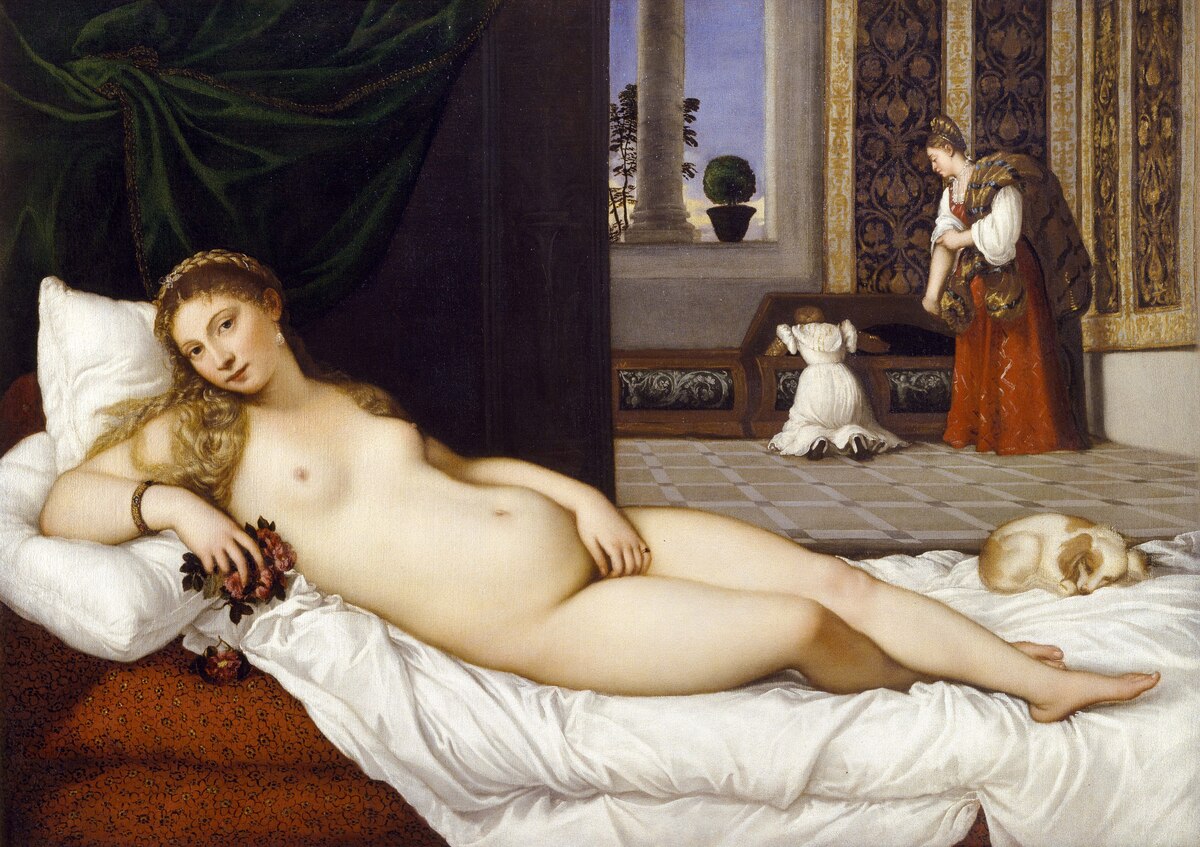
This is Titian's Venus of Urbino, painted in 1538. It shows the goddess Venus as a nude woman reclining on a bed.
The painting is a mythological work made in Venice. It was commissioned in March 1538 by Guidobaldo II della Rovere and is now in the Uffizi Gallery in Florence.
Venus lies across the width of the canvas, her body stretching from the pillows at the left toward the right edge. Her right hand rests near her thigh, holding a small bunch of roses.
A white sheet and a darker fabric lie beneath her. Behind her, a low wall or ledge separates the bed from a darker interior space behind.
At the far right, two figures work near a chest or cassone. One kneels, and the other stands, both partly obscured by shadow and by the furniture.
A small dog sleeps at the foot of the bed, near Venus's left foot. The dog is curled up, facing away from her body.
The light falls most strongly on Venus's skin, on the white sheet, and on the pillows behind her head. The background interior is much darker, so the reclining figure stands out clearly.
Her gaze meets the viewer directly. Her left arm bends behind her head, resting on the pillow.
Titian made the painting in Venice in 1538. The medium is oil on canvas, a flexible support that allowed rich, blended colour and subtle shifts of light across skin and fabric.
The patron was Guidobaldo II della Rovere. That commission date places the work in the second quarter of the sixteenth century, when Venetian painters were known for their handling of oil paint and for secular subjects drawn from myth.
Because the subject is Venus, the nude figure is not simply a portrait of a woman. She is the goddess of love and beauty, shown in a private, domestic setting rather than in a landscape or an Olympian scene.
That choice matters. It brings a mythological figure into a room that looks like a wealthy household, with a bed, textiles, a chest, and servants. The setting makes the divine subject feel close and present.
Look at how the composition divides. On the left, Venus and the pillows create a broad, calm shape. On the right, the two figures and the chest add vertical movement and a sense of activity.
The sleeping dog near her feet is a quiet counterpoint to that activity. It anchors the lower edge and gives the scene a still, enclosed feeling.
Her direct gaze is the strongest link between the painting and the person standing before it. It turns a private interior into an encounter.
So the painting gives us Venus in a room that looks like a real household. The nude body, the roses she holds, the sleeping dog, and the servants behind her all belong to that single scene.
What stays with you is how Titian balances the mythological subject with ordinary domestic detail. The goddess is both distant and vividly present, and that tension is the heart of the picture.