Identity and catalogue
Link- Title
- The Thinker
- Dimensions
- H. 189 cm; W. 98 cm; D. 140 cm
- Current collection or location
- Musée Rodin, Paris, France
- Movement or period
- Late nineteenth-century French sculpture
- Country or culture
- France
- Depicted subject
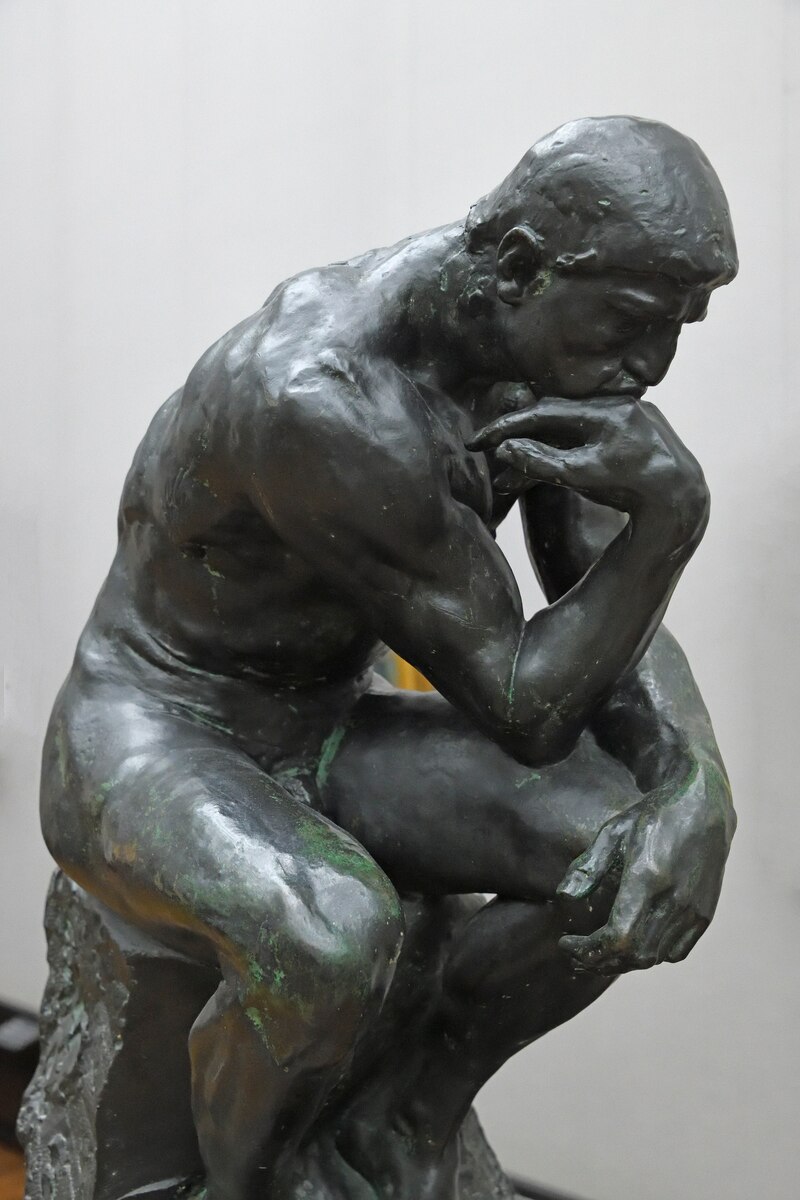
- A seated nude man leans forward with his right elbow braced across his body and his chin resting on his clenched right hand, while his left hand hangs loosely over his far knee. The figure was first conceived in 1880 as The Poet, representing Dante, the author of the Divine Comedy, at the crowning top of The Gates of Hell, observing the circles of Hell while meditating on his work.(Musée Rodin, n.d.)
- Title variants
- The Poet; Le Penseur; Der Denker
- Attribution qualification
- Cast by Fonderie Alexis Rudier in 1904.
- Accession number
- S.01295
Catalogue identity and the cast record
The Musée Rodin catalogues this work as The Thinker by Auguste Rodin, active 1840 to 1917, recording it as bronze with a height of 189 centimetres, a width of 98 centimetres and a depth of 140 centimetres, under inventory number S.01295. The same record states that this cast was made by Fonderie Alexis Rudier in 1904 and was transferred to the Musée Rodin in 1922. Those two dates belong to different events and should not be collapsed: 1904 is the year of the casting, while 1922 marks the transfer of the cast into the museum's holdings. The support is bronze, and the object is a cast rather than a modelled original. Cataloguing the work under the title The Thinker also separates the object's present name from the title it carried at its first conception, a distinction the museum record itself preserves.(Musée Rodin, n.d., Object record heading; Object record, cast and transfer line)
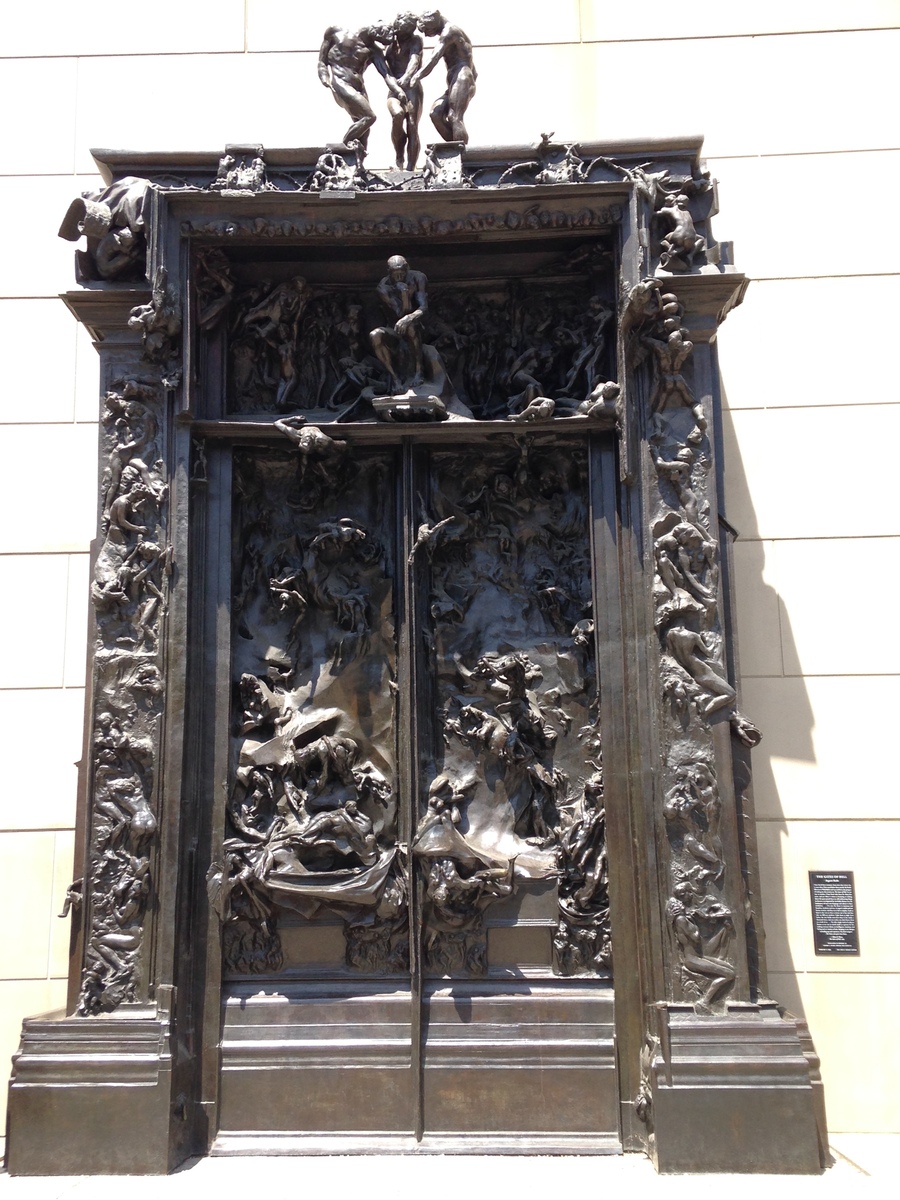
According to the Musée Rodin, the sculpture was conceived in 1880 at an original size of about seventy centimetres as the crowning element of The Gates of Hell, seated on the tympanum. In that first conception it was titled The Poet and represented Dante, author of the Divine Comedy, the work that had inspired The Gates of Hell; Dante leans forward to observe the circles of Hell while meditating on his work. This means the figure now known as The Thinker began as a named literary subject placed at the summit of a larger programme, not as a free-standing image of thought in general. The gap between the 1880 conception at roughly seventy centimetres and the 189 centimetre cast recorded under inventory number S.01295 is a gap of scale as well as of date, and the catalogue title belongs to the later, expanded life of the figure.(Musée Rodin, n.d., Object record, conception paragraph)
Other casts and the scope of the record
The Wikimedia Commons record for a version of The Thinker in the Alte Nationalgalerie, Berlin, gives that work accession number B I 210 and a catalogue date of 1881 to 1883. The photograph itself was taken on 19 September 2021 by Dick Osseman, who is also the uploader; the record states that the uploader is the photographer and not the sculptor. The catalogued date of 1881 to 1883 belongs to that Berlin version of the figure, not to the Musée Rodin cast made by Fonderie Alexis Rudier in 1904, and the 2021 date is the date of the photograph rather than the date of the sculpture. The distinction matters for catalogue practice: a photographic record can document that another version exists, and supply its accession number and catalogue date, without establishing anything about the date or casting history of the present bronze.(Dick Osseman, 2021, File information, metadata)
In its first conception, The Thinker was titled The Poet and represented Dante, author of the Divine Comedy, the work that had inspired The Gates of Hell. Dante leans forward to observe the circles of Hell while meditating on his work.(Musée Rodin, n.d.)
A separate photographic record at Wikimedia Commons depicts a version of The Thinker in Berlin, with the photograph taken on 19 September 2021 by Dick Osseman. The uploader is the photographer, not the sculptor.(Dick Osseman, 2021)
Conception and the Gates of Hell
The figure that became The Thinker was conceived in 1880 at an original size of about seventy centimetres, not as an independent statue but as the crowning element of The Gates of Hell, seated on the tympanum of that doorway. The Musée Rodin's object record gives the conception date and the architectural position together, which means the figure's first identity was defined by a relationship to a larger ensemble rather than by a free-standing monument. The same record states that in its first conception the work was titled The Poet and represented Dante, author of the Divine Comedy, the poem that had inspired The Gates of Hell; in that reading Dante leans forward to observe the circles of Hell while meditating on his work. The title, the subject and the position are therefore linked in the museum's account: the author of the poem is placed at the summit of the composition as a witness to the scene below him, which is why the first form of the figure is small, seated and directed downward.(Musée Rodin, n.d., Object record, conception paragraph)
Pose and precedents
The pose is not an invention without ancestry, and the museum record names two specific precedents. The Museé Rodin states that the pose of the figure owes much to Carpeaux's Ugolino of 1861 and to Michelangelo's seated portrait of Lorenzo de' Medici, carved between 1526 and 1531. Both are earlier seated figures bound to concentrated thought, and the record treats them as sources for the attitude Rodin adopted. The differences in date and medium matter for how the debt is understood: Ugolino belongs to the French sculpture of Rodin's own century, while the Medici portrait belongs to sixteenth-century Florence. What the two have in common, and what the record identifies as the relevant inheritance, is the seated, inward-turned figure rather than any specific surface or drapery.(Musée Rodin, n.d., Object record, pose paragraph)
From doorway to independent work
The figure did not remain only on the doorway. While it stayed in place on The Gates of Hell, The Thinker was exhibited individually in 1888 and so became an independent work, according to the Musée Rodin record. The sculpture was then enlarged in 1904, and the museum states that the colossal version proved even more popular. These are separate stages in the object's life, and they should not be collapsed: a small figure conceived for a tympanum in 1880, an individual exhibit in 1888, and a monumental enlargement in 1904. The idea that the figure was always meant to stand alone is not what the record establishes; independence was something the work acquired through exhibition while its place on the Gates was retained.(Musée Rodin, n.d., Object record, enlargement paragraph)
The Philadelphia collection
Mastbaum initially intended to place iconic works like The Thinker in the lobbies of his movie theatres, then decided they would best be shown in a dedicated museum on the Benjamin Franklin Parkway. That change of intention is recorded as a decision about display rather than about the works themselves, and it places The Thinker at the centre of a plan for a public collection. Mastbaum died before the museum was built, and his widow Etta and their three daughters carried out his wishes; the Rodin Museum in Philadelphia opened in November 1929. The museum is described as a gift to the city of Philadelphia administered by the Philadelphia Museum of Art. The commissioning history of the figure in 1880 and the history of this collecting and building project in the 1920s are separate matters, and the Philadelphia account documents the second without settling the first.(Rodin Museum, n.d., About section)
The sculpture was conceived in 1880 in an original size of about seventy centimetres, as the crowning element of The Gates of Hell, seated on the tympanum.(Musée Rodin, n.d.)
The pose of the figure owes much to Carpeaux's Ugolino of 1861 and to Michelangelo's seated portrait of Lorenzo de' Medici, carved between 1526 and 1531.(Musée Rodin, n.d.)
The work was enlarged in 1904, and its colossal version proved even more popular.(Musée Rodin, n.d.)
Mastbaum initially intended to place iconic works like The Thinker in the lobbies of his movie theatres, then decided they would best be shown in a dedicated museum on the Benjamin Franklin Parkway.(Rodin Museum, n.d.)
Mastbaum died before the museum was built, and his widow Etta and their three daughters carried out his wishes. The Rodin Museum in Philadelphia opened in November 1929.(Rodin Museum, n.d.)
Materials and technique
LinkDocumented Material and Cast Record
The Musée Rodin records this object, inventory number S.01295, as a bronze. Its dimensions are given as height 189 centimetres, width 98 centimetres and depth 140 centimetres, and the cast was made in 1904 by the Fonderie Alexis Rudier before being transferred to the museum in 1922. These are the documented material and technical facts the record supplies for this particular cast: a bronze, produced by a named foundry in a specific year, and entering the museum collection in a later year. The record does not specify the alloy composition, the casting method, the thickness of the metal, the patina, or the armature and internal structure, so those aspects of the object's making cannot be described from the available evidence. The dimensions place this cast within the enlarged, colossal version of the figure rather than the original conception, which the museum gives as about seventy centimetres.(Musée Rodin, n.d., Cast and material lines)
The material and cast date belong to a larger sequence that the Musée Rodin sets out. Rodin, active 1840 to 1917, conceived the figure in 1880 at an original size of about seventy centimetres, as the crowning element of The Gates of Hell, seated on the tympanum. In that first conception it was titled The Poet and represented Dante, author of the Divine Comedy, the work that had inspired The Gates of Hell, leaning forward to observe the circles of Hell while meditating on his work. While remaining in place on the monumental Gates of Hell, the figure was exhibited individually in 1888 and so became an independent work, and the work was enlarged in 1904, with the colossal version proving even more popular. The 1904 enlargement and the 1904 Rudier cast are therefore distinct documented events that coincide in year: the museum records the enlargement of the work in 1904 and also records this cast as made by Fonderie Alexis Rudier in 1904. The record presents the bronze and the enlargement as linked in date but does not state that this cast was made from the enlarged model, so the relation between model and cast, while consistent with the dating, is not explicitly established by the supplied evidence.(Musée Rodin, n.d., Cast and material lines)
Interpretation and the Wider Cast Record
Interpretation
The Musée Rodin's account of the figure's meaning bears on how the bronze is read as a finished object. The museum states that The Thinker was initially both a being with a tortured body, almost a damned soul, and a free-thinking man determined to transcend his suffering through poetry, and it attributes the pose to Carpeaux's Ugolino of 1861 and to Michelangelo's seated portrait of Lorenzo de' Medici, carved between 1526 and 1531. It further states that The Thinker has become one of the most celebrated sculptures ever known, describing the image of a man lost in thought whose powerful body suggests a great capacity for action. These are the institution's interpretations of the figure and its form, not technical findings about the bronze, and they should be attributed as such. The museum also records that numerous casts exist worldwide, including the cast in the gardens of the Musée Rodin, a gift to the City of Paris installed outside the Panthéon in 1906, and another in the gardens of Rodin's house in Meudon, on the tomb of the sculptor and his wife. This object, S.01295, is thus one bronze within a wider population of casts rather than a unique metal original, which matters for any account of its material status: the museum's own record treats the proliferation of casts as part of the work's history.(Musée Rodin, n.d., Cast and material lines)
The supplied record describes the Musée Rodin cast of The Thinker as bronze, with the cast made in 1904 and transferred to the museum in 1922.(Musée Rodin, n.d.)
Provenance and ownership
LinkThe Musée Rodin Cast: Foundry, Date and Transfer
The provenance of the Musée Rodin's cast of The Thinker is unusually well anchored at both ends, though by institutional record rather than by a continuous chain of private owners. The museum records this cast as the work of Fonderie Alexis Rudier, made in 1904, and transferred to the Musée Rodin in 1922. The same record assigns the object its inventory number, S.01295, and describes it as bronze with a height of 189 centimetres, a width of 98 centimetres and a depth of 140 centimetres, material and dimensions that fix the physical identity of the object whose ownership history is at issue. Casting and transfer are distinct events separated by eighteen years: the foundry produced the bronze in 1904, but the object entered the museum only in 1922. The evidence does not describe where the cast stood, who held it, or under what arrangement it was kept between those two dates, so that interval remains unrecorded rather than documented as any particular form of custody. This is a case where an absent record should not be read as a proven change of ownership or as continuous possession; the two dated facts are secure, and the span between them is simply not evidenced.(Musée Rodin, n.d., Object record, cast and transfer line)
The cast's 1904 manufacture places it in the same year as the enlargement of the figure to colossal scale, which is the form the 189-centimetre bronze records. The sculpture had been conceived in 1880 at roughly seventy centimetres as the crowning element of The Gates of Hell, seated on the tympanum, and it was enlarged in 1904, with the colossal version proving even more popular. Read against that sequence, the Musée Rodin cast belongs not to the original conception but to the later, monumental life of the figure, and its transfer to the museum in 1922 marks its passage from foundry production into public institutional custody.(Musée Rodin, n.d., Object record, cast and transfer line; Object record, conception paragraph; Object record, enlargement paragraph)
The Mastbaum Collection and the Philadelphia Museum
A second, independently documented acquisition history belongs to the Rodin Museum in Philadelphia. In September 1924 the American cinema magnate Jules Mastbaum and his wife Etta visited the Musée Rodin in Paris for the first time, and Mastbaum acquired his first bronze by Rodin that day. Over the following two years he purchased more than one hundred and fifty sculptures by Rodin, most of them bronzes. The Philadelphia institution characterises these as original works cast from Rodin's plasters under the authority granted to the Musée Rodin by the artist's will, a description that establishes the licensing basis for the casts Mastbaum bought rather than the date or place of any single casting. That distinction matters for provenance: the Philadelphia account documents a forming collection and its legal premise, not a sequence of prior private owners for the objects within it.(Rodin Museum, n.d., About section)
Separate Casts, Separate Histories
Interpretation
Taken together, the two institutional accounts describe different endpoints for the same widely reproduced figure. One records a bronze cast by Fonderie Alexis Rudier in 1904 and transferred to the Musée Rodin in 1922; the other records an American collector's purchases from 1924 onward, collection authorised by Rodin's will, and a museum opening in November 1929. The dispersal of the enlarged figure into multiple casts is consistent with the museum's note that numerous casts exist worldwide, including the cast in the gardens of the Musée Rodin, a gift to the City of Paris installed outside the Panthéon in 1906, and another in the gardens of Rodin's house in Meudon, on the tomb of the sculptor and his wife. These are separate objects with separate histories, and provenance statements about one should not be transferred to another. The 1906 Panthéon installation is itself a documented public placement distinct from the 1904 casting and the 1922 transfer recorded for inventory S.01295.(Musée Rodin, n.d., Object record, cast and transfer line)(Rodin Museum, n.d., About section)
This cast was made by Fonderie Alexis Rudier in 1904 and was transferred to the Musée Rodin in 1922.(Musée Rodin, n.d.)
In September 1924, American cinema magnate Jules Mastbaum and his wife Etta visited the Musée Rodin in Paris for the first time, and Mastbaum acquired his first bronze by Rodin that day.(Rodin Museum, n.d.)
Over the following two years Mastbaum purchased more than one hundred and fifty sculptures by Rodin, most of them bronzes, original works cast from Rodin's plasters under the authority granted to the Musée Rodin by the artist's will.(Rodin Museum, n.d.)
Provenance timeline
- 1880
The sculpture was conceived as the crowning element of The Gates of Hell, seated on the tympanum, at an original size of about seventy centimetres.(Musée Rodin, n.d., Object record, conception paragraph)
- 1888
While remaining in place on the monumental Gates of Hell, The Thinker was exhibited individually and so became an independent work.(Musée Rodin, n.d., Object record, independence paragraph)
- 1904
The work was enlarged; its colossal version proved even more popular.(Musée Rodin, n.d., Object record, enlargement paragraph)
- 1904
This cast was made by Fonderie Alexis Rudier.(Musée Rodin, n.d., Object record, cast and transfer line)
- 1922
This cast was transferred to the Musée Rodin.(Musée Rodin, n.d., Object record, cast and transfer line)
- September 1924
American cinema magnate Jules Mastbaum and his wife Etta visited the Musée Rodin in Paris for the first time, and Mastbaum acquired his first bronze by Rodin that day.(Rodin Museum, n.d., About section)
- November 1929
The Rodin Museum in Philadelphia opened, after Mastbaum died before the museum was built and his widow Etta and their three daughters carried out his wishes.(Rodin Museum, n.d., About section)
Exhibition and Independence
The Musée Rodin records that The Thinker, while it remained in place on the monumental Gates of Hell, was exhibited individually in 1888 and so became an independent work. The account places that single showing inside a longer relationship between the figure and the doorway it crowns: the sculpture was not removed from the ensemble for the occasion but displayed on its own terms while still belonging to the larger project. The same record dates the conception of the figure to 1880, at an original size of about seventy centimetres, seated on the tympanum, so the 1888 exhibition belongs to a period in which the figure was already an element of The Gates of Hell rather than a freestanding monument. Independence, in this account, is a matter of how the work was shown and received, not simply of physical detachment from the doorway.(Musée Rodin, n.d., Object record, independence paragraph)
The supplied object record establishes the date of the conception, the original size and the placement of the figure on the tympanum of The Gates of Hell, and it ties that placement to a first title and subject: The Poet, representing Dante, author of the Divine Comedy, the work that had inspired the doorway. In that first conception Dante leans forward to observe the circles of Hell while meditating on his work. The Musée Rodin also states that the figure was initially both a being with a tortured body, almost a damned soul, and a free-thinking man determined to transcend his suffering through poetry. These attributions to the museum matter for the exhibition history because they describe the identity the sculpture carried into the 1888 showing, before the enlargement and before the independent life of the work had accumulated its later casts.(Musée Rodin, n.d., Object record, independence paragraph)
The record continues the chronology beyond 1888: the work was enlarged in 1904, and its colossal version proved even more popular. The same source documents the cast now under discussion as made by Fonderie Alexis Rudier in 1904 and transferred to the Musée Rodin in 1922, recording bronze as the material, dimensions of height 189 centimetres, width 98 centimetres and depth 140 centimetres, and inventory number S.01295. The enlargement year and the casting year coincide in the evidence, but the record does not state that this particular cast is the colossal version or that it was made for the enlargement; it supplies the foundry, the year of casting, the transfer and the physical data, which together locate the museum's cast within the later, enlarged phase of the figure's history rather than in the 1880 conception.(Musée Rodin, n.d., Object record, independence paragraph; Object record, cast and transfer line)
Casts, Settings and Collections
The same object record places the museum's cast among numerous casts of The Thinker worldwide, naming the cast in the gardens of the Musée Rodin, a gift to the City of Paris installed outside the Panthéon in 1906, and another in the gardens of Rodin's house in Meudon, on the tomb of the sculptor and his wife. These examples describe display settings rather than a formal exhibition programme: a garden, a public site in Paris and a grave. The record distinguishes the museum's own cast, documented as bronze, made in 1904 and transferred in 1922, from the others it lists, which is important for any exhibition history because the movements of individual casts cannot be inferred from the history of the figure as a whole.(Musée Rodin, n.d., Object record, independence paragraph; Object record, cast and transfer line)
The Musée Rodin states that The Thinker has become one of the most celebrated sculptures ever known, describing the image of a man lost in thought whose powerful body suggests a great capacity for action. The institution's assessment is part of the reception the object carries, and the pose itself has a documented art-historical parentage: the record notes that it owes much to Carpeaux's Ugolino of 1861 and to Michelangelo's seated portrait of Lorenzo de' Medici, carved between 1526 and 1531. Both precedents are seated figures of concentrated thought, and the museum's own reading holds two ideas in the same figure, a tortured body, almost a damned soul, and a free-thinking man determined to transcend suffering through poetry. Taken with the 1888 showing, these attributions explain why a figure conceived for a doorway could be exhibited alone and then reproduced across the world without losing its identity.(Musée Rodin, n.d., Object record, independence paragraph; Object record, popularity paragraph)
Exhibition Chronology Across Collections
Interpretation
Across the two accounts, exhibition history divides into distinct episodes that the evidence keeps separate. The 1888 individual showing belongs to the figure's life on The Gates of Hell, before the 1904 enlargement. The Musée Rodin's own cast, made by Fonderie Alexis Rudier in 1904 and transferred to the museum in 1922, enters an institutional collection after the enlargement, and the same record lists other casts in the museum's gardens, outside the Panthéon in 1906 and at Meudon on Rodin's tomb and that of his wife. In Philadelphia, the works acquired from 1924 were intended first for theatre lobbies and ultimately shown in a museum that opened in November 1929. These are not competing versions of one story but records of different casts, venues and moments, and the evidence does not establish that The Thinker was itself shown in the theatre lobbies or that the Philadelphia collection included this particular Musée Rodin cast.(Musée Rodin, n.d., Object record, independence paragraph; Object record, cast and transfer line)(Rodin Museum, n.d., About section)
While remaining in place on the monumental Gates of Hell, The Thinker was exhibited individually in 1888 and so became an independent work.(Musée Rodin, n.d.)
Reception and literature
LinkEarly Admiration and the Making of an Independent Work
The Musée Rodin, custodian of the artist's estate and of this cast, states that The Thinker has become one of the most celebrated sculptures ever known, and characterizes the image as a man lost in thought whose powerful body suggests a great capacity for action. This is an institutional assessment of repute, not a measurement, and it is inseparable from the museum's holdings: the same object record that makes the claim also documents the cast itself as bronze, made by Fonderie Alexis Rudier in 1904 and transferred to the Musée Rodin in 1922, with inventory number S.01295 and dimensions of height 189 centimetres, width 98 centimetres and depth 140 centimetres. Fame and physical custody therefore travel together in the evidence. The sculpture's standing rests on a figure whose conception the record places in 1880 at roughly seventy centimetres, the crowning element of The Gates of Hell seated on the tympanum, so the later celebrity attaches to a form originally devised on a small scale for an architectural setting rather than as a free-standing monument.(Musée Rodin, n.d., Object record, popularity paragraph; Object record, cast and transfer line; Object record, conception paragraph)
Collecting, Cinema, and the Philadelphia Museum
The Musée Rodin's account indicates that celebrity did not remain attached to a single bronze but was carried by multiple casts distributed across sites. Its record notes numerous casts of The Thinker worldwide, including the cast in the gardens of the Musée Rodin, a gift to the City of Paris installed outside the Panthéon in 1906, and another in the gardens of Rodin's house in Meudon, on the tomb of the sculptor and his wife. The Meudon cast places the figure in a commemorative function over Rodin's own grave, while the Panthéon cast represents a municipal gift, so the same form served public honor and private memorial within the artist's orbit. Taken with the Philadelphia collection formed from 1924 onward, these examples show that the sculpture's wide visibility depends on replication and siting rather than on the uniqueness of any one object. The present cast's own status is circumscribed by the same record: made by Fonderie Alexis Rudier in 1904 and transferred to the Musée Rodin in 1922, it is one documented instance within an internationally distributed group whose other placements are recorded only summarily.(Musée Rodin, n.d., Object record, popularity paragraph; Object record, cast and transfer line)
Accumulated Meanings and the Limits of the Evidence
Interpretation
Read across these documented stages, the reception of The Thinker accumulates in layers that should not be collapsed into one another. Its original function, established by the Musée Rodin, was as the crowning element of The Gates of Hell, seated on the tympanum and titled The Poet in representation of Dante; separate exhibition in 1888 detached it from that doorway in practice, and the 1904 enlargement made a colossal version that the record says proved even more popular. Museum custody, commercial casting authority, municipal gift, tomb sculpture and the ambitions of a cinema magnate each attached new meanings to the figure without erasing the earlier ones. The most frequently repeated later meanings, thought as effort and the powerful body as restrained capacity for action, are the interpretation offered by the Musée Rodin, not an intrinsic property of the bronze, and they coexist in the record with the sculptor's documented debts to Carpeaux and Michelangelo. It is therefore the accumulation of documented functions and placements, rather than any single dramatic moment, that accounts for the sculpture's standing as one of the most celebrated ever known.(Musée Rodin, n.d., Object record, popularity paragraph; Object record, conception paragraph; Object record, independence paragraph; Object record, enlargement paragraph; Object record, pose paragraph)
The Musée Rodin states that The Thinker has become one of the most celebrated sculptures ever known, describing the image of a man lost in thought whose powerful body suggests a great capacity for action.(Musée Rodin, n.d.)
Interpretations and debates
LinkThe Musée Rodin's Reading of the Figure
Interpretation
The most fully articulated interpretation supplied here is the Musée Rodin's own. The museum states that The Thinker was initially both a being with a tortured body, almost a damned soul, and a free-thinking man determined to transcend his suffering through poetry. Two distinct characterizations are held together in a single figure: one defined by bodily suffering and near-damnation, the other by intellectual freedom and poetic transcendence of that suffering. Because the Musée Rodin presents this as its account of the figure's initial conception rather than as a claim about Rodin's private intention, it should be treated as an attributed institutional reading. It is also internally consistent with the documented conception of the work: the sculpture was conceived in 1880 in an original size of about seventy centimetres, as the crowning element of The Gates of Hell, seated on the tympanum, and in its first conception carried the title The Poet and represented Dante, author of the Divine Comedy. Placing Dante at the summit of a doorway inspired by his poem gives the museum's dual description a specific narrative setting, since the figure at the top of the tympanum would both preside over and belong to the scene of suffering below, while the figure's identity as an author supplies the free-thinking, poetry-transcending half of the reading.(Musée Rodin, n.d., Object record, conception paragraph)
The museum's interpretation is not offered in isolation from the figure's form. The Musée Rodin separately states that The Thinker has become one of the most celebrated sculptures ever known, describing the image of a man lost in thought whose powerful body suggests a great capacity for action. That description links the contemplative subject to the emphatic physical presence of the sculpture, so that thought and capacity for action are presented as belonging to the same image rather than as opposing qualities. Read together with the museum's account of the figure as simultaneously tortured and free-thinking, the emphasis on a powerful body gives the dual characterization a visual basis in the institution's own record, though the record as supplied does not itself derive the one reading from the other. The two statements are separate attributions, and the connection between them is an interpretation of the evidence rather than a documented claim.(Musée Rodin, n.d., Object record, popularity paragraph; Object record, conception paragraph)
The Musée Rodin states that The Thinker was initially both a being with a tortured body, almost a damned soul, and a free-thinking man determined to transcend his suffering through poetry.(Musée Rodin, n.d.)
Collection and display
LinkThe Musée Rodin cast and its documented particulars
The Musée Rodin's object record for The Thinker gives the work's materials as bronze and its dimensions as 189 centimetres in height, 98 centimetres in width and 140 centimetres in depth, and it assigns the piece inventory number S.01295. These are the measurements and registration data of one specific bronze cast rather than of the figure in the abstract, and they matter for the collection history because they anchor the largest, post-1904 state of the composition in a documented museum holding. Anyone comparing this cast with the smaller original conception or with the many other casts that exist elsewhere has to reckon with the fact that the recorded dimensions describe an enlarged and monumentalised version, since the record also states that the work was enlarged in 1904 and that this cast was made by Fonderie Alexis Rudier in 1904 and transferred to the Musée Rodin in 1922. Material, scale, foundry, date of casting and date of transfer therefore all belong to the same documented core of information about the Musée Rodin's bronze, and they are the facts against which the museum's own published claims about the sculpture's fame and reception are made.(Musée Rodin, n.d., Object record, details block)
The Musée Rodin states that numerous casts of The Thinker exist worldwide. Among those it names are the cast in the gardens of the Musée Rodin, a gift to the City of Paris installed outside the Panthéon in 1906, and another in the gardens of Rodin's house in Meudon, placed on the tomb of the sculptor and his wife. This distribution is not incidental to the work's history; it is part of how The Thinker became an image encountered in public space rather than only in a gallery. The Panthéon cast, a civic gift, and the Meudon cast, a funerary marker, show two different institutional functions for the same figure, one commemorative and public, the other personal and memorial. Both are documented by the museum, but the record does not supply the foundry, accession number or casting date for those two examples, so their particulars should not be assumed to match those of the Musée Rodin's S.01295 bronze. What the evidence establishes is the existence and placement of these casts, not a complete casting history of the figure.(Musée Rodin, n.d., Object record, casts paragraph)
Casts and versions in different collections
A different record documents a version of The Thinker in the Alte Nationalgalerie, Berlin, under accession number B I 210, with a date of 1881 to 1883. This is a separate institutional account from the Musée Rodin record and it uses a different evidentiary form: an accession number and a date range attached to a version of the work in a Berlin collection. The date range falls early in the history of the composition, well before the 1904 enlargement and before the 1904 Rudier cast, which means that the Berlin version and the Musée Rodin bronze cannot be treated as the same state of the work despite sharing Rodin's title. The record does not specify the Berlin version's material, dimensions or founder, so the date range is the principal fact it contributes. It also supplies a second national collection as a documented site of the figure, complementing the Paris, Philadelphia and Meudon locations attested elsewhere.(Dick Osseman, 2021, File information, structured data)
The Rodin Museum in Philadelphia is described as a gift to the city of Philadelphia that is administered by the Philadelphia Museum of Art. That governance arrangement distinguishes it from the Musée Rodin, which holds the S.01295 bronze as part of its own collection, and from the Alte Nationalgalerie, whose Berlin version is recorded under an accession number. The Philadelphia institution is therefore a municipal gift held under the administration of another museum, which is a distinct kind of custody from direct ownership by the museum that bears the sculptor's name. The evidence does not state which casts the Philadelphia museum holds or how many, so the description should be understood as a statement about the institution's status and administration rather than about a particular bronze of The Thinker.(Rodin Museum, n.d., About section)
Interpretation
Taken together, the four units of evidence describe a figure whose material life is dispersed across at least four documented situations: a bronze of 1904 in the Musée Rodin, an outdoor cast in the museum's gardens, a civic cast installed outside the Panthéon in 1906, a Meudon cast on Rodin's tomb, a Berlin version dated 1881 to 1883 under accession B I 210, and an institutional collection in Philadelphia. The evidence does not permit a total count of casts, and the famous claim that numerous casts exist worldwide is an attributed statement of the Musée Rodin, not an inventory. Because the accounts come from different institutions and different record types, object record, institutional history and photographic record, they establish different things: the Musée Rodin record establishes materials, dimensions, foundry and transfer; the Philadelphia source establishes institutional status; the Berlin unit establishes an accession number and an early date range. Where they overlap on the existence of multiple casts, they corroborate one another; where they are silent, notably on the material and dimensions of the Panthéon, Meudon and Berlin versions, the gaps should remain gaps. For the history of art and material culture, this accumulation is itself the point: The Thinker became a work that exists in many places and many states at once, and the object-specific facts, a Rudier bronze of 1904 at 189 by 98 by 140 centimetres, a 1906 gift to Paris, a tomb figure at Meudon, an early Berlin version, and a Philadelphia collection, are the concrete anchors for that broader claim.(Musée Rodin, n.d., Object record, details block; Object record, casts paragraph)(Dick Osseman, 2021, File information, structured data)(Rodin Museum, n.d., About section)
The Musée Rodin records the materials of this work as bronze, with dimensions of height 189 centimetres, width 98 centimetres and depth 140 centimetres, and inventory number S.01295.(Musée Rodin, n.d.)
Numerous casts of The Thinker exist worldwide, including the cast in the gardens of the Musée Rodin, a gift to the City of Paris installed outside the Panthéon in 1906, and another in the gardens of Rodin's house in Meudon, on the tomb of the sculptor and his wife.(Musée Rodin, n.d.)
A version of The Thinker in the Alte Nationalgalerie, Berlin, is recorded in a photographic record with accession number B I 210 and a date of 1881 to 1883.(Dick Osseman, 2021)
The Rodin Museum in Philadelphia is described as a gift to the city of Philadelphia that is administered by the Philadelphia Museum of Art.(Rodin Museum, n.d.)
Documented values and qualified estimates
LinkRecorded values
Interpretation
The only valuation material supplied for this object is a working insurance range, not a market figure. The record states an estimated insurance range of US$8M to US$20M, with the recorded date given as a working calculation generated 2026-10-16. The stated methodology is a conservative model-generated working range for manual insurance review only, based on confirmed Auguste Rodin authorship, The Thinker, conceived 1880, this cast made 1904 by Fonderie Alexis Rudier, bronze, monumental scale H. 189 cm, W. 98 cm, D. 140 cm, in the Musée Rodin collection, inventory S.01295, transferred 1922. The range is said to reflect Rodin's canonical status and the sculpture's prominence as described in the supplied museum records, and explicitly not to rely on comparable sales, private insurance data, or any claimed public appraisal; it is described as intentionally broad to accommodate manual review before any coverage decision. The accompanying qualification is that this is a model-generated working range for manual review only, not an official insurance value, appraisal, auction result, or sale price, and that it does not reflect a real policy limit, replacement cost, or market transaction. No comparable sales or private insurance records were used, and the record advises confirming all valuation inputs with a qualified fine-art insurance professional and a certified appraiser before relying on the range. Read alongside the museum record, the valuation rests on documented authorship, date, foundry, material, dimensions, collection and transfer rather than on any transaction evidence, which is why the figure is presented as a review input rather than as a value of record.(Musée Rodin, n.d.)(Rodin Museum, n.d.)(Dick Osseman, 2021)
Reading across the accounts
Taken together, the supplied units describe one figure at several different levels rather than competing versions of a single fact. The Musée Rodin record is the primary object documentation for the bronze in its collection: authorship, 1880 conception, the original title The Poet and Dante subject, the 1904 enlargement, the 1904 Rudier casting, the 1922 transfer, the recorded dimensions and inventory number. The Berlin record documents a different cast, dated 1881 to 1883 in its catalog and known through a 2021 photograph by Dick Osseman, and therefore cannot be used to date or describe the Musée Rodin bronze. The Philadelphia institutional history explains why monumental Rodin bronzes came to circulate so widely in the early twentieth century, since more than one hundred and fifty sculptures were purchased over two years from 1924 in castings authorized by the artist's will and intended first for cinema lobbies before being redirected to a dedicated museum that opened in November 1929. The valuation unit is not an independent source of art-historical fact; it is a derived model output that takes the museum record as its input, and its own qualification confines its standing to a broad working range for manual review. In a material-culture history, that ordering is the useful one: conception and cast information come from the museum record, geographic distribution and reception history come from the collecting record and the record of other casts, and any monetary figure stands at the end of the chain, contingent on those documented attributes rather than supplying them.(Musée Rodin, n.d.)(Rodin Museum, n.d.)(Dick Osseman, 2021)
Working estimate
Calculated working insurance estimate, not a sale price: Estimated insurance range: US$8M to US$20M Recorded date: Working calculation, generated 2026-10-16. Methodology: Conservative model-generated working range for manual insurance review only. Basis: confirmed Auguste Rodin authorship, The Thinker, conceived 1880, this cast made 1904 by Fonderie Alexis Rudier, bronze, monumental scale H. 189 cm, W. 98 cm, D. 140 cm, in the Musee Rodin collection, inventory S.01295, transferred 1922. The range reflects Rodin's canonical status and the sculpture's prominence as described in the supplied museum records. It does not rely on comparable sales, private insurance data, or any claimed public appraisal. It is intentionally broad to accommodate manual review before any coverage decision. Qualification: This is a model-generated working range for manual review only. It is not an official insurance value, appraisal, auction result, or sale price. It does not reflect a real policy limit, replacement cost, or market transaction. No comparable sales or private insurance records were used. Confirm all valuation inputs with a qualified fine-art insurance professional and a certified appraiser before relying on this range.(Musée Rodin, n.d.)(Rodin Museum, n.d.)(Dick Osseman, 2021)