A docent-led look at Rodin's monumental bronze portal at the Rodin Museum in Philadelphia, where figures of the damned crowd around a seated thinker and three shades. The article distinguishes what is visible from what is documented and what remains uncertain about this particular cast.
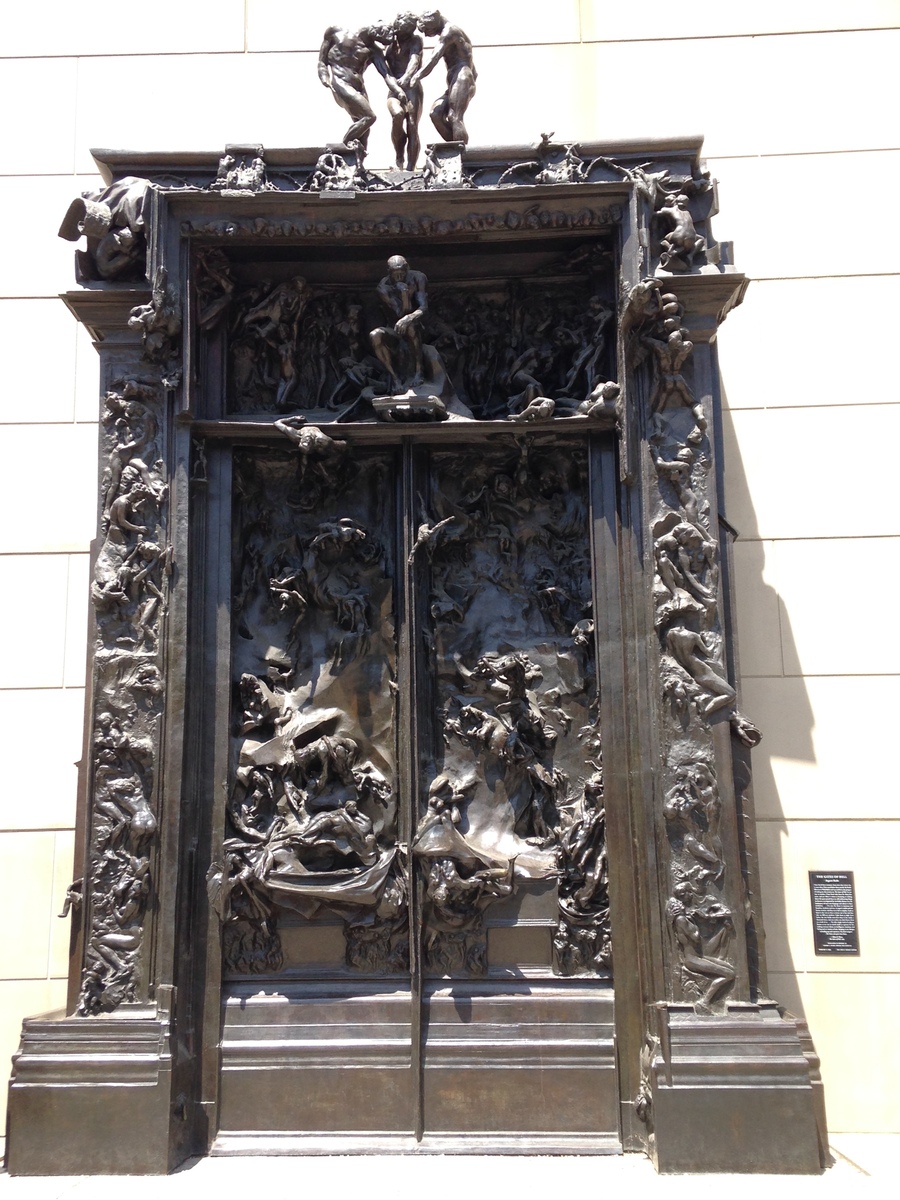
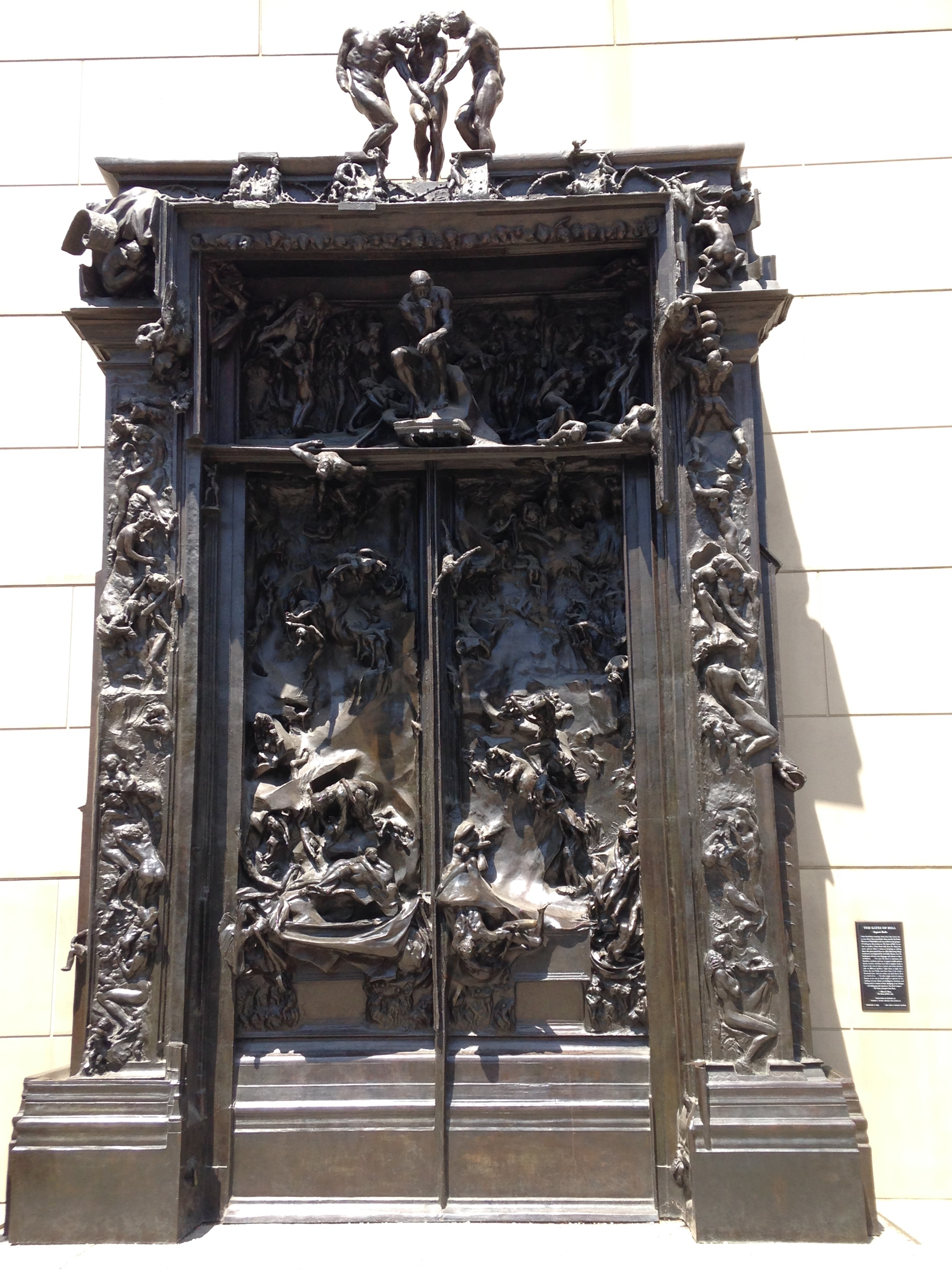
Mirroring the left, the right pilaster carries another column of writhing, grasping figures cast in the same dark bronze, marking the transition from the free-standing door leaves to the fixed architectural frame.
02
Figures on the left jamb
A vertical stack of small tormented figures clambering down the left pilaster of the frame, their limbs and torsos projecting from the door surround as if clinging to the architecture.
03
Right door panel with struggling bodies
The right leaf holds another knot of intertwined, gesturing nudes, including a prominent open hand and a crouching figure reaching toward the central seam, showing Rodin's rough, agitated modelling intended to catch light.
Your gallery guide
The Gates of Hell by Auguste Rodin (Modelled 1880–1917; this bronze cast 1929 or earlier)
A docent-led look at Rodin's monumental bronze portal at the Rodin Museum in Philadelphia, where figures of the damned crowd around a seated thinker and three shades. The article distinguishes what is visible from what is documented and what remains uncertain about this particular cast.
Editorial review by Artifact Archive automated publishing
This is Auguste Rodin's Gates of Hell, a monumental bronze portal crowded with figures of the damned.
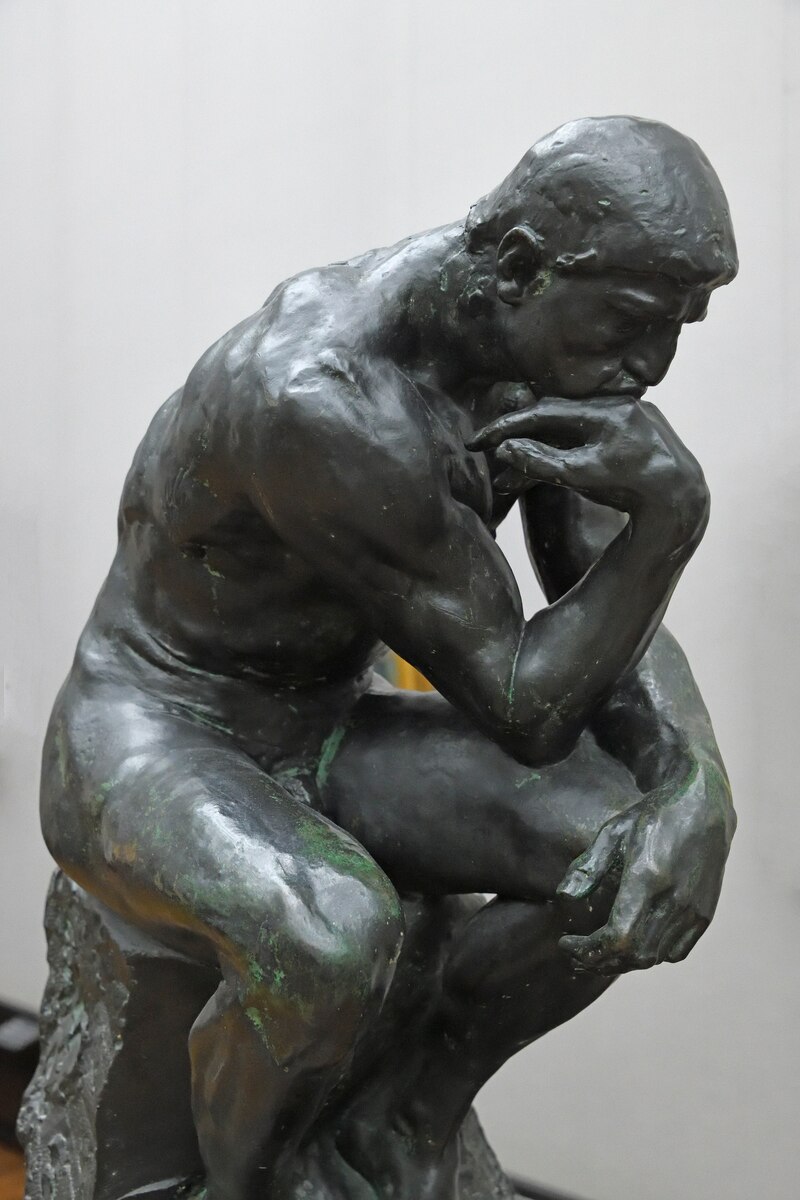
The composition draws on Dante's Inferno. Above the doors, a seated nude known as The Thinker broods over the scene, while the Three Shades stand at the summit.
The work was modelled between 1880 and 1917, and this bronze cast dates to 1929 or earlier. It is held at the Rodin Museum in Philadelphia.
Stand close and the surface is restless. Bodies twist, reach and overlap across the doors, and the bronze catches light on shoulders, backs and outstretched arms.
The Thinker sits directly above the lintel, large and still compared with the churn below. The Three Shades stand at the very top, their heads bowed together.
Rodin never completed the work as a functional door. What you see is a sculpture that behaves like a portal but was not made to open and close.
The Gates of Hell began as a commission for a museum of decorative arts in Paris, but that project was never realised. Rodin continued to rework the portal for decades.
Many of its figures became independent sculptures, including The Thinker and the Three Shades. The version here is one of several bronze casts made after Rodin's death.
This cast entered the Rodin Museum's collection through Jules Mastbaum, who acquired more than 150 Rodin sculptures between 1924 and 1926. Most were bronzes cast from Rodin's plasters under authority granted to the Musée Rodin by the artist's will.
The museum opened in November 1929 as a gift to the city of Philadelphia, designed by the French architects Paul Phillippe Cret and Jacques Gréber.
The Gates of Hell is one of the works on view there. Its placement in a purpose-built French neoclassical museum gives the portal a setting Rodin never saw.
What the work represents stays constant across its casts: a vision of judgment and descent, with the thinker as a solitary witness above the crowd.
The Gates of Hell is not a single finished door but an evolving project that occupied Rodin for most of his career.
This bronze cast preserves that ambition in Philadelphia, where the damned, the thinker and the shades confront you at close range.
The story and its sources
Editorial review by Artifact Archive automated publishing.
Historical claims are linked to the records below. Close looking and interpretation are identified in the passage notes.
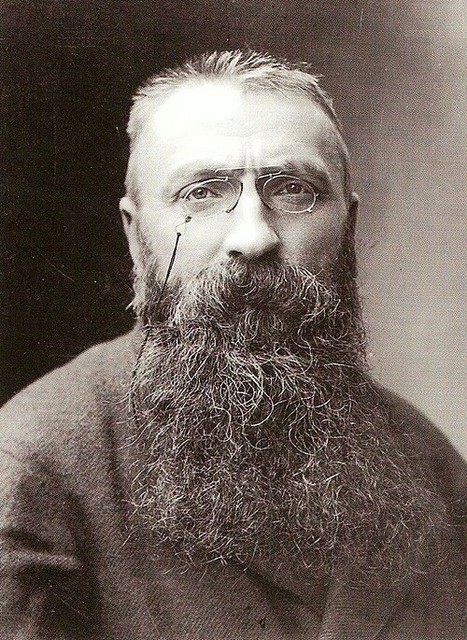
Auguste Rodin was a French sculptor (1840–1917). Their work is associated with modern art; Symbolism. Their recorded places of work include Brussels; Meudon; Paris; Rome; Dordrecht; London; Buenos Aires.
A monumental bronze portal densely populated with figures of the damned, derived from Dante's Inferno. Above the doors, the seated nude known as The Thinker broods over the scene below, while the Three Shades stand at the summit. The work was never completed as a functional door and exists in multiple casts.
Title variants
La Porte de l'Enfer
Dimensions
Not recorded in supplied sources
The work and its records
The object under consideration is known in English as 'The Gates of Hell' and in French as 'La Porte de l'Enfer'. A Wikidata item on Wikimedia Commons describes the photographed file as depicting one of the bronze casts for this sculptural work, located at Stanford University. The same Commons file page lists the category 'La Porte de l'enfer by Auguste Rodin in the Iris & B. Gerald Cantor Center for Visual Arts'. These two statements establish the work's dual-language title and identify the Stanford bronze cast as an instance of it, catalogued in a university art museum context rather than only as a photograph. The title itself carries the monumentality of the conception: a gate, not a freestanding figure group, and hell, not a single scene.(commons.wikimedia.org, n.d.)
The catalogue records for the photographic file are discovery aids rather than authoritative object records, and the Wikimedia entry itself is a Wikidata description of a file, not a museum catalogue entry. It names the location as Stanford University and categorizes the depicted work within the Cantor Center's holdings. What this establishes is the existence of multiple bronze casts of the same sculptural composition in different collections, each photographable and each catalogued under the same title. The Stanford identification does not fix the date of that cast, its founder, or its edition number; those details are not established by the supplied evidence. The attribution qualification embedded in the Commons description is precise: 'one of the bronze casts,' a phrase that acknowledges plurality and discourages treating any single cast as the original. For the accumulating research account, the Stanford file documents reception and documentation as much as the object itself.(commons.wikimedia.org, n.d.)
Interpretation
The Wikimedia Commons item and the Rodin Museum object page document the same titled work in two distant collections, Stanford and Philadelphia, and both are presented as bronze casts. The Commons page describes the file as depicting one of the bronze casts located at Stanford University, while the Rodin Museum page identifies its own cast as part of the Philadelphia collection. The two records therefore establish plurality directly from primary identification, not merely from inference. What they do not establish is any relationship of priority, edition sequence, or dependence between the casts; the evidence contains no founder's marks, edition numbers, casting dates, or measurements for either. Within the accumulating account, these two casts function as parallel witnesses: they corroborate that the work known as The Gates of Hell exists in bronze in multiple institutional settings, and they show that cataloguing practices differ between a museum object page and a crowd-sourced file description. Neither record should be treated as a complete catalogue raisonne entry.(commons.wikimedia.org, n.d.)(Rodin Museum, Philadelphia, n.d.)
A Wikidata item on Wikimedia Commons describes this file as depicting one of the bronze casts for the sculptural work known as 'The Gates of Hell' or 'La Porte de l'Enfer' in French, located at Stanford University.(commons.wikimedia.org, n.d.)
The object at hand is Auguste Rodin's The Gates of Hell, a monumental bronze portal whose composition draws on Dante's Inferno. Above the doors a seated nude known as The Thinker broods over the scene, with the Three Shades standing at the summit; the surface is crowded with twisting bodies that reach and overlap across the doors, and the bronze catches light on shoulders, backs and outstretched arms. Rodin modelled the work between 1880 and 1917, and the Rodin Museum in Philadelphia identifies a bronze cast of The Gates of Hell in its collection, with the cast on view dating to 1929 or earlier. The work is not a single finished door but an evolving project that occupied Rodin for most of his career; he never completed it as a functional door, so what stands here is a sculpture that behaves like a portal but was not made to open and close. The cast preserves that ambition, so that the damned, the thinker and the shades confront the viewer at close range.(Rodin Museum, Philadelphia, n.d.)
Interpretation
The commission history supplies the frame for understanding why the portal looks as it does. The Gates of Hell began as a commission for a museum of decorative arts in Paris, but that project was never realised; Rodin continued to rework the portal for decades afterward. The modelling span of 1880 to 1917 places the work across nearly the whole of his mature career, and many of its figures became independent sculptures, including The Thinker and the Three Shades. The Rodin Museum, Philadelphia's object page is the source for the composition's relation to Dante's Inferno and for the identity of the figures at the lintel and summit. This means that the visual program visible in the bronze, a vision of judgment and descent with the thinker as a solitary witness above the crowd, is also a record of an abandoned institutional project and of Rodin's long labour on an unresolvable design.(Rodin Museum, Philadelphia, n.d.)
The later history of this particular bronze depends on Jules Mastbaum. Mastbaum acquired more than 150 sculptures by Rodin between 1924 and 1926, most of them bronzes cast from Rodin's plasters under authority granted to the Musée Rodin by the artist's will. The cast in Philadelphia is one of several bronze casts made after Rodin's death, and it entered the Rodin Museum's collection through Mastbaum's acquisitions of 1924 to 1926. The museum itself opened in November 1929 as a gift to the city of Philadelphia, designed by the French architects Paul Phillippe Cret and Jacques Gréber. The Gates of Hell is one of the works on view there, and the museum's own account places it in a purpose-built French neoclassical setting that Rodin never saw. The sequence is therefore compressed: Mastbaum's purchases in the mid 1920s, the posthumous casting of the plasters under the authority of the artist's will, and the opening of the building in 1929 furnished the setting and the object within a few years of one another, which is why the cast's date of 1929 or earlier and the museum's November 1929 debut are best read together rather than as separate facts.(Rodin Museum, Philadelphia, n.d.)
The Rodin Museum opened in November 1929 in Philadelphia as a gift to the city, designed by French architects Paul Phillippe Cret and Jacques Gréber.(Rodin Museum, Philadelphia, n.d.)
The documented provenance of the bronze Gates of Hell at the Rodin Museum in Philadelphia begins not with the sculpture itself but with the collecting activity of Jules Mastbaum, who acquired more than 150 sculptures by Rodin between 1924 and 1926. The overwhelming majority of these were bronzes cast from Rodin's plasters under authority granted to the Musée Rodin by the artist's will, a posthumous casting regime that shapes what a Rodin bronze acquired in the mid-1920s actually is. The record establishes the scale and the legal basis of the acquisition but does not itemize which single purchase brought this cast into Mastbaum's hands, so the transaction that secured the portal specifically remains unrecorded in the available evidence.(Rodin Museum, Philadelphia, n.d.)
The Posthumous Cast and Its Civic Setting
The Gates of Hell is one of the works on view at the Rodin Museum in Philadelphia, a placement that matters for how the object is encountered. A portal conceived for a Paris museum of decorative arts that was never realized now stands in a purpose-built French neoclassical building designed by Cret and Gréber, a setting its maker did not live to see. The provenance record here is unusually compressed: it moves from an undocumented purchase within a documented collecting campaign, through a documented institutional gift, to a documented display, without a continuous chain of owners, sale dates, or accession identifiers. Where an unrecorded interval appears, it should be described as unrecorded rather than treated as a proven change of ownership.(Rodin Museum, Philadelphia, n.d.)
Jules Mastbaum acquired more than 150 sculptures by Rodin between 1924 and 1926, most of them bronzes cast from Rodin's plasters under authority granted to the Musée Rodin by the artist's will.(Rodin Museum, Philadelphia, n.d.)
Provenance timeline
between 1924 and 1926
Jules Mastbaum acquired more than 150 sculptures by Rodin, most of them bronzes cast from Rodin's plasters under authority granted to the Musée Rodin by the artist's will.(Rodin Museum, Philadelphia, n.d.)
November 1929
The Rodin Museum opened in Philadelphia as a gift to the city, designed by French architects Paul Phillippe Cret and Jacques Gréber.(Rodin Museum, Philadelphia, n.d.)
The Rodin Museum in Philadelphia lists The Gates of Hell among the works on view in its galleries, so the portal's exhibition history and its present display are documented for this one venue rather than for a sequence of loan exhibitions. The evidence establishes that the work is on view there and identifies the museum, but it supplies no exhibition title, venue list, opening or closing date, catalogue number, page or plate for any showing of the work. On the evidence available, the exhibition record for this object consists of its continuing place in the Philadelphia collection and not of a documented programme of temporary installations, and a reader should not infer dates or installation titles beyond what the museum page states.(Rodin Museum, Philadelphia, n.d.)
The Rodin Museum in Philadelphia holds a bronze cast of The Gates of Hell by Auguste Rodin in its collection, and the museum's own object page identifies the work as one of the pieces on view there. That pairing of a single cast with an institution is the concrete starting point for the display history: the portal is not only a canonical composition in photographs and surveys but a physical bronze with a documented Philadelphia custodian. According to the same museum record, Jules Mastbaum acquired more than 150 sculptures by Rodin between 1924 and 1926, most of them bronzes cast from Rodin's plasters under authority granted to the Musée Rodin by the artist's will. The museum opened in November 1929 as a gift to the city of Philadelphia, designed by the French architects Paul Phillippe Cret and Jacques Gréber. The Philadelphia cast therefore belongs to an ensemble assembled in a narrow acquisition window and installed in a purpose-built French neoclassical building, so its display context is inseparable from the institutional project that produced it rather than from Rodin's own lifetime arrangements.(Rodin Museum, Philadelphia, n.d.)
A separate institutional record on Wikimedia Commons describes a photograph of a bronze cast of the sculptural work known as The Gates of Hell, or La Porte de l'Enfer in French, located at Stanford University. The same file page lists the category 'La Porte de l'enfer by Auguste Rodin in the Iris & B. Gerald Cantor Center for Visual Arts'. The Commons annotation explicitly frames this page as a discovery aid and not an authoritative object record, so the file establishes that a bronze cast is documented at Stanford's Cantor Center and that the photograph is catalogued under that category, but it does not supply the cast's date, founder, edition number or acquisition history. Read alongside the Philadelphia record, it shows that the work's collection history is plural: multiple bronze casts exist in multiple university and museum settings, each with its own institutional documentation and its own evidentiary weight. The Philadelphia object page is the authoritative holding for the claim that the Rodin Museum holds a cast; the Commons page for Stanford is useful only for locating a cast there and for showing how such casts are classified in a public media repository.(commons.wikimedia.org, n.d.)
The Rodin Museum in Philadelphia holds a bronze cast of The Gates of Hell by Auguste Rodin in its collection.(Rodin Museum, Philadelphia, n.d.)
The Wikimedia Commons file page lists the category 'La Porte de l'enfer by Auguste Rodin in the Iris & B. Gerald Cantor Center for Visual Arts'.(commons.wikimedia.org, n.d.)
The calculated working insurance estimate records a broad range of US$500K to US$2M, generated as a working calculation on 2026-10-16 for manual review only. Its stated methodology uses the confirmed artist, Auguste Rodin, the model date of 1880 to 1917, the bronze medium, and the monumental subject of The Gates of Hell, together with the supplied evidence that the Rodin Museum holds a Gates of Hell bronze and that multiple bronze casts exist. Because no dimensions, cast number, edition size, provenance, condition, or official valuation is provided, the range is described as intentionally wide and conservative and as not derived from comparable sales, auction results, or private insurance records. It is explicitly not an official insurance value, appraisal, auction result, or sale price, and it does not reflect a specific cast, provenance, condition, or market transaction.(Rodin Museum, Philadelphia, n.d.)(commons.wikimedia.org, n.d.)
Read together, these records separate what the evidence documents from what it only frames. The museum record documents the holding and display of a Gates of Hell bronze in Philadelphia; the Mastbaum and museum-founding material documents a collecting campaign and an institutional setting established between 1924 and 1929; the Commons page documents another cast's placement at Stanford; and the insurance calculation documents a methodological working range rather than a market fact. The result is an object whose material presence is documented in at least two collections while its specific cast identity, condition, and market standing are not established by the supplied evidence.(Rodin Museum, Philadelphia, n.d.)(commons.wikimedia.org, n.d.)
Working estimate
Calculated working insurance estimate, not a sale price: Estimated insurance range: US$500K to US$2M Recorded date: Working calculation, generated 2026-10-16. Methodology: This broad working range is calculated for manual review only. It uses the confirmed artist (Auguste Rodin), the model date of 1880 to 1917, the bronze medium, and the monumental subject of The Gates of Hell. The supplied Rodin Museum excerpt confirms that the museum holds a Gates of Hell bronze and that Jules Mastbaum acquired more than 150 Rodin sculptures between 1924 and 1926, mostly cast under Musee Rodin authority. The Wikimedia Commons excerpt confirms the existence of multiple bronze casts. Because no dimensions, cast number, edition size, provenance, condition, or official valuation is provided, the range is intentionally wide and conservative. It is not derived from comparable sales, auction results, or private insurance records. Qualification: Model-generated working range for manual review only. This is not an official insurance value, appraisal, auction result, or sale price. It does not reflect a specific cast, provenance, condition, or market transaction.(Rodin Museum, Philadelphia, n.d.)(commons.wikimedia.org, n.d.)
Further reading
Books for a closer look
Paid links. As an Amazon Associate I earn from qualifying purchases.
Titled 'Auguste Rodin', listing Rodin among its authors and recording subjects 'Rodin, auguste, 1840-1917', 'Influence' and 'Exhibitions'. A scholarly exhibition linked study of Rodin that can support comparison and reception context for The Gates of Hell, without assuming coverage of the work in its full text.
References are arranged by author or organisation, with links to the original publications. Where no publication date is recorded, n.d. means no date.
Source notes updated .
No recorded sources match these filters. Reset the filters to see the full bibliography.
03
Book
Antoinette Le Normand-Romain (2001).Rodin, La Porte de l'Enfer. Nouv. éd. revue et augmentée. Musée Rodin.
Recorded title 'Rodin, La Porte de l'Enfer' by Antoinette Le Normand-Romain, with subjects 'Relief (Sculpture), French', 'Criticism and interpretation' and 'Hell in art'. This is the only candidate whose recorded title names the artwork itself and whose subjects tie directly to Rodin's sculptural relief and its hell theme, making it the most object specific study in the list.
Wikimedia Commons file page for a photograph of a bronze cast at Stanford University. Used only as a discovery aid; not an authoritative object record.
Titled 'Auguste Rodin', listing Rodin among its authors and recording subjects 'Rodin, auguste, 1840-1917', 'Influence' and 'Exhibitions'. A scholarly exhibition linked study of Rodin that can support comparison and reception context for The Gates of Hell, without assuming coverage of the work in its full text.
Titled 'Rodin' by Yann Le Pichon with the recorded subject 'Criticism and interpretation'. It is a documented critical study of Rodin, offering art historical context relevant to The Gates of Hell, though the catalogue record does not confirm discussion of that work specifically.
Advertising supports the archive. These preferences control aggregate page counting, reading activity and ad-delivery diagnostics. They use no visitor tracking cookie.