Identity and catalogue
Link- Title
- The Scapegoat
- Artist or attribution
- William Holman Hunt
- Object date
- exhibition 1923 purchase; original painting date not stated in the supplied excerpts
- Medium and support
- painting; the supplied excerpts do not specify support or technique
- Dimensions
- not stated in the supplied excerpts
- Current collection or location
- Lady Lever Art Gallery, National Museums Liverpool; further city and country not stated in the supplied excerpts
- Movement or period
- not stated in the supplied excerpts; the artist is associated with the Pre-Raphaelite circle, though this excerpt does not name a movement
- Country or culture
- British; painted during the artist's stay in the Holy Land
- Depicted subject
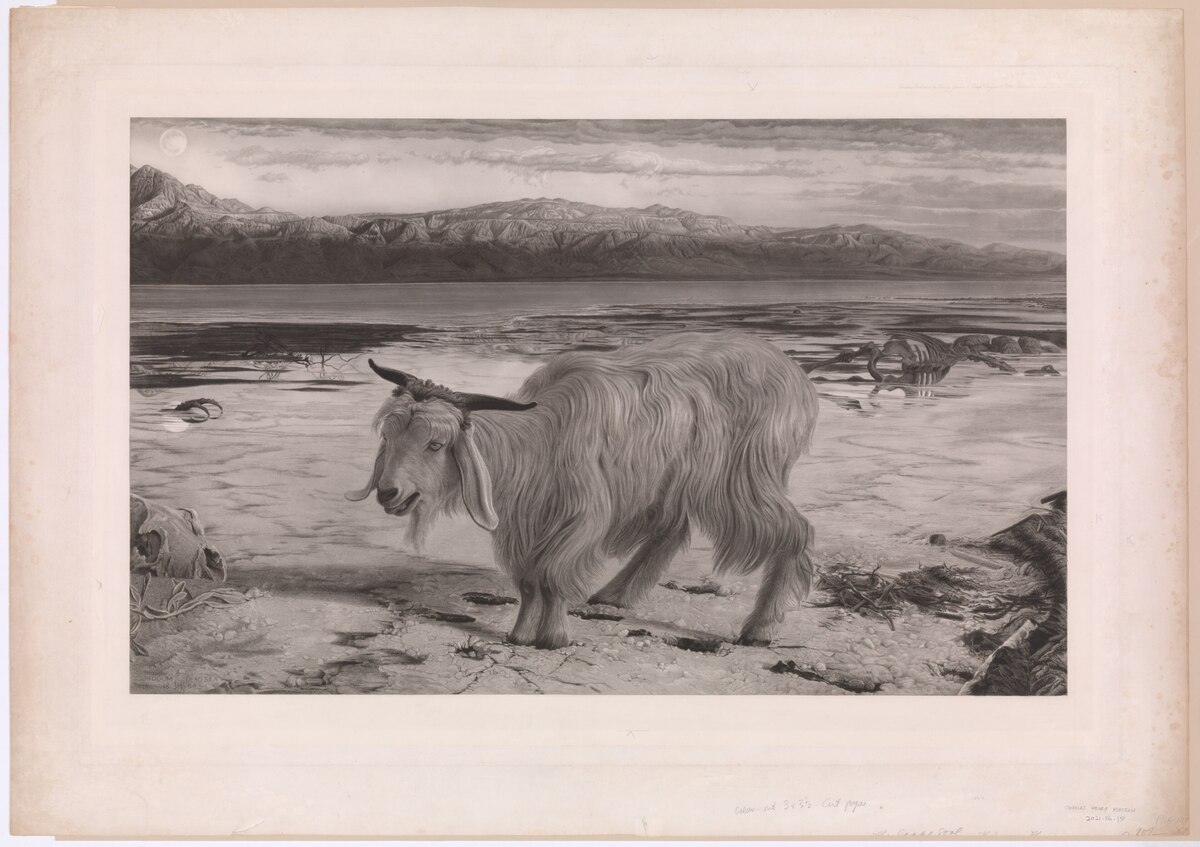
- A goat stands alone on the shore of the Dead Sea at Osdoom, with the mountains of Edom in the distance. The animal embodies the Old Testament scapegoat, the goat sent out from the temple on the Day of Atonement carrying the congregation's sins, understood by Hunt as an equivalent to the suffering and death of Christ.(Dominic Janes, 2015)
- Title variants
- The Scapegoat
- Attribution qualification
- Attributed to William Holman Hunt by the Lady Lever Art Gallery record.
The Scapegoat holds a foundational position in William Holman Hunt's career as the first major painting he made during his first stay in the Holy Land. That fact establishes the work's place at the opening of his extended engagement with the region, and it is the starting point for any catalogue identity: the picture belongs to the moment when Hunt moved from researching sacred history in England to painting it on the ground where, in his understanding, it had taken place. The museum record that preserves this information is also the source for the painting's later documentation and collecting history, so the object's identity and its nineteenth- and twentieth-century institutional life are recorded together.(Dominic Janes, 2015)
The Scapegoat was the first major painting William Holman Hunt made during his first stay in the Holy Land.(Dominic Janes, 2015)
Commission and creation circumstances
The foundational circumstances of The Scapegoat belong to William Holman Hunt's research practice rather than to a commission in the ordinary sense. The museum record states that Hunt had the idea for the painting while researching Jewish rituals for another painting, The Finding of the Saviour in the Temple, which is now in Sudley House. The two works are therefore linked at the level of inquiry: the ritual material Hunt gathered for one picture generated the subject of another. The painting is also described as the first major painting Hunt made during his first stay in the Holy Land, and he spent long periods of time living and working in Egypt and Palestine. That sustained residence matters for how the picture's setting should be understood, since it places Hunt in the region for an extended period rather than on a brief tour, and it explains the access to landscape and local observation that the Dead Sea subject required.(Dominic Janes, 2015)
The ritual that generated the subject
Interpretation
The underlying subject is the Day of Atonement ritual. The museum record states that during his research Hunt learned that on the Festival of the Day of Atonement a goat was sent out from the temple with a piece of scarlet cloth on its head, symbolising the sins of the congregation, and that it was believed that if the congregation's sins were forgiven the scarlet cloth would turn white. From this ritual, the record continues, stems the broader concept of the scapegoat as a person, or animal, who takes on the sins of others, or is unfairly blamed for problems. The museum record attributes to Hunt the interpretation that he regarded the Old Testament scapegoat as an equivalent to the New Testament Christ whose suffering and death similarly expunged men's sins. That is an attributed reading of typology rather than a neutral description of the biblical text, and it is the interpretive hinge on which the painting's religious meaning rests.(Dominic Janes, 2015)
The setting: Osdoom, Sodom and the accursed shore
The choice of site is inseparable from the picture's argument. The museum record notes that Hunt chose to set his goat on the shore of the Dead Sea at Osdoom, with the mountains of Edom in the distance, and that the site had been identified by Louis de Saulcy as the original site of the city of Sodom. In his diary, as reported in the museum record, Hunt described the Dead Sea setting as a 'horrible figure of sin' that no one could say 'is not accursed by God'. The historical identification by de Saulcy supplies the topography with a specific scriptural association, while Hunt's own diary language shows him treating the physical desolation as evidence of divine judgement. The desolation is therefore not merely picturesque backdrop but the visual carrier of the painting's subject: barren shore, salt water and distant mountains were selected to make the accursed condition visible around a single animal.(Dominic Janes, 2015)
Hunt's religious position and the limits of inference about motive
Interpretation
Hunt's own confession bears on how his symbolism is described. The museum record states that Hunt was an Anglican. The same record contains a further suggestion attributed to it: that Hunt, an Anglican, may have wanted to suggest with his goat that homosexuals could be redeemed by 'atoning for their sins'. This suggestion is presented by the museum as a possibility rather than a documented intention, and it must be weighed as such. It concerns motive, which is not directly recoverable from the painting or from Hunt's recorded words about the ritual, and the wording of the record itself holds it at the level of what Hunt may have wanted to suggest. The Anglican identity is documented; the redemption reading for homosexuals is an interpretation attached to that identity, not a fact established by it.(Dominic Janes, 2015)
Homosexuality, Sodom and the problem of a later interpretive account
A distinct and later interpretive layer has been built on the Sodom identification. Historian Dominic Janes has speculated that Sodom was chosen as the location for the image because Hunt wanted to make a connection between the Day of Atonement and homosexuality. The museum record supplies the background for why such a reading is available: in the Bible Sodom is described as a city destroyed by God in a rain of fire and brimstone for the 'sins' of its inhabitants, and this sin has traditionally been thought to have been male homosexual intercourse, hence the word 'sodomy'. Janes's proposal is explicitly a speculation in the museum record and is reported there through a scholarly book rather than being a claim from a contemporary document. It sits beside, and does not displace, the documented ritual subject and the typological reading of the scapegoat as a forerunner of Christ.(Dominic Janes, 2015, Janes, 'Picturing the Closet', Oxford University Press, 2015, pp. 87-94.)
Fear of attention in the region
One further documented detail of Hunt's time in the region complicates any simple account of his attitude. The museum record states that Hunt was apparently unusually frightened of attracting the attention of gay men, and advised John Everett Millais, who was travelling to the region, to grow a beard to make himself less desirable to local men. The record presents this as apparent rather than certain, and the advice to Millais is the concrete form the report takes. This evidence is part of the same documentary picture as the questions raised around Sodom, and it belongs to the historical context in which the painting was conceived. It does not by itself establish what Hunt intended in the painting, and it should not be used to convert Janes's speculation into a documented motive.(Dominic Janes, 2015)
Why the object matters
Interpretation
Taken together, the evidence shows an object whose importance lies in the collision of a documented ritual programme with a contested interpretive history. Hunt came to the scapegoat through research into Jewish ritual for another painting, learned the Day of Atonement detail of the goat sent out with scarlet cloth, and carried that subject to a specific site identified by Louis de Saulcy as Sodom. He then described that site in his diary as a 'horrible figure of sin' accursed by God, and, on the museum's account, treated the Old Testament scapegoat as a type of Christ. The later readings about homosexuality, whether Janes's speculation about the choice of Sodom or the museum's suggestion about redemption, attach to the Sodom identification and to Hunt's Anglican position rather than to the documented ritual. The goat standing alone on that shore is therefore a case study in how a religious image can accumulate meanings its maker did not document, and how the evidence distinguishes what was made, what was meant and what has since been argued.(Dominic Janes, 2015)
Hunt had the idea for the painting while researching Jewish rituals for another painting, The Finding of the Saviour in the Temple.(Dominic Janes, 2015)
The concept of the scapegoat as a person, or animal, who takes on the sins of others, or is unfairly blamed for problems, stems from this ritual.(Dominic Janes, 2015)
The site had been identified by Louis de Saulcy as the original site of the city of Sodom.(Dominic Janes, 2015)
In his diary Hunt described the Dead Sea setting as a 'horrible figure of sin' that no one could say 'is not accursed by God'.(Dominic Janes, 2015)
Hunt was an Anglican.(Dominic Janes, 2015)
Hunt spent long periods of time living and working in Egypt and Palestine.(Dominic Janes, 2015)
Hunt was apparently unusually frightened of attracting the attention of gay men, and advised John Everett Millais, who was travelling to the region, to grow a beard to make himself less desirable to local men.(Dominic Janes, 2015)
Interpretations and debates
LinkThe Scapegoat: ritual, setting and attributed readings
Reported tradition
The reported traditions attached to this painting belong to William Holman Hunt's research process rather than to the canvas alone. While researching Jewish rituals for another picture, The Finding of the Saviour in the Temple, now at Sudley House, Hunt learned that on the Festival of the Day of Atonement a goat was sent out from the temple with a piece of scarlet cloth on its head, symbolising the sins of the congregation. The associated belief held that if the congregation's sins were forgiven the scarlet cloth would turn white. Both details are recorded as tradition in the museum record, not as ritual practice documented from other sources, and they supply the picture's central motif: a single animal bearing away communal guilt. The theme recurs in the source's account of the broader idea of the scapegoat, a person or animal who takes on the sins of others or is unfairly blamed for problems, which the record derives from this ritual.(Dominic Janes, 2015)
A second, distinct tradition attaches to the location Hunt chose rather than to the rite. In the Bible, Sodom is described as a city destroyed by God in a rain of fire and brimstone for the sins of its inhabitants, and that sin has traditionally been thought to have been male homosexual intercourse, hence the word sodomy. Hunt set his goat on the shore of the Dead Sea at Osdoom, with the mountains of Edom in the distance, and the source records that the site had been identified by Louis de Saulcy as the original site of the city of Sodom. The identification is presented as a reported attribution to de Saulcy, not as an established fact about the landscape, and it is this attribution that allows the setting to carry the Sodom tradition into the image. Hunt's own diary description of the Dead Sea setting as a horrible figure of sin that no one could say is not accursed by God belongs to the same evidentiary layer: the artist's recorded words about the place, not a statement about the rite.(Dominic Janes, 2015)
Interpretation
The hardest reading of the image is explicitly attributed and explicitly speculative, and it should be weighed as such. Historian Dominic Janes has speculated that Sodom was chosen as the location for the image because Hunt wanted to make a connection between the Day of Atonement and homosexuality. The museum record goes further and suggests that Hunt, an Anglican, may have wanted to suggest with his goat that homosexuals could be redeemed by atoning for their sins. Both statements are framed in the source as speculation and suggestion rather than as documented intention, and Janes's reading is reported through the museum record rather than consulted directly there. Because the record also notes that Hunt regarded the Old Testament scapegoat as an equivalent to the New Testament Christ whose suffering and death similarly expunged men's sins, Janes's proposal runs alongside a well-attested Christian typological meaning rather than replacing it. The two readings can be held together without treating the interpretive one as settled: the typological equivalences are what the source presents as Hunt's own understanding, while the connection to homosexuality is an argument about why he chose that particular shore.(Dominic Janes, 2015)
Theological reading and scholarly speculation
The Scapegoat carries two related but separable readings that the museum record and its cited scholarship do not treat as equally established. The first is theological and is attributed to Hunt himself: he regarded the Old Testament scapegoat as an equivalent to the New Testament Christ whose suffering and death similarly expunged men's sins. On that account the animal is a type or forerunner, and the painting is a work of atonement in the straightforward Christian sense. The second reading is Dominic Janes's speculation, reported through the same museum record, that Sodom was chosen as the location because Hunt wanted to make a connection between the Day of Atonement and homosexuality. Janes's proposal is an attributed scholarly hypothesis, not a statement of the artist's intent, and it is reported here at second hand through the museum record rather than consulted directly. Keeping these two readings distinct matters: the typological reading rests on a position the evidence assigns to Hunt, while the Sodom reading rests on a scholar's inference about why a particular site was selected.(Dominic Janes, 2015, Janes, 'Picturing the Closet', Oxford University Press, 2015, pp. 87-94.)
The setting is what allows the two readings to be held together at all, and it is also where the account becomes most contested. Hunt chose to set his goat on the shore of the Dead Sea at Osdoom, with the mountains of Edom in the distance, and the museum record notes that the site had been identified by Louis de Saulcy as the original site of the city of Sodom. That identification is a nineteenth-century antiquarian attribution, not an uncontested geographical fact, and the interpretation of the place depends on accepting it. The connection to Sodom is therefore layered: de Saulcy's identification supplies the location as a historical claim, Janes's speculation supplies a reason for choosing it, and the museum record's own suggestion that Hunt, an Anglican, may have wanted to suggest that homosexuals could be redeemed by 'atoning for their sins' supplies a third, more tentative reading. Each of these is an inference built on the same choice of site, and none of them is documented as Hunt's stated intention. In the biblical account recounted in the record, Sodom was destroyed by God in a rain of fire and brimstone for the 'sins' of its inhabitants, a sin traditionally thought to have been male homosexual intercourse, which is where the word 'sodomy' comes from; that background is what makes the site legible as a moral landscape as well as a geographical one.(Dominic Janes, 2015)
Historian Dominic Janes has speculated that Sodom was chosen as the location for the image because Hunt wanted to make a connection between the Day of Atonement and homosexuality.(Dominic Janes, 2015)
Hunt regarded the Old Testament scapegoat as an equivalent to the New Testament Christ whose suffering and death similarly expunged men's sins.(Dominic Janes, 2015)
The museum record suggests that Hunt, an Anglican, may have wanted to suggest with his goat that homosexuals could be redeemed by 'atoning for their sins'.(Dominic Janes, 2015)
Reported tradition
During his research, Hunt learned that on the Festival of the Day of Atonement a goat was sent out from the temple with a piece of scarlet cloth on its head, symbolising the sins of the congregation.(Dominic Janes, 2015)
It was believed that if the congregation's sins were forgiven the scarlet cloth would turn white.(Dominic Janes, 2015)
In the Bible, Sodom is described as a city destroyed by God in a rain of fire and brimstone for the 'sins' of its inhabitants; this sin has traditionally been thought to have been male homosexual intercourse, hence the word 'sodomy'.(Dominic Janes, 2015)
Collection and display
LinkTwo paintings, one line of research
The museum record for The Scapegoat states that the idea for the painting arose while William Holman Hunt was researching Jewish rituals for a different picture, The Finding of the Saviour in the Temple, and that the earlier work is now in Sudley House. That single sentence in the record links the two paintings by more than chronology: it makes the scapegoat subject a by-product of research Hunt had already undertaken for a Jerusalem temple scene, so the later Dead Sea canvas inherits the liturgical enquiry that the first painting required. The record does not say when Hunt transferred his attention from one to the other, and no interval between the two projects is supplied, only the direction of the dependence.(Dominic Janes, 2015)
The later history of the two works diverges in the documentation supplied. The Finding of the Saviour in the Temple is recorded in the museum record as being at Sudley House, while The Scapegoat is described in the same museum source as entering the Lady Lever collection after Lever bought it in 1923, and the Lady Lever Art Gallery accession number for the painting is LL 3623. The two Liverpool institutions hold the two pictures whose subjects are connected in Hunt's research, although the evidence units supplied here do not themselves state that relationship between the collections.(Dominic Janes, 2015)
Purchase and accession
Purchase details for The Scapegoat are given twice in the museum record in nearly identical terms: Lever bought the picture in 1923 for £4,950, from the 1923 Autumn Exhibition at the Walker Art Gallery. The repetition confirms the transaction rather than adding information, and it fixes the painting's movement from a Liverpool exhibition into a private collection that became the Lady Lever Art Gallery. The record gives no intermediate owner, no earlier sale, and no reason why the picture was available in 1923, so the acquisition cannot be reconstructed beyond the exhibition it left and the price paid.(Dominic Janes, 2015)
The painting's presence in the Lady Lever Art Gallery is inseparable from its gallery accession number, LL 3623, the identifier by which the institution tracks the object. Alongside the 1923 purchase, the accession number is the clearest piece of institutional documentation supplied for the work's current whereabouts, and it anchors the painting to the same collection through which the museum record communicates its account of Hunt's Dead Sea setting and his reading of the scapegoat as an equivalent to Christ.(Dominic Janes, 2015)
The print after the painting
A separate print after the painting survives in a different national collection. Charles Henry Mottram made a print after William Holman Hunt titled The Scapegoat, dated 1861, using various engraving techniques on chine collé. Its recorded dimensions are Chine 23 1/4 × 35 1/2 in. (59 × 90.1 cm), Plate 24 7/16 × 36 1/2 in. (62.1 × 92.7 cm), and Sheet 23 1/4 × 35 1/2 in. (59 × 90.1 cm), a format that shows the reproductive print circulated the composition on its own scale. The record for this print, structured by Wikimedia Commons, is not an owner-published catalogue entry, and no edition size, publisher, or printing sequence is supplied with it.(Wikimedia Commons, n.d.)
The Mottram print is held in the Metropolitan Museum of Art, Department of Drawings and Prints, accession number 2021.15.19, with the credit line Bequest of James David Draper and the Robert Isaacson Collection, 2020. That credit line documents the print's arrival in New York through a bequest rather than a purchase, and it places the reproductive image of Hunt's scapegoat in a department and collection built around works on paper. Together with the painting's 1923 purchase and the Sudley House location of the related Finding of the Saviour in the Temple, this gives the subject three separate institutional homes in the record supplied here.(Dominic Janes, 2015)(Wikimedia Commons, n.d.)
The Finding of the Saviour in the Temple is now in Sudley House, as stated in the supplied museum record.(Dominic Janes, 2015)
The Mottram print after Hunt is in the Metropolitan Museum of Art, Department of Drawings and Prints, accession number 2021.15.19, credit line Bequest of James David Draper and the Robert Isaacson Collection, 2020.(Wikimedia Commons, n.d.)
Documented values and qualified estimates
LinkRecorded values
The documented acquisition record for The Scapegoat anchors the work in a specific commercial and institutional moment. Lever purchased the painting in 1923 for £4,950 from the 1923 Autumn Exhibition at the Walker Art Gallery. That figure is recorded in the Lady Lever Art Gallery object record for the painting, and the source that supplies it is careful to qualify its status: it is a documented 1923 purchase price, not a current market value, insurance figure or market estimate. The acquisition brought the work into the Lady Lever collection, where it carries the accession number LL 3623. This is the only directly monetised value the supplied evidence establishes for the object, and its precision is bounded by its date. The price tells us what one buyer paid at one exhibition in one year, and nothing about what the picture would fetch, or has been insured for, at any later point.(Dominic Janes, 2015)
A second order of value recorded for the painting is symbolic, and the evidence states it as the plain meaning Hunt himself attached to the animal rather than as a modern reading. Hunt regarded the Old Testament scapegoat as an equivalent to the New Testament Christ, whose suffering and death similarly expunged men's sins. The idea for the picture arose while he researched Jewish rituals for a different painting, The Finding of the Saviour in the Temple, which the supplied museum record places at Sudley House. In the course of that research he learned that on the Festival of the Day of Atonement a goat was sent out from the temple with a piece of scarlet cloth on its head, symbolising the sins of the congregation; it was believed that if the congregation's sins were forgiven the scarlet cloth would turn white. The museum record also notes that the modern sense of a scapegoat as a person or animal who takes on the sins of others, or is unfairly blamed for problems, stems from this ritual. The ritual detail, the colour change and the modern idiom all belong to the same redemptive logic that Hunt transposed onto canvas.(Dominic Janes, 2015)
Interpretation
The setting carries an additional, contested layer of meaning. Hunt chose to set his goat on the shore of the Dead Sea at Osdoom, with the mountains of Edom in the distance, and the site had been identified by Louis de Saulcy as the original site of the city of Sodom. In his diary Hunt described the Dead Sea setting as a horrible figure of sin that no one could say is not accursed by God. Historian Dominic Janes has speculated that Sodom was chosen as the location because Hunt wanted to make a connection between the Day of Atonement and homosexuality. In the Bible Sodom is described as a city destroyed by God in a rain of fire and brimstone for the sins of its inhabitants, and this sin has traditionally been thought to have been male homosexual intercourse, which gives us the word sodomy. The museum record further suggests that Hunt, an Anglican, may have wanted to suggest with his goat that homosexuals could be redeemed by atoning for their sins. These propositions are attributed to Janes and to the museum record respectively, and the record itself frames the reading as an interpretation rather than a settled fact; the diary entry, by contrast, is Hunt's own words and supports the desolation as deliberate without settling the erotic reading.(Dominic Janes, 2015)
Biographical and contextual qualifications sharpen the picture of Hunt as the maker of this image. He was an Anglican, and the museum record notes that he spent long periods of time living and working in Egypt and Palestine; the painting was the first major work he made during his first stay in the Holy Land. The same record reports that Hunt was apparently unusually frightened of attracting the attention of gay men, and that he advised John Everett Millais, who was travelling to the region, to grow a beard to make himself less desirable to local men. Evidence of this kind is reported through the museum record and concerns Hunt's disposition rather than the painting's content. It bears on the Janes reading only circumstantially, because it documents a period anxiety in Hunt's circle and not a private intention for The Scapegoat. The documented creation history the evidence does support is narrower: an Anglican painter, working in the Holy Land on his first major canvas there, translating a ritual of atonement into a landscape.(Dominic Janes, 2015)
Lever bought the picture in 1923 for £4,950 from the 1923 Autumn Exhibition at the Walker Art Gallery.(Dominic Janes, 2015)
Historical acquisition value: Purchased by Lever in 1923 for £4,950 from the 1923 Autumn Exhibition at the Walker Art Gallery. Recorded date: 1923. Methodology: Historical acquisition price recorded in the Lady Lever Art Gallery object record for the painting. This is a documented 1923 purchase price, not a current market value. Qualification: This is a historical acquisition price from 1923 and does not represent a current valuation, insurance figure or market estimate.(Dominic Janes, 2015)