Identity and catalogue
Link- Movement or period
- Dutch Golden Age, Utrecht Caravaggism
- Country or culture
- Dutch
- Depicted subject
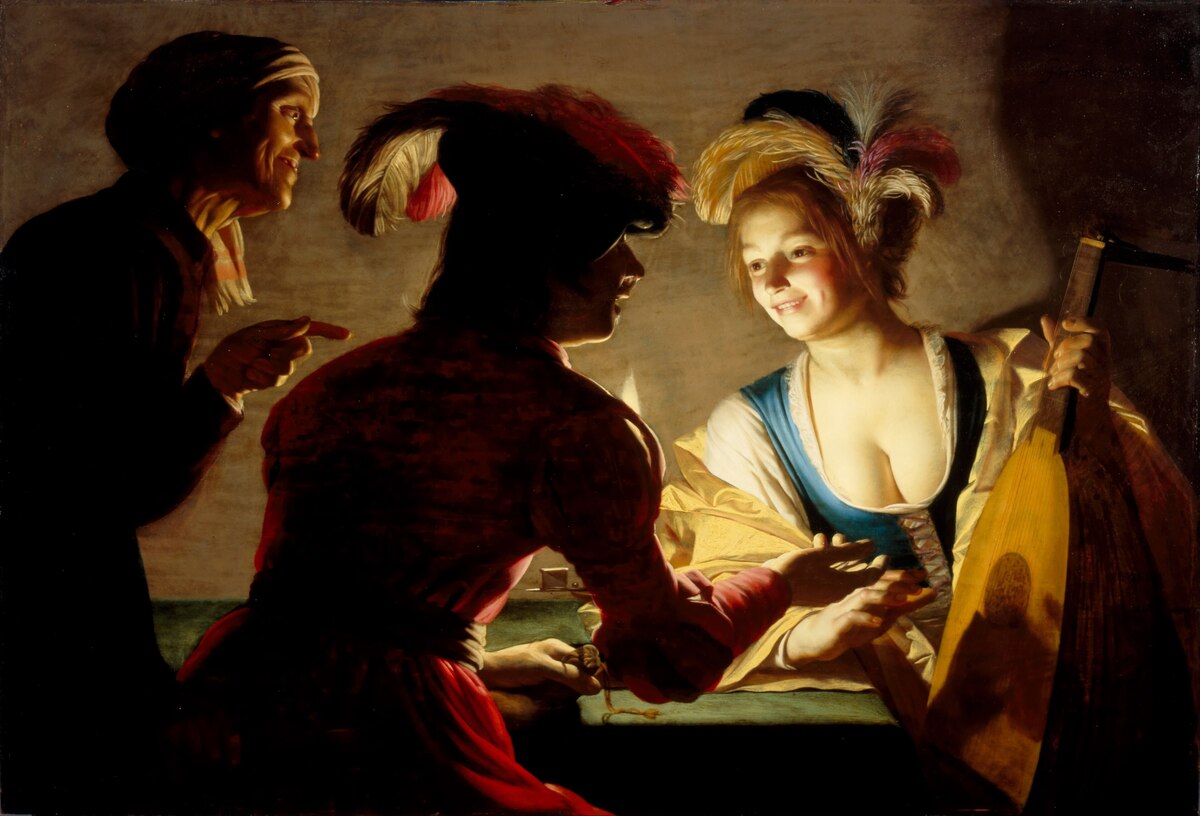
- A genre scene showing a matchmaker or procuress, an older woman, who directs a young woman and a client in a transactional arrangement, with a lute and an exchange of money.
- Title variants
- The Matchmaker; The procuress; L'Entremetteuse; Mezzana
- Support
- Panel
Title, attribution and category
Interpretation
The painting is catalogued as The Procuress, with The Matchmaker recorded as an alternate title. Although the evidence supplied here is thin on the internal history of the title, the pairing of the two names already marks a translation and an interpretation: 'procuress' names the woman's occupational role in a transaction, while 'matchmaker' softens that same role toward the arrangement of a match. Later cataloguers could therefore describe the same scene with a slightly different emphasis without changing the subject on the panel. The object itself belongs to a recognisable category of painting, the genre scene, which depicts everyday life rather than a sacred narrative, and it is associated with Utrecht Caravaggism, the grouping of Dutch painters influenced by Caravaggio. Those two classifications together determine how the picture is normally approached: not as a story told in a fixed devotional key, but as a scene of ordinary social exchange produced within a specific local movement.(Wikimedia Commons: The Procuress, n.d., Captions; Genre; Usage on other wikis (Utrecht Caravaggism))
The work is attributed to Gerard van Honthorst (1592–1656), a Dutch painter, and is dated 1625. To keep the catalogue record accurate, three distinct kinds of information should be separated: the artist's life dates, which bracket his career; the 1625 date of the painting, which places it in the middle years of that career; and the later compilation of the catalogue entry itself, which is a modern act of documentation rather than a fact about the seventeenth-century object. The 1625 date is the object date or the date the painting carries as a work of art, and it should not be confused with the date on which the Wikimedia Commons file page or any inventory record was assembled. The attribution to Van Honthorst and the 1625 date belong to the primary documentation of the work. The medium is oil on panel, that is, oil on wood, with dimensions of 71 × 104 cm (28 × 41 in.). The accession number is 10786, and the painting is in the collection of the Centraal Museum, Utrecht. Together, the accession number and the holding institution convert the object into an identifiable collection item, while the dimensions and support describe its physical form. The width, more than half again the height, gives the composition a horizontal format, which is itself a design decision that affects how the figures are grouped across the panel. The support is a rigid wooden one rather than a flexible canvas, and the catalogue record is the reason these facts can be stated at all, since the physical object is not reproduced here in any form that would allow independent measurement.(Wikimedia Commons: The Procuress, n.d., Summary; Date; Dimensions)
Subject and composition
The scene is one of arrangement rather than portraiture. It depicts a matchmaker or procuress, an older woman who arranges encounters, together with a young woman and a client, and it includes a lute and an exchange of money. Read against the genre category, this is precisely the kind of subject genre painting was designed to carry: a small social transaction made legible through characters and through objects. The procuress is not a background presence. She is the arranger, and the young woman and the client are the parties she brings together. The lute and the money are not incidental props; in this context the lute signals the arrangement being negotiated, while the money marks what is being exchanged. That the arrangement is not a specific documented portrait of named sitters follows from the genre classification rather than from any surviving identification of individuals, and it should be treated as the catalogue's reading of the subject rather than as a fact about real people. The title and the objects in the scene are what make the subject clear, and it is the interaction among the figures and those objects, rather than any single face, that the composition organises.(Wikimedia Commons: The Procuress, n.d., Captions; Genre)
Material, technique and light
Interpretation
The medium and support matter for how the scene reads visually. The painting is oil on panel, and because the panel is a smooth, rigid support, the paint does not have to contend with a woven canvas texture underneath the image; the light can fall across faces and hands without that texture interrupting it. This is a technical observation about the relation between support and finish. It links directly to the lighting associated with Utrecht Caravaggism, the movement of Dutch painters influenced by Caravaggio to which the painting belongs. Caravaggio's influence shows in the strong contrasts of light and shadow that define the figures, and in this scene that light makes the transaction feel immediate and close. The effect is therefore not merely stylistic decoration; the directional light and the close grouping work together to make the exchange of lute and money the centre of the picture. Honthorst worked in Utrecht, so the painting belongs both geographically and stylistically within that local movement, and the association is an institutional classification of the work rather than a claim the painting makes about itself.(Wikimedia Commons: The Procuress, n.d., Genre; Usage on other wikis (Utrecht Caravaggism); Dimensions)
Documentary status and significance
The central question for the catalogue record is what is documented and what is inferred. The documented facts are the title and its variant, the attribution to Gerard van Honthorst (1592–1656), the date 1625, the medium of oil on panel, the dimensions of 71 × 104 cm (28 × 41 in.), the holding collection, the Centraal Museum, Utrecht, and the accession number 10786. The description of the scene, including the procuress, the young woman, the client, the lute and the exchange of money, is also documented, as are the genre classification and the association with Utrecht Caravaggism. What is not documented in the evidence supplied here is any identification of individual sitters, any earlier or later provenance history, or any claim about why the artist chose the subject. The composition should therefore be understood as a genre scene about a matchmaker arranging an encounter, not a portrait of specific sitters, and the lasting impression is the arrangement itself: an older woman, a young woman, a client, a lute and money. Within the larger history of art, the object's significance lies in this combination: a Dutch painter working in Utrecht in 1625, using an oil-on-panel support and Caravaggesque light to stage a subject drawn from everyday social life, and doing so in a picture now preserved as a numbered collection item in the city's Centraal Museum.(Wikimedia Commons: The Procuress, n.d., Summary; Date; Genre; Usage on other wikis (Utrecht Caravaggism))
The object and its documentary record
The object is an oil painting on panel, attributed on the cited reference page to Gerard van Honthorst (1592–1656) and dated 1625, measuring 71 by 104 centimeters, held in the Centraal Museum, Utrecht, under accession number 10786. It carries the title The Procuress, and is also known as The Matchmaker. The reference categorizes it as a genre scene, a category of painting depicting everyday life rather than a sacred narrative. Within the standard classification of the period, this is a modestly scaled panel picture made for a domestic or private viewing context rather than for an altarpiece or monumental public wall.(Wikimedia Commons: The Procuress, n.d., Genre)
Attribution and movement
The painting is associated with the movement known as Utrecht Caravaggism, a group of Dutch painters influenced by Caravaggio. The attribution to Honthorst and the association with that Utrecht circle place the picture within a specific Dutch artistic formation rather than a generic seventeenth-century European school. Since the attribution, the date and the movement association all come from the same reference page, the strength of all three stands or falls with that source, and the commissioning history of the picture is not established by the attribution alone.(Wikimedia Commons: The Procuress, n.d., Usage on other wikis (Utrecht Caravaggism))
The painting is a genre scene, a category of painting depicting everyday life.(Wikimedia Commons: The Procuress, n.d.)
The painting is associated with the Utrecht Caravaggism movement, a group of Dutch painters influenced by Caravaggio.(Wikimedia Commons: The Procuress, n.d.)
Materials and technique
LinkThe recorded medium
The Procuress is recorded in museum and open-access documentation as an oil painting on panel, that is, oil on wood. The recorded medium places the picture within the panel tradition of seventeenth-century northern European painting, in which a rigid wooden support could be prepared and painted to produce a comparatively smooth surface. This is a documented cataloguing fact rather than a technical examination result: the supplied record states the medium but does not specify the species of wood, the number or joinery of the panels, the ground or preparation layers, the pigments, the binding medium beyond oil, or any varnish or later treatment.(Wikimedia Commons: The Procuress, n.d., Medium)
Interpretation
The support matters for how the picture reads because of what panel permits at the surface. In the published account of the painting, the panel is described as a smooth support that lets light fall across faces and hands without the texture of canvas interrupting it. That statement belongs to the interpretive commentary rather than to a published condition or imaging report in the supplied material, and it should be weighed as such. Still, it identifies the technical point at issue: on panel the paint film can sit on a more continuous, less visibly woven ground, which is consistent with the sharply defined transitions and legible modelling that characterize the picture's lit faces and hands. No cross-section, raking-light photograph, infrared image or pigment analysis is supplied here, so the relationship between support and surface effect remains an argued reading of the object rather than an instrumentally demonstrated finding.(Wikimedia Commons: The Procuress, n.d., Medium)
The picture is titled The Procuress, also known as The Matchmaker, and is attributed to Gerard van Honthorst (1592–1656), a Dutch painter, with a date of 1625. It measures 71 by 104 centimetres (28 by 41 inches) and belongs to the Centraal Museum, Utrecht, under accession number 10786. These particulars establish the object's identity, scale, date and institutional home, and they also frame the technical questions the section title raises: a horizontal panel of this size, painted in oil in 1625 by a Utrecht artist, is the material situation within which every claim about preparation, layering and finish must be located. The supplied documentation does not include a technical dossier describing those layers.(Wikimedia Commons: The Procuress, n.d., Medium)
What the picture depicts and how it is classified are established by the same record: it is a genre scene, a category of painting depicting everyday life, showing a matchmaker or procuress, an older woman who arranges encounters, together with a young woman and a client, and including a lute and an exchange of money. It is associated with Utrecht Caravaggism, the group of Dutch painters influenced by Caravaggio. For a materials-and-technique account, these subject and movement facts are not decoration: the depicted lute is a musical instrument whose strings, body and angled neck require fine linear work to read clearly, and the exchange of money requires small, precisely placed passages of paint. Whether such passages were built up wet-in-wet, with glazes, or with separate sittings is not documented in the evidence supplied, so the making sequence of those details cannot be stated.(Wikimedia Commons: The Procuress, n.d., Medium)
Interpretation
The commentary on the painting emphasizes strong contrasts of light and shadow that define the figures, an effect it ties to Caravaggio's influence and to the Utrecht Caravaggism association, and describes the light as making the transaction feel immediate and close. That is a visually grounded reading of the picture's tonal structure, not a report of a technical study of how the darks and lights were actually constructed. The distinction is worth keeping explicit in this section: the dramatic tonal organisation is plainly visible in the work, while the pigment mixtures, layer counts and drying intervals that produced it are not established by the supplied units. The account can therefore say that the painting's technique is characterised by closely grouped figures and marked tonal contrast as described in the published commentary, and cannot say which materials or application methods generated that contrast.(Wikimedia Commons: The Procuress, n.d., Medium)
The significance of the panel support extends beyond connoisseurship of surface. Because the object is oil on wood, dated 1625 and held in Utrecht, it belongs to a documented body of work made in a specific city at a specific moment, and its medium is part of the evidence by which such works are compared, condition-checked and displayed. The Centraal Museum collection record and accession number 10786 give the object a fixed institutional identity against which future technical examination could be reported, but the supplied evidence does not include conservation history, exhibition history, provenance intervals, or any record of treatment. Any statement about how the painting was prepared, primed, underpainted, glazed or later restored would go beyond what these units establish, and the account should leave those questions open rather than filling them in.(Wikimedia Commons: The Procuress, n.d., Medium)
Interpretations and debates
LinkThe Object and Its Documentation
Interpretation
The painting known as The Procuress, also called The Matchmaker, is attributed to Gerard van Honthorst (1592–1656), a Dutch painter, and is dated 1625. It is oil on panel, measuring 71 × 104 cm (28 × 41 in.), and belongs to the Centraal Museum, Utrecht, under accession number 10786. These are the object's basic identifying facts as recorded in the source metadata. They establish the physical terms on which any interpretation must rest: a sixteenth-century-trained, seventeenth-century Dutch hand working in oil on a wooden support at a moderate scale suited to a densely grouped interior scene. Any reading of what the picture means has to be consistent with what it is, where it is, and when it was made.(Wikimedia Commons: The Procuress, n.d., Title and genre)
The Matchmaker Reading and Its Limits
The matchmaker reading is an interpretation, not a statement of the maker's private intent. The evidence records it as a reading of the painting: the older woman is understood as a procuress who arranges the encounter between the young woman and the client, and the lute and the money are treated as the visible markers of the arrangement being negotiated. This is an attributed account about what the depicted action means, and it should be kept distinct from any claim about what Honthorst himself thought or intended. The evidence does not supply his intentions, and the interpretation stands on the internal relations of the scene rather than on external testimony about the artist.(Wikimedia Commons: The Procuress, n.d., Title and genre)
Utrecht Caravaggism and the Caravaggesque Idiom
Read together, the identification of the subject and the movement affiliation explain why this object matters beyond its own frame. A genre scene of a procuress and her clients, painted in oil on panel in Utrecht in 1625 by a leading member of the Caravaggist group, shows how a Mediterranean pictorial idiom and a transactional, everyday subject were brought together in the Dutch Republic. The picture is therefore useful evidence for two histories at once: the history of genre painting as a category that took ordinary social exchange as its material, and the history of Utrecht Caravaggism as a movement that adapted strong light and close grouping to that material. The source does not record exhibitions, provenance intervals, or later treatment, so the account must stay with the documented identification, medium, date, location, and affiliation.(Wikimedia Commons: The Procuress, n.d., Title and genre; Genre; Usage on other wikis (Utrecht Caravaggism))
The painting depicts a matchmaker or procuress, an older woman who arranges encounters, together with a young woman and a client, and includes a lute and an exchange of money.(Wikimedia Commons: The Procuress, n.d.)
Documented values and qualified estimates
LinkCatalog Identity and Confirmed Facts
Interpretation
The Procuress, also known as The Matchmaker, is a genre scene dated 1625 and painted by Gerard van Honthorst (1592 to 1656), a Dutch painter associated with the Utrecht Caravaggism movement of Dutch artists influenced by Caravaggio. It is executed in oil on panel, measuring 71 by 104 centimetres (28 by 41 inches), and is held in the collection of the Centraal Museum, Utrecht, under accession number 10786. Its subject is a matchmaker or procuress, an older woman who arranges encounters, shown together with a young woman and a client, with a lute and an exchange of money forming part of the scene. These are the confirmed catalog facts on which every valuation statement about the work depends, and the combination of an identified major artist, a secure date early in his career, the panel support, a scale of roughly a metre wide, and an institutional home in the city where the artist worked gives the object a stable documentary profile even though its market history is unrecorded in the supplied material.(Wikimedia Commons: The Procuress, n.d.)
Recorded Values
A working insurance estimate of US$800,000 to US$2,000,000 is recorded for the painting, generated on 2026-10-16 as a model-produced calculation for manual review. The methodology states that the range was derived from confirmed catalog information only, namely the artist, title, 1625 date, oil on panel, dimensions of 71 by 104 centimetres, and accession 10786 at the Centraal Museum. The calculation explicitly assumes a secure museum collection context for a documented, published, high-confidence Dutch Golden Age Utrecht Caravaggism panel by a major artist at a strong scale. Because the work is an institutional holding with no public sale, auction, or documented acquisition price in the supplied records, the figure is described as a broad order-of-magnitude estimate rather than a market-derived valuation, and no comparable sales, private insurance data, or proprietary appraisal records were used.(Wikimedia Commons: The Procuress, n.d.)
The estimate carries its own qualifications, and they are central to how it should be read. It is a model-generated working range for manual review only, not an official insurance value, appraisal, auction result, or sale price, and it is not based on a physical examination, condition report, provenance verification, or market comparables. The supplied records direct that actual insurance coverage should be determined by a qualified appraiser or insurer using current market and condition information. The distinction between the two figures should be preserved as well: the low and high bounds are the range of the working calculation itself, not two documented prices or two competing appraisals, and nothing beyond that calculation, such as a price record, a physical condition that would move the figure up or down, or a specific provenance chain, has been supplied to corroborate or refine it.(Wikimedia Commons: The Procuress, n.d.)
Working estimate
Calculated working insurance estimate, not a sale price: Estimated value: US$800K to US$2M Recorded date: Working calculation, generated 2026-10-16. Methodology: Working insurance range derived from confirmed catalog information only: Gerard van Honthorst (1592 to 1656), The Procuress or The Matchmaker, 1625, oil on panel, 71 x 104 cm (28 x 41 in.), accession 10786, Centraal Museum, Utrecht. The calculation assumes a secure museum collection context for a documented, published, high-confidence Dutch Golden Age Utrecht Caravaggism panel by a major artist at a strong scale. Because it is an institutional holding with no public sale, auction, or documented acquisition price in the supplied records, the range is a broad order-of-magnitude estimate for manual review and not a market-derived valuation. No comparable sales, private insurance data, or proprietary appraisal records were used. Qualification: This is a model-generated working range for manual review only. It is not an official insurance value, appraisal, auction result, or sale price. It is not based on a physical examination, condition report, provenance verification, or market comparables. Actual insurance coverage should be determined by a qualified appraiser or insurer using current market and condition information.(Wikimedia Commons: The Procuress, n.d.)