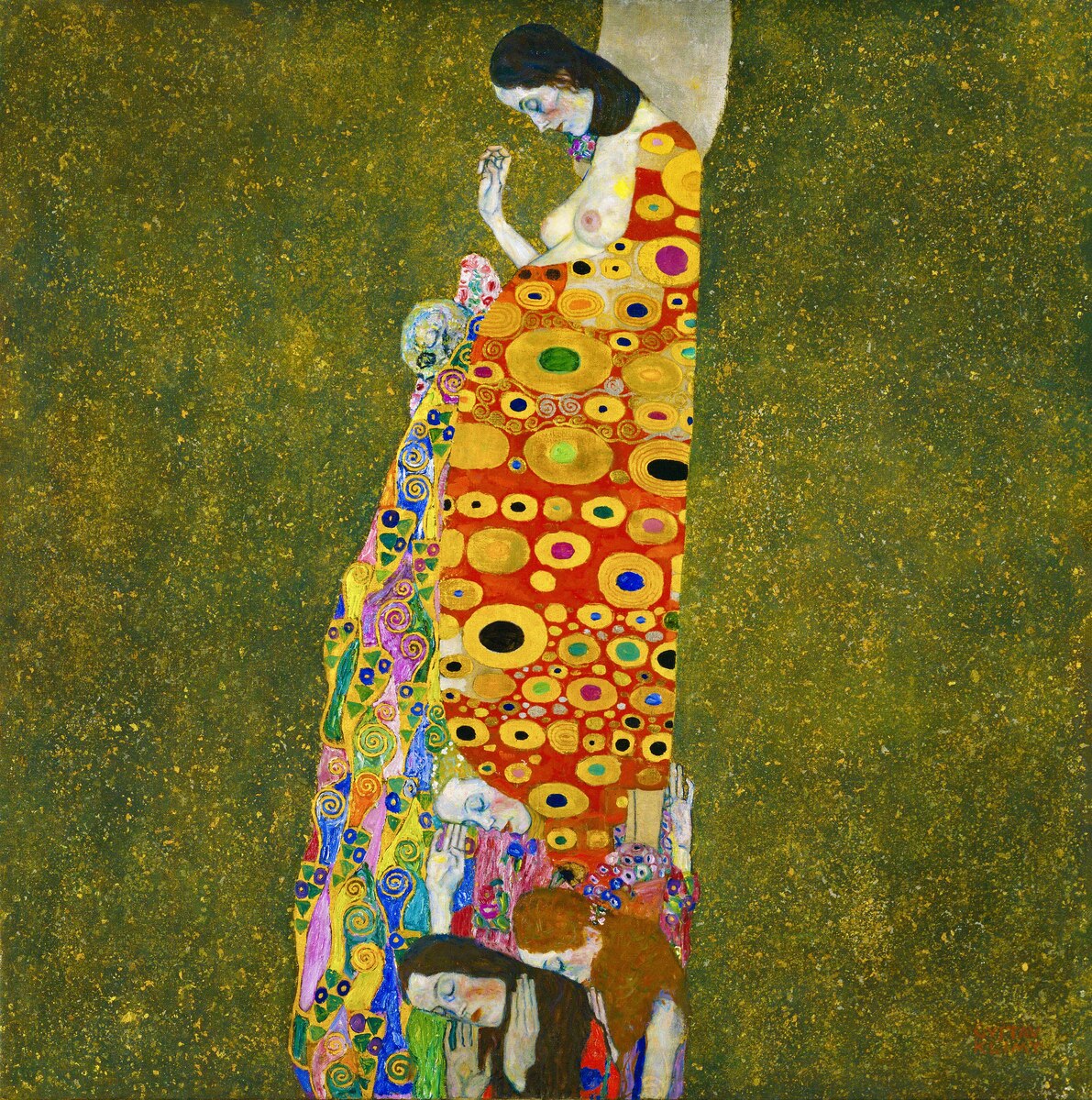
Gustav Klimt's The Kiss, painted between 1907 and 1908, shows two lovers locked in an embrace, their bodies wrapped in a shimmering gold cloak. In this spoken tour, a docent explains what the painting depicts, how its composition and materials shape the narrative, and how the accepted reading of the work rests on the limited evidence available.
At the lower right, the woman's pale bare foot emerges from the gold robe and rests against the flowering slope, with pendulum-like gold tendril lines falling beside it. It anchors her body and adds a note of exposed, vulnerable flesh against the ornament.
02
Carpet of flowers beneath the couple
A dense meadow of violet, blue, yellow and white blossoms forms the ground on which the couple kneels, turning the gilded void into a garden and giving the embrace its physical footing.
03
Woman's dress with round flower motifs
The right half of the gold cloak is the woman's dress, studded with concentric circles, eye-like rosettes and small flower clusters in red, blue and violet. It signals fertility, femininity and Klimt's decorative craftsmanship.
Your gallery guide
The Kiss by Gustav Klimt (1907-1908)
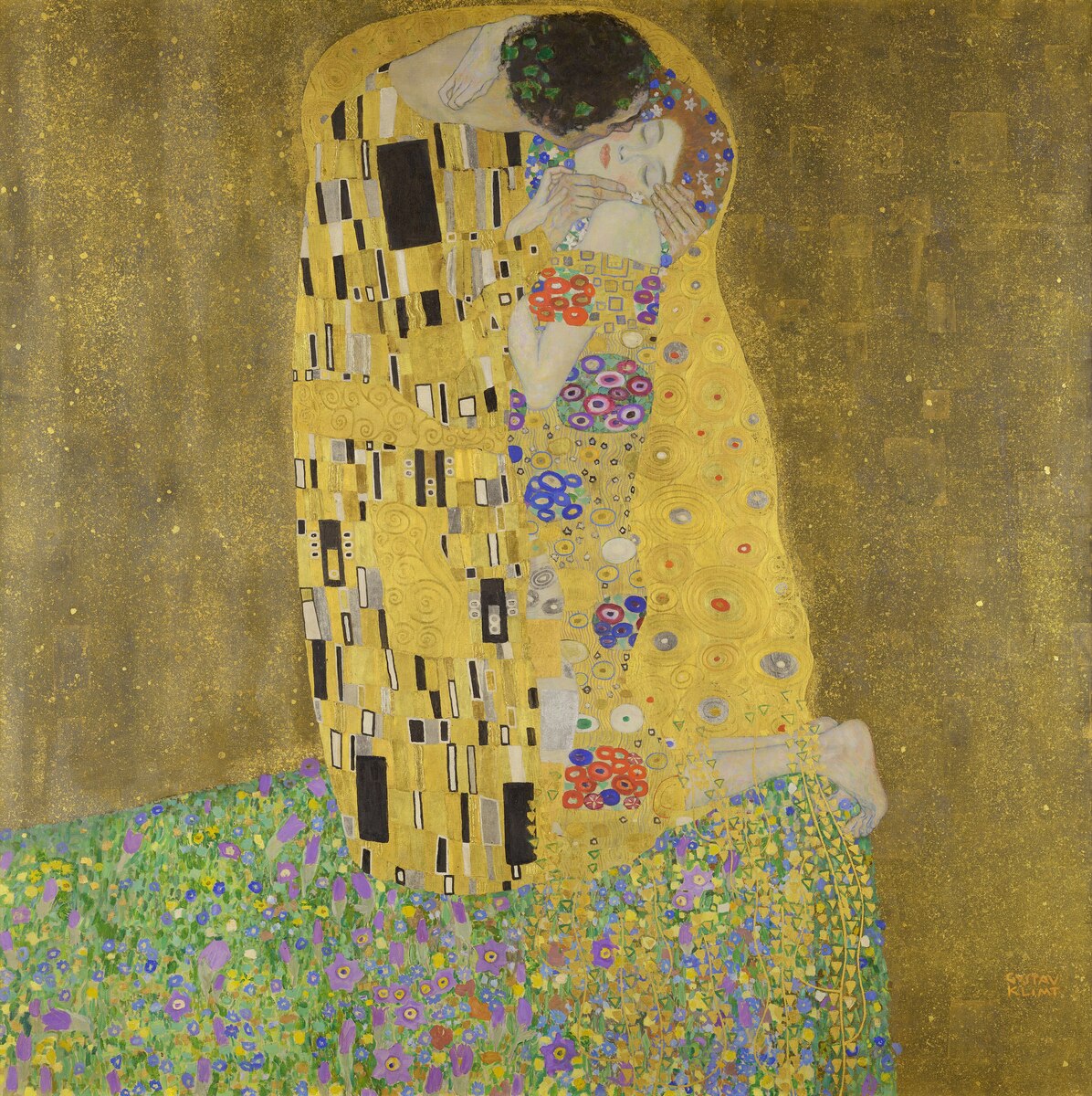
Gustav Klimt's The Kiss, painted between 1907 and 1908, shows two lovers locked in an embrace, their bodies wrapped in a shimmering gold cloak. In this spoken tour, a docent explains what the painting depicts, how its composition and materials shape the narrative, and how the accepted reading of the work rests on the limited evidence available.
Editorial review by Artifact Archive automated publishing
Gustav Klimt painted The Kiss between 1907 and 1908. The work is made of oil and gold leaf on canvas.
The painting shows a pair of lovers locked in an embrace. Their bodies are enveloped in a shimmering gold cloak, and their faces are pressed together in a kiss.
This is the subject you meet first: two people, one tender action, and the gold that surrounds them.
Step closer, and the gold cloak does more than decorate. It wraps the two figures into a single, glowing shape.
The man bends over the woman, and she tilts her head back to meet him. Their faces join at the centre of the canvas.
Because the gold covers so much of their bodies and clothes, the painting gives weight to the kiss itself rather than to individual details of dress.
Klimt made this painting in Vienna in the early twentieth century, and it belongs to the Vienna Secession and Symbolist currents of that time.
The work is now held in the collection of the Österreichische Galerie Belvedere in Vienna. That collection fact tells you where the painting lives today, not what the kiss meant to Klimt.
What the supplied record establishes is the embrace and its gold setting. It does not name the lovers as specific historical people.
The gold leaf is the painting's most distinctive material choice, and it changes how the kiss reads. Gold catches light and flattens the space, so the couple can feel both intimate and monumental.
That effect is visible in the canvas, but the reasons behind Klimt's choice are not settled by the supplied evidence. What we can say is that the gold binds the two figures visually and makes the embrace the dominant event.
The painting asks you to read the kiss as the centre of meaning, even as the gold keeps their bodies partly hidden.
The Kiss is about a single moment of contact. Two lovers meet, their faces touch, and a gold cloak holds them together.
Klimt's materials and composition make that moment feel both tender and grand without needing a story beyond the embrace. The painting leaves the private lives of the figures outside the frame and gives you the kiss itself.
The story and its sources
Editorial review by Artifact Archive automated publishing.
Historical claims are linked to the records below. Close looking and interpretation are identified in the passage notes.
Gustav Klimt was an Austrian symbolist painter (1862–1918). Their work is associated with Symbolism; Art Nouveau; Jugendstil. Their recorded places of work include Vienna; Brussels-Capital Region; Florence; Ravenna; Venice; London.
A pair of lovers locked in an embrace, their bodies enveloped in a shimmering gold cloak, their faces pressed together in a kiss.(Wikimedia Commons: The Kiss, 2015)
Title variants
Der Kuß; Liebespaar
Support
Canvas
Catalogue record
The work carries the title The Kiss and is attributed to Gustav Klimt, with a date of 1907 to 1908. The supplied record also gives its material composition as oil and gold leaf on canvas, and states that it is held in the collection of the Österreichische Galerie Belvedere in Vienna. These are the catalogue facts the record establishes: a named artist, a two-year span for the making of the picture, a mixed medium combining paint with applied gold, and a current holding institution.(Wikimedia Commons: The Kiss, 2015, Summary)
The date 1907 to 1908 belongs to the making of the painting, not to any later catalogue or publication event. The supplied unit for this section carries only the summary-level attribution, so the object date and the dating of any document about the object must be kept apart. The record supports the title, the painter, the date range, the medium and the collection, but it does not supply dimensions, inscriptions, accession numbers or recorded title variants, and none should be assumed from it.(Wikimedia Commons: The Kiss, 2015, Summary)
Materials and support
The medium named in the record, oil and gold leaf on canvas, is materially consequential rather than incidental. A painting that combines oil paint with applied gold leaf sits between two traditions: the easel picture and the gold-ground surface associated with earlier sacred and decorative work. The record establishes the combination as fact, and that combination is what makes the surface of The Kiss behave differently from a wholly painted canvas. What the record does not establish is which gold was used where, how it was applied, or whether the gold was laid by the artist's own hand or with studio assistance.(Wikimedia Commons: The Kiss, 2015, Summary)
Interpretation
Taken together, the title, the attribution to Klimt, the 1907 to 1908 date, the oil and gold leaf on canvas, and the Belvedere holding give the object a secure place in early twentieth-century Viennese painting. The interest of the catalogue entry lies precisely in that combination: a twentieth-century canvas that still relies on gold as a structural element of the image. Anyone working from this record should treat the medium and the date as the load-bearing facts, and treat the absence of dimensions, inscriptions and accession data as gaps in the supplied evidence rather than as characteristics of the object.(Wikimedia Commons: The Kiss, 2015, Summary)
The painting known as The Kiss, painted by Gustav Klimt between 1907 and 1908, depicts a lovers' embrace, according to the description supplied for the work. The same record establishes its materials as oil and gold leaf on canvas. This combination is central to how the picture reads: the painted passages and the applied gold together constitute the image, so any account of its visual effect has to reckon with both the oil medium and the metallic surface. The medium and the date are documented facts about the object; the identification of the subject as a lovers' embrace is likewise presented as the work's descriptive content rather than as an interpretation of a named narrative.(Wikimedia Commons: The Kiss, 2015, Description; Captions)
The painting is held in the collection of the Österreichische Galerie Belvedere in Vienna, a collection fact that locates the work institutionally today. That holding should not be confused with evidence about what the kiss meant to its maker, and the supplied record does not name the lovers as specific historical people. What the record does establish is the embrace and its gold setting, so identifications of the figures must be treated as outside the evidence rather than as documented content of the picture.(Wikimedia Commons: The Kiss, 2015, Description; Captions)
The material record for The Kiss is compact but consequential: the painting is executed in oil and gold leaf on canvas. That single documented medium statement, carried on the Wikimedia Commons file page that also supplies title, artist, date range, dimensions and collection, coordinates the object with the customary description of Gustav Klimt's work of 1907 to 1908 now held by the Österreichische Galerie Belvedere in Vienna. It matters that the medium is recorded as a combination rather than a single substance. Gold leaf is a material applied to a surface, while oil paint is a medium built up in layers. Describing the picture as oil and gold leaf on canvas therefore already asserts a layered construction, even though the supplied evidence does not specify the order of application, the nature of any ground or preparation, the tools used, or whether the gold was laid in discrete areas or broadly across the field.(Wikimedia Commons: The Kiss, 2015, Captions)
Visual observation
The distinction between what has been documented and what can be seen is central to any account of this picture. The medium statement is a documented fact attached to the file record. The description of the subject, that the painting depicts a lovers' embrace, is classified in the supplied material as an observation rather than as a technical finding. Nothing in the evidence units reports a conservator's examination, a pigment analysis, a canvas thread count, an infrared or X-radiographic image, or a condition report. Claims about how the gold behaves optically, how it catches light, or how it flattens space rest on visual inference from the completed surface, not on laboratory study of its materials.(Wikimedia Commons: The Kiss, 2015, Description; Captions)
What the evidence does establish about the gold is its extent and its visual consequence rather than its chemistry or its method of application. The gold covers so much of the two figures' bodies and clothes that the account of the subject treats the couple as enveloped in a shimmering gold cloak. Because the gold occupies that much of the picture surface, the embrace and the contact of the faces read as the dominant event of the composition, and details of dress are subordinated to the metallic field around them. This is a statement about the picture as it now appears, derived from the descriptive record, and it should not be converted into a claim about Klimt's intention or about the sequence in which paint and leaf were laid down.(Wikimedia Commons: The Kiss, 2015, Description; Captions)
Material and Compositional Effect
Interpretation
Reading the recorded medium alongside the recorded subject suggests why the choice of oil with gold leaf carries more weight here than a medium line usually does. The two materials behave differently at the surface: oil paint can carry the modelling of the faces and the varied patterning of the garments, while the gold leaf introduces a material that belongs to the same decorative register as the surrounding ornament. The result within the account is that the two figures are bound visually into a single shape rather than separated into distinct bodies, and the kiss rather than the sitters' identities becomes the centre of meaning. The painting is described as leaving the private lives of the figures outside the frame, and the supplied record does not name the lovers as specific historical people. This synthesis treats the medium as an agent in the composition, while keeping it distinct from any undocumented claim about Klimt's reasons for choosing gold.(Wikimedia Commons: The Kiss, 2015, Captions; Description)
Visual observation
The description of the embrace, with the man bending over the woman and her head tilting back so that the faces join at the centre of the canvas, provides the compositional counterpart to the material account. The gold does not simply surround the figures; it wraps them so that they form one glowing shape, and the point at which the faces meet is also the point around which the gold mass is organised. Read together with the medium statement, the evidence supports a description of a picture in which support, paint and applied metal are coordinated toward a single visual event, without any of the supplied units specifying the number of gold layers, the use of any adhesive or bole, or the tools employed in laying the leaf.(Wikimedia Commons: The Kiss, 2015, Description; Captions)
The Kiss is held in the collection of the Österreichische Galerie Belvedere in Vienna. The same record identifies the work as a painting by Gustav Klimt titled The Kiss, executed between 1907 and 1908, and made of oil and gold leaf on canvas; it describes the painting's subject as a lovers' embrace. These are the collection, attribution, dating and medium facts that the supplied record establishes for the object, and they place it today in a public Viennese museum rather than in the private or commercial setting in which it was made.(Wikimedia Commons: The Kiss, 2015, Collection)
The record for this painting begins with a descriptive identification supplied by the Wikimedia Commons file page: Gustav Klimt's The Kiss (Der Kuss), dated 1907-1908, executed in oil and gold leaf on canvas at a scale of 180 by 180 cm, and held by the Österreichische Galerie Belvedere in Vienna. These are the coordinates the source fixes for the work, and they do more than label it. The square format is unusual for a narrative easel painting of this period, and it gives the gold field no dominant horizontal or vertical axis; the embracing figures occupy a nearly equal-sided plane. The medium statement names two distinct materials, oil paint and gold leaf, which means the surface is not a single continuous technique but a layered construction in which applied metal and painted pigment are meant to be read together. The attribution to Klimt, the date span, the dimensions and the collecting institution are the facts the source supports, and the vaulting claims about meaning or biography are not among them.(Wikimedia Commons: The Kiss, 2015)
What the valuation is and is not
The same source records the subject as a lovers' embrace, and the working insurance calculation built from these excerpts treats that embrace, along with the confirmed attribution, date, medium, scale, institutional collection status and prominence, as the validated context for the work. It is worth separating what that calculation actually does from what it might appear to do. The calculation states an estimated insurance range of US$250M to US$500M, generated as a working figure on 2026-10-16 for manual review only. Its methodology applies conservative tiered factors for a securely held, publicly displayed museum masterpiece by a canonical artist. The range is deliberately broad because, as the calculation itself records, no public appraisal, auction result, sale price or comparable transaction is cited in the supplied excerpts. The text explicitly directs refinement by a qualified fine-art insurance specialist with access to the institution's official schedules and current market evidence, and qualifies that the range is model-generated, is not an official insurance value, appraisal, auction result or sale price, does not represent the collection's records or any private insurance schedule, and depends on institutional policy, coverage terms, condition, provenance and specialist appraisal data. Treating that figure as a market fact would reverse its stated status.(Wikimedia Commons: The Kiss, 2015)
Institutional value and its limits
Read together, the source material and the calculation expose a gap that is itself historically informative. The Belvedere's holding is described as a securely held, publicly displayed museum masterpiece, and the dollar range is an inference drawn from exactly that status rather than from any transaction involving the painting. The value attributed to the work in this record is therefore institutional and canonical rather than transactional: it rests on the painting's place in a public collection, its confirmed attribution and date, its medium and its prominence. The calculation also lists condition and provenance among the factors that would determine an actual insurance value, yet the supplied excerpts establish neither. Nothing in the evidence documents the painting's condition history or its route into the Belvedere's collection. Those absences are not minor omissions to be smoothed over; they mark precisely the limits of what this archive can presently assert about the object's material state and collecting history.(Wikimedia Commons: The Kiss, 2015)
Working estimate
Calculated working insurance estimate, not a sale price: Estimated insurance range: US$250M to US$500M Recorded date: Working calculation, generated 2026-10-16. Methodology: Broad working insurance range calculated for manual review only. The supplied excerpts confirm the artwork as Gustav Klimt's The Kiss (Der Kuss, 1907-1908), oil and gold leaf on canvas, 180 by 180 cm, held by the Osterreichische Galerie Belvedere in Vienna. The calculation applies conservative tiered factors for a securely held, publicly displayed museum masterpiece by a canonical artist, using confirmed attribution, date, medium, scale, institutional collection status, and prominence as context. No public appraisal, auction result, sale price, or comparable transaction is cited in the supplied excerpts, so the range is intentionally broad and low-confidence. It should be refined by a qualified fine-art insurance specialist with access to the institution's official schedules and current market evidence. Qualification: This is a model-generated working range for manual review only. It is not an official insurance value, appraisal, auction result, or sale price. It does not represent the collection's records, any private insurance schedule, or any confirmed market transaction. Actual insurance values depend on institutional policy, coverage terms, condition, provenance, and current specialist appraisal data. Verify all figures with qualified professionals before use.(Wikimedia Commons: The Kiss, 2015)
Further reading
Books for a closer look
Paid links. As an Amazon Associate I earn from qualifying purchases.
Recorded as Gustav Klimt. Complete Paintings by Tobias G. Natter, with subjects including Catalogues raisonnés, Criticism and interpretation, and Painting, Austrian. A complete paintings catalogue raisonné is the type of object-specific reference likely to document individual Klimt paintings such as The Kiss. Listed subject terms support direct relevance to the named artwork, though the record does not confirm a specific entry.
Recorded as Gustav Klimt, a catalog/exhibition publication (subjects: Expositions, Catalogues d'exposition, Catalogs, Art, Austrian, Erotic drawing, Women in art). Exhibition catalogues on Klimt often treat major paintings and their reception, making this a plausible art-historical reference for The Kiss, without asserting specific contents.
Recorded as Gustav Klimt by Alessandra Comini, with subjects including Erotic art, Women in art, Catalogs, and Criticism and interpretation. Comini is a known Klimt scholar, and the listed subjects align with themes central to The Kiss, supporting academic comparison and interpretation.
Recorded as Gustav Klimt, a catalog/exhibition publication (subjects: Expositions, Catalogues d'exposition, Catalogs, Art, Austrian, Erotic drawing, Women in art). Exhibition catalogues on Klimt often treat major paintings and their reception, making this a plausible art-historical reference for The Kiss, without asserting specific contents.
Recorded as Gustav Klimt by Alessandra Comini, with subjects including Erotic art, Women in art, Catalogs, and Criticism and interpretation. Comini is a known Klimt scholar, and the listed subjects align with themes central to The Kiss, supporting academic comparison and interpretation.
Recorded as Gustav Klimt. Complete Paintings by Tobias G. Natter, with subjects including Catalogues raisonnés, Criticism and interpretation, and Painting, Austrian. A complete paintings catalogue raisonné is the type of object-specific reference likely to document individual Klimt paintings such as The Kiss. Listed subject terms support direct relevance to the named artwork, though the record does not confirm a specific entry.
Fit and fill keep the painting’s proportions. Stretch changes them.
Move and zoom the painting on your biodegradable phone case.
Preparing the artwork for your edition…
Made to order
From the archive
36.6 cm / 14.4 in30.7 cm / 12.1 in
36.6 × 30.7 cm / 14.4 × 12.1 in · Standard
Drag to rotate
36.6 × 30.7 cm / 14.4 × 12.1 in · Standard
14.4 in / 36.6 cm12.1 in / 30.7 cm
14.4 × 12.1 in / 36.6 × 30.7 cm · Standard
14.4 in / 36.6 cm12.1 in / 30.7 cm
14.4 × 12.1 in / 36.6 × 30.7 cm · Standard
14.4 in / 36.6 cm12.1 in / 30.7 cm
14.4 × 12.1 in / 36.6 × 30.7 cm · Standard
Drag to rotate1 / 3
Desk mat
GBP 15.20
Delivery GBP 5.46 / Total GBP 20.66
A smooth polyester desk mat with a natural rubber non-slip base and anti-fray edges, available in three sizes.
Fit and fill keep the painting’s proportions. Stretch changes them.
Move and zoom the painting on your desk mat.
Preparing the artwork for your edition…
Made to order
The 30 cm ruler is scaled alongside your selected print. Keep the painting’s proportions with a black background, or stretch it to fill. Frame width, material texture and screen colours are illustrative.
Advertising supports the archive. These preferences control aggregate page counting, reading activity and ad-delivery diagnostics. They use no visitor tracking cookie.