Official
Institutional record for The Hay Wain. Institutional record for The Hay Wain on Wikimedia Commons.
Image and structured data record; used only as a discovery aid. No unique curatorial interpretation supplied.
- Language
- en
Artwork record / 285 of 331
Artist: John Constable
A gallery tour of Constable's The Hay Wain, explaining what is happening in the scene, how the picture was built from sketches, and why its reception in France matters.
Read the story ↓ About the artist ↓ Research and record ↓ Literature and sources ↓ Listen to the article ↓Your browser could not copy automatically. Select the research text below, then copy it.
Open the complete research text
The highest-resolution file we hold, available without payment or an account.3,840 × 2,648 pixels.
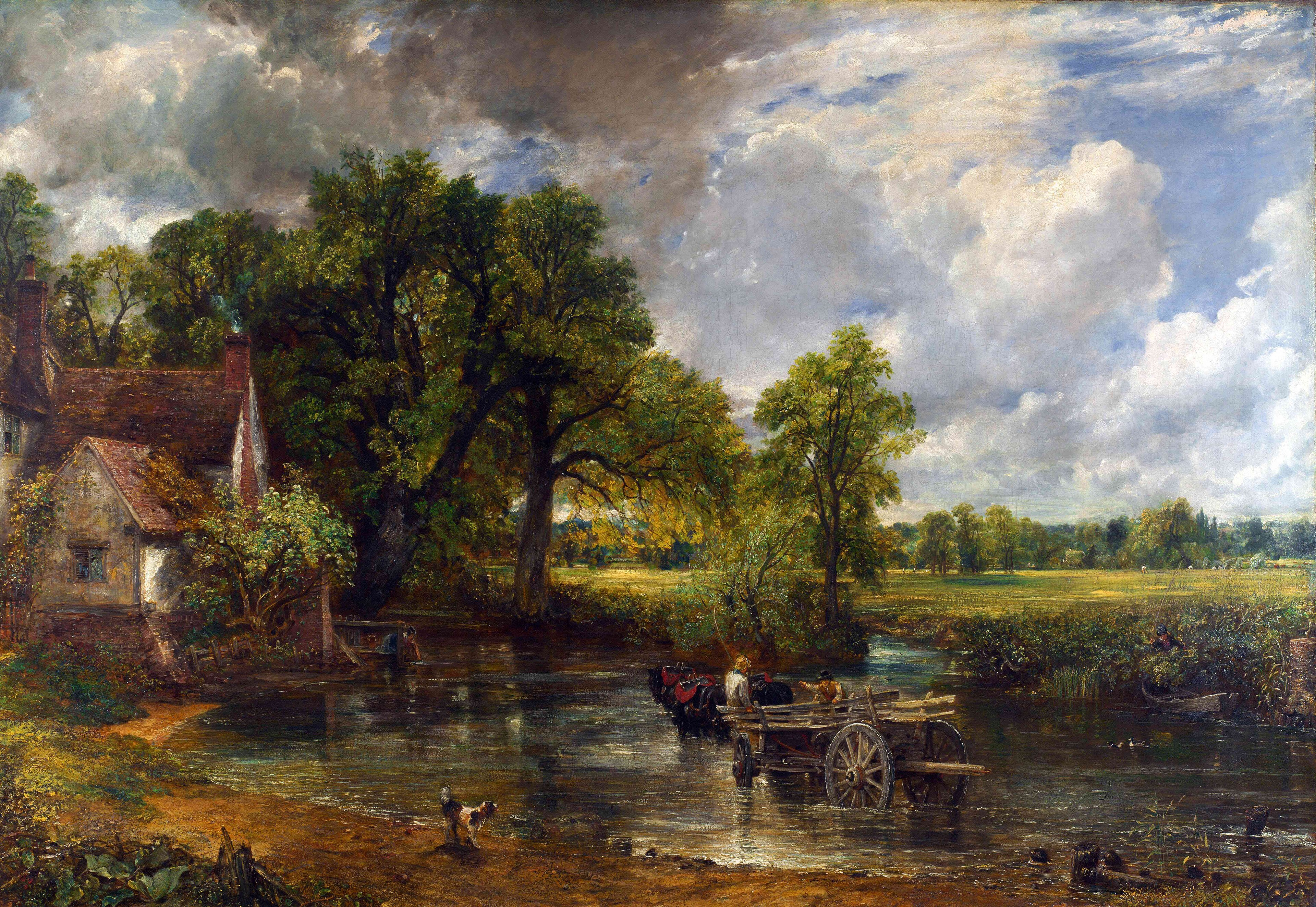
Download highest-resolution imageThe brightly lit fields and tree line on the right bank with tiny figures working in the hay, the still background that sets off the dark water and shadowed trees of the foreground.
The white and dark sheepdog standing on the muddy near bank, alert and turned toward the wagon, the one animated foreground animal detail that gives the scene its sense of paused activity.
The two small figures riding the cart, one in pale clothing gesturing forward and one darker seated companion, the only human presence in the foreground and the point where the wagon's movement is directed.
Your gallery guide
A gallery tour of Constable's The Hay Wain, explaining what is happening in the scene, how the picture was built from sketches, and why its reception in France matters.
Editorial review by Artifact Archive automated publishing
Explore the researchThe story About 6 minutes to read
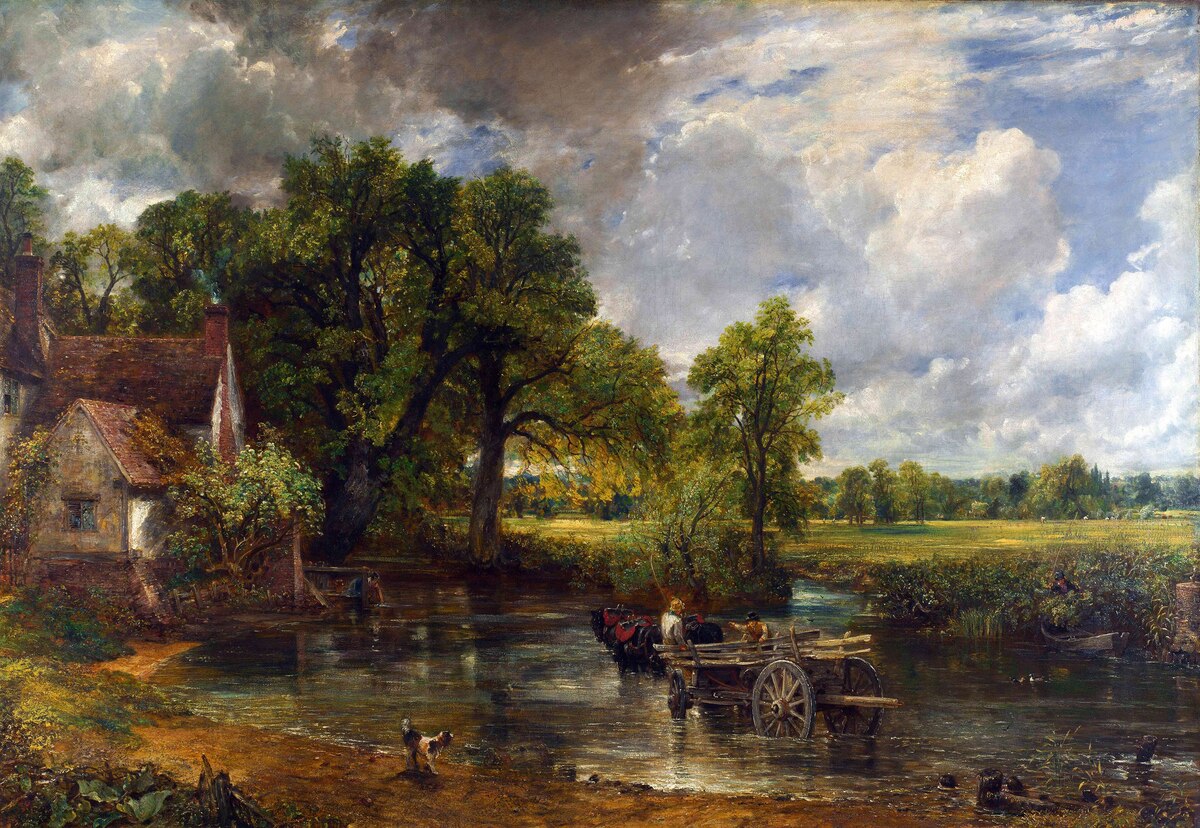
Stand before a wide canvas showing a shallow millpond on the River Stour at Flatford. An empty wooden hay wagon, drawn by three black horses, crosses the water. Beyond the pond, haymakers are gathering dried meadow grass in the field. This is a working day in the Suffolk countryside, not a portrait of a place at rest. The painting was made by John Constable and shown at the Royal Academy in 1821 under the title Landscape: Noon. The familiar name, The Hay Wain, came later, from his friend Archdeacon Fisher.
Look at how the pond divides the scene. The house and the wagon frame the left and centre of the picture, while a small empty boat rests at the right. The boat was based on a study Constable made in 1809, and it helps balance the house on one side and the wagon in the middle. The wagon itself was developed through a small oil sketch around 1820 and a full-size preparatory sketch.
A woman stoops at the water's edge outside the house, with a pitcher beside her. Her pose repeats a figure Constable had used in three small oil sketches of the house from 1811. The building on the left was occupied by tenant farmer Willy Lott in Constable's time, and it still survives. The thick red fringes on the horses' collars add a bright note against the greens and greys.
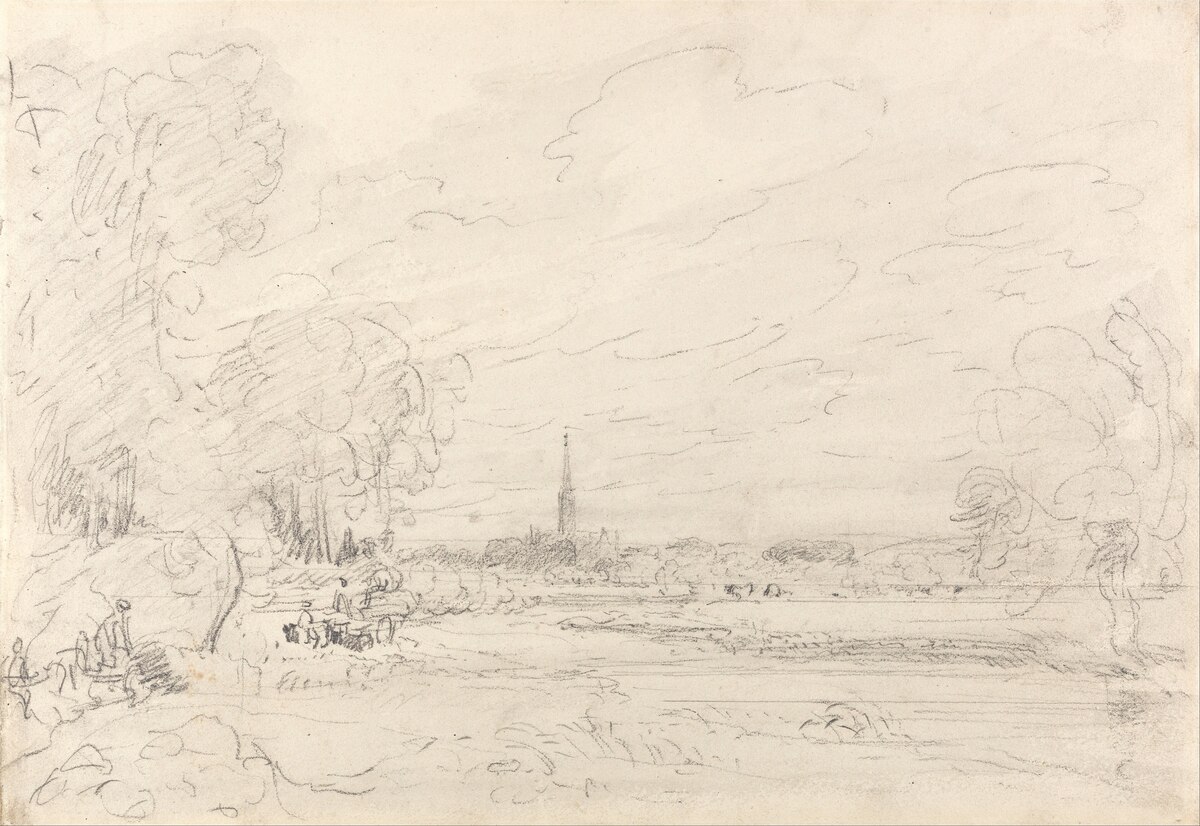
Constable painted The Hay Wain in his London studio. He worked from open-air sketches made over several years at Flatford, then from a full-size preparatory oil sketch before the final picture. The horses and wagon, the woman and the boat are all assembled into one scene, a remembered Suffolk day composed for exhibition.
The Hay Wain belongs to a group of six-foot exhibition canvases Constable made between 1819 and 1825. Tate describes his decision to paint at that scale as a turning point in his career. The size helped him draw notice at the Royal Academy exhibitions and let him treat landscape with the ambition usually reserved for classical painting.
Scenes of a cart crossing a ford go back to seventeenth-century Flemish and Dutch landscape painting, which Constable admired for showing nature directly rather than in a classicising style. He generally did not copy other artists, preferring to work from observation of nature. Yet the wagon here is unusual: its low sides suit timber more than hay. It closely resembles Rubens's chalk study of a hay cart for Return from the Harvest, a comparison the National Gallery notes.
The National Gallery suggests Constable's determination to capture the Suffolk landscape of his boyhood was likely shaped by a sense that this way of life was changing. Industrialisation was transforming Britain. Factories, steam power and locomotives appear in work by painters such as Turner, but they are absent from Constable's scenes. Whether or not he meant it as nostalgia, the picture shows a working rural world held in view rather than a document of industrial change.
The painting did not sell in Britain. Constable reluctantly sold it to a French art dealer, who exhibited it in Paris. There it caused a sensation, won Constable a gold medal from the French king, and encouraged a new generation of French artists to paint directly from nature. A picture rooted in Suffolk helped shape landscape painting far beyond England.
The Hay Wain is not a snapshot of a single moment. It is a composed memory of a working landscape, built from studies and adjusted on a large scale for exhibition. The empty wagon crossing the water carries the day's work forward, while the figures and buildings hold the place steady. What stays with you is a rural world observed closely and arranged deliberately.
Editorial review by Artifact Archive automated publishing.
Historical claims are linked to the records below. Close looking and interpretation are identified in the passage notes.
Stephencdickson. Image source · CC BY-SA 4.0
About the artist
1776 to 1837
John Constable was an English painter (1776-1837). Their work is associated with realism; Romanticism. Their recorded places of work include London; Dedham; Hampton; Lavenham.
The research & record
Find catalogue details, historical context, technical research and the literature behind this artwork.
Your browser could not copy automatically. Select the research text below, then copy it.
Open the complete research textThe artwork record
Catalogue information and detailed research, with references that link to the bibliography.
Updated .
The National Gallery, London records that its painting of The Hay Wain is signed and dated, though the museum's entry title joins that object-level documentation to a name the artist himself did not use. Constable exhibited the picture at the Royal Academy in 1821 as Landscape: Noon, and the familiar title by which it is now universally known was a nickname given by his friend Archdeacon Fisher. The gap between the two titles is worth holding onto: the museum's catalogue entry, the exhibition title of 1821, and the later nickname are three distinct names attached to one canvas, and the accession history adds a fourth layer of identity, since the National Gallery acquired the painting in 1886 as a gift from Henry Vaughan. That sequence, from an 1821 Royal Academy submission titled Landscape: Noon to an 1886 public gift under the title The Hay Wain, means the object's recorded identity is inseparable from the vocabulary of its later owners and audiences.(The National Gallery, London, n.d., Details)
Interpretation
Read as a whole, the evidence supports a picture of the object as a composed exhibition machine rather than a documentary record of one place and moment. The subject is documented as the Flatford millpond with a wain and haymakers; the making is documented as studio work from open-air sketches made over several years, mediated by at least one small sketch of the wagon around 1820 and a full-size oil sketch with changes carried into the final canvas; the motifs are documented as borrowings and repetitions from as early as 1809 and 1811; and the vehicle at the centre of the composition is documented as a form poorly suited to its depicted task and close to a Rubens chalk study. The painting's significance in a larger history of material culture rests on that combination: a landscape treated at the scale and ambition usually reserved for classical painting, prepared through a large sketch practice its own curators call unprecedented, and received abroad with a force that its British sale did not produce at the time.(The National Gallery, London, n.d., Overview; Details)(Tate, 2006)
The painting is signed and dated.(The National Gallery, London, n.d.)
Visual observation
The National Gallery's description of the picture records a shallow millpond on the River Stour at Flatford, with an empty wooden hay wagon, or wain, drawn through the water by three black horses. The wagon is shown heading across the water toward the meadow on the far side, where haymakers are at work gathering cut and dried meadow grass. The Gallery's in-depth entry also notes a detail of colour within this largely green and grey scene: the thick red fringes decorating the horses' leather collars, which add a bright note against the surrounding tones. Taken together, these observations establish the subject as a working day in the Suffolk countryside rather than a place at rest: the empty wagon is in transit, and the labour of the hay harvest continues beyond the water.(The National Gallery, London, n.d., Overview; Audio description; Overview; In-depth)
Interpretation
The Gallery's account places the picture's subject within a larger change in the landscape of Constable's boyhood, suggesting that his determination to capture the rural Suffolk landscape in these monumental paintings was likely due in part to a sense that this way of life was changing because of rapid industrialisation. The same account observes that factories, steam power and locomotives appear in works by his contemporaries such as Turner but are absent from Constable's paintings. The Gallery's wording marks this as a likely motive rather than a documented statement by the artist, and the absence of industrial subjects is itself a fact about the pictures rather than a claim about his intentions. Within this evidence, the picture shows a working rural world held in view while the signs of industrial change that appear in the work of other painters are excluded from its frame.(The National Gallery, London, n.d., Overview; Audio description; Overview)
Visual observation
The painting depicts the millpond at Flatford on the River Stour, with an empty wooden hay wagon (wain) being drawn through shallow water by three black horses.(The National Gallery, London, n.d.)
The wagon is heading across the water to the meadow on the other side, where haymakers are at work gathering cut and dried meadow grass.(The National Gallery, London, n.d.)
The thick red fringes decorating the horses' leather collars add a bright note of colour.(The National Gallery, London, n.d.)
Visual observation
The picture now universally known as The Hay Wain depicts the millpond at Flatford on the River Stour, with an empty wooden hay wagon drawn through shallow water by three black horses; the wagon heads across the water toward the meadow on the other side, where haymakers are at work gathering cut and dried meadow grass. The house on the left was occupied in Constable's time by tenant farmer Willy Lott and still survives, anchoring the scene in a documented working farmstead rather than an invented rustic setting. The thick red fringes decorating the horses' leather collars add a bright note of colour within the predominantly green and grey tonality, and the small empty boat on the right balances the house on the left against the wagon in the centre.(The National Gallery, London, n.d., Overview; Audio description; Overview; In-depth)
Interpretation
The object belongs to a defined group: it was one of six large six-footer canvases Constable painted between 1819 and 1825, all exhibited at the Royal Academy, and the third of the Stour series shown between 1819 and 1825. Constable's decision to begin painting six-foot landscapes around 1818 to 1819 marks a significant turning point in his career; he was determined to work on a larger scale both to attract more notice at the Royal Academy exhibitions and to project his ideas about landscape on a scale more in keeping with classical landscape painting. His own words to John Fisher in 1821 make the ambition explicit: he wrote that he did not consider himself at work without he was before a six-foot canvas. The six-footers are now among the best-known images in British art and comprise the famous series of views on the river Stour, including The Hay Wain of 1820 to 1821, as well as later works such as Hadleigh Castle of 1829 and Salisbury Cathedral from the Meadows of 1831.(Tate, 2006)
The canvas was made in the artist's London studio, working from a number of open-air sketches made over several years, then a full-size preparatory oil sketch before the final picture; it is signed and dated. Scenes of a cart going through a ford recur in seventeenth-century Flemish and Dutch landscape paintings, which Constable admired for their depiction of natural rather than classicising landscape. Yet Constable did not generally copy other artists directly, preferring to pursue a way of painting founded on original observation of nature, so the recurrence of the motif registers a tradition he valued rather than an act of transcription. This distinction matters for how the object is described: the National Gallery notes that the wagon does not conform to the usual design of hay wagons of Constable's period, since its sides are too low for carting hay and it appears more suited to carrying timber, and that it closely resembles Rubens's chalk study of a hay cart for Return from the Harvest. That comparison is an attributed observation and a point of formal resemblance, not a documented statement of Constable's source or intent, and the wagon's apparent unsuitability for hay should be weighed alongside the picture's conventional title and subject rather than substituted for them.(The National Gallery, London, n.d., In-depth)
The house on the left was occupied by tenant farmer Willy Lott in Constable's time and still survives.(The National Gallery, London, n.d.)
Scenes of a cart going through a ford recur in seventeenth-century Flemish and Dutch landscape paintings, which Constable admired for their depiction of natural rather than classicising landscape.(The National Gallery, London, n.d.)
Constable did not generally copy other artists directly, preferring to pursue a way of painting 'founded on original observation of nature'.(The National Gallery, London, n.d.)
Constable wrote to John Fisher in 1821: 'I do not consider myself at work without I am before a six-foot canvas'.(Tate, 2006)
The six-footers are among the best-known images in British art and comprise the famous series of views on the river Stour, which includes The Hay Wain (1820–1), as well as later works such as Hadleigh Castle (1829) and Salisbury Cathedral from the Meadows (1831).(Tate, 2006)
Visual observation
Constable did not paint The Hay Wain directly from the motif. The picture was made in the artist's studio in London, working from a number of open-air sketches made over several years, and then from a full-size preparatory oil sketch before the final canvas. This sequence matters for how the surface is read: the finished picture is a studio construction that draws on outdoor observation rather than a single plein-air session. The canvas supports a view of the millpond at Flatford on the River Stour, in which an empty wooden hay wagon (wain) is drawn through shallow water by three black horses, heading across the water toward a meadow where haymakers gather cut and dried grass. The preparatory chain documented for the wagon itself is more specific still: Constable made a small preliminary oil sketch of the hay wagon around 1820, followed by a full-scale oil sketch to develop the composition. In that full-scale sketch the horse and rider in the foreground were kept, but they were later painted out of the final picture. The final canvas therefore records a decision made between stages, not simply a transcription of the first idea. The thick red fringes decorating the horses' leather collars remain in the finished work, adding a bright note of colour against the surrounding greens and greys.(The National Gallery, London, n.d., Overview; In-depth; Overview; Audio description)
Not every element in the composition was developed for this canvas alone. The small empty boat on the right is based on a study Constable made in 1809. That study had already been used in The White Horse of 1819 and was later reused again in Salisbury Cathedral from the Meadows of 1831. Within The Hay Wain the boat functions compositionally as a balance to the house on the left and the wagon in the centre. The figure of the woman is likewise carried over from earlier work: a woman stooping over the water from the step outside Willy Lott's house, with a pitcher beside her, appears in the same pose and position as in three small oil sketches Constable made of the house in 1811. Read together with the wagon's preparatory sketches, these repetitions show a working method that assembled motifs from a stock of studies made over years, recombining them into a single exhibition scene. The house at the left, occupied by tenant farmer Willy Lott in Constable's time, still survives.(The National Gallery, London, n.d., In-depth)
Interpretation
The Hay Wain was one of six large six-footer canvases Constable painted between 1819 and 1825, exhibited at the Royal Academy, and the third of the Stour series shown between 1819 and 1825. As important as the six-footers themselves was his decision to paint related full-scale preliminary sketches for most of them. Those large sketches, with their free and vigorous brushwork, were unprecedented at the time. The evidence for this practice is curatorial and art-historical rather than technical analysis of the pigments or ground layers of the finished picture, and the two categories of claim should be kept distinct. What the documentation establishes is the existence and function of large-scale preparatory sketches, and the placement of this canvas within the six-footer group; it does not establish the specific materials, medium or layer structure of the final paint film, which the supplied evidence does not describe. The preparatory sketch for this composition is the documented instance of that broader practice, and the painting out of the horse and rider is the documented consequence of working through a full-scale sketch before committing to the final picture.(Tate, 2006)(The National Gallery, London, n.d., Overview)
A woman stooping over the water from the step outside Willy Lott's house with a pitcher beside her appears in the same pose and position as in three small oil sketches Constable made of the house in 1811.(The National Gallery, London, n.d.)
Constable made a small preliminary oil sketch of the hay wagon around 1820, followed by a full-scale oil sketch to develop the composition, in which the horse and rider in the foreground were kept but later painted out of the final picture.(The National Gallery, London, n.d.)
The small empty boat on the right is based on a study Constable made in 1809, already used in The White Horse (1819) and later reused in Salisbury Cathedral from the Meadows (1831); it balances the house on the left and the wagon in the centre.(The National Gallery, London, n.d.)
The painting was created in the artist's studio in London, working from a number of open-air sketches made over several years, then a full-size preparatory oil sketch before the final picture.(The National Gallery, London, n.d.)
As important as the six-footers themselves was Constable's decision to paint related full-scale preliminary sketches for most of them. These large sketches, with their free and vigorous brushwork, were unprecedented at the time.(Tate, 2006)
The first recorded change of hands followed a failure in the domestic market. The painting did not sell in Britain, and Constable reluctantly sold it to a French art dealer, who exhibited it in Paris. According to the account, its Paris showing caused a sensation, won Constable a gold medal from the French king, and inspired a new generation of French artists to paint directly from nature. In this trajectory an unsold British exhibition canvas becomes the vehicle of Constable's continental reputation. The sources supplied here do not name the dealer, give the year of the sale, or record any intervening owner between that French dealer and the picture's later arrival in London, so the sequence from Paris to the National Gallery remains an unrecorded interval rather than a documented chain of transfers, and the sale itself is best described at the level of detail the evidence supports: a reluctant sale to an unnamed French dealer who exhibited it in Paris.(The National Gallery, London, n.d., In-depth)
The acquisition that brings the picture into a public collection is documented with a date and a named donor. The painting was acquired by the National Gallery, London, in 1886 as a gift from Henry Vaughan. This establishes the terminus of the provenance as the source records it: a gift rather than a purchase, and a benefactor rather than a vendor. The same museum record also notes that the painting is signed and dated, a feature of the object itself rather than of its ownership history, but one that matters to provenance because the signature and date anchor the attribution of the canvas that passed through these hands.(The National Gallery, London, n.d., Details)
Interpretation
Read against the picture's early British reception, the sale to France looks less like a rejection of an obscure work than the redirection of a painting already argued over at home. The Examiner declared that the picture 'approaches nearer to the actual look of rural nature than any modern landscape whatever', language that frames it as a claim about truth to nature rather than about price or patronage. The evidentiary record supplied here supports the exhibition, the critical notice, the failure to sell in Britain, the sale to a French dealer, and the Paris exhibition, but it does not establish Constable's private motives for selling, nor any price, nor the mechanism by which the work left the dealer's hands. Where the account says he sold reluctantly, that is the reported character of the transaction and should be cited as such rather than treated as a documented emotional fact.(The National Gallery, London, n.d., In-depth)
The painting did not sell in Britain, so Constable reluctantly sold it to a French art dealer who exhibited it in Paris, where it caused a sensation, won Constable a gold medal from the French king, and inspired a new generation of French artists to paint directly from nature.(The National Gallery, London, n.d.)
The painting was acquired by the National Gallery, London, in 1886 as a gift from Henry Vaughan.(The National Gallery, London, n.d.)
Constable paints six large six-footer canvases, exhibited at the Royal Academy, with The Hay Wain as the third of the Stour series shown in this period.(The National Gallery, London, n.d., In-depth)(Tate, 2006)
Constable writes to John Fisher that he does not consider himself at work without being before a six-foot canvas.(Tate, 2006)
The painting is acquired by the National Gallery, London, as a gift from Henry Vaughan.(The National Gallery, London, n.d., Details)
The exhibition Constable: The Great Landscapes at Tate Britain offers the first opportunity to view the six-foot exhibition canvases together.(Tate, 2006)
The display history of The Hay Wain began well before the picture acquired its familiar name. Constable exhibited it at the Royal Academy in 1821 under the title Landscape: Noon; the title The Hay Wain was not his own but a nickname given by his friend Archdeacon Fisher. Contemporary press reception is recorded in The Examiner, which declared that the painting approaches nearer to the actual look of rural nature than any modern landscape whatever. The work belongs within a deliberate exhibition strategy rather than standing alone: it was one of six large six-footer canvases Constable painted between 1819 and 1825 and exhibited at the Royal Academy, and it was the third of the Stour series shown between 1819 and 1825.(The National Gallery, London, n.d., In-depth)(Tate, 2006)
The scale of these canvases was itself a programmatic decision. Constable wrote to John Fisher in 1821 that he did not consider himself at work without he was before a six-foot canvas. His decision to start painting six-foot landscapes around 1818 to 1819 marks a significant turning point in his career. He was determined to paint on a larger scale both to attract more notice at the Royal Academy exhibitions and to project his ideas about landscape on a scale more in keeping with classical landscape painting. As important as the six-footers themselves, according to Tate, was his decision to paint related full-scale preliminary sketches for most of them; these large sketches, with their free and vigorous brushwork, were unprecedented at the time. For The Hay Wain specifically, Constable worked in his studio in London, developing the composition through a small preliminary oil sketch around 1820, then a full-scale oil sketch, before the final picture.(The National Gallery, London, n.d., In-depth)(Tate, 2006)
The 2006 exhibition Constable: The Great Landscapes at Tate Britain, held 1 June to 28 August 2006, offered the first opportunity to view the six-foot exhibition canvases together; not even in the artist's lifetime were they ever brought together. This claim concerns exhibition history, not the present display of the picture. It establishes a distinction the evidence leaves open elsewhere: what the 2006 hang made visible as a group is a modern curatorial act, whereas the six-footers were originally encountered individually within the Royal Academy exhibitions for which they were made.(Tate, 2006)
The Hay Wain was one of six large 'six-footer' canvases painted by Constable between 1819 and 1825, exhibited at the Royal Academy, and the third of the Stour series shown between 1819 and 1825.(The National Gallery, London, n.d.)(Tate, 2006)
The exhibition 'Constable: The Great Landscapes' at Tate Britain (1 June – 28 August 2006) offered the first opportunity to view the six-foot exhibition canvases together; not even in the artist's lifetime were they ever brought together.(Tate, 2006)
Visual observation
The picture now known as The Hay Wain entered public view under a different name. Constable himself did not call it The Hay Wain; that title was a nickname given by his friend Archdeacon Fisher, and the canvas was exhibited at the Royal Academy in 1821 as "Landscape: Noon." The gap between the plain exhibition title and the familiar nickname matters for reception history, because the name under which the work first appeared associated it with a time of day rather than with the wagon that later became its identifying motif. The wagon at the centre of the composition is in fact an empty wooden hay wagon, or wain, drawn through shallow water by three black horses, crossing the millpond at Flatford on the River Stour toward the meadow on the far side, where haymakers are gathering cut and dried meadow grass. The borrowed, familiar name therefore fastened on one element of a working scene whose activity extended well beyond the cart itself.(The National Gallery, London, n.d., In-depth; Overview; Audio description; Overview)
The favourable notice the painting received in Britain was phrased in terms of naturalism rather than of the subject's name. The Examiner declared that the painting "approaches nearer to the actual look of rural nature than any modern landscape whatever." This was a claim about truth to nature, the criterion Constable himself invoked when he described his aim as a way of painting "founded on original observation of nature," and it belongs to a period when he generally did not copy other artists directly. Contemporary praise of this kind thus attached the picture to a method and an ideal rather than to the rural anecdote of the wagon, and it did so some years before the painting's French success and decades before its arrival in a national collection.(The National Gallery, London, n.d., In-depth)
Constable himself did not call this picture The Hay Wain; the title was a nickname given by his friend Archdeacon Fisher. It was exhibited at the Royal Academy in 1821 as 'Landscape: Noon'.(The National Gallery, London, n.d.)
The Examiner declared that the painting 'approaches nearer to the actual look of rural nature than any modern landscape whatever'.(The National Gallery, London, n.d.)
Interpretation
Constable's decision to begin painting six-foot landscapes around 1818–9 is described by Tate as a significant turning point in his career; he was determined to paint at that scale both to attract more notice at the Royal Academy exhibitions and to project his ideas about landscape on a scale more in keeping with classical landscape painting. The Hay Wain belongs to the group of six large six-footer canvases painted between 1819 and 1825, shown at the Royal Academy, and it is identified as the third of the Stour series exhibited between 1819 and 1825. Constable's own words to John Fisher in 1821 make the scale a matter of professional identity rather than mere size: 'I do not consider myself at work without I am before a six-foot canvas'. The six-footers are among the best-known images in British art and comprise the series of views on the river Stour, including The Hay Wain of 1820–1 and later works such as Hadleigh Castle of 1829 and Salisbury Cathedral from the Meadows of 1831. Tate notes that Constable's related full-scale preliminary sketches for most of the six-footers, with their free and vigorous brushwork, were as important as the finished canvases and unprecedented at the time. The exhibition Constable: The Great Landscapes at Tate Britain from 1 June to 28 August 2006 offered the first opportunity to view the six-foot exhibition canvases together; not even in the artist's lifetime were they ever brought together. Tate's reading of the 1818–9 decision as a career turning point is an institutional interpretation, but it is grounded in Constable's own 1821 statement and in the documented pattern of large canvases exhibited between 1819 and 1825.(Tate, 2006)
The National Gallery observes that the wagon does not conform to the usual design of hay wagons of Constable's period: its sides are too low for carting hay, and it appears more suited to carrying timber. The same account notes that it closely resembles Rubens's chalk study of a hay cart for Return from the Harvest. This comparison sits within a broader documented pattern in which scenes of a cart going through a ford recur in seventeenth-century Flemish and Dutch landscape paintings, which Constable admired for their depiction of natural rather than classicising landscape. The Gallery also records that Constable did not generally copy other artists directly, preferring to pursue a way of painting 'founded on original observation of nature'. The divergence between the visual evidence of the low-sided wagon and the picture's title and subject is therefore a genuine interpretive question posed by the museum record, not a settled fact about the maker's intention. The resemblance to Rubens and the recurrence of the ford motif are observations and comparisons attributed to the National Gallery; they establish a visual and art-historical relationship without establishing that Constable deliberately quoted Rubens here. What the evidence supports is a tension between the object as seen, its conventional designation as a hay wain, and the pictorial tradition in which carts crossing fords were a recognised subject.(The National Gallery, London, n.d., In-depth; Overview; Audio description)
The National Gallery proposes that Constable's determination to capture the rural Suffolk landscape of his boyhood in these monumental paintings was likely due in part to a sense that this way of life was changing because of rapid industrialisation; factories, steam power and locomotives appear in works by his contemporaries such as Turner but are absent from Constable's paintings. This is offered as a likely motivation, a scholarly inference about context rather than a documented statement of intention by the artist, and it should be weighed as such. Within the picture, the working landscape is anchored by the house on the left, which was occupied by tenant farmer Willy Lott in Constable's time and still survives, a documented fact about the site and its continuity into the present. The contrast between the survival of the building and the absence of industry from Constable's scenes gives the painting a double character: it is a record of a specific working place, and it is a selection that omits the transforming infrastructure of its period. The evidence establishes the omission and the sense of change as an attributed explanation; it does not establish that Constable experienced or intended nostalgia.(The National Gallery, London, n.d., In-depth; Overview)
The evidence base for interpretation here rests on museum and curatorial accounts that themselves distinguish observation, documented fact and attributed reading. The National Gallery's identification of the wagon's low sides and its resemblance to Rubens is a published comparison; its suggestion that industrial change shaped Constable's choice of subject is framed as likely and in part; Tate's account of the 1818–9 decision as a turning point is an institutional interpretation supported by Constable's 1821 letter and by the documented exhibition sequence. What the units do not establish is the maker's private intent, and they do not supply further provenance intervals, pigments or treatments for this object beyond what the cited passages state. The interpretive value of the object lies in the convergence of several independently evidenced strands: a specific working site at Flatford with a surviving tenant house, a monumental exhibition scale adopted from about 1818–9, a composition built from studies and preliminary sketches, and a title and reception history that diverged from the artist's own presentation. Reading the picture as a composed memory of a working landscape rather than a snapshot of a single moment is a synthesis consistent with those strands, but it is a qualified synthesis and not a claim about what Constable privately meant.(The National Gallery, London, n.d., In-depth; Overview)(Tate, 2006)
The wagon does not conform to the usual design of hay wagons of Constable's period: its sides are too low for carting hay and it appears more suited to carrying timber. It closely resembles Rubens's chalk study of a hay cart for Return from the Harvest.(The National Gallery, London, n.d.)
Constable's determination to capture the rural Suffolk landscape of his boyhood in these monumental paintings was likely due in part to a sense that this way of life was changing because of rapid industrialisation; factories, steam power, and locomotives appear in works by his contemporaries such as Turner but are absent from Constable's paintings.(The National Gallery, London, n.d.)
Constable's decision to start painting six-foot landscapes around 1818–9 marks a significant turning point in his career; he was determined to paint on a larger scale both to attract more notice at the Royal Academy exhibitions and to project his ideas about landscape on a scale more in keeping with classical landscape painting.(Tate, 2006)
Interpretation
The valuation material supplied here is a different kind of record from the museum and exhibition accounts. The calculated working insurance estimate gives a range of US$150M to US$500M, recorded as a working calculation generated on 2026-10-16, described as a broad, conservative working insurance range for manual review. It states that it is calculated from the confirmed artwork context: John Constable, The Hay Wain, 1821, oil on canvas, large six-foot scale, held by the National Gallery, London (NG1207), presented by Henry Vaughan in 1886. The range is said to reflect the painting's canonical status within British Romanticism, its central place in Constable's Stour series, and its prominence in museum and exhibition sources. The methodology states explicitly that because no public sale price, official appraisal, or insurance record is supplied, the range is a modelled reservation figure rather than a market-derived value; the bottom of the range is set at a conservative order of magnitude for a museum-quality masterpiece of this level, and the top allows for the greater significance indicated by institutional, art-historical, and exhibition contexts. No comparable sales or private insurance records are used or claimed.(The National Gallery, London, n.d.)(Tate, 2006)(commons.wikimedia.org, n.d.)
The qualification attached to that figure governs how it should be read. It is described as a model-generated working insurance range for manual review only, not an official insurance value, appraisal, auction result, or sale price, and it should not be used for binding insurance, financial, tax, or transactional purposes without independent expert appraisal and professional review. No official valuation, recent sale, or insurance schedule for this painting is claimed. The record therefore documents a modelled range and the reasoning behind it, not a transaction or an institutional valuation. In this it contrasts with the other evidence: the National Gallery source supplies the object's canonical description, attribution, dating, medium, scale, accession number, 1886 gift, and exhibition history, while this unit supplies an explicitly hypothetical figure resting on those documented attributes.(The National Gallery, London, n.d.)(Tate, 2006)(commons.wikimedia.org, n.d.)
Taken together, the evidence establishes several distinct layers of value for the same object: an art-historical value grounded in Constable's six-foot Stour series and its place in British Romanticism; an institutional value embodied in the National Gallery accession NG1207 and the Vaughan gift of 1886; a reception value recorded in the 1821 press notice, the Paris sensation, the French royal gold medal and the influence on French artists painting directly from nature; and an explicitly modelled monetary range dated 2026-10-16 that is calibrated to those attributes and disclaims any sale, appraisal or insurance record. The monetary estimate depends on the documented context rather than adding new documentation, and the documented context does not itself assign a price. Keeping these registers separate matters for a picture whose cultural standing is unusually well documented while its monetary standing, on the supplied evidence, is not documented at all.(The National Gallery, London, n.d.)(Tate, 2006)(commons.wikimedia.org, n.d.)
Working estimate
Calculated working insurance estimate, not a sale price: Estimated insurance range: US$150M to US$500M Recorded date: Working calculation, generated 2026-10-16. Methodology: A broad, conservative working insurance range for manual review. It is calculated from the confirmed artwork context: John Constable, The Hay Wain, 1821, oil on canvas, large six-foot scale, held by the National Gallery, London (NG1207), presented by Henry Vaughan in 1886. The range reflects the painting's canonical status within British Romanticism, its central place in Constable's Stour series, and its prominence in museum and exhibition sources. Because no public sale price, official appraisal, or insurance record is supplied, the range is a modelled reservation figure rather than a market-derived value. The bottom of the range is set at a conservative order of magnitude for a museum-quality masterpiece of this level, and the top allows for the greater significance indicated by institutional, art-historical, and exhibition contexts. No comparable sales or private insurance records are used or claimed. Qualification: This is a model-generated working insurance range for manual review only. It is not an official insurance value, appraisal, auction result, or sale price. It should not be used for binding insurance, financial, tax, or transactional purposes without independent expert appraisal and professional review. No official valuation, recent sale, or insurance schedule for this painting is claimed.(The National Gallery, London, n.d.)(Tate, 2006)(commons.wikimedia.org, n.d.)
Bibliography
References are arranged by author or organisation, with links to the original publications. Where no publication date is recorded, n.d. means no date.
Source notes updated .
No recorded sources match these filters. Reset the filters to see the full bibliography.
Official
Institutional record for The Hay Wain. Institutional record for The Hay Wain on Wikimedia Commons.
Image and structured data record; used only as a discovery aid. No unique curatorial interpretation supplied.
Museum · Background reading
Constable: The Great Landscapes. Constable: The Great Landscapes (Tate Britain exhibition, 1 June – 28 August 2006).
Curatorial exhibition page explaining Constable's six-footers, their working method and the Stour series.
Museum · About this artwork
John Constable, The Hay Wain. The National Gallery, London: John Constable, The Hay Wain.
Official museum record with overview, in-depth entry, audio description, provenance, exhibition history and bibliography.
Art to live with
A piece of the archive, made yours. Explore The Hay Wain in a size and finish that fits your space.
Your text and annotations appear on these editions. Adding to cart saves that design for printing.
Combine this painting with your favourites01 / Find your edition
Choose your delivery country for available editions and delivery prices. Prices and delivery are shown in GBP.
11 products
Preparing your editions…

30.5 × 20.3 cm / 12 × 8 in · Standard

12 × 8 in / 30.5 × 20.3 cm · Standard

12 × 8 in / 30.5 × 20.3 cm · Standard

12 × 8 in / 30.5 × 20.3 cm · Standard
GBP 12.84
Delivery GBP 4.98 / Total GBP 17.82
A gallery paper print with a smooth art-paper surface. Choose a size that suits the painting.
Fit and fill keep the painting’s proportions. Stretch changes them.
Move and zoom the painting on your fine art poster.
Preparing the artwork for your edition…
Unframed · frame it your way

30.4 × 20.3 cm / 12 × 8 in · Black frame

12 × 8 in / 30.4 × 20.3 cm · Black frame

12 × 8 in / 30.4 × 20.3 cm · Black frame

12 × 8 in / 30.4 × 20.3 cm · Black frame

12 × 8 in / 30.4 × 20.3 cm · Black frame
GBP 35.80
A ready-to-hang wooden frame with a clear Perspex cover and a semi-gloss printed insert, made in the UK.
Delivery is quoted for all selected copies together.
Fit and fill keep the painting’s proportions. Stretch changes them.
Move and zoom the painting on your framed art print.
Preparing the artwork for your edition…
Wooden frame & protective clear front included


11oz · 2 image repeats
11oz · Standard


11oz · 2 image repeats


11oz · 2 image repeats


11oz · 2 image repeats


11oz · 2 image repeats


11oz · 2 image repeats
GBP 7.75
Delivery GBP 3.74 / Total GBP 11.49
An 11oz white ceramic mug with AAA+ ORCA coating and a C-shaped handle. Dishwasher and microwave safe, printed and dispatched in the UK.
repeat layout · choose single, double or a repeating pattern in Customise.
Repeat, fit, fill and position your artwork around the mug.
Preparing the artwork for your edition…
Made to order

38 × 42 cm / 15 × 16.5 in · Black

15 × 16.5 in / 38 × 42 cm · Black

15 × 16.5 in / 38 × 42 cm · Black

15 × 16.5 in / 38 × 42 cm · Black

15 × 16.5 in / 38 × 42 cm · Black

15 × 16.5 in / 38 × 42 cm · Black
GBP 17.60
Delivery GBP 3.45 / Total GBP 21.05
A cotton tote with reinforced handles and artwork on the front, printed and dispatched in the UK.
Fit and fill keep the painting’s proportions. Stretch changes them.
Move and zoom the painting on your canvas tote bag.
Preparing the artwork for your edition…
Front print · reinforced cotton handles

22 × 22 cm / 8.7 × 8.7 in · Standard

8.7 × 8.7 in / 22 × 22 cm · Standard

8.7 × 8.7 in / 22 × 22 cm · Standard
GBP 20.15
Delivery GBP 4.51 / Total GBP 24.66
A rectangular PU leather mouse mat with a non-slip base, printed locally for your delivery country.
Fit and fill keep the painting’s proportions. Stretch changes them.
Move and zoom the painting on your mouse mat.
Preparing the artwork for your edition…
Made to order

A5 · Glossy cover · Lined pages

A5 · Glossy cover · Lined pages

A5 · Glossy cover · Lined pages

A5 · Glossy cover · Lined pages

A5 · Glossy cover · Lined pages

A5 · Glossy cover · Lined pages
GBP 12.78
Delivery GBP 4.40 / Total GBP 17.18
An A5 notebook with 150 lined pages, a glossy laminated front cover carrying your artwork, black wire-o binding and a white back cover.
Fit and fill keep the painting’s proportions. Stretch changes them.
Move and zoom the painting on your notebook.
Preparing the artwork for your edition…
Made to order
iPhone 12 Mini ? Glossy ? back view
iPhone 12 Mini · Glossy
iPhone 12 Mini ? Glossy ? back view
Loading price
Loading price and delivery…
A two-layer phone case with a printed polycarbonate shell and a shock-absorbing inner liner.
Two layers with a shock-absorbing TPU liner
Rear outline and camera openings follow this variant's Printify template. Case depth and small hardware remain illustrative.
Supplier product detailsFit and fill keep the painting’s proportions. Stretch changes them.
Move and zoom the painting on your tough phone case.
Preparing the artwork for your edition…
Made to order

iPhone 17 Pro ? Standard ? back view
iPhone 17 Pro · Standard

iPhone 17 Pro ? Standard ? back view

iPhone 17 Pro ? Standard ? back view

iPhone 17 Pro ? Standard ? back view
GBP 15.02
Delivery GBP 3.16 / Total GBP 18.18
A clear phone case with artwork on the back. Leave areas transparent to show the phone underneath.
Clear shell with shock-absorbing TPU sides
Illustrative model proportions and camera openings.
Supplier product detailsFit and fill keep the painting’s proportions. Stretch changes them.
Move and zoom the painting on your clear phone case.
Preparing the artwork for your edition…
Made to order
iPhone 12 Mini ? Standard ? back view
iPhone 12 Mini · Standard
iPhone 12 Mini ? Standard ? back view
GBP 15.50
Delivery GBP 3.16 / Total GBP 18.66
A flexible TPU phone case with a frosted finish, a printed back and precise port openings.
Flexible TPU with a frosted, matte finish
Rear outline and camera openings follow this variant's Printify template. Case depth and small hardware remain illustrative.
Supplier product detailsFit and fill keep the painting’s proportions. Stretch changes them.
Move and zoom the painting on your flexible phone case.
Preparing the artwork for your edition…
Made to order
iPhone 12 Mini ? Standard ? back view
iPhone 12 Mini · Standard
iPhone 12 Mini ? Standard ? back view
GBP 20.84
Delivery GBP 3.16 / Total GBP 24.00
A matte phone case made from plant polymers and bamboo fibre, with the artwork printed on the back.
Flexible plant-polymer shell with a matte finish
Rear outline and camera openings follow this variant's Printify template. Case depth and small hardware remain illustrative.
Supplier product detailsFit and fill keep the painting’s proportions. Stretch changes them.
Move and zoom the painting on your biodegradable phone case.
Preparing the artwork for your edition…
Made to order

36.6 × 30.7 cm / 14.4 × 12.1 in · Standard

14.4 × 12.1 in / 36.6 × 30.7 cm · Standard

14.4 × 12.1 in / 36.6 × 30.7 cm · Standard

14.4 × 12.1 in / 36.6 × 30.7 cm · Standard
GBP 15.20
Delivery GBP 5.46 / Total GBP 20.66
A smooth polyester desk mat with a natural rubber non-slip base and anti-fray edges, available in three sizes.
Fit and fill keep the painting’s proportions. Stretch changes them.
Move and zoom the painting on your desk mat.
Preparing the artwork for your edition…
Made to order
The 30 cm ruler is scaled alongside your selected print. Keep the painting’s proportions with a black background, or stretch it to fill. Frame width, material texture and screen colours are illustrative.