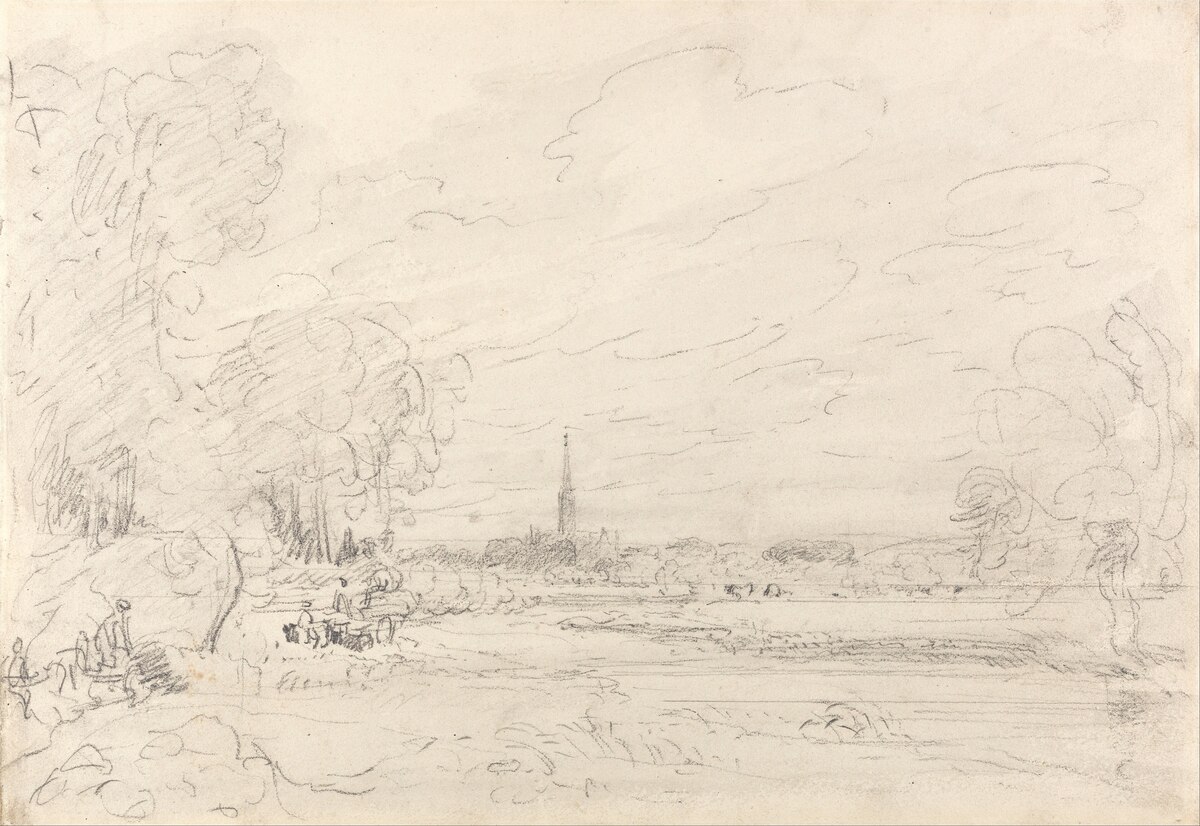
The lightly sketched trunk and canopy at the right edge, closing the composition opposite the left tree mass and balancing the open meadow and sky.
02
Left tree mass
The large clump of loosely outlined trees dominating the left side, whose canopy shape and foliage scribbles frame the view toward the spire and establish the composition's dark repoussoir.
03
River and meadow reflections
The drawn band of water with horizontal scribbled reflections and meadow marks running across the middle ground, the spatial hinge between foreground observers and the distant cathedral.
Your gallery guide
Salisbury Cathedral from the Meadows by John Constable (1829)
A close look at John Constable's 1829 drawing of Salisbury Cathedral seen across the meadows, and what the sparse record allows us to say about it.
Editorial review by Artifact Archive automated publishing
This is John Constable's drawing Salisbury Cathedral from the Meadows, dated 1829.
The subject is a view across open ground toward Salisbury Cathedral, whose spire rises in the distance as the landmark that identifies the place.
Small figures are grouped in the foreground. The record does not name them, so we cannot say who they are.
The composition leads your eye the way the landscape does: level ground in front, the cathedral set well back, and a tall spire marking the horizon.
The foreground figures give the fields a sense of scale, a reminder of how large the building is and how far away it sits.
The object is catalogued as a drawing rather than a painting.
It was made with graphite and white gouache on medium, moderately textured, cream wove paper laid to card.
Gouache is an opaque water-based paint. Here the white gouache would have been used to lift highlights against the grey of the graphite. The file record states the work is not signed and not dated.
One caution belongs here: the 1829 date in the record is a catalogue attribution, not a signature or inscription by the artist.
That distinction matters. It tells us the dating rests on the catalogue, not on anything written on the sheet itself.
The supplied record also does not describe the drawing's subject or meaning beyond naming the view, so we should not push the interpretation further than the evidence goes.
What we can say with confidence is this: Constable drew a wide meadow view with Salisbury Cathedral's spire as its anchor, and he used white gouache to build light into a graphite drawing.
The sheet belongs to the Yale Center for British Art, and its digitised image comes from the Google Art Project.
Its identity is secure; its interpretation, on this evidence, stays modest.
The story and its sources
Editorial review by Artifact Archive automated publishing.
Historical claims are linked to the records below. Close looking and interpretation are identified in the passage notes.
John Constable was an English painter (1776-1837). Their work is associated with realism; Romanticism. Their recorded places of work include London; Dedham; Hampton; Lavenham.
Born
1776
Died
1837
Nationality
Kingdom of Great Britain; United Kingdom of Great Britain and Ireland; United Kingdom
A landscape drawing by John Constable dated 1829, with a view across meadows toward Salisbury Cathedral. The cathedral's spire is rendered in the distance as the identifying landmark, and small figures are grouped in the foreground.
The object documented by the supplied file record is John Constable's Salisbury Cathedral from the Meadows, dated 1829. The record names the artist as John Constable (1776-1837) and describes him in a cluster of occupational labels: English painter, landscape painter, architectural drafter, visual artist and artist. Those labels locate the sheet within a practice that moved between landscape and architecture, which is pertinent to a view in which a cathedral is the identifying landmark. The record assigns the object type as drawing and supplies the Wikidata item number Q93184 for it. These are catalogue-level identifications rather than curatorial arguments about the subject, and they establish what the object is taken to be, not what it means.(Wikimedia Commons: Salisbury Cathedral from the Meadows, n.d., File information, Summary; Summary, Artist; Summary, Object type)
The record states that the work is not signed and not dated. This qualification belongs beside the 1829 date rather than beneath it: the year is carried by the catalogue entry, not by an inscription on the sheet, and the record itself reports no artist's signature or date to corroborate it. The distinction between an object date and a later catalogue date is therefore load-bearing here. Nothing in the supplied evidence fixes the moment of execution beyond the catalogue attribution, and no provenance interval, commission history or exhibition record accompanies it. The drawing's documentary identity is secure at the level of artist, title and attributed year; the basis of that year remains cataloguing rather than the object's own marks.(Wikimedia Commons: Salisbury Cathedral from the Meadows, n.d., Summary, Inscriptions; File information, Summary)
Physically, the sheet measures 235 mm in height by 340 mm in width, equivalent to 9.25 by 13.38 inches. That is a landscape-format rectangle, wider than it is tall, a proportion consistent with the panoramic meadow view the title describes. Since the file record supplies no other physical description, the dimensions are the only metrical evidence available for reconstructing how the composition was scaled, and they matter for any later comparison with Constable's related treatments of the same subject, where format and support choices condition what a viewer sees.(Wikimedia Commons: Salisbury Cathedral from the Meadows, n.d., Summary, Dimensions)
The object is catalogued as a drawing rather than a painting, and its medium is recorded as graphite and white gouache on medium, moderately textured, cream wove paper laid to card. The support is described in the same terms: medium, moderately textured, cream wove paper laid to card. Two features of that description carry weight for how the sheet was made and how it has survived. The paper is a wove sheet, not a laid sheet with visible chain lines, and it is cream in tone and moderately textured rather than smooth. The phrase laid to card indicates that the sheet has been mounted overall onto a card backing, so the drawing as it now exists is a composite: the working surface and a secondary support. The file record also states that the work is not signed and not dated, which means the sheet itself supplies no artist's inscription or date that could be checked against the catalogue entry.(Wikimedia Commons: Salisbury Cathedral from the Meadows, n.d., Summary, Medium)
Within that medium, the two materials do different jobs. Graphite supplies the grey drawing, the linear and tonal structure of the image, while the white gouache is an opaque water-based paint that could be applied over the graphite to lift highlights. That combination is a mixed technique rather than a single-medium drawing: the artist draws in graphite and then works against its grey with an opaque white. The evidence establishes the presence and identity of these materials through the catalogue record; it does not, on its own, document the order in which they were applied, the tools or brushes used, or any intermediate preparation layers on the sheet. Descriptions of how the gouache functions in the image therefore remain visual inference rather than findings of technical examination.(Wikimedia Commons: Salisbury Cathedral from the Meadows, n.d., Summary, Medium)
The object's identity is established by a file record that gives the artist as John Constable (1776-1837), an English painter, landscape painter, architectural drafter, visual artist and artist, with the work dated 1829, and the object type as drawing, with the Wikidata item number Q93184. The same record supplies the dimensions, height 235 mm and width 340 mm, or 9.25 by 13.38 inches, and the collection as the Yale Center for British Art, a parent institution of Yale University, located in New Haven, Connecticut, United States, with the accession number YCBA/lido-TMS-46480. The current location field in the file record states that the work is not on view, and the source of the file is credited to uQFl3kOthIr8jg at Google Cultural Institute maximum zoom level, made available through the Google Art Project.(Wikimedia Commons: Salisbury Cathedral from the Meadows, n.d., Summary, Medium)
Interpretation
A qualification belongs with the date, because the record states that the work is not signed and not dated. The 1829 date therefore rests on catalogue attribution and not on any inscription written on the sheet by the artist. The distinction matters for materials research as much as for dating: nothing visible on the drawing itself confirms the year, and the same record does not describe the drawing's subject or meaning beyond naming the view, so interpretation should not be pushed further than the evidence goes. What the medium description does establish is the physical character of the sheet as a mixed graphite and white gouache drawing on a cream wove paper mounted to card, held in a public collection with a fixed accession number.(Wikimedia Commons: Salisbury Cathedral from the Meadows, n.d., Summary, Medium)
The file record that fixes the identity of this object credits its source to uQFl3kOthIr8jg at Google Cultural Institute maximum zoom level, made available through the Google Art Project. That credit governs only the digital file's origin as a reproduction; it is not a statement about who owned or made the drawing itself, and it should not be read as a provenance document for the physical sheet. The same file record describes the drawing as John Constable's Salisbury Cathedral from the Meadows, dated 1829, an object type recorded as drawing with Wikidata item number Q93184.(Wikimedia Commons: Salisbury Cathedral from the Meadows, n.d., Summary, Source/Photographer)
Collection, Accession Number and Current Location
The record places the work in the Yale Center for British Art, a parent institution of Yale University in New Haven, Connecticut, United States, under the accession number YCBA/lido-TMS-46480. The current location field in the file record states that the work is not on view, so its presence in the collection is documented even though it is not presently on display. The record lists the artist as John Constable (1776-1837), an English painter, landscape painter, architectural drafter, visual artist and artist.(Wikimedia Commons: Salisbury Cathedral from the Meadows, n.d., Summary, Source/Photographer)
Medium, Support, Dimensions and the Absence of a Signature
For the physical object, the record gives a medium of graphite and white gouache on medium, moderately textured, cream wove paper laid to card, with the support described in the same terms. The height is 235 mm and the width 340 mm, that is 9.25 by 13.38 inches. The record further states that the work is not signed and not dated, which means the attribution of 1829 rests on the catalogue rather than on any inscription by the artist on the sheet, and no documented signature or dated inscription marks the handover of the object between any individuals.(Wikimedia Commons: Salisbury Cathedral from the Meadows, n.d., Summary, Source/Photographer)
Unrecorded Provenance and the Difference Between Absence and Change of Ownership
Interpretation
Taken together, the record establishes only the object's current institutional custody, its accession identifier, its physical description and its catalogue attribution. It does not supply any earlier owner, dealer, sale, gift, bequest or transfer, and it does not name any collector who held the sheet before it entered the Yale Center for British Art. The interval between the drawing's making and its appearance in that collection is therefore simply unrecorded in the supplied evidence, and an unrecorded interval must not be mistaken for a proven change of ownership: nothing here documents a sale, an inheritance or a move between hands. Because the file is an online reproduction record rather than the institution's own catalogue entry, its accession number and collection statement remain the strongest custodial facts available, while any earlier chain of title stays absent from this account.(Wikimedia Commons: Salisbury Cathedral from the Meadows, n.d., Summary, Source/Photographer)
The object under examination is catalogued in the collection of the Yale Center for British Art, which the file record identifies as a parent institution of Yale University, located in New Haven, Connecticut, in the United States. Within that collection it carries the accession number YCBA/lido-TMS-46480. Although the accession number and the institutional parentage are documented in the record, the current location field states that the work is 'not on view,' meaning it is not presently displayed to the public. That single field is important for any account of the object's museum life: it establishes the work as a held collection item rather than a work currently on exhibition, and it is the only display-status information the record supplies.(Wikimedia Commons: Salisbury Cathedral from the Meadows, n.d., Summary, Collection; Summary, Accession number; Summary, Current location)
The object catalogued here is a drawing by John Constable (1776–1837), titled Salisbury Cathedral from the Meadows and dated 1829 in the record. It is a graphite and white gouache drawing on medium, moderately textured, cream wove paper laid to card, measuring 235 by 340 mm, or 9.25 by 13.38 inches. The work carries the accession number YCBA/lido-TMS-46480 and belongs to the Yale Center for British Art, a parent institution of Yale University in New Haven, Connecticut, United States. The collection record states that it is not on view. The catalogued object is a drawing, not the well-known oil painting of the same title, and the file record confirms both an object type of drawing and a Wikidata item number, Q93184. The digitised image is credited to uQFl3kOthIr8jg at Google Cultural Institute maximum zoom level, made available through the Google Art Project.(Wikimedia Commons: Salisbury Cathedral from the Meadows, n.d.)
Recorded values
Recorded values for the drawing are not market values. The only figure supplied is a model-generated working insurance range, estimated at US$500,000 to US$2 million, generated on 2026-10-16 as a working calculation. The methodology describes it as a conservative range calculated from the confirmed artwork context: Constable's major market position, the rarity of a documented 1829 Constable drawing with a Salisbury Cathedral subject, the stable institutional collection context, and the moderate scale and mixed drawing medium. The record explicitly qualifies this figure as a broad review band for manual insurance consideration, not a precise valuation. It is not an official insurance value, appraisal, auction result, or sale price, and no comparable sales, private insurance records, or current market data were used or claimed. Actual coverage, condition, provenance, title, exhibit history, and a qualified appraiser's inspection are required before any insurance amount is set. What we can say is that the range reflects the artist's standing and the object's documented subject and 1829 date rather than any transaction, and that the figure should not be treated as evidence of a price the drawing has ever commanded.(Wikimedia Commons: Salisbury Cathedral from the Meadows, n.d.)
Working estimate
Calculated working insurance estimate, not a sale price: Estimated value: US$500K to US$2M Recorded date: Working calculation, generated 2026-10-16. Methodology: Working insurance range calculated conservatively from confirmed artwork context: John Constable, Salisbury Cathedral from the Meadows, dated 1829, graphite and white gouache on cream wove paper laid to card, 235 x 340 mm, accession YCBA/lido-TMS-46480, held at the Yale Center for British Art and not on view. The object is an unsigned, undated drawing, not the well-known oil painting of the same title. The range reflects the artist's major market position, the rarity of a documented 1829 Constable drawing with a Salisbury Cathedral subject, stable institutional collection context, and the moderate scale and mixed drawing medium. It is intended as a broad review band for manual insurance consideration, not a precise valuation. Qualification: This is a model-generated working insurance range for manual review only. It is not an official insurance value, appraisal, auction result, or sale price. No comparable sales, private insurance records, or current market data were used or claimed. Actual coverage, condition, provenance, title, exhibit history, and a qualified appraiser's inspection are required before setting any insurance amount.(Wikimedia Commons: Salisbury Cathedral from the Meadows, n.d.)
Bibliography
Sources and further reading
References are arranged by author or organisation, with links to the original publications. Where no publication date is recorded, n.d. means no date.
Source notes updated .
No recorded sources match these filters. Reset the filters to see the full bibliography.
Catalogue record lists 'Exhibitions' among its subjects, indicating a Constable exhibition catalogue rather than a general biography. Exhibition catalogues often treat individual paintings in detail, so this is a plausible source for object-specific discussion.
Discovery aid used to identify the exact object by title, artist, date, medium, dimensions, collection and accession number. The file record provides catalogue identity, not curatorial interpretation of the subject or meaning. Not an institutional object record. Treated as discovery metadata only.
Advertising supports the archive. These preferences control aggregate page counting, reading activity and ad-delivery diagnostics. They use no visitor tracking cookie.