The story About 4 minutes to read
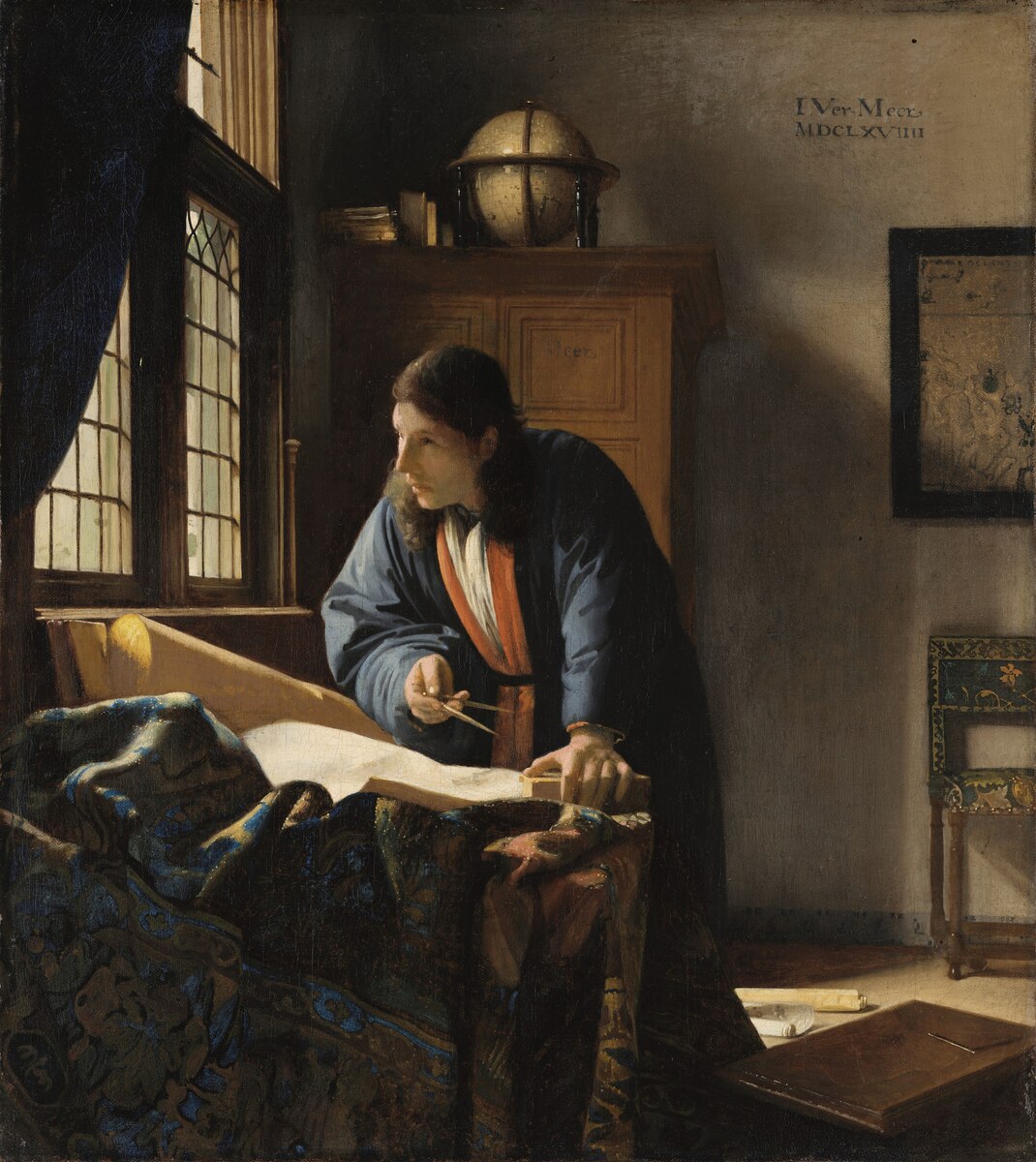
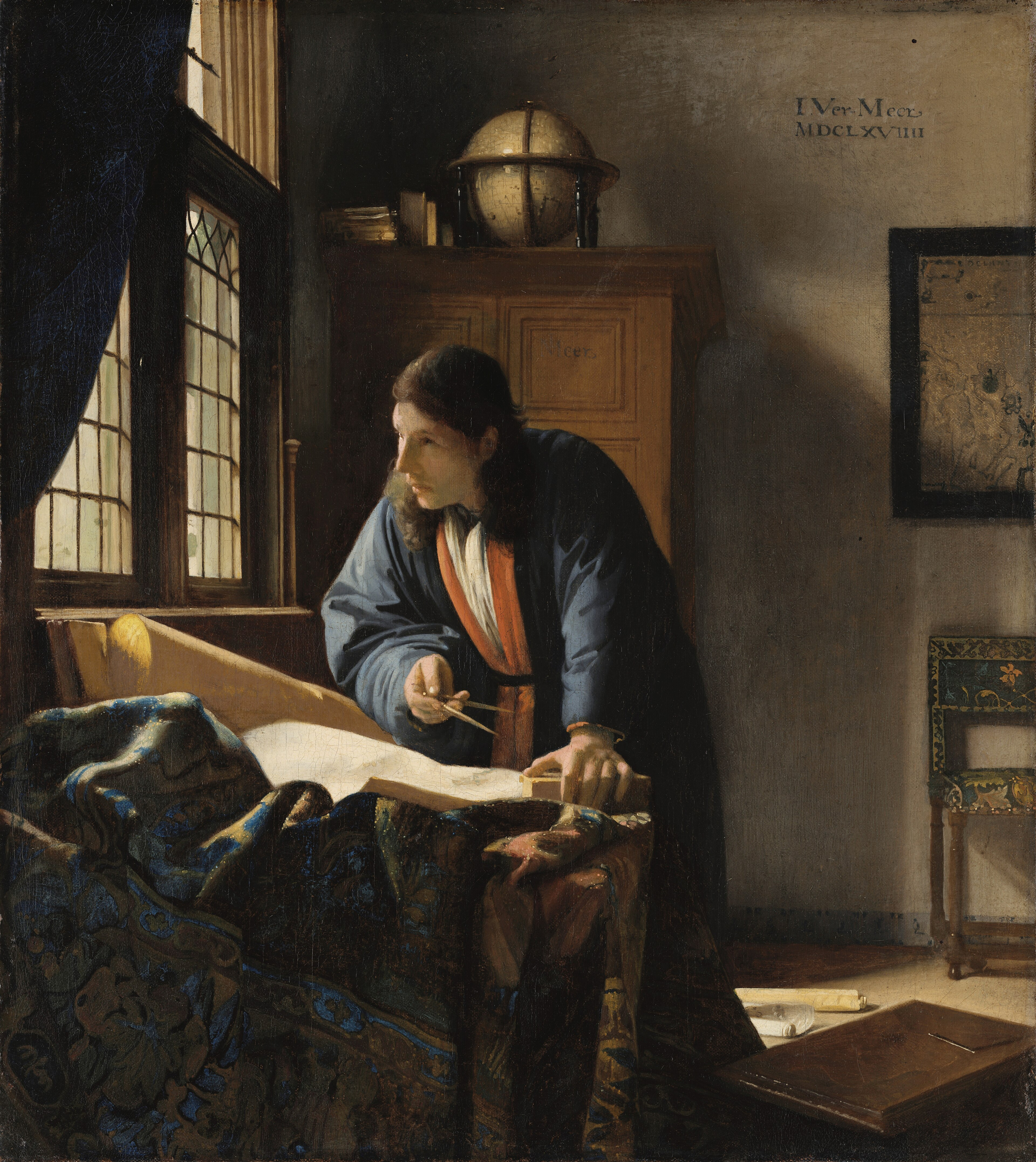
Here is a man who has just been measuring distances on a map with his compass.
Now he pauses. Vermeer shows us that pause, the moment of thought rather than the act of measuring.
This is not a portrait, and it tells no story. It is a genre painting: a man in an interior, caught at his work.
The compass stays in his raised right hand, and his left arm rests along a book or folio on the table.
He turns toward the closed window, his body twisting while his weight settles on one hip.
That half-turn is what gives the picture its tension. His hand has stopped, but his mind evidently has not.
The globe and the wall map stand for the state of the art of cartography, which the Netherlands pioneered.
The globe shows Europe's coastlines; the wall map shows the Indian Ocean, a crucial body of water for a country whose economy rested on maritime trade.
So the room is not just a study. It is a small picture of Dutch knowledge and Dutch commerce together.
The museum's reading is that Vermeer set out to capture, through painterly means, the moment the geographer surveys the world in his mind.
The map is therefore not a backdrop. It is the subject he is thinking about, and the picture's real action happens behind his eyes.
Vermeer painted a counterpart to this canvas the year before, The Astronomer, now in the Louvre.
Notice how little happens in the room. A closed window, a hanging map, a globe, and a man standing still.
Because the setting is so quiet, the smallest movements carry weight: the twist of the shoulders, the lifted hand, the face turning into the light.
Vermeer leaves the geographer's thoughts unreported. We see only that he has stopped, and that something is being worked out.
Vermeer signed and dated the canvas in two places: a monogram on the cabinet door, and his name with the year 1669 on the wall at the upper right.
The painting belongs to the Baroque period and to the seventeenth-century Dutch school.
By then the Netherlands was a centre of mapmaking and overseas trade, which is why these objects could be so naturally at home in a private study.
What stays with you is the pause itself, not the instruments.
Vermeer gives us a man who has measured the world and is now considering it, and he trusts that quiet moment to hold our attention.
That is what the painting is about: thought, not travel, and the inward work that follows the map.