Subject and iconography
LinkComposition and deliberate departures from the event
Visual observation
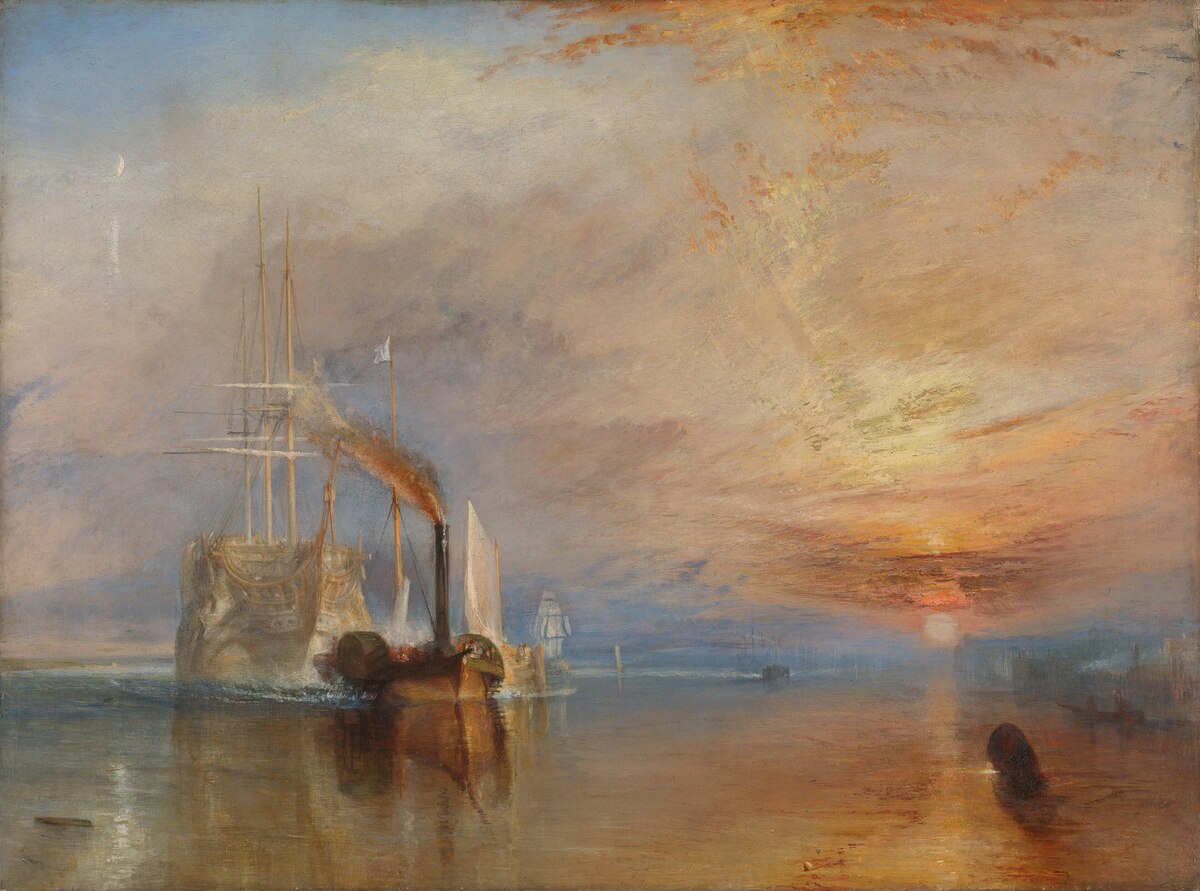
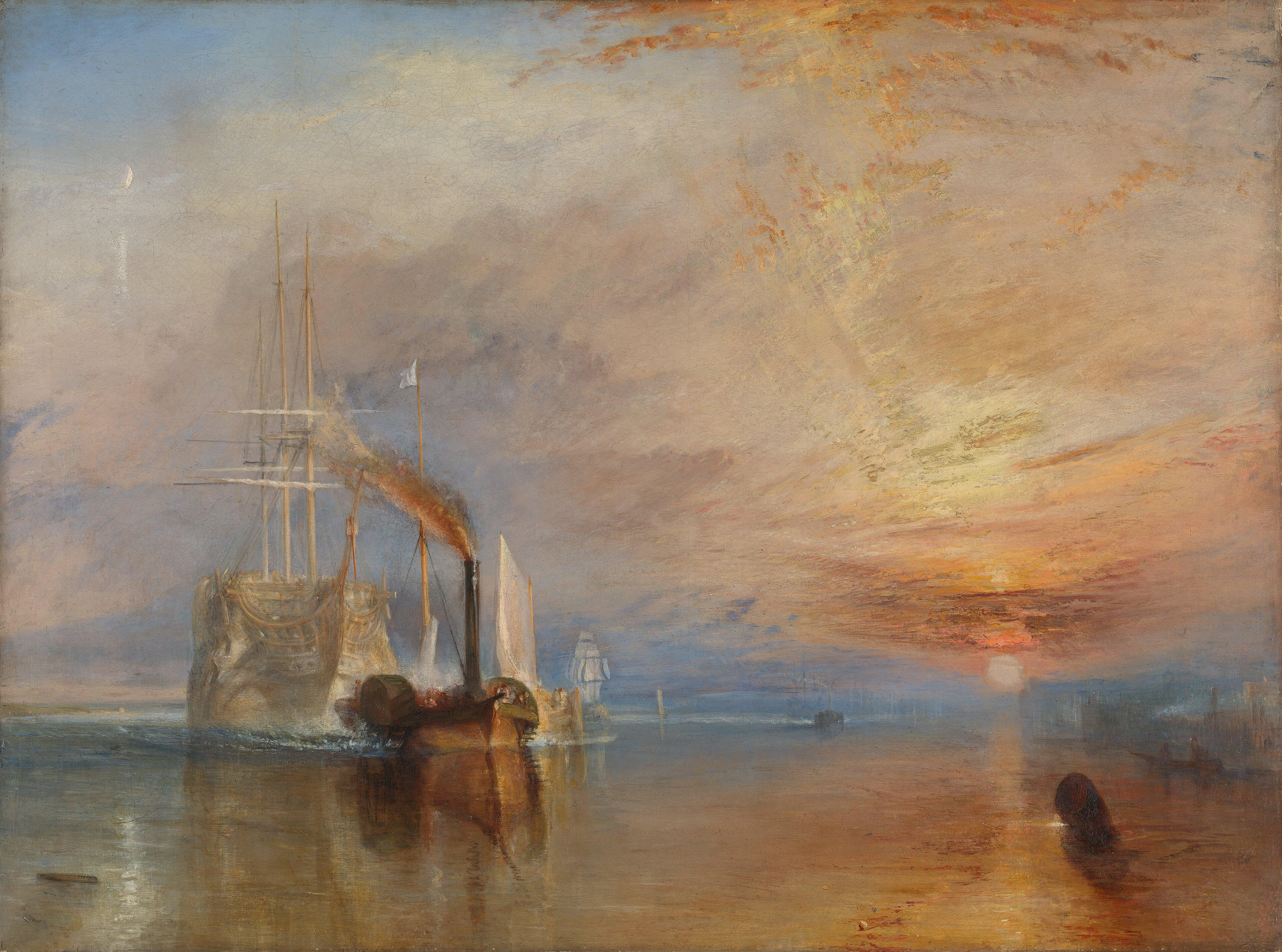
Against the documented history, the composition departs from the event in specific, describable ways. Although the Temeraire was towed by two tugs, Turner depicted only one pulling the ship, with a second tug just visible in the distance. The National Gallery account further states that Turner deliberately altered the construction of the tug, placing its black funnel in front of its mast rather than behind it, which allows a long plume of sooty smoke to blow backwards through the Temeraire's masts. The same source characterises that revision as heightening the drama of the scene and adding the possible symbolic dimension of steam power overtaking sail power. The two changes belong to different orders of evidence: the reduced number of tugs is a demonstrable difference between painting and tow, while the symbolic reading of the altered funnel is an interpretation advanced by the Gallery and should be attributed as such.(The National Gallery, London, n.d., In-depth)
The right side of the picture is occupied by a white setting sun hovering over a hazy blue horizon, with thick clouds above and around it painted in expanding swathes of orange, brown, pink and yellow, applied in places so thickly that the paint stands proud from the canvas. The calm water below the sun reflects a golden line in the faint ripples, and a large dark buoy bobs in the water in the foreground on the right. The recorded haze is not empty: a small rowboat and the shadowy outlines of buildings loom out of it on the shore to the right, but they are tiny and dim compared with the vast expanse of colourful sky and water. These observations belong to the description of the painting as it appears, including its handling of paint, rather than to any claim about the actual Thames on the day of the tow.(The National Gallery, London, n.d., In-depth)
The distribution of light and dark in the lower half is carefully balanced. The blazing copper hues of the clouds echo the tug's fiery smoke, and the white disk of the sun itself is counterbalanced by the dark buoy in the lower right corner, which also creates scale and leads the viewer into the scene. The same buoy, bobbing in the water in the foreground on the right, balances the dark reddish-brown tugboat opposite. Read together, these observations describe a constructed symmetry between the dark smoking tug on one side and the dark buoy and bright setting sun on the other, which organises the viewer's movement into the picture rather than merely recording a stretch of river.(The National Gallery, London, n.d., In-depth)
Turner deliberately altered the construction of the tug, placing its black funnel in front of its mast rather than behind it, allowing a long plume of sooty smoke to blow backwards through the Temeraire's masts.(The National Gallery, London, n.d.)
The blazing copper hues of the clouds echo the tug's fiery smoke and the white disk of the sun itself is counterbalanced by the dark buoy in the lower right corner, which also creates scale and leads us into the scene.(The National Gallery, London, n.d.)
On the right, a white setting sun hovers over a hazy blue horizon; the thick clouds above and around the sun are painted with expanding swathes of orange, brown, pink and yellow, applied so thickly in places that the paint stands proud from the canvas.(The National Gallery, London, n.d.)
A small rowboat and the shadowy outlines of buildings loom out of the haze on the shore to the right, but they are tiny and dim compared to the vast expanse of colourful sky and water.(The National Gallery, London, n.d.)
The calm water below the sun reflects a golden line in the faint ripples; a large dark buoy bobs in the water in the foreground on the right, balancing the dark reddish-brown tugboat opposite.(The National Gallery, London, n.d.)
The ship's documented career
The object at the centre of this research is a veteran warship whose documented service and documented sale are the factual spine of everything that follows. The Temeraire was built from the wood of over 5000 oaks and was a 98-gun, three-decker warship, a scale of construction that made it a major capital unit of the sailing navy rather than a routine vessel. It had played a distinguished role in the Battle of Trafalgar in 1805, defending Nelson's flagship Victory, and the National Gallery's curatorial discussion states that Turner certainly knew of its action at Trafalgar. That combination of material scale, combat record and the painter's awareness of the ship's history is what allows the later image to bear the weight of a national subject.(The National Gallery, London, n.d., In-depth)
The ship's post-war history explains how a Trafalgar veteran came to be an expendable hull. With the advent of peace in 1815, most of Britain's great warships became redundant, and from 1820 the Temeraire had been moored off Sheerness, serving mainly as a supply ship. By 1838 it was over 40 years old and had been sold off by the Admiralty. In June 1838 the Admiralty ordered that the decaying Temeraire be sold, as the ship was by then over 40 years old and worth only the value of the timbers. The stated rationale is therefore financial and material rather than commemorative: the state valued an obsolete hull for its wood, not for its battle honours.(The National Gallery, London, n.d., In-depth)
The disposal process stripped the ship of the attributes that make a warship legible as one. Prior to sale, Temeraire was stripped by the Navy of all re-usable parts, including masts and yards, and reduced to an empty hull. As the mastless 2110-ton Temeraire was unable to sail independently, Beatson hired two steam tugs to tow it along the Thames from Sheerness to his breaker's wharf at Rotherhithe. Moving the Temeraire took about two days, and the ship finally berthed at Beatson's wharf on 6 September. Two qualifications deserve emphasis in any account of the picture's subject: the historical tow was performed by two tugs, not one, and the vessel that travelled was already a mastless, stripped hull, with no masts, yards or flag left to show. The National Gallery records that the Temeraire was the largest ship ever to have been sold by the Admiralty for breaking up and the largest to have been brought so high up the Thames, so the journey itself was an unusual logistical event, not a routine scrap run.(The National Gallery, London, n.d., In-depth)
Reconstructing the event
The relationship between the event and the image is one of reconstruction rather than reportage. It is unlikely that Turner witnessed the Temeraire being towed; he may not even have been in England at the time, although he could have previously seen the ship when travelling past Sheerness. Instead, Turner imaginatively recreated the scene using contemporary reports. This matters for how the painting is used as evidence: it is a documented public subject painted from second-hand information, and the National Gallery's account explicitly frames the composition as an imaginative recreation. The evidence also shows that Turner was not encountering the ship for the first time in 1838: he had already included a glimpse of the Temeraire in a large painting of 1806, The Battle of Trafalgar, as seen from the Mizen Starboard Shrouds of the Victory (Tate, London). The earlier canvas establishes a prior, documented engagement with the ship and its most famous action, which is independent of the 1838 tow.(The National Gallery, London, n.d., In-depth; Overview)
Reception and historical weight
Reception history provides a documented counterpoint to the reading of the canvas as elegy. Literal-minded viewers were quick to point out Turner's apparent 'mistake', but he was furious when the tug's design was 'corrected' in a later engraving of the painting. Some critics, such as the novelist William Makepeace Thackeray, viewed the painting as critical of the tug and what it represented, but Turner's attitude to industrial modernity was more ambiguous. The same curatorial account documents that although Turner may have mourned the passing of a great warship from the age of sail, he also acknowledged and often painted the realities of modern life and regularly travelled on new modes of transport, including steamships and the railways. The painter's anger at the correction is the strongest documented evidence that the altered tug was an intentional pictorial decision, while the attributed readings by critics remain interpretations of the image rather than statements of the artist's programme.(The National Gallery, London, n.d., In-depth)
Interpretation
Taken together, the evidence establishes a subject whose significance lies in the collision of two documented chronologies. One chronology is naval and administrative: a 98-gun, three-decker built from over 5000 oaks, a Trafalgar veteran, redundant after 1815, moored off Sheerness from 1820 as a supply ship, ordered sold in June 1838, stripped to an empty hull, and towed by two hired steam tugs for about two days to Rotherhithe, berthing on 6 September. The other is pictorial: a scene Turner did not witness, assembled from contemporary reports, altered in the number of tugs and in the tug's construction, and defended against correction. The ship's passage was notable in its own right, as the largest vessel ever sold by the Admiralty for breaking up and the largest brought so high up the Thames. Placing these alongside one another shows why the object functions as a point of transition in a larger history of material culture, where a warship built of oak and valued for its timbers meets a steam-powered towing economy on the same river; the painting's symbolic force depends on the documented obsolescence of the one and the documented presence of the other, while the assertion of Turner's intent remains an attributed interpretation rather than a documentary record.(The National Gallery, London, n.d., In-depth; Overview)
The veteran warship had played a distinguished role in the Battle of Trafalgar in 1805, defending Nelson's flagship Victory.(The National Gallery, London, n.d.)
By 1838 the Temeraire was over 40 years old and had been sold off by the Admiralty.(The National Gallery, London, n.d.)
In June 1838 the Admiralty ordered that the decaying Temeraire be sold, as the ship was by then over 40 years old and worth only the value of the timbers.(The National Gallery, London, n.d.)
Prior to sale, Temeraire was stripped by the Navy of all re-usable parts, including masts and yards, and reduced to an empty hull.(The National Gallery, London, n.d.)
As the mastless 2110-ton Temeraire was unable to sail independently, Beatson hired two steam tugs to tow it along the Thames from Sheerness to his breaker's wharf at Rotherhithe.(The National Gallery, London, n.d.)
Moving the Temeraire took about two days, and the ship finally berthed at Beatson's wharf on 6 September.(The National Gallery, London, n.d.)
It is unlikely that Turner witnessed the Temeraire being towed; he may not even have been in England at the time, although he could have previously seen the ship when travelling past Sheerness.(The National Gallery, London, n.d.)
Turner imaginatively recreated the scene using contemporary reports.(The National Gallery, London, n.d.)
Although Turner may have mourned the passing of a great warship from the age of sail, he also acknowledged and often painted the realities of modern life and regularly travelled on new modes of transport, including steamships and the railways.(The National Gallery, London, n.d.)
Turner had already included a glimpse of the Temeraire in a large painting of 1806, The Battle of Trafalgar, as seen from the Mizen Starboard Shrouds of the Victory (Tate, London).(The National Gallery, London, n.d.)
The Temeraire was built of the wood from over 5000 oaks, and was a 98-gun, three-decker veteran warship.(The National Gallery, London, n.d.)
With the advent of peace in 1815, most of Britain's great warships became redundant, and from 1820 the Temeraire had been moored off Sheerness, serving mainly as a supply ship.(The National Gallery, London, n.d.)
Not only was the Temeraire the largest ship ever to have been sold by the Admiralty for breaking up and the largest to have been brought so high up the Thames, but Turner certainly knew of its action at the Battle of Trafalgar.(The National Gallery, London, n.d.)
Reception and literature
LinkEarly Viewers: The Tug "Mistake" and Turner's Response
Visual observation
The first documented controversy around the painting concerned something a viewer could check against a real vessel rather than against the painting's meaning. Turner deliberately altered the construction of the tug, placing its black funnel in front of its mast rather than behind it, which allowed a long plume of sooty smoke to blow backwards through the Temeraire's masts; the National Gallery's curatorial discussion treats this revision as heightening the drama of the scene and as adding the possible symbolic dimension of steam power overtaking sail power. Literal-minded viewers were quick to point out Turner's apparent "mistake," but the artist was furious when the tug's design was later "corrected" in an engraving of the painting. The episode is revealing precisely because the objection was technical and the response was authorial: the engraving's correction removed a distortion that Turner had introduced on purpose, and his anger indicates that he understood the inaccuracy as part of the picture's argument rather than an error to be repaired. This is the earliest documented stage of the work's reception, and it already shows the pattern that would recur: viewers reading the image as reportage, and the painter insisting on licence.(The National Gallery, London, n.d., In-depth)
Contemporaneous interpretation divided over what the steam tug meant. Some critics, such as the novelist William Makepeace Thackeray, viewed the painting as critical of the tug and what it represented, but Turner's attitude to industrial modernity was more ambiguous. The evidence supplied for that ambiguity is behavioural as well as pictorial: although Turner may have mourned the passing of a great warship from the age of sail, he also acknowledged and often painted the realities of modern life and regularly travelled on new modes of transport, including steamships and the railways. Thackeray's reading therefore stands as an attributed critical position rather than a settled account of the artist's intention, and the same novelistic voice is associated elsewhere with a further act of description, since it was Thackeray who described the forest of pale masts below the sun as "a countless navy that fades into the distance," fading into a dim blue haze. Reading and describing the picture were thus intertwined from the outset: the same writer who supplied one of the earliest moralising interpretations also supplied one of the earliest pieces of sustained visual description.(The National Gallery, London, n.d., In-depth)
Critical Authority and the Accumulation of Meaning
Interpretation
Subsequent critical authority was attached to the sunset by John Ruskin, whose observation that Turner's "most deeply crimsoned sunset skies" often signified death supplied a generalising principle that later accounts could apply to this picture. The attribution matters: the claim is Ruskin's, stated as a pattern in Turner's work rather than as a statement about this canvas alone, and it is reported in the curatorial discussion as such. The broader symbolic reading that the National Gallery's discussion sets out, that set against a blazing sunset the last voyage of the Temeraire takes on a greater symbolic meaning as the age of sail gives way to the age of steam, is similarly an attributed interpretation rather than a documented intention of the painter. This is where the accumulated meanings of the object become visible in layers. A viewer in 1839 met a canvas with an accompanying poem; a later viewer met the same canvas through Ruskin's general rule about crimson skies; a still later viewer meets it through the now-familiar narrative of one technology replacing another. Each layer was added by readers rather than by the maker, and each was enabled by features the maker did paint, which is why the accretions could take hold so durably.(The National Gallery, London, n.d., In-depth)
Original Function and Later Roles
Keeping the object's original function distinct from its later cultural roles helps explain why meanings could accumulate rather than compete. The ship's identities were successive and documented: a 98-gun, three-decker veteran built from the wood of over 5000 oaks and distinguished at Trafalgar in 1805, then redundant after the peace of 1815, then from 1820 moored off Sheerness mainly as a supply ship, then sold by Admiralty order in June 1838, then stripped of masts, yards and other re-usable parts and reduced to an empty hull, then towed by two hired steam tugs and berthed at Beatson's wharf on 6 September. The painting intervened not by inventing the ship's significance but by selecting and compressing it, and the curatorial account of the departure from the two-tug reality belongs to that compression. What later viewers added was a further identity, that of a picture about transition, which the National Gallery discussion reports as a symbolic meaning taken on when the last voyage is set against the blazing sunset. The distinction is worth stating plainly: the tow, the sale and the stripping are documented events, while the reading of the scene as the age of sail giving way to the age of steam is an interpretation offered by the museum's curatorial discussion, and some of the earliest critical opinion along those lines, Thackeray's, is likewise attributed to a named critic rather than established as fact.(The National Gallery, London, n.d., In-depth)
Literal-minded viewers were quick to point out Turner's apparent 'mistake', but he was furious when the tug's design was 'corrected' in a later engraving of the painting.(The National Gallery, London, n.d.)
Some critics, such as the novelist William Makepeace Thackeray, viewed the painting as critical of the tug and what it represented, but Turner's attitude to industrial modernity was more ambiguous.(The National Gallery, London, n.d.)
Interpretations and debates
LinkThe Sunset and the Elegaic Reading
Interpretation
The elegiac reading of the picture is grounded in the painting's treatment of light. The sunset fills the right-hand third of the painting and, on the curatorial account, is fundamental to the picture's elegiac tone, reinforcing the narrative of the Temeraire approaching its final berth. The sunset also carries the larger symbolic meaning the same account proposes for the last voyage: set against a blazing sunset, that voyage takes on the meaning of the age of sail giving way to the age of steam. This reading is attached to the sky as painted, where a white setting sun hovers over a hazy blue horizon and thick clouds around it are laid in with expanding swathes of orange, brown, pink and yellow, applied so thickly in places that the paint stands proud from the canvas. The curatorial discussion also records the critic John Ruskin's observation that Turner's most deeply crimsoned sunset skies often signified death, which gives the colouristic intensity a precedent within Turner's own practice rather than standing as a claim about what he privately intended here.(The National Gallery, London, n.d., In-depth; Overview)
Turner introduced a second celestial body into the same spectacle. As the sun sets, a pale crescent moon rises in the top left corner; the curatorial discussion notes that Turner had long been interested in the simultaneous appearance of the sun and the moon, and proposes that here their joint presence perhaps also accentuates notions of transition. The word perhaps belongs to the attribution: the moon's transitional force is offered as a possible symbolic dimension, not as a recorded statement by the artist. The reading is consistent with the composition's architecture of balance. The blazing copper hues of the clouds echo the tug's fiery smoke, while the white disk of the sun is counterbalanced by the dark buoy in the lower right corner, which also creates scale and leads the viewer into the scene. The calm water below the sun reflects a golden line in the faint ripples, and the large dark buoy bobs in the foreground on the right, balancing the dark reddish-brown tugboat opposite. Light in this painting is thus not simply a mood but a compositional system in which each luminous and each dark element answers another.(The National Gallery, London, n.d., In-depth)
Steam, Sail and the Altered Tug
The most consequential alterations in the painting concern the tug. Although the Temeraire was towed by two tugs, Turner depicted only one pulling the ship, with a second tug just visible in the distance. He also deliberately altered the construction of the tug, placing its black funnel in front of its mast rather than behind it, allowing a long plume of sooty smoke to blow backwards through the Temeraire's masts. On the curatorial reading, that revision heightens the drama of the scene and adds the possible symbolic dimension of steam power overtaking sail power. The two tugs hired for the historical tow and the single vessel shown hauling the ship are therefore not in conflict; they belong to different registers, one a documented operation and the other a constructed image. What the alteration achieves is visible in the paint: the smoke crosses the pale, mastless hull and gives the small dark tug a disproportionate visual authority over the ship it tows.(The National Gallery, London, n.d., In-depth)
Flags, Nickname and the Language of Honour
Flags carry some of the picture's argument about honour and loss. The inclusion of the tug's white commercial flag, flying prominently from its tall mast, adds to the pathos of the Temeraire's missing flag, since the warship had already been stripped by the Navy of all re-usable parts, including masts and yards, and reduced to an empty hull. The absence is therefore historical before it is pictorial. In adopting the ship's nickname, the Fighting Temeraire, Turner explicitly signalled its valour, and the curatorial account treats that signal as explicit on the artist's part. The valour had a documented basis: the veteran warship had played a distinguished role in the Battle of Trafalgar in 1805, defending Nelson's flagship Victory, and the curatorial account states that Turner certainly knew of its action at Trafalgar. The painting's honour language thus rests on events that predate the towing by more than three decades, and it attaches a commemorative vocabulary to a hull that had ceased to resemble the ship those events concerned.(The National Gallery, London, n.d., In-depth)
Limits of the Interpretation
Several of the symbolic readings offered in the curatorial discussion are marked as possibilities rather than established facts. The possible symbolic dimension of steam power overtaking sail power is described as possible; the crescent moon perhaps accentuates notions of transition; the sunset takes on a greater symbolic meaning when set against the blazing sky. These qualifications matter because the evidence does not record the maker's private intent for the composition. What is documented is the painted evidence, the historical events at Sheerness, Rotherhithe and Trafalgar, and the alterations Turner made to what he had read. Where the curatorial account attributes a meaning to the painting, that meaning belongs to the attributed account and is reported here as such. Where the evidence records an action, such as the deliberate placement of the funnel in front of the mast or the correction in a later engraving that made Turner furious, that action is treated as documented. The interpretation section can therefore explain why the object matters within a larger history of art and material culture: a wooden warship built of thousands of oaks, reduced to a hull worth only its timber, is shown being carried to its end by the very machinery that had made its kind obsolete, and the evidence for that claim is visible in the paint as much as it is in the Admiralty's sale.(The National Gallery, London, n.d., In-depth; Overview)
The documented last voyage and its sources
Reported tradition
The National Gallery's curatorial and interpretive discussion records the subject of Turner's painting as the Temeraire's final journey, towed by a paddle-wheel steam tug from Sheerness in Kent along the Thames to Rotherhithe in south-east London, where it was to be scrapped. The same account establishes the ship's service history: a 98-gun, three-decker veteran built from the wood of over 5000 oaks, which had played a distinguished role at Trafalgar in 1805 by defending Nelson's flagship Victory. With the advent of peace in 1815 most of Britain's great warships became redundant, and from 1820 the Temeraire was moored off Sheerness, serving mainly as a supply ship. By 1838 the ship was over 40 years old and the Admiralty had sold it off; in June 1838 the Admiralty ordered that the decaying vessel be sold, since it was then worth only the value of its timbers.(The National Gallery, London, n.d., In-depth)
The Gallery's account supplies the physical and commercial particulars behind the voyage. Prior to sale the Navy stripped the Temeraire of all re-usable parts, including masts and yards, reducing it to an empty hull; the mastless 2110-ton ship was then sold for £5530 to John Beatson, a Rotherhithe shipbreaker and timber merchant. Because the Temeraire could not sail independently, Beatson hired two steam tugs to tow it along the Thames from Sheerness to his breaker's wharf at Rotherhithe. Moving the ship took about two days, and it finally berthed at Beatson's wharf on 6 September. The Gallery notes that this was not only the largest ship ever to have been sold by the Admiralty for breaking up and the largest to have been brought so high up the Thames, and that Turner certainly knew of its action at Trafalgar; in adopting the ship's nickname, the 'Fighting' Temeraire, the artist explicitly signalled its valour.(The National Gallery, London, n.d., In-depth)
From reports to painted scene: invention, error and correction
The relation between what Turner painted and what happened is set out explicitly in the Gallery's account: it is unlikely that Turner witnessed the Temeraire being towed, and he may not even have been in England at the time, although he could previously have seen the ship when travelling past Sheerness. The painting's scene was therefore an imaginative recreation using contemporary reports. The account further records where the image departs from the reports: although the Temeraire was towed by two tugs, Turner depicted only one pulling the ship, with a second tug just visible in the distance. Turner also deliberately altered the construction of the tug, placing its black funnel in front of its mast rather than behind it, so that a long plume of sooty smoke blows backwards through the Temeraire's masts; the Gallery reads this revision as heightening the drama and adding a possible symbolic dimension of steam power overtaking sail power. The reception of those alterations is part of the record: literal-minded viewers were quick to point out Turner's apparent 'mistake', and Turner was furious when the tug's design was 'corrected' in a later engraving of the painting.(The National Gallery, London, n.d., In-depth)
The sunset sky, poetry and the flag
The Gallery's reading of the sunset ties the painting's dominant colour to its subject of ending. The sunset fills the right-hand third of the painting and is described as fundamental to the picture's elegiac tone, reinforcing the narrative of the Temeraire approaching its final berth. More broadly, the Gallery cites the critic John Ruskin's observation that Turner's 'most deeply crimsoned sunset skies' often signified death, a reported critical tradition offered as context for the colour rather than as a statement of the artist's stated intention. The account also records accompanying verse: when the painting was exhibited at the Royal Academy in 1839 it was accompanied by lines Turner adapted from Thomas Campbell's poem Ye Mariners of England, 'The flag which braved the battle and the breeze, / No longer owns her.' Set against the blazing sunset, the last voyage of the Temeraire is said to take on a greater symbolic meaning as the age of sail gives way to the age of steam, and the inclusion of the tug's white commercial flag, flying prominently from its tall mast, is read as adding to the pathos of the Temeraire's missing flag.(The National Gallery, London, n.d., In-depth)
Thackeray, the haze and the painted surface
Two descriptive traditions about the picture's haze are recorded in the Gallery's discussion. Below the sun, a forest of pale masts was described by the novelist William Makepeace Thackeray as 'a countless navy that fades into the distance', fading into a dim blue haze; the Gallery's own description likewise notes that on the right a white setting sun hovers over a hazy blue horizon, with thick clouds above and around the sun painted in expanding swathes of orange, brown, pink and yellow, applied so thickly in places that the paint stands proud from the canvas. The same description places small rowboat and shadowy building outlines on the shore to the right, tiny and dim compared with the vast expanse of colourful sky and water, and notes that the calm water below the sun reflects a golden line in the faint ripples, while a large dark buoy in the right foreground balances the dark reddish-brown tugboat opposite. The blazing copper hues of the clouds are said to echo the tug's fiery smoke, and the white disk of the sun is counterbalanced by that dark buoy, which also creates scale and leads the viewer into the scene. As the sun sets, a pale crescent moon rises in the top left corner; the Gallery observes that Turner had long been interested in the simultaneous appearance of the sun and the moon, but that here their presence perhaps also accentuates notions of transition.(The National Gallery, London, n.d., In-depth)
Turner, the tug and industrial modernity
Interpretation
The Gallery's account situates this late painting within Turner's longer relationship to the ship and reframes the simplest reading of it. The Temeraire had already appeared in a glimpse within a large painting of 1806, The Battle of Trafalgar, as seen from the Mizen Starboard Shrouds of the Victory (Tate, London). On the question of the artist's stance toward industrial change, the Gallery records that some critics, such as Thackeray, viewed the painting as critical of the tug and what it represented, but that Turner's attitude to industrial modernity was more ambiguous: although he may have mourned the passing of a great warship from the age of sail, he also acknowledged and often painted the realities of modern life, and regularly travelled on new modes of transport, including steamships and the railways.(The National Gallery, London, n.d., In-depth)
Set against a blazing sunset, the last voyage of the Temeraire takes on a greater symbolic meaning, as the age of sail gives way to the age of steam.(The National Gallery, London, n.d.)
The sunset that fills the right-hand third of the painting is fundamental to the picture's elegiac tone, as it reinforces the narrative of the Temeraire approaching its final berth.(The National Gallery, London, n.d.)
As the sun sets, a pale crescent moon rises in the top left corner; Turner had long been interested in the simultaneous appearance of the sun and the moon, but here their presence perhaps also accentuates notions of transition.(The National Gallery, London, n.d.)
Below the sun, a forest of pale masts was described by Thackeray as 'a countless navy that fades into the distance,' fading into a dim blue haze.(The National Gallery, London, n.d.)
Documented values and qualified estimates
LinkThe documented sale and last voyage
The documented end of the Temeraire can be reconstructed from the National Gallery's curatorial account with unusual precision for a subject whose fame rests on a painting rather than on its own survival. By 1838 the ship was over forty years old, and in June 1838 the Admiralty ordered that the decaying vessel be sold, since it was then worth only the value of its timbers. Before sale the Navy stripped the ship of all re-usable parts, including masts and yards, reducing it to an empty hull. It was then sold for £5530 to John Beatson, a Rotherhithe shipbreaker and timber merchant, whose towing of the mastless 2110-ton ship up the Thames required the hire of two steam tugs; the move took about two days and the ship berthed at Beatson's wharf on 6 September. Together these facts establish that the sale price, the buyer, the route and the dates are archival matters, recorded independently of Turner's invention, and that the vessel Turner painted had already been materially reduced before it moved.(The National Gallery, London, n.d., In-depth)
The confidence attached to those figures rests on the distinction between a museum's synthesis of archival evidence and the surviving documentation itself; the National Gallery discussion is the source for the June 1838 Admiralty order, the removal of re-usable parts, the £5530 sale to John Beatson, the hiring of two steam tugs to move the mastless 2110-ton ship from Sheerness to Rotherhithe, the roughly two-day duration and the berthing on 6 September. The same page supplies the physical history that made the sale possible: the Temeraire was a 98-gun, three-decker built of the wood of over 5000 oaks; with the advent of peace in 1815 most of Britain's great warships became redundant, and from 1820 the ship had been moored off Sheerness, serving mainly as a supply ship. The curatorial text adds a superlative that matters for the vessel's status rather than for the painting's making, noting that the Temeraire was not only the largest ship ever to have been sold by the Admiralty for breaking up but also the largest to have been brought so high up the Thames. The recorded value of the ship is therefore double: a timber price of £5530 paid in 1838, and a scale of hull that made the tow itself an event.(The National Gallery, London, n.d., In-depth)
Documented history behind the image
The painting's subject, as the National Gallery describes it, is the final journey of the Temeraire, towed by a paddle-wheel steam tug from Sheerness in Kent along the river Thames to Rotherhithe in south-east London, where it was to be scrapped. The same account supplies the ship's martial claim: the veteran warship had played a distinguished role in the Battle of Trafalgar in 1805, defending Nelson's flagship Victory. The institution also notes that Turner had already included a glimpse of the Temeraire in a large painting of 1806, The Battle of Trafalgar, as seen from the Mizen Starboard Shrouds of the Victory, now at Tate, London, and that in adopting the ship's nickname, the 'Fighting' Temeraire, Turner explicitly signalled its valour. The value the painting records is thus not only the scrap value of a hull but a named naval reputation that the artist chose to foreground in his own title.(The National Gallery, London, n.d., In-depth)
The historical tow and the painted scene
The evidence is explicit about the gap between the historical voyage and the painted scene. The National Gallery states that it is unlikely Turner witnessed the Temeraire being towed, that he may not even have been in England at the time, though he could previously have seen the ship when travelling past Sheerness, and that he imaginatively recreated the scene using contemporary reports. The historical tow employed two tugs, but Turner depicted only one pulling the ship, with a second tug just visible in the distance. He also deliberately altered the construction of the tug, placing its black funnel in front of its mast rather than behind it, so that a long plume of sooty smoke blows backwards through the Temeraire's masts. The curatorial account reads this revision as heightening the drama and adding a possible symbolic dimension of steam power overtaking sail power. Turner's fury when the tug's design was 'corrected' in a later engraving is documented, and it shows that the alteration was his own and not an oversight: the difference between the two tugs of the historical voyage and the single tug of the painting is a decision, not a report, even though the evidence stops short of stating his motive.(The National Gallery, London, n.d., In-depth)
Visual conventions and symbolic readings
The visual and iconographic programme described by the National Gallery gives the scene its elegiac charge. Set against a blazing sunset, the last voyage of the Temeraire takes on a greater symbolic meaning as the age of sail gives way to the age of steam. The institution observes that the inclusion of the tug's white commercial flag, flying prominently from its tall mast, adds to the pathos of the Temeraire's missing flag. When the painting was exhibited at the Royal Academy in 1839 it was accompanied by lines Turner had adapted from Thomas Campbell's poem, Ye Mariners of England: "The flag which braved the battle and the breeze, / No longer owns her." The sunset that fills the right-hand third of the painting is fundamental to the picture's elegiac tone, reinforcing the narrative of the Temeraire approaching its final berth. Attribution for the reading of sunset as a sign of death is explicitly given: as the critic John Ruskin observed, Turner's 'most deeply crimsoned sunset skies' often signified death. The blazing copper hues of the clouds echo the tug's fiery smoke, and the white disk of the sun is counterbalanced by the dark buoy in the lower right corner, which also creates scale and leads the viewer into the scene. As the sun sets, a pale crescent moon rises in the top left corner; Turner had long been interested in the simultaneous appearance of the sun and the moon, but here their presence perhaps also accentuates notions of transition. Below the sun, a forest of pale masts was described by Thackeray as 'a countless navy that fades into the distance,' fading into a dim blue haze.(The National Gallery, London, n.d., In-depth)
The National Gallery's account of the picture's surface is detailed enough to link painted effects to pictorial meaning. On the right a white setting sun hovers over a hazy blue horizon, and the thick clouds above and around the sun are painted with expanding swathes of orange, brown, pink and yellow, applied so thickly in places that the paint stands proud from the canvas. A small rowboat and the shadowy outlines of buildings loom out of the haze on the shore to the right, but they are tiny and dim compared with the vast expanse of colourful sky and water. The calm water below the sun reflects a golden line in the faint ripples, and a large dark buoy bobs in the foreground on the right, balancing the dark reddish-brown tugboat opposite. These observations are the description of one institution rather than an independent technical analysis, and no pigments, media analysis, conservation treatment or condition report is supplied by any unit here; the evidence establishes composition and handling, not materials beyond the recorded oil on canvas.(The National Gallery, London, n.d., In-depth)
Reception and contested readings
The critical and biographical qualifications attached to the picture complicate any simple reading of it as a lament. Some critics, such as the novelist William Makepeace Thackeray, viewed the painting as critical of the tug and what it represented, but the National Gallery states that Turner's attitude to industrial modernity was more ambiguous. Although Turner may have mourned the passing of a great warship from the age of sail, he also acknowledged and often painted the realities of modern life and regularly travelled on new modes of transport, including steamships and the railways. Literal-minded viewers were quick to point out Turner's apparent 'mistake' over the tug's design, but he was furious when the design was corrected in a later engraving. The competing readings, one elegiac and one critical of the tug, are attributed to named critics and to the institution's assessment, and neither is presented here as the artist's own stated intention.(The National Gallery, London, n.d., In-depth)
Recorded values and the limits of valuation
Interpretation
The economic value of the object can be separated into three distinct registers, and the evidence supports very unevenly across them. The first is documented: the ship itself was sold for £5530 to John Beatson, a figure that measures a decaying hull by its timbers rather than by its fame. The second is institutional: the painting is held in a public national collection, accessioned as NG524 and received through the Turner Bequest of 1856, a status that removes it from the market and places it among nationally significant works of British art. The third register is a working insurance estimate generated on 2026-10-16, which gives an estimated value of US$80M to US$150M as a Calculated_insurance range for manual review, based on the work's status as a Turner masterpiece, its large oil-on-canvas format, and its exceptional prominence and British national significance. That estimate carries its own explicit qualification: it is model-generated for manual review only, it is not an official insurance value, appraisal, auction result or sale price, and the sources used confirm attribution, date, medium, scale and institutional status but contain no price, insurance figure or comparable sales. No market, auction or private insurance data was used or claimed. Read together, the three registers show why this object resists valuation: the only hard monetary figure in the record belongs to the scrapped warship, while the painting's worth is asserted through custodial standing and a hedged, self-limiting model output rather than through transactions.(The National Gallery, London, n.d.)(commons.wikimedia.org, n.d.)
The relationship between what can be seen and what the evidence establishes is itself part of the object's significance. The visible picture, as described by the National Gallery, presents a pale, mastless veteran towed by a dark, smoke-plumed tug beneath a crimson sunset, a composition the institution reads as a transition from sail to steam. The historical record establishes something narrower and stranger: a 98-gun, three-decker built of over 5000 oaks, redundant after 1815 and moored off Sheerness from 1820 as a supply ship, ordered sold in June 1838, stripped of its re-usable parts, sold for £5530 to a Rotherhithe shipbreaker, and moved in about two days to his wharf by two hired steam tugs, arriving on 6 September, in a voyage unlikely to have been witnessed by the artist. Turner's painting is therefore not a report of the tow but a reconstruction from contemporary reports, in which the number of tugs and the position of a funnel were altered for pictorial effect. The picture matters within a larger history of art and material culture because it converts a documented transaction in old timber, and the martial memory of Trafalgar, into an image about the passing of one technological era into another, and because its subsequent institutional life as NG524, a bequest-held oil on canvas of 1839, has made that conversion far more consequential than the breaking up of the ship it depicts.(The National Gallery, London, n.d., In-depth)(commons.wikimedia.org, n.d.)
Working estimate
Calculated working insurance estimate, not a sale price: Estimated value: US$80M to US$150M Recorded date: Working calculation, generated 2026-10-16. Methodology: Calculated_insurance range for manual review. Basis: J.M.W. Turner, The Fighting Temeraire, 1839, oil on canvas, 90.7 x 121.6 cm, National Gallery NG524, Turner Bequest 1856, held in a public national collection. Sources confirm attribution, date, medium, scale, and institutional status but contain no price, insurance figure, or comparable sales. Range is a conservative, broad working estimate reflecting the work's status as a Turner masterpiece, its large oil-on-canvas format, and its exceptional prominence and British national significance. No market, auction, or private insurance data was used or claimed. Qualification: Model-generated working range for manual review only. Not an official insurance value, appraisal, auction result, or sale price. Sources provide context only and contain no valuation or comparable data.(The National Gallery, London, n.d.)(commons.wikimedia.org, n.d.)