Auguste Rodin's Burghers of Calais remembers six men who, in a long tradition, offered themselves to the English king during the siege of Calais in 1347. Rodin models them as stricken figures bound together by heavy sackcloth and a single bronze base. This tour looks closely at how gesture, clothing and group arrangement carry that story, and it keeps clear what the supplied record establishes, what is later tradition, and what remains undocumented.
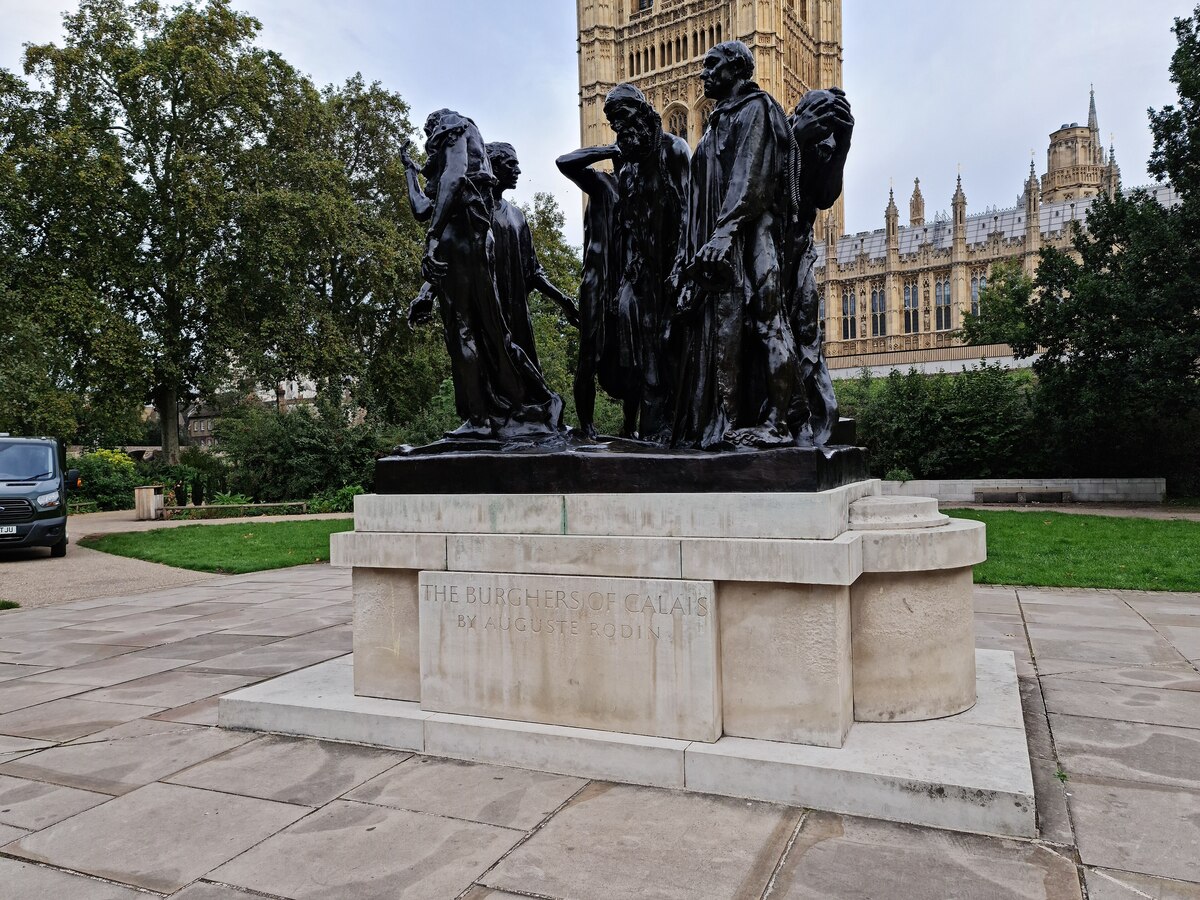
Deeply modelled sackcloth robes falling from the figures' shoulders to the dark bronze plinth; their weight and rough cast surface bind the six men into a single mass.
02
Rodin inscription
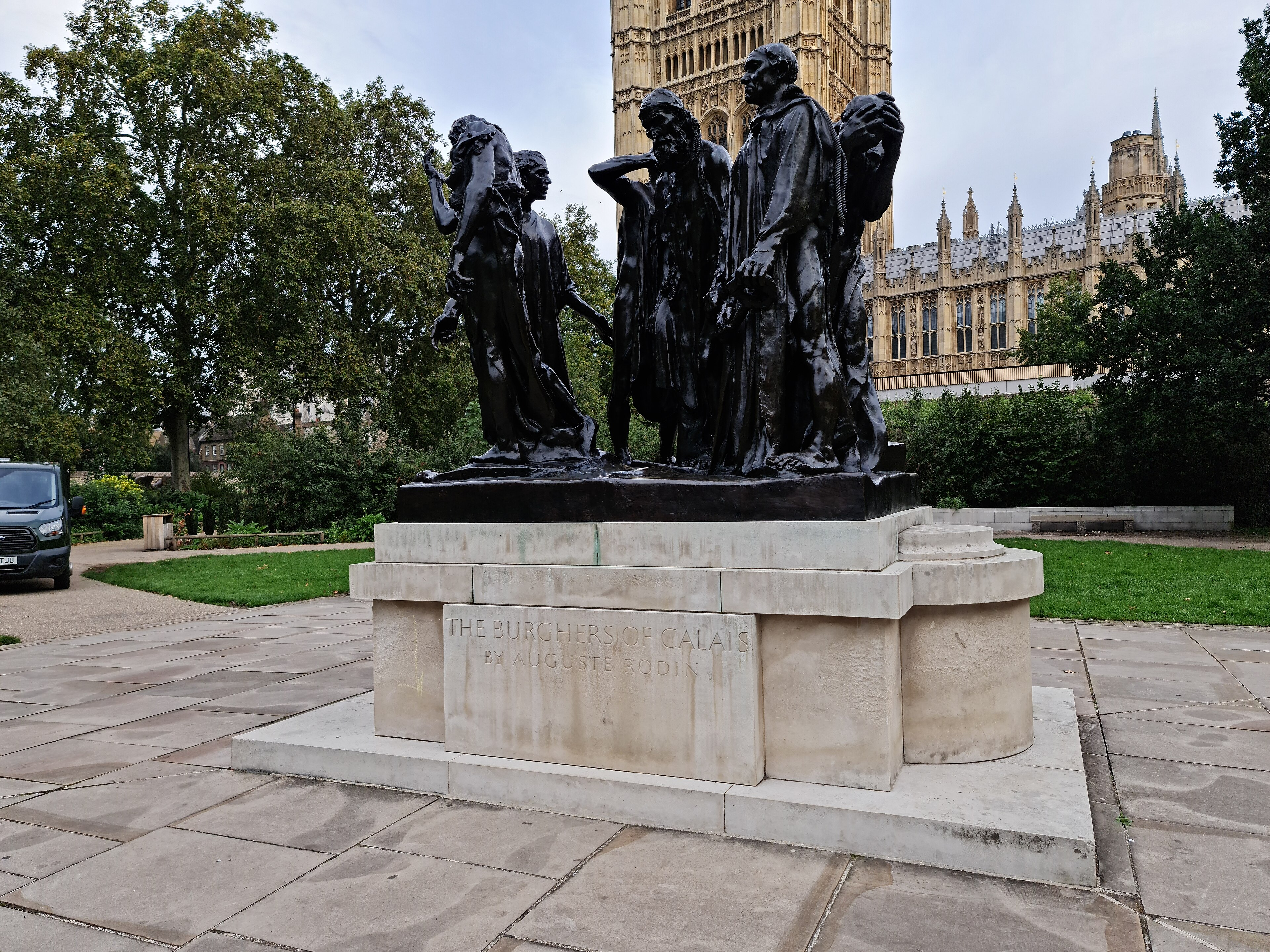
Incised lettering on the limestone pedestal reading THE BURGHERS OF CALAIS BY AUGUSTE RODIN, the monument's own identification of subject and author.
03
Burgher turning away
Leftmost burgher of the group shown in profile, body twisting back toward his companions with an arm lifted toward his face, the visible note of hesitation among the volunteers.
Your gallery guide
The Burghers of Calais by Auguste Rodin (1884–1889 (modelled); this cast later)
Auguste Rodin's Burghers of Calais remembers six men who, in a long tradition, offered themselves to the English king during the siege of Calais in 1347. Rodin models them as stricken figures bound together by heavy sackcloth and a single bronze base. This tour looks closely at how gesture, clothing and group arrangement carry that story, and it keeps clear what the supplied record establishes, what is later tradition, and what remains undocumented.
Editorial review by Artifact Archive automated publishing
This is Auguste Rodin's Burghers of Calais, a bronze group modelled between 1884 and 1889, though this particular cast was made later.
It remembers six men of Calais who, in a long tradition, offered themselves to the English king during the siege of 1347. Rodin models them as stricken volunteers, not triumphant heroes.
Look at the six figures on their single bronze base. They wear heavy sackcloth robes, and their bodies are bound together by that shared clothing and by the low, continuous platform beneath them.
One man turns back. Another covers his face. A third holds the keys of the city. These gestures spread across the group rather than resolving into one pose.
The story the group remembers is a tradition, not a documented eyewitness account. In that tradition, the burghers volunteered to give themselves to the English king so the besieged city might be spared.
The keys carried by one figure belong to that narrative of surrender and civic offering. The source record for this work presents the six burghers as figures remembered in that long tradition.
Rodin's choices change how that tradition reads. By giving the men sackcloth, turning one away, hiding another's face, and setting them all on one base, he keeps them together as a group rather than isolating a single hero.
The result is not a victory monument. It is a monument to stricken men who are bound to one another by clothing, posture and the shared ground they stand on.
What stays with you is the group. The keys, the turned body and the hidden face each belong to one figure, but the heavy robes and single base hold all six in one fate.
Rodin's Burghers of Calais asks you to read the tradition through that shared condition, not through any one man's glory.
The story and its sources
Editorial review by Artifact Archive automated publishing.
Historical claims are linked to the records below. Close looking and interpretation are identified in the passage notes.
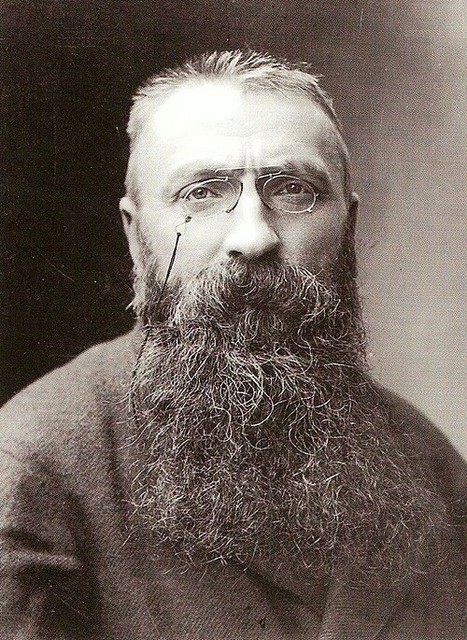
Auguste Rodin was a French sculptor (1840–1917). Their work is associated with modern art; Symbolism. Their recorded places of work include Brussels; Meudon; Paris; Rome; Dordrecht; London; Buenos Aires.
Rodin Museum, Philadelphia Museum of Art, Philadelphia, United States(Rodin Museum, n.d.)
Movement or period
Late nineteenth-century French sculpture; modern monumental bronze
Country or culture
France
Depicted subject
A group of six burghers of Calais, remembered in a long tradition as volunteers who offered themselves to the English king during the siege of Calais in 1347. Rodin models them as stricken men, one turning back, one covering his face, one holding the keys of the city, bound together by heavy sackcloth robes and a single bronze base.
Dimensions
Unknown
Catalogue record and photographic documentation
A Wikimedia Commons file documents a photograph of The Burghers of Calais in London by Auguste Rodin, taken on 7 September 2020. The file is an institutional record for the sculpture as it appears in that London location, and its metadata describes the image file rather than the sculpture itself. The photographer is recorded as Irid Escent, with the image sourced from Flickr and licensed under Creative Commons Attribution-ShareAlike 2.0. The Commons entry supplies a documented viewing date and place for one version of the work, but it does not establish when that version was cast, nor does it supply its accession history.(Irid Escent, 2020, Description and Structured data; Licensing and Structured data)
The Rodin Museum in Philadelphia lists The Burghers of Calais among works on view by Auguste Rodin. The museum's own history of its building is relevant to how the sculpture is encountered there: the Rodin Museum was designed by the French architects Paul Phillippe Cret and Jacques Gréber to evoke Parisian gardens and to give the sculpture an elegant setting both indoors and outdoors. Together with the Commons photograph of a London display, this shows that the group is documented in more than one institutional setting, each of which frames the work differently for viewers. The museum source supports the attribution to Rodin and lists the work among those on view; the Commons source supports the attribution and a dated London photograph. Neither record, on the evidence supplied, gives the object's catalogue title, its date, its support, its inscriptions or its accession identifiers.(Rodin Museum, n.d., About section)(Irid Escent, 2020, Description and Structured data; Licensing and Structured data)
A Wikimedia Commons file documents a photograph of The Burghers of Calais in London by Auguste Rodin, taken on 7 September 2020.(Irid Escent, 2020)
The Rodin Museum in Philadelphia holds The Burghers of Calais among the works listed on view by Auguste Rodin, and the institution describes its own building as the work of the French architects Paul Phillippe Cret and Jacques Gréber. That account says the architects designed the museum to evoke Parisian gardens and to give the sculpture an elegant setting both indoors and outdoors. The two facts sit at different levels of the object's history: the bronze group belongs to Rodin's production, while the building belongs to a later American collecting and display tradition that placed his work in a deliberately garden-like, transatlantic setting. The museum's own framing of its architecture therefore supplies the institutional and spatial context in which this cast is encountered, not evidence about the sculpture's commission or making.(Rodin Museum, n.d., About section)
The Rodin Museum was designed by French architects Paul Phillippe Cret and Jacques Gréber to evoke Parisian gardens and to give the sculpture an elegant setting indoors and outdoors.(Rodin Museum, n.d.)
The provenance record for the photograph of The Burghers of Calais in London begins with its creator, Irid Escent, whose image is documented on a Wikimedia Commons file dated 7 September 2020. The same file establishes that the photograph was sourced from Flickr and carries a Creative Commons Attribution-ShareAlike 2.0 licence, a licence that requires attribution and permits reuse under equivalent terms. This digital provenance chain, from photographer to Flickr platform to Commons repository, is distinct from the provenance of the sculpture itself: the Commons metadata documents the image file rather than the bronze cast. The museum whose collection page lists The Burghers of Calais among works on view provides a further institutional point of custody, although that source page is a collection listing rather than a full accession record. The photographer’s identity and the licensing terms are the earliest fixed points in the recovery of this photographic object; earlier intervals in the image’s circulation from camera to Flickr remain unrecorded in the supplied evidence, and the absence of such records must be distinguished from a proven transfer of ownership.(Irid Escent, 2020, Licensing and Structured data)
The Commons file records the photographer as Irid Escent, with the image sourced from Flickr and licensed under Creative Commons Attribution-ShareAlike 2.0.(Irid Escent, 2020)
The Rodin Museum in Philadelphia lists The Burghers of Calais among the works by Auguste Rodin currently on view at the institution. The museum's collection record presents the group as part of its public display rather than as a stored or study object, and it names Rodin as the author of the work. This is a display and attribution statement: it establishes where the sculpture can be seen and to whom it is credited, but it does not by itself date the particular cast, describe its material condition, or explain how the work came into the collection.(Rodin Museum, n.d., Artwork On View list)
Interpretation
The documentary record for the Philadelphia display is thin in ways worth stating plainly. The collection page consulted is the museum's own listing, and its reliability for the present account rests on the institution's identification of the work and its presence on view. The same source also supplies information about the museum building itself, described as designed by the French architects Paul Phillippe Cret and Jacques Gréber to evoke Parisian gardens and to give the sculpture an elegant setting both indoors and outdoors. That architectural context matters for reading the Burghers: the group is presented in a space conceived with a French garden sensibility, so the setting itself participates in the work's reception. The evidence does not establish when the Philadelphia cast was made, how it was acquired, or whether the display has changed over time, and no such claims should be inferred from the listing alone.(Rodin Museum, n.d., Artwork On View list)
The Rodin Museum, Philadelphia, lists The Burghers of Calais among works on view by Auguste Rodin.(Rodin Museum, n.d.)
The archive also carries a calculated working insurance estimate for the object: an estimated value of US$500K to US$2M, recorded as a working calculation generated 2026-10-16. The stated methodology describes this as a deliberately wide and conservative range computed for manual insurance review, built from the confirmed artist, date, medium, and the scale implied by a monumental Rodin bronze group, together with the work's prominence as one of Rodin's best-known public monuments, the confirmed presence of a Burghers of Calais cast in a major public collection, and the documented historical acquisition context of more than 150 Rodin sculptures acquired by Jules Mastbaum under the authority granted to the Musee Rodin. The record is explicit that this figure is not derived from a specific comparable sale, a private insurance schedule, or an official appraisal. Its own qualification states that it is a model-generated working range for manual review only, not an official insurance value, appraisal, auction result, or sale price, and that the supplied sources support artwork identification and institutional context rather than a public valuation. The record further directs that the specific cast, dimensions, provenance, condition, and accession record be confirmed with a qualified professional before any figure is relied upon. This qualification is the substantive point for the present account: the range exists as an internal working hypothesis whose width reflects the absence, in the supplied excerpts, of the object-specific documentation that would normally anchor a valuation.(Rodin Museum, n.d.)(Irid Escent, 2020)
Working estimate
Calculated working insurance estimate, not a sale price: Estimated value: US$500K to US$2M Recorded date: Working calculation, generated 2026-10-16. Methodology: This broad working range is calculated for manual insurance review using the confirmed artist, date, medium, and scale implied for a monumental Rodin bronze group, together with the work's prominence as one of Rodin's best-known public monuments, the confirmed presence of a Burghers of Calais cast in a major public collection, and the documented historical acquisition context of more than 150 Rodin sculptures by Jules Mastbaum under the authority granted to the Musee Rodin. It is not derived from a specific comparable sale, private insurance schedule, or official appraisal. The range is deliberately wide and conservative because the specific cast, dimensions, provenance, condition, and accession details are not confirmed in the supplied excerpts. Qualification: This is a model-generated working insurance range for manual review only. It is not an official insurance value, appraisal, auction result, or sale price. The supplied sources support artwork identification and institutional context, not a public valuation. Confirm the specific cast, dimensions, provenance, condition, and accession record with a qualified professional before relying on any figure.(Rodin Museum, n.d.)(Irid Escent, 2020)
Bibliography
Sources and further reading
References are arranged by author or organisation, with links to the original publications. Where no publication date is recorded, n.d. means no date.
Source notes updated .
No recorded sources match these filters. Reset the filters to see the full bibliography.
Catalogue record by Susan Beattie titled 'The Burghers of Calais in London' with recorded subjects Exhibitions, French Bronze sculpture, and Public opinion. These subjects directly name the monument, a bronze, and its documented public reception context, making it the most object-specific candidate for the named artwork.
Art from the archiveSizes for your spaceMade to order
01 / Find your edition
Made for you
Choose your delivery country for available editions and delivery prices. Prices and delivery are shown in GBP.
1 product
Preparing your editions…
From the archive
Handle edgeFull mug wrap · laid flatHandle edge
11oz · 2 image repeats
Drag to rotate
11oz · Standard
Handle edgeFull mug wrap · laid flatHandle edge
11oz · 2 image repeats
Handle edgeFull mug wrap · laid flatHandle edge
11oz · 2 image repeats
Handle edgeFull mug wrap · laid flatHandle edge
11oz · 2 image repeats
Handle edgeFull mug wrap · laid flatHandle edge
11oz · 2 image repeats
Handle edgeFull mug wrap · laid flatHandle edge
11oz · 2 image repeats
Front · your design1 / 5
Mug
GBP 7.75
Delivery GBP 3.74 / Total GBP 11.49
An 11oz white ceramic mug with AAA+ ORCA coating and a C-shaped handle. Dishwasher and microwave safe, printed and dispatched in the UK.
repeat layout · choose single, double or a repeating pattern in Customise.
Repeat, fit, fill and position your artwork around the mug.
Preparing the artwork for your edition…
Made to order
The 30 cm ruler is scaled alongside your selected print. Keep the painting’s proportions with a black background, or stretch it to fill. Frame width, material texture and screen colours are illustrative.
Advertising supports the archive. These preferences control aggregate page counting, reading activity and ad-delivery diagnostics. They use no visitor tracking cookie.