The Broken Column by Maker unknown (Rock-cut tomb in the Lycian tradition, at Fethiye (ancient Telmessos); photograph taken 7 August 2018)
Artist: Maker unknown
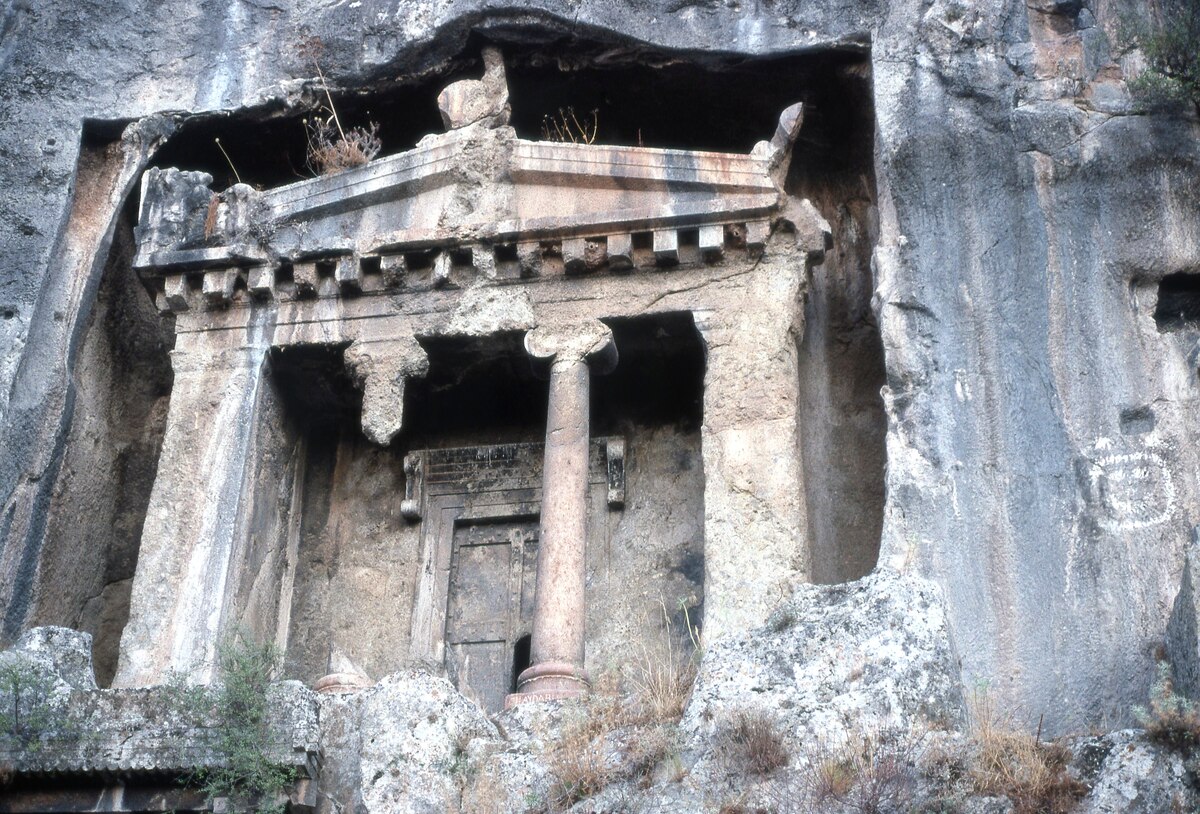
A rock-cut tomb in the Lycian tradition at Fethiye, ancient Telmessos, photographed on 7 August 2018. Its Greek-influenced facade combines two antes with Ionian columns and a pediment, and it is named for its broken column.
DateRock-cut tomb in the Lycian tradition, at Fethiye (ancient Telmessos); photograph taken 7 August 2018CultureLycia, Anatolia (modern Turkey)PeriodLycian rock-cut tomb architecture with Greek influencesCurrent locationFethiye, Turkey (ancient Telmessos); rock graves site
Listen to the article
100%
Loading full-resolution artwork…
Drag to explorePinch or double-tap to explore
Scroll to zoom · drag to pan · double-click to focusPinch to zoom · drag to explore · double-tap to focusFIELD VIEW / 154
Tools & download
Pixel colour Select a pixel with the eyedropper
No pixel selected
Choose the eyedropper, then click or tap the image. Scroll to zoom for finer selection.
Add text
Hand to pan · Select to move text and drawings · Add as many texts as you like · Scroll to zoom
The Broken Column: high-resolution image
The highest-resolution file we hold, available without payment or an account.3,840 × 2,604 pixels.
Close view of the column capital, an irregular eroded block where the stone has broken away on one side, the visible evidence of the damage that left the column unfinished or broken.
02
Carved console brackets
Two blocky carved brackets projecting where the door jambs meet the architrave, either side of the porch; they translate Lycian wooden beam ends into stone and frame the entrance.
03
Pediment and dentil frieze
Rock-cut temple entablature: triangular pediment with raking cornice above a row of dentils and a plain architrave, the classicising stonework that shows the tomb was modelled on a Greek temple front.
Your gallery guide
The Broken Column by Maker unknown (Rock-cut tomb in the Lycian tradition, at Fethiye (ancient Telmessos); photograph taken 7 August 2018)
A rock-cut tomb in the Lycian tradition at Fethiye, ancient Telmessos, photographed on 7 August 2018. Its Greek-influenced facade combines two antes with Ionian columns and a pediment, and it is named for its broken column.
Editorial review by Artifact Archive automated publishing
This is a tomb cut directly into the cliff at Fethiye, the ancient city of Telmessos, in modern Turkey. It belongs to the Lycian tradition of rock-cut graves, but its design also shows Greek architectural influence.
The tomb is known as The Broken Column. It takes that name from one of its columns, which survives incomplete.
The facade is organised around two projecting wall ends, or antes, with Ionian columns set between them. Above the columns sits a pediment, the triangular element familiar from Greek temple fronts.
Before the actual burial chamber, the plan includes a narthex-like space. This is a transitional area in front of the grave chamber rather than the chamber itself.
Lycian grave architecture often evokes wooden construction, with round ornamental supports understood as carrying the roof. Here those round wooden elements have been replaced by a dentilled cornice.
The source describes this tomb as being in the same style as the Amyntas tomb. That comparison places it within a group of Lycian tombs that adopt Greek architectural forms.
Below this tomb is another grave in a simpler Lycian style, with a flat roof. It is described as representing similar wooden Lycian houses.
Seeing the two together makes the architectural choice clearer. The upper tomb turns the Lycian rock-cut grave toward a Greek orders-based facade, while the lower one keeps the simpler flat-roofed form.
So this is not simply a hole cut for a burial. It is a tomb designed as a small architectural front, with antes, Ionian columns, a pediment and a dentilled cornice.
Its broken column gives it a memorable name, but the deeper subject is the meeting of Lycian burial tradition with Greek architectural language at Telmessos.
The story and its sources
Editorial review by Artifact Archive automated publishing.
Historical claims are linked to the records below. Close looking and interpretation are identified in the passage notes.
Rock-cut tomb in the Lycian tradition, at Fethiye (ancient Telmessos); photograph taken 7 August 2018
Medium and support
Rock-cut tomb carved into the cliff face; digital photograph
Current collection or location
Fethiye, Turkey (ancient Telmessos); rock graves site(Dosseman, 2018)
Movement or period
Lycian rock-cut tomb architecture with Greek influences
Country or culture
Lycia, Anatolia (modern Turkey)
Depicted subject
A rock-cut tomb carved in the Lycian tradition, with Greek influences: it has two antes with Ionian columns carrying a pediment, and a narthex-like space before the burial chamber. The round wooden ornamental roof supports of Lycian grave architecture are replaced by a dentilled cornice. The tomb is named for its column, which is now broken.(Dosseman, 2018)
Title variants
Tomb with broken column; Fethiye Rock graves Tomb with broken column
Attribution qualification
The tomb's maker is not named in the supplied sources. Dosseman is the photographer of the digital image, not the maker of the tomb.
Support
Rock-cut cliff face
Dimensions
Unknown
Object and setting
The object under consideration is a rock-cut tomb at Fethiye, in ancient Telmessos, modern Turkey. The cemetery setting establishes the object's location within a Lycian burial ground that the source associates with that ancient city. The tomb is described as belonging to the Lycian tradition of rock-cut graves while also showing Greek architectural influence, a combination that gives the monument its place in the study of Lycian funerary architecture and its engagement with Greek forms. The burial chamber is approached through a narthex-like space situated before the actual grave chamber, a transitional area that is distinct from the chamber itself. This spatial arrangement, together with the facade elements, distinguishes the tomb from a simple excavation cut for interment and makes it a designed architectural front.(Dosseman, 2018, Description; Category: Tomb with broken column in Telmessos)
Name and architectural form
The tomb is known as The Broken Column, a name taken from one of its columns, which survives incomplete. Its facade is organised around two projecting wall ends, or antes, with Ionian columns set between them, and above the columns sits a pediment, the triangular element familiar from Greek temple fronts. The source compares the tomb stylistically to the Amyntas tomb, describing it as in the same style: although Lycian, it has Greek influences. That comparison places the monument within a group of Lycian tombs that adopt Greek architectural forms, so the label The Broken Column records a condition of the structure rather than its original design intention. The visible incompleteness of the column is therefore a feature of the tomb's present state, while the architectural vocabulary of antes, Ionian columns and pediment belongs to its conception.(Dosseman, 2018, Description)
In Lycian grave architecture, round ornamental elements are understood as carrying the roof, evoking wooden construction. In this tomb, those round wooden elements have been exchanged for a dentilled cornice. The substitution is significant for the history of the monument: it marks a translation of forms associated with timber architecture into stone detailing, and it aligns the tomb with the Greek architectural language evident elsewhere in its facade. The source treats this exchange as a defining feature of the tomb's design, alongside the antes, Ionian columns and pediment. Within the larger history of Lycian rock-cut tombs, the dentilled cornice is thus not a neutral ornament but evidence of how local burial architecture could reinterpret and restate its own wooden references in a Greek orders-based idiom.(Dosseman, 2018, Description)
Relationship to the neighbouring tomb
Below the tomb with the broken column is another tomb in the simpler Lycian style, with a flat roof, described as representing similar wooden Lycian houses. Seeing the two together makes the architectural choice of the upper tomb clearer: the upper monument turns the Lycian rock-cut grave toward a Greek orders-based facade, while the lower one keeps the simpler flat-roofed form. The source does not date either tomb or attribute the comparison to a named scholar, so the relationship between the two should be understood as the source's descriptive account of the cemetery rather than as a documented chronological sequence. The juxtaposition nevertheless supplies the immediate architectural context in which the tomb with the broken column is seen and identified.(Dosseman, 2018, Description)
The object depicted is a tomb in the same style as the Amyntas tomb: although Lycian, it has Greek influences.(Dosseman, 2018)
The rock-cut tomb known as The Broken Column is described as taking its name from one of its columns, which survives incomplete. Its facade is organised around two projecting wall ends, or antes, with Ionian columns set between them; above the columns sits a pediment, the triangular element familiar from Greek temple fronts. This combination of antes, Ionic columns and pediment gives the burial place the appearance of a small architectural front rather than a simple opening cut for interment. The same description places the tomb within a group of Lycian tombs that adopt Greek architectural forms, comparing it in style to the Amyntas tomb. The comparison is a source-established stylistic grouping, not a claim of shared patronage, date or workshop, and the identification of the columns as Ionian rests on the source's description of the order rather than on any measured analysis of the capitals.(Dosseman, 2018, Description)
Before the actual grave chamber there is a narthex-like space. The qualifier is important: the source describes a transitional area in front of the grave chamber, analogous in position to a narthex, but it does not identify the space by a securely attested ancient name or liturgical function. What the description establishes is a two-part sequence, an entrance zone followed by the chamber itself, and this sequence can be read together with the facade elements above and around the entrance. The interior arrangement is known here only through that description and through what the photograph records of the exterior approach, so the account of the plan remains general.(Dosseman, 2018, Description)
Timber conventions in stone
Lycian grave architecture often evokes wooden construction, with round ornamental supports understood as carrying the roof. In this tomb those round wooden elements have been exchanged for a dentilled cornice. The observation records a substitution within a recognised convention: a form associated with timber roof supports is rendered instead as a carved stone cornice. Read alongside the facade's antes, Ionic columns and pediment, the dentilled cornice shows that the design works in two registers at once, quoting the timber vocabulary of Lycian graves while also adopting the orders-based language of Greek architecture. The source presents the round elements as carrying the roof, so the dentilled cornice is understood by analogy with a structural function even though it is described as a decorative stone member.(Dosseman, 2018, Description)
Below the tomb with the broken column is another tomb in the simpler Lycian style, with a flat roof, representing similar wooden Lycian houses. The two graves are seen together, and the juxtaposition clarifies the architectural choice made at the upper tomb: the upper one turns the Lycian rock-cut grave toward a Greek orders-based facade, while the lower keeps the simpler flat-roofed form. Because the two are described as adjacent and as variations on similar wooden house types, the flat-roofed tomb provides a comparison internal to the cemetery rather than an isolated example, and it supports the source's account that the wooden-house reference is a shared Lycian convention from which the more Greek-facing design departs. The description does not date either tomb or establish which came first, so the relationship between them remains a matter of observed proximity and shared type, not of documented sequence.(Dosseman, 2018, Description)
The tomb has two antes with Ionian columns, on top of which a pediment is placed.(Dosseman, 2018)
Before the actual grave chamber there is a narthex-like space.(Dosseman, 2018)
The round wooden ornamental elements carrying the roof in Lycian grave architecture have been exchanged for a dentilled cornice.(Dosseman, 2018)
Below the tomb with the broken column is another tomb in the simpler Lycian style, with a flat roof, representing similar wooden Lycian houses.(Dosseman, 2018)
The rock-cut tomb known as The Broken Column belongs to the cemetery at Fethiye, the site of ancient Telmessos, in modern Turkey. The dead were therefore placed in a cliff face of a Lycian city that later fell within the Greek and Roman cultural sphere of western Anatolia. What survives is not a freestanding monument but an excavation: a burial complex quarried directly into the rock, so that its architecture and its setting in the cliff cannot be separated. The name by which it is commonly known is descriptive rather than ancient; it refers to one of the tomb's columns, which survives incomplete. The photograph that documents this state was taken by Dosseman on 7 August 2018 and is released under CC BY-SA 4.0, and the digital image is 6,064 by 4,112 pixels.(Dosseman, 2018, Category: Tomb with broken column in Telmessos; Date and Licensing)
The cemetery is at Fethiye, ancient Telmessos, in modern Turkey.(Dosseman, 2018)
The record for this tomb rests on a single Wikimedia Commons file page, and the evidence it supplies is correspondingly narrow: it documents one digital photograph of the tomb cut into the cliff, together with a description of the architecture visible in that photograph. The file page states that the digital image is 6,064 by 4,112 pixels and that the file is licensed under Creative Commons Attribution-Share Alike 4.0 International. Those two facts are the whole of the technical record available here, and they matter for how the object can be studied. The pixel dimensions establish the resolution at which the facade and its carved details were captured, while the license establishes the terms under which the image can be reproduced, reused and built upon in further research. Neither statement describes the tomb itself. They describe the photograph as a document, and any claim about the monument that is drawn from this page is therefore a claim about what one photograph, taken at one moment, shows.(Dosseman, 2018, File information)
The digital image is 6,064 by 4,112 pixels and the file is licensed under Creative Commons Attribution-Share Alike 4.0 International.(Dosseman, 2018)
The documented provenance of this research record concerns the photograph through which the tomb is known to the archive rather than the ancient monument itself. The image was taken by Dosseman on 7 August 2018 and is released under CC BY-SA 4.0, with the digital file measuring 6,064 by 4,112 pixels and licensed under Creative Commons Attribution-Share Alike 4.0 International. This attribution and licensing statement is the only documented chain of custody supplied here, and it establishes the date of the photographic record and the conditions of its circulation, not the date of the tomb or any historical sequence of owners. The file's publication title on the source page references 1995, a discrepancy between the filename and the stated capture date of 7 August 2018 that should be flagged rather than resolved: the evidence does not explain the 1995 element, and it cannot be treated as a second documented photographic date.(Dosseman, 2018, Date and Licensing)
The photograph was taken by Dosseman on 7 August 2018 and is released under CC BY-SA 4.0.(Dosseman, 2018)
Provenance timeline
7 August 2018
The photograph of the tomb with the broken column was taken by Dosseman, who released it under a Creative Commons Attribution-Share Alike 4.0 International license.(Dosseman, 2018, Date and Licensing)
The object at the centre of this record is a rock-cut Lycian tomb at Fethiye, ancient Telmessos, in modern Turkey, documented in a digital photograph taken by Dosseman on 7 August 2018 and released under a Creative Commons Attribution-Share Alike 4.0 International license. The Wikimedia Commons file describes the tomb as belonging to the Lycian tradition of graves cut directly into the cliff, while also showing Greek architectural influence, and reports that it is known as The Broken Column after one of its columns, which survives incomplete. The same description places the tomb in the style of the Amyntas tomb, grouping it with Lycian tombs that adopt Greek architectural forms. The image is credited to Dosseman, dated 7 August 2018, and the cemetery is located at Fethiye, ancient Telmessos.(Dosseman, 2018)
Architectural Description
According to the Commons description, the facade is organised around two projecting wall ends, or antes, with Ionian columns set between them, and above the columns sits a pediment, the triangular element familiar from Greek temple fronts. Before the actual burial chamber the plan includes a narthex-like space, a transitional area in front of the grave chamber rather than the chamber itself. The description further notes that where Lycian grave architecture often evokes wooden construction with round ornamental supports understood as carrying the roof, this tomb has replaced those round wooden elements with a dentilled cornice. Below this tomb is another grave in a simpler Lycian style, with a flat roof, described as representing similar wooden Lycian houses; seeing the two together makes the architectural choice clearer, since the upper tomb turns the Lycian rock-cut grave toward a Greek orders-based facade while the lower one keeps the simpler flat-roofed form.(Dosseman, 2018)
Valuation Estimate
The only valuation evidence supplied here is a model-generated working insurance estimate, recorded as a working calculation generated 2026-10-16, with an estimated insurance range of US$1,500 to US$6,000. Its stated methodology derives the range only from the confirmed context: a digital photograph taken 7 August 2018 by Dosseman, licensed CC BY-SA 4.0, depicting a rock-cut Lycian tomb at Fethiye. The methodology explains that the tomb itself is an immovable ancient monument in situ in Turkey and is not insurable as private chattel; that no maker, catalogue number, or institutional collection is supplied; and that the calculable asset is therefore a single high-resolution digital image file of 6,064 by 4,112 pixels, about 15.84 MB. The range was built from modest licensing and reproduction value for a single openly licensed documentary photograph of a heritage site, with a low-end floor reflecting a readily available CC BY-SA image and an upper bound reflecting high-resolution editorial or publication use.(Dosseman, 2018)
The estimate carries explicit qualifications that must travel with the figure. It is described as a model-generated working range for manual review only, not an official insurance value, appraisal, auction result, or sale price, and not a quote. It reflects only the supplied Wikimedia Commons context for a digital photograph and does not value the in-situ ancient tomb, which is immovable cultural heritage generally not insurable as private property. No comparable sales, auction records, or private insurance schedules were consulted, and the range is characterised as a broad working figure for manual review by a qualified professional. Identification confidence is medium and alternate identifications remain possible; the methodology advises confirming copyright status, intended use, and any separate schedule with a qualified fine art insurance professional before relying on the figure. In effect, the record separates two different kinds of value: the immovable monument, whose worth cannot be expressed as insurable chattel, and the single digital image file, whose modest licensing and reproduction value is the only calculable asset in the supplied context.(Dosseman, 2018)
Working estimate
Calculated working insurance estimate, not a sale price: Estimated insurance range: US$1,500 to US$6,000 Recorded date: Working calculation, generated 2026-10-16. Methodology: Working insurance range derived only from the confirmed context: a digital photograph taken 7 August 2018 by Dosseman, licensed CC BY-SA 4.0, depicting a rock-cut Lycian tomb at Fethiye. The tomb itself is an immovable ancient monument in situ in Turkey and is not insurable as private chattel; no maker, catalogue number, or institutional collection is supplied. The calculable asset is therefore a single high-resolution digital image file (6,064 x 4,112 pixels, about 15.84 MB). A conservative range was built from modest licensing and reproduction value for a single openly licensed documentary photograph of a heritage site, with a low-end floor reflecting a readily available CC BY-SA image and an upper bound reflecting high-resolution editorial or publication use. No comparable sales, auction records, or private insurance schedules were consulted; this is a broad working figure for manual review by a qualified professional. Qualification: This is a model-generated working range for manual review only. It is not an official insurance value, appraisal, auction result, or sale price, and it is not a quote. It reflects only the supplied Wikimedia Commons context for a digital photograph and does not value the in-situ ancient tomb, which is immovable cultural heritage generally not insurable as private property. Identification confidence is medium, and alternate identifications remain possible. Confirm copyright status, intended use, and any separate schedule with a qualified fine art insurance professional before relying on this figure.(Dosseman, 2018)
Further reading
Books for a closer look
Paid links. As an Amazon Associate I earn from qualifying purchases.
Recorded as a biography of Frida Kahlo by Hayden Herrera. The artwork title The Broken Column corresponds to Kahlo's known painting La Columna Rota (1944), so a scholarly Kahlo biography is the strongest candidate here for object-level context, though the record does not confirm discussion of that specific painting.
Recorded as a pamphlet on Masonic symbolism of the broken column. Relevant only if the artwork's iconography concerns the broken column motif in Masonic usage; the record lists no subjects, so its treatment cannot be verified and it may not concern this artwork at all.
Recorded as a pamphlet on Masonic symbolism of the broken column. Relevant only if the artwork's iconography concerns the broken column motif in Masonic usage; the record lists no subjects, so its treatment cannot be verified and it may not concern this artwork at all.
Wikimedia Commons file page with a description of the tomb's Lycian and Greek architectural features, attribution to Dosseman, date 7 August 2018, and a CC BY-SA 4.0 license.
Recorded as a biography of Frida Kahlo by Hayden Herrera. The artwork title The Broken Column corresponds to Kahlo's known painting La Columna Rota (1944), so a scholarly Kahlo biography is the strongest candidate here for object-level context, though the record does not confirm discussion of that specific painting.
Advertising supports the archive. These preferences control aggregate page counting, reading activity and ad-delivery diagnostics. They use no visitor tracking cookie.