A docent-led reading of Edward Burne-Jones's Arthurian scene, in which the enchantress Nimue works a spell over a spellbound Merlin amid hawthorn blossom, with the painting's pictorial choices connected to the story it tells.
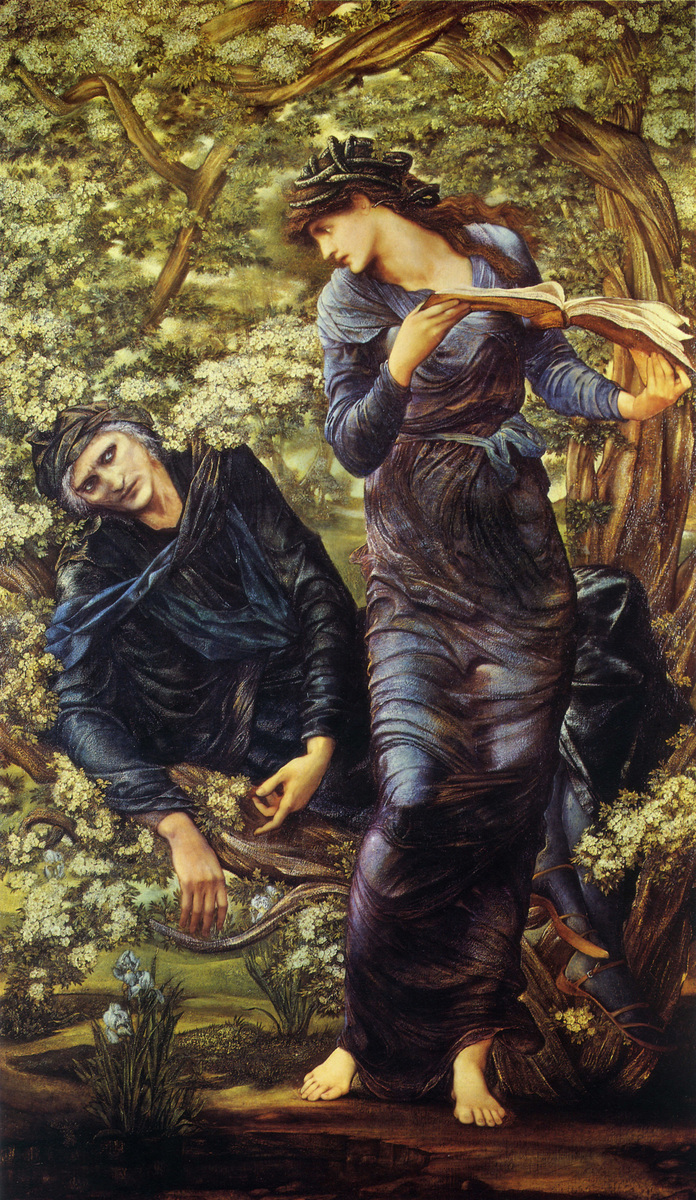
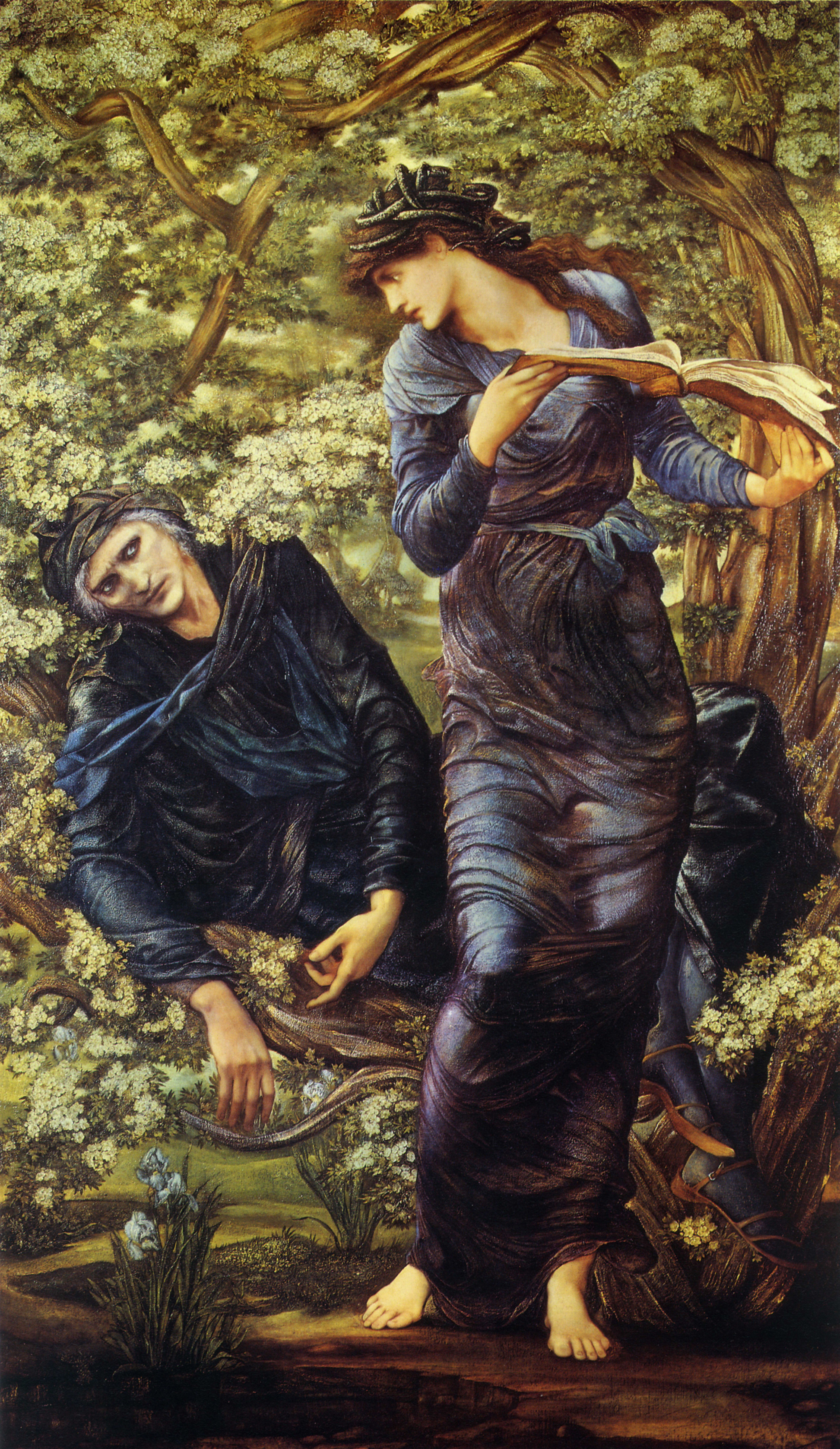
The dense mass of white hawthorn blossom and twisting bough that engulfs Merlin, the symbolic trap of the tree in which he is imprisoned.
02
Merlin's limp hand
Merlin's slack hands and draped sleeve resting over the branch, the gesture of surrender and drowsy weakness at the heart of his defeat.
03
Serpent headdress
The coiled serpent diadem wound through Nimue's hair, the identifying emblem of the enchantress and a key symbolic object in the scene.
Your gallery guide
The Beguiling of Merlin by Edward Burne-Jones (1873-1874)
A docent-led reading of Edward Burne-Jones's Arthurian scene, in which the enchantress Nimue works a spell over a spellbound Merlin amid hawthorn blossom, with the painting's pictorial choices connected to the story it tells.
Editorial review by Artifact Archive automated publishing
This is Edward Burne-Jones's The Beguiling of Merlin, painted between 1873 and 1874.
It shows the Arthurian moment when the prophet and advisor Merlin is overcome by the enchantress Nimue.
She stands over him with an open book of magic, and he is caught in the branches of a flowering tree.
Start with Merlin's face. It is pale and hollow-eyed, with a dark headcloth, and it tilts upward in an exhausted, spellbound expression.
His hands and draped sleeve have gone slack over a branch. That looseness is the picture's clearest sign of surrender, a body no longer holding itself up.
Around him, white hawthorn blossom and twisting boughs press close, so the tree does not sit behind him as scenery. It closes over him like a trap.
Nimue is the active figure here, and the painting gives her the tools of her magic. Both her hands hold a large open grimoire, the book through which the beguiling spell is worked.
A coiled serpent diadem is wound through her hair. That emblem identifies her as the enchantress in the scene.
The story belongs to Arthurian legend, and Burne-Jones painted this version of it in the early 1870s.
The painting turns the usual balance of power between a prophet and a sorceress around.
Merlin, the advisor whose knowledge should protect him, is the one who cannot move. Nimue, reading from the book, is the one in control.
The white hawthorn mass is not just decorative, it symbolizes the trap of the tree in which he is imprisoned. What looks like blossom is also the enclosure that holds him.
So the picture is about a defeat that happens quietly, through drowsiness and surrender rather than through violence.
Merlin's tilted face, his slack hands and the flowering branches all describe the same thing. He is being held by the spell, and the tree is already closing around him.
Burne-Jones gives the moment its stillness, and that stillness is what makes the enchantment legible.
The story and its sources
Editorial review by Artifact Archive automated publishing.
Historical claims are linked to the records below. Close looking and interpretation are identified in the passage notes.
Edward Burne-Jones was a British Pre-Raphaelite painter (1833-1898). Their work is associated with Pre-Raphaelite Brotherhood; Symbolism. Their recorded places of work include Birmingham; London.
Born
1833
Died
1898
Nationality
United Kingdom of Great Britain and Ireland; United Kingdom
The painting depicts the Arthurian episode in which Merlin, the prophet and advisor, is beguiled and overcome by Nimue, the enchantress. Merlin's slack hands and draped sleeve rest over a branch, and his pale, hollow-eyed face is tilted upward with an exhausted, spellbound expression that conveys his helpless enchantment. Nimue holds a large open grimoire, the instrument of the beguiling spell being worked over the fallen Merlin. A coiled serpent diadem is wound through her hair, and a dense mass of white hawthorn blossom and twisting bough engulfs Merlin. The scene represents the moment of Merlin's defeat by the enchantress's magic.(Wikimedia Commons: The Beguiling of Merlin, n.d.)
Title variants
The Beguiling of Merlin
Accession number
LL 3121
Support
canvas
Catalogue record and object data
The object is catalogued as The Beguiling of Merlin, attributed to Edward Burne-Jones, and is dated between 1873 and 1874. The recorded dimensions are 186 cm in height and 111 cm in width, and the subject is drawn from Arthurian legend, specifically the beguiling of Merlin by Nimue. These particulars come from the Wikimedia Commons object record, whose summary, dimensions, depicted-people and date fields supply the title, attribution, measurements and date range together.(Wikimedia Commons: The Beguiling of Merlin, n.d., Summary; Dimensions; Depicted people; Date)
The composition turns on the exchange of power between two figures. The prophet Merlin, whose knowledge ought to protect him, is held motionless in the branches, while Nimue stands over him as the active agent of the scene. The visual evidence locates the spell's instrument in her hands: both of Nimue's hands hold a large open grimoire, the book through which the beguiling is worked over the fallen Merlin. Merlin's defeat is described through the body rather than through violence. His slack hands and draped sleeve rest over a branch, a gesture of surrender and drowsy weakness, so that the picture presents a defeat accomplished quietly, through enchantment and the failure of the body to hold itself up, with the book rather than a weapon as the means.(Wikimedia Commons: The Beguiling of Merlin, n.d., Visual focus candidate)
Visual observation
Merlin's face carries the psychological weight of the scene. It is pale and hollow-eyed, framed by a dark headcloth and tilted upward, with an exhausted, spellbound expression that conveys helpless enchantment. That description places him in the position of the enchanted rather than the enchanter. The upward tilt of the head and the hollowness of the eyes are the features through which the state of enchantment becomes visible in the picture, so the surface of the face documents the spell as much as the open book does. The evidence describes this as how the figure appears, and the identification of the expression as one of helpless enchantment follows from the depicted features at the centre of the scene.(Wikimedia Commons: The Beguiling of Merlin, n.d., Visual focus candidate)
Nimue is identified by an emblem carried in the design of her hair. A coiled serpent diadem is wound through it, acting as the identifying emblem of the enchantress in the scene. In a composition where two figures share the picture space and the narrative depends on knowing who is working the spell, this worn sign performs a specific function: it marks her as the enchantress, distinct from the woman reading, and ties the act of reading in the picture to sorcery rather than to ordinary learning. The evidence treats the diadem as an identifying attribute, and the visual reading of the figure rests on that attribute.(Wikimedia Commons: The Beguiling of Merlin, n.d., Visual focus candidate)
The tree is not background but an active part of the composition. A dense mass of white hawthorn blossom and twisting bough engulfs Merlin, and the evidence states that this mass symbolises the trap of the tree in which he is imprisoned. The blossom and the bough work in the same direction as the spell: what appears as flowering vegetation also functions as enclosure, closing over the figure rather than standing behind him as scenery. The hawthorn foliage and the slack body of Merlin belong to one visual argument, since the branches supply the physical prison that coincides with the spell of the book. The descriptive and symbolic levels of the evidence converge here, which is why the tree can be read both as what is shown and as what the picture means.(Wikimedia Commons: The Beguiling of Merlin, n.d., Visual focus candidate)
The depicted figure of Merlin has a pale, hollow-eyed face with a dark headcloth, tilted upward with an exhausted, spellbound expression that conveys his helpless enchantment.(Wikimedia Commons: The Beguiling of Merlin, n.d.)
The Beguiling of Merlin is an oil on canvas, the medium recorded in the object record for the work and the only material fact the present evidence establishes about its making. That record is the same source from which the painting's dimensions of 186 cm by 111 cm and its present location at the Lady Lever Art Gallery, Liverpool, under accession number LL 3121, derive; these are cataloguing facts about the object as it now exists rather than observations of its surface. Nothing in the supplied evidence names the canvas weave, the ground or priming, the brand or composition of the paint, or any varnish, and no technical examination is cited here, so the account of materials must remain at the level of the medium itself. What the medium does establish is category: this is a large-scale oil painting on a flexible woven support, not a fresco, panel, watercolour or print, and its pictorial effects are therefore the effects of oil paint worked on canvas at a scale of roughly two metres in height.(Wikimedia Commons: The Beguiling of Merlin, n.d., Medium)
Interpretation
Nothing in the supplied units documents a pigment, a preparation layer, a brush, a tool or a step-by-step making technique for this painting, and no examination report, conservation record or artist's account is cited. The evidence does establish two things that bound any discussion of technique. First, the work is oil on canvas, which fixes the physical class of the object. Second, whether the units come from the object record's cataloguing or from its visual description, they describe the finished picture and its subject matter rather than its construction, so the careful account must separate what is documented about the medium from what is inferred by looking. The visual descriptions of faces, hands, textiles, a book, a diadem and blossoms are evidence about what is depicted; the medium statement is evidence about what carries the depiction. Where the evidence does not reach, the archive should say so rather than fill the gap with an assumed pigment or procedure, and any future technical study of the canvas, ground, paint layers or surface coating would be a genuinely new contribution rather than a confirmation of what is already known.(Wikimedia Commons: The Beguiling of Merlin, n.d., Medium; Visual focus candidate)
Materials, meaning and art-historical frame
The painting's place in a larger history of art and material culture follows from the combination of medium, scale and iconography rather than from any single unit alone. It is a large oil on canvas, 186 cm by 111 cm, held at the Lady Lever Art Gallery in Liverpool as LL 3121, and the object record assigns it to the years 1873 to 1874. Its subject is Arthurian: the beguiling of Merlin by Nimue, a scene in which a prophet and advisor is overcome by an enchantress who works her spell from an open book while a flowering tree closes over him. In the history of narrative painting this is a subject built from objects, a grimoire, a serpent diadem, a headcloth, a sleeve and a hawthorn, and the evidence's identification of those items as instruments and emblems connects the picture to a wider nineteenth-century interest in representing magic through tangible apparatus rather than through spectacle. The same evidence, however, keeps the account honest about its limits: the materials it documents extend only so far as the medium, and the technique of the picture remains, on this evidence, described rather than examined, a state of affairs that should be reported as such rather than smoothed over.(Wikimedia Commons: The Beguiling of Merlin, n.d., Medium; Visual focus candidate)
The Beguiling of Merlin by Edward Burne-Jones is held at the Lady Lever Art Gallery in Liverpool, where it carries the accession number LL 3121. This collection record anchors the object in a public museum collection and supplies the institutional identity by which the painting can be traced in the Gallery's holdings.(Wikimedia Commons: The Beguiling of Merlin, n.d., Collection)
Visual conventions of the scene
Interpretation
Taken together, these described elements support the reading that the painting concerns a quiet defeat rather than a violent one: Merlin's tilted face, his slack hands, and the flowering branches all belong to the same account of a body held by enchantment while the tree closes around it, and Nimue's open book places the source of that enchantment in her hands. The object record's identification of the white hawthorn mass as a symbol of the tree-prison is an interpretive claim made within the description, not a separate documentary fact about the painting's making, so it should be attributed to the source rather than treated as a detached given. The painting's importance for a larger history of art and material culture lies in this conjunction of a literary subject with a carefully specified set of visual attributes, a grimoire, a serpent diadem, hawthorn blossom, and a tree that functions as an enclosure, all preserved together in the collection record for an object held at the Lady Lever Art Gallery under accession number LL 3121.(Wikimedia Commons: The Beguiling of Merlin, n.d., Collection)
The object is The Beguiling of Merlin, an oil on canvas by Edward Burne-Jones, dated 1873 to 1874 and measuring 186 cm in height and 111 cm in width. It is held by the Lady Lever Art Gallery, Liverpool, under accession number LL 3121. The subject is drawn from Arthurian legend: the moment at which the prophet and advisor Merlin is overcome by the enchantress Nimue, who stands over him with an open book of magic while he is caught in the branches of a flowering tree. The painting is identified as a large-scale work by a major Pre-Raphaelite artist in a named institutional collection, and these identification and collection facts are the evidentiary foundation on which the valuation statement below depends.(Wikimedia Commons: The Beguiling of Merlin, n.d.)
Recorded valuation and its limits
The only valuation figure supplied is explicitly an interpretation rather than a documented market fact. A calculated working insurance estimate records a range of US$4M to US$12M, with the recorded date given as a working calculation generated 2026-10-16. The stated methodology is that the range is model-generated and derived from the supplied confirmed context, namely a large-scale 1873-1874 oil on canvas by Edward Burne-Jones, a major Pre-Raphaelite artist, held by the Lady Lever Art Gallery under accession LL 3121. The range is anchored to the work's art-historical prominence and museum collection status rather than to any reported sale, auction, or appraisal, and reflects conservative insurance-calculation convention for a unique, high-profile institutional painting. The estimate is recorded as intended only for manual review.(Wikimedia Commons: The Beguiling of Merlin, n.d.)
The qualifications attached to that estimate are as consequential as the figure itself. The record states that it is a model-generated working range for manual review only, and is not an official insurance value, appraisal, auction result, or sale price. The supplied sources confirm identification and collection context but contain no public valuation. No comparable sales and no private insurance records were used in producing the range. The record advises verification with a qualified appraiser and the institutional lender or insurer before relying on any figure. This means the 1873-1874 date, the oil on canvas medium, the measured dimensions, the attribution to Burne-Jones, and the Lady Lever Art Gallery holding with accession LL 3121 are documented facts about the object, while the monetary range is a modelled inference from those facts and carries no independent market evidence behind it.(Wikimedia Commons: The Beguiling of Merlin, n.d.)
Working estimate
Calculated working insurance estimate, not a sale price: Estimated insurance range: US$4M to US$12M Recorded date: Working calculation, generated 2026-10-16. Methodology: Model-generated working range derived from the supplied confirmed context: a large-scale 1873-1874 oil on canvas by Edward Burne-Jones, a major Pre-Raphaelite artist, held by the Lady Lever Art Gallery (accession LL 3121). The range is anchored to the work's art-historical prominence and museum collection status rather than to any reported sale, auction, or appraisal. It reflects conservative insurance-calculation convention for a unique, high-profile institutional painting and is intended only for manual review. Qualification: This is a model-generated working range for manual review only. It is not an official insurance value, appraisal, auction result, or sale price. The supplied sources confirm identification and collection context but do not contain a public valuation. No comparable sales or private insurance records were used. Verify with a qualified appraiser and the institutional lender or insurer before relying on any figure.(Wikimedia Commons: The Beguiling of Merlin, n.d.)
Further reading
Books for a closer look
Paid links. As an Amazon Associate I earn from qualifying purchases.
Visionary and dreamer; two poetic painters: Samuel Palmer and Edward Burne-Jones.
Princeton University Press
Recorded subjects include criticism and interpretation of Edward Burne-Jones, framing him as a visionary and poetic painter alongside Samuel Palmer. That art-historical comparison bears directly on the mythic, dreamlike character of The Beguiling of Merlin. It is the only candidate whose subjects indicate interpretive critical analysis rather than biography alone.
Penelope Fitzgerald's Edward Burne-Jones is catalogued with subjects including Artists, Biography, and Burne-Jones, Edward Coley, 1833-1898. A scholarly biographical study of the artist provides documented context for his paintings and their cultural reception, which is relevant background for The Beguiling of Merlin.
Recorded subjects include criticism and interpretation of Edward Burne-Jones, framing him as a visionary and poetic painter alongside Samuel Palmer. That art-historical comparison bears directly on the mythic, dreamlike character of The Beguiling of Merlin. It is the only candidate whose subjects indicate interpretive critical analysis rather than biography alone.
Penelope Fitzgerald and Edward Burne Jones (2003).Edward Burne-Jones. History Press Limited, The.
Penelope Fitzgerald's Edward Burne-Jones is catalogued with subjects including Artists, Biography, and Burne-Jones, Edward Coley, 1833-1898. A scholarly biographical study of the artist provides documented context for his paintings and their cultural reception, which is relevant background for The Beguiling of Merlin.
Fit and fill keep the painting’s proportions. Stretch changes them.
Move and zoom the painting on your biodegradable phone case.
Preparing the artwork for your edition…
Made to order
From the archive
36.6 cm / 14.4 in30.7 cm / 12.1 in
36.6 × 30.7 cm / 14.4 × 12.1 in · Standard
Drag to rotate
36.6 × 30.7 cm / 14.4 × 12.1 in · Standard
14.4 in / 36.6 cm12.1 in / 30.7 cm
14.4 × 12.1 in / 36.6 × 30.7 cm · Standard
14.4 in / 36.6 cm12.1 in / 30.7 cm
14.4 × 12.1 in / 36.6 × 30.7 cm · Standard
14.4 in / 36.6 cm12.1 in / 30.7 cm
14.4 × 12.1 in / 36.6 × 30.7 cm · Standard
Drag to rotate1 / 3
Desk mat
GBP 15.20
Delivery GBP 5.46 / Total GBP 20.66
A smooth polyester desk mat with a natural rubber non-slip base and anti-fray edges, available in three sizes.
Fit and fill keep the painting’s proportions. Stretch changes them.
Move and zoom the painting on your desk mat.
Preparing the artwork for your edition…
Made to order
The 30 cm ruler is scaled alongside your selected print. Keep the painting’s proportions with a black background, or stretch it to fill. Frame width, material texture and screen colours are illustrative.
Advertising supports the archive. These preferences control aggregate page counting, reading activity and ad-delivery diagnostics. They use no visitor tracking cookie.