The Room and Its Making
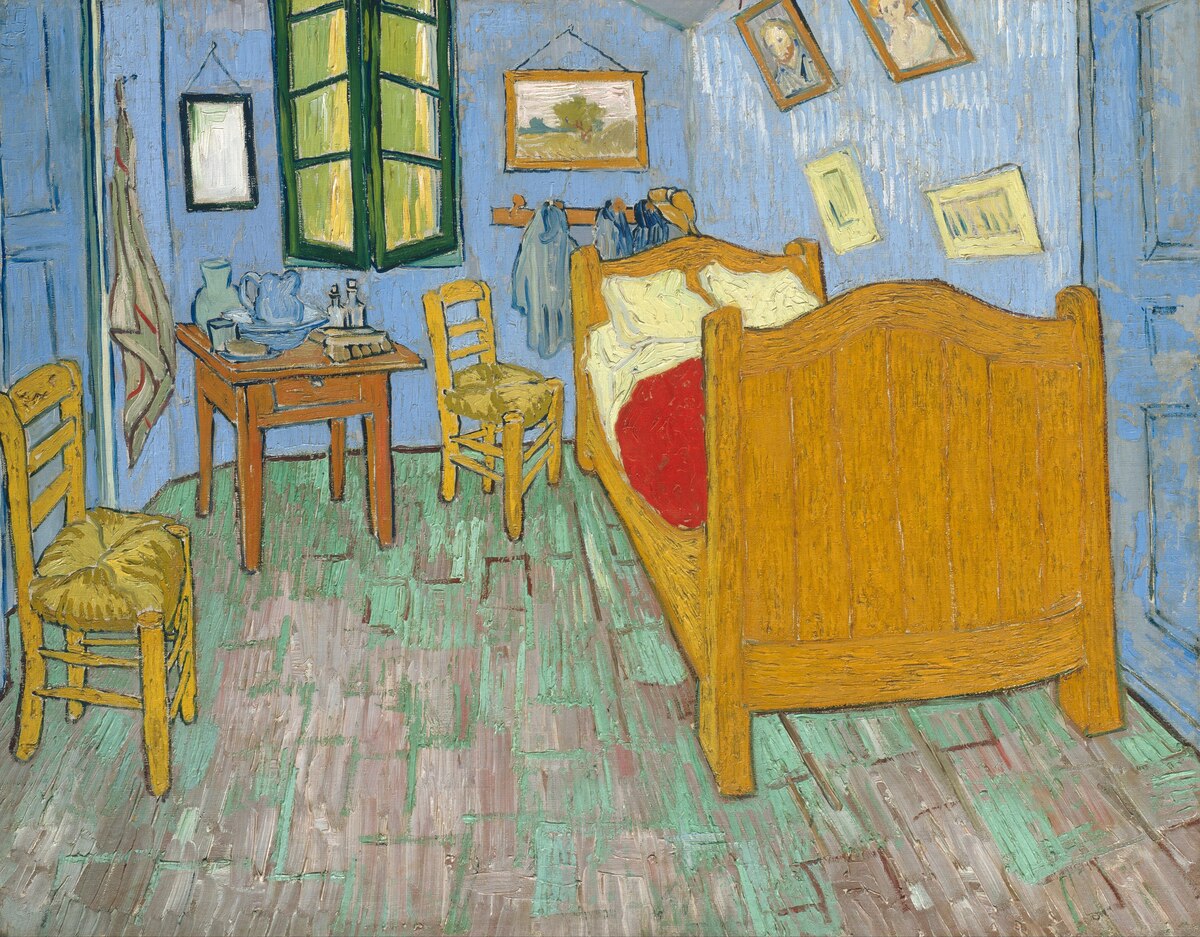
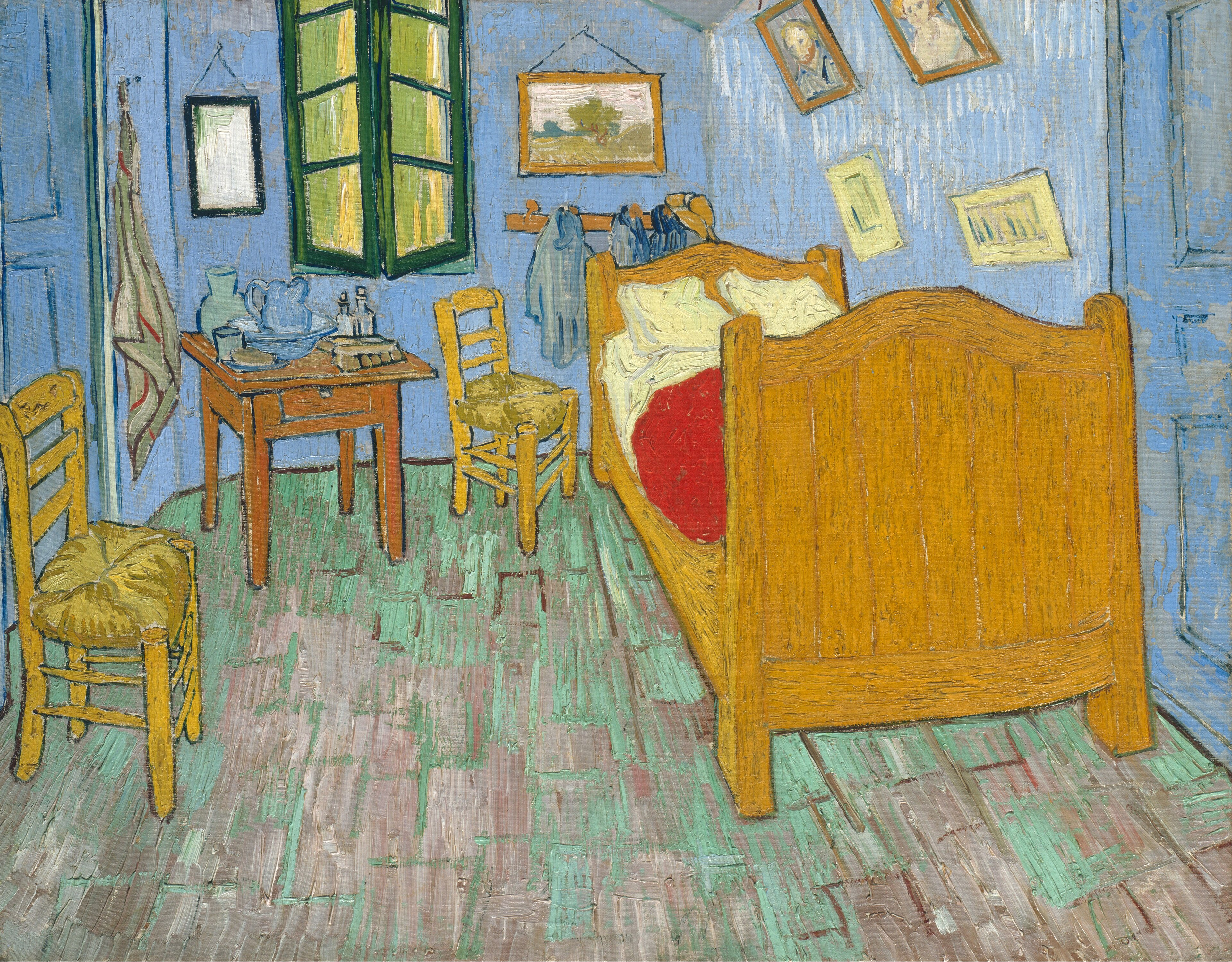
The Van Gogh Museum's object record establishes that Vincent van Gogh painted The Bedroom while he was in Arles, depicting his bedroom in the Yellow House. The same record states that he prepared the room himself with simple furniture and his own work on the wall. That sequence matters for how the picture is usually read: the room was not inherited as a furnished interior but assembled by the painter, so the plain bed, chairs and washstand that dominate the composition correspond to objects he had chosen and placed, and the pictures shown hanging on the wall correspond to his own work rather than to borrowed decoration. The subject is therefore both a private domestic space and a space of the painter's own making, which is why the museum presentation treats the room itself, and not only the canvas, as part of the object's documented circumstances.(Van Gogh Museum, Amsterdam, n.d.)
Interpretation
The record also preserves a physical qualification about the room. According to the Van Gogh Museum, the odd angle of the rear wall is not a mistake on Van Gogh's part; the corner really was skewed. This is a documented claim about the actual configuration of the Yellow House room, and it limits how far the picture's irregular geometry can be explained by artistic licence alone. Alongside it, the museum separately describes the treatment of perspective: the rules of perspective seem not to have been accurately applied throughout the painting, but this was a deliberate choice. The two statements operate at different levels. The skewed corner is a fact about the space depicted; the deliberate departure from perspective is an interpretation of the painter's decision. Read together, they warn against treating every anomaly in the room as either a defect of observation or a purely stylistic device, since at least one irregularity belongs to the room's real construction.(Van Gogh Museum, Amsterdam, n.d.)
Vincent van Gogh painted The Bedroom while he was in Arles, depicting his bedroom in the Yellow House.(Van Gogh Museum, Amsterdam, n.d.)
Van Gogh prepared the room himself with simple furniture and his own work on the wall.(Van Gogh Museum, Amsterdam, n.d.)
The odd angle of the rear wall is not a mistake on Van Gogh's part; the corner really was skewed.(Van Gogh Museum, Amsterdam, n.d.)
Materials and technique
LinkSupport and medium
The Bedroom is an oil on canvas measuring 72.4 cm by 91.3 cm. That medium and support are what the museum's object record documents, and they frame everything else that can be said about how the picture was made: the paint sits on a woven canvas rather than on panel, and the working method is oil painting, the technique Van Gogh used for the Arles canvases of this period. The dimensions are modest in the scale of exhibition pictures, close to a metre wide, and they describe a canvas whose subject, a furnished room, is presented at something near the scale of the room's own contents rather than as a grand interior. The record also locates the painting in the Van Gogh Museum, Amsterdam, where it is currently on view, so the physical object itself, not only a reproduction, remains the primary reference for any technical description.(Van Gogh Museum, Amsterdam, n.d.)
The most consequential technical finding recorded for this painting concerns colour change. Research cited by the museum shows that the strongly contrasting colours seen in the work today are the result of discolouration over the years, and that the walls and doors were originally purple rather than the blue they now appear. This is a statement about the paint layer itself, established by research on the object, not a visual inference from looking at the surface: what the viewer now sees is a later state of the canvas, altered by time. The finding matters because the picture's chromatic structure is part of its documented making. Where blue now sets up a sharp opposition within the room, the original scheme paired purple surfaces with the other colours of the interior, and the contrast available to the painter was therefore different from the contrast available to a viewer today. Any description of the painting's colour that treats the present appearance as the intended appearance would misstate the evidence, and any reconstruction of its original effect has to begin from the documented shift rather than from the surface as it stands.(Van Gogh Museum, Amsterdam, n.d.)
The room as constructed subject
Van Gogh prepared the room he painted himself, furnishing it with simple furniture and hanging his own work on the wall. That detail belongs to the making of the subject as well as to the making of the picture: the interior was arranged by the painter before it was depicted, so the canvas records a space that had been deliberately set up rather than one simply found. The same body of description reports that the corner of the room really was skewed, so the odd angle of the rear wall is not a mistake on Van Gogh's part. Together these points separate two different questions that are often run together. One is what the room was like, and the evidence is that its geometry included a genuinely skewed corner. The other is how the painter handled that geometry on the canvas, which the evidence treats as a matter of deliberate treatment rather than failed observation. The qualification is important: the skewed corner is a fact about the room, while the treatment of perspective is a fact about the painting's construction, and the museum's account distinguishes them.(Van Gogh Museum, Amsterdam, n.d.)
Van Gogh told his brother Theo in a letter that he had deliberately flattened the interior and left out the shadows so that his picture would resemble a Japanese print. The museum's account adds that the rules of perspective seem not to have been accurately applied throughout the painting, but that this too was a deliberate choice. Taken with the prepared room and its true skew, this gives a consistent picture of the making: an interior whose actual geometry was uneven, rendered with flattened space and suppressed shadow as a chosen pictorial language rather than as a failure to record what was there. The evidence attributes the intention to Van Gogh himself through his own correspondence, which is the strongest form of attribution available here for intent, and it attributes the observation about perspective to the museum's interpretation of the work. Bright colour, too, is described as meant to express absolute repose or sleep, so colour and spatial treatment are presented as carrying the picture's purpose rather than merely describing a room. What cannot be established from this evidence is the precise sequence of laying in the paint, the number of layers, or the specific pigments used beyond the documented colour shift; those details are not recorded in the supplied material and should not be supplied from assumption.(Van Gogh Museum, Amsterdam, n.d.)
Evidence and its limits
Two kinds of evidence meet in this painting and should be kept distinct. The museum's object record documents the medium, support and dimensions, and reports the results of research on discolouration; the letter to Theo documents the painter's stated intention to flatten the interior and omit shadows in emulation of a Japanese print. The visual surface of the canvas supplies the third term: the flat, even arrangement in which objects sit side by side rather than receding into deep space, and the strong colour contrasts as they now appear. The technical finding about original purple walls and doors sits between these registers, because it explains why the present surface differs from the made surface. Read together, the evidence supports a description of the picture as an oil painting on a canvas of specific size whose spatial and chromatic construction was chosen, whose subject was a room the painter had furnished himself, and whose appearance has since been altered by discolouration. It does not support claims about pigments, grounds, varnishes, lining, retouching or examination methods that the supplied units do not contain.(Van Gogh Museum, Amsterdam, n.d.)
Interpretation
The painting's importance in a history of nineteenth-century art practice lies partly in this convergence of purpose and material fate. A canvas made to express absolute repose or sleep through bright colour and flattened, shadowless space is exactly the kind of object whose meaning is bound to its surface, and that surface has changed. The documented shift from purple walls and doors to blue means that a central element of the intended effect is no longer directly visible, while the evidence of that intention survives in the record and in the artist's own statement. Van Gogh's later remark, that after an illness what seemed to him the best of his canvases was the bedroom, confirms how highly he valued the work and gives the painting a place in his own ranking of his output; a related version dated September 1889, now in the Art Institute of Chicago as part of the Helen Birch Bartlett Memorial Collection, shows that the composition was revisited. For the study of materials and technique, the object is therefore instructive on two fronts at once: it preserves a documented example of deliberate spatial flattening and colouristic intention, and it demonstrates how discolouration can quietly rewrite the colour relations on which such an intention depended, so that technical research rather than unaided looking becomes the route back to the picture as it was made.(Van Gogh Museum, Amsterdam, n.d.)
Condition and original colour
Technical examination
The strongly contrasting colours seen in the work today are the result of discolouration over the years. Research indicates that the walls and doors, which now appear blue, were originally purple. This finding concerns the painting's present appearance as a record of alteration rather than of the artist's original colour scheme, and it bears directly on any reading of the picture's chromatic contrasts: the effect visible now is not the effect originally set down. Within the larger history of late nineteenth-century painting, such evidence of pigment change is consequential because it separates what a canvas shows from what it once showed, and it makes the painting a document of material instability as well as of deliberate composition.(Van Gogh Museum, Amsterdam, n.d.)
Technical examination
Research shows that the strongly contrasting colours seen in the work today are the result of discolouration over the years; the walls and doors were originally purple rather than blue.(Van Gogh Museum, Amsterdam, n.d.)
Provenance and ownership
LinkRelated versions and the Chicago record
A related version of the painting is in the Art Institute of Chicago, dated September 1889, oil on canvas, 73.6 cm by 92.3 cm, accession number 1926.417. That version belongs to the Helen Birch Bartlett Memorial Collection. These are the documented particulars of the Chicago canvas: its date, its medium, its slightly larger dimensions relative to the Amsterdam painting, its accession number, and the named collection through which it entered the museum. The institutional record supplied here establishes the accession number and collection but does not record an earlier owner, a sale, or the date of transfer into the collection. Any account of how the canvas reached Chicago, or of who held it before the memorial collection, would therefore go beyond the evidence; what is documented is the object's identification by accession number and its place in the Helen Birch Bartlett Memorial Collection.(commons.wikimedia.org, n.d.)
Interpretation
The two records must be kept distinct when the paintings are discussed. The Amsterdam canvas and the Chicago canvas are related versions, not the same object: the Chicago work carries the September 1889 date and the accession number 1926.417, while the Amsterdam work is the canvas on view at the Van Gogh Museum. Because the evidence supplies an accession number and a named memorial collection only for the Chicago version, it does not license statements about the Amsterdam painting's own ownership history. Within the wider history of van Gogh's multiple treatments of the bedroom, the Chicago record is useful precisely because it fixes one version to a documented institutional identity, leaving the sequence of private hands, if any, unstated in the evidence.(commons.wikimedia.org, n.d.)
Reception and literature
LinkThe Artist's Own Judgment
Van Gogh was very pleased with the painting. After an illness he wrote, 'When I saw my canvases again after my illness, what seemed to me the best was the bedroom.' This is the artist's own retrospective ranking of the canvas, and it belongs to the documented reception of the work by its maker rather than to later commentary: the picture was valued by Van Gogh himself as the strongest of the canvases he returned to after that illness.(Van Gogh Museum, Amsterdam, n.d.)
Colour Change and Its Consequences
Research shows that the strongly contrasting colours seen in the work today are the result of discolouration over the years; the walls and doors were originally purple rather than the blue they now appear. This finding changes how the painted surface should be read against Van Gogh's stated intention of expressing absolute repose or sleep through bright colour: the chromatic relationships now visible are not identical to those he set down. The evidence attributes the colour change to discolouration established by research, so the original purple walls and doors are a documented reconstruction of the painting's earlier state rather than a description of what a viewer sees today.(Van Gogh Museum, Amsterdam, n.d.)
Van Gogh was very pleased with the painting, writing 'When I saw my canvases again after my illness, what seemed to me the best was the bedroom.'(Van Gogh Museum, Amsterdam, n.d.)
Interpretations and debates
LinkColour, Intention and Change
Interpretation
The Van Gogh Museum attributes to Van Gogh the intention that the bright colours express absolute repose or sleep. This is a reading of purpose, framed by the museum as what the colours were meant to do rather than as a claim about the viewer's response, and it places rest, not description alone, at the centre of the picture's colour programme. The museum's technical research complicates any account that treats the colours now visible as identical with those Van Gogh chose: the strongly contrasting colours in the work today are said to result from discolouration over the years, and the walls and doors are reported to have been purple originally rather than the blue they now appear. Purple and blue are not the same colour, and the shift matters because the present contrast between walls and furnishings is partly an effect of time rather than an entirely authored final state. The museum presents this as the finding of research, not as an unqualified observation of the canvas.(Van Gogh Museum, Amsterdam, n.d.)
Flattening, Perspective and the Japanese Print
Two separate points in the museum's account concern spatial structure, and they should not be conflated. First, the odd angle of the rear wall is not a mistake on Van Gogh's part, because the corner of the actual room was skewed; the painted irregularity corresponds to a real condition of the Yellow House interior. Second, the rules of perspective seem not to have been accurately applied throughout the painting, and the museum characterises this as a deliberate choice. One claim is about fidelity to a skewed room, the other about a departure from perspectival convention. The museum also reports that Van Gogh told his brother Theo in a letter that he had deliberately flattened the interior and left out the shadows so that his picture would resemble a Japanese print. That letter, as the museum reports it, is Van Gogh's own stated rationale, which is a different order of evidence from the museum's inference that the perspective is deliberately handled. The three points together explain why the room reads as flat and why objects sit side by side rather than receding into depth, but each rests on its own evidential footing.(Van Gogh Museum, Amsterdam, n.d.)
Colour, Intention and Change
Taken together, the museum's account supports a reading in which The Bedroom is deliberately constructed as an image of rest whose means are both descriptive and anti-naturalistic: a room that was really prepared with simple furniture and the painter's own work on the wall; a real skewed corner that survives in the picture; a flattening Van Gogh himself justified by reference to Japanese prints; and a colour scheme intended for repose but subsequently altered by discolouration. The object therefore matters within a larger history of art and material culture on two levels at once. As a document of practice, it records an interior the painter arranged and then transformed according to a stated pictorial aim. As a physical object, it demonstrates that what viewers see today is not identical with what was painted, which limits any interpretation built directly on the present appearance of the walls and doors. The limits of further synthesis lie here: the record as supplied supports the attribution of the repose intention and the Japanese-print rationale to Van Gogh as reported, but it does not license claims about private motives beyond what the letter is said to contain, nor about pigments, treatments or condition history beyond the discolouration finding.(Van Gogh Museum, Amsterdam, n.d.)
The Painter's Own Judgment
The interpretive claims gathered here belong to different speakers, and keeping them apart is part of interpreting the picture responsibly. The museum is the source of the statement that the bright colours were meant to express absolute repose or sleep, the statement that the perspective is deliberately rather than accidentally handled, the report of the letter to Theo about flattening the interior in emulation of a Japanese print, the report that the walls and doors were originally purple, and the account of the rear wall's skew. Van Gogh is the source of the self-assessment in the quoted sentence about the bedroom being the best of his canvases after his illness. None of these should be promoted into a documented statement of private intent that the evidence does not contain. The distinction matters especially for the discolouration finding and the Japanese-print rationale: the first is a technical result about what the painting has become, the second is a rationale attributed to the painter and reported through a letter.(Van Gogh Museum, Amsterdam, n.d.)
Van Gogh told Theo in a letter that he had deliberately 'flattened' the interior and left out the shadows so that his picture would resemble a Japanese print.(Van Gogh Museum, Amsterdam, n.d.)
Collection and display
LinkObject and Collection Record
This section examines the material, documentary, and interpretive accounts surrounding Vincent van Gogh's The Bedroom, painted in Arles, and its current placement in the Van Gogh Museum, Amsterdam. The museum record supplies the object's medium of oil on canvas and its dimensions of 72.4 by 91.3 centimetres, and identifies the subject as van Gogh's own bedroom in the Yellow House, a room he prepared himself with simple furniture and his own work on the wall. These physical and biographical particulars anchor the discussion: the painting is not an imagined interior but a record of a domestic space the artist arranged, and the documentation of medium and measurement makes the object's material identity concrete for comparison with other accounts and versions.(Van Gogh Museum, Amsterdam, n.d.)
The Van Gogh Museum states that the painting is currently on view at the museum in Amsterdam, which establishes its present custodial and display location. This is a documented status rather than an inferred one, and it matters for how the work is encountered: the account of its original conception in Arles and the account of its current visibility belong to different institutional and historical moments. The museum record therefore connects the historical object to its living public presentation, without implying that the current viewing conditions reproduce those of the Yellow House.(Van Gogh Museum, Amsterdam, n.d.)
Colour, Effect, and Intention
The museum's interpretation identifies the bright colours of the painting as intended to express absolute repose or sleep, an account that links colouristic choice to a stated emotional programme rather than to merely descriptive likeness. This interpretation is attributed to the museum record and is consistent with the artwork's documentary identity as an Arles interior. The claim is significant for the history of art because it positions colour as a carrier of psychological states, a development often associated with van Gogh's practice, while the evidence here establishes the intended association between colour and repose rather than any broader theory of his colour use.(Van Gogh Museum, Amsterdam, n.d.)
According to the museum record, van Gogh told his brother Theo in a letter that he had deliberately 'flattened' the interior and left out the shadows so that the picture would resemble a Japanese print. This documentary attribution is important for understanding the painting's spatial conventions: the flattening and suppression of shadow are not deficiencies of execution but deliberate formal choices connected by the artist himself to Japanese print exemplars. The museum adds that although the rules of perspective seem not to have been accurately applied throughout the painting, this was a deliberate choice, and that the odd angle of the rear wall is not a mistake because the corner really was skewed. Taken together, these points distinguish between observed irregularities and their explanations, and they show that the work's departures from conventional perspective are supported by both artistic intention and the physical geometry of the room.(Van Gogh Museum, Amsterdam, n.d.)
Research reported by the museum shows that the strongly contrasting colours seen in the work today are the result of discolouration over the years, and that the walls and doors were originally purple rather than blue. This finding has a direct bearing on interpretation: the colour relationships now visible are not identical to those van Gogh intended, so readings of the painting's chromatic effect must account for change over time. The evidence establishes a documented alteration in the object's appearance without specifying pigments or treatment details beyond the purple-to-blue shift, and it qualifies any account that treats the present surface as an unmediated record of the artist's palette. It also connects the object to broader technical research on nineteenth-century painting materials, where colour change alters the historical evidence available to viewers and scholars alike.(Van Gogh Museum, Amsterdam, n.d.)
Reception and Attribution
The museum record documents van Gogh's own assessment of the work: he was very pleased with the painting and wrote, 'When I saw my canvases again after my illness, what seemed to me the best was the bedroom.' This quotation, attributed in the record to van Gogh, places the painting within the artist's own hierarchy of his production and ties its valuation to a moment of recovery after illness. It is evidence of reception by the maker rather than by later audiences, and it shows that the work's importance was asserted early and in the artist's own words, not only constructed by subsequent scholarship or display.(Van Gogh Museum, Amsterdam, n.d.)
Interpretation
The combined evidence presents the painting as a site where intention, material change, and institutional care intersect. The museum record establishes the work's medium, dimensions, subject, preparatory arrangement of the room, intended colour effect, deliberate formal flattening, documented discolouration, and current display, while attributing interpretive claims to the museum or to van Gogh's letters. The account therefore supports a layered understanding of the object: what can be seen today is the product of deliberate compositional choices and of subsequent material alteration, and the object's significance within the history of art and material culture rests on this documented interaction rather than on any single account. Where the record attributes a view to the museum or reports a letter, that attribution is retained, and uncertainties about colour, perspective, and later appearance are kept explicit rather than resolved into a single narrative.(Van Gogh Museum, Amsterdam, n.d.)
A related version of the painting is in the Art Institute of Chicago, dated September 1889, oil on canvas, 73.6 cm by 92.3 cm, accession number 1926.417, from the Helen Birch Bartlett Memorial Collection.(commons.wikimedia.org, n.d.)
Documented values and qualified estimates
LinkCalculated valuation and its qualifications
Interpretation
The calculated working insurance estimate for Vincent van Gogh's The Bedroom (F482) places its value at US$500M to US$2B, a range generated on 2026-10-16 as a broad, conservative working figure for manual review only. The methodology behind this figure is explicitly non-market-based: it derives from a conservative baseline for a major museum-quality Van Gogh, widened to reflect the uncertainty of placing any insurance figure on a unique, non-marketable cultural asset. No comparable sales were used and no private insurance records were accessed. The stated basis for the calculation is the confirmed artwork context: a major oil on canvas by Van Gogh dated October 1888, held by the Van Gogh Museum, Amsterdam, a canonical Post-Impressionist painting and foundational image of the artist's Arles period, and one of the most widely reproduced works in Western art.(Van Gogh Museum, Amsterdam, n.d.)(commons.wikimedia.org, n.d.)
The estimate is qualified in several consequential ways that bear on how it should be read. It is model-generated for manual review only and is not an official insurance value, appraisal, auction result, or sale price; it should not be relied upon for underwriting, coverage, tax, legal, or financial decisions. The artwork is held in a public museum collection and is not available for sale, which limits the usefulness of any market-based valuation. Actual insurance arrangements for museum-held works are typically handled through institutional policies, sovereign indemnity, or specialized fine-art coverage that may differ substantially from this figure. The range is intentionally broad to avoid implying precision.(Van Gogh Museum, Amsterdam, n.d.)(commons.wikimedia.org, n.d.)
Documented facts and the limits of the figure
Taken together, the evidence establishes a clear split between documented object facts and a model-generated financial figure. The artist, date, medium, dimensions, current location, and institutional status are confirmed by the source excerpts cited in the valuation methodology and by the Van Gogh Museum record. The US$500M to US$2B range, by contrast, is a working calculation for manual review only, derived without comparable sales or private insurance records and explicitly not an official valuation. Because The Bedroom is an irreplaceable museum-held masterpiece not available for public sale, the range is a deliberately broad and conservative construct rather than a market observation, and its usefulness is limited by the non-marketable character of the asset it describes.(Van Gogh Museum, Amsterdam, n.d.)(commons.wikimedia.org, n.d.)
Working estimate
Calculated working insurance estimate, not a sale price: Estimated value: US$500M to US$2B Recorded date: Working calculation, generated 2026-10-16. Methodology: This calculated insurance range is a broad, conservative working figure for manual review only. It is based on the confirmed artwork context: a major oil on canvas by Vincent van Gogh dated October 1888, The Bedroom (F482), held by the Van Gogh Museum, Amsterdam. The work is a canonical Post-Impressionist painting, a foundational image in Van Gogh's Arles period, and one of the most widely reproduced works in Western art. The source excerpts confirm the artist, date, medium, dimensions, current location, and institutional status. Because the painting is an irreplaceable museum-held masterpiece that is not available for public sale, the range is derived from a conservative baseline for a major museum-quality Van Gogh and then widened to reflect the uncertainty of placing any insurance figure on a unique, non-marketable cultural asset. The range is intentionally broad to avoid implying precision. No comparable sales were used, and no private insurance records were accessed. Qualification: This is a model-generated working insurance range for manual review only. It is not an official insurance value, appraisal, auction result, or sale price. It should not be relied upon for underwriting, coverage, tax, legal, or financial decisions. The artwork is held in a public museum collection and is not available for sale, which limits the usefulness of any market-based valuation. Actual insurance arrangements for museum-held works are typically handled through institutional policies, sovereign indemnity, or specialized fine-art coverage that may differ substantially from this figure.(Van Gogh Museum, Amsterdam, n.d.)(commons.wikimedia.org, n.d.)