A docent-led reading of Rembrandt's 1632 group portrait, showing Dr Nicolaes Tulp demonstrating a dissected forearm to guild members. The tour connects the painting's staged composition and the anatomy lesson's public function, using the supplied object record.
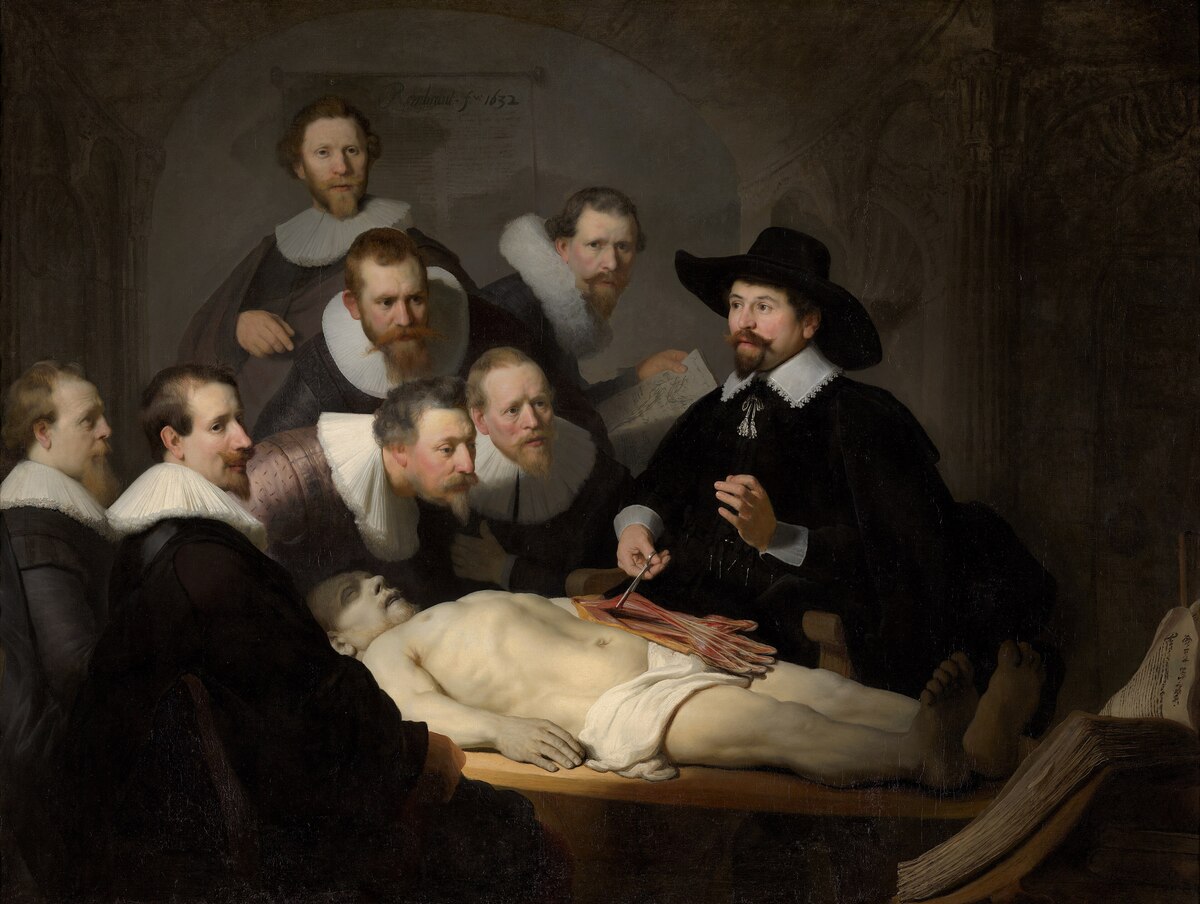
A large open folio propped at the lower right edge, its text standing in for the anatomical authority behind the demonstration and closing the composition in the foreground.
02
Man holding the paper
The figure with the white fur collar and pointed beard at the back right holds up a sheet of paper, traditionally read as the list of guild members paying to be portrayed.
03
Leaning spectators
The clustered guild members in ruffs and dark doublets who crowd toward the body, their craning heads and fixed gazes conveying the collective concentration of the lesson.
Your gallery guide
The Anatomy Lesson of Dr Nicolaes Tulp by Rembrandt (1632)
A docent-led reading of Rembrandt's 1632 group portrait, showing Dr Nicolaes Tulp demonstrating a dissected forearm to guild members. The tour connects the painting's staged composition and the anatomy lesson's public function, using the supplied object record.
Editorial review by Artifact Archive automated publishing
This is Rembrandt's The Anatomy Lesson of Dr Nicolaes Tulp, painted in 1632. It shows Dr Nicolaes Tulp and other figures gathered around a cadaver during an anatomy lesson.
The subject is a group portrait, but it records an event: a public dissection in which Tulp demonstrates the muscles of the forearm. The painting belongs to the Baroque period and is now in the Mauritshuis.
The body lies diagonally across the lower half of the canvas, head at the left and feet toward the right. Tulp sits or leans above it, positioned slightly left of centre, and his hand is raised near the opened forearm.
The other men cluster behind and around the table, their faces turned toward the demonstration. The composition arranges them in a shallow arc, so the viewer sees both the lesson and the group.
In seventeenth-century Holland, anatomy lessons were held by surgeons' guilds and were often public events. The painting commemorates one such lesson, and the figures are identified as Dr Nicolaes Tulp and others.
Rembrandt was in his mid-twenties when he made this group portrait. The work is oil on canvas and measures about 169.5 by 216.5 centimetres.
The painting has been read as more than a simple record. Tulp's gesture directs attention to the dissected arm, while the listeners' stillness turns the scene into a demonstration of authority and inquiry.
That reading depends on the visible arrangement: the central action is the dissection, but the men's poses and glances also construct a social hierarchy. The guild members are not passive; they are shown as witnesses to specialised knowledge.
What stays with you is the tension between the corpse's slack body and the alert, orderly group above it. Rembrandt gives the lesson a stage, and the stage makes the lesson memorable.
The painting is a group portrait, a professional record, and a dramatisation of discovery. Its subject is not just anatomy but the public performance of knowing.
The story and its sources
Editorial review by Artifact Archive automated publishing.
Historical claims are linked to the records below. Close looking and interpretation are identified in the passage notes.
Rembrandt was a Dutch painter and printmaker whose portraits, historical scenes and self-portraits explore expression through light and shadow. Born in Leiden, he trained locally and with Pieter Lastman in Amsterdam before establishing his own workshop. He moved to Amsterdam around 1631, where commissions, teaching and collecting became central to his career.
The Anatomy Lesson of Dr. Nicolaes Tulp; De anatomische les van Dr Nicolaes Tulp; Lección de anatomía del Dr. Nicolaes Tulp; Die Anatomie des Dr. Tulp; 尼古拉斯·杜爾博士的解剖學課; テュルプ博士の解剖学講義
Accession number
146
Support
canvas
Catalogue identity
The object is catalogued as The Anatomy Lesson of Dr Nicolaes Tulp, a title that names both the presiding surgeon and the occasion depicted. The recorded attribution is to Rembrandt, and the recorded date of the painting is 1632. The painting is described as a group portrait showing Dr Nicolaes Tulp together with other figures during an anatomy lesson. Within that group, Nicolaes Tulp is among the depicted people. These are the identifying particulars the catalogue record establishes: a named sitter who is a doctor, a named collective subject, a named maker, and a single year. The record does not, in the material available, break the attribution down into a signature, a document or a later connoisseurial judgement, so the attribution stands here as a catalogue attribution rather than as an argued case.(Wikimedia Commons: The Anatomy Lesson of Dr Nicolaes Tulp, n.d.)
The object at issue is The Anatomy Lesson of Dr Nicolaes Tulp, a group portrait painted by Rembrandt in 1632 and today in the collection of the Mauritshuis, The Hague, where it carries accession number 146. It is executed in oil on canvas and measures 169.5 by 216.5 centimetres, a scale suited to a large group composition rather than a small cabinet picture. The depicted people include Nicolaes Tulp, the figure around whom the scene is organised, and the work is associated with the Baroque period. These particulars establish the secure identification of the painting, its maker, its date, its medium and dimensions, and its current institutional home, and they set the frame within which the circumstances of its making have to be discussed.(Wikimedia Commons: The Anatomy Lesson of Dr Nicolaes Tulp, n.d.)
Composition and the anatomy lesson
The subject is a group portrait depicting Dr Nicolaes Tulp and others during an anatomy lesson, and the event shown is a public dissection in which Tulp demonstrates the muscles of the forearm. In the composition the body lies diagonally across the lower half of the canvas, head at the left and feet toward the right, while Tulp sits or leans above it, positioned slightly left of centre, his hand raised near the opened forearm. The other men cluster behind and around the table with their faces turned toward the demonstration, arranged in a shallow arc so that the viewer sees both the lesson and the group. The painting is therefore legible at once as a portrait of named individuals and as a record of a procedure, with the demonstrator's gesture supplying the action that the sitters' attention answers.(Wikimedia Commons: The Anatomy Lesson of Dr Nicolaes Tulp, n.d.)
Guild practice and the occasion of the commission
In seventeenth-century Holland, anatomy lessons were held by surgeons' guilds and were often public events. The painting commemorates one such lesson, and its figures are identified as Dr Nicolaes Tulp and others. Rembrandt was in his mid-twenties when he made this group portrait. This is the social world in which the object belongs: a guild occasion, public in character, commemorated in paint by a young artist working for a professional body rather than for a private devotional or domestic setting. The evidence describes the lesson as an event of that kind and identifies the participants only as Tulp and others, so the precise commissioning arrangements, the terms agreed, and the individual roles of the sitters remain outside what these units document.(Wikimedia Commons: The Anatomy Lesson of Dr Nicolaes Tulp, n.d.)
Authority, inquiry and the group portrait
Interpretation
The painting has been read as more than a simple record. On that account, Tulp's gesture directs attention to the dissected arm, while the listeners' stillness turns the scene into a demonstration of authority and inquiry. The reading depends on the visible arrangement: the central action is the dissection, but the men's poses and glances also construct a social hierarchy, and the guild members are shown not as passive bystanders but as witnesses to specialised knowledge. This is an attributed interpretation rather than a bare description, and it matters for how the object is placed in a larger history: it treats a professional group portrait as a staging of knowledge and status, in which the painted performance of inquiry is as much the subject as the anatomy itself.(Wikimedia Commons: The Anatomy Lesson of Dr Nicolaes Tulp, n.d.)
The Anatomy Lesson of Dr Nicolaes Tulp is recorded as an oil painting on canvas measuring 169.5 cm by 216.5 cm, a scale that places the figures close to life size and gives the grouping a public, almost theatrical presence. The object is catalogued as by Rembrandt, dated 1632, and held in the collection of the Mauritshuis, The Hague, under accession number 146. These basic facts about support, dimensions, attribution and location frame any discussion of how the picture was made: they establish that the work is a large, portable canvas painting in the European oil tradition rather than a panel, fresco or print, and they identify the specific object to which the technical and visual evidence belongs.(Wikimedia Commons: The Anatomy Lesson of Dr Nicolaes Tulp, n.d.)
Interpretation
The documentary record supplied here is limited to the medium, dimensions, attribution, date and collection of the painting. It does not specify a canvas weave, a preparatory ground, an underdrawing, a priming layer, a varnish, a palette, a brush type or any conservation treatment. Claims about how the paint was applied, how the composition was laid in, or what pigments were used are therefore not established by the evidence at hand; they would require technical examination, such as raking light, X-radiography, infrared imaging or pigment analysis, none of which is reported among the supplied units. The distinction matters because the single documented material fact, that the work is oil on canvas of a stated size, should not be inflated into a full account of making.(Wikimedia Commons: The Anatomy Lesson of Dr Nicolaes Tulp, n.d.)
Subject and classification
Within the limits of this evidence, the picture is described as a group portrait depicting Dr Nicolaes Tulp and others during an anatomy lesson, with Tulp among the named depicted figures. That description identifies the subject matter and the principal sitter but does not itemise the other individuals, their number, their professions or their relationship to Tulp beyond their presence in the scene. The association of the painting with the Baroque period is likewise a stylistic classification rather than a technical finding about materials. For a materials-and-technique account, these units establish the genre and the nominal subject, not the physical construction of the canvas.(Wikimedia Commons: The Anatomy Lesson of Dr Nicolaes Tulp, n.d.)
Interpretation
Read together, the supplied units support a careful separation between what the object is documented to be and what viewers may infer from its appearance. The painting is documented as oil on canvas, of the stated dimensions, attributed to Rembrandt, dated 1632, titled The Anatomy Lesson of Dr Nicolaes Tulp, and associated with the Baroque; the depicted people include Nicolaes Tulp. Everything about preparation, layering, tool use or pigment remains outside the evidence. In writing about this canvas, the responsible course is to treat the medium and dimensions as documented and to mark any further technical statement as unverified until a source reports it. The object's importance in the history of art rests here on its identity as a large Baroque group portrait on canvas depicting an anatomy lesson, a form and subject that the evidence itself establishes.(Wikimedia Commons: The Anatomy Lesson of Dr Nicolaes Tulp, n.d.)
The Anatomy Lesson of Dr Nicolaes Tulp, painted by Rembrandt in 1632, is held in the collection of the Mauritshuis in The Hague under accession number 146. The museum record gives the work's medium as oil on canvas and its dimensions as 169.5 by 216.5 centimetres, and it identifies the depicted figures as including Nicolaes Tulp in a group portrait showing an anatomy lesson. Because the same record supplies the title, artist, date, medium, dimensions, collection and accession number together, those details function as a single object identification rather than as separate, independently confirmed claims. The accession number is the crucial anchor for research purposes: it is the identifier through which the painting can be located in the Mauritshuis's own cataloguing, distinct from any title or attribution that circulates in reproduction or secondary discussion.(Wikimedia Commons: The Anatomy Lesson of Dr Nicolaes Tulp, n.d.)
The Anatomy Lesson of Dr Nicolaes Tulp is an oil on canvas by Rembrandt dated 1632, measuring approximately 169.5 by 216.5 cm, held in the collection of the Mauritshuis, The Hague, under accession number 146. Wikimedia Commons records it as a group portrait depicting Dr Nicolaes Tulp and others during an anatomy lesson, and associates the work with the Baroque period. These basic object facts, artist, date, medium, dimensions, collection and accession number, are the confirmed anchors on which the record of the painting's value rests. The work is additionally documented as a public domain, highly prominent museum collection piece, one of Rembrandt's most celebrated early masterpieces, whose scale is large. Because the painting is held by an institution and does not trade on the open market, its recorded values have been approached through insurance-oriented estimation rather than through sale.(Wikimedia Commons: The Anatomy Lesson of Dr Nicolaes Tulp, n.d.)
The working insurance range
The one value figure supplied for this object is explicitly a working calculation rather than a market fact. A calculated working insurance estimate records a range from US$300M to US$1B, generated on a recorded date of 2026-10-16. Its stated methodology is a broad range calculated for manual insurance review only. The estimate is anchored on the confirmed facts already established: that the work is an oil on canvas by Rembrandt dated 1632, one of his most celebrated early masterpieces, large in scale at approximately 169.5 by 216.5 cm, held by the Mauritshuis with accession number 146, and documented as a public domain, highly prominent museum collection work. Because no official insurance appraisal, auction result, or private valuation is provided, the method estimates a conservative upper and lower band by treating the painting as an irreplaceable, superlative museum-held Rembrandt of extreme art historical significance. The range is deliberately wide to account for the absence of market comparables and for the fact that such a work would not trade on the open market, and it is stated to require refinement only by qualified fine art appraisers with access to institutional insurance schedules and specialist counsel.(Wikimedia Commons: The Anatomy Lesson of Dr Nicolaes Tulp, n.d.)
Qualifications on the figure
The qualifications attached to that range are as consequential as the figures themselves. The estimate is described as a model-generated working range for manual review only. It is not an official insurance value, appraisal, auction result, sale price, or statement of market value, and no comparable sales or private insurance records were accessed or invented in producing it. The recorded qualification further states that actual insurance placement for a work of this significance would require a formal appraisal by a qualified specialist and may differ materially from the range shown. Read alongside the object record, the estimate therefore does not establish a price for the painting; it documents a provisional band generated for review, bounded by the confirmed physical and institutional facts of the work, and explicitly open to revision by specialist appraisal. The absence of an official appraisal, auction result, or private valuation is itself part of the record, since the methodology names that absence as the reason the band is wide and the comparables unavailable.(Wikimedia Commons: The Anatomy Lesson of Dr Nicolaes Tulp, n.d.)
The gap between the documented object and any monetary figure is the central problem of this record. What is firmly established is the work's material and institutional identity: an oil on canvas of 1632 by Rembrandt, approximately 169.5 by 216.5 cm, in the Mauritshuis under accession number 146, publicly accessible and catalogued on Wikimedia Commons as a Baroque group portrait showing Dr Nicolaes Tulp during an anatomy lesson. What remains provisional is every monetary expression of that identity, which in this archive takes the form of a US$300M to US$1B working insurance band dated 2026-10-16 and labelled a calculation for manual review rather than an appraisal. The two orders of evidence should not be conflated: the first is documented collection and object data, the second is a deliberately broad, revisable estimate anchored on that data. This is why the record matters for a larger history of material culture. The value of an irreplaceable, superlative museum-held Rembrandt cannot be read off the market, since the work is not offered to it; valuation language correspondingly shifts from price to insurance review, and any figure functions as a placeholder for specialist appraisal rather than as a statement of worth. Preserved together, the object record and the qualified working range show both what the painting demonstrably is and how little of its significance a number can carry.(Wikimedia Commons: The Anatomy Lesson of Dr Nicolaes Tulp, n.d.)
Working estimate
Calculated working insurance estimate, not a sale price: Working insurance range: US$300M to US$1B Recorded date: Working calculation, generated 2026-10-16. Methodology: This broad working range is calculated for manual insurance review only. It is anchored on the confirmed facts that the work is an oil on canvas by Rembrandt dated 1632, one of his most celebrated early masterpieces, large in scale at approximately 169.5 by 216.5 cm, held by the Mauritshuis with accession number 146, and documented as a public domain, highly prominent museum collection work. Because no official insurance appraisal, auction result, or private valuation is provided, a conservative upper and lower band is estimated by treating the painting as an irreplaceable, superlative museum-held Rembrandt with extreme art historical significance. The range is deliberately wide to account for the absence of market comparables and the fact that such a work would not trade on the open market. It should be refined only by qualified fine art appraisers with access to institutional insurance schedules and specialist counsel. Qualification: This is a model-generated working range for manual review only. It is not an official insurance value, appraisal, auction result, sale price, or statement of market value. No comparable sales or private insurance records were accessed or invented. Actual insurance placement for a work of this significance would require a formal appraisal by a qualified specialist and may differ materially from the range shown.(Wikimedia Commons: The Anatomy Lesson of Dr Nicolaes Tulp, n.d.)
Bibliography
Sources and further reading
References are arranged by author or organisation, with links to the original publications. Where no publication date is recorded, n.d. means no date.
Source notes updated .
No recorded sources match these filters. Reset the filters to see the full bibliography.
Advertising supports the archive. These preferences control aggregate page counting, reading activity and ad-delivery diagnostics. They use no visitor tracking cookie.