Identity and catalogue
Link- Artist or attribution
- Maker unknown
- Object date
- Anglo-Saxon period (6th to early 7th century)
- Medium and support
- Iron helmet with gilt-bronze, silver and garnet fittings
- Movement or period
- Anglo-Saxon, early medieval
- Country or culture
- Anglo-Saxon England
- Depicted subject
- An Anglo-Saxon helmet with a mask-like face, animal ornament and inlaid garnets, made for a high-status warrior or ruler.
- Dimensions
- Unknown
The object supplied here is the Sutton Hoo helmet, recorded in the Wikimedia Commons file title and description under that name. The photograph was taken in 2015 and was uploaded to Wikimedia Commons by the user Geni, who is identified as the photographer and uploader of the image. That credit governs the photograph as a photographic record, not the helmet: Geni is not the maker of the object. Distinguishing the two is essential for the identity of the artefact, because the file page documents a modern image of a much older object rather than an institutional object record. Statements about date, dimensions, current display location and physical condition therefore cannot be derived from the image file itself, and the supplied evidence does not establish them. What the file does establish is the subject's identification by name, the date of the photograph, and the provenance of the digital file within Wikimedia Commons.(Geni, 2016, File title and description; Summary and file history)
The file page places the helmet within the category Sutton Hoo helmet and links it to other Wikimedia pages, among them A History of the World in 100 Objects and Kunst der Völkerwanderungszeit. A History of the World in 100 Objects is the title of a project that selected one hundred objects to represent a broad human history, so the link indicates that the helmet has been treated within that framework. Kunst der Völkerwanderungszeit means art of the Migration Period, the era of large-scale movements of peoples in Europe in the first millennium, which situates the helmet in a wider art-historical field. These are categorical and referential connections. They demonstrate how widely the helmet circulates as a reference point, and they point toward the larger histories in which it has been placed, but they do not by themselves supply an institutional object record, a date, dimensions or a current display location. The distinction matters for catalogue identity: category membership and cross-reference are not the same as documented object data.(Geni, 2016, File title and description; Summary and file history)
The photograph was taken in 2015 and uploaded by the Wikimedia Commons user Geni, who is the photographer and uploader, not the maker of the helmet.(Geni, 2016)
Subject and iconography
LinkThe front view as evidence
Interpretation
The primary visual record supplied for this account is a photograph taken in 2015 and published on the Wikimedia Commons file page 'Sutton Hoo helmet 2016.JPG'. The image shows the helmet from the front, and the identification of the object as the Sutton Hoo helmet is established by the file page and its categories. Because the supplied evidence consists of this single front photograph and its file-page description, the account below distinguishes throughout between what the photograph permits a viewer to observe directly and what the same source states as documented fact about the object's materials and construction. The photograph records the helmet's appearance in 2015, not its original appearance, and the imaging convention of a single frontal view shapes which details are available to description and which are not.(Geni, 2016, Description: Photo of the sutton hoo helmet from the front in 2015; Vision-derived semantic focus candidates)
The mask and its ornament
Visual observation
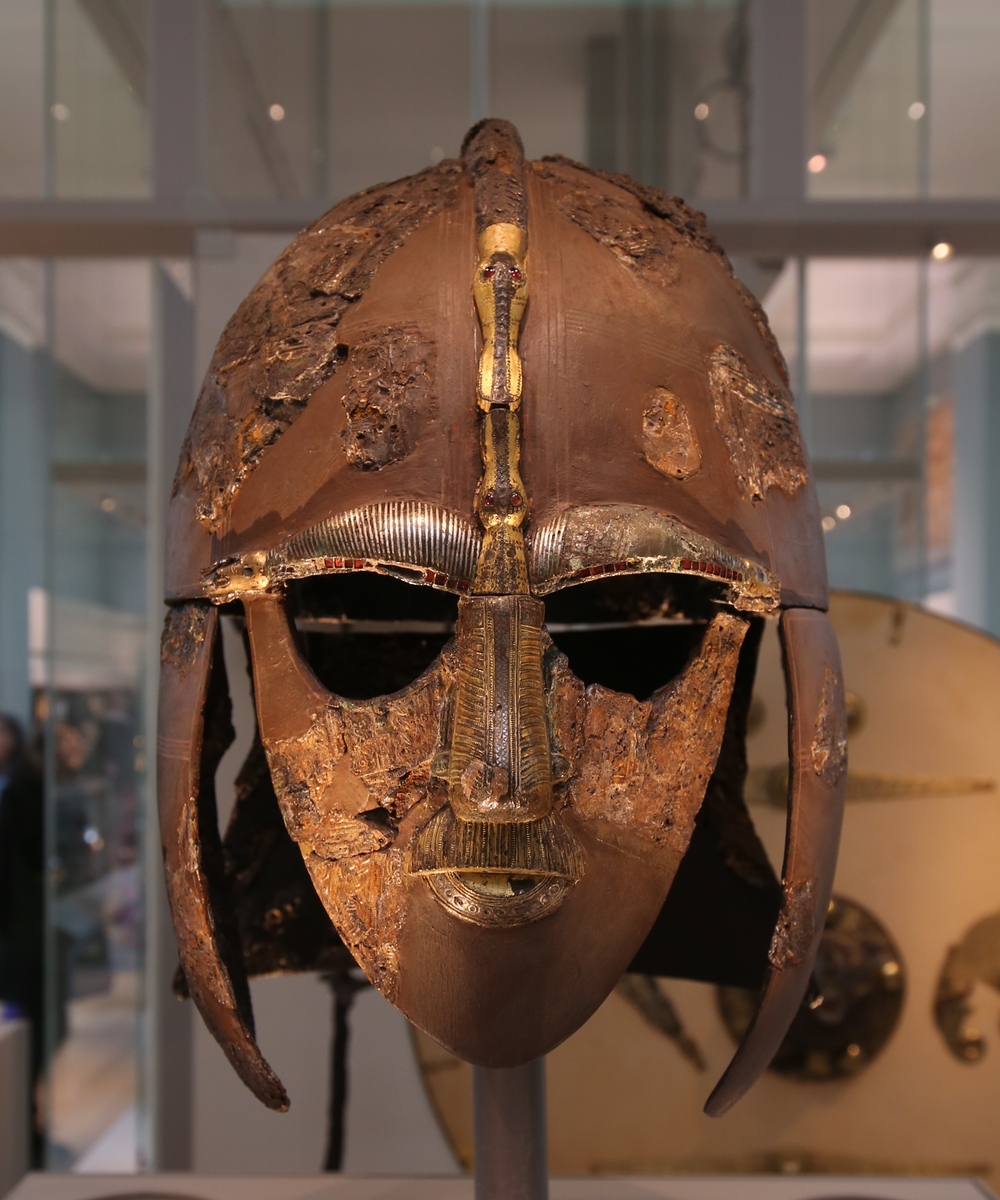
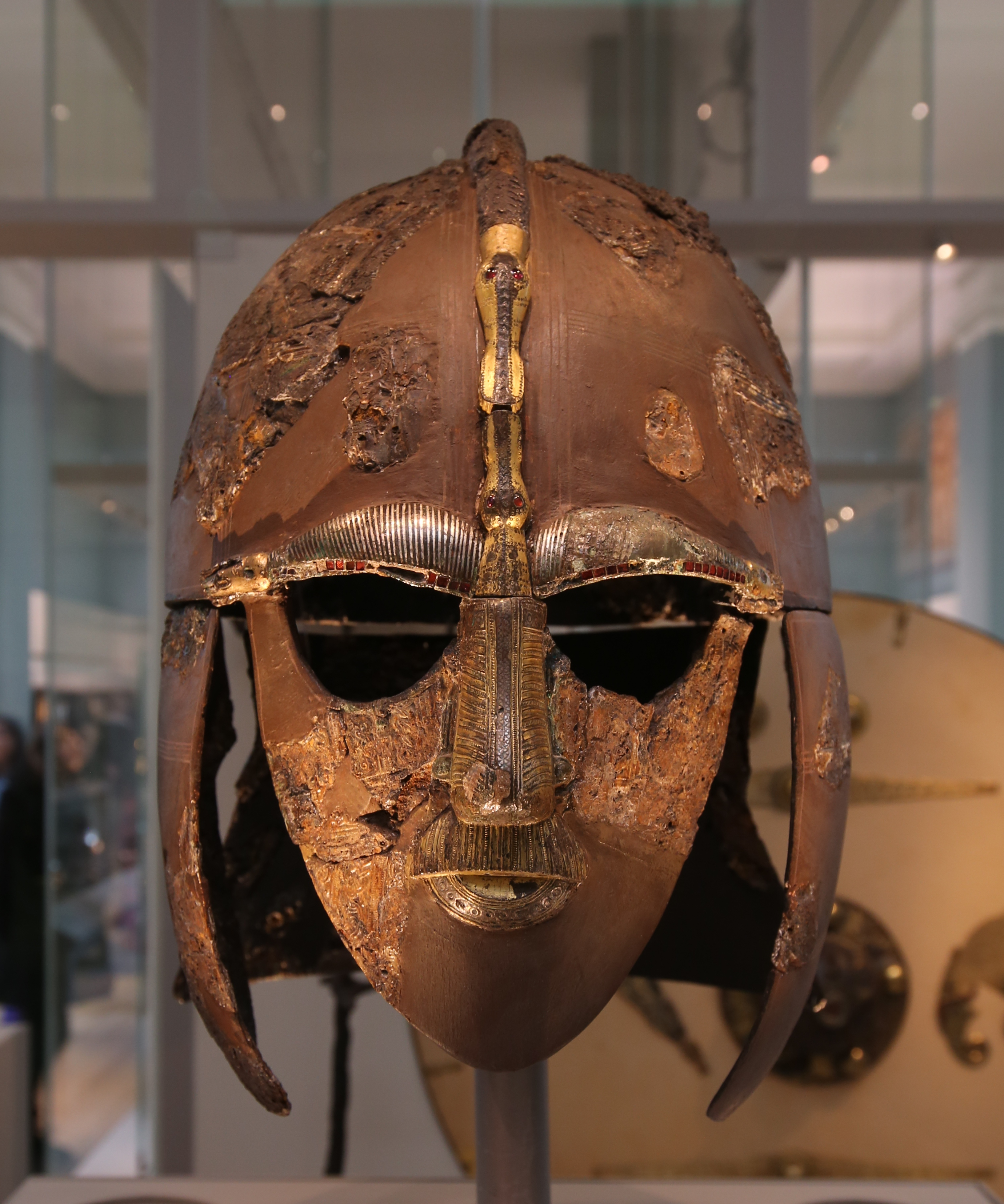
Within the frontal photograph, the helmet's most prominent feature is a mask-like face. The nose is formed as a boar snout, engraved with animal ornament that terminates in a boar head, and immediately below it runs a ribbed silver-gilt moustache. Above the nose, the eyebrows are rendered as arched ridges of silver ribbing carrying red garnet inlay, and these ridges end at the temples in small heads described as boar or animal heads. Running from front to back over the dome is a crest ridge set with garnets. Together these features describe a surface organised around a human face at the front, elaborated at its edges and centreline by animal forms and by coloured inlay.(Geni, 2016, Vision-derived semantic focus candidates)
The helmet is documented as made of iron with gilt-bronze, silver and garnet fittings, and the garnet-set crest ridge is documented as running from front to back over the dome. It is important to separate levels of statement here. The boar-snouted nose, the engraved animal ornament ending in a boar head, the ribbed silver-gilt moustache, and the arched eyebrow ridges with red garnet inlay are presented in the source as observations derived from the image. The underlying material composition of iron with gilt-bronze, silver and garnet fittings is presented as documented fact. The photograph alone cannot establish which metal lies beneath which surface, so the material account and the visual description are related but not equivalent kinds of evidence.(Geni, 2016, Vision-derived semantic focus candidates)
Condition and the limits of the visible
The front view is also a record of damage. Corrosion has affected the iron dome, producing losses, while decorative fittings survive and a cheek flap is damaged. This means the mask and the animal ornament do not present a complete original surface: the decorated face is legible in the photograph as part of a surviving structure of iron, gilt-bronze, silver and garnet fittings rather than as an untouched design. The 2015 photograph therefore documents a state of preservation as much as a composition, and any description of the whole helmet must be qualified by the fact that the visible face is partly a record of what has been lost from the iron.(Geni, 2016, Description: Photo of the sutton hoo helmet from the front in 2015; Vision-derived semantic focus candidates)
Animal ornament and its limits
Interpretation
The visual vocabulary of the helmet is animal ornament, and the source states that the boar-snouted nose is engraved with animal ornament ending in a boar head, and that the eyebrow ridges terminate at the temples in small boar or animal heads. This is a named visual convention in the sense that the source identifies animal forms as the organising motif of the face's ornaments, but the source does not name a specific stylistic tradition, predecessor, or successor for the helmet's ornament, and it does not establish a channel of influence from any other object to this one. The relationship the evidence supports is internal to the helmet: the mask, the animal ornament, and the garnet-set crest ridge belong to the decorative programme of a single high-status object. A resemblance between this helmet and other animal-ornamented works of the period would be a resemblance only, not an influence, on the evidence supplied.(Geni, 2016, Vision-derived semantic focus candidates)
Circulation and categorisation
Visual observation
The file page places the helmet within the category 'Sutton Hoo helmet' and links it to other Wikimedia pages, including 'A History of the World in 100 Objects' and 'Kunst der Völkerwanderungszeit'. These links show the frames through which the helmet circulates as a reference point, from a widely distributed history-in-objects project to a category concerned with the art of the Migration Period. They do not supply an institutional object record, a date, dimensions, or a current display location, so they establish the helmet's position in a scheme of reference and categorisation rather than any physical fact about the object itself.(Geni, 2016, File usage on Commons and other wikis; Description: Photo of the sutton hoo helmet from the front in 2015)
The photograph itself is licensed under Creative Commons Attribution-ShareAlike 4.0 International and other licenses, and its photographer is credited as Geni. The credit identifies the maker of the image, not the maker of the helmet, and the Commons file page is a photographic record rather than an institutional catalogue entry for the object. For research purposes, this means the image can be reused and attributed, but the date of 2015 fixes only when the helmet was photographed, not when it was made, buried, excavated, or conserved.(Geni, 2016, Licensing section; Description: Photo of the sutton hoo helmet from the front in 2015)
A helmet made to be seen
Interpretation
The front photograph makes visible the helmet's double character as protective equipment and as a crafted image of authority. The iron dome is made to be worn, while the mask, the animal ornament, and the garnet inlay are made to be seen, and the 2015 image shows both at once: an object whose iron has corroded and lost material, and whose decorated face still presents a face to the viewer. This reading is an interpretation of the visible evidence rather than a statement the source makes in these words, and it must be qualified by the single frontal view: the photograph does not document the rest of the helmet's circumference, its interior, or the cheek flap beyond the fact of its damage.(Geni, 2016, Description: Photo of the sutton hoo helmet from the front in 2015; Vision-derived semantic focus candidates)
Visual observation
The supplied image shows the helmet from the front.(Geni, 2016)
The helmet's mask-like face incorporates a boar-snouted nose with engraved animal ornament ending in a boar head, and a ribbed silver-gilt moustache below it.(Geni, 2016)
The helmet has arched eyebrow ridges of silver ribbing with red garnet inlay that terminate in small boar or animal heads at the temples.(Geni, 2016)
Materials and technique
LinkMaterials and structure
The helmet is made of iron with gilt-bronze, silver and garnet fittings. A garnet-set crest ridge runs from front to back over the dome. This material inventory comes from the supplied record of the object, not from a laboratory report, so the identifications of iron, gilt bronze, silver and garnet stand as documented description rather than as the result of a named technical examination. No analysis method, sampling procedure, alloy composition or gemstone provenance is given in the supplied evidence, and none should be inferred from the material list alone.(Geni, 2016, Vision-derived semantic focus candidates)
Interpretation
The evidence available here separates two registers of knowledge. The material composition and the crest ridge are documented, whereas the nose, moustache and eyebrow ridges are recorded as observed features of the object. There is no technical examination in the supplied material that establishes layer sequence, core-metal preparation, gilding method or the adhesive or setting technique for the garnets. The relationship between the iron dome and the decorative fittings is therefore established as a co-presence of materials and a pattern of loss, not as a reconstruction of the workshop process. Treating the fittings as a protective system and an ornamental system at once is consistent with the evidence, but which specific techniques united them remains outside what these units establish.(Geni, 2016, Vision-derived semantic focus candidates)
The image record that carries these observations shows the helmet from the front, which shapes how the materials are encountered: the decorated face, the nose, the moustache and the eyebrow ridges read as a single frontal composition, while the crest ridge is described as running over the dome from front to back. The dome's garnet-set ridge and the surviving fittings belong to the same object whose corrosion is also visible in the record. Reading materials through a frontal photograph means the front-facing ornament is comparatively accessible in the evidence, and the rest of the dome is known mainly through the description of the crest ridge and the corrosion losses rather than through a full multi-angle technical record.(Geni, 2016, Vision-derived semantic focus candidates; Description: Photo of the sutton hoo helmet from the front in 2015)
The helmet is made of iron with gilt-bronze, silver and garnet fittings, and a garnet-set crest ridge runs from front to back over the dome.(Geni, 2016)
Condition and conservation
LinkRecorded condition
The published account of the Sutton Hoo helmet states that the object shows corrosion damage: a corroded iron dome with losses, surviving decorative fittings, and a damaged cheek flap. These are the only dated condition observations present in the supplied material, and they are attached to the 2015 front photograph through which the object was encountered. Taken together with the recorded construction of the helmet from iron with gilt-bronze, silver and garnet fittings, and with a garnet-set crest ridge running from front to back over the dome, the damage account describes fittings that survive alongside a dome that does not. What can be seen in the photograph is therefore a partial surface: the iron body is incomplete, while the decorative metalwork and garnet settings remain as the readable elements of the object.(Geni, 2016, Vision-derived semantic focus candidates)
Interpretation
The evidential basis for these observations is narrow and should be treated as such. The condition description derives from a Wikimedia Commons file page, specifically from vision-derived semantic focus candidates, rather than from an institutional condition report, treatment record or examination by a conservator. The photograph itself was taken in 2015 and uploaded by the Wikimedia Commons user Geni, who is credited as the photographer and uploader and not as the maker of the helmet; the file carries a Creative Commons Attribution-ShareAlike 4.0 International licence among other licences. The source therefore establishes what a particular photograph shows and how its publisher described that image, not an object-condition assessment with laboratory support. Nothing in the supplied evidence records conservation interventions, treatment materials, environmental controls, or any change in the object's state since 2015, and no earlier condition account is supplied that could be compared with it.(Geni, 2016, Vision-derived semantic focus candidates)
Within the limits of that evidence, the damage is not incidental to how the object reads. The helmet's mask-like face and its animal ornament carry the object's identity as an Anglo-Saxon helmet made for a high-status warrior or ruler, and those are precisely the elements described as surviving decorative fittings rather than as part of the lost iron. The visibility of corrosion alongside intact ornament means that the surviving structure of iron, gilt-bronze, silver and garnet is what the viewer actually faces, and that the decorated surface is not a complete one. Any statement about the helmet's appearance should consequently be tied to the 2015 photographic record and to the fittings that survive, rather than extended into a general claim about the object's present condition.(Geni, 2016, Vision-derived semantic focus candidates)
The helmet shows corrosion damage, including a corroded iron dome with losses and surviving decorative fittings, and a damaged cheek flap.(Geni, 2016)
Reception and literature
LinkCirculation and classification
Visual observation
The supplied record for the helmet is a Wikimedia Commons file page rather than a museum object record. Its value for reception history lies precisely in what it does register: the file page files the photograph under the category 'Sutton Hoo helmet' and links it to other Wikimedia pages, among them 'A History of the World in 100 Objects' and 'Kunst der Völkerwanderungszeit'. Those two links are not decorative. They place the helmet, in one direction, inside a broadly public narrative of world history told through a hundred selected things, and in the other inside an art-historical category of Migration Period material. The pairing shows the object circulating simultaneously as a popular historical emblem and as a scholarly art-historical type, though the file page supplies no institutional object record, no date, no dimensions and no current display location that would substantiate either framing on its own.(Geni, 2016, File usage on Commons and other wikis; Description: Photo of the sutton hoo helmet from the front in 2015)
The image itself has an authorship distinct from the helmet. The photograph is licensed under Creative Commons Attribution-ShareAlike 4.0 International and other licenses, and the photographer is credited as Geni. The supplied image shows the helmet from the front as it appeared in 2015, and the source identifies Geni as the 2015 photographer and uploader rather than as the maker of the helmet. Reception of the object through this file therefore depends on a modern photographic act and a modern licensing regime, and the open license is what permits the image to be reused and recirculated across Wikimedia projects. That reuse is a documented stage of the helmet's public life, but it is a stage in the afterlife of the photograph, not evidence about the object's early history or original function.(Geni, 2016, Licensing section; Description: Photo of the sutton hoo helmet from the front in 2015)
Accumulated layers
Interpretation
Taken as a whole, the supplied units describe a layered reception rather than a single moment of fame. The file page's category and cross-links show the helmet operating as a reference point in both popular and art-historical frameworks; the Creative Commons license and the credit to Geni show a photographic image with its own circulation rules; and the front view of the mask, with its boar ornament, garnet inlay and surviving fittings, shows the visual material on which that circulation depends. Each of these is a distinct, documented layer attached to a different kind of evidence: a wiki classification, a license statement, an observation of a photograph. None of them by itself establishes the helmet's date, its excavation, its museum display history, or the intentions of its maker and wearer, and the accumulation should not be read as if one layer explained the others.(Geni, 2016, File usage on Commons and other wikis; Licensing section; Vision-derived semantic focus candidates)
The photograph is licensed under Creative Commons Attribution-ShareAlike 4.0 International and other licenses, and the photographer is credited as Geni.(Geni, 2016)
Documented values and qualified estimates
LinkObject and source record
Interpretation
The object documented by the supplied file page is the Sutton Hoo helmet, described as an Anglo-Saxon period iron helmet made for a high-status warrior or ruler, identified as the Sutton Hoo helmet, maker unknown. The supplied sources support the medium and period and describe the helmet as made of iron with gilt-bronze, silver and garnet fittings, with a garnet-set crest ridge running from front to back over the dome. The photograph that anchors this record was taken in 2015 and uploaded by the Wikimedia Commons user Geni, who is credited as the photographer and uploader rather than as the maker of the helmet. The file page places the object in the category Sutton Hoo helmet and links it to other Wikimedia pages, including A History of the World in 100 Objects and Kunst der Völkerwanderungszeit. Those links indicate how widely the helmet circulates as a reference point, but they do not by themselves supply an institutional object record, date, dimensions or current display location, and the supplied sources provide photographic and identification context only.(Geni, 2016)
Recorded values
The recorded working insurance estimate gives a range of US$5M to US$20M, with a recorded date of a working calculation generated 2026-10-16. Its methodology is explicit that this is a broad working insurance range calculated for manual review from the confirmed context of an Anglo-Saxon period iron helmet with gilt-bronze, silver and garnet fittings, identified as the Sutton Hoo helmet, maker unknown, with medium and period supported by the supplied excerpts and identification notes. Because the object is a unique, internationally prominent early medieval artifact with no documented sale, no auction result, no official appraisal, and no institutional object record in the supplied sources, the calculation uses a conservative heritage-object bracket keyed to the supplied prominence, rarity, material complexity, and period rather than to any comparable sale. The low end reflects a conservative review floor for an exceptional archaeological artifact; the high end reflects the upper bound of a broad working range for manual review. No private insurance records, institutional valuations, or comparable sales were accessed or assumed. This is a model-generated working range for manual review only. It is not an official insurance value, appraisal, auction result, or sale price. It does not represent any institutional, governmental, or market valuation, and it should not be used to bind coverage or to make financial decisions.(Geni, 2016)
Reading the valuation beside the object record clarifies the relationship between the two. The figure is a generated range for manual review, not a market fact: it exists precisely because the supplied sources contain no auction result, no official appraisal, and no institutional object record. The value therefore rests on the stated characteristics of the object, its uniqueness, international prominence, rarity, material complexity, and period, rather than on any transaction or institutional assessment. The qualification attached to the calculation limits its use accordingly and should be carried with the number wherever the number is cited. Interpreted within this accumulating account, the range documents the valuation question and its evidentiary limits rather than establishing a price for the helmet.(Geni, 2016)
Working estimate
Calculated working insurance estimate, not a sale price: Estimated value: US$5M to US$20M Recorded date: Working calculation, generated 2026-10-16. Methodology: Broad working insurance range calculated for manual review from the confirmed context: an Anglo-Saxon period iron helmet with gilt-bronze, silver and garnet fittings, identified as the Sutton Hoo helmet, maker unknown, with medium and period supported by the supplied excerpts and identification notes. Because the object is a unique, internationally prominent early medieval artifact with no documented sale, no auction result, no official appraisal, and no institutional object record in the supplied sources, the calculation uses a conservative heritage-object bracket keyed to the supplied prominence, rarity, material complexity, and period rather than to any comparable sale. The low end reflects a conservative review floor for an exceptional archaeological artifact; the high end reflects the upper bound of a broad working range for manual review. No private insurance records, institutional valuations, or comparable sales were accessed or assumed. Qualification: This is a model-generated working range for manual review only. It is not an official insurance value, appraisal, auction result, or sale price. It does not represent any institutional, governmental, or market valuation, and it should not be used to bind coverage or to make financial decisions. The supplied sources provide photographic and identification context only and do not contain an appraisal or an official object record.(Geni, 2016)