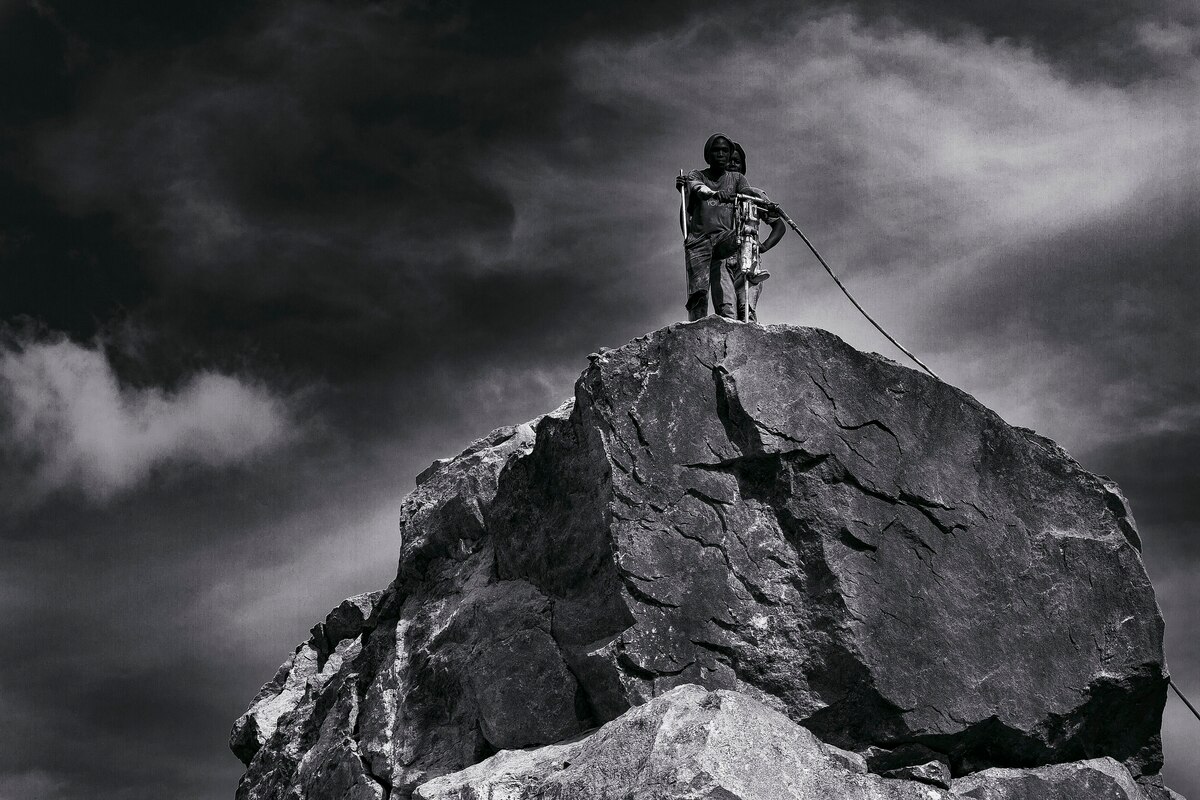
A digital photograph by Ampaire Edger records young men breaking stone at a rocky summit in central Uganda, using a pneumatic drill to supply Kampala's construction industry.
The hose cable arcs from the drill down across the rock toward the right edge, a graphic line that links the workers' machinery to the wider quarry below the frame.
02
Fractured boulder face
The split and fissured granite summit where the men stand, scored by cracks and tool scars, is the raw material and workplace itself, embodying the struggle between human effort and stone.
03
Rock drill rig
The pneumatic drill rig and its coupling between the two men is the tool of their trade, the visible craftsmanship of mechanized stone breaking that defines the image's central tension.
Your gallery guide
Stone breakers in central Uganda by Ampaire Edger (5 October 2017)
A digital photograph by Ampaire Edger records young men breaking stone at a rocky summit in central Uganda, using a pneumatic drill to supply Kampala's construction industry.
Editorial review by Artifact Archive automated publishing
This photograph shows young men breaking stone at a rocky summit in central Uganda. They are at work with a pneumatic rock drill.
The image is titled Stone breakers in central Uganda and was created by Ampaire Edger. The stone they break supplies the construction industry around Kampala, where building is immense.
At the top of the frame, the ground is stony and uneven. The workers stand among broken rock, and one of them operates the drill.
The photograph was taken with a 50 mm lens on a Canon EOS 7D, at 1/400 sec, f/7.1, ISO 100. That fast shutter freezes the action of the drill and the stance of the workers, so the physical effort of the job stays sharp.
The workers are described as young men who drop out of school in Muyenga to earn quick money by breaking stones.
That detail connects the image to a wider economy. Construction in central Uganda is immense, and the stone these men break feeds it.
The photograph was uploaded to Wikimedia Commons on 12 November 2017 as part of the Wiki Loves Africa 2017 photographic contest. It received no further reception within the supplied record.
The file itself is a 5,184 by 3,456 pixel JPEG, 10.67 megabytes, created with a Canon EOS 7D and edited with Adobe Photoshop CC 2017.
What the photograph records is specific: young men, a rocky summit, a mechanized drill, and stone that will become building material. The image holds that labor in a single moment, and the details of the scene are enough to understand the trade.
The story and its sources
Editorial review by Artifact Archive automated publishing.
Historical claims are linked to the records below. Close looking and interpretation are identified in the passage notes.
Two young men at a rocky summit in central Uganda operate a pneumatic rock drill to break stone for the construction industry around Kampala. The image records the physical labor and the mechanized tool of their trade.(Ampaire Edger, 2017)
Title variants
Stone breakers in central Uganda; The Stone Breakers
Attribution qualification
Uploader and copyright holder: Ampaire Edger. Camera EXIF author: lutaaya roy. The file record names Ampaire Edger as author; no further attribution information is supplied.
Catalogue identity and attribution
The image file is titled "Stone breakers in central Uganda" and is credited to Ampaire Edger. Its companion description states that the photograph depicts stone breaking in central Uganda, showing young men who drop out of school in Muyenga to earn quick money by breaking stones. Both the title and the account of the subjects are supplied by the Wikimedia Commons file record rather than by any independent catalogue, so the attribution, the location and the characterization of the workers all rest on the same single source. That concentration matters for how the object should be cited: the creator is named, the place is named, and the social description is offered, but no second documentary witness in the available material corroborates them.(Ampaire Edger, 2017, Description and author fields; English description)
The image file is titled 'Stone breakers in central Uganda' and was created by Ampaire Edger.(Ampaire Edger, 2017)
The photograph depicts stone breaking in central Uganda, showing young men who drop out of school in Muyenga to earn quick money by breaking stones.(Ampaire Edger, 2017)
The photograph titled Stone breakers in central Uganda shows young men at work breaking stones in a hilly, stony area of central Uganda. The location matters to what the image records: construction is immense in central Uganda, where the capital city Kampala is located, and the stone-breaking work supplies that industry. The scene therefore documents not only an activity but a supply chain, in which manual and mechanized stone extraction in the hills around the capital feeds a large building sector. The supplied source describes the workers as young men who drop out of school in Muyenga to earn quick money by breaking stones, an account that links the visual scene to a reported social and economic circumstance rather than to anything the photograph alone can verify.(Ampaire Edger, 2017, Description; English description)
The image shows young men at work breaking stones in a hilly, stony area of central Uganda.(Ampaire Edger, 2017)
The photograph titled "Stone breakers in central Uganda" is attributed to Ampaire Edger, who uploaded it to Wikimedia Commons on 12 November 2017 as part of the Wiki Loves Africa 2017 photographic contest. The file is a JPEG of 5,184 by 3,456 pixels and 10.67 MB, created with a Canon EOS 7D and edited with Adobe Photoshop CC 2017. Within the supplied source record, the image received no further reception beyond that contest submission, and no condition or conservation information is supplied in the available source excerpt. These are the documented circumstances of the object's making and circulation: a 2017 contest entry by a named photographer, hosted on an open media repository under a Creative Commons Attribution-ShareAlike 4.0 International license, rather than a work with a recorded commission, patron or exhibition history.(Ampaire Edger, 2017, File history and description; Description and categories; English description)
Subject and Historical Context
Visual observation
The subject the image records is stone breaking in central Uganda, a region in which the capital city Kampala is located. Construction there is described as immense, and the stone-breaking work supplies that industry. The photograph's own description identifies the workers as young men who drop out of school in Muyenga to earn quick money by breaking stones, and the visible scene corresponds to that account: young men at work breaking stones in a hilly, stony area of central Uganda. Read together, the image and its description place the labor at the intersection of a local building boom and a livelihood that draws young men out of schooling, but the evidence establishes only these reported circumstances, not the individual histories or earnings of the men shown.(Ampaire Edger, 2017, English description; Description)
Construction is immense in central Uganda, where the capital city Kampala is located, and the stone-breaking work supplies that industry.(Ampaire Edger, 2017)
The primary technical evidence for how this photograph was made is its capture metadata. The photograph was taken with a Canon EOS 7D camera, using a 50 mm lens, at exposure time 1/400 sec, f/7.1, ISO 100. These settings establish the optical and exposure conditions of the exposure itself: a normal focal length on an APS-C sensor camera, a moderately stopped-down aperture, and a low sensitivity. The 1/400 second exposure is brief enough to arrest motion, which is relevant because the scene depicts active labor. The camera body and lens are named, so the record identifies the specific equipment rather than a generic camera type. This capture information is separate from the file's later processing history and from any visual inference about the scene, and the two should not be conflated.(Ampaire Edger, 2017, Metadata section)
What Capture and File Data Establish Together
Visual observation
Reading the capture metadata, the file-level description and the visual observation together, the evidence establishes a digital photographic workflow rather than a single unmediated exposure. The photograph was taken with a Canon EOS 7D and a 50 mm lens at 1/400 sec, f/7.1, ISO 100, and the resulting file is a 5,184 × 3,456 pixel JPEG of 10.67 MB that was edited with Adobe Photoshop CC 2017. The observed subject is young men breaking stones in a hilly, stony area of central Uganda, which explains why the record includes a high shutter speed suitable for freezing active labor. The record does not specify whether the editing was limited to export or included substantive changes to the image, and this uncertainty should be preserved. The technical evidence therefore supports claims about equipment, exposure settings, output format, dimensions and editing software, while the visual evidence supports claims about subject and setting.(Ampaire Edger, 2017, Metadata section; File information and metadata; Description)
Interpretive Synthesis
Interpretation
Interpreted as a record of a making process, this object illustrates how contemporary documentary photography is characterized by layered technical evidence. The camera settings and equipment establish the moment of exposure, while the file dimensions, compression format, and editing software establish a post-capture stage that can alter tone, framing and detail without leaving a visible trace in the metadata. The absence of condition and conservation information is itself significant: for born-digital work, technical description and preservation documentation are separate research problems, and the supplied record addresses only the former. The documented combination of a 1/400 sec exposure with a 50 mm lens and low ISO is consistent with the observed scene of manual stone breaking in bright outdoor conditions, but consistency is not proof of intent or of an unmodified final file. This is an interpretive reading of the relationship between the units, not a claim recorded in the source.(Ampaire Edger, 2017, Metadata section; File information and metadata; Description; Overall record)
Capture and File Data
The technical record for this photograph begins with the file itself and the camera that produced it. The image is a 5,184 by 3,456 pixel JPEG, 10.67 MB in size, created with a Canon EOS 7D and edited with Adobe Photoshop CC 2017. The stated pixel dimensions correspond to the camera's sensor output, and the file size is consistent with a high-quality JPEG at that resolution. The metadata establishes both capture hardware and subsequent software editing: the record documents that the file passed through Photoshop CC 2017 after capture, though the supplied source does not specify what those edits were or whether they altered the image content. Two distinct stages are therefore documented, capture and post-processing, and only the second is recorded as an edit rather than a straight export. No condition or conservation information is supplied in the available source excerpt, so the technical account cannot extend to the physical state of any print or negative, and nothing in the record establishes an assessment of the file's integrity beyond the stated format and dimensions.(Ampaire Edger, 2017, File information and metadata; Overall record)
The photograph was taken with a Canon EOS 7D camera, using a 50 mm lens, at exposure time 1/400 sec, f/7.1, ISO 100.(Ampaire Edger, 2017)
Technical examination
The file is a 5,184 × 3,456 pixel JPEG image, 10.67 MB in size, created with a Canon EOS 7D and edited with Adobe Photoshop CC 2017.(Ampaire Edger, 2017)
The condition record for this object is, in the supplied evidence, an explicit absence rather than a set of observations. The available source excerpt states that no condition or conservation information is supplied in it, and the source's own annotation lists that absence among the claims the record supports. This means the archive can document the negative result of consulting the Wikimedia Commons file page and its associated metadata, but cannot document any examination, damage report, treatment, intervention, loss, or environmental measure. The absence applies to the source as consulted, which is described as partially consulted, so the negative finding is bounded by that consultation and should not be generalised into a claim that no condition history of the photograph exists anywhere, only that none appears in this record.(Ampaire Edger, 2017, Overall record)
No condition or conservation information is supplied in the available source excerpt.(Ampaire Edger, 2017)
The only documented event in the life of this photograph is its upload to Wikimedia Commons by Ampaire Edger on 12 November 2017, made as part of the Wiki Loves Africa 2017 photographic contest. That upload is the single provenance act the available record establishes: an author depositing a born-digital file in an open media repository under the contest's terms. The file page records the upload and its contest affiliation, and the same source notes that the image received no further reception within the supplied record, which is a statement about the limits of the documentation rather than evidence of the image passing unnoticed elsewhere. Nothing in the available material records a prior owner, a sale, a gift, an inheritance or an institutional acquisition, so no chain of custody before or after 12 November 2017 can be reconstructed. The interval between the making of the photograph and its upload is simply unrecorded; it should not be read as a period of proven private ownership, and it should not be read as proof that no such ownership existed. The distinction matters for how the object is described: this is a photograph whose ownership history begins, so far as the evidence goes, at the moment of digital deposit, and any earlier or later transfer remains an evidentiary gap rather than a documented change of hands.(Ampaire Edger, 2017, File history and description)
The upload is inseparable from the technical identity of the file that was deposited. The file held on Wikimedia Commons is a 5,184 by 3,456 pixel JPEG of 10.67 MB, created with a Canon EOS 7D and edited with Adobe Photoshop CC 2017, and it is hosted under the Creative Commons Attribution-ShareAlike 4.0 International license. That description establishes what the repository actually holds: not the camera's original capture file but a processed, resized and edited derivative, whose post-production history is partly documented by the naming of the editing software. The license and the contest context also condition what provenance can mean here, since the deposit both recorded authorship and granted reuse rights in one transaction. The photographic metadata recorded on the file page, a 50 mm lens, exposure time 1/400 sec, f/7.1 and ISO 100, belongs to the making of the image rather than to its transfer, but it is preserved alongside the upload record and is part of how the deposited object is described. No condition or conservation information is supplied in the available source excerpt, so the physical or digital integrity of the file over time cannot be assessed from this material.(Ampaire Edger, 2017, File history and description)
Publication and its Limits
Placing the upload in its publication context clarifies what kind of provenance document the Commons file page is. The image was deposited as an entry in the Wiki Loves Africa 2017 photographic contest, a contest whose subject matter concerns construction and labour in central Uganda, where the capital city Kampala is located and where the stone-breaking work supplies an immense building industry. That context explains the deposit as a deliberate act of public documentation rather than an incidental transfer: the photograph entered the repository to circulate, under an open license, as a record of a specific trade. The reception evidence available within the same source is correspondingly narrow, since the image is reported as receiving no further reception within the supplied record. Reading these two facts together, the documented provenance of the object is essentially a single act of publication, and the archive's knowledge of the photograph's afterlife is exhausted by that act. It is worth keeping that limit explicit: the absence of later documented transfers is not evidence of a quiet or contested ownership history, only evidence that the supplied source does not record one.(Ampaire Edger, 2017, File history and description; Description and categories; English description)
The photograph was uploaded to Wikimedia Commons by Ampaire Edger on 12 November 2017 as part of the Wiki Loves Africa 2017 photographic contest.(Ampaire Edger, 2017)
The reception record for this photograph is unusually thin, and the evidence says so directly. The supplied source establishes that the image was uploaded as part of the Wiki Loves Africa 2017 photographic contest and that it received no further reception within that source. There is therefore no documented history of critical commentary, exhibition, prize recognition, or subsequent citation to narrate. What can be established about its public life is confined to the platform on which it was deposited and the contest context that brought it there. Any account of the photograph's later cultural role would have to be built on something beyond the surviving record, and the evidence does not supply that material.(Ampaire Edger, 2017, Description and categories)
The image was uploaded as part of the Wiki Loves Africa 2017 photographic contest and received no further reception within the supplied source.(Ampaire Edger, 2017)
The photograph titled Stone breakers in central Uganda was created by Ampaire Edger and depicts young men breaking stone at a rocky summit in the central region of the country. The image shows the workers among broken rock, with one of them operating a pneumatic rock drill, a combination of manual labour and mechanised equipment that locates the scene at a particular stage of quarry work. The source identifies the stone being broken as material that supplies the construction industry around Kampala, where building activity is described as immense, so the photograph documents not only an occupation but one node in a supply chain linking rural stone extraction to urban construction demand. Alongside this description, the source reports that the workers are young men who drop out of school in Muyenga to earn quick money by breaking stones, a characterisation that the record presents as part of the file's own account of the scene rather than as an independently verified social survey.(Ampaire Edger, 2017, Licensing section)
The file is hosted on Wikimedia Commons, an open media repository, under the Creative Commons Attribution-ShareAlike 4.0 International license. This licensing status is the only condition, rights or conservation information the available excerpt supplies; the source explicitly notes that no condition or conservation information is provided. Because the object here is a digital photographic file rather than a physical artefact, the relevant stewardship facts are those of file provenance, rights and metadata rather than of materials conservation, and the Commons page is the record that establishes them.(Ampaire Edger, 2017, Licensing section)
Technical metadata and upload history
The image was made with a Canon EOS 7D camera and a 50 mm lens at an exposure time of 1/400 sec, f/7.1, and ISO 100. The file is a 5,184 × 3,456 pixel JPEG of 10.67 MB, created with that camera and edited with Adobe Photoshop CC 2017. The upload to Wikimedia Commons was made by Ampaire Edger on 12 November 2017 as part of the Wiki Loves Africa 2017 photographic contest. Within the supplied source, the image received no further reception: the contest entry and upload are documented, but the record does not establish subsequent awards, reviews or curatorial attention. These technical values describe the camera settings and the digital processing applied to the file, not the physical conditions of a darkroom print, and the description of the scene as taken with a 50 mm lens at a fast shutter speed belongs to the same metadata layer.(Ampaire Edger, 2017, Licensing section)
The file is hosted on Wikimedia Commons, an open media repository, under the Creative Commons Attribution-ShareAlike 4.0 International license.(Ampaire Edger, 2017)
The single supplied evidence unit for this object is not a sale record or an appraisal but a model-generated working insurance estimate, recorded as a working calculation generated on 16 October 2026. It proposes an estimated insurance range of US$150 to US$600 and states plainly that it is a conservative figure produced for manual review rather than an appraisal. Because the evidence for the artwork is confined to this one valuation account, the range has to be read together with the object description that the same unit carries: a digital photograph by Ampaire Edger, dated 5 October 2017, measuring 5,184 by 3,456 pixels, hosted on Wikimedia Commons under a CC BY-SA 4.0 license. The estimate's own reasoning ties the modest level of the range to the absence of any documented sale, auction, gallery, or private collection record in the supplied sources, and therefore treats the insurable replacement value as a digital-file and license-based figure rather than a unique-object market value. The unit also explains what pushes the figure toward its upper bound: the photographer's confirmed authorship, the documentary subject matter, the Wiki Loves Africa 2017 contest context, and the high-resolution file size, while noting that it remains deliberately low because no commercial edition, print, or institutional acquisition is documented.(Ampaire Edger, 2017)
The qualifications attached to the estimate are as consequential as the number itself, and they mark the limits of what this valuation can support. The unit states that it is model-generated, for manual review only, and is not an official insurance value, an appraisal, an auction result, or a sale price; it does not draw on comparable sales or private insurance records. It also warns that because the artwork is a freely licensed digital photograph on Wikimedia Commons, its insurable value may differ substantially from that of a unique physical artwork, and it instructs that all details, licensing, and provenance be verified with a qualified appraiser or insurer before the figure is relied upon. Read as a whole, the estimate functions as a placeholder for a qualified fine-art insurance review rather than a statement of fair market value, and any account of the photograph's monetary worth should carry that qualification forward rather than treating the range as a market finding.(Ampaire Edger, 2017)
Working estimate
Calculated working insurance estimate, not a sale price: Estimated insurance range: US$150 to US$600 Recorded date: Working calculation, generated 2026-10-16. Methodology: This is a conservative, model-generated working insurance range for manual review, not an appraisal. The work is a digital photograph by Ampaire Edger, dated 5 October 2017, 5,184 by 3,456 pixels, hosted on Wikimedia Commons under a CC BY-SA 4.0 license. Because the image is freely licensed open media with no documented sale, auction, gallery, or private collection record in the supplied sources, its insurable replacement value is best approximated as a modest digital-file and license-based figure rather than a unique-object market value. The upper bound accounts for the photographer's confirmed authorship, the documentary subject matter, the Wiki Loves Africa 2017 contest context, and the high-resolution file size, while remaining deliberately low because no commercial edition, print, or institutional acquisition is documented. This range should be treated as a placeholder for a qualified fine-art insurance review, not as a statement of fair market value. Qualification: This is a model-generated working insurance range for manual review only. It is not an official insurance value, appraisal, auction result, or sale price. It does not use comparable sales or private insurance records. The artwork is a freely licensed digital photograph on Wikimedia Commons, so its insurable value may differ substantially from any unique physical artwork. Verify all details, licensing, and provenance with a qualified appraiser or insurer before relying on this figure.(Ampaire Edger, 2017)
Bibliography
Sources and further reading
References are arranged by author or organisation, with links to the original publications. Where no publication date is recorded, n.d. means no date.
Source notes updated .
No recorded sources match these filters. Reset the filters to see the full bibliography.
Advertising supports the archive. These preferences control aggregate page counting, reading activity and ad-delivery diagnostics. They use no visitor tracking cookie.