Identity and catalogue
Link- Title
- Standard of Ur
- Artist or attribution
- Maker unknown
- Object date
- ca. 2600-2400 BC
- Medium and support
- Mosaic inlay (shell, lapis lazuli, and bitumen)
- Movement or period
- Early Dynastic III, Sumerian
- Country or culture
- Sumer (ancient Mesopotamia, present-day Iraq)
- Depicted subject
- A Sumerian artifact from tomb 779 at Ur, decorated with inlaid scenes including a seated banquet figure attended by standing figures.
- Attribution qualification
- Maker unknown; the name refers to the object's traditional title.
- Dimensions
- Unknown
Catalogue identification
Catalogued as the Standard of Ur, the object is described in the supplied record as a Sumerian artwork dated ca. 2600-2400 BC and reported as coming from tomb 779 at Ur. The Wikimedia Commons file record consulted here gives the title, culture, date range and findspot together, and the same source description places the piece in the collection of the British Museum, London. Because the account is a Commons file record rather than a full museum catalogue entry, the catalogue data it supplies are best treated as a summary identification: the stated culture, the broad fourth-millennium-and-a-half range of ca. 2600-2400 BC, the tomb number and the London collection are all recorded, but the record as consulted does not set out acquisition history, registration or accession identifiers, nor does it name a maker. The date itself is a catalogue date range rather than a dated event, and the object is not tied in this evidence to a single year of manufacture.(Michel wal, 2009, File description: Standard of Ur. Sumerian artwork, ca. 2600-2400 BC. From tomb 779 Ur.)
Find context and period
The find context reported for the object is tomb 779 within the royal cemetery at Ur, and the object is assigned to the Early Dynastic III period. This matters for how the piece is understood: it is not an isolated museum curiosity but an object recovered from a burial assemblage in a major Mesopotamian city, which is why its imagery and materials are so often read against questions of wealth, status and funerary practice in Early Dynastic Ur. The account given here rests on the supplied description and its stated findspot; the record does not itemise the other contents of tomb 779, the excavation circumstances or the exact position of the object within the tomb, so those details cannot be asserted from this evidence.(Michel wal, 2009, File description: Standard of Ur. Sumerian artwork, ca. 2600-2400 BC. From tomb 779 Ur.)
Title, attribution and qualifications
The title by which the object is known, Standard of Ur, is traditional and does not establish that the object served as a military standard. The evidence states that the traditional title does not mean it was a military standard, and that the maker is unknown. This is a significant qualification for catalogue use: the name functions as a conventional label inherited by the object, while function, authorship and original use remain unestablished in the supplied material. Any account that treats the title as a description of the object's purpose, or that attributes it to a named artist, goes beyond what this evidence supports.(Michel wal, 2009, File description: Standard of Ur. Sumerian artwork, ca. 2600-2400 BC. From tomb 779 Ur.)
The banquet scene and hierarchical scale
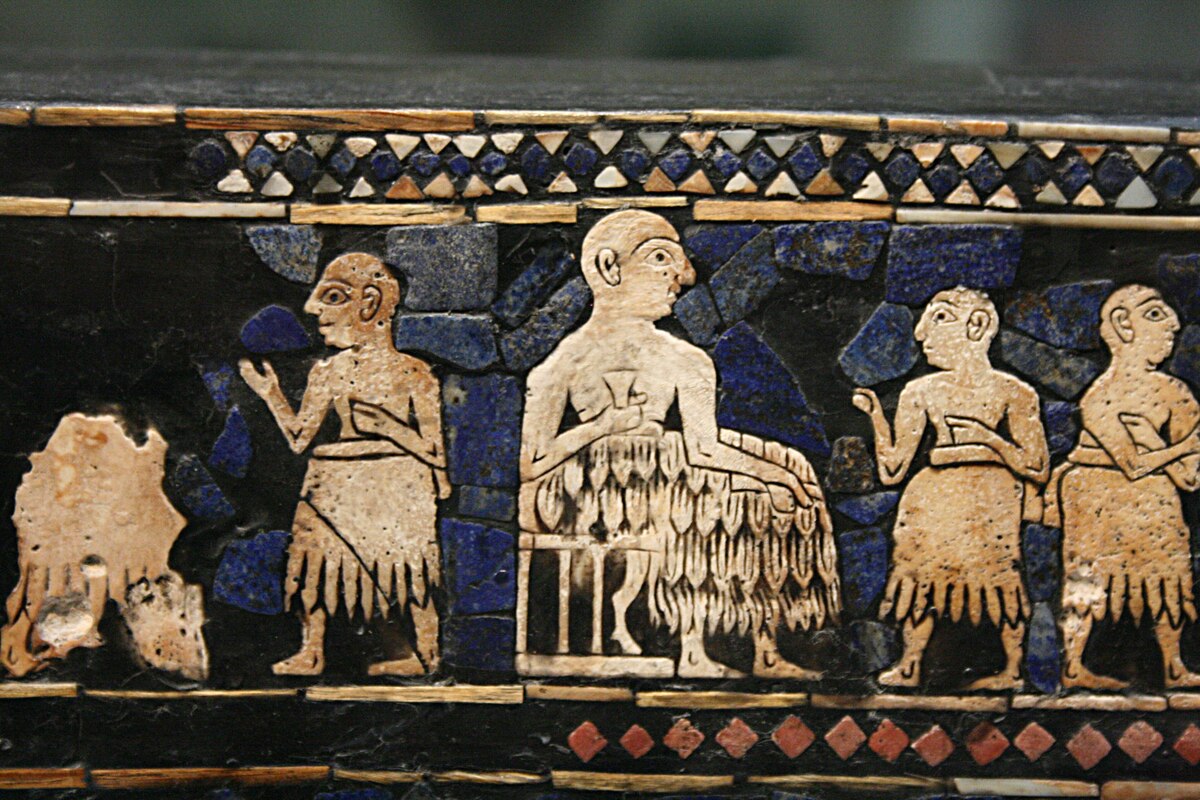
What the object presents visually is partly reconstructable from the supplied description. A seated figure holds a small cup or beaker against his chest, wears a thick fringed fleece garment and rests on a low chair; his larger size marks his higher status within the banquet scene. To the left, a standing figure in a fringed skirt raises one hand at shoulder height in a gesture read as salute or address toward the seated man. To the right of the seated figure, two smaller standing figures in fringed skirts hold their arms across their bodies. The evidence treats these size differences as hierarchical scale, and the arrangement as reinforcing a service relationship between the seated man and those around him. The scene is therefore described not as a casual meal but as a formal event in which status and service are displayed through posture, scale and dress.(Michel wal, 2009, File description: Standard of Ur. Sumerian artwork, ca. 2600-2400 BC. From tomb 779 Ur.)
Materials, inlay technique and condition
The materials described are consistent with Early Dynastic inlay practice at Ur. An upper border band consists of alternating lapis lazuli and shell triangles set in bitumen between two pale inlay strips, described as geometric inlay characteristic of Early Dynastic Ur. At the lower left, an irregular pale patch marks where shell and lapis inlay has been lost or restored, exposing the rough bitumen bedding beneath. This damage record is part of the object's identity as it survives: the description distinguishes preserved inlay, lost or restored areas and the bedding material, and it shows that the surface has a history of loss and intervention rather than being an untouched original surface. The evidence does not specify what was restored, when, or by whom, so the extent of modern intervention cannot be quantified from this account.(Michel wal, 2009, File description: Standard of Ur. Sumerian artwork, ca. 2600-2400 BC. From tomb 779 Ur.)
Materials, meaning and the limits of the record
Interpretation
Read together, the descriptive and contextual elements point to an object whose pictorial programme and material choices reinforce one another. Precious lapis lazuli and shell set in bitumen are described as signalling the wealth and connections of Early Dynastic Ur, while the banquet composition organises figures by scale, dress and gesture to display order and hierarchy: the seated figure receives, the others serve or attend. The damaged area, meanwhile, reminds the viewer that the object has a history of use, burial and recovery. This synthesis is offered as an interpretation of the supplied evidence rather than as a documented function, and it should be weighed against the explicit qualification that the traditional title does not establish a military standard and that the maker is unknown. What the evidence does establish is an Early Dynastic III object from tomb 779 at Ur, now in the British Museum, combining lapis, shell and bitumen inlay in a hierarchical banquet scene; what it leaves open is authorship, precise use, the full excavation context and the detail of later restoration.(Michel wal, 2009, File description: Standard of Ur. Sumerian artwork, ca. 2600-2400 BC. From tomb 779 Ur.)
The object is the Standard of Ur, a Sumerian artwork dated ca. 2600-2400 BC, from tomb 779 at Ur.(Michel wal, 2009)
Subject and iconography
LinkThe banquet group and its hierarchy
Visual observation
The face of the object recorded here presents a compact group of figures whose relations are legible at a glance, because the composition is built on differences of size and posture rather than on setting or background. A seated figure occupies the visual centre of gravity: he holds a small cup or beaker against his chest, wears a thick fringed fleece garment, and rests on a low chair. His greater scale is not incidental but the principal carrier of meaning in the scene, marking him as the person of highest status in what the record describes as a banquet. The cup held close to the body, the heavy fleece, and the low seat together establish a figure who is both served and stationary, the fixed point around which the other participants are arranged. Because the record identifies this as a banquet scene, the visible actions should be understood within the conventions of formal commensality rather than as a casual meal: the seating, the vessel, and the demeanour of the surrounding figures all belong to a recognised visual vocabulary of status and service.(Michel wal, 2009, Vision-derived focus: seated banquet figure)
The hierarchy is reinforced by the figures who attend the seated man. At the left, a standing figure wearing a fringed skirt raises one hand at shoulder height in a gesture described in the record as one of salute or address directed toward the seated figure. This raised hand is the only explicit gesture of communication in the group, and it establishes a relation of speech or homage between the standing man and the seated recipient. To the right of the seated man, two further figures stand, smaller again and dressed in fringed skirts, with their arms held across the body. Their diminished size and closed, frontal pose contrast with the raised hand on the left, and the record reads both features as reinforcing hierarchical scale and the relationship of service. Taken together, the three standing figures create a graded scale of presence: the speaker or saluter on one side, the silent attendants on the other, and the seated man between them. The clothing is consistent across the group, since all three standing figures wear fringed skirts, but the seated man's thick fringed fleece distinguishes him within that shared costume. The evidence supports these as observations of pose, dress and relative size; it does not name the individuals, and no inscription or label is recorded that would identify them.(Michel wal, 2009, Vision-derived focus: attendant raising his hand; Vision-derived focus: attendant pair at right)
Materials and the framing band
Framing the figural scene is an upper border band composed of alternating lapis lazuli and shell triangles set in bitumen between two pale inlay strips. The record treats this as an observation of the surviving object and characterises the geometric inlay as characteristic of Early Dynastic Ur. The border is therefore not merely decorative trim but a technical signature: the combination of a dark blue stone, white shell, and black bituminous bedding is a material practice with a known regional and period association in the record, and its repetition in triangular units shows deliberate geometric design rather than figural narrative. This matters for how the scene below should be read, because the same materials and the same inlay method structure the image as a whole. The border also frames the human action and separates it from whatever lies beyond the visible field, concentrating attention on the graded figures within.(Michel wal, 2009, Vision-derived focus: triangular mosaic border)
The surviving surface is not complete. An irregular pale patch at the lower left marks where shell and lapis lazuli inlay has been lost or restored, exposing the rough bitumen bedding beneath. This is a documented condition of the object rather than a feature of its original design, and it registers two distinct histories at once: the original method of construction, in which pieces of shell and stone were set into bitumen, and the later history of damage, burial, recovery, and possibly restoration. The exposure of the bedding is technically informative, because it shows the adhesive and supporting medium that normally lies hidden beneath the inlay, and it also cautions against treating the present appearance of the lower left as evidence for the original composition. Any account of the scene must therefore distinguish between what is preserved, what is lost, and what may have been restored, exactly as the record does in describing the patch as showing loss or restoration.(Michel wal, 2009, Vision-derived focus: triangular mosaic border)
Object, date and context
These visual observations belong to a specific object with a documented identity and setting. The record identifies the object as the Standard of Ur, a Sumerian artwork dated around 2600 to 2400 BC, from tomb 779 at Ur, an ancient city in Mesopotamia, and states that it is in the collection of the British Museum, London. The same record notes that its traditional title, Standard of Ur, does not mean that it was a military standard, and that the maker is unknown. For the visual evidence, these facts set limits on interpretation. The find context in a tomb within the royal cemetery, and the dating to the Early Dynastic III period, place the banquet scene and its materials within a particular funerary and courtly horizon, while the unknown maker means that the composition must be read as an anonymous workshop product rather than as the work of a named individual. The title is a later designation, and the record explicitly disclaims its military implication, so the scene should not be interpreted through the modern name.(Michel wal, 2009, Vision-derived focus: seated banquet figure; Vision-derived focus: attendant raising his hand; Vision-derived focus: attendant pair at right; Vision-derived focus: triangular mosaic border)
Observation, identification and attribution
Interpretation
The record's characterisation of the geometric inlay as characteristic of Early Dynastic Ur, and its identification of the scene as a banquet in which status and service are on display, are attributed readings rather than neutral descriptions. The observations of posture, dress, scale, material and damage are the secure layer of the account; the claim that larger size signifies higher status, and that the raised hand is a salute or address, are interpretations offered by the source to explain what is seen. The evidence does not, in these units, establish the names or titles of the figures, the specific event depicted, or the function of the object in antiquity; it establishes the materials, the technique, the find circumstances, the date range, the present collection, and the condition of the surface. Keeping these layers distinct allows the visual account to remain useful without converting a plausible reading of a banquet into a documented event.(Michel wal, 2009, Vision-derived focus: seated banquet figure; Vision-derived focus: attendant raising his hand; Vision-derived focus: attendant pair at right; Vision-derived focus: triangular mosaic border)
Visual observation
The scene includes a seated figure holding a small cup or beaker against the chest, wearing a thick fringed fleece garment and resting on a low chair; his larger size signifies higher status in the banquet scene.(Michel wal, 2009)
A standing figure at the left, wearing a fringed skirt, raises one hand at shoulder height in a gesture of salute or address toward the seated figure.(Michel wal, 2009)
Two smaller standing figures in fringed skirts are at the right of the seated man, arms held across the body, reinforcing hierarchical scale and the service relationship.(Michel wal, 2009)
An upper border band consists of alternating lapis lazuli and shell triangles set in bitumen between two pale inlay strips, showing geometric inlay technique characteristic of Early Dynastic Ur.(Michel wal, 2009)
Collection and display
LinkMuseum collection and object identity
The Standard of Ur is held in the collection of the British Museum, London, which is the documented present location of the object. The same source record identifies it as a Sumerian artwork dated to approximately 2600 to 2400 BC, from tomb 779 at Ur, and associates it with the Early Dynastic III period and the royal cemetery at Ur. The object is also known under the traditional title "Standard of Ur." Associating the findspot with a royal cemetery and with tomb 779 places the object within a burial context rather than a purely display context, which matters for how its imagery and materials have been studied.(Michel wal, 2009, Collection: British Museum)
Visual conventions of the banquet scene
The visible composition centers on a seated figure who holds a small cup or beaker against his chest, wears a thick fringed fleece garment, and rests on a low chair. His larger size relative to the other figures marks his higher status within the banquet scene. At the left, a standing figure in a fringed skirt raises one hand at shoulder height in a gesture described as salute or address toward the seated man. To the right of the seated figure are two smaller standing figures in fringed skirts with their arms held across the body, a pose and scale that reinforce hierarchical scale and a relationship of service. These details establish the banquet as a formal event in which status and service are displayed through relative scale, gesture and posture rather than through any single attribute alone.(Michel wal, 2009, Collection: British Museum)
Materials, inlay technique and condition
Above the figures runs an upper border band composed of alternating lapis lazuli and shell triangles set in bitumen between two pale inlay strips, a geometric inlay technique characteristic of Early Dynastic Ur. At the lower left, an irregular pale patch marks where shell and lapis inlay has been lost or restored, exposing the rough bitumen bedding. This damage and restoration history is part of the object's documented physical state and qualifies how the surviving surface is read. It also shows that the same materials used to compose the scene, shell and lapis lazuli, are the materials whose loss is most visible in the damaged area.(Michel wal, 2009, Collection: British Museum)
Documented values and qualified estimates
LinkThe object and its materials
Interpretation
The Standard of Ur is a Sumerian mosaic inlay of shell, lapis lazuli and bitumen, dated about 2600 to 2400 BC, that is, to the Early Dynastic III period. It was recovered from tomb 779 in the royal cemetery at Ur, an ancient city in Mesopotamia, and it is held in the collection of the British Museum, London. Its traditional title, Standard of Ur, does not mean that the object served as a military standard, and the maker is unknown. Because the composition is an inlay rather than a carving, its imagery is built from separately cut pieces of pale shell and blue lapis lazuli bedded in dark bitumen, a technique in which the colored elements are held by the adhesive rather than by the surface of a single block.(Michel wal, 2009)
Figures and hierarchy in the banquet scene
A scene on the object shows a seated figure who holds a small cup or beaker against his chest. He wears a thick fringed fleece garment and rests on a low chair, and his larger size marks his higher status within the banquet scene. To his left stands a figure in a fringed skirt who raises one hand at shoulder height in a gesture of salute or address toward the seated man. To the seated man's right are two smaller standing figures in fringed skirts, their arms held across their bodies. The difference in scale between the seated man and the standing figures, together with their postures, presents hierarchy and a relationship of service rather than a group of equals, and this reading treats the banquet as a formal event in which status and attendance are on display rather than as a casual meal.(Michel wal, 2009)
Inlay technique, border design and condition
Above the figures runs a border band made of alternating lapis lazuli and shell triangles set in bitumen, framed between two pale inlay strips. This geometric arrangement is characteristic of Early Dynastic Ur and shows how the same two precious materials used for the figures were also used for a repeating decorative pattern. At the lower left of the object an irregular pale patch marks where shell and lapis inlay has been lost or restored, exposing the rough bitumen bedding beneath. That loss and the restoration it prompted are part of the object's condition history and show that the bitumen served as bedding for inlay that no longer survives there in its original state.(Michel wal, 2009)
Materials as social meaning and the object's later history
The materials themselves, precious lapis lazuli and shell set in bitumen, are treated in the available account as signals of the wealth and connections of Early Dynastic Ur and of the resources commanded by those who commissioned and were buried with such work. Read together with the hierarchical arrangement of the banquet, the object can be described as a pictorial statement about order and hierarchy in which the seated figure receives, the others serve, and the materials of the image reinforce that message. What survives, including the damaged lower left area, also recalls that the object had a long history of use followed by burial and eventual recovery, so its present appearance preserves both its original making and the later episode of loss and restoration. Its secure institutional collection status at the British Museum is a further part of its modern history, placing it among canonical museum masterpieces of the ancient Near East.(Michel wal, 2009)
Recorded valuation status
No public sale, auction, appraisal or official insurance figure for the object is supplied in the available record. A model-generated working insurance range of about US$500 million to US$2 billion, recorded as a working calculation generated on 2026-10-17, was derived for manual review by applying conservative, high-level reasoning to the confirmed context: a unique and exceptionally prominent Early Dynastic III Sumerian mosaic inlay of shell, lapis lazuli and bitumen, ca. 2600-2400 BC, from tomb 779 at Ur, held by the British Museum. Because no market evidence exists in the record, no comparable sales were used. The range instead reflects qualitative factors such as extreme rarity, the object's status as a canonical museum masterpiece, its ancient Near Eastern origin and materials, and its secure institutional collection, which makes replacement on the open market effectively impossible; the lower bound is a deliberately conservative placeholder and the upper bound is broad to accommodate the absence of market evidence. The qualification attached to this calculation states that it is not an official insurance value, appraisal, auction result or sale price, that it is not based on comparable sales or private insurance records, and that it should not be used for underwriting, claims or financial decisions without review by a qualified specialist, with currency and range illustrative and subject to adjustment after expert assessment.(Michel wal, 2009)
Working estimate
Calculated working insurance estimate, not a sale price: Estimated value: US$500M to US$2B Recorded date: Working calculation, generated 2026-10-17. Methodology: A broad working insurance range was derived for manual review by applying conservative, high-level reasoning to the confirmed context: a unique, exceptionally prominent Early Dynastic III Sumerian mosaic inlay of shell, lapis lazuli, and bitumen, ca. 2600-2400 BC, from tomb 779 at Ur, held by the British Museum, London. Because no public sale, auction, appraisal, or official insurance figure is supplied, no comparable sales were used. The range instead reflects qualitative factors including the object's extreme rarity, its status as a canonical museum masterpiece, its ancient Near Eastern origin and materials, and its secure institutional collection status, which makes replacement in the open market effectively impossible. The lower bound is a deliberately conservative placeholder and the upper bound is broad to accommodate the absence of market evidence. The range is not derived from any official valuation, insurance schedule, or transaction record. Qualification: This is a model-generated working insurance range for manual review only. It is not an official insurance value, appraisal, auction result, or sale price. It is not based on comparable sales or private insurance records, and it should not be used for underwriting, claims, or financial decisions without review by a qualified specialist. Currency and range are illustrative and may be adjusted after expert assessment.(Michel wal, 2009)