Museum · Background reading
Self-Portrait at the Age of 63. Rijksmuseum, Amsterdam.
Museum record for a different Rembrandt self-portrait, c. 1628, SK-A-4691. Consulted only to confirm it is not the object under study.
- Language
- English
Artwork record / 12 of 17
Artist: Rembrandt
Rembrandt painted himself in the final months of his life, at sixty-three, in a work whose concentrated surface, shadowed background, and ambiguous half-smile have made it one of his most discussed late self-portraits. This short tour looks closely at what he chose to put in, what he painted out, and how the National Gallery's curators read the result.
Read the story ↓ About the artist ↓ Research and record ↓ Literature and sources ↓ Listen to the article ↓Your browser could not copy automatically. Select the research text below, then copy it.
Open the complete research text
The highest-resolution file we hold, available without payment or an account.3,417 × 4,227 pixels.
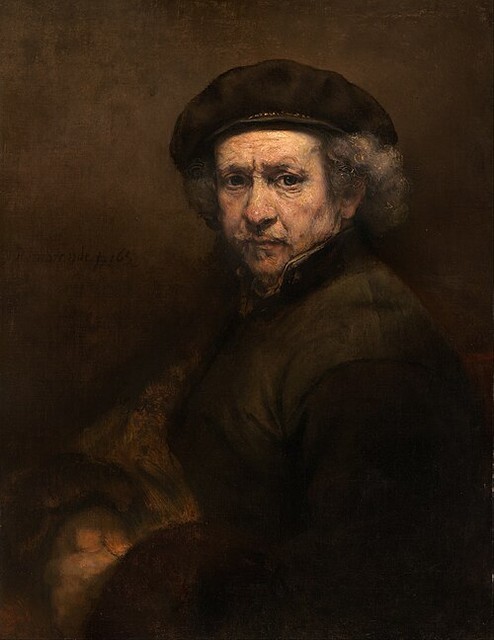
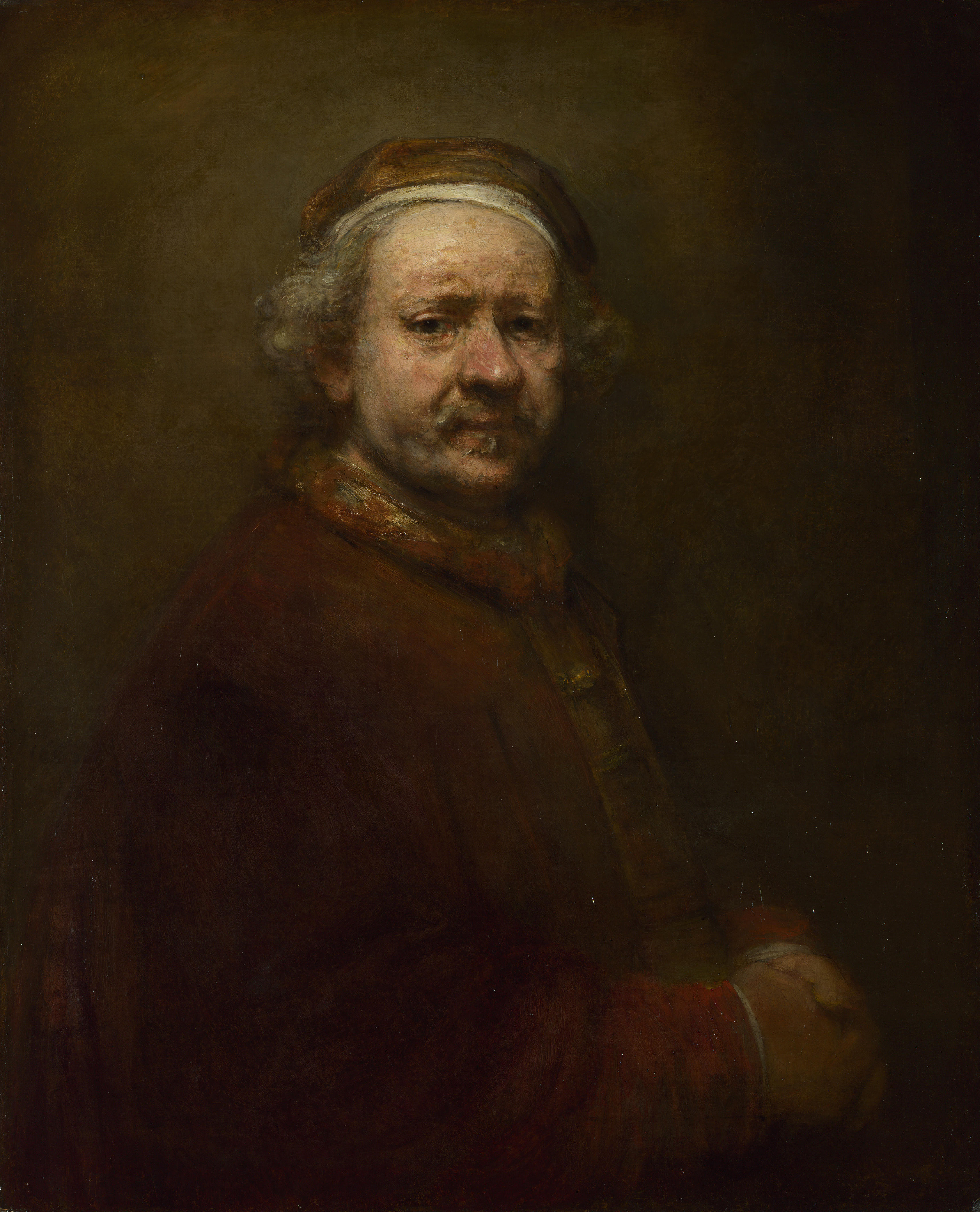
Download highest-resolution imageClose view of the tired, hooded eyes and furrowed brow under the pale headband, where the sitter's scrutiny of himself is most legible in the paint.
The thick collar of the reddish-brown cloak, with its furred or embroidered edge and the gleam of a clasp or edging below; it separates head from body and carries the warm palette and heavy paint texture.
The soft brown cap with its pale band, with wispy grey hair curling out at the temples; this headwear identifies the studio costume and frames the face.
Your gallery guide
Rembrandt painted himself in the final months of his life, at sixty-three, in a work whose concentrated surface, shadowed background, and ambiguous half-smile have made it one of his most discussed late self-portraits. This short tour looks closely at what he chose to put in, what he painted out, and how the National Gallery's curators read the result.
Editorial review by Artifact Archive automated publishing
Explore the researchAudio transcript The complete spoken story
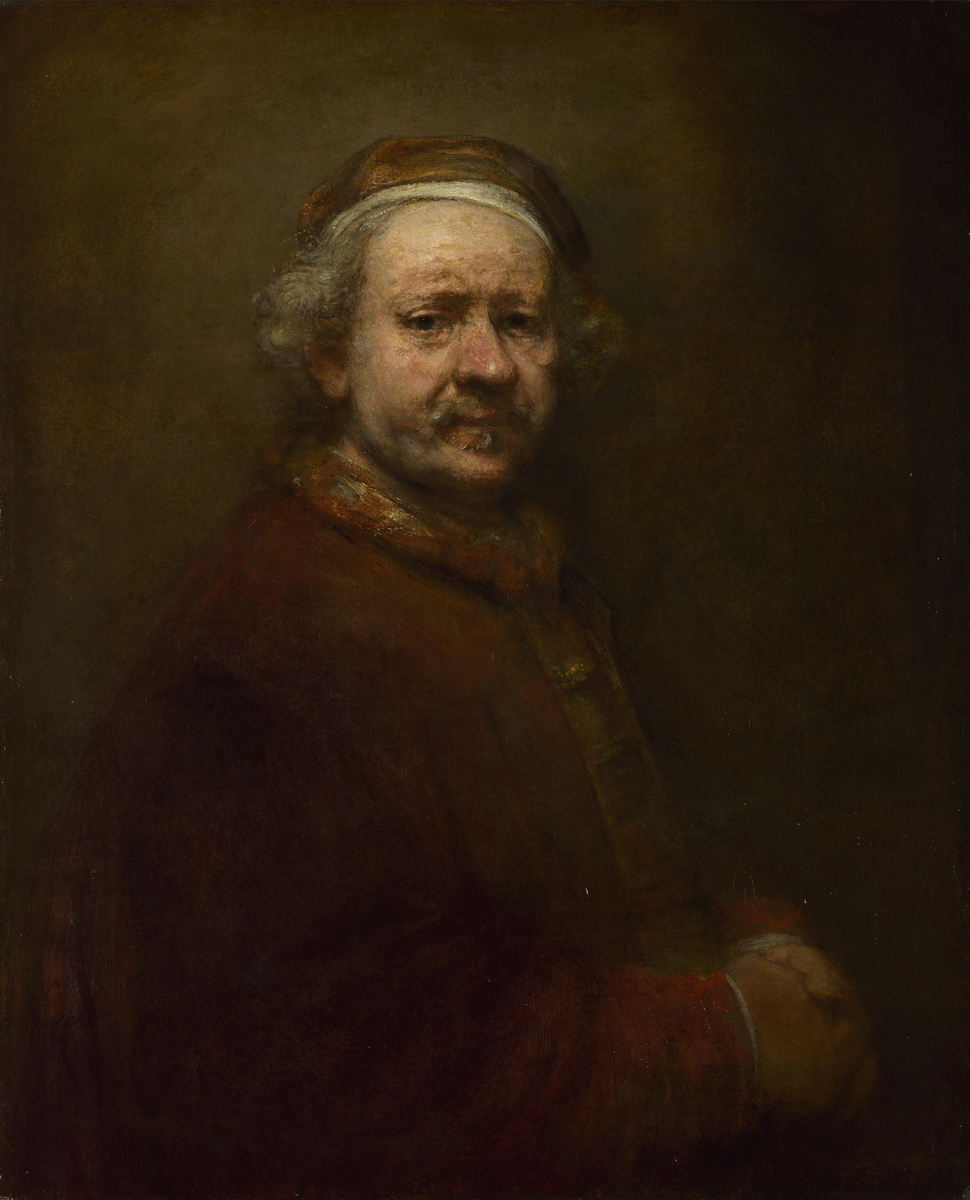
This is Rembrandt at sixty-three, painted in the months before his death in 1669. His face fills the canvas. His hands are clasped across his chest. He looks straight out at us from a dark, almost empty field of paint. It is one of three self-portraits he made at the very end of his life.
Start with the light. It falls on his high forehead and the tip of his nose, as though a beam had been aimed at them. It catches the pitted texture of his brow, the tufts of hair around his lips, the heavy folds beneath his eyes. Everything else in the picture is left deliberately vague.
Look at how unevenly the picture is painted. The background is thin and shadowy. The robe and fur collar are sketched in looser, quicker strokes. His clasped hands are blurred and indistinct. The face is the opposite. The paint there is thickly and intensively applied, so that it seems he is sculpting skin rather than describing it.
The sagging fold under his right eye is one swirl of a heavily loaded brush. The blemishes on his forehead are blotches of thickened paint. Through translucent layers he builds greys and whites, pinks, purples and pasty yellows. That contrast between the blurred body and the overly particular face is the engine of the whole picture.
X-ray images let us see what he changed. He had first shown himself as a painter at work, with open hands holding what seems to be a brush. Then he painted it out. We cannot know his private intent, but a later hand position with no brush keeps our attention on the face. So the painting gives us the man, not the tools of his trade.
That choice matters, because self-portraits served many purposes in seventeenth-century Holland. Rembrandt made around eighty of them across a long career, more than any painter of his time. He used them to try expressions, to test lighting, and to sell to wealthy collectors. King Charles I, for one, owned several self-portraits by artists, including one by Rembrandt.
Many later writers have read this picture as intense honesty about death, as if he were facing his own end without flinching. That reading is powerful, but it is a reading, not a record of his thoughts. The Gallery warns us to be careful: in the seventeenth century, ideas about self-examination and how the mind works were not the same as ours.
Seen that way, his motives may have been more practical. He may have been studying how age marked his own skin, while perfecting how he would paint the skin of clients his own age. His dark eyes are hard to read. Some visitors find weariness there, some a trace of self-satisfaction, others a wry, knowing half-smile. What feels like existential gloom may simply be a painter absorbed in the difficulties of his craft.
So the picture holds two things together. The body and the setting are left blurred and thin, as though they mattered less. The face is built up, layer on layer, with a concentration that makes the skin feel touchable. That is where the painting's attention lives. Whether we call the result a meditation on mortality or a professional's study of ageing, the choice is the same: everything is subordinated to the face.
Editorial review by Artifact Archive automated publishing.
Historical claims are linked to the records below. Close looking and interpretation are identified in the passage notes.
Rembrandt. Image source · Public domain
About the artist
15 July 1606 to 4 October 1669
Rembrandt was a Dutch painter and printmaker whose portraits, historical scenes and self-portraits explore expression through light and shadow. Born in Leiden, he trained locally and with Pieter Lastman in Amsterdam before establishing his own workshop. He moved to Amsterdam around 1631, where commissions, teaching and collecting became central to his career.
The research & record
Find catalogue details, historical context, technical research and the literature behind this artwork.
Your browser could not copy automatically. Select the research text below, then copy it.
Open the complete research textThe artwork record
Catalogue information and detailed research, with references that link to the bibliography.
Updated .
The National Gallery, London catalogues this painting as "Self-Portrait at the Age of 63", and its subject description states that Rembrandt is 63 and that this is one of three self-portraits he painted in the months before his death in 1669. The Gallery's overview phrases the same identification as one of three self-portraits made just before that death in 1669, while the fallback encyclopedic entry gives the month as October 1669 and describes the work as one of the last in Rembrandt's series of around eighty self-portraits, painted in the months before that date. A separate Rijksmuseum record for an early self-portrait, c. 1628, SK-A-4691, was consulted only to confirm that it is not the object under study; it describes a different painting in which Rembrandt used the butt end of his brush to make scratches in the wet paint to accentuate the curls of his tousled hair. Brought together, these units establish the object as a late Rembrandt self-portrait of 1669, distinguished from the early Amsterdam self-portrait that carries a different inventory number.(The National Gallery, London, n.d., In-depth; Overview)(Wikipedia fallback: Self-Portrait at the Age of 63, n.d., Description)(Rijksmuseum, Amsterdam, n.d., Self-Portrait, Rembrandt)
The Gallery's reading of the surface describes an unequal distribution of finish that governs how the picture is seen. It states that the dark, shadowy background is thinly painted, that the texture of the robe and fur collar is sketchy, and that the folded hands are blurred and indistinct, whereas the paint in the face is much thicker and more intensively applied, so much so that Rembrandt appears to be modelling the skin in three dimensions. Particular marks are described in the same terms: the sagging fold beneath Rembrandt's right eye is made with the swirl of a heavily loaded brush, and the blemishes on his forehead are formed of blotches of coagulated paint. The account of colour states that he builds up translucent layers and colours, the greys and whites, pinks, purples and pasty yellows which he sees in his own face. The fallback entry adds that Rembrandt employed his usual rather limited palette of lead white, ochres and red lakes, a statement of pigment range that the Gallery passage does not make. Together the units document a face worked thickly with loaded strokes and translucent layers while the body and setting remain thin and unresolved, and they pair that observation with a distinct, narrower claim about the pigments used.(The National Gallery, London, n.d., In-depth)(Wikipedia fallback: Self-Portrait at the Age of 63, n.d., Description)
The Gallery's description of lighting treats it as an identifiable effect rather than a mood: it seems as though Rembrandt has turned a spotlight on his features, with the beam bouncing off his high forehead and the tip of his nose and catching on his mottled, pitted brow and the tufts of hair around his lips. Because the background is thinly painted and the robe, fur collar and folded hands are sketchy or blurred, that concentrated light stands out against an otherwise vague surrounding. The evidence therefore supports a technical account in which the face alone receives intensive, three-dimensional treatment while the rest of the canvas is left deliberately unresolved, and it is this contrast, rather than any single stroke, that the Gallery identifies as the picture's emphasis on the face.(The National Gallery, London, n.d., In-depth)
The Gallery's own account is careful to mark the limits of interpretation. It says plainly that in this painting Rembrandt's intentions are not so clear, and it records that many later writers and artists have interpreted the work as intense, unflinching, existential honesty, Rembrandt coming to terms with the approach of death. Against that reception it sets a historical qualification: in the seventeenth century people had different ideas about self-analysis and how the mind works than we do now, so Rembrandt's motives may have been more straightforward, driven less by soul-searching and more by a professional fascination with the challenges of his art. The same passage proposes a practical reading, that it seems as though Rembrandt was not only studying how time was ageing his own skin, he was perfecting how he might depict the skin of his clients, many of whom were the same age as him. The existential reading is thus attributed to later writers and artists, the professional reading to the Gallery's own curatorial suggestion, and the difference between them is preserved rather than resolved.(The National Gallery, London, n.d., In-depth)
Interpretation
The recorded responses to Rembrandt's expression are themselves part of the object's reception history. The Gallery notes that some see weariness and resignation in his dark, rheumy eyes, some a trace of self satisfaction, others the hint of a wry, knowing smile, and it proposes that the mysterious look in his eye may not be one of existential angst, but that of a painter deeply engaged in the challenges of his art. These are reported readings of an ambiguous expression, not statements about Rembrandt's state of mind, and the evidence offers no document of his private intent. The disagreement is therefore better treated as evidence of how the finished surface supports divergent responses than as a dispute that the technical record can settle; the X-ray findings about the abandoned brush and the beret bear on what was painted, not on what the eyes are meant to mean.(The National Gallery, London, n.d., In-depth)
Taken together, the units describe an object whose importance lies in the concentration of its making and the openness of its meaning. The Gallery's own account supports reading the late self-portrait as continuous with Rembrandt's lifelong use of self-depiction for expression, lighting experiment and sale, while also distinguishing it from the early Amsterdam self-portrait in which the brush handle was scratched through wet paint. The documented history, the X-ray evidence of revision, the recorded prices of 1722 and 1851, and the Gallery's caution about anachronistic ideas of self-analysis all belong to the same object, and each qualifies the others. What remains least documented, and is preserved here as such, is the painter's purpose in turning a working self-portrait into a face alone.(The National Gallery, London, n.d., In-depth; Provenance; Key facts)(Rijksmuseum, Amsterdam, n.d., Self-Portrait, Rembrandt)(Wikipedia fallback: Self-Portrait at the Age of 63, n.d., Description)
Rembrandt is 63 and this is one of three self-portraits he painted in the months before his death in 1669.(The National Gallery, London, n.d.)
Visual observation
The National Gallery's reading of the picture begins with light, and describes an effect as though Rembrandt had turned a spotlight on his own features: the beam bounces off his high forehead and the tip of his nose, and catches on his mottled, pitted brow and on the tufts of hair around his lips. Against that illuminated area, the rest of the composition is left deliberately unresolved. The dark, shadowy background is thinly painted, the texture of his robe and fur collar is sketchy, and his folded hands are blurred and indistinct. The distinction is therefore not incidental but structural: a sharply particularized head set within a loosely indicated body and an almost empty field of paint.(The National Gallery, London, n.d., In-depth)
The handling of the face itself is described in physical terms rather than literary ones. The paint in the face is much thicker and more intensively applied, so much so that the artist appears to be modelling the skin in three dimensions, rather than merely describing its appearance. Individual passages show how that modelling was achieved: the sagging fold beneath his right eye is made with the swirl of a heavily loaded brush, and the blemishes on his forehead are formed of blotches of coagulated paint. The marks of age in the face are thus, at least in part, marks of paint. A sagging fold and a blemish are both observed features of a face and documented features of a surface.(The National Gallery, London, n.d., In-depth)
It seems as though Rembrandt has turned a spotlight on his features; the beam bounces off his high forehead and the tip of his nose, and catches on his mottled, pitted brow and the tufts of hair around his lips.(The National Gallery, London, n.d.)
The dark, shadowy background is thinly painted, the texture of his robe and fur collar is sketchy, and his folded hands are blurred and indistinct.(The National Gallery, London, n.d.)
The sagging fold beneath Rembrandt's right eye is made with the swirl of a heavily loaded brush.(The National Gallery, London, n.d.)
The blemishes on Rembrandt's forehead are formed of blotches of coagulated paint.(The National Gallery, London, n.d.)
The National Gallery presents this painting as one of three self-portraits Rembrandt made just before his death in 1669, and its curatorial record states that in this painting his intentions are not so clear. That qualification matters for how the object is framed: the secure identification of the subject as the ageing artist, and the late date within a career of self-depiction, do not by themselves explain why the picture was made, whether on the artist's own initiative, for a buyer, or for some other purpose. The Gallery's overview notes that Rembrandt painted self-portraits for different reasons, including practising different expressions, experimenting with lighting effects, and selling to wealthy patrons and collectors. Each of those functions is documented in general terms, but no supplied evidence assigns a specific one to this canvas, so the commissioning circumstances remain open rather than settled.(The National Gallery, London, n.d., Overview; In-depth)
Self-portraiture in Rembrandt's milieu was not a strictly private exercise. The National Gallery records that some wealthy patrons collected self-portraits by artists, and that King Charles I owned several, including one by Rembrandt. This indicates a formed market for such works among elite collectors, which is the context in which at least some of Rembrandt's self-portraits are said to have been made for sale. The Gallery also notes that about 80 self-portraits, including sketches, etchings and paintings, survive from Rembrandt's 40-year career, far more than by any other painter of his time. The scale of that output, sustained across four decades and in more than one medium, supports the broader point that self-depiction was a continuous professional practice for him, in which this late head belongs as much by its quantity and medium as by its subject.(The National Gallery, London, n.d., In-depth)
Interpretation
Rembrandt's habit of using self-portraits as technical testing grounds is documented in an earlier work. The Rijksmuseum record describes a different early self-portrait, of about 1628, SK-A-4691, in which Rembrandt used the butt end of his brush to make scratches in the wet paint to accentuate the curls of his tousled hair. That object is not the painting under discussion, and its presence here is only as evidence of method and of the museum record's role in distinguishing the two works. It establishes that by his early twenties Rembrandt was already treating his own image as a site for handling experiments in wet paint. The late London canvas, painted some four decades later, belongs to the same long practice, even though the specific technical means documented for the early picture are not the means documented for the late one.(Rijksmuseum, Amsterdam, n.d., Self-Portrait, Rembrandt)
This is one of three self-portraits Rembrandt made just before his death in 1669.(The National Gallery, London, n.d.)
About 80 self-portraits, including sketches, etchings and paintings, survive from Rembrandt's 40-year career, far more than any other painter of his time.(The National Gallery, London, n.d.)
Rembrandt painted self-portraits for different reasons: to practise different expressions, to experiment with lighting effects, and also to sell to wealthy patrons and collectors.(The National Gallery, London, n.d.)
Some wealthy patrons collected self-portraits by artists; King Charles I owned several, including one by Rembrandt.(The National Gallery, London, n.d.)
In this painting, Rembrandt's intentions are not so clear.(The National Gallery, London, n.d.)
The Rijksmuseum excerpt describes a different early self-portrait, c. 1628, SK-A-4691, in which Rembrandt used the butt end of his brush to make scratches in the wet paint to accentuate the curls of his tousled hair.(Rijksmuseum, Amsterdam, n.d.)
Technical examination
Technical examination of the Self-Portrait at the Age of 63 has produced the clearest evidence for a change of mind within the composition. X-ray images show that Rembrandt at first depicted himself as an artist at work, with hands open, holding what seems to be a brush; he then altered the design. The National Gallery, which holds the painting, explains the change as apparently intended to avoid distracting the viewer from the detail of his face. This is a proposed explanation of an observed alteration rather than a record of the painter's private intent, and the evidence does not permit us to know why he made the change. What the examination does establish is that the brush and the open, active hands were painted out, so that the finished image presents the man rather than the implements of his trade.(The National Gallery, London, n.d., In-depth)
A second account of the same imaging describes two pentimenti rather than one. According to the encyclopedic fallback entry, X-ray analysis has shown that the beret was originally larger and white in colour, and that the hands originally had a different position, holding a paintbrush and maulstick. The hand change is therefore recorded in both accounts, while the beret, its original size and its white colour, and the maulstick appear only in the fallback entry. The two accounts are not contradictory: the National Gallery text concentrates on the figure's action and the resulting focus on the face, whereas the fallback enumerates the physical alterations in the headwear and the hands. Read together, they indicate that the underlayers of the picture contain a figure both differently hatted and differently occupied from the one now visible.(Wikipedia fallback: Self-Portrait at the Age of 63, n.d., Description)
Interpretation
The technical findings carry weight within a larger history of self-portraiture because they show a decision about what a self-portrait should contain. The change from an artist at work to a figure with folded, indistinct hands removes the tools of the trade from the finished image, and the dense modelling of the face directs attention there instead. Within the history of artists' self-representation, that choice is consequential: it separates the depiction of the person from the depiction of the profession, even though the painting was made by someone whose profession was the subject of many earlier self-portraits. The evidence establishes the alteration and the resulting distribution of finish; it does not establish the painter's reasons, and the gallery's explanation that he wished to avoid distracting the viewer from the face remains an attributed interpretation.(The National Gallery, London, n.d., In-depth)
Visual observation
The face is the centre of the picture's making as well as its subject. The National Gallery's account describes the paint in the face as much thicker and more intensively applied than elsewhere, so much so that Rembrandt appears to be modelling the skin in three dimensions. Within the face, particular passages are built with loaded, heavily charged touches: the sagging fold beneath Rembrandt's right eye is made with the swirl of a heavily loaded brush, and the blemishes on his forehead are formed of blotches of coagulated paint. These are described as seen in the work, marking where the paint stands proud of the surface and where thickened, partly set material has been used to register the texture of ageing skin. Alongside this thick application, the same account describes Rembrandt building up translucent layers and colours, the greys and whites, pinks, purples and pasty yellows he sees in his own face. Read together, the two descriptions indicate that the flesh is not a single procedure but a sequence of applications, some translucent and some heavily loaded, with the final surface carrying both the layered colour and the raised deposits of paint that give it palpability.(The National Gallery, London, n.d., In-depth)
The Wikipedia fallback entry records that Rembrandt employed his usual rather limited palette of lead white, ochres and red lakes. This is a statement about pigments rather than a description of handling, and it complements rather than duplicates the National Gallery's account of greys and whites, pinks, purples and pasty yellows. The named materials establish the range from which those flesh tones were mixed: lead white as the principal light and body colour, ochres among the earth colours, and red lakes contributing the pink and purplish notes observed in the surface. Because the palette evidence comes from the encyclopedic entry and the colour description from the museum account, the two are worth keeping distinct as sources; they agree in substance about the restricted character of the palette and about the presence of pale, warm and purplish tones in the face.(Wikipedia fallback: Self-Portrait at the Age of 63, n.d., Description)(The National Gallery, London, n.d., In-depth)
Interpretation
The unevenness just described is not an incidental feature of the surface but the organising principle of the picture, and technical examination gives it a documented history. Where the background is thin and shadowy, the robe and fur collar sketchy, and the hands blurred, we can see a hierarchy of finish in which the face alone receives sustained, thickened attention. Where X-rays reveal open hands holding what seems to be a brush and, in the other account, hands with a paintbrush and maulstick, we can see that the blurred hands of the finished state were arrived at by painting out an earlier, more explicit configuration. The two bodies of evidence converge on the same conclusion: the concentration of material and of decision-making lies in the head, and the painting preserves the trace of a choice to subordinate hand and setting to face. Because the palette was limited to lead white, ochres and red lakes, the range of effects available in the flesh was achieved through layering and loading rather than through variety of pigments, which is consistent with the observed contrast between translucent passages and raised, coagulated touches.(The National Gallery, London, n.d., In-depth)(Wikipedia fallback: Self-Portrait at the Age of 63, n.d., Description)
Visual observation
The visual evidence of how the face is lit belongs to the same account of making, because it identifies where the thickest and most detailed work is placed. The National Gallery describes it as though Rembrandt has turned a spotlight on his features; the beam bounces off his high forehead and the tip of his nose, and catches on his mottled, pitted brow and the tufts of hair around his lips. This is presented as an observation of the picture rather than a record of studio practice, but it corresponds to the documented concentration of paint in the face and to the description of blemishes as coagulated paint and of the brow as pitted. The visual account and the material account are therefore mutually reinforcing: the areas singled out by the light are the areas where paint is most heavily charged and where the texture of the skin is most explicitly manufactured.(The National Gallery, London, n.d., In-depth)
The paint in the face is much thicker and more intensively applied, so much so that Rembrandt appears to be modelling the skin in three dimensions.(The National Gallery, London, n.d.)
Rembrandt builds up translucent layers and colours, the greys and whites, pinks, purples and pasty yellows which he sees in his own face.(The National Gallery, London, n.d.)
Rembrandt employed his usual rather limited palette of lead white, ochres and red lakes.(Wikipedia fallback: Self-Portrait at the Age of 63, n.d.)
Technical examination
X-ray images show that Rembrandt did, at first, depict himself as an artist at work, with hands open, holding what seems to be a brush, but he changed his mind, apparently to avoid distracting the viewer from the detail of his face.(The National Gallery, London, n.d.)
X-ray analysis has shown two pentimenti: the beret was originally larger and white in colour, and the hands originally had a different position, holding a paintbrush and maulstick.(Wikipedia fallback: Self-Portrait at the Age of 63, n.d.)
The documented condition history of the painting begins with a cleaning carried out in 1967. That treatment revealed a signature and date, but the signature is described as damaged, so what the cleaning brought back is a compromised inscription rather than a fully legible one. The same account records a belief that the work has been cut down on all four sides, meaning that the painted surface we see may preserve less of the original composition than Rembrandt set down. Both observations come from the fallback encyclopedic entry, which is used here to note condition material absent from the official overview; the official museum record takes precedence, and neither the National Gallery record nor any other supplied unit reports a treatment, loss or alteration beyond these. The date of the cleaning and the damaged state of the signature are established by that source, while the trimming of the edges is given not as a finding but as something believed, so it should be held at that level of confidence. This matters because the condition of the support and the legibility of the signature bear directly on how the object is authenticated and on how much of the original design survives at its margins.(Wikipedia fallback: Self-Portrait at the Age of 63, n.d., Description)
A damaged signature and date were revealed when the painting was cleaned in 1967, and it is believed that the work has been cut down on all four sides.(Wikipedia fallback: Self-Portrait at the Age of 63, n.d.)
The documented sequence of owners begins in London, where the painting hung in the collection of William van Huls. At van Huls's sale in August 1722, the picture was bought by Thomas Brodrick, a Member of Parliament. Brodrick paid £80 for it, a price recorded in the encyclopedic fallback entry; the official National Gallery provenance notes the purchase but not the sum. Brodrick's ownership ended at his death in 1730, when the painting passed to his brother, Alan, 1st Viscount Midleton. It then remained at Peper Harow, the Midleton seat, across the generations until the sale held by the 5th Viscount Midleton in 1851. That sale is the point at which the picture left the family and entered public ownership.(The National Gallery, London, n.d., Provenance)(Wikipedia fallback: Self-Portrait at the Age of 63, n.d., Description)
The National Gallery, London bought the painting in 1851, the year of the 5th Viscount Midleton sale. The Gallery records the acquisition twice in its own material, once in the provenance line linking the purchase to that sale and once as a key fact, and states that the picture is now in its Main Collection. The fallback entry supplies the purchase price of £430 10s, roughly five and a half times the £80 Brodrick had paid in 1722. The two 1851 figures, the £430 10s sum and the sale context, are consistent in identifying the same transaction; only the encyclopedic source records the amount, while the Gallery's own record establishes the buyer and the route by which the picture arrived there.(The National Gallery, London, n.d., Key facts; Provenance)(Wikipedia fallback: Self-Portrait at the Age of 63, n.d., Description)
Interpretation
Two facts about price are worth separating carefully. The £80 paid by Thomas Brodrick in 1722 and the £430 10s paid by the National Gallery in 1851 are both documented figures, and they bracket a 129-year interval in which the painting moved from a private London collection through the Brodrick family and the Midleton title to a family sale. That interval is not an unrecorded gap: the chain of descent from Thomas Brodrick to Alan, 1st Viscount Midleton and then to the 5th Viscount Midleton sale is stated. What remains unstated is the exact date on which the painting left Brodrick's possession and the terms of each intergenerational transfer, though the provenance establishes that the picture stayed at Peper Harow through the 5th Viscount Midleton sale of 1851.(The National Gallery, London, n.d., Provenance; Key facts)(Wikipedia fallback: Self-Portrait at the Age of 63, n.d., Description)
The provenance history is inseparable from the painting's status as a late work. The Gallery dates it to the months before Rembrandt's death in 1669 and identifies it as one of three self-portraits he made just before that death. The fallback entry adds that it was painted in the months before his death in October 1669 and places it at the end of his series of around eighty self-portraits. Those two accounts of the series, one from the Gallery and one from the encyclopedic fallback, agree on the scale of Rembrandt's self-portraiture and on the terminal position of this picture. The provenance therefore documents not simply an object that passed through three owners, but the market afterlife of one of the last self-portraits by an artist whose self-portrait production was exceptional in his period.(The National Gallery, London, n.d., Overview; In-depth)(Wikipedia fallback: Self-Portrait at the Age of 63, n.d., Description)
A note of caution belongs with any account of this picture's early modern circulation. Wealthy seventeenth-century patrons did collect self-portraits by artists, and King Charles I owned several, including one by Rembrandt, so a market for such works existed before van Huls's ownership. The Gallery states that Rembrandt painted self-portraits for several reasons, to practise expressions, to experiment with lighting, and to sell to patrons and collectors. But for this particular painting the Gallery says his intentions are not so clear. The documented provenance, running from a London collection in 1722 to a national collection in 1851, shows the picture circulating in the market for old master paintings, not the terms on which Rembrandt himself released or retained it, which the evidence does not record.(The National Gallery, London, n.d., In-depth; Overview; Provenance)
The technical evidence the Gallery reports concerns construction and revision rather than ownership. X-ray images show that Rembrandt first depicted himself as an artist at work, with hands open and holding what seems to be a brush, and then changed his mind, apparently to avoid distracting the viewer from the detail of his face. The face itself is built with a spotlight-like beam bouncing off a high forehead, the tip of the nose, a mottled and pitted brow, and tufts of hair around the lips. The background is thinly painted, the robe and fur collar sketched, and the folded hands blurred and indistinct, while the paint in the face is thicker and more intensively applied, so much so that the Gallery describes Rembrandt as modelling skin in three dimensions. The sagging fold beneath the right eye is made with the swirl of a heavily loaded brush, and the forehead blemishes are blotches of coagulated paint, with translucent layers of greys and whites, pinks, purples and pasty yellows built up in the face.(The National Gallery, London, n.d., Provenance; In-depth)
The fallback encyclopedic entry adds technical and condition material that the official overview does not carry, and it should be weighed as such. It reports that a damaged signature and date were revealed when the painting was cleaned in 1967, and that the work is believed to have been cut down on all four sides. It also reports X-ray analysis showing two pentimenti: the beret was originally larger and white, and the hands originally held a paintbrush and maulstick in a different position. The brush evidence in this fallback account agrees in substance with the Gallery's X-ray observation that a brush was painted out, while the beret change and the proposed reduction of the canvas are additions found only in the encyclopedic source. The fallback also states that Rembrandt employed his usual rather limited palette of lead white, ochres and red lakes. These claims are not corroborated by the Gallery material supplied here and should be treated as the fallback source's report.(Wikipedia fallback: Self-Portrait at the Age of 63, n.d., Description)
The painting was in the collection of William van Huls in London; at his sale in August 1722 it was bought by Thomas Brodrick, MP. At his death in 1730 it passed to his brother, Alan, 1st Viscount Midleton, and remained at Peper Harow until the 5th Viscount Midleton sale in 1851, when it was bought for the National Gallery.(The National Gallery, London, n.d.)
It was bought by the National Gallery, London in 1851.(The National Gallery, London, n.d.)
Rembrandt painted this work, one of three self-portraits made in the months before his death in 1669.(The National Gallery, London, n.d., Overview)
The painting, then in the London collection of William van Huls, was sold; Thomas Brodrick, MP, bought it.(The National Gallery, London, n.d., Provenance)
Thomas Brodrick is recorded as having bought the painting for 80 pounds.(Wikipedia fallback: Self-Portrait at the Age of 63, n.d., Description)
On the death of Thomas Brodrick the painting passed to his brother, Alan, 1st Viscount Midleton.(The National Gallery, London, n.d., Provenance)
At the 5th Viscount Midleton sale, after the painting had remained at Peper Harow, it was bought for the National Gallery.(The National Gallery, London, n.d., Provenance; Key facts)
The purchase price paid by the National Gallery is recorded as 430 pounds and 10 shillings.(Wikipedia fallback: Self-Portrait at the Age of 63, n.d., Description)
Interpretation
Many later writers and artists have interpreted this work as intense, unflinching, existential honesty: Rembrandt coming to terms with the approach of death. The National Gallery presents that reading as a tradition of interpretation rather than as a record of Rembrandt's thoughts, and it qualifies it by noting that seventeenth-century ideas about self-analysis and how the mind works differed from modern ones. Within the same interpretive field, the Gallery records that some see weariness and resignation in his dark, rheumy eyes, some a trace of self-satisfaction, others the hint of a wry, knowing smile. It further proposes that the mysterious look in his eye may not be one of existential angst, but that of a painter deeply engaged in the challenges of his art. The divergence among these descriptions is itself part of the object's reception: the same painted eyes support incompatible emotional readings, and no documentary source fixes one meaning over another.(The National Gallery, London, n.d., Overview; In-depth)
The two broad interpretive positions the Gallery sets out are not simply a contrast between sentimental viewers and expert historians. The mortality reading attaches to something visible: a face built up in thick paint while body and setting are thin and blurred, and eyes whose expression resists a single description. The professional reading attaches to documented context: a painter who produced about 80 self-portraits, who used them to test expressions and lighting, who could sell them, and who in this painting at first showed himself holding a brush before painting the tool out. Both readings therefore rest on evidence, and each explains part of the object while leaving the other partly unaccounted for; the Gallery leaves the question of Rembrandt's intentions open, stating only that they are not so clear.(The National Gallery, London, n.d., Overview; In-depth)
Interpretation
The painted surface itself is deliberately unequal. The dark, shadowy background is thinly painted, the texture of the robe and fur collar is sketchy, and the folded hands are blurred and indistinct, while the face is where the density of paint accumulates and where the modelling of skin in three dimensions is concentrated. Specific marks are legible as working decisions: the sagging fold beneath Rembrandt's right eye is made with the swirl of a heavily loaded brush, and the blemishes on his forehead are formed of blotches of coagulated paint. Light behaves in a related way, seeming to be aimed at his features so that it bounces off his high forehead and the tip of his nose and catches on his mottled, pitted brow and the tufts of hair around his lips. This distribution of attention is the strongest visual argument in the picture, and it is also the ground on which later readings of the face as psychologically transparent have been built.(The National Gallery, London, n.d., In-depth)
The Gallery describes paint in the face as much thicker and more intensively applied, so much so that Rembrandt appears to be modelling the skin in three dimensions, and notes that he builds up translucent layers and colours, the greys and whites, pinks, purples and pasty yellows which he sees in his own face. A separate account records that he employed his usual rather limited palette of lead white, ochres and red lakes. The two descriptions are not in conflict so much as different in kind: one describes visible colour relationships and layering, the other names pigments. The technical account also records that a damaged signature and date were revealed when the painting was cleaned in 1967, and that it is believed the work has been cut down on all four sides. Cleaning and trimming matter to interpretation because they qualify what can be inferred about the artist's original framing of the composition and about the legibility of its inscribed date.(The National Gallery, London, n.d., In-depth)(Wikipedia fallback: Self-Portrait at the Age of 63, n.d., Description)
Some see weariness and resignation in his dark, rheumy eyes, some a trace of self satisfaction, others the hint of a wry, knowing smile. The Gallery reports these as competing readings of the same features rather than settling on one, which is itself evidence about the picture's reception: the expression is legible enough to prompt strong responses and ambiguous enough that those responses diverge. Many later writers and artists have interpreted this work as intense, unflinching, existential honesty, Rembrandt coming to terms with the approach of death. That tradition is documented as a tradition, not as a record of Rembrandt's thoughts, and the divergence among viewers of the eyes shows how much of the emotional content is supplied by the act of looking.(The National Gallery, London, n.d., In-depth; Overview)
The Gallery cautions that in the seventeenth century people had different ideas about self-analysis and how the mind works than we do now, so Rembrandt's motives may have been more straightforward, driven less by soul-searching and more by a professional fascination with the challenges of his art. On this account the mysterious look in his eye may not be one of existential angst, but that of a painter deeply engaged in the challenges of his art. The Gallery also proposes that Rembrandt was not only studying how time was ageing his own skin, he was perfecting how he might depict the skin of his clients, many of whom were the same age as him. These are attributed interpretations rather than claims about private intent, and they are framed as possibilities. They sit against the existential reading not as a correction but as a competing explanation whose strength lies in the documented commercial and professional functions of Rembrandt's self-portraiture.(The National Gallery, London, n.d., Overview; In-depth)
The evidence assembled here supports a layered account rather than a single meaning. Technically, the composition was revised, the inscription is damaged, and the work has likely been trimmed, so the object as it survives is not identical to the object as it left the studio. Visually, attention is concentrated in the face through thick and translucent paint while body and ground are loosened. Historically, the painting belongs to a large and commercially motivated practice of self-portraiture and to a documented chain of owners ending in a public collection. Interpretively, the existential reading and the professional-study reading both draw on the same evidence of an ambiguous face and an erased brush, and neither can claim to recover Rembrandt's private intent. The most defensible synthesis treats the division of the surface as the argument: whatever the picture means, it locates meaning in the face and subordinates everything else to it, and that emphasis is the common ground beneath the rival readings the Gallery reports.(The National Gallery, London, n.d., In-depth; Overview)(Wikipedia fallback: Self-Portrait at the Age of 63, n.d., Description)
Reported tradition
The evidence for this late self-portrait arrives in two distinct registers, and they do not carry the same weight. The supplied encyclopedic entry states that the work belongs to the final phase of Rembrandt's self-portraiture, described there as a series of around eighty such paintings, and that it was painted in the months before his death in October 1669. The record further notes a dating practice rather than a narrating of the work itself: when the painting was cleaned in 1967, a damaged signature and date were revealed. Any account of the picture's authorship and chronology therefore rests on that inscription and its condition, not solely on style. The same entry adds a qualification about the physical object as it now survives, reporting that it is believed to have been cut down on all four sides, so the dimensions and framing we encounter are not necessarily those of the original support. These are reported positions rather than uncontested facts, and the damaged state of the inscription and the loss of original edges are precisely the conditions that make absolute certainty about dating and format difficult to secure.(Wikipedia fallback: Self-Portrait at the Age of 63, n.d., Lead)
Interpretation
Many later writers and artists have interpreted this work as intense, unflinching, existential honesty: Rembrandt coming to terms with the approach of death.(The National Gallery, London, n.d.)
In the seventeenth century people had different ideas about self-analysis and how the mind works than we do now, so Rembrandt's motives may have been more straightforward, driven less by soul-searching and more by a professional fascination with the challenges of his art.(The National Gallery, London, n.d.)
It seems as though Rembrandt was not only studying how time was ageing his own skin, he was perfecting how he might depict the skin of his clients, many of whom were the same age as him.(The National Gallery, London, n.d.)
Some see weariness and resignation in his dark, rheumy eyes, some a trace of self satisfaction, others the hint of a wry, knowing smile.(The National Gallery, London, n.d.)
That mysterious look in his eye may not be one of existential angst, but that of a painter deeply engaged in the challenges of his art.(The National Gallery, London, n.d.)
Reported tradition
It was one of the last in Rembrandt's series of around 80 self-portraits, painted in the months before his death in October 1669.(Wikipedia fallback: Self-Portrait at the Age of 63, n.d.)
The Self-Portrait at the Age of 63 belongs to the Main Collection of the National Gallery, London, the institution that acquired it in 1851. The museum's own object record frames the picture around a double identity: Rembrandt is sixty-three in the work, and it is one of three self-portraits he made in the months just before his death in 1669. That conjunction of a specific age, a specific late moment and a specific surviving group of three is what the record establishes; it does not supply a date of execution within those months, nor the size, support or inscriptions of the canvas.(The National Gallery, London, n.d., Key facts)
The National Gallery's published account describes the picture's making in unusual physical detail. X-ray images show that Rembrandt first depicted himself as an artist at work, with hands open and holding what seems to be a brush, and that he then painted the tool out, apparently to avoid distracting the viewer from the detail of his face. The record reads the visible surface as a deliberately uneven performance: the dark, shadowy background is thinly painted; the texture of the robe and fur collar is sketchy; the folded hands are blurred and indistinct; while the paint in the face is much thicker and more intensively applied, so much so that Rembrandt appears to be modelling the skin in three dimensions. The sagging fold beneath the right eye is described as the swirl of a heavily loaded brush, and the blemishes on the forehead as blotches of coagulated paint, with translucent layers and colours built up in the greys and whites, pinks, purples and pasty yellows the painter saw in his own face. Light is described as acting like a spotlight on the features, bouncing off the high forehead and the tip of the nose and catching the mottled, pitted brow and the tufts of hair around the lips. Because the brush has been removed, the evidence for Rembrandt's working method survives not on the surface but in the X-ray record, and the difference between those two layers of information is central to how the object is now understood.(The National Gallery, London, n.d., Key facts)
The record is explicit that Rembrandt's intentions in this painting are not so clear, and this qualification governs how the rest of its interpretation should be read. The Gallery places the work within a career in which about eighty self-portraits, including sketches, etchings and paintings, survive from a forty-year span, far more than by any other painter of the time, and it distinguishes among the reasons those works were made: to practise different expressions, to experiment with lighting effects, and to sell to wealthy patrons and collectors. The collecting context is documented by the example of King Charles I, who owned several self-portraits by artists, including one by Rembrandt. Set against that background, the Gallery proposes that Rembrandt's motives here may have been more straightforward than later readings allow, driven less by soul-searching and more by a professional fascination with the challenges of his art, and that he was not only studying how time was ageing his own skin but perfecting how he might depict the skin of clients many of whom were the same age as him.(The National Gallery, London, n.d., Key facts)
Reception of the work is documented as interpretation rather than fact. Many later writers and artists have read it as intense, unflinching, existential honesty, Rembrandt coming to terms with the approach of death. The record counters with a historical caveat: in the seventeenth century people had different ideas about self-analysis and how the mind works than we do now. The Gallery also records that the expression itself is disputed among viewers, with some seeing weariness and resignation in the dark, rheumy eyes, some a trace of self-satisfaction, others the hint of a wry, knowing smile, and it offers the alternative that the look may belong to a painter deeply engaged in the challenges of his art rather than to existential angst. These are attributed readings, and the surviving disagreement about what the face expresses is part of the object's documented history rather than a problem to be resolved.(The National Gallery, London, n.d., Key facts)
Provenance establishes a long English afterlife before the picture entered public ownership. It was in the collection of William van Huls in London; at his sale in August 1722 it was bought by Thomas Brodrick, MP. At Brodrick's death in 1730 it passed to his brother, Alan, 1st Viscount Midleton, and remained at Peper Harow until the 5th Viscount Midleton sale in 1851, when it was bought for the National Gallery. Read together with the acquisition statement, the trail runs from a London collector through a parliamentary family and a country house to a national institution in the same year as the Midleton sale, which is the moment the work moved from private inheritance into the Main Collection. The record does not document the painting's whereabouts or ownership before van Huls, and that interval remains open.(The National Gallery, London, n.d., Key facts)
Interpretation
Taken as a whole, the evidence supports a synthesis in which the object's material decisions and its institutional reading are inseparable. The X-ray finding that a brush was painted out, the concentration of thick paint in the face against the thin background and sketchy clothing, and the record's insistence that Rembrandt's intentions are not clear all point the same way: the picture subordinates everything to the face, and the surviving questions about expression and motive are consequences of that choice rather than gaps in the documentation. Within a longer history of art, the work matters less as a transparent window onto Rembrandt's last thoughts than as a documented late example of a self-portrait practice the Gallery describes as exceptional in its scale, roughly eighty works across forty years, and as an object whose meaning has been repeatedly rebuilt by later writers while its physical making has been recovered by technical examination. The reading of the face belongs to its viewers; the removed brush and the layered paint belong to the canvas.(The National Gallery, London, n.d., Key facts)
The painting is in the Main Collection of the National Gallery, London.(The National Gallery, London, n.d.)
The recorded monetary history of this late self-portrait rests on two documented transactions, both preserved in the fallback encyclopedic entry that the official museum record is said to supersede. The painting was bought for £80 by Thomas Brodrick in 1722, and it was later bought for £430 10s by the National Gallery, London, in 1851. The 1851 purchase is specifically described as the price paid by the National Gallery at the Midleton sale, which ties the acquisition to a named dispersal of a collection rather than to an anonymous dealer transaction. These are historical prices attached to identified moments of exchange. The entry itself marks the £430 10s figure as a nineteenth-century acquisition price, not a present valuation: it is not adjusted for inflation and does not represent the painting's current worth. The distinction matters for how any later use of these numbers should proceed. Repeating 430 pounds and 10 shillings as though it described the work's value today would convert a dated archival fact into a false contemporary claim, and the source explicitly guards against that reading. What the record does establish is a chain of custody with prices attached at two points roughly a century and a quarter apart, and a change of scale between the 1722 purchase by a private buyer and the 1851 institutional purchase at auction.(Wikipedia fallback: Self-Portrait at the Age of 63, n.d.)
The price evidence arrives through a source whose status is itself part of the record. The fallback Wikipedia entry is annotated as having been used only to corroborate the painting's identity and to note technical and condition material not present in the official overview, with the official museum record taking precedence. Its consultation status is partial, and its language English. The same entry carries a wider set of supported claims, including that the work was one of the last in Rembrandt's series of around eighty self-portraits, painted in the months before his death in October 1669; that a damaged signature and date were revealed when the painting was cleaned in 1967 and that the work is believed to have been cut down on all four sides; that X-ray analysis has shown two pentimenti, with the beret originally larger and white and the hands originally in a different position holding a paintbrush and maulstick; that Rembrandt employed his usual rather limited palette of lead white, ochres and red lakes; and that the painting was bought for £80 by Thomas Brodrick in 1722 before the £430 10s National Gallery purchase in 1851. Those claims are context for the valuation record rather than independent proof of it. Where the fallback and an official record diverge, the annotation instructs that the official record governs, so the prices should be treated as documented but lower-priority citations, useful precisely because they preserve transactional figures and condition observations in one place.(Wikipedia fallback: Self-Portrait at the Age of 63, n.d.)
It was bought for £80 by Thomas Brodrick in 1722 and later bought for £430 10s by the National Gallery in 1851.(Wikipedia fallback: Self-Portrait at the Age of 63, n.d.)
Historical acquisition value: Purchased by the National Gallery, London, in 1851 for 430 pounds and 10 shillings. Recorded date: 1851. Methodology: Historical acquisition price recorded in the fallback entry, stated as the price paid by the National Gallery at the 1851 Midleton sale. This is a documented historical transaction, not a current market value. Qualification: This is a nineteenth-century acquisition price, not a present valuation. It is not adjusted for inflation and does not represent the painting's current worth.(Wikipedia fallback: Self-Portrait at the Age of 63, n.d.)
Further reading
Paid links. As an Amazon Associate I earn from qualifying purchases.

Random House of Canada · 1st ed.
Schama's study is recorded with the subject 'Rembrandt harmenszoon van rijn, 1606-1669' and with 'Influence' and 'Painters', indicating a sustained art-historical treatment of Rembrandt's life and self-representation. The late self portraits, including the one made at age 63, are central to any account of Rembrandt's self-imaging, so this is the most directly object-relevant candidate here. It is a broad but scholarly interpretive study rather than a narrow catalogue entry, and its contents should be checked before citing specifics.
ISBN 0679309551

Waanders Uitgevers
Recorded as an exhibition catalogue on Rembrandt and Caravaggio with subjects including 'Dutch Painting', 'Baroque Painting', 'Influence' and 'Exhibitions'. Its relevance to the age-63 self portrait is comparative and contextual: it addresses Rembrandt within Baroque painting and questions of influence, which can inform a reading of the late style of the self portraits. It is not an object-specific study of the age-63 picture, so it should be used only for broader art-historical framing.
ISBN 9789040091353
Bibliography
References are arranged by author or organisation, with links to the original publications. Where no publication date is recorded, n.d. means no date.
Source notes updated .
No recorded sources match these filters. Reset the filters to see the full bibliography.
Museum · Background reading
Self-Portrait at the Age of 63. Rijksmuseum, Amsterdam.
Museum record for a different Rembrandt self-portrait, c. 1628, SK-A-4691. Consulted only to confirm it is not the object under study.
Book
Rembrandt's eyes. 1st ed. Random House of Canada.
Schama's study is recorded with the subject 'Rembrandt harmenszoon van rijn, 1606-1669' and with 'Influence' and 'Painters', indicating a sustained art-historical treatment of Rembrandt's life and self-representation. The late self portraits, including the one made at age 63, are central to any account of Rembrandt's self-imaging, so this is the most directly object-relevant candidate here. It is a broad but scholarly interpretive study rather than a narrow catalogue entry, and its contents should be checked before citing specifics.
Book
Rembrandt & Caravaggio. Waanders Uitgevers.
Recorded as an exhibition catalogue on Rembrandt and Caravaggio with subjects including 'Dutch Painting', 'Baroque Painting', 'Influence' and 'Exhibitions'. Its relevance to the age-63 self portrait is comparative and contextual: it addresses Rembrandt within Baroque painting and questions of influence, which can inform a reading of the late style of the self portraits. It is not an object-specific study of the age-63 picture, so it should be used only for broader art-historical framing.
Museum · About this artwork
Self-Portrait at the Age of 63. The National Gallery, London.
Official museum object record for Self Portrait at the Age of 63 (NG221), with overview, in-depth interpretation, key facts, provenance and exhibition history. Primary source for identity, subject, technique and curatorial reading.
Secondary · About this artwork
Wikipedia fallback: Self-Portrait at the Age of 63 (n.d.). Wikipedia. Wikipedia.
Fallback encyclopedic entry used only to corroborate identity and to note technical and condition material not present in the official overview. Official museum record takes precedence.
Art to live with
A piece of the archive, made yours. Explore Self Portrait at the Age of 63 in a size and finish that fits your space.
Your text and annotations appear on these editions. Adding to cart saves that design for printing.
Combine this painting with your favourites01 / Find your edition
Choose your delivery country for available editions and delivery prices. Prices and delivery are shown in GBP.
11 products
Preparing your editions…

22.9 × 27.9 cm / 9 × 11 in · Standard

9 × 11 in / 22.9 × 27.9 cm · Standard

9 × 11 in / 22.9 × 27.9 cm · Standard

9 × 11 in / 22.9 × 27.9 cm · Standard
GBP 17.37
Delivery GBP 5.01 / Total GBP 22.38
A gallery paper print with a smooth art-paper surface. Choose a size that suits the painting.
Fit and fill keep the painting’s proportions. Stretch changes them.
Move and zoom the painting on your fine art poster.
Preparing the artwork for your edition…
Unframed · frame it your way

40.6 × 50.8 cm / 16 × 20 in · Black frame

16 × 20 in / 40.6 × 50.8 cm · Black frame

16 × 20 in / 40.6 × 50.8 cm · Black frame

16 × 20 in / 40.6 × 50.8 cm · Black frame

16 × 20 in / 40.6 × 50.8 cm · Black frame
Loading price
Loading price and delivery…
A ready-to-hang wooden frame with a clear Perspex cover and a semi-gloss printed insert, made in the UK.
Delivery is quoted for all selected copies together.
Fit and fill keep the painting’s proportions. Stretch changes them.
Move and zoom the painting on your framed art print.
Preparing the artwork for your edition…
Wooden frame & protective clear front included


11oz · 2 image repeats
11oz · Standard


11oz · 2 image repeats


11oz · 2 image repeats


11oz · 2 image repeats


11oz · 2 image repeats


11oz · 2 image repeats
GBP 7.78
Delivery GBP 3.76 / Total GBP 11.54
An 11oz white ceramic mug with AAA+ ORCA coating and a C-shaped handle. Dishwasher and microwave safe, printed and dispatched in the UK.
repeat layout · choose single, double or a repeating pattern in Customise.
Repeat, fit, fill and position your artwork around the mug.
Preparing the artwork for your edition…
Made to order

38 × 42 cm / 15 × 16.5 in · Black

15 × 16.5 in / 38 × 42 cm · Black

15 × 16.5 in / 38 × 42 cm · Black

15 × 16.5 in / 38 × 42 cm · Black

15 × 16.5 in / 38 × 42 cm · Black

15 × 16.5 in / 38 × 42 cm · Black
GBP 17.69
Delivery GBP 3.46 / Total GBP 21.15
A cotton tote with reinforced handles and artwork on the front, printed and dispatched in the UK.
Fit and fill keep the painting’s proportions. Stretch changes them.
Move and zoom the painting on your canvas tote bag.
Preparing the artwork for your edition…
Front print · reinforced cotton handles

22 × 22 cm / 8.7 × 8.7 in · Standard

8.7 × 8.7 in / 22 × 22 cm · Standard

8.7 × 8.7 in / 22 × 22 cm · Standard
GBP 20.26
Delivery GBP 4.53 / Total GBP 24.79
A rectangular PU leather mouse mat with a non-slip base, printed locally for your delivery country.
Fit and fill keep the painting’s proportions. Stretch changes them.
Move and zoom the painting on your mouse mat.
Preparing the artwork for your edition…
Made to order

A5 · Glossy cover · Lined pages

A5 · Glossy cover · Lined pages

A5 · Glossy cover · Lined pages

A5 · Glossy cover · Lined pages

A5 · Glossy cover · Lined pages

A5 · Glossy cover · Lined pages
GBP 12.87
Delivery GBP 4.43 / Total GBP 17.30
An A5 notebook with 150 lined pages, a glossy laminated front cover carrying your artwork, black wire-o binding and a white back cover.
Fit and fill keep the painting’s proportions. Stretch changes them.
Move and zoom the painting on your notebook.
Preparing the artwork for your edition…
Made to order
iPhone 12 Mini ? Glossy ? back view
iPhone 12 Mini · Glossy
iPhone 12 Mini ? Glossy ? back view
Loading price
Loading price and delivery…
A two-layer phone case with a printed polycarbonate shell and a shock-absorbing inner liner.
Two layers with a shock-absorbing TPU liner
Rear outline and camera openings follow this variant's Printify template. Case depth and small hardware remain illustrative.
Supplier product detailsFit and fill keep the painting’s proportions. Stretch changes them.
Move and zoom the painting on your tough phone case.
Preparing the artwork for your edition…
Made to order

iPhone 17 Pro ? Standard ? back view
iPhone 17 Pro · Standard

iPhone 17 Pro ? Standard ? back view

iPhone 17 Pro ? Standard ? back view

iPhone 17 Pro ? Standard ? back view
GBP 15.13
Delivery GBP 3.19 / Total GBP 18.32
A clear phone case with artwork on the back. Leave areas transparent to show the phone underneath.
Clear shell with shock-absorbing TPU sides
Illustrative model proportions and camera openings.
Supplier product detailsFit and fill keep the painting’s proportions. Stretch changes them.
Move and zoom the painting on your clear phone case.
Preparing the artwork for your edition…
Made to order
iPhone 12 Mini ? Standard ? back view
iPhone 12 Mini · Standard
iPhone 12 Mini ? Standard ? back view
GBP 15.62
Delivery GBP 3.19 / Total GBP 18.81
A flexible TPU phone case with a frosted finish, a printed back and precise port openings.
Flexible TPU with a frosted, matte finish
Rear outline and camera openings follow this variant's Printify template. Case depth and small hardware remain illustrative.
Supplier product detailsFit and fill keep the painting’s proportions. Stretch changes them.
Move and zoom the painting on your flexible phone case.
Preparing the artwork for your edition…
Made to order
iPhone 12 Mini ? Standard ? back view
iPhone 12 Mini · Standard
iPhone 12 Mini ? Standard ? back view
GBP 20.98
Delivery GBP 3.19 / Total GBP 24.17
A matte phone case made from plant polymers and bamboo fibre, with the artwork printed on the back.
Flexible plant-polymer shell with a matte finish
Rear outline and camera openings follow this variant's Printify template. Case depth and small hardware remain illustrative.
Supplier product detailsFit and fill keep the painting’s proportions. Stretch changes them.
Move and zoom the painting on your biodegradable phone case.
Preparing the artwork for your edition…
Made to order

36.6 × 30.7 cm / 14.4 × 12.1 in · Standard

14.4 × 12.1 in / 36.6 × 30.7 cm · Standard

14.4 × 12.1 in / 36.6 × 30.7 cm · Standard

14.4 × 12.1 in / 36.6 × 30.7 cm · Standard
GBP 15.31
Delivery GBP 5.50 / Total GBP 20.81
A smooth polyester desk mat with a natural rubber non-slip base and anti-fray edges, available in three sizes.
Fit and fill keep the painting’s proportions. Stretch changes them.
Move and zoom the painting on your desk mat.
Preparing the artwork for your edition…
Made to order
The 30 cm ruler is scaled alongside your selected print. Keep the painting’s proportions with a black background, or stretch it to fill. Frame width, material texture and screen colours are illustrative.