ArchiveSelf Portrait at the Age of 34

Artwork record / 14 of 17

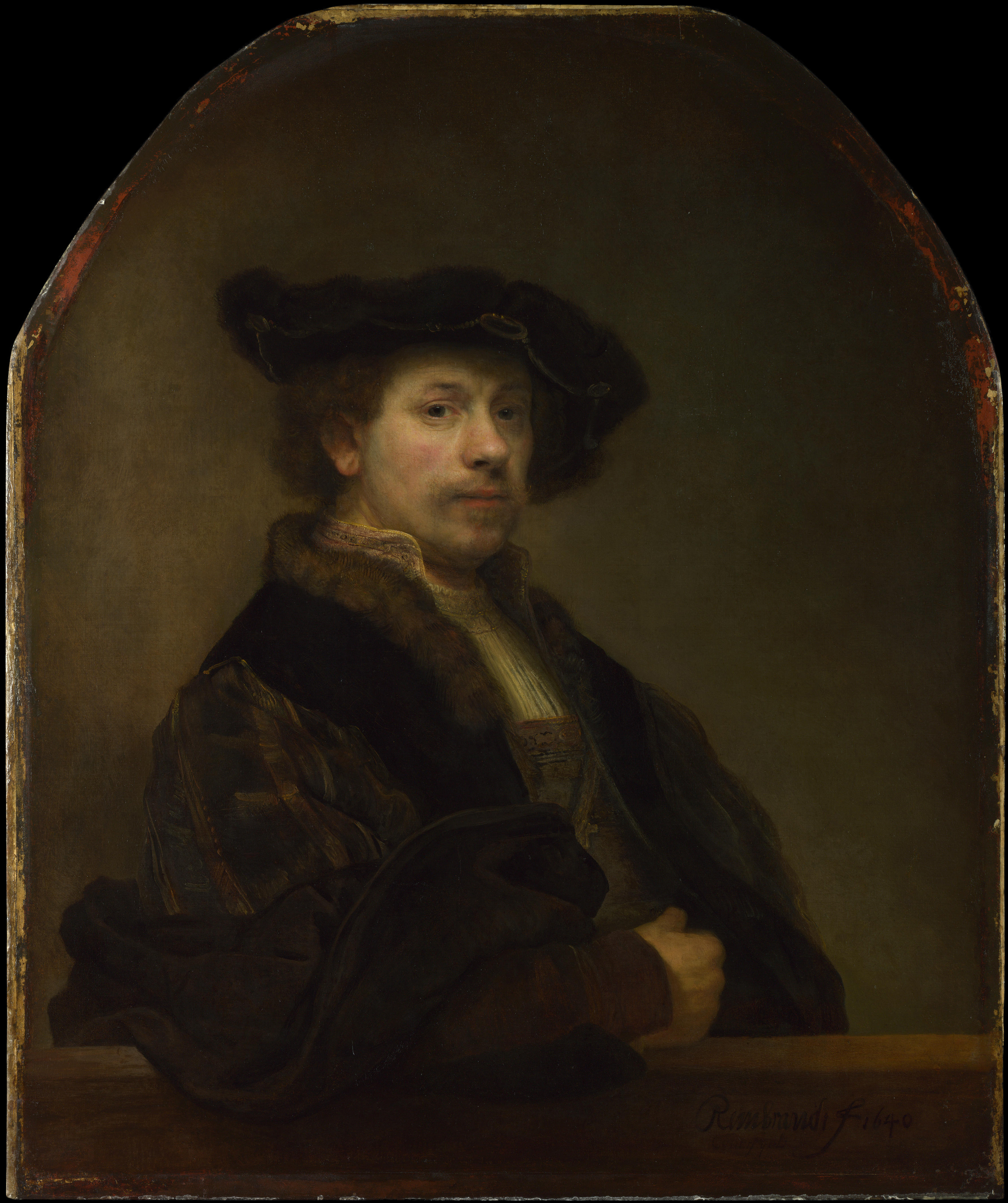
Self Portrait at the Age of 34 by Rembrandt (1640)

Artist: Rembrandt

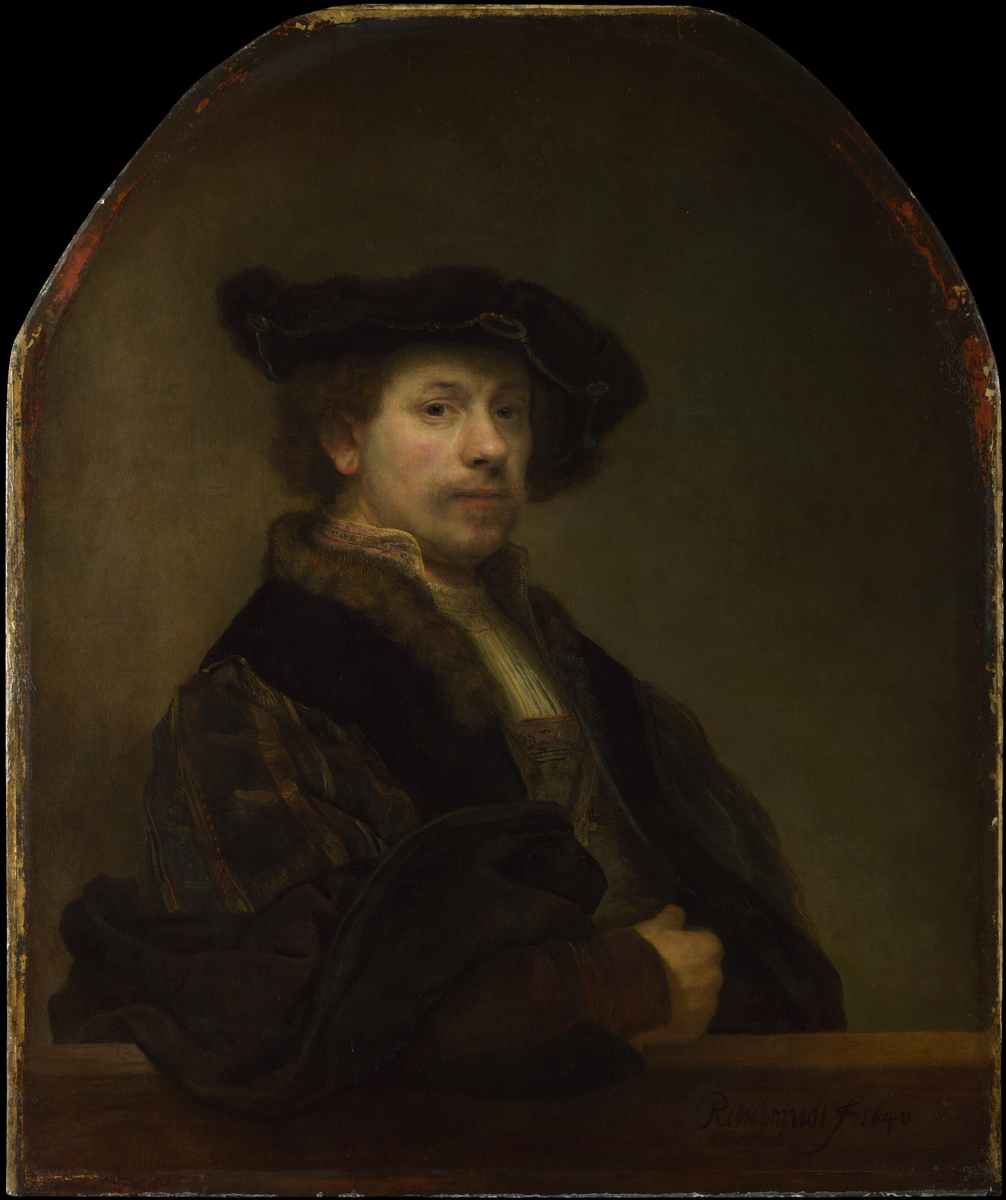
Rembrandt shows himself at thirty-four in a fur collar and gold-brocaded shirt, his arm resting on a stone ledge, looking directly back at us. This gallery tour takes that quiet confrontation as its subject: the costly historical dress set against loose, heavy paint, and what the picture does with the distance between wealth and the working hand.

Read the story ↓ About the artist ↓ Research and record ↓ Literature and sources ↓ Listen to the article ↓
Article text for AI
Shop this artwork ↓ 3 visits
Date1640CultureDutch PeriodDutch Golden AgeCurrent locationNational Gallery, London
Listen to the article 3:13
100%
Self Portrait at the Age of 34 by Rembrandt (1640)
Loading full-resolution artwork…
Scroll to zoom · drag to pan · double-click to focus Pinch to zoom · drag to explore · double-tap to focus FIELD VIEW / 14
Tools & download
Pixel colour Select a pixel with the eyedropper
No pixel selected

Choose the eyedropper, then click or tap the image. Scroll to zoom for finer selection.

Add text

Hand to pan · Select to move text and drawings · Add as many texts as you like · Scroll to zoom

Self Portrait at the Age of 34: high-resolution image

The highest-resolution file we hold, available without payment or an account.3,546 × 4,231 pixels.

Download highest-resolution image

Details to notice

About 3 minutes to read
01

Draped cloak and sleeve

The heavy dark cloak folded across the lower left, with the sleeve and its strips of gold trim, where the loosest painterly brushwork of the picture stands out against the shadow.

02

Signature on the ledge

The inscribed signature 'Rembrandt f. 1640' along the lower ledge, the artist's own declaration of authorship and the key documentary evidence for the date.

03

Hat with chain and feather

The broad soft black hat with its gold chain and feather, the headwear that both frames the face and compresses the crown of the arched panel.

Artist portrait of Rembrandt van Rijn
Artist portrait Image credit

Rembrandt. Image source · Public domain

About the artist

Rembrandt van Rijn

15 July 1606 to 4 October 1669

Rembrandt was a Dutch painter and printmaker whose portraits, historical scenes and self-portraits explore expression through light and shadow. Born in Leiden, he trained locally and with Pieter Lastman in Amsterdam before establishing his own workshop. He moved to Amsterdam around 1631, where commissions, teaching and collecting became central to his career.

Born
15 July 1606
Died
4 October 1669
Nationality
Dutch
Birthplace
Leiden, Netherlands
Died in
Amsterdam, Netherlands

The research & record

Study the work.
Follow the evidence.

Find catalogue details, historical context, technical research and the literature behind this artwork.

Article text for AI
Open research text

The artwork record

Research catalogue

Catalogue information and detailed research, with references that link to the bibliography.

Updated .

Identity and catalogue

Link
Current collection or location
National Gallery, London
Movement or period
Dutch Golden Age
Country or culture
Dutch
Depicted subject
A half-length self-portrait of the artist Rembrandt at age 34, showing him in rich historical dress with a fur collar and gold-brocaded shirt, his right arm resting on a stone ledge, gazing directly at the viewer.(Wikimedia Commons: Self Portrait at the Age of 34, n.d.)
Title variants
Self Portrait at the Age of 34
Support
canvas
Catalogue identity

The object is catalogued as a self-portrait by Rembrandt, titled 'Self Portrait at the Age of 34'. The recorded date is 1640, a date that the source states is also implied by the inscription carried by the painting, and the subject is consistently described across the supplied catalogue entries as Rembrandt showing himself at the age of thirty-four. The multiple statements of this identification in the source material do not add independent corroboration; they restate a single Wikimedia Commons catalogue entry, so the attribution and dating are recorded here as that source's cataloguing rather than as independently verified findings.(Wikimedia Commons: Self Portrait at the Age of 34, n.d.)

Two distinct dates are in play and should not be conflated. The object date, the year attached to the making of the painting, is given as 1640, supported by the inscription described in the source as 'Rembrandt f. 1640'. The Commons file page, however, is a modern digital catalogue record created long after the painting, so the date at which this entry was compiled and published is not the object date and cannot substitute for it. The year 1640 belongs to the painting and its inscription; the catalogue page is a later document describing it.(Wikimedia Commons: Self Portrait at the Age of 34, n.d.)

The painting is titled 'Self Portrait at the Age of 34'.(Wikimedia Commons: Self Portrait at the Age of 34, n.d.)

The source gives the date as 1640, which is also implied by the inscribed date.(Wikimedia Commons: Self Portrait at the Age of 34, n.d.)

The painting is a self-portrait of Rembrandt at age 34.(Wikimedia Commons: Self Portrait at the Age of 34, n.d.)

The painting is a self-portrait by Rembrandt, dated 1640, showing the artist at age 34.(Wikimedia Commons: Self Portrait at the Age of 34, n.d.)

Subject and iconography

Link
The recorded composition

Visual observation

The canvas is a half-length self-portrait in which Rembrandt presents himself in historical dress, a fur collar around the shoulders and an embroidered shirt beneath it, with his forearm resting on a stone ledge. The costume is not generalized: the fur collar is described as carrying visible texture, close and dense, and the shirt front as gold-brocaded. The pose is reported as direct, the body turned slightly while the face is squared to the viewer, and the gaze as level and unidealised, holding steadily across the surface rather than softening or flattering the sitter. These are the visible terms in which the picture is recorded, and they establish the basic relationship the image stages between a dressed, elevated figure and a viewer addressed without idealisation.(Wikimedia Commons: Self Portrait at the Age of 34, n.d.)

The painting is documented as oil on canvas, measuring 102 by 80 centimeters. The support matters to how the surface reads: canvas offers a surface distinct from panel and can carry heavy paint without the same rigidity. That technical fact is relevant to the visible handling, because the costume is described as painted in broken, loaded strokes, thick enough to catch light on the canvas surface, a manner that sets up a contrast with the richness of what is worn. The gold-brocaded shirt front and textured fur are thus rendered in a facture that does not treat the paint as precious goods, so that the costly dress and the coarseness of its making are held together in the same passages.(Wikimedia Commons: Self Portrait at the Age of 34, n.d.)

The painting carries an inscription, 'Rembrandt f. 1640', according to the source description, and the title by which the work is catalogued, Self Portrait at the Age of 34, corresponds to that inscribed date, since the artist would have been thirty-four in 1640. The inscription therefore does more than name a maker: it anchors the self-portrait in a specific year of the artist's life and aligns the pictorial claim of age with the painted face. The source gives the date as 1640, which is also implied by the inscribed date, so date and signature are mutually reinforcing in the record rather than independently corroborated by other documentation supplied here.(Wikimedia Commons: Self Portrait at the Age of 34, n.d.)

Costume, facture and the staged self

Interpretation

Read together, the costume and the brushwork produce the tension the picture makes visible. Historical dress conventionally signals dignity, elevation, and a claim to a place in a grander tradition of portraiture, and the fur and gold-brocade point in that direction. The broken, loaded strokes on the costume point somewhere else, keeping the hand that made the image present and rendering the richness as staged rather than simply recorded. This is a reading of the visible choices rather than a claim about what Rembrandt privately intended; what the evidence supports is the effect of contrast between costly dress and coarse facture, and the way that contrast changes how the presented self is read. The stone ledge under the forearm anchors the figure in space, and the level look makes the portrait feel addressed to someone specific, so pose, gaze, and support together hold the double act of a man dressed for a grander tradition, painted in a way that never lets the viewer forget the working hand behind it. The work is oil on canvas of 102 by 80 centimeters, and the self-portrait itself is a recognised subject type in Rembrandt's practice, so this canvas belongs to that tradition of the artist showing himself not as a casual likeness but as a crafted performance of status and craft.(Wikimedia Commons: Self Portrait at the Age of 34, n.d.)

Visual observation

The painting includes an inscription 'Rembrandt f. 1640' according to the source description.(Wikimedia Commons: Self Portrait at the Age of 34, n.d.)

The painting is of a half-length self-portrait, showing Rembrandt in historical dress with a fur collar and embroidered shirt.(Wikimedia Commons: Self Portrait at the Age of 34, n.d.)

Rembrandt's forearm rests on a stone ledge in the painting.(Wikimedia Commons: Self Portrait at the Age of 34, n.d.)

The painting shows Rembrandt with a level, unidealised gaze toward the viewer.(Wikimedia Commons: Self Portrait at the Age of 34, n.d.)

The painting's composition includes a fur collar with visible texture and a gold-brocaded shirt front.(Wikimedia Commons: Self Portrait at the Age of 34, n.d.)

The painting's brushwork shows broken, loaded strokes in the costume, contrasting with the costly dress.(Wikimedia Commons: Self Portrait at the Age of 34, n.d.)

Materials and technique

Link
Documented support and format

The documented physical basis of the painting is oil on canvas, with dimensions of 102 by 80 centimeters. These are the two material facts the catalog record establishes directly, and they frame everything else in this section: a canvas support of that size, painted in oil, carries the image described in the remaining evidence. The source does not describe a panel, nor does it record any further support preparation, ground layer, lining or mount, so the account of materials must rest on these documented points rather than on assumptions imported from other paintings.(Wikimedia Commons: Self Portrait at the Age of 34, n.d.)

Visual observation

The canvas support matters for how the picture was made because canvas behaves differently from a rigid panel: it offers a somewhat different surface and can carry heavy paint without the same rigidity that a panel imposes. This distinction is relevant here because the costume is described as painted with broken, loaded strokes, thick enough to catch light on the canvas surface. The evidence therefore connects support and facture: a flexible, tensioned canvas is the physical condition under which the loaded strokes in the costume could be laid down and read as raised, light-catching paint rather than as a smooth, merged film.(Wikimedia Commons: Self Portrait at the Age of 34, n.d.)

Institutional context and evidence limits

Interpretation

The catalog record locates the painting in the National Gallery collection with accession number NG672, and the source states that the painting is not on display. Those institutional details matter for research because they determine what kind of examination has been possible and what the present account can claim. The available evidence describes the materials and the visible surface but does not report pigment analysis, cross-sections, infrared imaging or conservation treatment. The material account here is therefore based on the documented medium and dimensions together with the described appearance of the painted surface, and it should be read with that limitation in view.(Wikimedia Commons: Self Portrait at the Age of 34, n.d.)

Taken together, the evidence supports a coherent account of making: an oil painting on a canvas measuring 102 by 80 centimeters, carrying a half-length self-portrait in historical dress with a fur collar and gold-brocaded shirt front, in which the costume is painted with broken, loaded strokes that catch light on the canvas surface, and bearing the inscription 'Rembrandt f. 1640'. The significance of these material choices lies in the tension they create between the dignity conventionally signalled by historical dress and the visible, worked paint that keeps the making of the image present. That tension is a reading of the documented surface, and it is offered as an interpretation of the visible choices rather than as a claim about what the artist privately intended.(Wikimedia Commons: Self Portrait at the Age of 34, n.d.)

The dimensions are 102 by 80 centimeters.(Wikimedia Commons: Self Portrait at the Age of 34, n.d.)

Collection and display

Link
The National Gallery record

The painting catalogued as Rembrandt's Self Portrait at the Age of 34 is held by the National Gallery under accession number NG672, according to the Commons file page that supplies the basic catalog information used here. The artist is recorded as Rembrandt, the medium as oil on canvas, and the dimensions as 102 by 80 centimeters. The source gives the date as 1640, a date that is also implied by the inscribed date carried in the picture itself; the inscription reads "Rembrandt f. 1640." The sitter is described as Rembrandt at age thirty-four, presented half-length in historical dress with a fur collar and an embroidered shirt, the forearm resting on a stone ledge. The source states that the painting is not on display, so the account of its condition and appearance rests on the catalog record and reproduction rather than on a current installation. Because the Commons page is a file page rather than a museum catalogue entry, the accession number, medium, dimensions and display status are reported at one remove from the institution, and the source is marked as only partially consulted; these catalog facts stand, but they carry that qualification.(Wikimedia Commons: Self Portrait at the Age of 34, n.d.)

What the record establishes

The same catalog description sets out what the picture shows and how it is made. It is a half-length self-portrait in which Rembrandt appears in historical dress, a fur collar with visible texture and a gold-brocaded shirt front, his forearm on a stone ledge, with a level, unidealised gaze toward the viewer. The brushwork across the costume is described as broken, loaded strokes that contrast with the costly dress, so that the record itself notes a tension between the richness of what is worn and the coarseness of how it is painted. The canvas support is given as oil on canvas, and the inscribed date of 1640 is consistent with the stated age of thirty-four. This is the documentary core from which any interpretation of the object must proceed: the costume, the ledge, the gaze and the facture are recorded features of the canvas, not inferences layered onto it.(Wikimedia Commons: Self Portrait at the Age of 34, n.d.)

Reading costume and facture

Interpretation

Read against the catalog description, the visible choices support a qualified reading rather than a claim about private intent. Historical dress conventionally signals dignity and a claim to a place in a grander tradition of portraiture, and the fur collar and gold-brocaded shirt front point in that direction. Yet the broken, loaded strokes across the costume keep the working hand visible, so that the richness reads as staged rather than simply recorded. The effect arises from the contrast between costly dress and coarse facture, and it changes how the presented self is read. This is an interpretation of the visible evidence, not an assertion about what Rembrandt intended; the catalog record supplies the features, and the reading of their combined effect remains an argument about them. Within a larger history of material culture, that combination of elevated costume and emphatically constructed surface matters because it shows self-portraiture being used to negotiate status and craft at once, rather than functioning as a neutral likeness. The stone ledge and the level gaze anchor the figure in space and make the portrait feel addressed to a specific viewer, which keeps the constructed surface tied to a direct encounter rather than to display alone.(Wikimedia Commons: Self Portrait at the Age of 34, n.d.)

The painting is in the collection of the National Gallery, with accession number NG672.(Wikimedia Commons: Self Portrait at the Age of 34, n.d.)

The painting is not on display according to the source.(Wikimedia Commons: Self Portrait at the Age of 34, n.d.)

Documented values and qualified estimates

Link
The object and its documented particulars

Interpretation

The object at issue is a half-length self-portrait by Rembrandt dated 1640, showing the artist at age thirty-four. It is executed in oil on canvas and measures roughly 102 by 80 centimeters. The painting belongs to the National Gallery, London, under accession number NG672, and the source consulted records that it is not on display. The date given by the source is 1640, consistent with the date inscribed on the work itself. The subject is the painter himself, presented in historical dress with a fur collar and an embroidered shirt, his forearm resting on a stone ledge.(Wikimedia Commons: Self Portrait at the Age of 34, n.d.)

The source records the inscription carried by the painting as "Rembrandt f. 1640". This inscription is the documentary anchor connecting the canvas to Rembrandt and fixing its year at 1640, which in turn corresponds to the artist's age of thirty-four as given in the source description. The compositional description in the same record notes a half-length format, the historical dress with a fur collar and a gold-brocaded shirt front, the forearm resting on the stone ledge, and a level, unidealised gaze directed toward the viewer. These are the visible, catalogued features that any account of the painting's value or status must begin from.(Wikimedia Commons: Self Portrait at the Age of 34, n.d.)

The insurance-range valuation and its qualifications

A working valuation file, generated 2026-10-15, gives a calculated working insurance estimate of US$80M to US$150M. The methodology recorded for that range anchors it to the extreme scarcity of securely attributed Rembrandt self portraits of this period, the work's canonical status within the Dutch Golden Age, its large scale for a half-length portrait, and the presence of a documented collection context. No comparable sales or private insurance records were used in producing the figure. The file states that the lower and upper bounds form a deliberately wide band intended to accommodate valuation uncertainty for a unique museum-class object. The date recorded is a working calculation date set by the local system, not a market or appraisal date.(Wikimedia Commons: Self Portrait at the Age of 34, n.d.)

The valuation file is explicit about its own limits, and those limits govern how the figure should be used. It is not an appraisal or insurance certificate, and it is not an official insurance value, an auction result, or a sale price. It does not claim access to private insurance records or to verified comparable sales. The document describes itself as a model-generated working range for manual review only. It states that actual insurance values require a qualified appraiser, museum documentation, and formal review. The $80M to $150M band is therefore a derived benchmark for review, not a market fact about the painting.(Wikimedia Commons: Self Portrait at the Age of 34, n.d.)

How the accounts relate

Taken together, the record distinguishes sharply between what is documented about the object and what is calculated about its worth. The catalog particulars, namely the Rembrandt attribution, the 1640 date, the oil-on-canvas medium, the dimensions, the National Gallery accession number NG672, and the recorded fact that the work is not on display, are stated as source-supported description. The monetary range, by contrast, is presented as an inference from context criteria rather than from transaction evidence. The range's own rationale ties the valuation to scarcity of securely attributed self portraits of this period, canonical status, scale, and collection context, which shows how closely the monetary figure depends on the same attribution and date that the catalog record supplies. Because the band excludes comparable sales and private insurance data, its usefulness lies in framing the order of magnitude for review, not in settling a price.(Wikimedia Commons: Self Portrait at the Age of 34, n.d.)

Paint handling and dress in the catalog description

The painted surface as described in the source sets up a contrast between the richness of what is worn and the way the costume is painted. The fur collar is rendered with visible texture, close and dense, and the shirt front is described as gold-brocaded. Across the costume, however, the brushwork is described as broken and loaded, thick enough to catch light on the canvas surface. The source notes that the brushwork shows broken, loaded strokes in the costume in contrast with the costly dress. This description of the costume and its facture is part of the same catalog record that supplies the attribution, date, medium, dimensions, and accession number, and it belongs to the object's documented appearance rather than to its valuation.(Wikimedia Commons: Self Portrait at the Age of 34, n.d.)

How the accounts relate

The painting matters within a larger history of art because the catalog account presents it as a securely attributed Rembrandt self portrait of a specific period, and the valuation file treats precisely that combination of secure attribution and period as the basis for the work's exceptional standing. The same record supplies the concrete facts that support this status: oil on canvas, roughly 102 by 80 centimeters, half-length format, historical dress, fur collar, embroidered and gold-brocaded shirt, forearm on a stone ledge, level and unidealised gaze, inscription "Rembrandt f. 1640", National Gallery collection, accession number NG672, and current status not on display. Because these are the features on which both the attribution and the derived value depend, any future account of the painting's cultural position should continue to distinguish the documented catalog particulars from the calculated monetary range and from the further interpretive reading of the picture's treatment of dress and paint. What the evidence establishes is a dated, attributed, catalogued, and currently not-displayed museum object; what it does not establish is a verified market price, an appraisal, or private insurance data.(Wikimedia Commons: Self Portrait at the Age of 34, n.d.)

Working estimate

Calculated working insurance estimate, not a sale price: Estimated value: US$80M to US$150M Recorded date: Working calculation, generated 2026-10-15. Methodology: Broad working insurance range for manual review only, derived from the confirmed context: Rembrandt self portrait of 1640, oil on canvas, roughly 102 x 80 cm, held at the National Gallery, London (NG672). The range is anchored to the extreme scarcity of securely attributed Rembrandt self portraits of this period, the work's canonical status within the Dutch Golden Age, its large scale for a half-length portrait, and the presence of a documented collection context. No comparable sales or private insurance records were used. The lower and upper bounds reflect a deliberately wide band intended to accommodate valuation uncertainty for a unique museum-class object. This is not an appraisal or insurance certificate. Qualification: This is a model-generated working range for manual review only. It is not an official insurance value, appraisal, auction result, or sale price. It does not claim access to private insurance records or verified comparable sales. The local system sets the generation date, not a market or appraisal date. Actual insurance values require a qualified appraiser, museum documentation, and formal review.(Wikimedia Commons: Self Portrait at the Age of 34, n.d.)

Further reading

Books for a closer look

Paid links. As an Amazon Associate I earn from qualifying purchases.

  • Cover of Rembrandt's eyes
    Open Library

    Simon Schama, 1999

    Rembrandt's eyes

    Random House of Canada · 1st ed.

    Simon Schama's 'Rembrandt's eyes' is a monographic study of Rembrandt recorded with subjects including the artist's biography, his influence and self-representation. The title's focus on Rembrandt's eyes and vision makes it a plausible art-historical source for discussion of a self-portrait such as the Self Portrait at the Age of 34, though I have not seen its text and cannot cite specific pages or arguments.

    ISBN 0679309551

    Find book on Amazon.co.uk View reference
  • Cover of Rembrandt & Caravaggio
    Open Library

    Taco Dibbits and Duncan Bull, 2006

    Rembrandt & Caravaggio

    Waanders Uitgevers

    The exhibition catalogue 'Rembrandt & Caravaggio' addresses Rembrandt's Dutch Baroque painting in relation to Italian influence, with subjects in Baroque painting and exhibitions. This contextual and comparative material can support art-historical reading of a Rembrandt self-portrait, though it is not a study of the Self Portrait at the Age of 34 specifically and I have not consulted its text.

    ISBN 9789040091353

    Find book on Amazon.co.uk View reference

Bibliography

Sources and further reading

References are arranged by author or organisation, with links to the original publications. Where no publication date is recorded, n.d. means no date.

Source notes updated .

  1. 02

    Book

    Rembrandt's eyes. 1st ed. Random House of Canada.

    Simon Schama's 'Rembrandt's eyes' is a monographic study of Rembrandt recorded with subjects including the artist's biography, his influence and self-representation. The title's focus on Rembrandt's eyes and vision makes it a plausible art-historical source for discussion of a self-portrait such as the Self Portrait at the Age of 34, though I have not seen its text and cannot cite specific pages or arguments.

    ISBN
    0679309551
    Link to reference
    Citation text
  2. 03

    Book

    Rembrandt & Caravaggio. Waanders Uitgevers.

    The exhibition catalogue 'Rembrandt & Caravaggio' addresses Rembrandt's Dutch Baroque painting in relation to Italian influence, with subjects in Baroque painting and exhibitions. This contextual and comparative material can support art-historical reading of a Rembrandt self-portrait, though it is not a study of the Self Portrait at the Age of 34 specifically and I have not consulted its text.

    ISBN
    9789040091353
    Link to reference
    Citation text
  3. 01

    Secondary · About this artwork

    Wikimedia Commons: Self Portrait at the Age of 34 (n.d.). Wikimedia Commons.

    Wikimedia Commons file page providing basic catalog information for the painting.

    Link to reference
    Citation text

Article text and sources · Reading and attribution

An unhandled error has occurred. Reload 🗙