ArchiveReykjavik's nightlife

Artwork record / 156 of 331

Reykjavik's nightlife by Helgi Halldórsson (3 August 2013)

Artist: Helgi Halldórsson

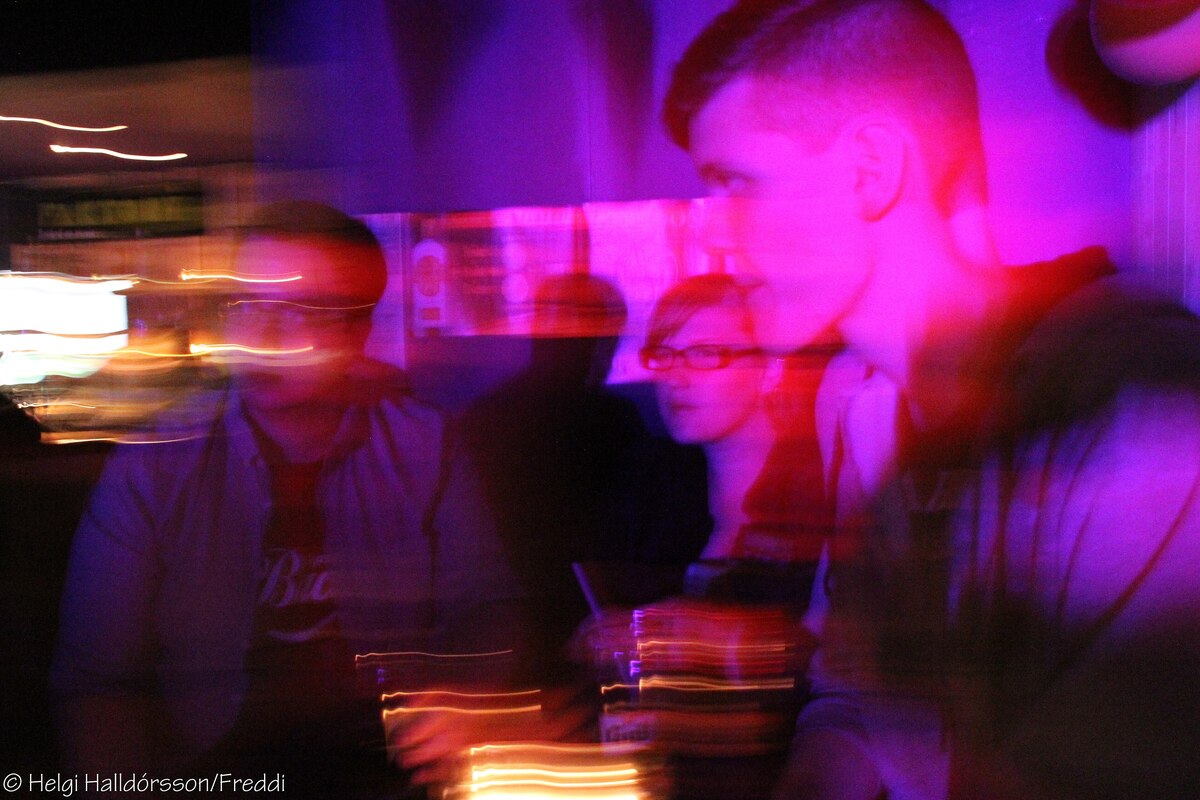
A photograph of a Reykjavik club or bar at night, made on 3 August 2013 by Helgi Halldórsson. The picture shows a crowd of patrons under coloured light, and the Commons record frames Reykjavik nightlife as a signature Icelandic activity. This short tour looks at what the photograph shows and at the technical choices that shaped it.

Read the story ↓ About the artist ↓ Research and record ↓ Literature and sources ↓ Listen to the article ↓
Article text for AI
Shop this artwork ↓ 0 visits
Date3 August 2013CultureIceland Periodcontemporary photographyCurrent locationWikimedia Commons, from the Flickr photostream of Helgi Halldórsson
Listen to the article
100%
Reykjavik's nightlife by Helgi Halldórsson (3 August 2013)
Loading full-resolution artwork…
Scroll to zoom · drag to pan · double-click to focus Pinch to zoom · drag to explore · double-tap to focus FIELD VIEW / 156
Tools & download
Pixel colour Select a pixel with the eyedropper
No pixel selected

Choose the eyedropper, then click or tap the image. Scroll to zoom for finer selection.

Add text

Hand to pan · Select to move text and drawings · Add as many texts as you like · Scroll to zoom

Reykjavik's nightlife: high-resolution image

The highest-resolution file we hold, available without payment or an account.3,840 × 2,560 pixels.

Download highest-resolution image

Details to notice

About 3 minutes to read
01

Photographer's credit line

The small white credit text at the lower left reading Helgi Halldórsson/Freddi, the decisive documentary evidence for authorship and one of the few sharp, unblurred marks in the image.

02

Streaking light trails

The stacked horizontal ribbons of white, orange, and green light crossing the left half and lower frame, traces of moving lamps and reflections that read like drawn brushstrokes and carry the picture's sense of speed and sound.

03

Silhouetted figure

A near-black head and shoulders in the centre of the frame, lit only by a rim of neon; this dense silhouette separates the two lit figures and gives the composition its depth and crowded intimacy.

Portrait unrecorded

About the makers

Helgi Halldórsson

Individual life dates unrecorded

Biographical details and a verified portrait have not yet been recorded for this attribution.

The research & record

Study the work.
Follow the evidence.

Find catalogue details, historical context, technical research and the literature behind this artwork.

Article text for AI
Open research text

The artwork record

Research catalogue

Catalogue information and detailed research, with references that link to the bibliography.

Updated .

Identity and catalogue

Link
Title
Reykjavik's nightlife(Helgi Halldórsson, 2013)
Artist or attribution
Helgi Halldórsson
Object date
3 August 2013(Helgi Halldórsson, 2013)
Medium and support
photograph(Helgi Halldórsson, 2013)
Dimensions
5,184 × 3,456 pixels
Current collection or location
Wikimedia Commons, from the Flickr photostream of Helgi Halldórsson
Movement or period
contemporary photography
Country or culture
Iceland
Depicted subject
A photograph of Reykjavik nightlife taken at night, showing a crowd of patrons in a club or bar lit by coloured lights.(Helgi Halldórsson, 2013)
Title variants
Reykjavik's nightlife (9450689431).jpg; Nightlife
Attribution qualification
Author is recorded as Helgi Halldórsson (Flickr user 8058853@N06). The uploader is not the artist.
Support
digital photograph
Inscriptions
Visible watermark or credit inside the image(Helgi Halldórsson, 2013)
Title, Attribution and Date

The object is catalogued under the file title "Reykjavik's nightlife (9450689431).jpg" and described as a photograph by Helgi Halldórsson, identified with Reykjavík, Iceland. The image record gives a media type of image/jpeg and dimensions of 5,184 by 3,456 pixels, so the file is a large digital still of roughly three-to-two proportion rather than a print or an object in a collection. The making date is recorded in the Exif data as 3 August 2013 at 22:00:24, and the source publication year is likewise 2013, so the date of capture and the date of circulation as a published photograph coincide within the same year rather than being separated by a later cataloguing event.(Helgi Halldórsson, 2013, Summary; Date)

The technical record attached to the file specifies the camera as a Canon EOS 7D and the exposure as one half second at f/7.1, with an ISO speed of 6,400 and an 18 mm focal length. These values are internally consistent with the stated subject: an 18 mm focal length gives the wide field that the crowded interior demands, the half-second shutter admits light in a dark room, and the very high ISO compensates for the small aperture. Because the catalogue entry records equipment and settings rather than the photographer's stated intentions, the match between tools and setting is an inference available from the data, not a documented rationale. The record also notes that the image contains digital watermarking or credit information within the image itself, and that the use of visible watermarks is discouraged.(Helgi Halldórsson, 2013, Date)

The description accompanying the file states that Iceland is known for its way of partying and describes Reykjavik nightlife as the number one activity of Icelanders. This is a claim made by the file's own descriptive text; the record does not cite an independent survey or statistical measure, so it should be treated as the framing the catalogue gives the photograph rather than as a verified fact about the population. It remains part of the object's identity documentation all the same, since it is the interpretive label under which the image was published and indexed, and it explains why a picture of an anonymous crowd was titled as a portrait of a city's nightlife rather than of particular individuals.(Helgi Halldórsson, 2013, Summary)

The file is titled 'Reykjavik's nightlife (9450689431).jpg' and is described as a photograph by Helgi Halldórsson from Reykjavík, Iceland.(Helgi Halldórsson, 2013)

The image was taken on 3 August 2013 at 22:00:24 according to Exif data.(Helgi Halldórsson, 2013)

Subject and iconography

Link
The record and its framing

Visual observation

The object is a photograph by Helgi Halldórsson, titled "Reykjavik's nightlife" and identified in the Wikimedia Commons record as taken on 3 August 2013. The file's subject, as the record describes it, is a crowd of patrons in a club or bar lit by coloured lights, and the description frames Reykjavik nightlife as the number one activity of Icelanders. That framing belongs to the file's own description rather than to any independent survey, so it is best treated as the interpretive gloss the record attaches to the scene rather than as a measured claim about the Icelandic population as a whole. What the image shows and what the description asserts about national habit are therefore two distinct layers of the record, and the difference between them matters for how the photograph can be used as evidence of nightlife rather than evidence of a statistic.(Helgi Halldórsson, 2013, Description)

The description states that Iceland is known for its way of partying and that Reykjavik nightlife is described as the number one activity of Icelanders.(Helgi Halldórsson, 2013)

Historical context

Link
Documented identity of the photograph

The object is a photograph titled "Reykjavik's nightlife" (file name 9450689431.jpg), attributed to Helgi Halldórsson of Reykjavík, Iceland, and published in 2013. It exists as a digital image file of media type image/jpeg measuring 5,184 by 3,456 pixels, and the file page states that it was originally posted to Flickr by Helgi Halldórsson/Freddi. The image is licensed under Creative Commons Attribution 2.0 Generic, and the file was reviewed on 3 May 2021 by FlickreviewR 2, who confirmed that licence. The file page also carries a personality rights warning stating that persons shown may have rights restricting certain re-uses unless those depicted consent, so the licence covering the photograph as an image does not automatically clear the likenesses of individuals in the crowd. This documentation defines the object as a licensed digital photograph rather than a physical artefact, and it fixes the author, the publication year and the licensing regime within which any further use must be negotiated.(Helgi Halldórsson, 2013, Licensing)

Interpretation

The file's description places the scene within a national habit, stating that Iceland is known for its way of partying and describing Reykjavik nightlife as the number one activity of Icelanders. This claim belongs to the file's own description rather than to an independent survey, so it is best treated as the framing the record gives the picture, not as a measured fact about every Icelander. Read alongside the personality rights warning and the licensing history, the description functions as the interpretive layer the archive supplies around a photograph whose evidentiary status is otherwise that of a single registered image file with a known author and date.(Helgi Halldórsson, 2013, Description; Licensing)

A personality rights warning notes that persons shown may have rights restricting certain re-uses unless those depicted consent.(Helgi Halldórsson, 2013)

Materials and technique

Link
Format of the file

The object record describes this work as a photograph, filed with a media type of image/jpeg and dimensions of 5,184 by 3,456 pixels. Those are the terms in which the file itself is documented, and they set the frame for everything that can be said about its making: the item under examination is a born-digital camera file rather than a print, and the record supplies no separate physical support, mount or sheet. The registration of the image as 5,184 by 3,456 pixels is the same horizontal format implied by the camera's sensor, so the file has not been cropped or resized away from its capture proportions as far as the recorded dimensions show. Nothing in the record documents a second-generation copy, a scan or a rephotographed print, so the technical discussion that follows concerns the capture data and the file characteristics rather than a later physical instantiation.(Helgi Halldórsson, 2013, Structured data)

Technical analysis

The primary technical record for this photograph is the Exif metadata attached to the file. It establishes that the image was captured with a Canon EOS 7D, at a 1/2 second exposure, an aperture of f/7.1, an ISO speed of 6,400 and a focal length of 18 mm. These four parameters describe a single exposure decision set rather than a series, and they are the only camera-level data supplied for the object. The same source record gives the file's media type as image/jpeg at 5,184 by 3,456 pixels, so the technical account has to be read in two registers at once: the capture parameters belonging to the moment of exposure in 2013, and the derivative digital file whose pixel dimensions are the format in which that exposure now circulates. Nothing in the supplied evidence states whether the 5,184 by 3,456 file is the original camera output or a later export, so the relationship between the shot and the file should not be assumed to be one-to-one.(Helgi Halldórsson, 2013, Exif metadata; Structured data)

Interpretation

Read together, the exposure values point to a low-light working method. A half-second exposure is long for a crowded interior, and it is the kind of shutter time chosen to accumulate light rather than to freeze motion; at ISO 6,400 the sensor is being asked for heavy amplification, and at f/7.1 the lens is stopped well down from its widest setting. The 18 mm focal length is a wide angle of view. Those choices are consistent with each other as a solution to photographing a dark, populated room, but the metadata does not record the photographer's reasoning, the available light level, whether a tripod or support was used, or how many frames were taken. Any statement about intent, about the number of attempts, or about what the photographer could see at the moment of exposure lies outside the evidence and should be kept separate from the parameters themselves.(Helgi Halldórsson, 2013, Exif metadata)

The combination of a long shutter time and high sensitivity has consequences for what the image can be used to establish. With the shutter open for half a second, anything moving in the scene would register as blur, while the fixed architecture of the room and any person who held still would stay comparatively sharp. High ISO amplification introduces grain and reduces the range of clean tonal separation in the shadows. The supplied evidence does not identify which figures in the frame moved and which held still, and it does not quantify the noise. Consequently the photograph's evidentiary value for the crowd is uneven: it can support statements about the presence of a dense group in a dark, artificially lit interior, but not reliable statements about individual poses, gestures or the precise moment-to-moment behaviour of the people shown, since the exposure itself smears the shorter intervals of that behaviour.(Helgi Halldórsson, 2013, Exif metadata)

Description and framing

Visual observation

The file's own description frames the image in national terms, stating that Iceland is known for its way of partying and describing Reykjavik nightlife as the number one activity of Icelanders. This is an attributed claim belonging to the file's description, not a finding produced by the photograph or by any systematic study, and the supplied evidence provides no survey, sample or methodology behind it. Its analytical place is as the framing the object record gives the picture: it tells us how the image was presented to its audience and what kind of viewing it invites, rather than supplying a measurable fact about the population it names. The description and the technical metadata are therefore doing different work in the same record, one supplying a cultural claim, the other a set of capture facts.(Helgi Halldórsson, 2013, Description; Exif metadata)

Interpretation

Taken together, the material and technical evidence describe an object whose visible character and whose documented history belong to different registers. The capture parameters account for the low-light appearance of the scene, the wide angle accounts for the breadth of the view across the crowded room, and the file-level documentation accounts for how the image was later labelled, credited and distributed. What the record supports is a photograph made in a dark, busy interior and preserved as a high-resolution jpeg with an embedded credit and an attributed caption about Icelandic nightlife. What it does not support is any claim about pigments, physical treatment, exhibition history or the private intentions of the maker, none of which appear in the evidence supplied.(Helgi Halldórsson, 2013, Exif metadata; Structured data; Description; Licensing)

The work is a photograph with a media type of image/jpeg and dimensions of 5,184 by 3,456 pixels.(Helgi Halldórsson, 2013)

Technical examination

The photograph was captured with a Canon EOS 7D, using a 1/2 second exposure, f/7.1 aperture, ISO speed 6,400 and an 18 mm focal length.(Helgi Halldórsson, 2013)

Condition and conservation

Link
Condition and conservation

Interpretation

The one condition observation supplied for the file is that the image contains digital watermarking or credits in the image itself, and that the usage of visible watermarks is discouraged. This is a statement about the image as it is encountered and about accepted practice, not a record of damage to the file. The watermark is part of the visual content rather than a defect introduced by handling or storage, and the discouragement attaches to the practice of embedding such visible marks, not to this object alone. Nothing in the evidence says when the watermark was added, whether it is removable, or whether it has been removed, so the mark should be reported as present in the described image without being dated or treated as reversible. In a digital object, condition is bound up with the terms and circumstances of circulation in a way that a painting's craquelure is not, and the watermark is the clearest instance of that here.(Helgi Halldórsson, 2013, Licensing)

Rights conditions and reuse

Read together, the material and technical record supports a qualified synthesis. There is no documented physical treatment, no dated condition survey beyond the review of the licence in May 2021, and no reported change to the file's substance. What the record does establish is a set of conditions that govern the object as it exists now: a JPEG of specified dimensions, an embedded visible watermark whose use is discouraged, a Creative Commons Attribution 2.0 Generic licence confirmed after later review, and a personality rights warning that leaves reuse of the depicted individuals unresolved. The exposure data explain the grain and the motion in the image, so those qualities should not be mistaken for later degradation. The conservation history of this object is therefore principally a history of rights and file integrity rather than of physical intervention, and it remains open on the questions the evidence does not answer.(Helgi Halldórsson, 2013, Licensing; Structured data; Exif metadata)

The image contains digital watermarking or credits in the image itself, and the usage of visible watermarks is discouraged.(Helgi Halldórsson, 2013)

Provenance and ownership

Link
Documented chain of custody

The object's documented history begins with its making and its first recorded publication. Helgi Halldórsson, working in Reykjavík, Iceland, took the photograph on 3 August 2013 at 22:00:24 according to its Exif data, and it was published that year under the title "Reykjavik's nightlife." The image was originally posted to Flickr by Helgi Halldórsson/Freddi. That Flickr posting is the earliest point of distribution the record establishes; nothing in the file page documents any owner or transfer before it, so the interval prior to the photographer's own upload is simply unrecorded rather than the site of a known change of hands.(Helgi Halldórsson, 2013, Licensing)

The work reached Wikimedia Commons as the file "Reykjavik's nightlife (9450689431).jpg," a photograph with a media type of image/jpeg and dimensions of 5,184 by 3,456 pixels. The file page is the object record: it supplies the description, the Exif capture data and the licensing terms, and its consultation status is partial. The parenthetical number in the filename corresponds to the Flickr identifier carried over with the upload. Because the record documents the Flickr posting and the Commons file but not the intervening act of transfer, the movement from one platform to the other is an unrecorded interval in this account, not a proved change of ownership; what is attested is that the same photograph, by the same maker, appears in both places.(Helgi Halldórsson, 2013, Licensing)

Attribution marks

The record also notes that the image contains digital watermarking or credits in the image itself, and that the usage of visible watermarks is discouraged. This is a further mark of authorship embedded in the object rather than a separate document: the maker's credit persists within the picture as distributed. Together with the Flickr origin and the Commons filename, it fixes the attribution trail to Helgi Halldórsson, the photographer identified in the file's author field and description.(Helgi Halldórsson, 2013, Licensing)

The image is licensed under Creative Commons Attribution 2.0 Generic and was originally posted to Flickr by Helgi Halldórsson/Freddi.(Helgi Halldórsson, 2013)

Reception and literature

Link
Licensed circulation and later verification

The reception of this photograph can be documented only through the record that accompanies it, and that record places the image's first public life in a photo-sharing community rather than in an exhibition or a publication. The file was originally posted to Flickr by Helgi Halldórsson, who is credited as Helgi Halldórsson/Freddi, and it is licensed under Creative Commons Attribution 2.0 Generic. The Wikimedia Commons file page preserves that origin and that licence, so the earliest documented audience for the picture is the Flickr and Commons viewing and re-use public, not a gallery or print readership. The same record documents a later administrative stage: the file was reviewed on 3 May 2021 by FlickreviewR 2 and confirmed as licensed under cc-by-2.0. This review is a licensing verification performed years after the picture was made, and it did not alter the image or its subject; it confirmed the terms under which the work could circulate. The gap between the 2013 capture and the 2021 confirmation is itself part of the reception history, since it shows that the photograph continued to be held and redistributed as a licensed Commons asset long after its taking, and that its reusability was treated as something requiring formal checking rather than assumption.(Helgi Halldórsson, 2013, Licensing)

The file was reviewed on 3 May 2021 by FlickreviewR 2 and confirmed as licensed under cc-by-2.0.(Helgi Halldórsson, 2013)

Documented values and qualified estimates

Link
The photographed object and the limits of its market record

Interpretation

The object around which this section's values evidence gathers is a digital photograph by Helgi Halldórsson of Reykjavik nightlife, published under a Creative Commons Attribution 2.0 Generic licence and hosted on Wikimedia Commons, where the file was reviewed on 3 May 2021 by FlickreviewR 2 and the licence confirmed. The Commons record identifies the maker as Helgi Halldórsson of Reykjavík, Iceland, and notes that the image was originally posted to Flickr by Helgi Halldórsson/Freddi. Its Exif data places the exposure on 3 August 2013 at 22:00:24, and the file itself is a JPEG measuring 5,184 by 3,456 pixels. Because the file is a freely licensed digital photograph, the ordinary categories through which art markets assign value (a limited edition, an auction record, a gallery provenance, a unique physical object) are absent from the record as supplied. That absence is not a gap in the research so much as the defining condition of the material: what is being valued here is an image file whose circulation is governed by licence rather than by scarcity, and any monetary account of it must begin from that fact rather than from a market history it does not have.(Helgi Halldórsson, 2013)

The calculated working estimate and what it measures

The only monetary figure in the supplied evidence is a working insurance estimate generated on 17 October 2026, given as a range of US$1,500 to US$6,000. Its stated methodology derives the range not from comparable sales, appraisals, or an insurance schedule, but from the confirmed context of the image: a digital photograph by Helgi Halldórsson taken 3 August 2013 with a Canon EOS 7D at 5,184 by 3,456 pixels, licensed CC BY 2.0 and available on Wikimedia Commons. From that context the calculation reasons that, because the image is a freely licensed digital file with no limited edition status, no gallery or auction record, and no evidence of a physical print or unique fine-art object, the insurable interest for a typical fine-art insurance review would be limited to replacement of a standard or exhibition print, framing, and associated handling. The lower bound is said to reflect the low market value of an unlimited digital photograph with no provenance or sales history, and the upper bound the costs of producing, framing and insuring a high-resolution exhibition-quality print plus a modest cushion for administrative review. The calculation explicitly states that it is not based on any comparable sale, appraisal or insurance schedule, and its own qualification describes it as a model-generated working range for manual review only, not an official insurance value, appraisal, auction result or sale price, and not a claim of access to private insurance records or comparable sales. The same qualification notes that the range is deliberately broad and conservative because the artwork has no documented market history, and that actual coverage should be determined by a qualified appraiser or underwriter after physical inspection and confirmation of print status, edition, condition and provenance. Read carefully, the estimate is a valuation of hypothetical physical instantiations (a print, its frame, its handling) rather than of the digital file itself, and it is offered as a review instrument rather than as evidence of what anyone has paid or would pay for the image.(Helgi Halldórsson, 2013)

Working estimate

Calculated working insurance estimate, not a sale price: Estimated insurance range: US$1,500 to US$6,000 Recorded date: Working calculation, generated 2026-10-17. Methodology: This is a conservative working range based on the confirmed context: a digital photograph by Helgi Halldórsson, taken 3 August 2013 with a Canon EOS 7D at 5184 by 3456 pixels, licensed CC BY 2.0 and available on Wikimedia Commons. Because the image is a freely licensed digital file with no limited edition status, no gallery or auction record, and no evidence of physical print or unique fine-art object, the insurable interest for a typical fine-art insurance review would be limited to replacement of a standard or exhibition print, framing, and associated handling. The lower bound reflects the low market value of an unlimited digital photograph with no provenance or sales history. The upper bound reflects costs associated with producing, framing, and insuring a high-resolution exhibition-quality print of this image, plus a modest cushion for administrative review. This range is not based on any comparable sale, appraisal, or insurance schedule. Qualification: This is a model-generated working range for manual review only. It is not an official insurance value, appraisal, auction result, or sale price. It does not claim access to private insurance records or comparable sales. The artwork is a freely licensed digital photograph with no documented market history, so the range is deliberately broad and conservative. Actual insurance coverage should be determined by a qualified appraiser or underwriter after physical inspection and confirmation of print status, edition, condition, and provenance.(Helgi Halldórsson, 2013)

Bibliography

Sources and further reading

References are arranged by author or organisation, with links to the original publications. Where no publication date is recorded, n.d. means no date.

Source notes updated .

  1. 01

    Secondary · About this artwork

    Wikimedia Commons: Nightlife. Reykjavik's nightlife. Wikimedia Commons.

    Wikimedia Commons file page providing the object record, Exif data, description, and licensing information for the photograph.

    Language
    English
    Link to reference
    Citation text

Article text and sources · Reading and attribution

An unhandled error has occurred. Reload 🗙