ArchivePlace de la Concorde

Artwork record / 59 of 331

Place de la Concorde by Edgar Degas (1875)

Artist: Edgar Degas

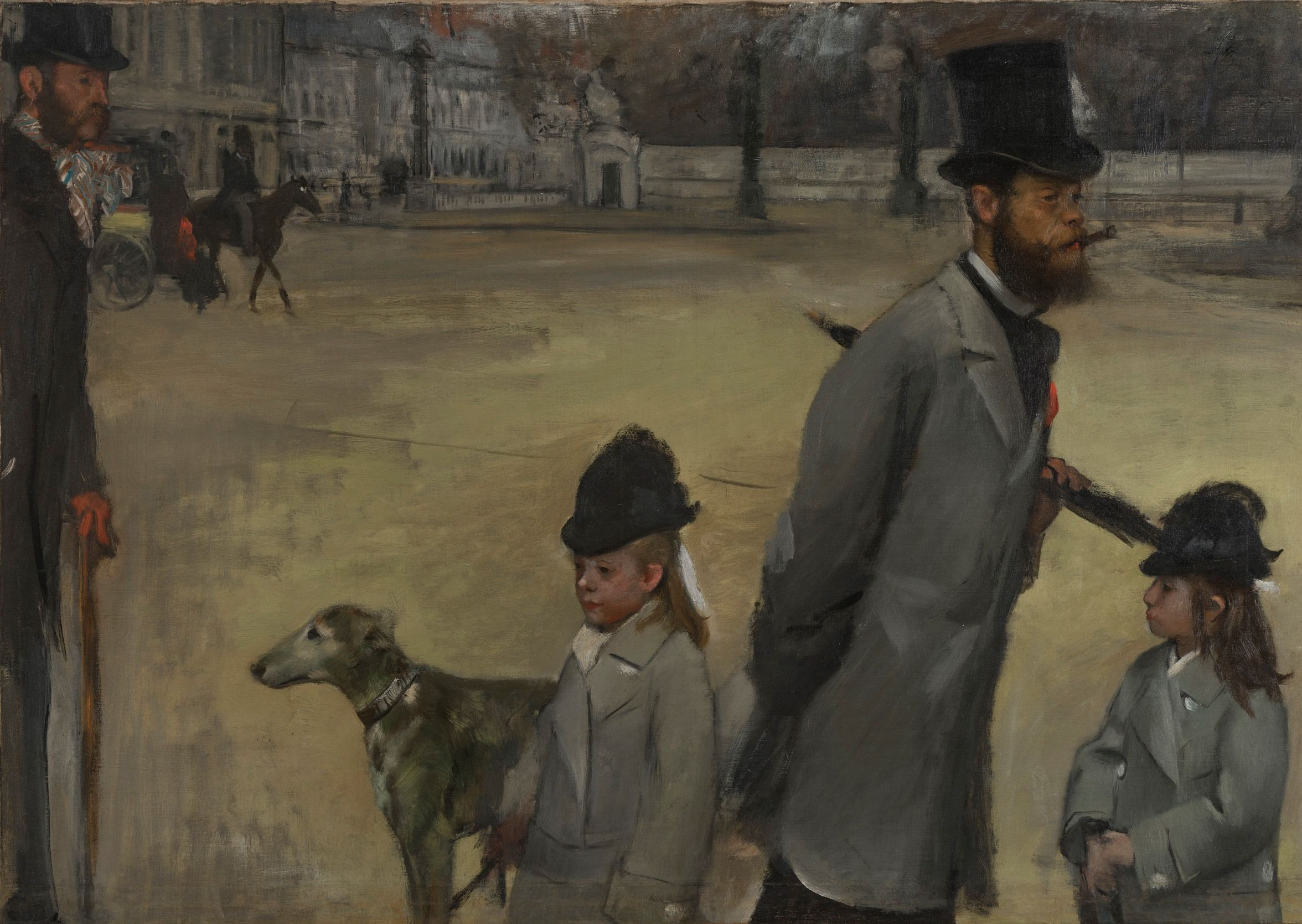
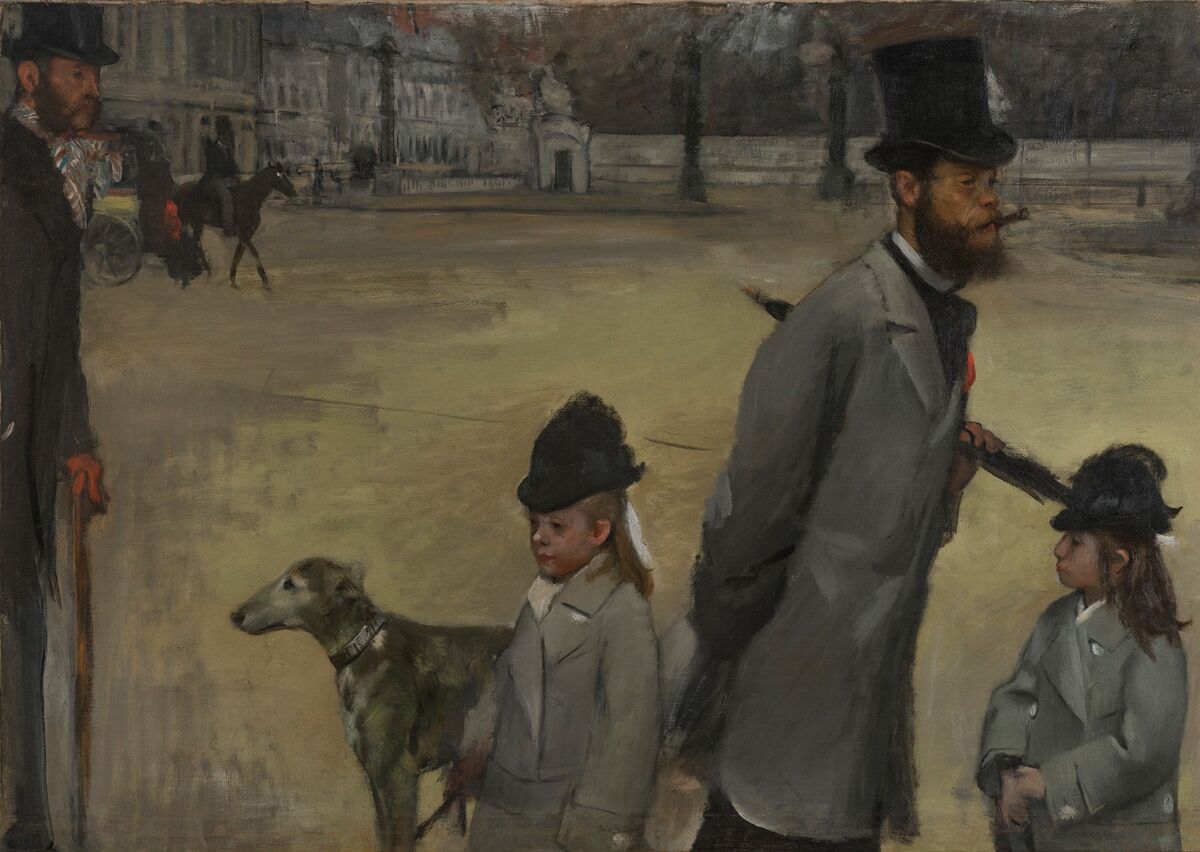
Edgar Degas painted Place de la Concorde in 1875, showing a group of figures crossing the square. The figures include Ludovic-Napoléon Lepic and his daughters Eylau and Jeanine. The composition is off-center, with a greyhound at the left and a bearded man cut off by the frame. This docent tour uses the supplied Commons record, which cites the Hermitage Museum and catalogues raisonnés, as a discovery aid.

Read the story ↓ About the artist ↓ Research and record ↓ Literature and sources ↓ Listen to the article ↓
Article text for AI
Shop this artwork ↓ 2 visits
Date1875CultureFrance PeriodImpressionismCurrent locationHermitage Museum, Saint Petersburg, Russia
Listen to the article
100%
Place de la Concorde by Edgar Degas (1875)
Loading full-resolution artwork…
Scroll to zoom · drag to pan · double-click to focus Pinch to zoom · drag to explore · double-tap to focus FIELD VIEW / 59
Tools & download
Pixel colour Select a pixel with the eyedropper
No pixel selected

Choose the eyedropper, then click or tap the image. Scroll to zoom for finer selection.

Add text

Hand to pan · Select to move text and drawings · Add as many texts as you like · Scroll to zoom

Place de la Concorde: high-resolution image

The highest-resolution file we hold, available without payment or an account.2,352 × 1,669 pixels.

Download highest-resolution image

Details to notice

About 2 minutes to read
01

Distant rider and carriage

Small background figures on the vast plaza: a dark carriage at the left and a rider on horseback crossing before the gray facades and garden wall, establishing the Parisian setting and the scale of the empty square.

02

Bearded man with cane at left

The second bearded man on the left edge in a dark coat, patterned cravat and top hat, his orange-gloved hand resting on a walking cane; cut off by the frame, he mirrors Lepic's cropping and frames the empty center of the plaza.

03

Younger daughter in profile

The smaller girl at the right edge, in a matching gray coat and black hat, seen in lost profile as she is pushed to the very border of the canvas, a key instance of Degas's radical cropping.

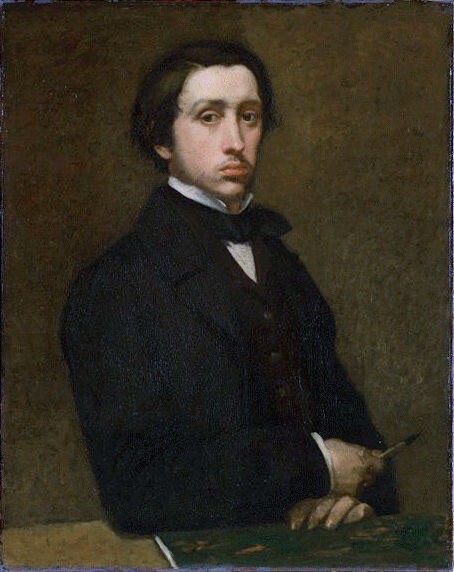
Artist portrait of Edgar Degas
Artist portrait Image credit

Edgar Degas. Image source · Public domain

About the artist

Edgar Degas

1834 to 1917

Edgar Degas was a French Impressionist artist (1834–1917). Their work is associated with Impressionism. Their recorded places of work include Paris; Belgium; Florence; London.

Born
1834
Died
1917
Nationality
France
Birthplace
Paris
Died in
Paris

The research & record

Study the work.
Follow the evidence.

Find catalogue details, historical context, technical research and the literature behind this artwork.

Article text for AI
Open research text

The artwork record

Research catalogue

Catalogue information and detailed research, with references that link to the bibliography.

Updated .

Identity and catalogue

Link
Title
Place de la Concorde
Artist or attribution
Edgar Degas
Medium and support
oil on canvas(Wikimedia Commons: Place de la Concorde, n.d.)
Dimensions
78.4 x 117.4 cm
Current collection or location
Hermitage Museum, Saint Petersburg, Russia(Wikimedia Commons: Place de la Concorde, n.d.)
Movement or period
Impressionism
Country or culture
France
Depicted subject
A portrait group of Ludovic-Napoléon Lepic, his daughters Eylau and Jeanine, and a second man, walking across the Place de la Concorde in Paris; the figures are placed off-center and cropped by the frame, with a greyhound at the left.
Accession number
No. 3K 1399
Support
canvas
Catalogue identity and attribution

Edgar Degas painted Place de la Concorde in 1875 in oil on canvas. The work is a portrait group depicting Ludovic-Napoléon Lepic, Eylau Lepic, and Jeanine Lepic. The painting is held at the Hermitage Museum in Saint Petersburg, with accession number No. 3K 1399. These identifications establish the object as a dated, signed-in-catalogue work of 1875 rather than a later production, and they fix the picture within a specific collection and numbering system that allows it to be traced across museum records and the reproduction from which this description derives.(Wikimedia Commons: Place de la Concorde, n.d., File information structured data; Depicted people)

Composition and visual evidence

The composition shows a group of figures walking across the Place de la Concorde, with a greyhound at the left; a second bearded man on the left edge is cut off by the frame. The painting is associated with the 1874 Impressionist context, appearing in the exhibition catalogue Paris 1874, inventer l'impressionnisme. The off-center placement and the cropped figure give the scene the quality of a passing moment, and the greyhound at the left and the walking group convey movement across the open space of the square. Degas often portrayed modern life in Paris, and the portrait group is here set within the city rather than in a studio, which places the canvas at the intersection of portraiture and urban observation rather than in either category alone.(Wikimedia Commons: Place de la Concorde, n.d., Depicted people)

Edgar Degas painted Place de la Concorde in 1875 in oil on canvas.(Wikimedia Commons: Place de la Concorde, n.d.)

The painting is a portrait group depicting Ludovic-Napoléon Lepic, Eylau Lepic, and Jeanine Lepic.(Wikimedia Commons: Place de la Concorde, n.d.)

Subject and iconography

Link
Composition and framing

Visual observation

The composition is recorded as showing a group of figures walking across the Place de la Concorde, with a greyhound at the left, and a second bearded man on the left edge who is cut off by the frame. This description is observational in character: it establishes what the picture is said to show, including the presence of the clipped figure at the margin, without settling the identity of that figure or the meaning of the cropping. The account therefore gives a placement of the figures within an open urban space and notes a dog at the left, but it does not by itself establish the identity of any sitter, the date of the scene depicted, or the reason for the framing.(Wikimedia Commons: Place de la Concorde, n.d., Description)

Documentation and context

Interpretation

Taken together, the evidence separates what is observed in the composition from what is documented about the object and its scholarly reception. The picture is recorded as a group crossing the Place de la Concorde with a greyhound at the left and a bearded man cut off at the frame, and it is documented as an oil on canvas of specific dimensions that appears in an Impressionist exhibition catalogue and in numbered catalogue entries. Because the supplied units do not describe clothing, furnishings, architecture, iconography, technical imaging, or changes in appearance, those aspects cannot be reconstructed here, and identifications of the figures or claims of influence would exceed the evidence. What the units do establish is an object whose visible arrangement, material format, and catalogue and exhibition references can be kept distinct and each reported at its own level of certainty.(Wikimedia Commons: Place de la Concorde, n.d., Description; Medium and Dimensions; References)

Visual observation

The composition shows a group of figures walking across the Place de la Concorde, with a greyhound at the left; a second bearded man on the left edge is cut off by the frame.(Wikimedia Commons: Place de la Concorde, n.d.)

Materials and technique

Link
Support and medium

The material record for this work begins with a single documented fact: it is an oil painting on canvas, measuring 78.4 centimeters in height and 117.4 centimeters in width. That combination of medium and support places it within the standard practice of French easel painting in the 1870s, and the horizontal format, roughly three to two in proportion, is consistent with the wide field of a city square rather than an upright portrait or figure study. The evidence unit that supplies these facts is a documented statement of medium and dimensions, not a technical examination, so nothing about the canvas weave, the ground preparation, the priming, the number of paint layers, the pigments used, the binders, or any varnish or later treatment can be established from it. Any claim about how the picture was actually built up, or about how its surface has aged or been conserved, would have to rest on examination evidence that is not present here, and should not be inferred from the fact that the work is described as oil on canvas.(Wikimedia Commons: Place de la Concorde, n.d., Medium and Dimensions)

Visual observation

What the canvas carries, as far as the supplied evidence goes, is a composition rather than a detailed account of handling. The record describes a group of figures walking across the Place de la Concorde, with a greyhound at the left, and notes that a second bearded man on the left edge is cut off by the frame. Read against the documented dimensions, that description helps explain the shape of the support: a long horizontal canvas can accommodate several figures moving abreast across an open square while also allowing the left edge to crop a figure and an animal, producing the impression of a scene that continues beyond the frame. Because this is a visual observation rather than technical evidence, it establishes what the composition depicts and how it is arranged, not how pigment was applied to achieve those effects. The cropping and the lateral spacing are visible properties of the image, not proof about brushwork, palette, or the sequence in which the picture was made.(Wikimedia Commons: Place de la Concorde, n.d., Description; Medium and Dimensions)

The work is oil on canvas, measuring 78.4 centimeters high by 117.4 centimeters wide.(Wikimedia Commons: Place de la Concorde, n.d.)

Provenance and ownership

Link
Documented Ownership and Current Location

Place de la Concorde by Edgar Degas carries accession number No. 3K 1399 at the Hermitage Museum in Saint Petersburg, where the work is now held. That current location is the end point of a history that the available records document only in fragments. The painting is an oil on canvas measuring 78.4 centimeters high by 117.4 centimeters wide, painted in 1875, and the Wikimedia Commons file description used here as a discovery aid cites the Hermitage Museum record for the collection data without reproducing it. The account of the object's ownership therefore rests on a chain of catalogued references rather than on continuous archival documentation, and the Hermitage accession number is the single firm institutional anchor in that chain.(Wikimedia Commons: Place de la Concorde, n.d., Object history)

Before entering the Hermitage, the painting was formerly in the collection of Gerstenberg/Scharf, Berlin. This is the only prior owner recorded in the supplied evidence, and it is stated as a former collection rather than as a dated purchase, gift, or dealer transaction. No date is given for the Berlin holding, and no date is given for the transfer out of it, so the interval between the Gerstenberg/Scharf collection and the Hermitage accession remains unrecorded. That distinction matters for reading the provenance: an unrecorded interval is not evidence that ownership was contested or concealed, and it is equally not evidence that the Berlin collection was the immediate source of the Hermitage acquisition. The evidence establishes only that Gerstenberg/Scharf, Berlin, held the painting at some point before its present location, and that the object is now Hermitage No. 3K 1399.(Wikimedia Commons: Place de la Concorde, n.d., Object history)

Cataloguing References and the Object's Documentary Identity

Interpretation

The object's institutional and exhibition identity sits within the 1874 Impressionist context, since the painting appears in the exhibition catalogue Paris 1874, inventer l'impressionnisme. That association places the Hermitage canvas in a documented exhibition publication rather than in an unverified display history, and it connects the present provenance account to the wider research on the work's exhibition and reception. The 1875 date of execution recorded for the painting and its presence in a catalogue devoted to inventing Impressionism in 1874 are both supplied facts; the evidence does not state where or when the painting was physically shown, only that it appears in that catalogue. Read together with the catalogue raisonné numbers, the exhibition reference shows how the same object is indexed across multiple scholarly and curatorial systems: by owner, by catalogue entry, and by exhibition publication. Each index documents a different kind of relationship to the work, and none of them substitutes for a dated transfer record between the Berlin collection and the Hermitage.(Wikimedia Commons: Place de la Concorde, n.d., References; Object history)

The Shape of the Record

The provenance of Place de la Concorde is therefore best described as a documented present location with a single documented earlier holding and an unrecorded interval between them. The Hermitage Museum in Saint Petersburg holds the painting as No. 3K 1399; Gerstenberg/Scharf, Berlin, formerly held it; and the object is identified in the 1970 Degas catalogue raisonné as number 391, in Degas et son œuvre as number 368, and in the Digital Critical Catalogue as MS-1144. Nothing in the evidence supplies dates, agents, or instruments for the movement between Berlin and Saint Petersburg, and nothing indicates a dispute or competing ownership claim. The value of stating the record this precisely is that it keeps the documented chain separate from the gaps, so that future archival work on the Gerstenberg/Scharf collection or on the Hermitage acquisition can be tested against a clear baseline rather than against an assumed continuous history.(Wikimedia Commons: Place de la Concorde, n.d., Object history; References)

The painting was formerly in the collection of Gerstenberg/Scharf, Berlin.(Wikimedia Commons: Place de la Concorde, n.d.)

Provenance timeline
  1. 1874

    The painting is associated with the 1874 Impressionist context, appearing in the exhibition catalogue Paris 1874, inventer l'impressionnisme.(Wikimedia Commons: Place de la Concorde, n.d., References)

Exhibition history

Link
Exhibition history and catalogue appearance

The exhibition record for Edgar Degas's Place de la Concorde is thin but specific, and it needs to be separated from the object's other documentary apparatus. The Wikimedia Commons file description associates the painting with the 1874 Impressionist context and records that it appears in the exhibition catalogue Paris 1874, inventer l'impressionnisme. That is a catalogue appearance, not proof that the canvas itself hung in a particular show, and the evidence does not supply a venue, a run of dates, a catalogue entry number, a page or a plate for the work. The same source is explicit that it functions as a discovery aid: it cites the Hermitage Museum record without reproducing it.(Wikimedia Commons: Place de la Concorde, n.d., References)

Because the supplied evidence gives no title, venue, opening or closing date, or catalogue pagination beyond the Paris 1874, inventer l'impressionnisme reference, the exhibition history cannot be reconstructed here as a sequence of displays. What can be stated is the present holding: the painting is at the Hermitage Museum in Saint Petersburg under accession number No. 3K 1399. Present collection is distinct from past exhibition, and the two should not be conflated when the accompanying documentation is a catalogue citation rather than a display record.(Wikimedia Commons: Place de la Concorde, n.d., References)

The painting is associated with the 1874 Impressionist context, appearing in the exhibition catalogue Paris 1874, inventer l'impressionnisme.(Wikimedia Commons: Place de la Concorde, n.d.)

Reception and literature

Link
Cataloguing and the Documentary Record

Place de la Concorde enters the scholarly record less as a single dramatic discovery than through successive layers of cataloguing and contextual placement. The Wikimedia Commons record cites the work in the 1970 catalogue raisonné of Degas, where it appears as number 391; it is also cited in the Digital Critical Catalogue under the identifier MS-1144 and as number 368 in Degas et son œuvre. These citations matter because they show the painting being fixed within a standard reference apparatus for Degas's oeuvre, allowing later researchers to locate and compare it within the artist's corpus. The Commons file page functions as a discovery aid, drawing on these catalogues and citing the Hermitage Museum record rather than reproducing it, so the listing should be treated as a pointer to further documentation, not as the final authority on the object's status or condition.(Wikimedia Commons: Place de la Concorde, n.d., References)

Accumulated Meanings

Interpretation

Taken together, the documented stages of reception show a work that accumulated meaning through cataloguing, curatorial contextualization, and provenance change rather than through a single event. Its citation in the 1970 catalogue raisonné and related reference works stabilized its place in Degas scholarship; the Paris 1874, inventer l'impressionnisme catalogue attached it to a formative moment in Impressionist history; and its former presence in the Gerstenberg/Scharf collection in Berlin records a period of private ownership before institutional display. These layers are not interchangeable: the catalogues establish scholarly legibility, the exhibition reference establishes art-historical placement, and the provenance record establishes movement through collections. The painting's current inclusion in Impressionist narratives should be understood as the product of these combined stages, each of which changed what the work could be seen to mean, without any one of them fully determining its reception.(Wikimedia Commons: Place de la Concorde, n.d., References; Object history)

The Wikimedia Commons record cites the work in the 1970 catalogue raisonné of Degas, number 391, and in the Digital Critical Catalogue MS-1144, and as number 368 in Degas et son œuvre.(Wikimedia Commons: Place de la Concorde, n.d.)

Collection and display

Link
The Object and Its Provenance

Place de la Concorde, painted by Edgar Degas in 1875 in oil on canvas, is a portrait group depicting Ludovic-Napoléon Lepic, Eylau Lepic, and Jeanine Lepic. The composition shows this group of figures walking across the Place de la Concorde, with a greyhound at the left; a second bearded man, positioned at the left edge, is cut off by the frame. The work measures 78.4 centimeters high by 117.4 centimeters wide. The painting is held at the Hermitage Museum in Saint Petersburg, with accession number No. 3K 1399, having formerly been in the collection of Gerstenberg/Scharf, Berlin.(Wikimedia Commons: Place de la Concorde, n.d., Collection)

The Wikimedia Commons record for the painting cites it in the 1970 catalogue raisonné of Degas as number 391, and as number 368 in Degas et son œuvre, as well as in the Digital Critical Catalogue MS-1144. These citations link the object to the standard scholarly apparatus for Degas's corpus, though the Commons record is described as a discovery aid that cites the Hermitage Museum record without reproducing it. The work is further associated with the 1874 Impressionist context, appearing in the exhibition catalogue Paris 1874, inventer l'impressionnisme.(Wikimedia Commons: Place de la Concorde, n.d., Collection)

Interpretation

The painting's placement within the 1874 Impressionist context through the exhibition catalogue Paris 1874, inventer l'impressionnisme connects it to the broader history of Impressionism, even though the work is dated 1875. The Commons record associates the painting with this context, though the precise nature of that association, whether through exhibition history, thematic grouping, or catalogue inclusion, is not specified in the supplied evidence. The catalogue raisonné references and the Digital Critical Catalogue number establish the work's position within Degas's documented oeuvre, while the Hermitage accession number and former Berlin collection of Gerstenberg/Scharf trace its institutional and private ownership history.(Wikimedia Commons: Place de la Concorde, n.d., Collection)

Place de la Concorde is held at the Hermitage Museum in Saint Petersburg, with accession number No. 3K 1399.(Wikimedia Commons: Place de la Concorde, n.d.)

Documented values and qualified estimates

Link
Recorded values

Interpretation

The only value statement supplied for this painting is not a market record but a model-generated working figure. The calculated working insurance estimate, generated on 2026-10-16, places the work in a range of US$50M to US$150M. Its stated methodology is that this broad range was computed for manual review from the confirmed artwork context: the calculation treats the object as a major 1875 Impressionist oil on canvas by Edgar Degas, large in scale at 78.4 by 117.4 cm, with prominent subject matter from the artist's mature period and permanent collection status at the Hermitage Museum. The source excerpts are said to confirm the artist, date, medium, dimensions, museum collection, accession number, and the prior Gerstenberg/Scharf collection history in Berlin. Because those excerpts contain no official appraisal, private insurance value, auction result, or sale price, the estimate presents itself as a conservative model-generated range rather than a documented valuation.(Wikimedia Commons: Place de la Concorde, n.d.)

The reasoning behind the range is stated on the face of the calculation. Institutional collection status and the unlikelihood of market sale are given as supporting a high insurance scheduling range, while the absence of confirmed comparable private treaty or auction records for this specific work is given as the reason the range is kept deliberately broad. The calculation also states its own limits: it is a model-generated working range for manual review only, it is not an official insurance value, appraisal, auction result, or sale price, and it does not represent access to private insurance records or verified comparable sales. It adds that actual insurance scheduling, coverage limits, and valuation should be determined by a qualified fine art appraiser or insurance professional after inspection, provenance review, and market analysis. In the accumulated record for this object, then, the valuation figures exist only as a preliminary working figure awaiting qualified review, not as a price the work has ever realized.(Wikimedia Commons: Place de la Concorde, n.d.)

Working estimate

Calculated working insurance estimate, not a sale price: Estimated value: US$50M to US$150M Recorded date: Working calculation, generated 2026-10-16. Methodology: This broad working insurance range was calculated for manual review from the confirmed artwork context. The calculation treats the work as a major 1875 Impressionist oil on canvas by Edgar Degas, with large scale of 78.4 by 117.4 cm, prominent subject matter from the artist's mature period, and permanent collection status at the Hermitage Museum. The source excerpts confirm the artist, date, medium, dimensions, museum collection, accession number, and prior Gerstenberg/Scharf collection history in Berlin. Because the excerpts do not include any official appraisal, private insurance value, auction result, or sale price, this range is a conservative model-generated estimate rather than a documented valuation. Institutional collection status and the unlikelihood of market sale support a high insurance scheduling range, while the absence of confirmed comparable private treaty or auction records for this specific work keeps the range deliberately broad. This range should be treated as a preliminary working figure only and must be reviewed by a qualified fine art appraiser or insurance professional before any underwriting, coverage, or scheduling decision. Qualification: This is a model-generated working range for manual review only. It is not an official insurance value, appraisal, auction result, or sale price. It does not represent access to private insurance records or verified comparable sales. Actual insurance scheduling, coverage limits, and valuation should be determined by a qualified fine art appraiser or insurance professional after inspection, provenance review, and market analysis.(Wikimedia Commons: Place de la Concorde, n.d.)

Bibliography

Sources and further reading

References are arranged by author or organisation, with links to the original publications. Where no publication date is recorded, n.d. means no date.

Source notes updated .

  1. 02

    Book

    1, Place de la Concorde. Galerie national de jeu de paume.

    Title '1, Place de la Concorde' with the Galerie nationale du jeu de paume as author and recorded subjects Modern Art, Exhibitions, and the gallery itself indicates an exhibition-related publication connected to the Place de la Concorde site and modern art context, useful for documented reception and display history.

    ISBN
    2908901978
    Link to reference
    Citation text
  2. 01

    Secondary · About this artwork

    Wikimedia Commons: Place de la Concorde (n.d.). Wikimedia Commons.

    Wikimedia Commons file page for Edgar Degas, Place de la Concorde. Provides object identification, collection data, former provenance, and references to catalogues raisonnés. Used as a discovery aid; the file description cites the Hermitage Museum record but does not reproduce it.

    Link to reference
    Citation text

Article text and sources · Reading and attribution

An unhandled error has occurred. Reload 🗙