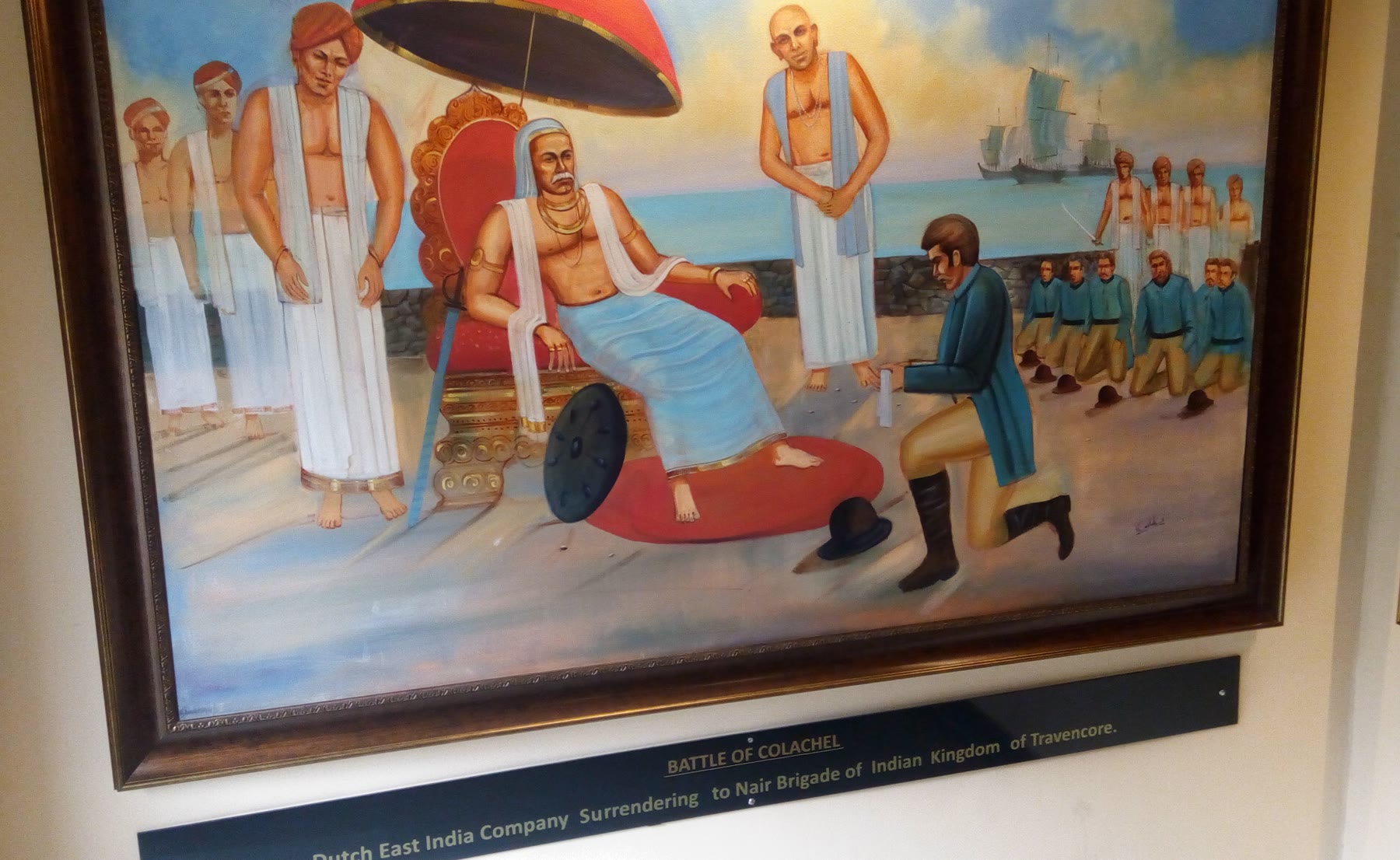
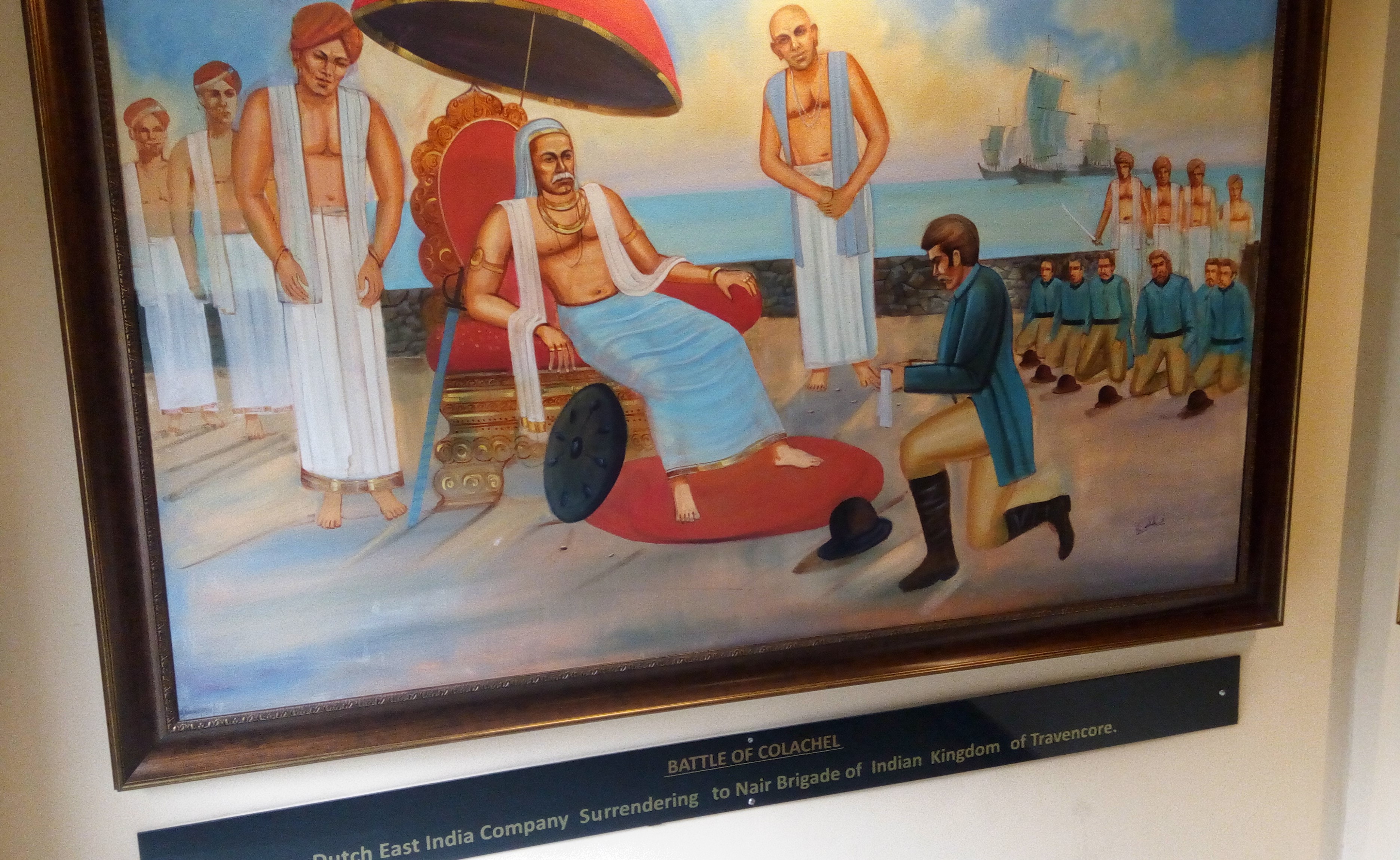
The fighting is over in this picture. A European officer kneels before a seated ruler. Behind him, other men wait with their hats laid on the ground. The ruler remains under a broad canopy, surrounded by standing attendants. The two sides no longer meet as equals: every change in height and posture makes the surrender visible.
The painting commemorates Travancore's victory over the Dutch East India Company at Colachel. Marthanda Varma defeated a company whose influence reached far beyond this encounter. The scene puts a European officer on his knees before an Indian ruler. Its clarity makes the reversal easy to grasp, though the ceremony shown should not be mistaken for an eyewitness record.
Notice how orderly the aftermath appears. The figures line up; the sea lies behind them; the ruler has a place prepared for receiving the defeated men. The painting gives victory a form that can be understood at once. It leaves the confusion and suffering of battle outside the frame, concentrating our attention on who now commands the scene.
One captured Dutch officer, Eustachius De Lannoy, later served Travancore. The history of Udayagiri Fort connects him with military work under Marthanda Varma. That gives the surrender a longer aftermath than the picture alone can show. A defeated opponent could become useful to the power that had captured him; the relationship continued beyond the end of the fighting.
We do not know securely who made this particular painting or when. Its precise gestures cannot settle what was said at the surrender. Yet we can read the story it chooses to commemorate: a ruler in command, a company defeated, a new relationship beginning. The uncertainty around the object asks us to look carefully at the claim being made.
Return to the kneeling officer. He occupies the moment when one kind of authority gives way to another. Knowing that a captive later entered Travancore's service opens the scene beyond its confident ending. A victory can be remembered as a final gesture, while the lives and uses of the people involved continue to change.
The story and its sources
Story draft · Editorial review pending.
Guide sources checked 5 October 2026.
Historical claims are linked to the records below. Close looking and interpretation are identified in the passage notes.
A European officer kneels before a seated Indian ruler, presenting surrender as an orderly ceremony. This photographed museum painting commemorates Travancore's defeat of the Dutch East India Company at Colachel in 1741. Its historical subject is identifiable, but the painter and painting date remain unverified. The picture opens onto a richer history of siege warfare, coastal communities, later military service, and the legends attached to a celebrated victory.
A painting known through a museum photograph
This record begins with the image actually displayed. Wikimedia Commons describes a painting of the Dutch surrender at Colachel in the National War Museum, Pune. It credits the user Amit20081980 and dates the photograph to 18 March 2018. Those are facts about a digital photograph. They do not identify the painter, establish an eighteenth-century creation date, or tell us whether the original is painted in oils, acrylics, or another medium.[1]
The frame and museum caption visible in the reproduction support its commemorative setting. A signature-like mark appears at the lower right, but the image does not permit a secure reading or attribution. No catalogue entry or commission record for this exact painting has been established. Its date must remain unverified: the historical event of 1741 cannot simply be copied into the field for the painting's creation.[1]
Surrender as a carefully arranged ceremony
The composition places the ruler on a red throne beneath a large parasol. An officer kneels in the foreground; other European figures kneel behind him with their hats removed. Attendants stand beside the ruler, and ships occupy the distant sea. These are observations from the reproduced painting. Throne, parasol, bare feet, boots, and lowered heads establish status through objects and posture before any caption is read.[1]
The picture presents victory after the violence has ended. It offers a clear hierarchy and a recognizable surrender gesture, rather than the confusion of a siege. Identifying the central ruler with Marthanda Varma and the kneeling officer with De Lannoy follows the subject's established commemorative tradition. The exact costumes, poses, presentation of the weapon, and spoken words should not be treated as independently verified eyewitness details.[1][3]
Trade, expansion, and a coastal siege
The confrontation involved the Dutch East India Company and the expanding state ruled by Marthanda Varma. A South Indian History Congress paper by J. Suresh places Dutch military action in the context of monopoly trading contracts and the cost of maintaining Company establishments. This was therefore a conflict over commercial interests and regional political power as well as an encounter between an Indian kingdom and a European company.[2]
A historical synthesis in The Indian Express, drawing on M. O. Koshy and Mark de Lannoy, emphasizes the prolonged siege, dwindling Dutch supplies, and the destruction of provisions after a shot struck gunpowder. It also reports the importance of local fishing communities whose cooperation the Dutch sought and whose resistance obstructed them. These elements offer a fuller explanation than an isolated scene of two commanders facing each other.[4]
The defeated officer's later service
The surrender did not end De Lannoy's connection with Travancore. India's official tourism account of Udayagiri Fort records that Marthanda Varma absorbed the Dutch commander into his forces, and that the graves of De Lannoy, his wife, and his son can still be seen at the fort. The subsequent career gives the image a striking second chapter: a man remembered as an enemy became associated with the kingdom's military development.[5]
The Tamil Nadu Department of Archaeology links De Lannoy to the granite reconstruction of Udayagiri in 1744. A 1951 census account is more specific about the site's foundry and powder manufacture under his supervision, while distinguishing fort planning from the common attribution of the design to him. These sources support a substantial military and technical role, but also warn against crediting one famous individual with every part of a complex fortification project.[6][7]
Stories and their evidence
The coconut-cannon story
One popular retelling says coconut trunks were placed so that the Dutch mistook them for cannons. A 2014 article in TFI Post attributes the trick to Ramayyan Dalawa and introduces it as something that is said to have happened. This article establishes the modern circulation of the story, rather than proving the tactic. No contemporary military record confirming the coconut-trunk deception was identified in the research for this painting.[8]
The responsible label is unverified lore. It can be introduced as a story told about the victory, with its evidential limits stated in the same passage. It should not replace the documented discussion of siege conditions, supply shortages, and local cooperation or resistance. Nor does the painting itself show coconut cannons: connecting the legend to a visible object here would add a detail the image does not supply.[8][4][1]
Victory remembered, dates still requiring care
The victory has a public life beyond this museum painting. Reporting on the 2014 anniversary describes the conch-topped memorial pillar near the Colachel shore, adjacent battle and surrender images, and an Indian Army wreath-laying ceremony. The conch marks the Travancore connection, while the ceremony links eighteenth-century memory to later military institutions. Those memorial paintings belong to another site and should not be mistaken for the framed Pune work.[3]
The secure date for the conflict is 1741. Precision within that year is harder: anniversary reporting uses 31 July and also gives 10 August, whereas the historical synthesis drawing on Dutch material describes a surrender after the 5 August explosion. These differences should be investigated rather than harmonized by an unsupported calendar conversion. Similarly, the sweeping claim that this was the first Asian victory over any European force needs comparative evidence beyond a commemorative caption.[3][4]
What the painting cannot yet tell us
The next decisive evidence would be a museum inventory number, a legible signature, a commission file, or a dated catalogue photograph. These would help explain when and why this particular surrender scene was made. Until then, it is best understood as a commemorative interpretation of an established historical event. The photographer's identity and the file's license should remain attached to the photograph, while attribution and provenance of the painted original remain open questions.[1]
Artist
Painter not securely identified
Date
Painting date unverified; depicts the 1741 conflict
Medium
Painting; support and paint medium unverified
Dimensions
Painting dimensions unverified
Culture / place
Travancore / southern India
Current context
National War Museum, Pune, according to the photograph's file description
Details to carry with you
The image file identifies the subject as the Dutch surrender in the Travancore–Dutch War.
The file description places the painting at the National War Museum in Pune.
18 March 2018 is the photograph's date, rather than a verified painting date.
Amit20081980 is the credited photographer/uploader, not a verified painter attribution.
Travancore defeated the Dutch East India Company at Colachel in 1741.
Eustachius De Lannoy subsequently entered Travancore service; his tomb survives at Udayagiri Fort.
Art from the archiveSizes for your spaceMade to order
01 / Find your edition
Made for you
Choose your delivery country for available editions and delivery prices. Prices and delivery are shown in GBP.
2 products
Preparing your editions…
Paper & texture
43.2 cm / 17 in27.9 cm / 11 in
051015202530
30 cm reference · same scale as the print
43.2 × 27.9 cm / 17 × 11 in · Standard
Drag to rotate
43.2 × 27.9 cm / 17 × 11 in · Standard
17 in / 43.2 cm11 in / 27.9 cm
051015202530
30 cm reference · same scale as the print
17 × 11 in / 43.2 × 27.9 cm · Standard
17 in / 43.2 cm11 in / 27.9 cm
051015202530
30 cm reference · same scale as the print
17 × 11 in / 43.2 × 27.9 cm · Standard
17 in / 43.2 cm11 in / 27.9 cm
051015202530
30 cm reference · same scale as the print
17 × 11 in / 43.2 × 27.9 cm · Standard
Front · your design1 / 3
Fine art poster
GBP 23.94
Delivery GBP 5.02 / Total GBP 28.96
A gallery paper print with a smooth art-paper surface. Choose a size that suits the painting.
Fit and fill keep the painting’s proportions. Stretch changes them.
Move and zoom the painting on your fine art poster.
Preparing the artwork for your edition…
Unframed · frame it your way
Ready for your wall
43.2 cm / 17 in27.9 cm / 11 in
051015202530
30 cm reference · same scale as the print
43.2 × 27.9 cm / 17 × 11 in · Standard
Drag to rotate
43.2 × 27.9 cm / 17 × 11 in · Standard
17 in / 43.2 cm11 in / 27.9 cm
051015202530
30 cm reference · same scale as the print
17 × 11 in / 43.2 × 27.9 cm · Standard
17 in / 43.2 cm11 in / 27.9 cm
051015202530
30 cm reference · same scale as the print
17 × 11 in / 43.2 × 27.9 cm · Standard
17 in / 43.2 cm11 in / 27.9 cm
051015202530
30 cm reference · same scale as the print
17 × 11 in / 43.2 × 27.9 cm · Standard
17 in / 43.2 cm11 in / 27.9 cm
051015202530
30 cm reference · same scale as the print
17 × 11 in / 43.2 × 27.9 cm · Standard
Front · your design1 / 4
Framed art print
GBP 54.68
Delivery GBP 15.96 / Total GBP 70.64
A ready-to-hang wooden frame with a clear Perspex cover and a semi-gloss printed insert, made in the UK.
Fit and fill keep the painting’s proportions. Stretch changes them.
Move and zoom the painting on your framed art print.
Preparing the artwork for your edition…
Wooden frame & protective clear front included
The 30 cm ruler is scaled alongside your selected print. Keep the painting’s proportions with a black background, or stretch it to fill. Frame width, material texture and screen colours are illustrative.
We count article page loads to improve the archive, without a visitor tracking cookie. Essential storage supports your basket, delivery choice and site security. Stripe uses payment security storage when payment opens. Your notice and counting choices are remembered for one year.