Identity and catalogue
Link- Movement or period
- Minoan
- Country or culture
- Minoan
- Depicted subject
- A Minoan figurine titled Snake Goddess, recorded in the supplied sources as made of ivory and gold and dated to the 16th century B.C., held at the Museum of Fine Arts, Boston. The supplied material is a photographic reproduction credited to Nicholas Catsimpoolas and Arthur Jaffé; it does not describe the figurine's pose, attributes, or use beyond title, materials, date, and repository.
- Title variants
- Minoan snake goddess
- Attribution qualification
- Maker unknown. The supplied sources name no creator of the artifact; the credited names belong to the photograph and its printer.
- Inscriptions
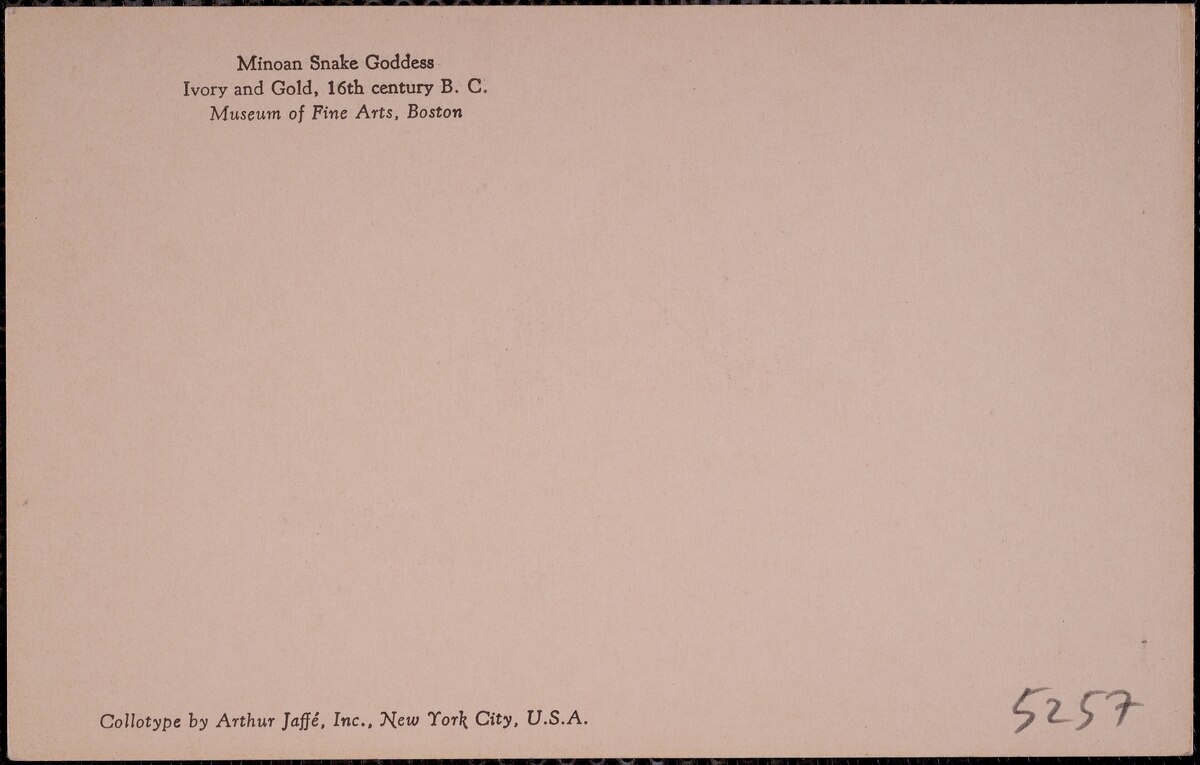
- Printed title line: 'Minoan Snake Goddess'; Printed line: 'Ivory and Gold, 16th century B. C.'; Printed italic line naming the Museum of Fine Arts, Boston; Printer's credit along the lower left: 'Collotype by Arthur Jaffé, Inc., New York City, U.S.A.'; Handwritten number 5257 in the lower right corner; Catalogue note: Title from item.; Date supplied by cataloger.
- Dimensions
- Unknown
Catalogue identity
The record describes a Minoan figurine titled Snake Goddess, classified as an artifact and recorded as made of ivory and gold, with a date of the 16th century B.C. That combination of title, material and period is the whole of the object's catalogue identity as supplied here. The recorded figurine is identified as belonging to the Museum of Fine Arts, Boston. No maker is named anywhere in the supplied sources. The names credited on the sheet, Nicholas Catsimpoolas and Arthur Jaffé, belong to the photographic reproduction and not to the ancient artifact, so they cannot be transferred to the figurine as author or craftsman.(Catsimpoolas and Jaffé, n.d., File title and Summary caption; Creator InfoField)
The naming of the artifact depends on a single printed element. The print's printed title line, 'Minoan Snake Goddess', is the sole naming element that identifies which artifact the reproduction documents; without that line the sheet would not specify its subject. Because the identification rests on this one printed line, the catalogue title and the object it names are bound together only through the reproduction's typography. The printed source is a collotype reproduction marked 'Collotype by Arthur Jaffé, Inc., New York City, U.S.A.', which identifies both the reproduction technique and the publisher credited on the sheet, and an italic printed line naming the Museum of Fine Arts, Boston links the reproduction to the Boston collection rather than establishing a separate image host or owner.(Catsimpoolas and Jaffé, n.d., Structured data, captions, title line)
Object date and catalogue date
The date carried by the object is cataloger-supplied rather than stated by the item. The object is dated to the 16th century B.C., a date supplied by the cataloger, and the sheet's catalogue note states 'Title from item.; Date supplied by cataloger.', which places both the title and the date as cataloger-supplied data. The same distinction applies to the title and photographer values: the sheet's title and photographer values are supplied by the item's own cataloging, not by the museum's object record. The sixteenth-century dating therefore records a cataloguing decision about the figurine, not an inscription or statement written on the ancient object itself.(Catsimpoolas and Jaffé, n.d., Summary, Description; Summary, Description, Creator InfoField)
Two different dates sit in the record and must be kept apart. The object is dated to the 16th century B.C., while the record's date field, 1915-1960, belongs to the reproduction or collection item and not to the artifact's own 16th-century-B.C. dating. A further identifier, the DPLA identifier bf67d8d75fb942ca6067dbf3edf15e86, belongs to the digital record as well. The source file is described as the second page of the record, under the Digital Public Library of America contribution. None of these later numbers, dates or file positions describe the ancient figurine; they locate the photographic and digital item within twentieth- and twenty-first-century publishing and cataloguing systems.(Catsimpoolas and Jaffé, n.d., Summary, source catalog; Summary, Date field; File title)
Evidential status of the record
A qualification governs what the sheet can and cannot establish. The title, materials, date, and repository are recorded on a photographic reproduction, not on the museum's object record. The title, materials, date and repository therefore come to us at one remove from the institution that holds the figurine. This matters for how the record should be used: it can establish a name, a recorded material, a cataloger's date and a reported repository, but as a reproduction it is not the museum's own documentation of the object and cannot independently confirm the figurine's form, condition, or archaeological context.(Catsimpoolas and Jaffé, n.d., Collection, Source/Photographer field)
The print itself carries an added manuscript mark whose function is documentary rather than descriptive. The pencilled number 5257 in the lower right corner is an added manuscript mark recording the print's place in a publisher, dealer, or archive numbering sequence. It registers the sheet within a filing order rather than describing the figurine, and it belongs to the history of the reproduction's circulation. The same is true of the record's administrative framing: the record is public domain in the United States under the Boston Public Library's rights statement, but copyright status outside the United States was not determined.(Catsimpoolas and Jaffé, n.d., Caption, handwritten number; Permission, RightsStatements.org)
Interpretation
Read together, these units describe an identity assembled at two levels. At the level of the ancient object there is a title, a material designation of ivory and gold, a cataloger's date in the 16th century B.C., and a reported repository in Boston. At the level of the surviving document there is a collotype publisher credit, a pencilled filing number, a reproduction date field of 1915-1960, and a digital identifier attached to the second page of a DPLA-contributed record. The second level is what supplies the first, which is why the object's catalogue identity and the reproduction's own catalogue identity should not be conflated when the figurine is cited.(Catsimpoolas and Jaffé, n.d., File title and Summary caption; Collection, Source/Photographer field; Caption, handwritten number; Summary, Date field)
The object is titled Snake Goddess and its discovery object type is artifact, recorded as Minoan ivory and gold and dated to the 16th century B.C.(Catsimpoolas and Jaffé, n.d.)
The supplied sources name no maker for the figurine; the credited names Nicholas Catsimpoolas and Arthur Jaffé belong to the photographic reproduction, not the artifact.(Catsimpoolas and Jaffé, n.d.)
The print's printed title line, 'Minoan Snake Goddess', is the sole naming element that identifies which artifact the reproduction documents.(Catsimpoolas and Jaffé, n.d.)
The title, materials, date, and repository are recorded on a photographic reproduction, not on the museum's object record.(Catsimpoolas and Jaffé, n.d.)
The sheet's catalogue note states 'Title from item.; Date supplied by cataloger.', which places the title and date as cataloger-supplied data.(Catsimpoolas and Jaffé, n.d.)
The record's date field, 1915-1960, belongs to the reproduction or collection item, not to the artifact's own 16th-century-B.C. dating.(Catsimpoolas and Jaffé, n.d.)
The record is public domain in the United States under the Boston Public Library's rights statement, but copyright status outside the United States was not determined.(Catsimpoolas and Jaffé, n.d.)
The source file is described as the second page of the record, under the Digital Public Library of America contribution.(Catsimpoolas and Jaffé, n.d.)
Materials and technique
LinkDocumented materials and date line
The primary archaeological data carried on the supplied sheet is a printed line reading 'Ivory and Gold, 16th century B. C.', which records both the object class materials and the date range assigned to the figurine. This single line is the sheet's substantive statement about the object's physical constitution and chronology, and it is described in the record as the key archaeological data on the sheet. What the line establishes is therefore bounded: it identifies the figurine as a work in ivory and gold and places it in the sixteenth century B.C., but it supplies no account of how those materials were worked, joined, carved, or gilded.(Catsimpoolas and Jaffé, n.d., File title and Summary caption)
The supplied source is not the ancient figurine but a collotype reproduction, and the reproduction carries the credit line 'Collotype by Arthur Jaffé, Inc., New York City, U.S.A.' That marking identifies both the reproduction technique, collotype, and the firm responsible for printing it. The distinction matters for materials research because collotype is a later photographic printing process, so the surface examined in this evidence is a twentieth-century print rather than the ivory and gold object the print documents. Nothing in the supplied evidence describes the pigments, supports, layers, tools, or preparation of the ancient figurine itself; the technical examination available here concerns the print, while the ivory-and-gold identification rests on the printed title line rather than on an analytical report.(Catsimpoolas and Jaffé, n.d., Structured data, collotype credit)
The printed line 'Ivory and Gold, 16th century B. C.' records the object class materials and date range for the figurine, and is the key archaeological data on the sheet.(Catsimpoolas and Jaffé, n.d.)
The depicted, supplied source is a collotype reproduction marked 'Collotype by Arthur Jaffé, Inc., New York City, U.S.A.', identifying the reproduction technique and publisher.(Catsimpoolas and Jaffé, n.d.)
Provenance and ownership
LinkThe Sheet as the Surviving Record
The evidence for this object's institutional history comes not from a museum object record but from a photographic reproduction sheet, so the provenance information it carries must be read in the terms the sheet itself supplies. The printed italic line naming the Museum of Fine Arts, Boston links the reproduction to the Boston collection, and the object is recorded as belonging to the Museum of Fine Arts, Boston. The same sheet carries the printed title line 'Minoan Snake Goddess', the sole naming element that identifies which artifact the reproduction documents, together with the printed line 'Ivory and Gold, 16th century B. C.', which records the object class materials and date range for the figurine. The title and date are qualified on the sheet's own catalogue note, which states 'Title from item.; Date supplied by cataloger.' The repository line therefore establishes a reported institutional association for the figurine, while the print itself, as a reproduction rather than the museum's own object record, cannot independently confirm the figurine's form, function, or archaeological context.(Catsimpoolas and Jaffé, n.d., Caption, handwritten number)
The reproduction has its own provenance, separate from the figurine's, and it is documented with more specificity than the artifact's. The depicted source is a collotype reproduction marked 'Collotype by Arthur Jaffé, Inc., New York City, U.S.A.', which identifies the reproduction technique and the publisher, and the credited names Nicholas Catsimpoolas and Arthur Jaffé belong to the photographic reproduction rather than to the ancient artifact. The print belongs to the Boston Public Library's holdings, contributed to Wikimedia Commons through the Digital Public Library of America, with Boston Public Library identifier 21_03_005257; the record also carries the DPLA identifier bf67d8d75fb942ca6067dbf3edf15e86, and the file is described as the second page of the record. The pencilled number 5257 in the lower right corner is an added manuscript mark recording the print's place in a publisher, dealer, or archive numbering sequence. That number is a filing mark for the reproduction, not a museum accession number for the figurine, and the two chains of custody, those of the print and of the artifact, must not be collapsed into one another.(Catsimpoolas and Jaffé, n.d., Caption, handwritten number)
Dating and Its Two Frames
Dating on this sheet involves two distinct time frames that the record keeps apart. The figurine is dated to the 16th century B.C., a date supplied by the cataloger rather than stated by the item, and the printed materials and date line is the key archaeological data on the sheet. The record's date field, 1915-1960, belongs to the reproduction or collection item, not to the artifact's own 16th-century-B.C. dating. The title, materials, date, and repository are recorded on a photographic reproduction, not on the museum's object record, and the sheet's title and photographer values are supplied by the item's own cataloging, not by the museum's object record. The 16th-century date therefore documents a cataloging attribution attached to the figurine in the course of reproducing it, while the 1915-1960 range documents the modern print and its collection context. Neither date is a statement written on the ancient object.(Catsimpoolas and Jaffé, n.d., Caption, handwritten number)
Rights, Holdings and Stated Uncertainty
Interpretation
Ownership status is stated only at the level of rights and holdings, and it is qualified. The record is public domain in the United States under the Boston Public Library's rights statement, but copyright status outside the United States was not determined. The printed italic line naming the Museum of Fine Arts, Boston links the reproduction to the Boston collection rather than establishing a separate image host or owner, so the repository statement should be read as a report carried on the sheet, not as a transferred or independently confirmed title. No transfer, sale, or acquisition transaction is documented in the supplied record, and no earlier or later owner of the figurine is named.(Catsimpoolas and Jaffé, n.d., Caption, handwritten number)
What the Provenance Record Establishes
Taken together, the documented chain runs from the figurine, recorded as Minoan ivory and gold and dated by a cataloger to the 16th century B.C. and reported as belonging to the Museum of Fine Arts, Boston, to a collotype reproduction made by Arthur Jaffé, Inc. of New York City, filed under the pencilled number 5257, and held by the Boston Public Library with identifier 21_03_005257, contributed through the Digital Public Library of America under DPLA identifier bf67d8d75fb942ca6067dbf3edf15e86. The interval between the ancient object and the modern reproduction is not documented in the supplied evidence as a sequence of owners; it remains an unrecorded interval rather than a proven change of ownership. What the evidence does establish is a naming, a material, a cataloger's date, a reported repository, and a well-documented modern print with its own publisher, numbering, and holding institution.(Catsimpoolas and Jaffé, n.d., Caption, handwritten number)
The pencilled number 5257 in the lower right corner is an added manuscript mark recording the print's place in a publisher, dealer, or archive numbering sequence.(Catsimpoolas and Jaffé, n.d.)
Documented values and qualified estimates
LinkThe object and its documentary frame
Interpretation
The artifact under consideration is recorded under the title Snake Goddess, an object classed as a Minoan figurine, described in the supplied record as made of ivory and gold, and dated to the 16th century B.C. It is identified as belonging to the Museum of Fine Arts, Boston. The same record states plainly that no maker is named for the figurine: the credited names on the sheet, Nicholas Catsimpoolas and Arthur Jaffé, refer to the photographic reproduction and its printing, not to the ancient object. This pairing of an attributed ancient object with named modern reproductive personnel is a common structure in early photographic documentation, and it matters for how the artifact is known: the surviving evidence for this exact figurine arrives through a later photographic sheet rather than through an object record or excavation report.(Catsimpoolas and Jaffé, n.d.)
The most consequential qualification in the record concerns the date. The printed line on the sheet reads Ivory and Gold, 16th century B. C., but the catalogue note states that the title came from the item and that the date was supplied by the cataloger. The 16th-century-B.C. dating is therefore cataloger-supplied data, not a statement written on the ancient object. The record also carries a separate date field of 1915 to 1960, which belongs to the reproduction or to the collection item that contains it, not to the artifact's own dating. Distinguishing these two chronologies is essential: a date range for a photograph and a date range for a Bronze Age figurine operate on entirely different scales and must never be conflated.(Catsimpoolas and Jaffé, n.d.)
The reproductive sheet and its marks
The photographic sheet itself is described as a collotype, marked Collotype by Arthur Jaffé, Inc., New York City, U.S.A., which identifies both the reproduction technique and the publisher of the print. The sheet carries the printed title line Minoan Snake Goddess, the materials and date line Ivory and Gold, 16th century B. C., and an italic line naming the Museum of Fine Arts, Boston. A pencilled number, 5257, appears in the lower right corner as an added manuscript mark recording the print's place in a publisher, dealer, or archive numbering sequence. According to the source annotation, these marks document how the image was published and filed; they do not describe the figurine's pose, dress, attributes, or use. The record also notes that the print is part of Boston Public Library's holdings, contributed to Wikimedia Commons through the Digital Public Library of America, with Boston Public Library identifier 21_03_005257 and DPLA identifier bf67d8d75fb942ca6067dbf3edf15e86, and that the source file is described as the second page of the record under the DPLA contribution.(Catsimpoolas and Jaffé, n.d.)
The rights and cataloging status of the record are part of what the evidence establishes and part of what it does not. The record is public domain in the United States under the Boston Public Library's rights statement, but copyright status outside the United States was not determined. The sheet's title and photographer values are supplied by the item's own cataloging, not by the museum's object record. This matters for the evidentiary weight of every fact drawn from the sheet: the title, materials, date, and repository are recorded on a photographic reproduction, and the sheet's own annotation states that it is not the museum's own object record and gives no description of the figurine's form, pose, attributes, or use.(Catsimpoolas and Jaffé, n.d.)
Recorded values and their limits
The evidence record includes a calculated working insurance estimate of US$500,000 to US$2,000,000, recorded as a working calculation generated on 2026-10-16. The methodology is explicit that this is a conservative, model-generated working range for manual review, built only from the confirmed context in the source excerpts. Those excerpts establish the title, culture, date (16th century B.C.), medium (ivory and gold), repository (Museum of Fine Arts, Boston), and the existence of a public-domain photographic reproduction contributed by Boston Public Library via the Digital Public Library of America. Because the object is recorded as held in a public museum, the range is framed as a broad replacement-cost consideration for manual review rather than a market or sale value. The lower and upper bounds are deliberately wide to reflect the absence of confirmed scale, condition, provenance, and institutional valuation data. Critically, the excerpts provide no object-specific market price, documented acquisition amount, auction record, insurance schedule, dimensions, or condition report, and the maker of the artifact is unknown; the estimate should not be treated as an appraisal, an official insurance value, or a transaction price. The record further instructs that any actual insurance treatment would depend on institutional verification, object-specific condition and provenance review, and applicable fine-art insurance practice, and that the museum object record should be confirmed and a qualified appraiser or insurer consulted before relying on any figure.(Catsimpoolas and Jaffé, n.d.)
Read together, the units describe an object whose secure documentation is narrow but precise, and whose valuation evidence is a working construct with stated boundaries rather than a documented figure. The object can be named, culturally attributed, material-classed, dated by a cataloger, and linked to a reported repository; the photographic reproduction preserves that title and reported collection, but not the figurine's full story. The pose, attributes, and meaning of the figurine remain outside what the supplied sources describe, and the insurance range remains explicitly a model-generated range for manual review only, not an official insurance value, appraisal, auction result, or sale price. What the record ultimately supports is a clear separation among three things that are easily blurred: the ancient object, the modern print that documents it, and the working estimate generated from the print's catalog data.(Catsimpoolas and Jaffé, n.d.)
Working estimate
Calculated working insurance estimate, not a sale price: Estimated value: US$500K to US$2M Recorded date: Working calculation, generated 2026-10-16. Methodology: The range is a conservative, model-generated working estimate for manual review, built only from the confirmed context supplied by the source excerpts. Those excerpts establish the title, culture, date (16th century B.C.), medium (ivory and gold), repository (Museum of Fine Arts, Boston), and the existence of a public-domain photographic reproduction contributed by Boston Public Library via the Digital Public Library of America. The excerpts do not provide an object-specific market price, documented acquisition amount, auction record, insurance schedule, dimensions, or condition report. The maker of the artifact is unknown; the named creators Catsimpoolas and Jaffé are the photographer and printer of the reproduction, not the artifact's maker. Because the object is recorded as held in a public museum, the range is framed as a broad replacement-cost consideration for manual review rather than a market or sale value. The lower and upper bounds are deliberately wide to reflect the absence of confirmed scale, condition, provenance, and institutional valuation data. The estimate should not be treated as an appraisal, an official insurance value, or a transaction price. Qualification: This is a model-generated working insurance range for manual review only. It is not an official insurance value, appraisal, auction result, or sale price. The supplied excerpts do not contain an appraisal, insurance schedule, auction record, documented acquisition amount, condition report, or dimensions, and no comparable sales are invented or relied upon here. The object is described as held at the Museum of Fine Arts, Boston; any actual insurance treatment would depend on institutional verification, object-specific condition and provenance review, and applicable fine-art insurance practice. Confirm the museum object record and consult a qualified appraiser or insurer before relying on any figure.(Catsimpoolas and Jaffé, n.d.)