The story About 4 minutes to read
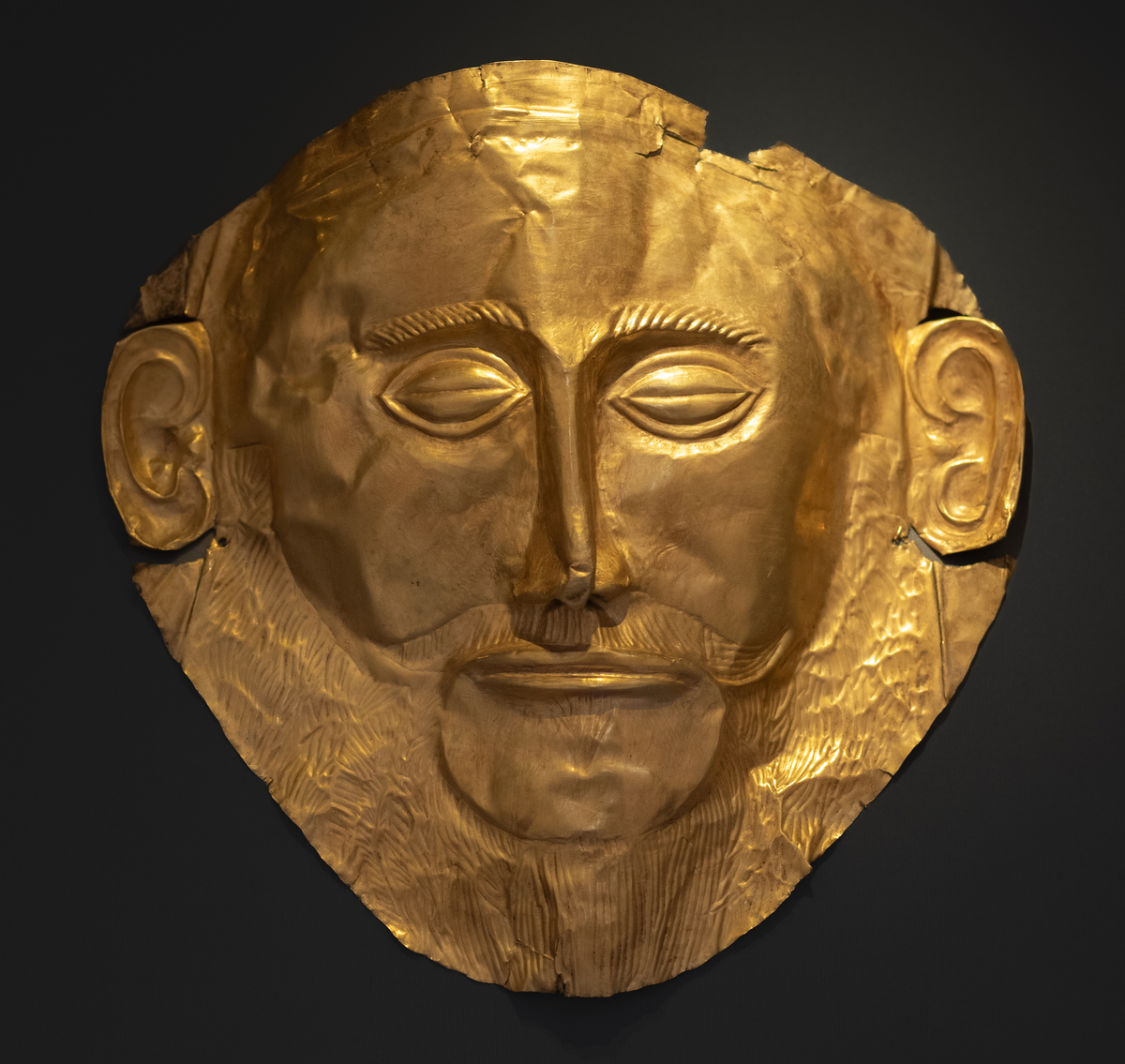
This is a gold death mask from Mycenaean Greece, shaped as a bearded man's face with closed eyes. It was made between about 1550 and 1500 BC, centuries before the Trojan War stories it would later be tied to.
It was found at Mycenae on 30 November 1876, in a Mycenaean tomb. The mask is anonymous; no maker is named, and we know it as a death mask placed over a face.
Look at the eyes. Two almond-shaped lids close over them, sharp at the edges, with finely chased arched eyebrows above. The effect is calm, the stillness we associate with a death mask.
Below, an upturned handlebar moustache sits over a broad beard. The beard is built from dense parallel strokes of chased or punched gold around the chin and jaw, so the hair reads as texture worked into the metal rather than painted on.
Across the forehead and crown, the gold is heavily crinkled and torn along the top edge. Those creases and tears record how the sheet metal was worked, and they also record damage it has taken since.
So the face is not a cast, but a thin sheet shaped and then incised. Its features were pressed and chased into the gold.
The mask is dated between about 1550 and 1500 BC, in the Mycenaean period. It was discovered at Mycenae on 30 November 1876.
That discovery is what attached the name Agamemnon to it. The name is a later association with the Homeric king, not an identification the object itself records.
The mask's calm, closed expression is what does the work here. A death mask does not show a living face; it fixes a face for the tomb. The arched brows, closed lids and worked beard all support that function.
The crinkled, torn top edge complicates the picture. It shows the sheet was shaped by hand and has since suffered, so the object holds both its making and its history in the same gold surface.
What you are looking at is a Mycenaean gold death mask: a bearded face in sheet gold, eyes closed, made around 1550 to 1500 BC and found at Mycenae in 1876.
Its later name links it to Agamemnon, but the mask itself is anonymous. That gap between the object and its famous name is part of what it now means.