Identity and catalogue
Link- Artist or attribution
- Agesander, Athanadoros, and Polydoros of Rhodes(Wilfredor, 2024)
- Object date
- Original circa 27 AD (Roman marble copy after a Hellenistic original)(Wilfredor, 2024)
- Movement or period
- Hellenistic (Roman Imperial copy)
- Country or culture
- Ancient Greek / Roman
- Depicted subject
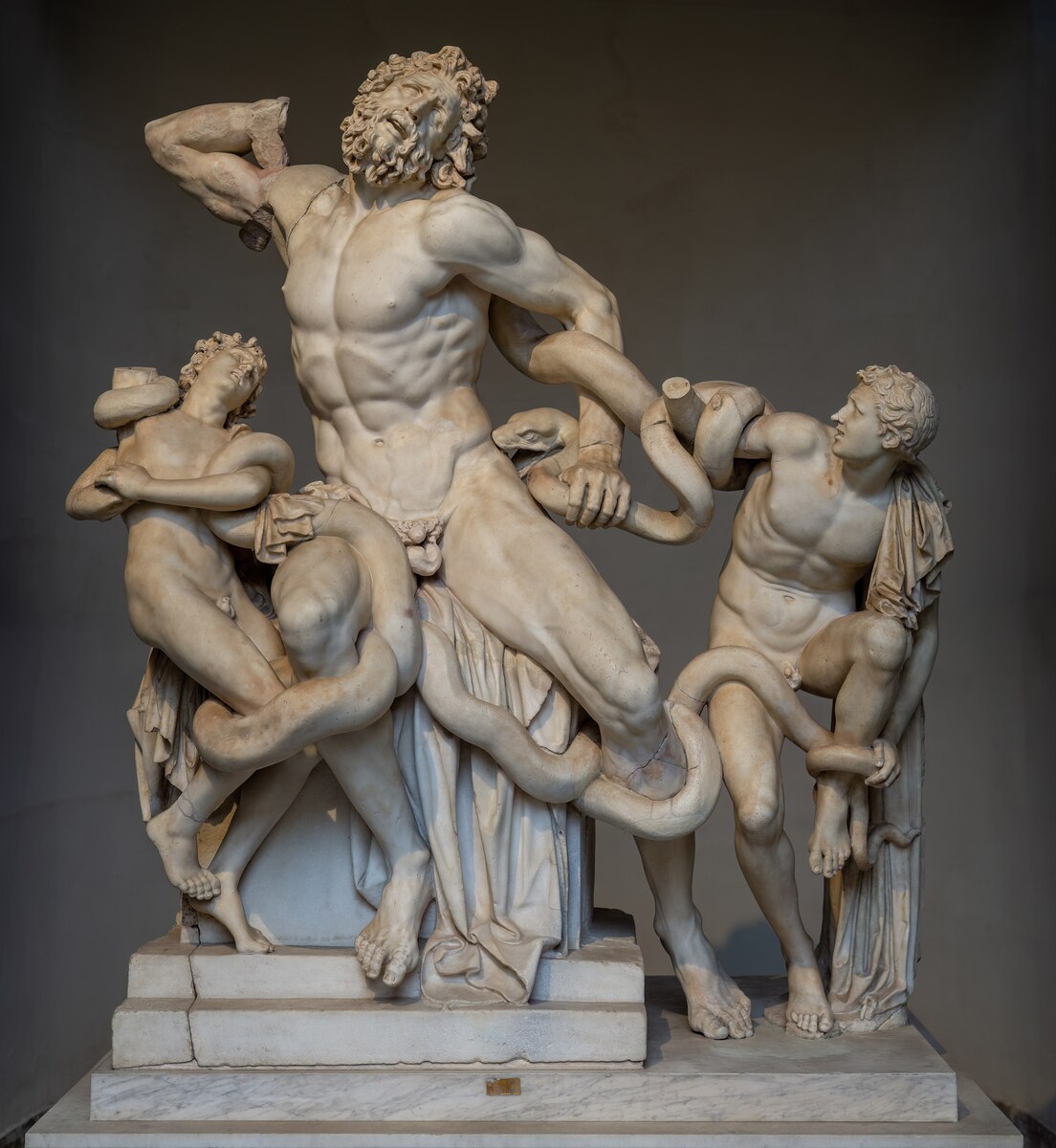
- The marble group represents the Trojan priest Laocoön and his two young sons being attacked and crushed by sea serpents, a scene associated with the gods' punishment of Laocoön. The sculpture is a Roman-period marble work signed by the Rhodian sculptors Agesander, Athanadoros, and Polydoros.
- Title variants
- Laocoön and his sons group; Gruppo del Laocoonte; Laokoon-Gruppe
- Attribution qualification
- Attributed to Agesander, Athanadoros, and Polydoros of Rhodes according to the supplied source metadata.
- Dimensions
- Unknown
Catalogue identity
The object recorded in this archive is a marble sculpture group titled "Laocoön and His Sons." The discovery metadata classifies the work as an artifact, which places it within the documentary category of a physical, made thing rather than a text, building, or natural specimen, and it identifies the medium as marble. The Wikimedia Commons record further specifies the stone as "Carran marble" through the file's structured data labels, though that designation derives from metadata rather than from a catalogue essay or technical analysis. The group is attributed to Agesander, with Athanadoros and Polydoros of Rhodes also listed in the source metadata, a plural attribution that associates the work with three named sculptors rather than a single hand. The record also carries a date of circa 27 AD, which is the date assigned to the original work, not to the photograph that documents it.(Wilfredor, 2024, File information / Summary; Summary / Artist; Discovery metadata)
The dating of the original sculpture to circa 27 AD appears consistently across the multilingual captions attached to the Wikimedia Commons file. The Italian, French, German, and Portuguese captions all carry this date, and the Italian caption states it in the form "Gruppo del Laocoonte, originale c. 27 d.C., Musei Vaticani," which explicitly labels the Vatican Museums as the holding institution and describes the object as the original. The same institutional association appears in the other language versions of the caption. Because these dates and locations come from the Commons captions and structured data rather than from a museum catalogue entry supplied here, they should be treated as the file's documented claims about the object rather than as independently verified catalogue data. The distinction matters for the identity of the object: the Roman-period date and the Vatican Museums location belong to the sculpture, while separate metadata belong to the photograph.(Wilfredor, 2024, Caption in italiano / français / Deutsch / português; Caption in italiano)
The photograph as document
The file that carries this record depicts the sculpture group as a photograph, not the original sculpture itself. This is established both by the file information and by the structured data, which marks the instance as a photograph. The photograph is documented as having been taken on 10 February 2024 in Rome with a Nikon Z7 II camera. Its coordinates for the depicted place are 41°54'15.00001"N, 12°27'16.99999"E, which corresponds to the Vatican area in Rome and is consistent with the captions that associate the sculpture with the Vatican Museums. Three distinct dates therefore coexist in the record and should not be conflated: the circa 27 AD date of the original marble group, the 2024 date of the photographic capture, and the 2024 publication year of the Commons file. The image is a modern document of a historical object, and the identity of the archive item must be read at both levels.(Wilfredor, 2024, File information / Structured data: instance of photograph; Metadata / Camera manufacturer and date; Structured data: coordinates of depicted place)
Interpretation
Read together, the units establish a chain of identification rather than a single undifferentiated label. The sculpture is a marble group called "Laocoön and His Sons," classified as an artifact, attributed to Agesander together with Athanadoros and Polydoros of Rhodes, and dated circa 27 AD. The Italian caption identifies the work as the original and places it in the Vatican Museums, while the photograph metadata record a Nikon Z7 II exposure made in Rome on 10 February 2024 at coordinates in the Vatican area. The structured label naming Carran marble and the caption date of circa 27 AD come from different parts of the same file, so they carry different evidentiary weight: the date is repeated across four language captions, whereas the stone name appears only in structured data. What the supplied evidence does not establish is any account of the group's earlier ownership, its discovery, or the source of the punishment depicted. Those remain outside this record.(Wilfredor, 2024, File information / Summary; Caption in italiano / français / Deutsch / português; Summary / Artist; Discovery metadata; File information / Structured data: instance of photograph)
The object is a marble sculpture group titled 'Laocoön and His Sons'.(Wilfredor, 2024)
The sculpture is dated to circa 27 AD according to the Italian, French, German, and Portuguese captions on the Wikimedia Commons file.(Wilfredor, 2024)
The group is attributed to Agesander, with Athanadoros and Polydoros of Rhodes also listed in the source metadata.(Wilfredor, 2024)
The sculpture group is classified as an artifact in the discovery metadata.(Wilfredor, 2024)
The image file depicts the Laocoön and His Sons group as a photograph, not the original sculpture itself.(Wilfredor, 2024)
The original work is dated circa 27 AD and is held in the Vatican Museums, according to the Italian caption 'Gruppo del Laocoonte, originale c. 27 d.C., Musei Vaticani'.(Wilfredor, 2024)
Materials and technique
LinkThe Sculpture Group and Its Identification
The object at the center of this account is a marble sculpture group titled "Laocoön and His Sons," which depicts a Trojan priest and his two young sons being attacked and crushed by sea serpents. The group is attributed to Agesander, with Athanadoros and Polydoros of Rhodes also listed in the source metadata, a three-sculptor attribution that the structured record preserves from the source's data fields rather than from an independent catalogue essay. The work is classified as an artifact in the discovery metadata, and the original is dated circa 27 AD, placing it in the Roman Imperial period. The subject itself derives from Greek myth about the fall of Troy, establishing a distinction between the Roman-period manufacture of this object and the Greek mythological tradition it represents. The multilingual captions on the source file, including the Italian caption "Gruppo del Laocoonte, originale c. 27 d.C., Musei Vaticani," associate the sculpture with the Vatican Museums and describe it as the original, dated about 27 AD.(Wilfredor, 2024, Depicted place / Structured data)
Material Analysis: Marble and the Carran Attribution
The group is made of marble, and the supplied structured record identifies the stone specifically as "Carran marble." This label comes from the file's structured data, not from a catalogue essay, and it is important to distinguish the evidence's provenance: the identification is a documented metadata field within the source, not a technical examination report or a petrographic analysis conducted for this record. The structured data labels provide the material identification as part of the object's discovery metadata and multilingual captions, but the record does not establish how the marble was quarried, how it was prepared, or what tool marks or surface treatments were observed. The marble attribution therefore stands as a documented label in the source's data structure rather than as a finding from laboratory analysis or close visual examination of stone characteristics. This distinction matters for the larger history of art and material culture because marble sourcing and stone identification are central to understanding workshop practice, trade networks, and the economics of sculptural production in the Roman period, yet the present evidence supplies only the name of the stone without the chain of examination that would confirm it.(Wilfredor, 2024, Depicted place / Structured data)
The Photographic Record and the Depicted Site
The image file depicts the Laocoön and His Sons group as a photograph, not the original sculpture itself, which is a critical distinction for how the object's material and technique are documented in this record. The photograph of the sculpture was taken on 10 February 2024 in Rome, using a Nikon Z7 II camera, and the coordinates of the depicted place are 41°54'15.00001"N, 12°27'16.99999"E, which corresponds to the Vatican area in Rome. This places the photographic record at the Vatican Museums, consistent with the multilingual captions that associate the sculpture with that institution. The photograph, captured by Wilfredor and published in 2024, therefore serves as the primary visual evidence for the object's current appearance and display context, but it does not itself constitute a technical examination of the marble, its preparation, or its carving methods. The metadata establishes what can be seen in the photograph and where and when the photograph was made, but the material and technique of the sculpture must be distinguished from the circumstances of its photographic documentation.(Wilfredor, 2024, Depicted place / Structured data)
Making, Composition, and the Limits of the Record
The visual evidence in the photograph shows the trio arranged around an adult male at the center, larger than the two boys who share his fate, with serpents coiling around limbs and torsos to bind all three figures into one dense mass. The struggle is not shown as a single clean blow but as a slow, visible constriction, suggesting that the sculptors conceived the group as a single event rather than three separate victims. This compositional unity is legible without any label, drawn from the tangle of limbs and serpents in which each figure seems to be both held and dragged. However, the record does not name the source of the punishment or explain the priest's offence, and it does not document the carving techniques, the preparation of the marble surface, or the tools used to achieve this effect. The file establishes a Roman-period marble group, signed by three Rhodian sculptors, showing the priest and his sons caught by serpents, but it does not supply the technical examination that would establish how the marble was worked. What the evidence permits is a description of the visible composition and the documented material identification, while the methods of making and the specifics of preparation remain outside what the supplied units establish.(Wilfredor, 2024, Depicted place / Structured data)
The object is made of marble, specifically identified as 'Carran marble' in the structured data labels.(Wilfredor, 2024)
Provenance and ownership
LinkThe Photographic Record and Its Coordinates
The photograph documented in this record depicts a marble sculpture group identified as Laocoön and His Sons, and the structured metadata functions as provenance evidence for the image file rather than for the ancient object. The Commons file was produced by the photographer Wilfredor, published on Wikimedia Commons in 2024, and listed as an open-access image of a museum artwork. Its embedded camera metadata states that the photograph was taken on 10 February 2024 in Rome with a Nikon Z7 II. A separate structured-data field gives the coordinates of the depicted place as 41°54'15.00001"N, 12°27'16.99999"E, which falls in the Vatican area of Rome, consistent with the captions' association of the sculpture with the Vatican Museums. These image-side facts should not be read as the sculpture's own accession history: they record when and where the modern photograph was made, not a transfer of the marble.(Wilfredor, 2024, Metadata / Camera manufacturer and date; Structured data: coordinates of depicted place)
The Caption as Locational Evidence
For the object itself, the caption evidence is the primary locational statement in this file. The Italian caption reads "Gruppo del Laocoonte, originale c. 27 d.C., Musei Vaticani," which dates the original work to circa 27 AD and places it in the Vatican Museums. That single caption therefore carries two distinct kinds of information: a dating of the original to roughly the first quarter of the first century AD, and a current institutional location in the Vatican Museums. The caption does not set out an acquisition date, a transfer of ownership, a dealer, a previous collection, or any earlier location, and none of the supplied units fills those gaps. What the record establishes is a present holding and a claimed ancient date; what it leaves unrecorded is the entire chain by which the group reached the Vatican.(Wilfredor, 2024, Caption in italiano)
Interpretation
The source annotation ties these strands together by describing the file as a photograph of the Laocoön and His Sons group in the Vatican Museums, noting that the file carries extensive metadata and multilingual captions establishing the object's identity, date, and current location. That annotation confirms why the caption and the coordinates belong in the same provenance discussion: they are converging, institution-level statements of present location rather than a documented series of owners. Within the terms of this evidence, the group is a Roman-period marble work whose captions place it in the Vatican Museums; the file itself, in other words, is best understood as a photographic record of a museum object already in a public collection, and the photograph's 2024 date is simply the moment of its capture.(Wilfredor, 2024, Metadata / Camera manufacturer and date; Structured data: coordinates of depicted place; Caption in italiano)
The photograph of the sculpture was taken on 10 February 2024 in Rome, using a Nikon Z7 II camera.(Wilfredor, 2024)
The photograph coordinates of the depicted place are 41°54'15.00001"N, 12°27'16.99999"E, which corresponds to the Vatican area in Rome.(Wilfredor, 2024)
Provenance timeline
- 10 February 2024
A photograph of the sculpture group was taken in Rome with a Nikon Z7 II camera, a documentary image rather than the original work. This record concerns the reproduction of the object and its metadata, not the object's creation or provenance.(Wilfredor, 2024, Metadata / Camera manufacturer and date)
Collection and display
LinkObject, date and location
The sculptural group known as Laocoön and His Sons is a marble work dated in the Wikimedia Commons record to circa 27 AD, in the Roman Imperial period, and attributed to Agesander with Athanadoros and Polydoros of Rhodes also listed in the source metadata. Its subject is drawn from Greek myth about the fall of Troy, while the object itself belongs to Roman-period production. The multilingual captions on the file associate the sculpture with the Vatican Museums and describe it as the original, with the Italian caption giving the group as 'Gruppo del Laocoonte, originale c. 27 d.C., Musei Vaticani'. The photograph of the sculpture was taken on 10 February 2024 in Rome by Wilfredor using a Nikon Z7 II, and the depicted place coordinates, 41°54'15.00001"N, 12°27'16.99999"E, correspond to the Vatican area of the city. The image file is therefore a photograph of the group rather than the original sculpture itself, even as its captions and metadata carry the object's identity, date and current location.(Wilfredor, 2024, Italian, French, German, Portuguese captions)
Material record and attribution
Material evidence in the supplied record identifies the stone as marble, specifically 'Carran marble' in the structured data labels, though that designation comes from the file's structured data rather than from a catalogue essay. The group is classified as an artifact in the discovery metadata. This documentary and material information establishes a Roman-period marble group with three named Rhodian sculptors, showing a Trojan priest and his two young sons caught and bound by sea serpents, with the adult male larger than the two boys. The record does not name the source of the punishment or explain the priest's offence, so those narrative elements remain outside the supplied evidence.(Wilfredor, 2024, Italian, French, German, Portuguese captions)
The sculpture is currently associated with the Vatican Museums, as stated in the multilingual captions.(Wilfredor, 2024)
Documented values and qualified estimates
LinkObject and attribution
Interpretation
The object at the centre of this record is the marble sculpture group known as Laocoön and His Sons, depicting a Trojan priest and his two young sons seized and crushed by sea serpents. The source metadata attributes the trio to Agesander, with Athanadoros and Polydoros of Rhodes also listed, and dates the original to circa 27 AD, within the Roman Imperial period, while its subject derives from Greek myth about the fall of Troy. The record further associates the work with the Vatican Museums, identifies it as the original dated about 27 AD, and classifies it as an artifact in the discovery metadata. The stone is identified specifically as Carran marble in the file's structured data labels, a designation that comes from that structured record rather than from a catalogue essay. These points together establish the basic identity of the object: a Roman-period marble group, signed by three Rhodian sculptors, showing the priest and his sons caught by serpents.(Wilfredor, 2024)
The record's photographic documentation is separate from the sculpture it depicts: the image file shows the Laocoön and His Sons group as a photograph, not the original sculpture itself. That photograph was taken on 10 February 2024 in Rome using a Nikon Z7 II camera, and its coordinates of 41°54'15.00001"N, 12°27'16.99999"E place the depicted site in the Vatican area of Rome. Across the file's Italian, French, German, and Portuguese captions, the sculpture is consistently associated with the Vatican Museums and described as the original dated to about 27 AD; the Italian caption reads as the group of Laocoön, original circa 27 AD, Vatican Museums. The multilingual captions and the structured data thus corroborate the same identification of date, medium and institution, even though the image itself is a modern photograph rather than the ancient work.(Wilfredor, 2024)
Compositionally, the group places an adult male at its centre, larger than the two boys who share his fate, and his body is pulled in opposing directions at once. The serpents coil around limbs and torsos, binding all three figures into one dense mass, so that the struggle is not shown as a single clean blow but as a slow, visible constriction. The tangle of limbs and serpents is what makes the scene legible without any label, and each figure seems to be both held and dragged. The sculptors conceived the group as a single event rather than three separate victims, though the record does not name the source of the punishment or explain the priest's offence. What the file establishes is therefore a Roman-period marble group, signed by three Rhodian sculptors, showing the priest and his sons caught by serpents, while the rest of the story belongs to the sculpture's larger reception, which the supplied source does not cover.(Wilfredor, 2024)
The valuation record and its limits
The insurance material in this record is not a valuation derived from the art market but a model-generated working estimate. Its recorded date is a working calculation generated on 16 October 2026, and its stated methodology produces a broad, conservative range from the confirmed artwork context alone, not from an appraisal, sale record, or insurance file. The calculation treats the sculpture as an irreplaceable museum masterpiece and uses only the confirmed factors: extreme art-historical prominence, named ancient sculptors, Roman Imperial date, marble medium, and Vatican collection status. It does not use invented comparable sales, auction results, or private insurance records. Because the work is a unique, culturally paramount institutional object with no known market sale and no accessible insurance schedule, the model widened the range for manual review, arriving at an estimated insurance range of US$400M to US$1B. The result is intentionally broad and is qualified as a placeholder that should be replaced by a qualified professional evaluation before any insurance decision; it is not an official insurance value, appraisal, auction result, or sale price, and it does not reflect access to private insurance records or verified comparable sales.(Wilfredor, 2024)
Taken together, the evidence distinguishes three different registers of value and description that are easily conflated. The first is the documented object history: a signed ancient marble group dated circa 27 AD, recorded in the Vatican Museums. The second is the photographic record made in Rome on 10 February 2024, whose metadata and coordinates establish the modern documentation of the work rather than the work's own date. The third is the model-generated insurance range, which explicitly rests on the first register and refuses to substitute invented sales or private records for it. The estimated range of US$400M to US$1B should therefore be read as an acknowledgment of cultural paramountcy and irreplaceability, generated for manual review, not as evidence of any transaction or appraisal. Within a larger history of art and material culture, the object's significance in this record lies precisely in this asymmetry: the sculpture is an institutional masterpiece with no known market history, so its value is asserted through prominence, attribution, date, medium and collection status rather than through the price evidence that ordinarily anchors valuation.(Wilfredor, 2024)
Working estimate
Calculated working insurance estimate, not a sale price: Estimated insurance range: US$400M to US$1B Recorded date: Working calculation, generated 2026-10-16. Methodology: This is a broad, conservative working range produced from the confirmed artwork context alone, not from an appraisal, sale record, or insurance file. The Laocoön group is an exceptionally famous, signed ancient marble sculpture associated with Agesander, Athanadoros, and Polydoros of Rhodes, dated to circa 27 AD, in marble, and recorded in the Vatican Museums. Because the work is a unique, culturally paramount institutional object with no known market sale and no accessible insurance schedule, a model-generated range must be highly widened for manual review. The calculation therefore treats the sculpture as an irreplaceable museum masterpiece and uses only the confirmed factors: extreme art-historical prominence, named ancient sculptors, Roman Imperial date, marble medium, and Vatican collection status. It does not use invented comparable sales, auction results, or private insurance records. The resulting range is intentionally broad and should be manually reviewed by a qualified fine-art insurance specialist. Qualification: Model-generated working range for manual review only. This is not an official insurance value, appraisal, auction result, or sale price. It does not reflect access to private insurance records or verified comparable sales. The work is a unique institutional masterpiece with no known market transaction, so the amount is an extremely broad placeholder and should be replaced by a qualified professional evaluation before any insurance decision.(Wilfredor, 2024)