Identity and catalogue
Link- Title
- L'Angélus (The Angelus)
- Artist or attribution
- Jean-François Millet
- Object date
- between 1857 and 1859
- Dimensions
- H. 55.5 cm; W. 66 cm
- Current collection or location
- Musée d'Orsay, Paris, France
- Movement or period
- Realism / Naturalism
- Country or culture
- France
- Depicted subject
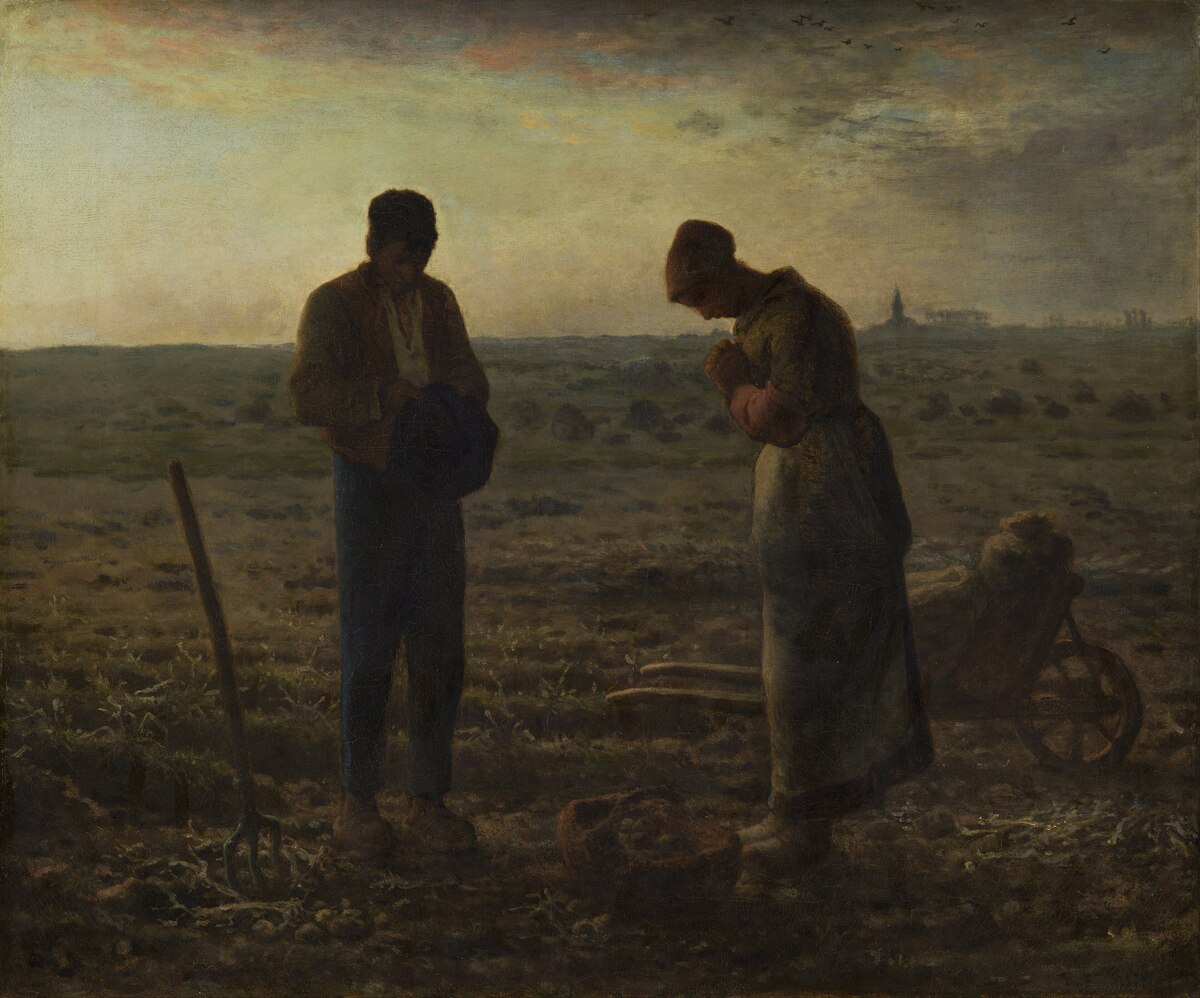
- A man and a woman have stopped digging potatoes in a vast, empty plain to recite the Angelus, a prayer commemorating the Annunciation of the angel Gabriel to Mary. Their farm tools lie around them.
- Title variants
- L'Angélus; The Angelus; El Ángelus; Das Angelusgebet; L'Àngelus; Het angelus
- Support
- canvas
Catalogue identity
The Musée d'Orsay records the work under the title L'Angélus, with the accession number RF 1877, an identifier also carried in the institutional record maintained for a reproduction of the painting. Both the English and French versions of the museum's object entry supply the same object data, so the catalogue identity rests on a single institutional source published in two languages rather than on two independent catalogues.(Musée d'Orsay, n.d.b, Accession number)(Musée d'Orsay, n.d.a)(Wikimedia Commons contributors, n.d.)
The subject the museum records for the canvas is a man and a woman reciting the Angelus, the prayer that commemorates the annunciation made to Mary by the angel Gabriel. Because the entry describes the scene through a devotional act performed by two unnamed peasants, the catalogue identity of the picture is inseparable from the prayer rather than from any identified sitters or a narrative episode.(Musée d'Orsay, n.d.b, Resume)(Musée d'Orsay, n.d.a)
Subject and iconography
LinkComposition and figure treatment
Visual observation
The couple have stopped digging potatoes, and every tool belonging to that labour has been left where it fell: the potato fork, the basket, the sacks and the wheelbarrow are strewn around the two figures rather than tidied away. This dispersal establishes the pause as abrupt and unposed, since the equipment normally held or pushed during work remains distributed across the ground near the couple. The Musée d'Orsay's curatorial account treats this as a short break, a moment of respite that Millet focused on in order to catch the immutable rhythms of peasant life in a simple scene. Alone in the foreground of a huge empty plain, the two peasants take on a monumental quality despite the small size of the canvas, and their faces are left in shadow while the light underlines their gestures and posture. The same curatorial reading holds that the canvas expresses a deep feeling of meditation and that Millet goes beyond the anecdote to the archetype.(Musée d'Orsay, n.d.b, Resume)(Musée d'Orsay, n.d.a)
Interpretation
The visible field is not exhausted by the two bodies. The foreground placement of the couple against an expansive empty plain, the shadowed faces and the lighting of gesture and posture together concentrate attention on the act performed rather than on individual features, an effect the museum's account describes in those terms and connects to the monumental impression produced by figures in a canvas measuring only 55.5 cm by 66 cm. Beyond the description itself, the relationship between small scale and monumental impression is a matter of how the picture is read, not a measurement: the evidence establishes the dimensions and the curatorial characterisation, and the two stand together as the museum's interpretation of the work's effect.(Musée d'Orsay, n.d.b, Resume; Object details)(Musée d'Orsay, n.d.a)
Inscription and attribution
Visual observation
The inscription is signed lower right: J.F. Millet. The signature therefore sits at the lower right of the composition, on the same canvas whose subject the museum record describes and whose dimensions it gives as oil on canvas, H. 55.5 cm; W. 66 cm. The signature is the only element of the object cited in the supplied evidence that names the author directly; the attribution of the subject and of the painting's meaning in the museum record is institutional commentary rather than a statement carried by the inscription itself.(Musée d'Orsay, n.d.b, Object details)(Musée d'Orsay, n.d.a)
Alone in the foreground in a huge empty plain, the two peasants take on a monumental quality, despite the small size of the canvas. Their faces are left in shadow, while the light underlines their gestures and posture.(Musée d'Orsay, n.d.b)(Musée d'Orsay, n.d.a)
Materials and technique
LinkDocumented support, format and signature
Visual observation
The Musée d'Orsay records L'Angélus as an oil painting on canvas, measuring 55.5 cm in height and 66 cm in width, and signed lower right with the inscription J.F. Millet. This much is documented in the museum's object details, and it frames every other question about the picture's making: the support is a fabric canvas prepared to receive oil paint, the signature is placed at the lower right of the composition, and the format is modest in scale, closer to an easel picture than to a large exhibition machine. The museum's English and French object records give the same medium, dimensions and signature, so these are not competing accounts but a single institutional description repeated across two language versions. Nothing in the supplied evidence describes the canvas weave, the ground layer, the priming, the varnish or any pigment, and no technical analysis, radiograph, cross-section or restoration report is cited. Any account of how the paint was actually built up, in what order, or with which materials beyond oil on canvas, would therefore go beyond what the evidence establishes. What can be said is that the picture is a small oil on canvas bearing the artist's signature, and that the museum presents it within that documented frame rather than through a published technical study.(Musée d'Orsay, n.d.b, Object details)(Musée d'Orsay, n.d.a)
Subject, reported memory and the museum's reading
The museum's account of the subject places the scene at the moment of the Angelus, a prayer commemorating the annunciation made to Mary by the angel Gabriel, and it connects the choice of that moment to Millet's own reported recollection. In 1865 Millet said that the idea for The Angelus came to him because he remembered his grandmother, hearing the church bell ringing while the family worked in the fields, always making them stop work to say the Angelus prayer for the poor departed. This is a statement attributed to the artist and reported by the museum; it is a remembered childhood episode offered as the origin of the idea, not a description of how the picture was made. The museum goes further and states that it was a childhood memory behind the painting rather than a desire to glorify religious feeling, adding that Millet was not a church-goer. It also describes Millet's aim as catching the immutable rhythms of peasant life in a simple scene, focused here on a short break, a moment of respite, and reads the canvas as expressing a deep feeling of meditation in which Millet goes beyond the anecdote to the archetype. These are the museum's interpretations, and they should be kept as such. They do not supply pigments, supports, preparatory drawings, studio procedures or date of execution beyond the command of the work, and the origin story they preserve is the artist's reported memory, not a documented account of technique.(Musée d'Orsay, n.d.b, Object details)(Musée d'Orsay, n.d.a)
Provenance, exhibition and damage
The object record supplies a documentary frame that bears on how the painting has been handled and seen over time, and some of that history has material consequences. It was commanded by Thomas Gold Appleton around 1857, but Appleton did not take delivery of it. It was exhibited at the Exposition Universelle at the Champ-de-Mars in Paris in 1867, number 480, and again at the Exposition Universelle at the Champ-de-Mars in 1889, hors catalogue, and the museum notes it has been shown in numerous exhibitions worldwide. Its later movements are recorded in money and custody: Paul Durand-Ruel bought it from Gavet for 30,000 francs on 3 February 1872, and Gauchez bought it from Durand-Ruel for 38,000 francs on 8 July 1872; it was in the collection of the American Art Association in 1889 to 1890, acquired at the Secrétan sale in Paris on 1 July; from 1890 to 1909 it belonged to Alfred Chauchard, acquired from the American Art Association; it was acquired by the State in 1910 as a bequest of Chauchard, assigned to the Musée du Louvre, Paris, from 1909 to 1986, and in 1986 assigned to the Musée d'Orsay, Paris, where it carries accession number RF 1877 and is on display in Room 5 on the ground floor. The same record states that in 1889, when the Louvre tried to buy it, the painting triggered an unbelievable rush of patriotic fervour, that Salvador Dalí venerated it, and that in 1932 a madman lacerated the canvas. The laceration is the one event in this history with a direct bearing on the physical object. The evidence records that the canvas was damaged in 1932 but does not describe the extent of the damage, any subsequent treatment, lining, retouching or conservation intervention, and none should be assumed. The rest of this record concerns ownership, valuation and reception, and it belongs to the object's cultural history rather than to its making.(Musée d'Orsay, n.d.b, Object details)(Musée d'Orsay, n.d.a)
What the evidence establishes and what it leaves open
Interpretation
Taken together, the evidence supports a limited but precise set of claims about materials and technique and leaves a large remainder unaddressed. The work is oil on canvas, 55.5 by 66 cm, signed lower right J.F. Millet, and it depicts a scene organised around tools left in a field, a shadowed pair of faces and light given to gesture and posture, at the devotional pause commemorated as the Angelus. The museum attributes the conception to a childhood memory Millet reported in 1865 of his grandmother stopping the family's field work at the sound of the church bell, and the museum reads the picture as a meditation on the immutable rhythms of peasant life that moves beyond anecdote toward archetype, while noting the artist was not a church-goer. Because no technical examination is supplied, the picture's material history remains, on this evidence, a surface description: a canvas support, an oil medium, a signature, documented dimensions, a documented 1932 laceration, and a display location. Within a larger history of materials and making, the object is significant precisely in this respect, that its documented record is strong on provenance, price, exhibition and reception and silent on ground, pigment, layer structure and treatment, so the famous image rests on a thin published technical base. The interpretive weight the picture carries in later culture, its veneration and its status as an icon, is established by the same museum record, but it should not be transferred back into claims about how the paint was laid down. Filling that gap would require evidence this archive does not yet hold.(Musée d'Orsay, n.d.b, Object details; Resume)(Musée d'Orsay, n.d.a)
Provenance and ownership
LinkDocumented Owners and Transfers
The documented record for this painting begins before its public life, when the work was commanded by Thomas Gold Appleton around 1857, an arrangement the museum account reports without indicating that the commission was ever completed by delivery: Appleton did not take delivery of it. That unfulfilled commission marks the first known point of contact between the canvas and a prospective owner, and it is also the earliest event in the chain, preceding the Paris exhibition record of 1867. Because the museum record states only that he did not take delivery, the object's whereabouts between the commission and the later documented transactions are simply not supplied; nothing in the evidence establishes who held the painting in that interval, and no change of ownership should be inferred from the commission alone.(Musée d'Orsay, n.d.b, Other; Exhibitions)(Musée d'Orsay, n.d.a)
A sequence of dated, priced transactions is recorded for the early 1870s. On 3 February 1872 the work was bought by Paul Durand-Ruel from Gavet for 30,000 francs, and on 8 July 1872 it was bought by Gauchez from Paul Durand-Ruel for 38,000 francs. These two entries are unusual for the precision they carry: buyer, seller, date and price are all specified, so they document transfers rather than merely placing the picture in a collection. The rise from 30,000 to 38,000 francs within roughly five months is a matter of record in the source, and the sums can be cited as prices realised at these two sales without extending them into a general claim about the painting's market standing. As with the Appleton commission, the evidence does not describe what happened to the work between these transactions and the next documented phase.(Musée d'Orsay, n.d.b, History - Provenance)(Musée d'Orsay, n.d.a)
Sale, Collection and Public Response, 1889 to 1909
The picture appears next in the collection of the American Art Association in 1889 and 1890, having been acquired at the Secrétan sale in Paris on 1 July. From 1890 to 1909 it was in the collection of Alfred Chauchard, who acquired it from the American Art Association. The same years in which the painting entered the American Art Association's collection coincide with its showing at the Exposition Universelle in Paris in 1889, hors catalogue, where it was displayed outside the official catalogue listings. The source reports that the Louvre's attempt to buy the work in 1889 triggered an unbelievable rush of patriotic fervour, a public response that belongs to the same period as the Secrétan sale and the American Art Association holding, but the evidence does not state that the fervour and the sale were causally connected, and that connection should not be assumed from their proximity in time.(Musée d'Orsay, n.d.b, History - Provenance; Exhibitions; Resume)(Musée d'Orsay, n.d.a)
Ownership passed to the State in 1910 as a bequest of Alfred Chauchard, and the work was assigned to the Musée du Louvre, Paris, from 1909 to 1986; in 1986 it was assigned to the Musée d'Orsay, Paris. The bequest year and the opening year of the Louvre assignment are not identical in the record, with the assignment dated from 1909 and the acquisition by the State dated 1910, and the evidence does not resolve that difference. The museum's account therefore distinguishes a bequest to the State from an institutional assignment, then records a later reassignment of the same object in 1986. The work is identified by the accession number RF 1877 and is on display in Room 5 on the ground floor of the Musée d'Orsay. The accession number and the room location are the identifiers that tie the provenance narrative to the physical object as it is administered today, while the successive institutional assignments show that a stable national holding can still involve changes in which museum is responsible for the work.(Musée d'Orsay, n.d.b, History - Provenance)(Musée d'Orsay, n.d.a)
Interpretation
The provenance record matters for how the object is understood, not only for where it has been. The museum's own account treats the painting as a world-famous icon in the twentieth century, venerated by Salvador Dalí and lacerated by a madman in 1932, and this later reception sits at the far end of a chain that begins with an unfulfilled commission and passes through priced private transactions, a public sale, a bequest and two institutional assignments. In this way the documented movements of the canvas and the claims made about its cultural status are recorded side by side in the same source, and the difference between them is worth keeping: the ownership sequence rests on dates, buyers, sellers, prices, an accession number and a collection location, whereas the language of patriotic fervour and world fame is the museum's characterisation of the work's reception. The evidence supports describing both, but it establishes the transfers in a way it does not establish the epithets.(Musée d'Orsay, n.d.b, Other; History - Provenance; Resume)(Musée d'Orsay, n.d.a)
The painting was acquired by the State in 1910 as a bequest of Alfred Chauchard, and assigned to the Musée du Louvre, Paris, from 1909 to 1986; in 1986 it was assigned to the Musée d'Orsay, Paris.(Musée d'Orsay, n.d.b)(Musée d'Orsay, n.d.a)
The work was in the collection of the American Art Association in 1889-1890, acquired at the Secrétan sale in Paris on 1 July; from 1890 to 1909 it was in the collection of Alfred Chauchard, acquired from the American Art Association.(Musée d'Orsay, n.d.b)(Musée d'Orsay, n.d.a)
Provenance timeline
- around 1857
The work was commissioned by Thomas Gold Appleton, who did not take delivery of it.(Musée d'Orsay, n.d.b, Other)(Musée d'Orsay, n.d.a)
- 1867
The painting was exhibited at the Exposition Universelle, Champ-de-Mars, Paris, no. 480.(Musée d'Orsay, n.d.b, Exhibitions)(Musée d'Orsay, n.d.a)
- 3 February 1872
It was bought by Paul Durand-Ruel from Gavet for 30,000 francs.(Musée d'Orsay, n.d.b, History - Provenance)(Musée d'Orsay, n.d.a)
- 8 July 1872
It was bought by Gauchez from Paul Durand-Ruel for 38,000 francs.(Musée d'Orsay, n.d.b, History - Provenance)(Musée d'Orsay, n.d.a)
- 1 July 1889
It was acquired at the Secrétan sale in Paris.(Musée d'Orsay, n.d.b, History - Provenance)(Musée d'Orsay, n.d.a)
- 1889
The painting was exhibited at the Exposition Universelle, Champ-de-Mars, Paris, hors catalogue, and its attempted purchase by the Louvre triggered a rush of patriotic fervour.(Musée d'Orsay, n.d.b, Exhibitions)(Musée d'Orsay, n.d.a)
- 1889-1890
The work was in the collection of the American Art Association.(Musée d'Orsay, n.d.b, History - Provenance)(Musée d'Orsay, n.d.a)
- 1890 to 1909
It was in the collection of Alfred Chauchard, acquired from the American Art Association.(Musée d'Orsay, n.d.b, History - Provenance)(Musée d'Orsay, n.d.a)
- from 1909 to 1986
The painting was assigned to the Musée du Louvre, Paris.(Musée d'Orsay, n.d.b, History - Provenance)(Musée d'Orsay, n.d.a)
- 1910
The painting was acquired by the State as a bequest of Alfred Chauchard.(Musée d'Orsay, n.d.b, History - Provenance)(Musée d'Orsay, n.d.a)
- 1986
It was assigned to the Musée d'Orsay, Paris.(Musée d'Orsay, n.d.b, History - Provenance)(Musée d'Orsay, n.d.a)
Documented Exhibition History
The exhibition record for this painting, as given by the Musée d'Orsay object documentation, begins with the Exposition Universelle held at the Champ-de-Mars in Paris in 1867, where the work was shown as no. 480. The same documentation records a second Parisian showing at the Exposition Universelle, Champ-de-Mars, Paris, 1889, this time hors catalogue, meaning it appeared outside the numbered catalogue listing. Beyond these two documented appearances the museum states that the work has been shown in numerous exhibitions worldwide, a general and unenumerated claim that indicates a long and widely distributed display history without specifying individual venues, dates or catalogue numbers. This 1867 presentation is the earliest exhibition information supplied by the evidence, and it precedes the 1872 transactions through which Paul Durand-Ruel bought the painting from Gavet for 30,000 francs on 3 February 1872 and Gauchez acquired it from Durand-Ruel for 38,000 francs on 8 July 1872.(Musée d'Orsay, n.d.b, Exhibitions; History - Provenance)(Musée d'Orsay, n.d.a)
Display and the Limits of the Record
The evidence distinguishes carefully between an object's historical exhibition record, its current display, and the limits of the catalogue entry itself. The Musée d'Orsay documentation gives the work the accession number RF 1877 and states that it is on display in Room 5 on the ground floor of the Musée d'Orsay, a current installation detail that is separate from the historical 1867 and 1889 Paris showings and separate again from the general statement about numerous exhibitions worldwide. The same documentation supplies the physical description of the work as oil on canvas, H. 55.5 cm; W. 66 cm, signed lower right: J.F. Millet, and records that Millet painted the scene after a childhood memory of his grandmother making the family stop work in the fields to say the Angelus prayer when the church bell rang. The 1865 statement attributed to Millet, in which he recalled that his grandmother, hearing the church bell ringing while the family worked in the fields, always made them stop work to say the Angelus prayer for the poor departed, is presented by the museum alongside the caution that this is a reported childhood memory behind the painting and not a desire to glorify religious feeling, noting that Millet was not a church-goer.(Musée d'Orsay, n.d.b, Exhibitions; Other)(Musée d'Orsay, n.d.a)
Reading the exhibition record against the object's documented form and subject clarifies what was being shown on those occasions. The scene depicts a man and a woman reciting the Angelus, a prayer which commemorates the annunciation made to Mary by the angel Gabriel; the couple have stopped digging potatoes, and the tools used for that task, the potato fork, the basket, the sacks and the wheelbarrow, are strewn around them. Alone in the foreground of a huge empty plain, the two peasants take on a monumental quality despite the small size of the canvas, while their faces are left in shadow and the light underlines their gestures and posture. The museum's reading is that Millet wanted to catch the immutable rhythms of peasant life in a simple scene, focusing on a short break, a moment of respite, and that the canvas expresses a deep feeling of meditation in which Millet goes beyond the anecdote to the archetype. These are attributed curatorial interpretations rather than documented facts about the painting's making or its reception, and they matter for exhibition history because they indicate what the two Paris showings were presenting to their publics: a small-scale, shadow-faced image of agricultural labour interrupted by prayer, understood by the museum as archetypal rather than anecdotal.(Musée d'Orsay, n.d.b, Exhibitions; Resume)(Musée d'Orsay, n.d.a)
Interpretation
Taken together, the supplied units support a research account in which a painting commissioned around 1857 by Thomas Gold Appleton and not delivered, later passing through the hands of the American Art Association in 1889 to 1890 and Alfred Chauchard from 1890 to 1909, then bequeathed to the State in 1910 and assigned to the Louvre from 1909 to 1986 before transfer to the Musée d'Orsay in 1986, was exhibited at the Paris Expositions Universelles of 1867 as no. 480 and 1889 hors catalogue and has since been shown in numerous exhibitions worldwide. The exhibition evidence is thin in the specific sense that only the 1867 and 1889 Paris events are named with dates and catalogue status, while the remainder of the display history is generalized; the reception evidence is similarly spare but does document the 1889 acquisition attempt, the admiration of Salvador Dali, the 1932 laceration and the work's 20th-century iconic status. The account therefore supports the conclusion that this object's exhibition history cannot be fully reconstructed from the supplied evidence, and that the documented Paris appearances and the unenumerated later showings stand in an unequal relation to what the record actually establishes.(Musée d'Orsay, n.d.b, Exhibitions; Other; History - Provenance; Resume)(Musée d'Orsay, n.d.a)
The painting was exhibited at the Exposition Universelle, Champ-de-Mars, Paris, 1867, no. 480, and at the Exposition Universelle, Champ-de-Mars, Paris, 1889, hors catalogue, and has been shown in numerous exhibitions worldwide.(Musée d'Orsay, n.d.b)(Musée d'Orsay, n.d.a)
Reception and literature
LinkThe Museum Record as a Source for Reception
Interpretation
The Musée d'Orsay's object record is the evidentiary spine of this painting's reception history, and it is important to state at the outset what kind of document it is: a museum catalogue entry, published in English and French versions, that combines documented provenance and exhibition data with curatorial commentary. Its own account of the work's afterlife is compressed into a single résumé sentence, and that sentence carries the whole narrative of fame: the painting triggered what the museum calls an unbelievable rush of patriotic fervour when the Louvre tried to buy it in 1889, was venerated by Salvador Dalí, was lacerated by a madman in 1932, and became a world-famous icon in the twentieth century. Because the museum is the institution that now holds the work, its formulations about reception are attributed institutional interpretation as much as neutral record, and they should be weighed as such.(Musée d'Orsay, n.d.b, Resume)(Musée d'Orsay, n.d.a)
Documented Reception and Exhibition History
The 1889 moment is often treated as the origin of the painting's fame, but the evidence places it inside a longer sequence. The museum states that the rush of patriotic fervour was triggered when the Louvre tried to buy the work that year. The same year the painting passed through the collection of the American Art Association in 1889 to 1890, having been acquired at the Secrétan sale in Paris on 1 July 1889; from 1890 to 1909 it belonged to Alfred Chauchard, who acquired it from the American Art Association. The attempted Louvre purchase and the auction sale are thus near-contemporaneous events, and the patriotic agitation the museum describes belongs to the same moment as a major market transaction, which then placed the work in Chauchard's hands for nearly two decades.(Musée d'Orsay, n.d.b, Resume; History - Provenance)(Musée d'Orsay, n.d.a)
Twentieth-Century Celebrity and Its Limits
Interpretation
The museum's account of reception runs together several different orders of event, and the evidence allows them to be distinguished. Veneration by Salvador Dalí is a documented claim about an artist's response; the laceration of the canvas by a madman in 1932 is a documented act of damage; the description of the work as a world-famous icon in the twentieth century is an assessment of its cultural standing. The museum presents these as a sequence, but the evidence does not establish that the attack caused the iconicity, nor that Dalí's veneration and the attack belong to a single continuous process. What can be said is that by the twentieth century the painting had become a world-famous icon, and that this standing coexisted with, rather than simply resulting from, the events the record lists.(Musée d'Orsay, n.d.b, Resume)(Musée d'Orsay, n.d.a)
The Scene the Reception Descends From
The museum's interpretation of the subject is explicitly qualified. It reports that the work shows a man and a woman reciting the Angelus, a prayer commemorating the annunciation made to Mary by the angel Gabriel. Millet's own account, dated in the record to 1865, is that the idea came from remembering his grandmother, who on hearing the church bell while the family worked in the fields always made them stop to say the Angelus prayer for the poor departed. The museum states that a childhood memory, not a desire to glorify religious feeling, lay behind the painting, and notes that Millet was not a church-goer. Millet wanted to catch the immutable rhythms of peasant life in a simple scene, focusing on a short break, a moment of respite. The museum's reading is thus an attributed institutional interpretation, and Millet's statement is reported memory rather than a direct account of the painting's making.(Musée d'Orsay, n.d.b, Resume)(Musée d'Orsay, n.d.a)
The painting triggered an unbelievable rush of patriotic fervour when the Louvre tried to buy it in 1889, was venerated by Salvador Dali, lacerated by a madman in 1932 and became a world-famous icon in the 20th century.(Musée d'Orsay, n.d.b)(Musée d'Orsay, n.d.a)
Interpretations and debates
LinkReported traditions and disputed accounts
Reported tradition
The Musée d'Orsay presents L'Angélus as a childhood memory rather than a desire to glorify religious feeling, and the same account notes that Millet was not a church-goer. On this reading Millet wanted to catch the immutable rhythms of peasant life in a simple scene, focusing on a short break, a moment of respite from labour. The museum describes the canvas as expressing a deep feeling of meditation, with Millet going beyond the anecdote to the archetype. These curatorial claims are important because they frame how the reported origin should be weighed: the recollection of the grandmother's bell and prayer is presented as the seed of the idea, while the painting's ambition is characterised as the durable rhythm of peasant life rather than devotional propaganda. The qualification that Millet was not a church-goer is the museum's, and it stands alongside, rather than cancels, the artist's own 1865 statement about the prayer his grandmother required the family to say for the poor departed.(Musée d'Orsay, n.d.b, Resume)(Musée d'Orsay, n.d.a)
In 1865, Millet said that the idea for The Angelus came to him because he remembered that his grandmother, hearing the church bell ringing while the family was working in the fields, always made them stop work to say the Angelus prayer for the poor departed. The Musée d'Orsay restates this as Millet having painted the scene after a childhood memory of his grandmother making the family stop work in the fields to say the Angelus prayer when the church bell rang. Both formulations agree on the essential elements: the grandmother, the bell, the interruption of field labour, and the prayer for the poor departed. This is a reported account of the artist's own recollection, given by Millet himself, not a direct record of the painting's making, and the museum does not present the work as the record of a particular event. What the evidence does not establish is how literally the remembered incident corresponds to anything Millet painted; the memory is offered as the origin of the idea, and the museum treats it as the background to the picture rather than as documentation of a specific occasion.(Musée d'Orsay, n.d.b, Resume)(Musée d'Orsay, n.d.a)
The museum's attributed reading
Interpretation
The Musée d'Orsay's commentary on L'Angélus attributes a specific interpretation to the work: that a childhood memory, rather than a desire to glorify religious feeling, lies behind the painting. The museum reinforces that attribution by noting that Millet was not a church-goer, which it offers as grounds for reading the image outside a devotional programme. This is the institution's reading of the evidence it holds; it is distinct from any claim about Millet's private intention at the moment of painting, and the record does not supply such a first-person statement. What the museum's account does establish is a difference of emphasis: the subject is the Angelus prayer, but the museum asks viewers to understand the picture through memory and habit rather than through religious advocacy.(Musée d'Orsay, n.d.b, Resume)(Musée d'Orsay, n.d.a)
Within that same commentary, the museum describes what Millet sought to capture: the immutable rhythms of peasant life, distilled into a simple scene, with attention focused on a short break and a moment of respite. The claim is about what the artist wanted, as the museum frames it, and it is not a quotation from Millet. It matters because it links the picture's subject to a larger programme in peasant painting, in which recurring labour and its pauses, rather than singular events, carry meaning. The tools and the posture of the figures are the visual means by which that recurring rhythm is made legible; the stopped work is the point, not an interruption of it.(Musée d'Orsay, n.d.b, Resume)(Musée d'Orsay, n.d.a)
The museum's third strand of interpretation holds that the canvas expresses a deep feeling of meditation and that Millet goes beyond the anecdote to the archetype. Read together with the museum's statement about childhood memory and its account of immutable peasant rhythms, this produces a coherent institutional reading: the specific occasion of prayer is subordinated to a general type of peasant experience. The word archetype is the museum's, and it is an evaluative judgement about the painting's reach rather than a documented fact about its making. Still, it explains why the figures can be read as monumental despite their small scale, a point the visual evidence develops directly.(Musée d'Orsay, n.d.b, Resume)(Musée d'Orsay, n.d.a)
Reception as separate evidence
The surviving interpretive evidence for L'Angélus is essentially one institution's account, repeated across the museum's English and French records, so the account here should not be treated as a survey of competing scholarly positions. The museum distinguishes memory from religious glorification, frames the subject as the immutable rhythms of peasant life, and characterizes the result as meditation pushed beyond anecdote toward archetype. Each of those claims is attributed and none is documented as the artist's own explanation in the supplied evidence. The visual observations, the tools left where they fell, the shadowed faces, the illuminated gestures, the monumental figures on an empty plain, are consistent with that reading and give it basis in the object, but they do not close the question of what Millet privately intended. The later patriotic fervour, Dalí's veneration, the 1932 laceration and the painting's 20th-century iconic status belong to reception history and should not be folded back into the interpretation of the scene's origin.(Musée d'Orsay, n.d.b, Resume)(Musée d'Orsay, n.d.a)
Reported tradition
In 1865, Millet said: 'The idea for The Angelus came to me because I remembered that my grandmother, hearing the church bell ringing while we were working in the fields, always made us stop work to say the Angelus prayer for the poor departed'.(Musée d'Orsay, n.d.b)(Musée d'Orsay, n.d.a)
Collection and display
LinkThe object and its documentation
The Musée d'Orsay records that L'Angélus is oil on canvas, measuring 55.5 cm in height and 66 cm in width, and that the inscription is signed lower right: J.F. Millet. The work was commanded by Thomas Gold Appleton around 1857, but Appleton did not take delivery of it. That commission and its failure establish the picture's starting point in a private transaction rather than in an institutional or religious programme; the museum's record carries the accession number RF 1877. Because the object is small but widely reproduced, the physical facts of medium, dimensions and signature are the stable ground against which every later account of its display, price and fame has to be measured.(Musée d'Orsay, n.d.b, Rez-de-chaussée, Salle 5)(Musée d'Orsay, n.d.a)
The Musée d'Orsay states that the man and woman are reciting the Angelus, a prayer which commemorates the annunciation made to Mary by the angel Gabriel. The couple have stopped digging potatoes, and all the tools used for that task, the potato fork, the basket, the sacks and the wheelbarrow, are strewn around them. The museum reads the scene as a short break, a moment of respite within the work, and says Millet wanted to catch the immutable rhythms of peasant life in a simple scene. Formally, the museum notes, the two peasants stand alone in the foreground of a huge empty plain and take on a monumental quality despite the small size of the canvas; their faces are left in shadow while the light underlines their gestures and posture. On the museum's account the canvas expresses a deep feeling of meditation and Millet goes beyond the anecdote to the archetype. These are attributed curatorial readings of a depicted action, not records of a specific event that the picture documents.(Musée d'Orsay, n.d.b, Rez-de-chaussée, Salle 5)(Musée d'Orsay, n.d.a)
The Musée d'Orsay reports that in 1865 Millet said the idea for The Angelus came to him because he remembered that his grandmother, hearing the church bell ringing while the family was working in the fields, always made them stop work to say the Angelus prayer for the poor departed. The museum states that it was this childhood memory, and not the desire to glorify some religious feeling, that stood behind the painting, adding that Millet was not a church-goer. This is a reported artist's recollection, recorded years after the commission of around 1857, and the same museum is the source of both the quotation and the interpretation drawn from it; the museum does not present the painting as the record of a particular event. Keeping the attribution intact matters, because the memory is the link the museum draws between the artist's biography and the scene's meaning.(Musée d'Orsay, n.d.b, Rez-de-chaussée, Salle 5)(Musée d'Orsay, n.d.a)
Provenance, prices and public acquisition
The provenance recorded by the Musée d'Orsay traces the painting through a sequence of named transactions and prices. Paul Durand-Ruel bought it from Gavet for 30,000 francs on 3 February 1872, and Gauchez bought it from Paul Durand-Ruel for 38,000 francs on 8 July 1872, a resale at a higher figure within months. The work was in the collection of the American Art Association in 1889 to 1890, acquired at the Secrétan sale in Paris on 1 July, and from 1890 to 1909 it was in the collection of Alfred Chauchard, acquired from the American Art Association. It was then acquired by the State in 1910 as a bequest of Alfred Chauchard, and assigned to the Musée du Louvre, Paris, from 1909 to 1986; in 1986 it was assigned to the Musée d'Orsay, Paris, where it carries the accession number RF 1877. These transfers, dates, agents and sums are what the museum establishes about ownership; they show a nineteenth-century market circuit passing through dealers, a sale and a private collector before the French State.(Musée d'Orsay, n.d.b, Rez-de-chaussée, Salle 5)(Musée d'Orsay, n.d.a)
The museum records that the painting was exhibited at the Exposition Universelle, Champ-de-Mars, Paris, in 1867, no. 480, and again at the Exposition Universelle, Champ-de-Mars, Paris, in 1889, hors catalogue, and that it has been shown in numerous exhibitions worldwide. The 1867 showing comes roughly a decade after the failed Appleton commission, and the 1889 appearance falls in the same year as the episode the museum describes: when the Louvre tried to buy the painting, it triggered what the museum calls an unbelievable rush of patriotic fervour. That display history is the evidential bridge between the object's private origins and its public career, and the museum's description of the 1889 reaction is an attributed account of reception rather than a record of the purchase itself.(Musée d'Orsay, n.d.b, Rez-de-chaussée, Salle 5)(Musée d'Orsay, n.d.a)
Public career and twentieth-century reception
The Musée d'Orsay states that the painting was venerated by Salvador Dalí, was lacerated by a madman in 1932, and became a world-famous icon in the 20th century. The attack and Dalí's admiration belong to distinct orders of evidence: one is an act of damage to the canvas, the other a later artist's declared regard, and both are reported by the museum as markers of the work's twentieth-century status. Taken with the 1889 reaction and the worldwide exhibition record, they show the picture accumulating meanings well beyond the peasant prayer it depicts, and they explain why its conservation and display history cannot be separated from its reception history.(Musée d'Orsay, n.d.b, Rez-de-chaussée, Salle 5)(Musée d'Orsay, n.d.a)
Interpretation
The Musée d'Orsay records that L'Angélus is on display in Room 5 on the ground floor of the museum, and the same record supplies the frame that connects the object's making, its subjects and its afterlife: a canvas commanded around 1857 by Thomas Gold Appleton, not delivered to him, signed lower right by Millet, sold through Durand-Ruel and Gauchez in 1872, passed through the Secrétan sale and the American Art Association, held by Alfred Chauchard until it entered the State as his bequest in 1910, assigned to the Louvre and then to the Musée d'Orsay in 1986, and now shown to the public in a named room. The account holds together because each stage is dated and attributed, while the painting's meaning remains the museum's reading of a remembered childhood rather than a documented event. Its importance for a larger history of material culture lies in that combination: a small, privately commissioned image of a working pause became an object of patriotic fervour, celebrity veneration, violent damage and continuous institutional display.(Musée d'Orsay, n.d.b, Rez-de-chaussée, Salle 5)(Musée d'Orsay, n.d.a)
Documented values and qualified estimates
LinkTransaction prices and the documentary record
The most concrete figure attached to the painting is a transaction price rather than any estimate of worth: Paul Durand-Ruel purchased the work from Gavet for 30,000 francs on 3 February 1872. The figure derives from the Musée d'Orsay's provenance record, which is to say from a documented historical sale rather than from a present-day market or insurance appraisal. That distinction matters for how the number should be used. It records what one dealer paid one seller on one day in the early 1870s, and it cannot be carried forward as a statement about the painting's current value. It does, however, anchor the object in a specific moment of the Paris art trade, when Durand-Ruel was building the stock of Barbizon and related nineteenth-century painting that would shape his later reputation as a dealer.(Musée d'Orsay, n.d.b)
The same provenance account shows that Durand-Ruel's ownership was brief. On 8 July 1872 the painting passed from him to Gauchez for 38,000 francs, a markup of 8,000 francs within roughly five months of the February purchase. The museum record supplies both figures alongside one another in its provenance sequence, so the two prices can be read as a pair rather than as isolated data points. What the record does not supply is the reasoning behind either price, the terms of the sales, or the identity of Gavet and Gauchez beyond the surnames the provenance uses. The evidence establishes the amounts, the parties and the dates, and no more than that.(Musée d'Orsay, n.d.b)
The making and first commission
The work is oil on canvas, 55.5 cm high and 66 cm wide, signed lower right with the inscription J.F. Millet, and it carries the accession number RF 1877. According to the museum record it was commissioned by Thomas Gold Appleton around 1857, and Appleton did not take delivery of it. That uncompleted commission is part of the painting's documented history rather than an inference from style or subject, and it belongs with the later exhibition record: the canvas was shown at the Exposition Universelle at the Champ-de-Mars in Paris in 1867, as number 480 in that display. The physical facts of medium, dimensions and signature, together with the commission and the 1867 showing, are what the object record actually establishes about the work's early career.(Musée d'Orsay, n.d.b)
Subject and gesture
The museum record describes what is depicted: a man and a woman reciting the Angelus, the prayer commemorating the annunciation made to Mary by the angel Gabriel. The couple have stopped digging potatoes, and the implements of that labour, the potato fork, the basket, the sacks and the wheelbarrow, are strewn around them. Alone in the foreground of a huge empty plain, the two peasants take on a monumental quality despite the small size of the canvas. Their faces are left in shadow while the light underlines their gestures and posture, so that attention settles on the act of prayer rather than on individual features. The museum reads the canvas as expressing a deep feeling of meditation, and describes Millet as going beyond the anecdote to the archetype.(Musée d'Orsay, n.d.b)
The museum's account of intention is worth separating from the picture itself. It states that a childhood memory, not a desire to glorify religious feeling, lies behind the painting, and it notes that Millet was not a church-goer. Millet's own statement, dated by the record to 1865, is the source of that memory: he said the idea for the Angelus came to him because he remembered his grandmother, hearing the church bell ringing while the family worked in the fields, always making them stop work to say the Angelus prayer for the poor departed. The record treats this as a reported childhood memory from the artist rather than a direct account of the painting's making. Millet, on this reading, wanted to catch the immutable rhythms of peasant life in a simple scene, focusing on a short break, a moment of respite within the working day.(Musée d'Orsay, n.d.b)
Collecting, display and reception
The painting's later ownership is documented step by step. It was in the collection of the American Art Association in 1889 and 1890, acquired at the Secrétan sale in Paris on 1 July, and from 1890 to 1909 it was in the collection of Alfred Chauchard, acquired from the American Art Association. Acquired by the State in 1910 as a bequest of Alfred Chauchard, it was assigned to the Musée du Louvre in Paris from 1909 to 1986, and in 1986 it was assigned to the Musée d'Orsay, where it is on display in Room 5 on the ground floor. The exhibition record runs alongside this: the 1867 Exposition Universelle at the Champ-de-Mars, the 1889 Exposition Universelle at the same venue shown hors catalogue, and many further exhibitions worldwide.(Musée d'Orsay, n.d.b)
The museum record places the painting at the centre of episodes that go well beyond ordinary collecting history. When the Louvre tried to buy it in 1889, the attempt triggered what the record describes as an unbelievable rush of patriotic fervour. Salvador Dalí later venerated the work. In 1932 a madman lacerated the canvas. The record characterises the painting as having become a world-famous icon in the twentieth century. These are not separate anecdotes but a sequence of reception events that the museum itself lists together, and they show an object whose cultural standing was produced as much by public emotion, artistic homage and violent incident as by its documented sale prices or its place in a dealer's stock.(Musée d'Orsay, n.d.b)
Reading the evidence together
Interpretation
Placed side by side, the documented prices and the documented reception tell different but compatible stories. The 1872 figures of 30,000 and 38,000 francs belong to the private trade, recorded by the museum as historical sale prices and nothing more; they cannot be read as a modern valuation of any kind. The reception events recorded from 1889 onward belong to public institutions, crowds and individual responses, from the Louvre's attempted purchase and the patriotic fervour it produced to Dalí's veneration and the 1932 laceration. The same museum record holds both kinds of fact, and neither cancels the other: a small oil on canvas that changed hands quietly in the early 1870s also became, over the following decades, an object of national feeling and international fame. Retaining both is what keeps the account of this painting honest about what is documented and what was made of it.(Musée d'Orsay, n.d.b)
Historical acquisition value: Purchased by Paul Durand-Ruel from Gavet for 30,000 francs on 3 February 1872. Recorded date: 1872-02-03. Methodology: Documented historical sale price from the Musée d'Orsay provenance record. Qualification: This is a historical transaction price, not a current market or insurance valuation.(Musée d'Orsay, n.d.b)