ArchiveFarm Garden with Sunflowers

Artwork record / 114 of 331

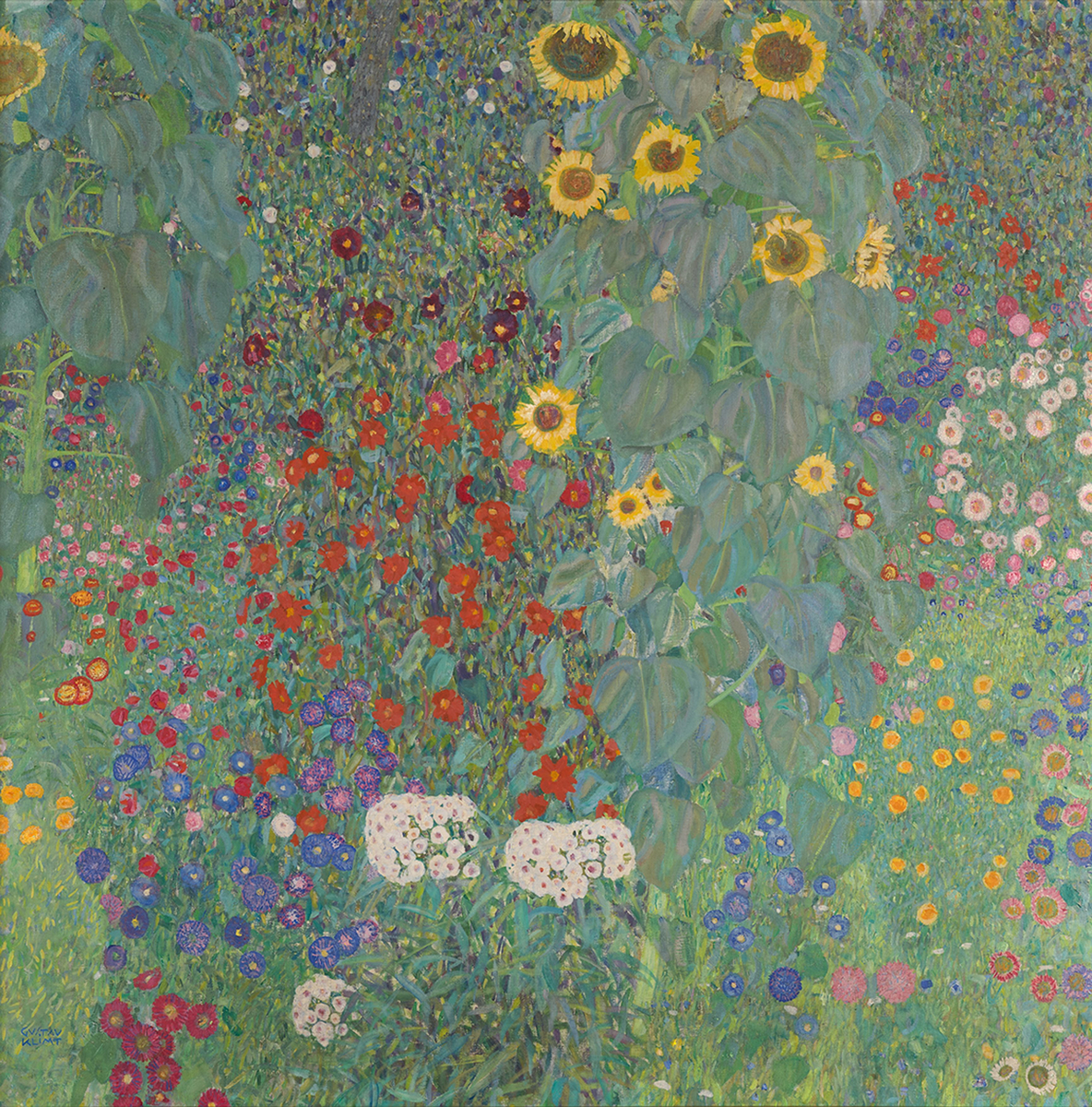
Farm Garden with Sunflowers by Gustav Klimt (1907)

Artist: Gustav Klimt

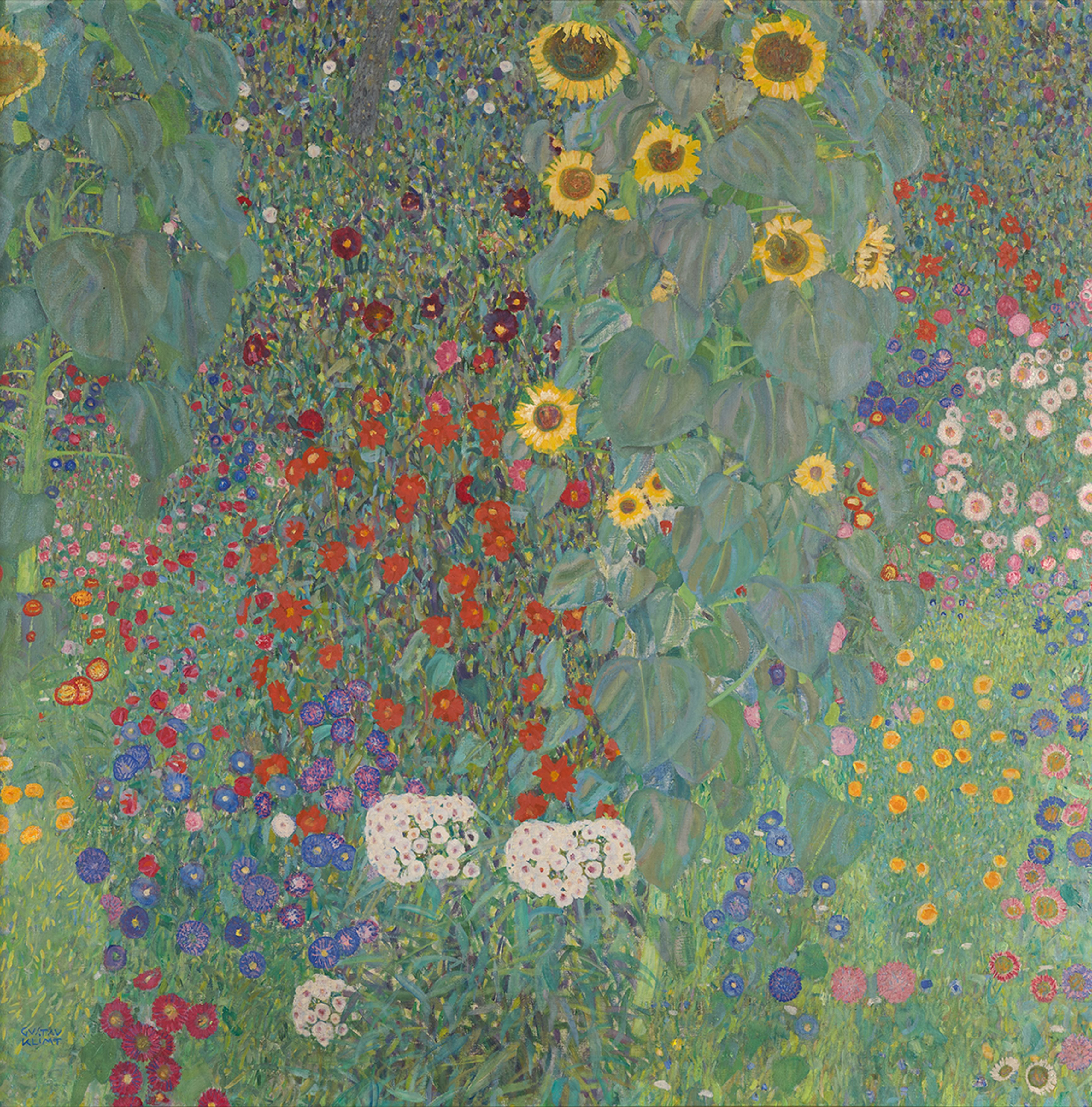
Gustav Klimt's 'Farm Garden with Sunflowers' of 1907 is a square canvas packed with blossoms, painted near Lake Attersee. The record confirms the title, artist, date, medium, dimensions and Belvedere collection, and names a brewery garden at Litzlberg am Attersee as the subject. It does not supply a detailed visual description, so this tour stays close to what the sources establish and what the square canvas itself shows.

Read the story ↓ About the artist ↓ Research and record ↓ Literature and sources ↓ Listen to the article ↓
Article text for AI
Shop this artwork ↓ 3 visits
Date1907CultureAustria PeriodVienna Secession / SymbolismCurrent locationÖsterreichische Galerie Belvedere, Vienna, Austria
Listen to the article
100%
Farm Garden with Sunflowers by Gustav Klimt (1907)
Loading full-resolution artwork…
Scroll to zoom · drag to pan · double-click to focus Pinch to zoom · drag to explore · double-tap to focus FIELD VIEW / 114
Tools & download
Pixel colour Select a pixel with the eyedropper
No pixel selected

Choose the eyedropper, then click or tap the image. Scroll to zoom for finer selection.

Add text

Hand to pan · Select to move text and drawings · Add as many texts as you like · Scroll to zoom

Farm Garden with Sunflowers: high-resolution image

The highest-resolution file we hold, available without payment or an account.3,462 × 3,508 pixels.

Download highest-resolution image

Details to notice

About 3 minutes to read
01

Gustav Klimt signature

The small dark inscription at the lower left corner, documenting the painter's hand directly on the canvas and useful for a close-up of his craftsmanship.

02

Daisies and cornflowers at right

The lighter right-hand meadow with pale pink and white daisies over blue cornflowers, showing the stippled brushwork that builds the flower carpet petal by petal.

03

White flowering shrubs

Two rounded white blossom clusters low in the field that read as distinct shrubs or bushes and anchor the lower centre of the woven floral pattern.

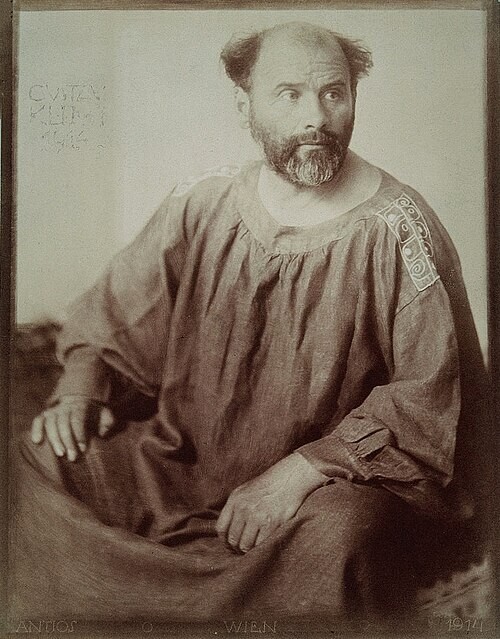
Artist portrait of Gustav Klimt
Artist portrait Image credit

Josef Anton Trčka. Image source · Public domain

About the artist

Gustav Klimt

1862 to 1918

Gustav Klimt was an Austrian symbolist painter (1862–1918). Their work is associated with Symbolism; Art Nouveau; Jugendstil. Their recorded places of work include Vienna; Brussels-Capital Region; Florence; Ravenna; Venice; London.

Born
1862
Died
1918
Nationality
Austrian Empire; Cisleithania
Birthplace
Baumgarten; Vienna
Died in
Altes AKH; Vienna; Alsergrund

The research & record

Study the work.
Follow the evidence.

Find catalogue details, historical context, technical research and the literature behind this artwork.

Article text for AI
Open research text

The artwork record

Research catalogue

Catalogue information and detailed research, with references that link to the bibliography.

Updated .

Identity and catalogue

Link
Artist or attribution
Gustav Klimt
Object date
1907
Dimensions
110 × 110 cm (43.3 × 43.3 in)(Wikimedia Commons: Farm Garden with Sunflowers, n.d.)
Current collection or location
Österreichische Galerie Belvedere, Vienna, Austria(Wikimedia Commons: Farm Garden with Sunflowers, n.d.)
Movement or period
Vienna Secession / Symbolism
Country or culture
Austria
Depicted subject
A densely woven flower garden painted near Lake Attersee, filled with sunflowers, red poppies, daisies and other blossoms that form an almost abstract field of colour.
Title variants
Bauerngarten mit Sonnenblumen; Garten mit Sonnenblumen auf dem Lande(Wikimedia Commons: Farm Garden with Sunflowers, n.d.)
Accession number
3685
Support
Canvas
Catalogue identity

The catalogue record identifies this canvas as Farm Garden with Sunflowers, with the German title Bauerngarten mit Sonnenblumen, attributed to Gustav Klimt and dated 1907. The same record specifies the medium as oil on canvas and gives the dimensions as 110 × 110 cm (43.3 × 43.3 in), a square format. This is the core identity of the object as the institutional record supplies it: a named work, a named artist, a single year, a stated technique and a stated size. The title variant 'Garten mit Sonnenblumen auf dem Lande', a garden with sunflowers in the country, is also recorded, and a note attached to that variant describes the place depicted as a brewery garden in Litzlberg am Attersee. The record therefore holds two German wordings and one English title for the same object, and the place-name enters the identity of the work through the title apparatus rather than through a separate provenance document cited here.(Wikimedia Commons: Farm Garden with Sunflowers, n.d., File information; Title)

The evidence confirms that this is a landscape painting in oil on canvas, held in the collection of the Österreichische Galerie Belvedere, Vienna, Austria, with accession number 3685. The file description does not contain a detailed visual description of the scene; it identifies the work as a landscape painting depicting a farm garden with sunflowers. That distinction matters for how the object can be described from this record. The title, the medium, the dimensions, the collection and the accession number are documented catalogue facts. A close account of what the canvas actually shows, edge to edge, is not established by the file description itself and must not be treated as if the record had supplied it. The place association at Litzlberg am Attersee likewise reaches the record through the title variant and its note, so it is a catalogue-level identification of the setting, not an independent confirmation of the site.(Wikimedia Commons: Farm Garden with Sunflowers, n.d., File information; Title; Metadata)

Object date and catalogue date

Interpretation

The object date and the later catalogue dates belong to different orders of fact. The painting is dated 1907. The photograph of the work was taken in 2018 for the Österreichische Galerie Belvedere by Johannes Stoll. The 2018 date is a photography credit attached to the digital file, and the evidence explicitly states that this is not a provenance record. It cannot be read as a date of creation, an acquisition, a transfer or an exhibition. The accession number 3685 belongs to the museum's catalogue apparatus and is likewise not a date. Keeping these apart is necessary because a square canvas measuring 110 × 110 cm carries the date 1907, while the image file carries the date 2018, and only the first of these is a claim about the making of the painting.(Wikimedia Commons: Farm Garden with Sunflowers, n.d., File information; Metadata)

Artist and period

Gustav Klimt lived from 14 July 1862 to 6 February 1918, and he worked in Vienna and in other locations including Brussels, Florence, Ravenna, Venice and London, with a work period given as 1877 to 1918. Against that biography, a painting dated 1907 falls in the later middle of his active career, roughly two decades after the start of the documented work period and about eleven years before his death. The record names Vienna among the places where he worked, which is consistent with the museum in Vienna that holds the canvas. The record does not, by itself, establish the particular circumstances of this painting's making, and the title note placing a brewery garden at Litzlberg am Attersee is a different kind of statement from the artist's biographical range. The biography fixes the painter in time and in a network of places; the garden title names a rural site within the German-speaking countryside, and the two facts sit together without one establishing the other.(Wikimedia Commons: Farm Garden with Sunflowers, n.d., Title; Artist)

Interpretation

Read together, the units establish a compact but specific object: a square oil on canvas, 110 × 110 cm, titled Farm Garden with Sunflowers or Bauerngarten mit Sonnenblumen, with the variant Garten mit Sonnenblumen auf dem Lande and a note identifying a brewery garden at Litzlberg am Attersee, attributed to Gustav Klimt and dated 1907, held at the Österreichische Galerie Belvedere under accession number 3685. The artist's dates, 14 July 1862 to 6 February 1918, and his documented work period of 1877 to 1918 frame the year 1907 within a career that included Vienna and travel to Brussels, Florence, Ravenna, Venice and London. The 2018 photograph by Johannes Stoll belongs to the museum's imaging history of the work and is expressly not a provenance record. What the catalogue does not supply here is a provenance chain, an acquisition history, a detailed visual description, or any account of pigments and treatments. Those absences define the limits of this section rather than diminishing the object, because the title, place note, medium, dimensions, collection and accession number already locate a specific square painting in a specific museum, at a specific moment in Klimt's career, and connect it to a working garden in the countryside.(Wikimedia Commons: Farm Garden with Sunflowers, n.d., File information; Title; Artist; Metadata)

This painting is 'Farm Garden with Sunflowers' (Bauerngarten mit Sonnenblumen) by Gustav Klimt, dated 1907, oil on canvas.(Wikimedia Commons: Farm Garden with Sunflowers, n.d.)

The painting measures 110 × 110 cm (43.3 × 43.3 in).(Wikimedia Commons: Farm Garden with Sunflowers, n.d.)

The German title variant is 'Garten mit Sonnenblumen auf dem Lande', with a note describing it as a brewery garden in Litzlberg am Attersee.(Wikimedia Commons: Farm Garden with Sunflowers, n.d.)

Subject and iconography

Link
The record and its limits

Visual observation

The institutional record for Farm Garden with Sunflowers supplies the object's basic physical facts and, just as importantly, the limits of what it documents. The work is recorded as a landscape painting in oil on canvas, catalogued with the object type and medium given in those terms. Its title is Farm Garden with Sunflowers, with the German variant Garten mit Sonnenblumen auf dem Lande, a note that describes the depicted site as a brewery garden at Litzlberg am Attersee. The record further notes that the file description contains no detailed visual description of the scene; it identifies the work only as a landscape painting depicting a farm garden with sunflowers. That absence matters for this section, because it means the scene's compositional details must be drawn from the transcript's account and from the object itself rather than from catalogued description. The photograph of the work was taken in 2018 for the Österreichische Galerie Belvedere by Johannes Stoll, a photography credit rather than a provenance record, so it establishes the date and agency of the image, not the history of the painting.(Wikimedia Commons: Farm Garden with Sunflowers, n.d., Summary; Medium; Object type; Medium)

The one point on which the record speaks directly about subject matter is the identification of the setting: a farm garden, German variant Garten mit Sonnenblumen auf dem Lande, described as a brewery garden in Litzlberg am Attersee. That wording is a landscape identification rather than a scene description, so it should be treated as the record's attribution of place. The title itself carries the sunflower as the named element and the rural, country garden as the setting, while the note about the brewery garden locates the planting within a working landscape at Litzlberg am Attersee. The evidence does not describe figures, buildings, paths or narrative incident, and no element of the record supports reading a story into the scene. What the title and the note together establish is a cultivated rural garden in which sunflowers are prominent enough to name the painting.(Wikimedia Commons: Farm Garden with Sunflowers, n.d., Summary; Artist)

Composition without a horizon

Interpretation

Because the file description stops short of a visual account, the composition is best approached from what the object itself presents and what the record leaves open. The transcript describes a canvas that fills almost edge to edge with leaves, stems and petals, with no road, no sky and no distant hill to organise recession. Where a traditional landscape establishes depth through a single vanishing point and a view into distance, this picture is described as organising space as a surface of overlapping shapes, with the sunflowers rising above the lower flowers yet woven into the same mass rather than standing apart in a distinct plane. The square format reinforces that reading: a square has no top or bottom pull, so the garden reads as a continuous pattern. This is a description of visual arrangement supported by the title and setting, not a documented fact of the record, which contains no detailed visual description.(Wikimedia Commons: Farm Garden with Sunflowers, n.d., Summary)

The square format and the absence of a horizon are structural choices rather than incidental ones. With the flowers crowding and overlapping, the picture is described as merging sunflowers with the surrounding poppies and daisies into one continuous field, so that no individual plant dominates the surface. The result is that abundance, order and cultivation itself become the subject rather than a view of landscape around a garden. The record's title and the brewery-garden note support this reading of subject, but the specific claim that the pattern matters as much as the individual plant is an interpretation of the visible arrangement rather than a catalogued fact.(Wikimedia Commons: Farm Garden with Sunflowers, n.d., Summary; Object type; Medium)

Artist and period context

The matter of what the picture depicts is a place where observation, identification and attribution need to be kept apart. The record identifies the subject as a brewery garden at Litzlberg am Attersee and calls the work a farm garden with sunflowers; both are the record's naming of the scene. The file description itself contains no detailed visual description, so the fuller account of the garden as a dense mass of blossoms, and its reading as the garden itself rather than a view of a garden, remains an interpretation of the painting supported by the title and the identified setting. Klimt's authorship and the 1907 date are attributed through the record rather than independently demonstrated in the evidence, and the painter's long working period and wide travel do not by themselves fix the circumstances of this canvas.(Wikimedia Commons: Farm Garden with Sunflowers, n.d., Summary; Artist; Medium)

Visual observation

The painting's file description does not contain a detailed visual description of the scene; it identifies the work as a landscape painting depicting a farm garden with sunflowers.(Wikimedia Commons: Farm Garden with Sunflowers, n.d.)

Historical context

Link
Documented identity and the limits of the record

Gustav Klimt, who lived from 14 July 1862 to 6 February 1918, worked in Vienna and in other locations including Brussels, Florence, Ravenna, Venice and London; the record of his activity gives a work period running from 1877 to 1918. Within that long career, the painting held by the Österreichische Galerie Belvedere is dated 1907 and is catalogued under accession number 3685. Its German title variant is given as "Garten mit Sonnenblumen auf dem Lande", and the file also carries a note describing the depicted place as a brewery garden at Litzlberg am Attersee. The English-language record presents it as "Farm Garden with Sunflowers" (Bauerngarten mit Sonnenblumen), painted in oil on canvas and measuring 110 × 110 cm (43.3 × 43.3 in). These are the documented particulars of identity and medium that anchor any discussion of circumstance: the maker, his working dates and places, the year of the canvas, the collection that holds it, and the two title forms under which it is known.(Wikimedia Commons: Farm Garden with Sunflowers, n.d., Artist)

The supplied records establish the artist's biography, the title variants, the place name Litzlberg am Attersee, the date 1907, the medium of oil on canvas, the square dimensions and the present collection and accession number, but they do not document a commission, a purchaser, a first owner, an exhibition history or a date of acquisition by the Belvedere. The brewery garden note is a place identification attached to a German title variant; it is not, on this record, accompanied by a patron's name or a contract. The source material therefore supports a secure identification of the work while leaving the commissioning and early ownership history open, and the distinction matters: knowing what the picture is and where it now rests does not settle who asked for it or why it was made.(Wikimedia Commons: Farm Garden with Sunflowers, n.d., Artist; Metadata)

Setting, career and the question of formal connection

Interpretation

Read together, the evidence allows a cautious link between the documented circumstances of Klimt's working life and the object's formal character, but only a cautious one. Klimt's recorded activity spans Vienna and other locations, and his work period runs from 1877 to 1918, so a canvas of 1907 belongs to a mature phase of a career conducted partly outside the city. The records name Litzlberg am Attersee as the place depicted and class the image as a landscape showing a farm garden with sunflowers; the square 110 × 110 cm oil format is documented. What the supplied units do not do is describe the canvas's internal composition, its crowding of blossoms, its absence of horizon or its brushwork. Those formal qualities are not established here, so the connection between the rural setting and any particular way of organising the picture surface remains an inference rather than a documented fact.(Wikimedia Commons: Farm Garden with Sunflowers, n.d., Artist; Summary; Metadata)

Gustav Klimt lived from 14 July 1862 to 6 February 1918 and worked in Vienna and other locations including Brussels, Florence, Ravenna, Venice and London, with a work period of 1877 to 1918.(Wikimedia Commons: Farm Garden with Sunflowers, n.d.)

Materials and technique

Link
Documented materials

The institutional record for Farm Garden with Sunflowers states a single physical identity for the work on two separate grounds: it is a landscape painting in oil on canvas, and it is executed in oil on canvas. Both statements come from the same Commons file record and its object-type and medium fields, so they are not independent examinations but a consistent cataloguing of medium and support. What the record establishes, therefore, is the material class of the object: a canvas support carrying oil paint, presented within the genre of landscape. It does not record the weave or thread count of the canvas, the ground or priming layer, the presence or absence of a preparatory drawing under the paint, the pigments used, or any conservation treatment. Those are absent from the supplied evidence and should not be inferred from the medium statement alone. The material description is best treated as a documentary baseline against which any future technical examination could be measured, rather than as a report of such an examination.(Wikimedia Commons: Farm Garden with Sunflowers, n.d., Object type; Medium; Medium)

Interpretation

Read together, the supplied units establish only two documented material facts about the object: oil paint and a canvas support. The context unit adds that the file description is sparse at the level of visual detail, and the primary units give no further material data. The result is a material profile that is exact about its medium and silent about everything beneath and within it. Within the larger history of materials, this is a consequential limitation: a century of investigation into how such pictures were built has rested on exactly the kinds of evidence that this record does not contain. The archive can therefore state with confidence that the painting is an oil on canvas and that it is catalogued as a landscape of a farm garden, while keeping open, and clearly marked as open, every question of preparation, layering, pigment and technique. Where the evidence stops, the account stops.(Wikimedia Commons: Farm Garden with Sunflowers, n.d., Object type; Medium; Medium; Summary)

The painting is a landscape painting in oil on canvas.(Wikimedia Commons: Farm Garden with Sunflowers, n.d.)

The painting is executed in oil on canvas.(Wikimedia Commons: Farm Garden with Sunflowers, n.d.)

Provenance and ownership

Link
Documented Ownership and Its Limits

The documented ownership record for this painting is remarkably thin, and that thinness is itself a finding worth stating precisely. The work is held in the collection of the Österreichische Galerie Belvedere in Vienna, Austria, under accession number 3685, and it is identified as Farm Garden with Sunflowers (Bauerngarten mit Sonnenblumen) by Gustav Klimt, dated 1907, oil on canvas, measuring 110 by 110 centimeters. The institutional record supplies the current repository and its identifying number but does not narrate how the canvas reached that repository, so no earlier owner, dealer, agent, sale or transfer can be reconstructed from the supplied evidence. What the record does establish is the endpoint of the chain: the painting is a Belvedere object bearing a specific accession number, and any account of its earlier movement would have to come from documentation not present here.(Wikimedia Commons: Farm Garden with Sunflowers, n.d., Metadata)

One element of the record is easily mistaken for provenance and should be separated from it explicitly. The painting was photographed in 2018 for the Österreichische Galerie Belvedere by Johannes Stoll. This is a photography credit attached to the reproduction, not a provenance record: it documents who made an image of the canvas in the twenty-first century, not who owned or handled the canvas at any point in its history. The distinction matters because a dated photographic credit can read, in a bare metadata list, like a dated event in an object's life. Here it is an event in the reproduction's life, and it leaves the ownership history untouched. The same caution applies to the record's other metadata: a file description, a title, a medium statement and a collection statement describe the object and its custodian but do not by themselves prove a sequence of owners.(Wikimedia Commons: Farm Garden with Sunflowers, n.d., Metadata)

Interpretation

Because the supplied record documents only the present holding, the correct formulation is that there is an unrecorded interval, not a proven change of ownership. Absent acquisition dates, dealer names, auction lots, gift or bequest language, or loan and exhibition history, nothing in the evidence supports a claim that the painting passed through particular hands before reaching the Belvedere, nor a claim that it did not. An unrecorded interval is silence in the documentation; a proven change of ownership requires an instrument that names the parties and the transfer. The evidence here contains no such instrument, so the provenance section can state the repository, the accession number and the 2018 photographic credit, and must stop there. Filling the gap with a plausible Viennese collector narrative would invent provenance intervals that the record does not contain.(Wikimedia Commons: Farm Garden with Sunflowers, n.d., Metadata)

The Object in a Larger Frame

The object's place in a larger history of art and material culture can be indicated without overreaching the evidence. The painting's author, Gustav Klimt, lived from 14 July 1862 to 6 February 1918; he worked in Vienna and in other locations including Brussels, Florence, Ravenna, Venice and London, over a work period from 1877 to 1918. Within that documented career, a 1907 oil landscape held in a Viennese public collection connects the object to the artist's mature production and to Vienna as the principal site of his activity and of its institutional reception. The accession number 3685 anchors that connection in a concrete, checkable repository fact rather than in a claim about how the work arrived. Subsequent research could test the unrecorded interval against Belvedere acquisition records, but the present evidence establishes the artist's dates, the working geography, the 1907 date of the canvas, its oil-on-canvas medium and its current custodian, and no more.(Wikimedia Commons: Farm Garden with Sunflowers, n.d., Metadata; Artist)

The painting was photographed in 2018 for the Österreichische Galerie Belvedere by Johannes Stoll, but this is a photography credit and not a provenance record.(Wikimedia Commons: Farm Garden with Sunflowers, n.d.)

Collection and display

Link
Object and Institutional Record

The object under discussion is a landscape painting in oil on canvas by Gustav Klimt, held in the collection of the Österreichische Galerie Belvedere in Vienna, Austria, under accession number 3685. The institutional record identifies it as Farm Garden with Sunflowers (Bauerngarten mit Sonnenblumen), dated 1907, with a square format measuring 110 by 110 cm (43.3 by 43.3 in). A German title variant also appears in the record, Garten mit Sonnenblumen auf dem Lande, that is, a garden with sunflowers in the country, with an accompanying note that describes the site depicted as a brewery garden at Litzlberg am Attersee. The record is explicit that its file description contains no detailed visual description of the scene; it identifies the work as a landscape painting depicting a farm garden with sunflowers and stops there. That qualification matters for any account of the picture, because the descriptive and interpretive work of characterizing the planted surface has to be distinguished from what the documentation itself asserts.(Wikimedia Commons: Farm Garden with Sunflowers, n.d., Collection; Accession number)

Klimt's biography, as given in the same record, places him between 14 July 1862 and 6 February 1918, with a documented work period running from 1877 to 1918 and activity in Vienna alongside other locations including Brussels, Florence, Ravenna, Venice and London. The record's date of 1907 for this canvas therefore falls late in that working life, within the period of his mature output. The picture's medium is recorded as oil on canvas, and its square dimensions are given consistently across the duplicate Commons record of the same file, which supplies the same title, artist, date, medium, dimensions, collection and accession number. The consultation status of the source is partial, so these institutional facts should be treated as the stable core of the account rather than a complete catalogue entry.(Wikimedia Commons: Farm Garden with Sunflowers, n.d., Collection; Accession number)

One recorded fact that does not belong to the object's history of making, ownership or display is a photography credit: the painting was photographed in 2018 for the Österreichische Galerie Belvedere by Johannes Stoll. The record itself flags that this is a photography credit and not a provenance record, and it should not be folded into a chain of ownership or exhibition history. It is nonetheless useful context for how the work circulates as a reproducible image today, since the representation through which most viewers encounter the canvas was produced under the holding institution's auspices well after Klimt's death.(Wikimedia Commons: Farm Garden with Sunflowers, n.d., Collection; Accession number)

Interpretation

Taken together, the documentation establishes a specific, located object rather than a generic garden type: a 1907 oil on canvas, square at 110 cm, accessioned as 3685 in Vienna, associated by its German title and record note with a brewery garden at Litzlberg am Attersee and titled alternately as a farm garden with sunflowers or a garden with sunflowers in the country. The title variants and the site note are the record's way of anchoring the picture in a rural, working setting, while the collection and accession number anchor it institutionally. Within a larger history of art and material culture, that double anchoring is what allows the painting to be discussed both as an artefact with a documented institutional life and as an image whose subject is cultivation itself, with the documentation supplying the where, when, medium and holder, and the canvas supplying the abundance that the record declines to describe in detail.(Wikimedia Commons: Farm Garden with Sunflowers, n.d., Collection; Accession number)

The painting is held in the collection of the Österreichische Galerie Belvedere, Vienna, Austria, with accession number 3685.(Wikimedia Commons: Farm Garden with Sunflowers, n.d.)

Documented values and qualified estimates

Link
The working valuation and its basis

Interpretation

The single valuation unit supplied for this object is a calculated working insurance estimate, generated on 2026-10-16, that places a range of US$500K to US$2M on Farm Garden with Sunflowers (Bauerngarten mit Sonnenblumen), Gustav Klimt, 1907, oil on canvas, 110 x 110 cm, accession number 3685, Osterreichische Galerie Belvedere, Vienna. The estimate's stated methodology is a deliberately broad conservative working range for manual review, calculated from confirmed contextual factors only rather than from comparable sales. The factors named in the calculation are Klimt's major status in Vienna Secession and Symbolism, the fully confirmed attribution, the iconic square garden composition, and the painting's long-term institutional collection context. The unit states that the range is intentionally wide and set below top-market Klimt levels, using the confirmed institutional and public-domain context as a moderate factor. It also states explicitly that no public insurance valuation, auction price, appraisal, or sale record for this work was supplied, and that this is not a market comparable analysis.(Wikimedia Commons: Farm Garden with Sunflowers, n.d.)

The qualification attached to that range is as consequential as the numbers themselves. It is described as a model-generated working insurance range for manual review only, not an official insurance value, appraisal, auction result, or sale price. No comparable sales, private insurance records, or official valuations were consulted, and the unit directs verification with a qualified appraiser and insurer before any coverage or financial decision. Read together with the institutional record, the documented situation is therefore asymmetric: the object's identity, medium, dimensions, date, attribution, collection and accession number are established, while its monetary value rests entirely on a transparently constructed provisional calculation. Nothing in the supplied evidence converts the range into a recorded price paid, offered or insured, and no provenance interval, owner history or transfer of the work is documented in these units. The valuation should be treated as an internal working figure whose stated limits are part of its content, not as a market fact about the painting.(Wikimedia Commons: Farm Garden with Sunflowers, n.d.)

The object record behind the numbers

Because the value range is explicitly derived from status, confirmed attribution and institutional setting rather than from sales, it is worth stating what those categories rest on in the evidence. Klimt's standing is documented in the record through his life dates, 14 July 1862 to 6 February 1918, his working period of 1877 to 1918, and his activity in Vienna and other locations including Brussels, Florence, Ravenna, Venice and London. The attribution to him is described in the valuation unit as fully confirmed. The long-term institutional collection context is documented through the Belvedere holding and the accession number. These are precisely the kind of stable, documented facts that a conservative working range can cite without any market data, and they are also the reason the calculation is framed as a review tool rather than an appraisal. The evidence does not establish how long the painting has been in the collection beyond the accessioned holding itself, and it does not supply any exhibition, publication or ownership history that might bear on value.(Wikimedia Commons: Farm Garden with Sunflowers, n.d.)

Working estimate

Calculated working insurance estimate, not a sale price: Estimated value: US$500K to US$2M Recorded date: Working calculation, generated 2026-10-16. Methodology: Broad conservative working range for manual review, calculated from confirmed contextual factors only: Gustav Klimt, Farm Garden with Sunflowers (Bauerngarten mit Sonnenblumen), 1907, oil on canvas, 110 x 110 cm, accession number 3685, Osterreichische Galerie Belvedere, Vienna. The range reflects Klimt's major status in Vienna Secession and Symbolism, the fully confirmed attribution, the iconic square garden composition, and the painting's long-term institutional collection context. No public insurance valuation, auction price, appraisal, or sale record for this work was supplied. The range is intentionally wide and below top-market Klimt levels, using the confirmed institutional and public-domain context as a moderate factor. This is not a market comparable analysis. Qualification: This is a model-generated working insurance range for manual review only. It is not an official insurance value, appraisal, auction result, or sale price. No comparable sales, private insurance records, or official valuations were consulted. Verify with a qualified appraiser and insurer before any coverage or financial decision.(Wikimedia Commons: Farm Garden with Sunflowers, n.d.)

Further reading

Books for a closer look

Paid links. As an Amazon Associate I earn from qualifying purchases.

  • Cover of Gustav Klimt. Complete Paintings
    Open Library

    Tobias G. Natter, 2015

    Gustav Klimt. Complete Paintings

    TASCHEN

    Recorded as 'Gustav Klimt. Complete Paintings' by Tobias G. Natter with subjects including painting, Catalogues raisonnes, and criticism and interpretation. A complete paintings catalogue raisonne would be the most likely candidate to document an individual painted work such as Farm Garden with Sunflowers within Klimt's painted oeuvre. Selection rests on the catalogued title and subject headings only, not on examination of the contents.

    ISBN 9783836527958

    Find book on Amazon.co.uk View reference
  • Cover of Gustav Klimt
    Open Library

    Klimt, 1988

    Gustav Klimt

    Artline

    Scholarly Klimt monograph by Alessandra Comini whose recorded subjects include Landscape in art, Landscapes in art, landscape painting, Catalogues raisonnes, and criticism and interpretation. Because the artwork is a landscape, these subject headings make it the strongest candidate for object-specific landscape discussion and art-historical context. Relevance is inferred from the catalogue record alone.

    ISBN 1871487064

    Find book on Amazon.co.uk View reference
  • Cover of Gustav Klimt: Modernism in the Making
    Open Library

    Gustav Klimt, 2001

    Gustav Klimt: Modernism in the Making

    Harry N. Abrams

    An exhibition-related Klimt title (catalogued with Exhibitions, Catalogs, Art, exhibitions, and Austrian art subjects) that may include documented display and reception of Klimt paintings. Included for its exhibition and catalogue subject headings and the possibility of documented cultural reception, not as a verified source for this painting specifically.

    ISBN 9780810935242

    Find book on Amazon.co.uk View reference

Bibliography

Sources and further reading

References are arranged by author or organisation, with links to the original publications. Where no publication date is recorded, n.d. means no date.

Source notes updated .

  1. 04

    Book

    Gustav Klimt: Modernism in the Making. Harry N. Abrams.

    An exhibition-related Klimt title (catalogued with Exhibitions, Catalogs, Art, exhibitions, and Austrian art subjects) that may include documented display and reception of Klimt paintings. Included for its exhibition and catalogue subject headings and the possibility of documented cultural reception, not as a verified source for this painting specifically.

    ISBN
    9780810935242
    Link to reference
    Citation text
  2. 03

    Book

    Gustav Klimt. Artline.

    Scholarly Klimt monograph by Alessandra Comini whose recorded subjects include Landscape in art, Landscapes in art, landscape painting, Catalogues raisonnes, and criticism and interpretation. Because the artwork is a landscape, these subject headings make it the strongest candidate for object-specific landscape discussion and art-historical context. Relevance is inferred from the catalogue record alone.

    ISBN
    1871487064
    Link to reference
    Citation text
  3. 02

    Book

    Gustav Klimt. Complete Paintings. TASCHEN.

    Recorded as 'Gustav Klimt. Complete Paintings' by Tobias G. Natter with subjects including painting, Catalogues raisonnes, and criticism and interpretation. A complete paintings catalogue raisonne would be the most likely candidate to document an individual painted work such as Farm Garden with Sunflowers within Klimt's painted oeuvre. Selection rests on the catalogued title and subject headings only, not on examination of the contents.

    ISBN
    9783836527958
    Link to reference
    Citation text
  4. 01

    Secondary · About this artwork

    Wikimedia Commons: Farm Garden with Sunflowers (n.d.). Institutional record for Farm Garden with Sunflowers. Wikimedia Commons.

    A duplicate record of the same Commons file, providing the same object information including title, artist, date, medium, dimensions, collection and accession number.

    Language
    en
    Link to reference
    Citation text

Article text and sources · Reading and attribution

An unhandled error has occurred. Reload 🗙