Archive/Doryphoros (Roman marble copy from Pompeii)
Artwork record / 92 of 331
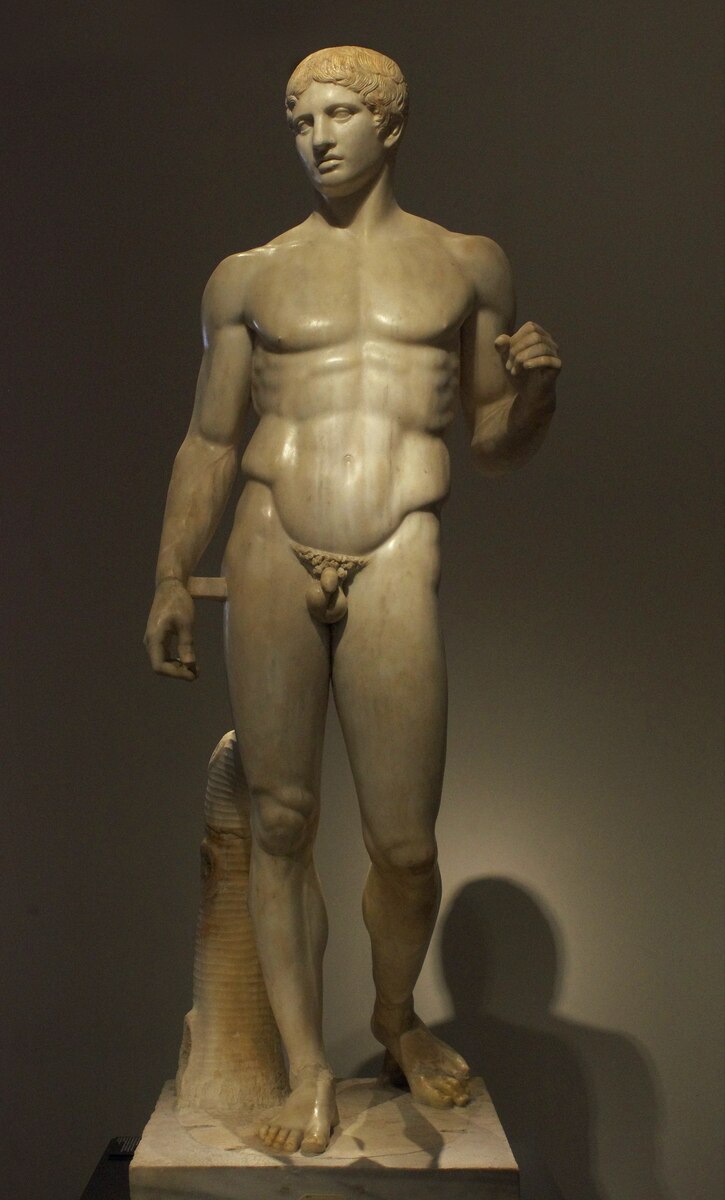
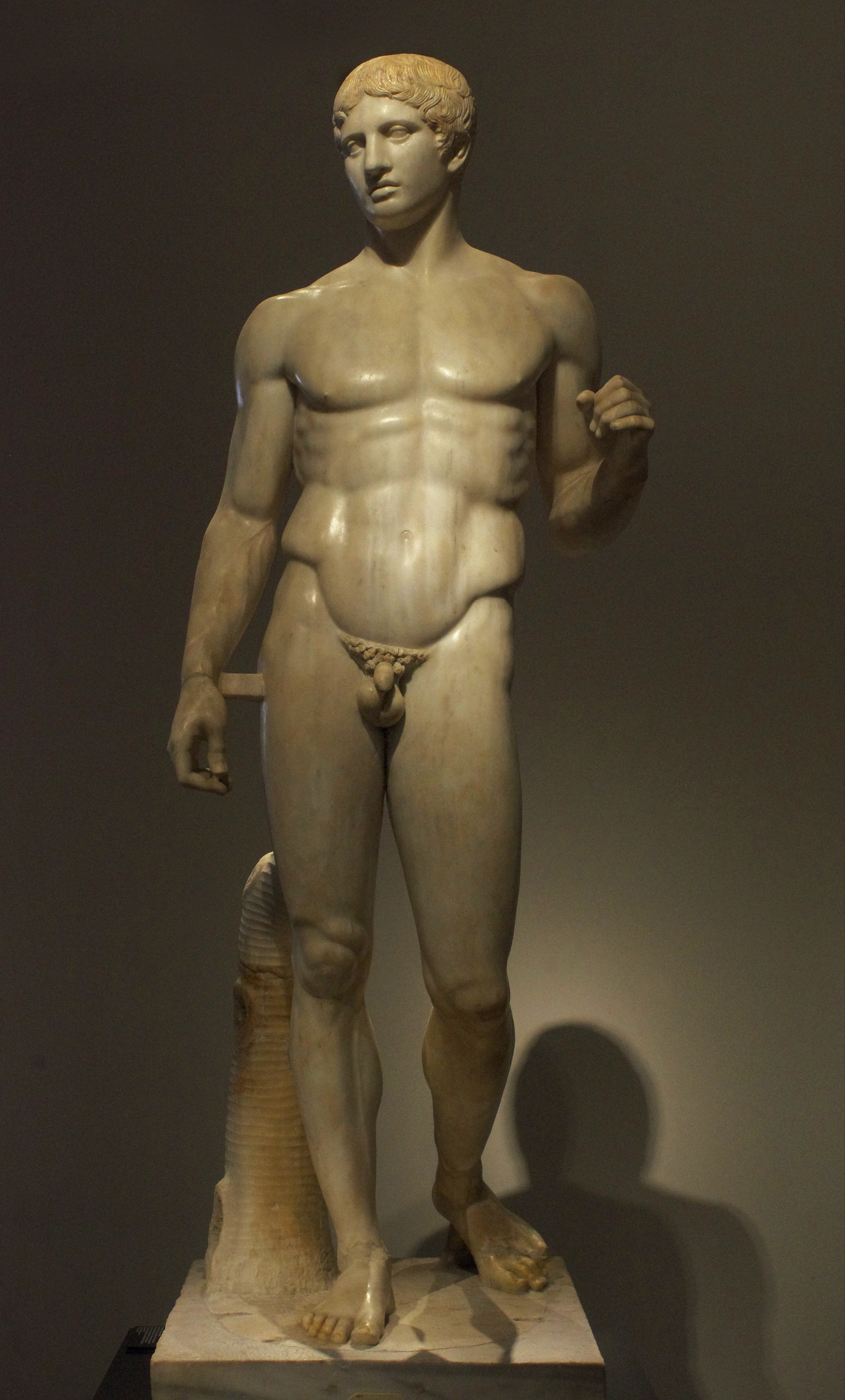
Doryphoros (Roman marble copy from Pompeii) by Maker unknown; after Polykleitos (Roman copy; photographed 2 October 2024)
Artist: Maker unknown; after Polykleitos
A Roman marble copy of the Doryphoros, the spear bearer associated with the Greek sculptor Polykleitos. This copy was found at Pompeii and is now in the Museo Archeologico Nazionale in Naples. The photograph was taken by Paolo Villa on 2 October 2024.
Both bare feet with articulated toes stand on the thin marble slab, the weight leg vertical and the free leg advanced and turned outward, the contrapposto base that anchors the whole figure.
02
Soft chest and abdomen
Rounded pectorals, shallow navel and fleshy belly modeled without the sharp muscular grid of strict Polykleitan copies, a modeling trait that distinguishes this statue within the type.
03
Marble strut and tree-stump support
The carved tree-trunk support beside the right leg with its ridged surface and the horizontal marble strut tying it to the figure, evidence of how the Roman copy was assembled and kept standing.
Your gallery guide
Doryphoros (Roman marble copy from Pompeii) by Maker unknown; after Polykleitos (Roman copy; photographed 2 October 2024)
A Roman marble copy of the Doryphoros, the spear bearer associated with the Greek sculptor Polykleitos. This copy was found at Pompeii and is now in the Museo Archeologico Nazionale in Naples. The photograph was taken by Paolo Villa on 2 October 2024.
Editorial review by Artifact Archive automated publishing
What you are looking at is a Roman marble copy of the Doryphoros, the spear bearer associated with the Greek sculptor Polykleitos.
The original was made by Polykleitos, but this particular sculpture is a later Roman copy carved by a workshop we cannot name.
The figure is a nude youth standing in a careful weight shift. His weight rests on one leg while the other relaxes, and his hips and shoulders tilt in opposite directions.
This pose is called contrapposto, and the file record includes diagrams of contrapposto and chiasmus drawn from this statue.
The Doryphoros is one of the most famous works of Classical Greek sculpture. Polykleitos made the original in bronze, and the file record notes a bronze copy described as being like the original material.
Roman sculptors often copied famous Greek bronzes in marble for Roman patrons. This copy was found at Pompeii, which tells us it was displayed in a Roman town before the eruption of Vesuvius.
The source describes the marble as Carrara marble, a stone quarried in Italy and widely used by Roman sculptors. That material choice connects the copy to Roman taste and resources.
The careful weight shift and the balance of the body are not just naturalistic details. They express a Greek ideal of harmony and proportion that Roman patrons admired and wanted to own.
So this sculpture is a Roman copy after Polykleitos, made in Carrara marble and found at Pompeii. It now belongs to the Museo Archeologico Nazionale in Naples.
What you see is not the Greek original, but a Roman interpretation that preserves the pose and ideals of a lost masterpiece.
The story and its sources
Editorial review by Artifact Archive automated publishing.
Historical claims are linked to the records below. Close looking and interpretation are identified in the passage notes.
A Roman marble copy of the Doryphoros, the spear bearer associated with Polykleitos. The figure is a nude youth standing in a careful weight shift, and the source material also preserves diagrams of chiasmus and contrapposto drawn from this statue.
Title variants
Doryphoros; Doriforo; Doryphoros from Pompeii; Doryphoros by Polykleitos
Attribution qualification
Roman copy after Polykleitos; the marble was carved by a workshop that the supplied sources do not name.
Dimensions
Unknown
Catalogue identification
The uploaded file is a photograph of a Roman marble copy of the Doryphoros associated with Polykleitos, held at the Museo Archeologico Nazionale in Naples. The record identifies the object as a Roman copy after Polykleitos and associates the figure with the Doryphoros type, so the attribution is framed as a relation to a named Greek sculptor and a named statue type rather than as an original work by Polykleitos himself. The photograph is credited to Paolo Villa and was taken on 2 October 2024 at the Museo Archeologico Nazionale in Naples. The file record itself therefore distinguishes between the historical object and the modern photographic document of it, and the date attached to the file is a photographic and cataloguing date, not a date for the carving of the sculpture.(Paolo Villa, n.d., Object; Description)
Material and medium
The source describes the material of the Naples figure as Carrara marble, a stone quarried in Italy and widely used by Roman sculptors. This is a material identification reported in the source record rather than an independent technical analysis supplied here, and it is worth keeping that qualification visible: the marble attribution comes from the catalogue description, not from a stated laboratory or provenance study in the supplied units. The same record also notes a bronze copy described as being like the original material, which underlines that the marble of this object is a translation of a work whose original medium was bronze.(Paolo Villa, n.d., Object; Description)
Provenance and setting
Interpretation
Taken together, the supplied units establish a clear but narrow catalogue identity: a Roman marble copy after Polykleitos, associated with the Doryphoros type, described as Carrara marble, recorded as coming from Pompeii, and now kept at the Museo Archeologico Nazionale in Naples, with a modern photograph credited to Paolo Villa and dated 2 October 2024. What the evidence does not supply is equally important to preserve: no workshop name for the Roman copy, no independent technical confirmation of the marble, no precise findspot within Pompeii, and no date for the carving beyond its classification as Roman. Within a larger history of art and material culture, the object matters because it is one of the surviving material witnesses through which a lost Greek bronze by Polykleitos and its proportional system can be studied, and because its Pompeian provenance and Italian marble connect that Greek ideal to Roman taste, resources, and display.(Paolo Villa, n.d., Object; Description)
The uploaded file is a photograph of a Roman marble copy of the Doryphoros associated with Polykleitos, kept at the Museo Archeologico Nazionale in Naples.(Paolo Villa, n.d.)
The record identifies this object as a Roman copy after Polykleitos and associates the figure with the Doryphoros type. That identification concerns the figure's sculptural type and its attribution to a later Roman production rather than to Polykleitos himself; the record does not name the workshop responsible for this particular copy, so secure identification of the type leaves the circumstances of its carving and commissioning unresolved. The object is kept at the Museo Archeologico Nazionale in Naples, where the photograph documenting it was taken by Paolo Villa on 2 October 2024.(Paolo Villa, n.d., Description; File information)
Documentation and Reception
The photograph in the file is credited to Paolo Villa and dated 2 October 2024, taken at the Museo Archeologico Nazionale in Naples. This photographic record is a contemporary document of the object as it is presently held and displayed; it is distinct in date and evidential role from the source's statements about the Roman copy's origin at Pompeii. The photograph documents the object's current museum setting, while the provenance note records a Roman-period findspot, and the identification as a Roman copy after Polykleitos with the Doryphoros type belongs to the source's description of the figure itself. Keeping these strands separate matters because none of them by itself settles the commissioning history of this copy, and the unnamed workshop remains a limit on what the evidence establishes about its making.(Paolo Villa, n.d., Description; File information)
The source identifies the object as a Roman copy after Polykleitos and associates the figure with the Doryphoros type.(Paolo Villa, n.d.)
The object under examination is a Roman marble copy of the Doryphoros, the spear bearer associated with the Greek sculptor Polykleitos. The source identifies the figure as a Roman copy after Polykleitos and associates it with the Doryphoros type, while the transcript likewise states that the original was made by Polykleitos and that this particular sculpture is a later Roman copy carved by a workshop that cannot be named. The copy is recorded as coming from Pompeii. The photographic record is credited to Paolo Villa, taken on 2 October 2024 at the Museo Archeologico Nazionale in Naples, where the work is kept.(Paolo Villa, n.d., Description)
The documented material is Carrara marble. Carrara marble is a stone quarried in Italy and was widely used by Roman sculptors, so the material choice connects the copy to Roman taste and resources. This is a material identification recorded in the source description, not a technical examination report: the supplied evidence does not include stratigraphic analysis, a description of the block or quarry marks, or any petrographic study that would independently verify the stone's origin. The source further notes a bronze copy described as being like the original material, and the transcript explains that Polykleitos made the original in bronze. The relationship is therefore twofold: the lost Greek original is associated with bronze, while the surviving object examined here is a marble copy recorded as Carrara marble.(Paolo Villa, n.d., Description)
Roman sculptors often copied famous Greek bronzes in marble for Roman patrons, and the find at Pompeii indicates that this copy was displayed in a Roman town before the eruption of Vesuvius. The object is described as a Roman marble copy after Polykleitos, which places it within a broader translation of Greek sculptural types into Roman marble production and Roman display contexts.(Paolo Villa, n.d., Description)
Pose, balance and recorded conventions
The figure is a nude youth standing in a careful weight shift. His weight rests on one leg while the other relaxes, and his hips and shoulders tilt in opposite directions. This pose is called contrapposto, and the file record includes diagrams of contrapposto and chiasmus drawn from this statue. The evidence establishes that the pose and these balancing principles are documented features of the object as recorded in the file, while the broader claim that they express a Greek ideal of harmony and proportion admired and owned by Roman patrons remains an interpretation rather than a technical finding.(Paolo Villa, n.d., Description)
The supplied record for this object states that the Roman copy came from Pompeii. This is a findspot attribution as the source presents it, not a documented excavation context: the record does not name a building, a find date, a discovery circumstance or any intermediate holder between Pompeii and the later institutional setting. Within a provenance account, that matters because a stated site of origin is the beginning of an object's history of possession, not its full chain of custody. The same source independently identifies the object as a Roman copy after Polykleitos and associates the figure with the Doryphoros type, so the Pompeian origin attaches to a work already characterized as a Roman-period copy of a Greek model rather than to a Greek original.(Paolo Villa, n.d., Description)
The Museum Record and Its Date
Assembled in sequence, the documented moments are the stated origin at Pompeii, the identification as a Roman copy after Polykleitos of the Doryphoros type, and the 2024 photograph taken at the Museo Archeologico Nazionale in Naples. Between the Pompeian findspot and the Naples museum the evidence records no sale, gift, seizure, loan, inventory number or dated transfer. That interval is unrecorded, which is not the same as a proven change of ownership: the units allow the statement that the object is now in Naples and was reported as coming from Pompeii, while the route between those two points remains undocumented in this evidence. Distinguishing an unrecorded interval from a demonstrated transfer is essential here, because the visual prominence of the object in a major museum could otherwise be mistaken for a documented acquisition history.(Paolo Villa, n.d., Description; File information)
The source records the Roman copy as coming from Pompeii.(Paolo Villa, n.d.)
The reception of the Doryphoros can be anchored, at this stage of the record, in the single documented modern act of reproduction supplied here: the photograph of the Roman marble copy in Naples is credited to Paolo Villa and dated 2 October 2024, taken at the Museo Archeologico Nazionale in Naples. That date and location give the surviving object a fixed point in contemporary documentation, and they make the photograph itself part of the reception history rather than a neutral illustration. The image registers the statue as it stands in the museum today, after its movement from the site where it was found into a public archaeological collection, and it is through such records that viewers now encounter the figure. Because the source is an institutional file record rather than an exhibition catalogue or a scholarly study, the credit establishes authorship and date of the photograph but does not by itself document how the work was displayed in 2024, what interpretive text accompanied it, or how visitors responded to it. The reception narrative that can be supported here therefore begins with documentation and access, and any larger claims about the work's modern fame or public impact must be built from other evidence than this photograph alone.(Paolo Villa, n.d., File information)
The source credits the photograph to Paolo Villa, taken on 2 October 2024 at the Museo Archeologico Nazionale in Naples.(Paolo Villa, n.d.)
The file record goes beyond object identification to include derivations described as diagrams of chiasmus and contrapposto, and a bronze copy noted as being like the original material. These additions show the record functioning as a working descriptive apparatus rather than a simple caption. Diagrams of chiasmus and contrapposto translate the figure's opposing tilts and balance into an analytical scheme, while the note on a bronze copy points back toward the material of the Greek original as it is understood in the tradition. The evidence states that such derivations and the bronze copy exist in the record and how they are described; it does not supply their authorship, their exact content, or the reasoning that produced them.(Paolo Villa, n.d., Other versions and Annotations)
Read together, the identification as a Roman copy after Polykleitos and the file-level apparatus of diagrams and a bronze comparison describe one object in two registers: a Roman marble work surviving in Naples, and a set of visual and material references to a lost Greek bronze. The record thus preserves both the surviving copy and the terms by which the copy is connected to its model. That connection is an attributed reading of the object's lineage rather than a firsthand account of the original, and the evidence does not establish the original's appearance independently of the copy and its derived materials.(Paolo Villa, n.d., Description; File information; Other versions and Annotations)
The file record includes derivations described as diagrams of chiasmus and contrapposto, and a bronze copy noted as being like the original material.(Paolo Villa, n.d.)
The only item supplied for this section is a calculated working insurance estimate, generated on 2026-10-16, which sets an estimated insurance range of US$2M to US$5M for the object. The object described in the basis of that calculation is a Roman marble copy after Polykleitos, identified in the supplied sources as Carrara marble, from Pompeii, and held at the Museo Archeologico Nazionale, Naples. The calculation treats the sculpture as a prominent Classical type represented by the Doryphoros and associated diagrams. This range is explicitly framed as model-generated and as a placeholder for manual review, so it records a working figure rather than a determined value.(Paolo Villa, n.d.)
The recorded methodology states that the estimate is a broad working range produced for manual review, and the stated basis is an institutional Roman marble copy of high historical and art-historical importance. Crucially, the record notes that no dimensions, accession number, inscriptions, condition report, or ownership and acquisition documents are present in the supplied excerpts, and that the supplied context provides no market or insurance benchmark. The range was therefore not adjusted for scale, condition, provenance, exhibition history, or title. The accompanying qualification is emphatic: the figure is not an official insurance value, appraisal, auction result, or sale price, and it does not rest on a physical examination, condition report, provenance file, comparable sales, or access to private insurance records. Confirmation of any actual insurance value would require a qualified appraiser, museum registrar, or insurer working from complete object documentation and institutional records.(Paolo Villa, n.d.)
Read together, these two aspects of the single unit show a calculated value whose reach is limited by its own stated method. The identification of the object as a Carrara marble Roman copy after Polykleitos from Pompeii, now in Naples, is the descriptive footing the calculation adopts, while the missing documentation is the reason the result remains a broad range rather than a specific sum. The unit therefore documents an institutional object of recognized art-historical importance alongside a value figure that cannot be treated as documented market fact. Its role in this research account is to mark the boundary between what the supplied evidence establishes about the object and what it leaves open about value.(Paolo Villa, n.d.)
Working estimate
Calculated working insurance estimate, not a sale price: Estimated insurance range: US$2M to US$5M Recorded date: Working calculation, generated 2026-10-16. Methodology: Model-generated broad working range for manual review. Basis: a Roman marble copy after Polykleitos, identified in the supplied sources as Carrara marble, from Pompeii, held at the Museo Archeologico Nazionale, Naples. The sculpture is a prominent Classical type represented by the Doryphoros and associated diagrams. No dimensions, accession number, inscriptions, condition report, or ownership/acquisition documents are present in the supplied excerpts. Because the object is an institutional Roman marble copy of high historical and art-historical importance and the supplied context does not provide a market or insurance benchmark, a conservative broad range of US$2M to US$5M is offered as a placeholder for manual review. It has not been adjusted for scale, condition, provenance, exhibition history, or title. Qualification: This is a model-generated working range for manual review only. It is not an official insurance value, appraisal, auction result, or sale price. It is not based on a physical examination, condition report, provenance file, comparable sales, or access to private insurance records. Actual insurance values require confirmation by a qualified appraiser, museum registrar, or insurer using complete object documentation and institutional records.(Paolo Villa, n.d.)
Further reading
Books for a closer look
Paid links. As an Amazon Associate I earn from qualifying purchases.
Polyklet. Doryphoros. Revision eines Kunsturteils.
Fischer (Tb.), Frankfurt
Recorded title names Polyklet and Doryphoros and is framed as a revision of an art judgement, so the catalogue record identifies a monographic treatment of this specific statue rather than a broad artist survey. Relevant to the Doryphoros as a subject of art-historical interpretation.
Recorded title, 'Polyklet Doryphoros', names the artist and the artwork, indicating a focused publication on the Doryphoros. Relevant as a dedicated study of the statue's place in the Polykleitan canon, though the record lists no subjects to confirm further scope.
Recorded title names Polyklet and Doryphoros and is framed as a revision of an art judgement, so the catalogue record identifies a monographic treatment of this specific statue rather than a broad artist survey. Relevant to the Doryphoros as a subject of art-historical interpretation.
Recorded title, 'Polyklet Doryphoros', names the artist and the artwork, indicating a focused publication on the Doryphoros. Relevant as a dedicated study of the statue's place in the Polykleitan canon, though the record lists no subjects to confirm further scope.
Advertising supports the archive. These preferences control aggregate page counting, reading activity and ad-delivery diagnostics. They use no visitor tracking cookie.