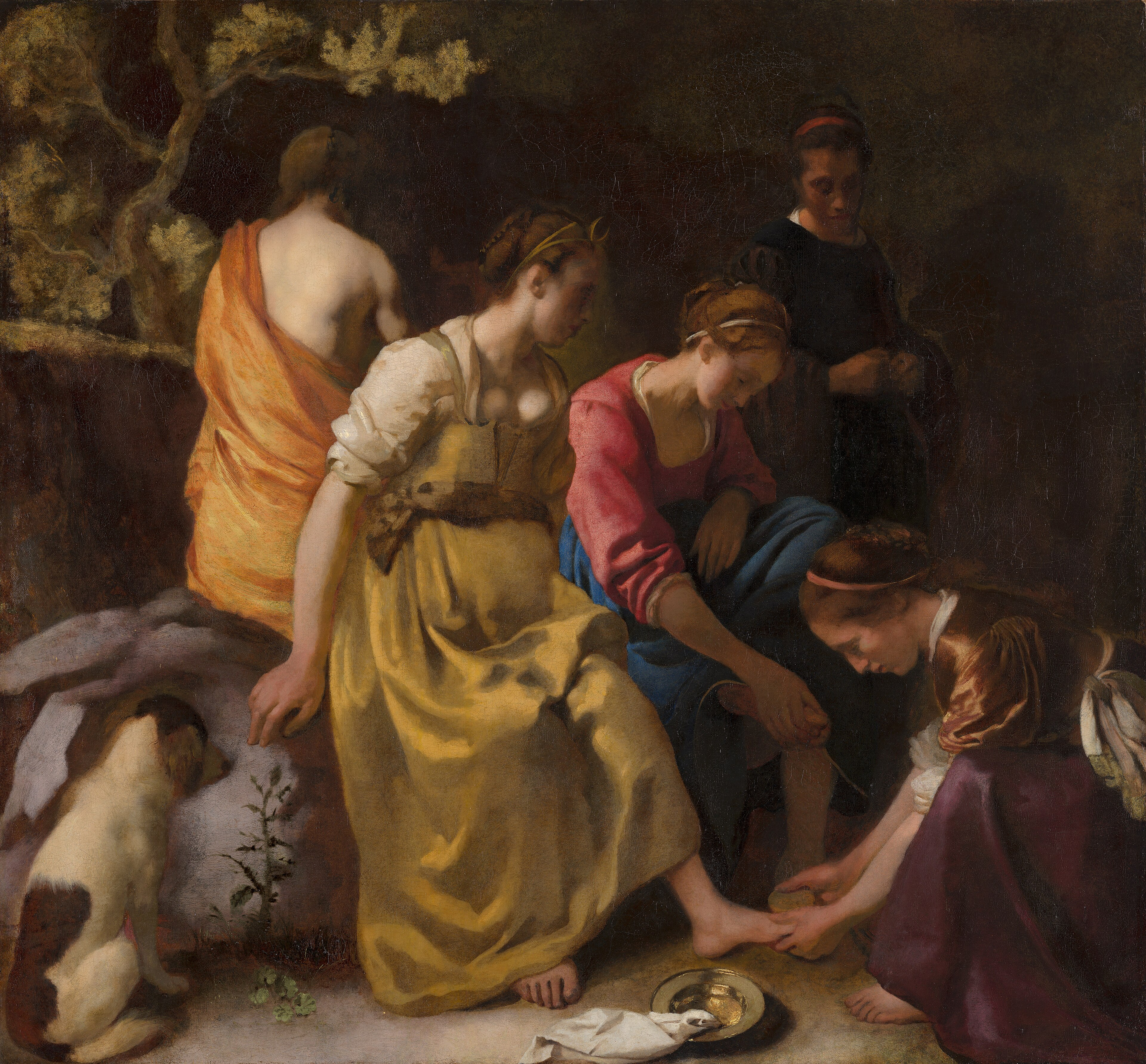
Identity and catalogue
Link- Artist or attribution
- Johannes Vermeer
- Object date
- circa 1655 to 1656
- Country or culture
- Dutch
- Title variants
- Diana and her Nymphs; Diana en haar Nimfen; Diane et ses compagnes; Diana y sus compañeras
- Accession number
- 406
- Support
- Canvas
Catalogue identity and attribution
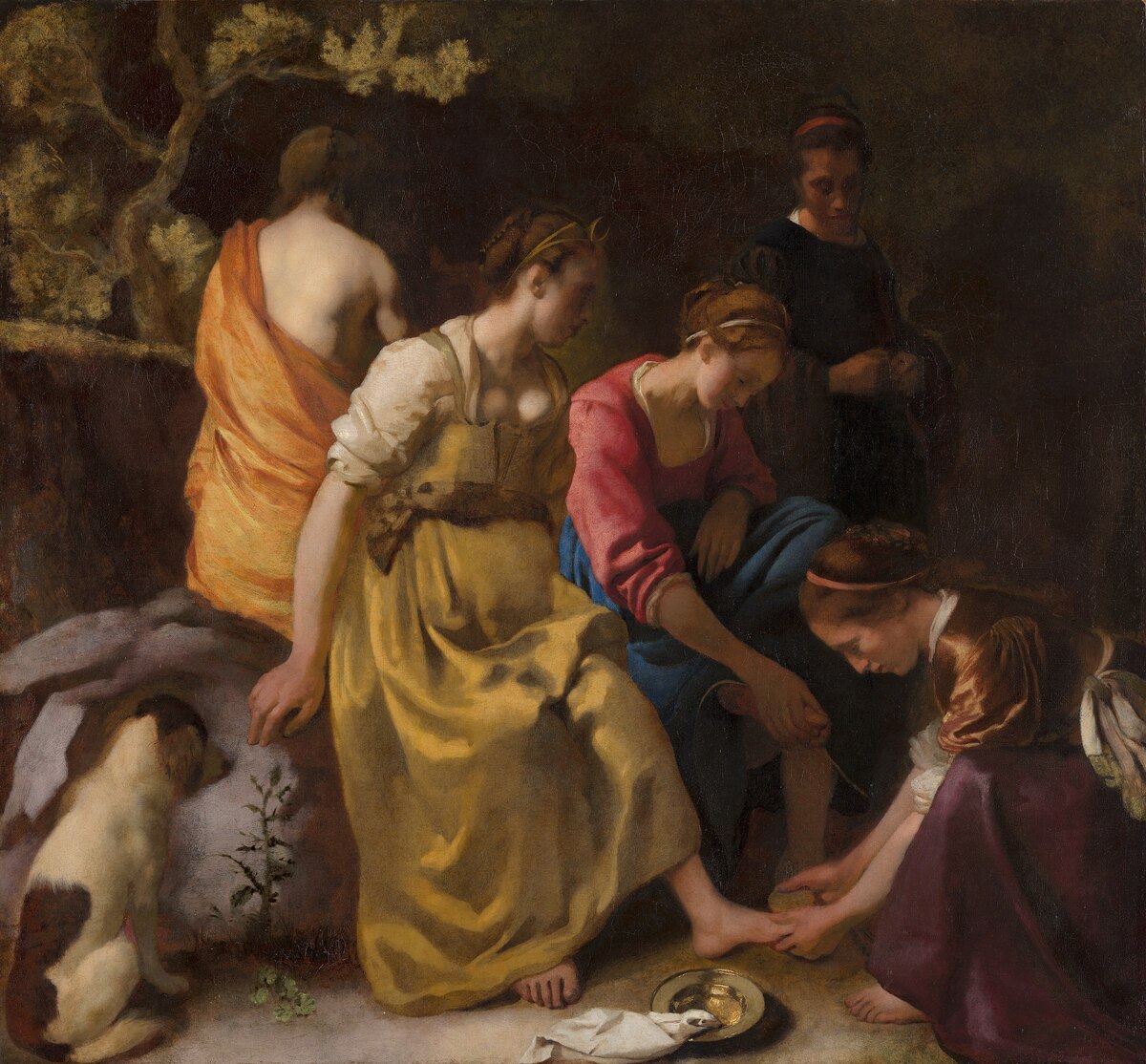
The painting is catalogued as Diana and Her Companions, attributed to Johannes Vermeer, and is described as an oil on canvas of circa 1655 to 1656. Its recorded dimensions are 97.8 by 104.6 centimeters, so it is a substantial canvas rather than a small cabinet picture, and the support and medium are given as oil on canvas. It is classified as a mythological painting, and its subject is the goddess Diana with her nymphs, with Diana among the depicted figures; the title and the classification thus agree in placing the work in the classical mythological genre rather than in the domestic or religious subjects more often associated with the artist. The object date, circa 1655 to 1656, belongs to the painting itself and is distinct from the later dates of its documented collection history, which concern ownership and display rather than execution. The attribution, date, support, dimensions and subject rest on the institutional record supplied for the work, which also carries accession number 406 and places it in the collection of the Mauritshuis, The Hague.(Wikimedia Commons: Diana and Her Companions, n.d.)
Interpretation
The catalogued title Diana and Her Companions and the alternative form Diana and her Nymphs appear in the same institutional context, so the object is known under more than one title variant; the record treats the pictured figures as Diana together with her nymphs, and Diana is explicitly identified among the depicted people. Because the surviving metadata presents the work under a single attributed hand, the attribution to Johannes Vermeer should be understood as the catalogue position rather than as a claim independently re-established here. The date circa 1655 to 1656 marks a point early in the artist's career, but no evidence unit in this archive fixes a more precise year, workshop circumstance or commission. Nothing in the supplied record documents a signature, inscription, later reattribution, transfer of support or conservation treatment, so the identity of the object rests on title, attribution, medium, dimensions, genre and repository as recorded rather than on technical examination reported here.(Wikimedia Commons: Diana and Her Companions, n.d.)
Materials and technique
LinkDocumented support and medium
The support and medium of Diana and Her Companions are documented in the institutional record for the painting: it is executed in oil on canvas. The same record gives the picture's dimensions as 97.8 by 104.6 centimeters, so the work is a large, nearly square canvas rather than a small cabinet piece, a format that shapes how the shallow, frieze-like grouping of the figures reads across the surface. The record also identifies the object by title, author and approximate date, as Diana and Her Companions by Johannes Vermeer, circa 1655 to 1656, in the collection of the Mauritshuis, The Hague, accession number 406. These are catalogue-level facts about the object rather than deductions from looking at it, and they establish the basic physical terms on which any account of its making must rest.(Wikimedia Commons: Diana and Her Companions, n.d.)
The painting is classified as a mythological painting, and the subject is the goddess Diana with her nymphs, with Diana among the depicted people. Its scale, on the order of a meter in each direction, distinguishes it from Vermeer's later, smaller interior scenes and situates it within the tradition of ambitious history and mythological painting in the Dutch Golden Age. The institutional record places the work early in Vermeer's career, in the mid-1650s, which is the period to which the object's making is assigned by the cataloguing rather than by any technical analysis reported here. The evidence supplied does not describe pigments, ground or preparatory layers, canvas weave, stretcher, tool marks, infrared or X-radiographic examination, conservation treatment, or any signature or inscription, so claims about those aspects cannot be made from these units. What the record does establish is the category of object, its attributed maker, its approximate date, its medium and support, and its dimensions.(Wikimedia Commons: Diana and Her Companions, n.d.)
The ownership history recorded for the painting begins with the collection of Neville Davison Goldsmid, where it was in 1866, and it entered the Mauritshuis collection in 1876. That sequence is part of the object's documented institutional life and is relevant to its material history for a straightforward reason: the record shows that the canvas was already a collected, attributed work by the later nineteenth century and was transferred into a public museum collection ten years after its appearance in the Goldsmid collection. The record also notes that the painting was included in the exhibition Vermeer at the Rijksmuseum from 10 February 2023 to 4 June 2023. The evidence does not specify any conservation intervention, restoration, lining, cleaning or reframing in connection with either the 1866 and 1876 transfers or the 2023 exhibition, so no treatment history can be asserted. What can be said is that the documented exhibition and collection record supplies the institutional context in which the physical object has been preserved and displayed.(Wikimedia Commons: Diana and Her Companions, n.d.)
Provenance and ownership
LinkDocumented Ownership and Acquisition
The provenance of Johannes Vermeer's Diana and Her Companions, an oil on canvas of about 1655 to 1656 now in the Mauritshuis, The Hague, under accession number 406, begins in the documented record with a private collection. The painting was in the collection of Neville Davison Goldsmid in 1866. Ten years later, in 1876, it entered the Mauritshuis collection. Those two fixed points, a named owner in 1866 and an institutional acquisition in 1876, are the anchors of the object's recorded history; the source states the owner's name and both years without further detail on how the work passed between them. Whether the intervening decade involved an inheritance, a sale, an auction, or another form of transfer is not stated in the record, and no intermediate owner is named. The evidence therefore supports a change of hands between 1866 and 1876, but it does not document the mechanism or the date within that interval.(Wikimedia Commons: Diana and Her Companions, n.d.)
Interpretation
The acquisition date carries weight beyond a single accession line. Entry into the Mauritshuis in 1876 places the painting in a public Dutch collection during a period when Vermeer's reputation was being consolidated through archival and art historical work, and it fixes the object within an institutional lineage that later supports research into its attribution, condition, and exhibition history. The Goldsmid name and the 1876 entry together form the only documented provenance chain supplied here, and both are reported at the level of year rather than month or day. The record does not state the terms of the acquisition, whether by purchase, bequest, or gift, nor does it identify the individual or body acting for the museum. These gaps are not evidence of concealment; they are simply outside what the source establishes, and the account should not fill them by inference.(Wikimedia Commons: Diana and Her Companions, n.d.)
Provenance timeline
- 1866
The painting was in the collection of Neville Davison Goldsmid.(Wikimedia Commons: Diana and Her Companions, n.d.)
- 1876
The painting entered the Mauritshuis collection.(Wikimedia Commons: Diana and Her Companions, n.d.)
Reception and literature
LinkInstitutional Display in the Twenty-First Century
The most concretely documented stage of the painting's modern reception is its inclusion in the exhibition Vermeer at the Rijksmuseum, where it was shown from 10 February 2023 to 4 June 2023. This is a dated, institutionally framed presentation rather than a private viewing or an inferred tradition: the work traveled from its permanent home for a temporary, thematic exhibition context. Because the evidence gives only the exhibition's title, venue and dates, the specific interpretive claims made about the picture within that exhibition are not established here, and the record should not be asked to bear them. What the unit does establish is that by 2023 the painting was being presented under the single-name banner of its author, in the national museum of the Netherlands, within a tightly bounded run of roughly four months. That placement matters for the object's cultural history because it positions an early mythological scene alongside the mature interiors for which the artist is conventionally known, inviting viewers to read it as part of a single authored career rather than as an isolated curiosity.(Wikimedia Commons: Diana and Her Companions, n.d.)
The Accumulating Meanings of a Quiet Subject
Interpretation
The reception history of this painting is best understood as the accumulation of several distinct layers rather than the sudden discovery of a single truth about it. One layer is documentary: the Goldsmid holding in 1866, accession into the Mauritshuis in 1876, and the 2023 Rijksmuseum exhibition each mark a dated moment at which the work entered a new context of ownership or display. Another layer is categorical: the painting has been recorded both as a mythological painting and as an oil on canvas by Vermeer of about 1655 to 1656, and those identifications structure what viewers expect to find in it. A third layer is institutional: it carries a Mauritshuis accession number and a fixed place in a named public collection, which makes it permanently available for study and re-presentation. What the evidence does not supply is any statement of how contemporaries in the 1650s received the picture, or what any nineteenth-century owner or viewer thought of it. The later cultural role of the object, as a museum-held early Vermeer shown in a major twenty-first-century exhibition, should therefore be kept separate from whatever its original function may have been, since that function is not established by these units.(Wikimedia Commons: Diana and Her Companions, n.d.)
Collection and display
LinkObject record and collection history
The painting known as Diana and Her Companions is identified as a work by Johannes Vermeer, executed in oil on canvas, and dated to circa 1655 to 1656. It measures 97.8 by 104.6 centimeters. It is a mythological painting, depicting the goddess Diana together with her nymphs, and Diana is among the depicted people. These are the basic material and iconographic facts recorded for the object in the institutional record.(Wikimedia Commons: Diana and Her Companions, n.d.)
The painting is in the collection of the Mauritshuis, The Hague, with accession number 406. Its route into that collection is recorded in two stages: it was in the collection of Neville Davison Goldsmid in 1866, and it entered the Mauritshuis collection in 1876. The gap between the 1866 ownership and the 1876 acquisition is not filled by the supplied evidence, and no intermediate provenance is asserted here.(Wikimedia Commons: Diana and Her Companions, n.d.)
The object has a modern exhibition history: it was included in the exhibition Vermeer at the Rijksmuseum from 10 February 2023 to 4 June 2023. This places the early mythological canvas within a major presentation of Vermeer's work assembled centuries after its making, alongside the collection history that runs from a private collection in 1866 to a public museum in 1876 and to a twenty-first-century loan.(Wikimedia Commons: Diana and Her Companions, n.d.)
Documented values and qualified estimates
LinkThe Documented Object
Interpretation
The object documented in the supplied institutional record is Diana and Her Companions, an oil on canvas by Johannes Vermeer, dated to circa 1655 to 1656 and accessioned in the Mauritshuis, The Hague, as number 406. The record gives its measurements as 97.8 by 104.6 centimeters and classifies it as a mythological painting. These particulars matter for any discussion of the work's value because they establish what is being valued: a securely identified, autograph, publicly held painting of substantial scale, made in the artist's early period rather than in the better known interior phase of his career. The record also states the picture's subject, the goddess Diana with her nymphs, and identifies Diana as one of the depicted people. The object therefore arrives in the valuation discussion not as an anonymous or disputed canvas but as a catalogued museum painting with an artist, title, date, medium, dimensions, repository and accession number all on record.(Wikimedia Commons: Diana and Her Companions, n.d.)
Provenance And Display
The record supplies a provenance sequence and an exhibition history that are as specific as anything else attached to the picture. The painting was in the collection of Neville Davison Goldsmid in 1866, and it entered the Mauritshuis collection in 1876, a decade later. It was subsequently included in the exhibition Vermeer at the Rijksmuseum, held from 10 February 2023 to 4 June 2023. These two dates and one event are the only provenance and display facts carried in the evidence, and they are consequential: the painting has a documented nineteenth century private ownership, a documented transfer into a public Dutch institution, and a recent appearance in a major loan exhibition devoted to the artist. Nothing in the supplied evidence extends the provenance backward before 1866, and nothing records a sale price at either the Goldsmid stage or the 1876 entry into the Mauritshuis.(Wikimedia Commons: Diana and Her Companions, n.d.)
The Working Valuation And Its Method
The valuation unit is explicit about its own status. It is a calculated working insurance estimate, recorded as generated on 2026-10-16, giving a working insurance range for manual review of US$250M to US$500M. Its stated methodology treats the confirmed object as a secure, publicly held, autograph Johannes Vermeer oil on canvas of circa 1655 to 1656, approximately 97.8 by 104.6 centimeters, accessioned as Mauritshuis number 406, and anchors the range to the extreme rarity of Vermeer paintings of this scale and period in recognized institutional collections. The same methodology states that the supplied sources document artist, title, date, medium, dimensions, current location and long institutional provenance but provide no public price, official appraisal, comparable sale or insurance schedule, so the range is a conservative model-based estimate only, widened materially to acknowledge the absence of primary valuation data, condition report, private policy limit or market transaction. The range is described as intentionally broad for manual review and as something that should not be narrowed without actual professional valuation evidence.(Wikimedia Commons: Diana and Her Companions, n.d.)
The qualifications attached to the estimate carry as much weight as the numbers themselves. The unit states that it is a model-generated working range for manual review only, not an official insurance value, not an appraisal, not an auction result and not a sale price; that it was not prepared by a licensed appraiser; that it does not reflect any private insurance record; and that it does not rely on comparable sales. It further states that actual insurance placement would require inspection, provenance review, condition assessment and confirmation by qualified professionals. Read against the object record, the two accounts relate in a specific way rather than a loose one: the institutional record establishes identity, attribution, medium, dimensions, repository, accession number, nineteenth century ownership, 1876 entry into the Mauritshuis and the 2023 Rijksmuseum showing, and the valuation unit takes exactly those established facts as its inputs while supplying no new object facts of its own. The value claim, in other words, rests on the documented object and on the rarity of comparable Vermeer paintings of this scale and period in recognized institutional collections, not on any transaction involving this canvas.(Wikimedia Commons: Diana and Her Companions, n.d.)
What The Evidence Does And Does Not Support
The gap between the object record and the valuation unit is itself the most informative feature of this section. One account is descriptive and historical and includes no monetary figure; the other is monetary and includes no new description. Because the evidence contains no public price, no official appraisal, no comparable sale and no insurance schedule, the US$250M to US$500M range cannot be traced to any documented transaction or professional assessment, and the estimate's own text says as much. The only date attached to the figure, 2026-10-16, is the date the working calculation was generated, not a date of sale, valuation or policy. A reader of this archive should therefore treat the range as a modelled planning aid whose breadth was chosen deliberately, and treat the attribution, date, medium, dimensions, accession number, 1866 ownership, 1876 acquisition and 2023 exhibition as the facts that are actually documented.(Wikimedia Commons: Diana and Her Companions, n.d.)
Working estimate
Calculated working insurance estimate, not a sale price: Working insurance range for manual review: US$250M to US$500M Recorded date: Working calculation, generated 2026-10-16. Methodology: This broad working range was calculated by treating the confirmed object as a secure, publicly held, autograph Johannes Vermeer oil on canvas of circa 1655 to 1656, approximately 97.8 by 104.6 centimeters, accessioned as Mauritshuis number 406. Because the supplied sources document the artist, title, date, medium, dimensions, current location, and long institutional provenance but do not provide any public price, official appraisal, comparable sale, or insurance schedule, the range is a conservative model-based estimate only. It is anchored to the extreme rarity of Vermeer paintings of this scale and period in recognized institutional collections, then widened materially to acknowledge that no primary valuation data, condition report, private policy limit, or market transaction is available. The range is intentionally broad for manual review and should not be narrowed without actual professional valuation evidence. Qualification: This is a model-generated working range for manual review only. It is not an official insurance value, not an appraisal, not an auction result, and not a sale price. It was not prepared by a licensed appraiser, does not reflect any private insurance record, and does not rely on comparable sales. Actual insurance placement would require inspection, provenance review, condition assessment, and confirmation by qualified professionals.(Wikimedia Commons: Diana and Her Companions, n.d.)