Dendra panoply by Maker unknown (End of 15th century BC)
Artist: Maker unknown
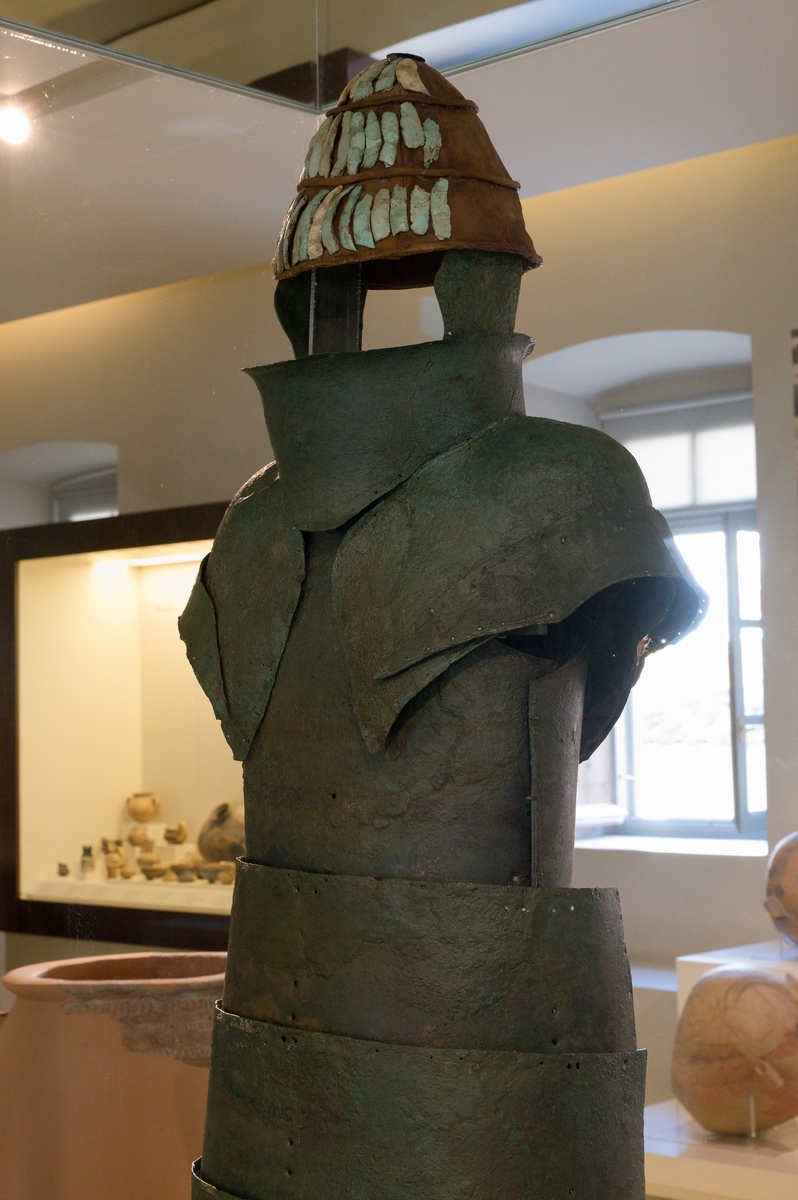
A Mycenaean bronze body armour known as the Dendra panoply, recovered from chamber tomb 12 in the cemetery of Dendra and displayed with a reconstructed boar's tusk helmet at the Archaeological Museum of Nafplio.
The stacked, slightly overlapping horizontal bronze bands forming the lower body of the panoply, each pierced with rivet holes along its edge and progressively widening toward the base.
02
Hammered torso plates
The front and side plates of the cuirass covering the chest and belly, their pitted green-brown patina and rivet line revealing the sheet-metal work and centuries of corrosion.
03
Articulated shoulder plates
The two large curved shoulder guards that overlap the chest plates, each a separate sheet of hammered bronze laced through rivet holes, demonstrating the armour's articulated construction and range of movement.
Your gallery guide
Dendra panoply by Maker unknown (End of 15th century BC)
A Mycenaean bronze body armour known as the Dendra panoply, recovered from chamber tomb 12 in the cemetery of Dendra and displayed with a reconstructed boar's tusk helmet at the Archaeological Museum of Nafplio.
Editorial review by Artifact Archive automated publishing
What you're looking at is a set of Mycenaean bronze body armour, known as the Dendra panoply. It was found in chamber tomb 12 in the cemetery of Dendra, a tomb called the cuirass tomb.
The armour dates to the end of the fifteenth century BC, and it belongs to the Mycenaean culture of Late Bronze Age Greece. With it is displayed a reconstructed boar's tusk helmet with bronze cheekpieces.
Look first at how the armour is built. Bronze plates overlap in horizontal bands, wrapping the torso rather than hanging as a single sheet.
The reconstructed helmet sits beside it, its rows of boar's tusk pieces now restored, with bronze cheekpieces framing the face opening.
The find spot matters for understanding what this object was. Chamber tomb 12 at Dendra is part of a Mycenaean cemetery, and the tomb's nickname, the cuirass tomb, comes directly from the armour found inside it.
The armour is dated to the end of the fifteenth century BC, placing it in the Late Bronze Age, when Mycenaean communities were building fortified centres and exchanging goods across the eastern Mediterranean.
The helmet is described as a reconstruction. Its boar's tusk elements and bronze cheekpieces are part of the display, not necessarily all ancient material recovered together with the bronze armour.
Keeping that distinction clear helps you read the case accurately: the bronze armour is the ancient object, while the helmet is a modern reconstruction associated with it.
The overlapping bronze bands aren't just a visual pattern. They show how the armour was engineered to protect a body in motion, distributing weight and allowing the wearer to move inside a rigid shell.
That design choice tells you this wasn't ceremonial jewellery. It was equipment made for a person who might need to fight while wearing it.
The armour and reconstructed helmet are held at the Archaeological Museum of Nafplio. Together they give you a rare, close look at Mycenaean protective gear from the end of the fifteenth century BC.
What stays with you is the practical intelligence of the object: bronze shaped into wearable defence, recovered from a tomb that still carries its name.
The story and its sources
Editorial review by Artifact Archive automated publishing.
Historical claims are linked to the records below. Close looking and interpretation are identified in the passage notes.
A set of Mycenaean bronze body armour with a reconstructed boar's tusk helmet, recovered from chamber tomb 12 (the cuirass tomb) in the Mycenaean cemetery of Dendra.
Title variants
Bronze armour, so called Dendra panoply, AM of nafplio, 202231
Attribution qualification
Maker unknown; the supplied sources do not name a creator.
Dimensions
Unknown
Catalogue identity
The object catalogued here is bronze armour known as the Dendra panoply, dated to the end of the fifteenth century BC. That date places the armour in the Late Bronze Age, and the object is assigned to the Mycenaean culture. Both the identification and the dating come from the Wikimedia Commons record for the photograph under which the armour is catalogued, so the catalogue title itself carries a qualification: the entry is listed as bronze armour that is "so called" the Dendra panoply, meaning the familiar name is a conventional label rather than a term recovered from the object or from an ancient text. The record is a file-level description of a photograph of the object in the Archaeological Museum of Nafplio, not a full excavation report or a museum catalogue entry, and it supplies identification, find context, date and collection information in that capacity. The physical character of the object, bronze armour, and its date near the end of the fifteenth century BC are the two pieces of information on which the identity of the piece primarily rests.(Zde, 2021, File title and Description; Description and Captions; Description)
The find context recorded for the armour is specific: it comes from the Mycenaean cemetery of Dendra, chamber tomb 12, a tomb called the cuirass tomb. The nickname of the tomb is tied to the armour found inside it, so the object has effectively named its own find spot. That detail matters for the catalogue because it joins the object to a particular burial within a particular cemetery rather than to a general region or period, and it explains why the armour is conventionally referred to as a panoply: the surviving record associates the bronze pieces with a single tomb group. The record consulted is a partially consulted, open access Wikimedia Commons file page, so the find information is reported there rather than established from an excavation publication.(Zde, 2021, Description; File title and Description)
The Wikimedia Commons record consulted carries the object title "Bronze armour, so called Dendra panoply, AM of nafplio, 202231.jpg" and was published in 2021 as a file page. The associated free-licence photograph was taken by Zde on 25 September 2020 and uploaded on 4 January 2021. Those later dates belong to the photograph and its upload, not to the object. The armour itself is dated to the end of the fifteenth century BC, roughly three and a half thousand years earlier than the image. The filename's "AM of nafplio" element and the number 202231 are identifiers in that file title, while the object's own accession identifiers are given by the source as a Wikimedia Commons photograph file: the record is context metadata rather than a museum registration number, and the file title is not an accession number in a museum register.(Zde, 2021, File title and Description)
The catalogue record links the armour to a reconstructed boar's tusk helmet with bronze cheekpieces, and both the armour and the reconstructed helmet are held at the Archaeological Museum of Nafplio. The helmet is described explicitly as a reconstruction, and it is displayed with the armour rather than being documented as ancient material recovered together with the bronze pieces. Boar's tusk elements and the bronze cheekpieces belong to the reconstructed display, whereas the bronze armour is the ancient object. This distinction, between the ancient armour and the modern reconstruction accompanying it in the museum case, is the qualification to preserve when the object's identity is cited: the helmet is associated with the armour in the catalogue, but the armour is what the find record documents.(Zde, 2021, File title and Description; Description)
Interpretation
Read together, the evidence establishes a set of catalogue facts without resolving every question a museum entry would normally answer. The object is bronze armour; its customary name is the Dendra panoply; it is Mycenaean; it is dated to the end of the fifteenth century BC; it comes from chamber tomb 12 of the Mycenaean cemetery at Dendra, the cuirass tomb; it shares a display setting at the Archaeological Museum of Nafplio with a reconstructed boar's tusk helmet with bronze cheekpieces; and the surviving record of it is a freely licensed photograph taken by Zde in 2020 and uploaded in 2021. The record consulted does not supply dimensions, inscriptions, or a fuller inventory history, and its identification rests on the photograph and file description rather than on a technical publication, a fact worth keeping visible when the armour is cited.(Zde, 2021, File title and Description; Description and Captions; Description)
The object is bronze armour known as the Dendra panoply.(Zde, 2021)
The armour is dated to the end of the fifteenth century BC.(Zde, 2021)
The object is a set of Mycenaean bronze body armour conventionally called the Dendra panoply, recovered from the Mycenaean cemetery of Dendra in chamber tomb 12, a tomb known as the cuirass tomb because of this find. The armor is assigned to the end of the fifteenth century BC, in the Late Bronze Age, and it belongs to the Mycenaean culture. The find spot and the object's name are therefore inseparable: the nickname of the tomb derives directly from the armour it contained, so the burial context is part of the identification of the piece rather than a separate piece of background. Securely placing the panoply in the Mycenaean cemetery of Dendra and in chamber tomb 12 does not by itself settle the circumstances of its commissioning or the identity of its owner, and the evidence supplied here does not document those circumstances.(Zde, 2021, Description)
The armour comes from the Mycenaean cemetery of Dendra, chamber tomb 12, called the cuirass tomb.(Zde, 2021)
The Dendra panoply belongs to the Mycenaean culture.(Zde, 2021)
The armour and its associated reconstructed helmet
A reconstructed boar's tusk helmet with bronze cheekpieces is associated with the bronze armour. The helmet is described as a reconstruction, and the association between the two objects is the relationship the evidence establishes, not a claim that the boar's tusk elements and bronze cheekpieces were recovered together with the armour as one ancient deposit. The armour itself is the ancient object in the display; the helmet is a modern reconstruction associated with it. Keeping that distinction clear is the necessary first step for reading every other material and technical statement about the group, because the two objects do not stand on the same evidential footing.(Zde, 2021, Description)
What the evidence directly establishes about the helmet is limited to its character as a reconstruction and to two named components: rows of boar's tusk pieces, now restored, and bronze cheekpieces that frame the face opening. The boar's tusk elements and the bronze cheekpieces are part of the display rather than necessarily ancient material recovered together with the bronze armour. No further detail about the helmet's construction, the source of its tusk pieces, or the method of its restoration is supplied, so those matters remain outside what the evidence can settle. The reconstructed helmet is held, together with the armour, at the Archaeological Museum of Nafplio, which is where the association between the two is presented.(Zde, 2021, Description)
The evidence identifies the object as bronze armour known as the Dendra panoply, and the material of the armour is therefore bronze. The helmet associated with it carries bronze cheekpieces alongside its boar's tusk elements. Beyond these named materials, no support, pigment, preparation layer, tool or making technique is documented in the supplied evidence. Technical examination is not reported here; the material statements the evidence supports are the bronze of the armour and the bronze and boar's tusk components of the reconstructed helmet. Claims about how the metal was worked, cast, raised or joined would go beyond what these units establish.(Zde, 2021, Description)
Find context, date and collection
The armour comes from the Mycenaean cemetery of Dendra, from chamber tomb 12, called the cuirass tomb, and the tomb's nickname derives directly from the armour found inside it. The find context places the bronze armour within a Mycenaean burial setting rather than an isolated or undocumented one, and the armour is dated to the end of the fifteenth century BC, in Late Bronze Age Greece. That dating is the chronological frame the evidence establishes for the armour, and it is the frame within which its material character as bronze body defence is presented. The Dendra panoply belongs to the Mycenaean culture, and the object and reconstructed helmet are held at the Archaeological Museum of Nafplio.(Zde, 2021, Description)
The freely licensed photograph through which this record documents the object and reconstructed helmet was taken by Zde on 25 September 2020 and uploaded on 4 January 2021. The Wikimedia Commons record supplies the identification, find context, date and collection information for the group, and the publication year attached to the photograph is 2021. The photographic date is a fact about the modern documentation of the display and carries no bearing on the ancient date of the armour; the two chronologies should not be conflated. This is the evidence base on which the material description of the group rests, and it is a record of the objects as displayed rather than a technical examination report.(Zde, 2021, Description)
A reconstructed boar's tusk helmet with bronze cheekpieces is associated with the bronze armour.(Zde, 2021)
The photograph of the Dendra panoply and its associated reconstructed helmet held at the Archaeological Museum of Nafplio was taken by Zde on 25 September 2020 and uploaded to Wikimedia Commons on 4 January 2021 under a free licence. This dating matters for reception history because it fixes the moment at which a high-quality, openly reusable image of the display entered circulation, a stage distinct from the object's excavation and from its museum installation. The uploader is credited as the photographer, and the institutional setting recorded is the Archaeological Museum of Nafplio, where the bronze armour and reconstructed helmet are held. The Wikimedia Commons record is the source for this image history and for the object's identification, find context, date and collection information, but its consultation is partial, so the account below is limited to what that record and its metadata establish.(Zde, 2021, File history and Metadata)
The freely licensed photograph of the object and reconstructed helmet was taken by Zde on 25 September 2020 and uploaded on 4 January 2021.(Zde, 2021)
The bronze body armour known as the Dendra panoply is held, together with a reconstructed boar's tusk helmet fitted with bronze cheekpieces, at the Archaeological Museum of Nafplio. That museum location is the one point of current custody and display that the available record documents directly; it establishes where the armour and the associated reconstruction can now be seen, but it does not by itself describe how they are arranged in the galleries or how the display has changed over time. The photograph through which the object is chiefly represented in this record, taken by Zde in the museum on 25 September 2020 and uploaded on 4 January 2021, is itself part of that display history: it shows the armour and the reconstructed helmet as they stood in the Nafplio case at that date, and the Wikimedia Commons file documentation supplies the identification, find context, date and collection information that frame them.(Zde, 2021, Description and Structured data)
The object is identified in the record as the Dendra panoply, bronze armour belonging to the Mycenaean culture of Late Bronze Age Greece and dated to the end of the fifteenth century BC. It comes from the Mycenaean cemetery of Dendra, specifically chamber tomb 12, which is called the cuirass tomb. The tomb's nickname is therefore not an independent piece of evidence about the armour but a name derived from the armour found inside it, so the designation and the find are bound together in the same account. The helmet displayed with the armour is described as a reconstruction: its boar's tusk elements and bronze cheekpieces are part of the display, not necessarily all ancient material recovered together with the bronze armour. That distinction is the qualification the record asks the viewer to keep in mind, since the bronze armour is the ancient object while the helmet is a modern reconstruction associated with it; the record does not specify which, if any, of the helmet components are ancient, and it does not treat the reconstruction as an original find of the tomb.(Zde, 2021, Description and Structured data)
The armour and reconstructed helmet are held at the Archaeological Museum of Nafplio.(Zde, 2021)
The bronze body armour known as the Dendra panoply belongs to the Mycenaean culture of Late Bronze Age Greece and is dated to the end of the fifteenth century BC. It was recovered from chamber tomb 12 within the Mycenaean cemetery of Dendra, a tomb that carries the nickname the cuirass tomb because of the armour found inside it. The find context is not incidental to the object's identity: the tomb's name, the cemetery, and the Late Bronze Age date are the primary facts that anchor both its archaeological description and every subsequent valuation or interpretive statement made about it. The armour is held, together with a reconstructed boar's tusk helmet with bronze cheekpieces, at the Archaeological Museum of Nafplio. Photographic documentation of the armour and the reconstructed helmet in that museum was made by Zde on 25 September 2020 and uploaded on 4 January 2021 under a free licence, which is how the object and its display arrangement have circulated to audiences beyond Nafplio.(Zde, 2021)
The reconstructed helmet displayed alongside the bronze armour requires a qualification that shapes how the whole display should be read. The helmet is described as a reconstruction: its rows of boar's tusk pieces and its bronze cheekpieces are part of the museum display and are not necessarily ancient material recovered together with the bronze armour. Keeping that distinction clear means the ancient object in the case is the bronze armour itself, while the helmet is a modern reconstruction associated with it. This matters for the accumulating record because descriptions that treat armour and helmet as a single recovered assemblage would overstate what the excavation context establishes, and because the reconstruction is exactly the element that makes the display legible as a complete panoply rather than as a set of bronze plates.(Zde, 2021)
Form, construction and the question of use
The form of the armour is described through its construction: bronze plates overlap in horizontal bands and wrap the torso rather than hanging as a single sheet. The overlapping bands are not only a visual pattern; they are presented as evidence of how the armour was engineered to protect a body in motion, distributing weight and allowing the wearer to move inside a rigid shell. On that reading, the design points to equipment made for a person who might need to fight while wearing it rather than to ceremonial jewellery. This is an attributed interpretation of function drawn from the object's construction, and it should be weighed as such: the physical arrangement of overlapping bands is the observation, while the inference about mobility, weight distribution and combat use is the explanation built on it. The reconstructed helmet, with its restored rows of boar's tusk pieces and bronze cheekpieces framing the face opening, supports the same reading of the display as protective gear.(Zde, 2021)
Recorded value and its limits
The recorded valuation evidence for the object is a working insurance estimate with a range of US$1M to US$5M, generated as a model working calculation dated 16 October 2026. The stated methodology calculates the range conservatively from the confirmed context: a unique Mycenaean bronze panoply with reconstructed boar's tusk helmet and bronze cheekpieces, dated to the end of the fifteenth century BC, recovered from chamber tomb 12 at Dendra, and held by the Archaeological Museum of Nafplio. Because the object is described as a rare, culturally significant, institutionally held archaeological artifact with no named maker and no public sale record, the range is anchored on the high material, research and exhibition value of comparable ancient bronze armour, adjusted upward for its unique and iconic status and downward for the absence of a documented market transaction. The range is deliberately broad to support manual review and should not be treated as a precise market estimate.(Zde, 2021)
The qualification attached to that figure is as consequential as the figure itself. It is a model-generated working insurance range for manual review only; it is not an official insurance value, appraisal, auction result or sale price, and it has not been verified by a qualified appraiser or insurer. The calculation does not rely on comparable sales, private insurance records or any other non-public valuation data, and the recorded note states that actual insurance coverage, if any, should be determined by a professional appraisal and the collecting institution's policy terms. The absence of a documented market transaction is therefore not a gap that further research can simply fill in the same terms, because the object's institutional holding is one of the premises of the estimate rather than a missing sale.(Zde, 2021)
Weighing the accounts
Taken together, the accounts establish a clear division between what can be described with confidence and what is attributed or provisional. The identification of the object as Mycenaean bronze armour, its find context in chamber tomb 12 at the cemetery of Dendra, its date at the end of the fifteenth century BC, its association with a reconstructed boar's tusk helmet with bronze cheekpieces, and its present holding at the Archaeological Museum of Nafplio form a stable core. The engineering rationale for the overlapping bands, the inference that the armour was made for combat rather than ceremonial display, and the insurance range of US$1M to US$5M all belong to a different evidential register: they are reasoned accounts built on that core, offered with explicit qualifications. Placing the Dendra panoply within a larger history of art and material culture depends on keeping those registers distinct, because the object's significance rests on its rarity, its cultural attribution and its institutional preservation rather than on any documented transaction, and its interpretation as wearable defence rests on the construction of the object itself rather than on external testimony about its use.(Zde, 2021)
Working estimate
Calculated working insurance estimate, not a sale price: Estimated value: US$1M to US$5M Recorded date: Working calculation, generated 2026-10-16. Methodology: Working insurance range calculated conservatively from the confirmed context: a unique Mycenaean bronze panoply with reconstructed boar's tusk helmet and bronze cheekpieces, dated to the end of the 15th century BC, recovered from chamber tomb 12 at Dendra, and held by the Archaeological Museum of Nafplio. Because the object is a rare, culturally significant, institutionally held archaeological artifact with no named maker and no public sale record, the range is anchored on the high material, research, and exhibition value of comparable ancient bronze armour, adjusted upward for its unique and iconic status and downward for the absence of a documented market transaction. The range is deliberately broad to support manual review and should not be treated as a precise market estimate. Qualification: This is a model-generated working insurance range for manual review only. It is not an official insurance value, appraisal, auction result, or sale price, and it has not been verified by a qualified appraiser or insurer. It does not rely on comparable sales, private insurance records, or any non-public valuation data. Actual insurance coverage, if any, should be determined by a professional appraisal and the collecting institution's policy terms.(Zde, 2021)
Bibliography
Sources and further reading
References are arranged by author or organisation, with links to the original publications. Where no publication date is recorded, n.d. means no date.
Source notes updated .
No recorded sources match these filters. Reset the filters to see the full bibliography.
01
Secondary · About this artwork
Zde (2021).Wikimedia Commons: Dendra panoply. File:Bronze armour, so called Dendra panoply, AM of nafplio, 202231.jpg. Wikimedia Commons.
Wikimedia Commons record for a photograph of the Dendra panoply and reconstructed boar's tusk helmet in the Archaeological Museum of Nafplio; supplies identification, find context, date and collection information.
Advertising supports the archive. These preferences control aggregate page counting, reading activity and ad-delivery diagnostics. They use no visitor tracking cookie.