ArchiveComposition VII

Artwork record / 84 of 184

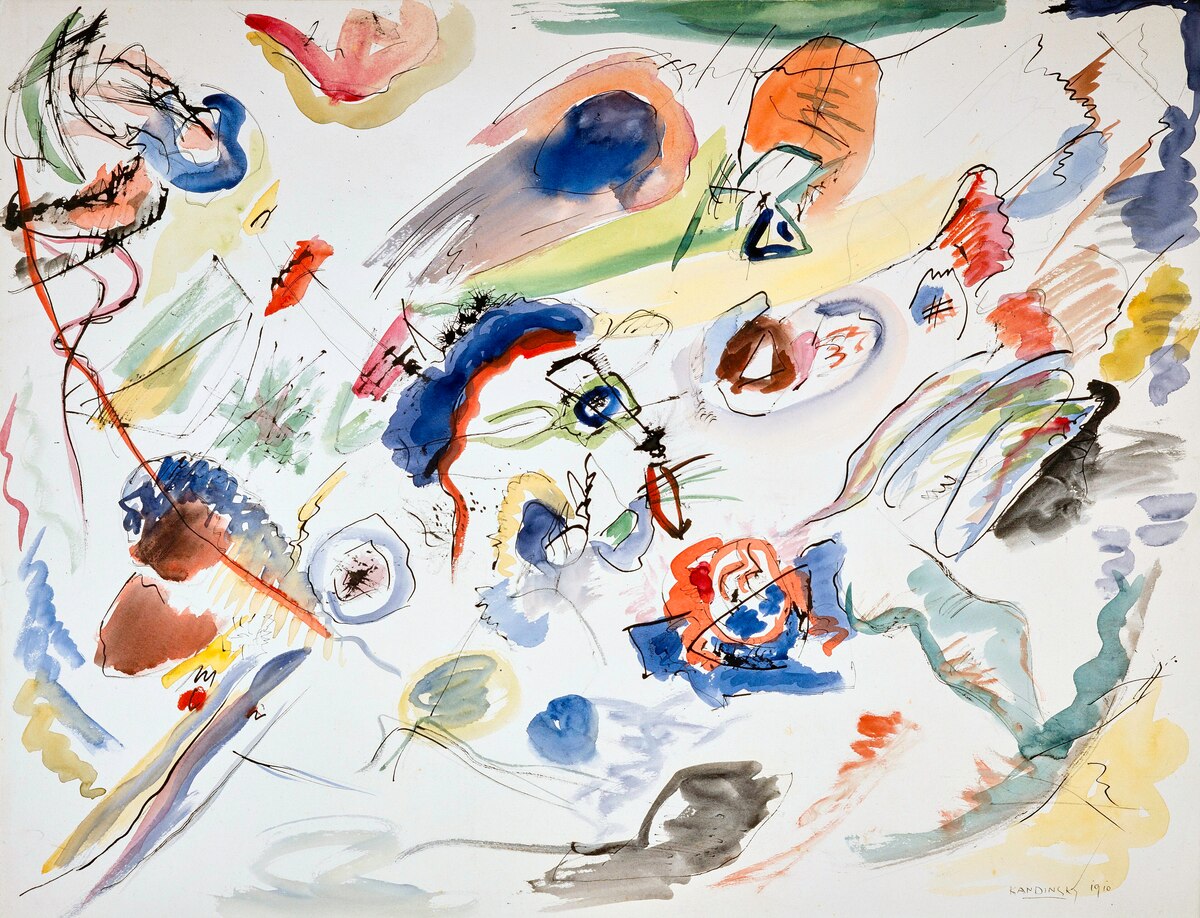
Composition VII by Wassily Kandinsky (1913)

Artist: Wassily Kandinsky

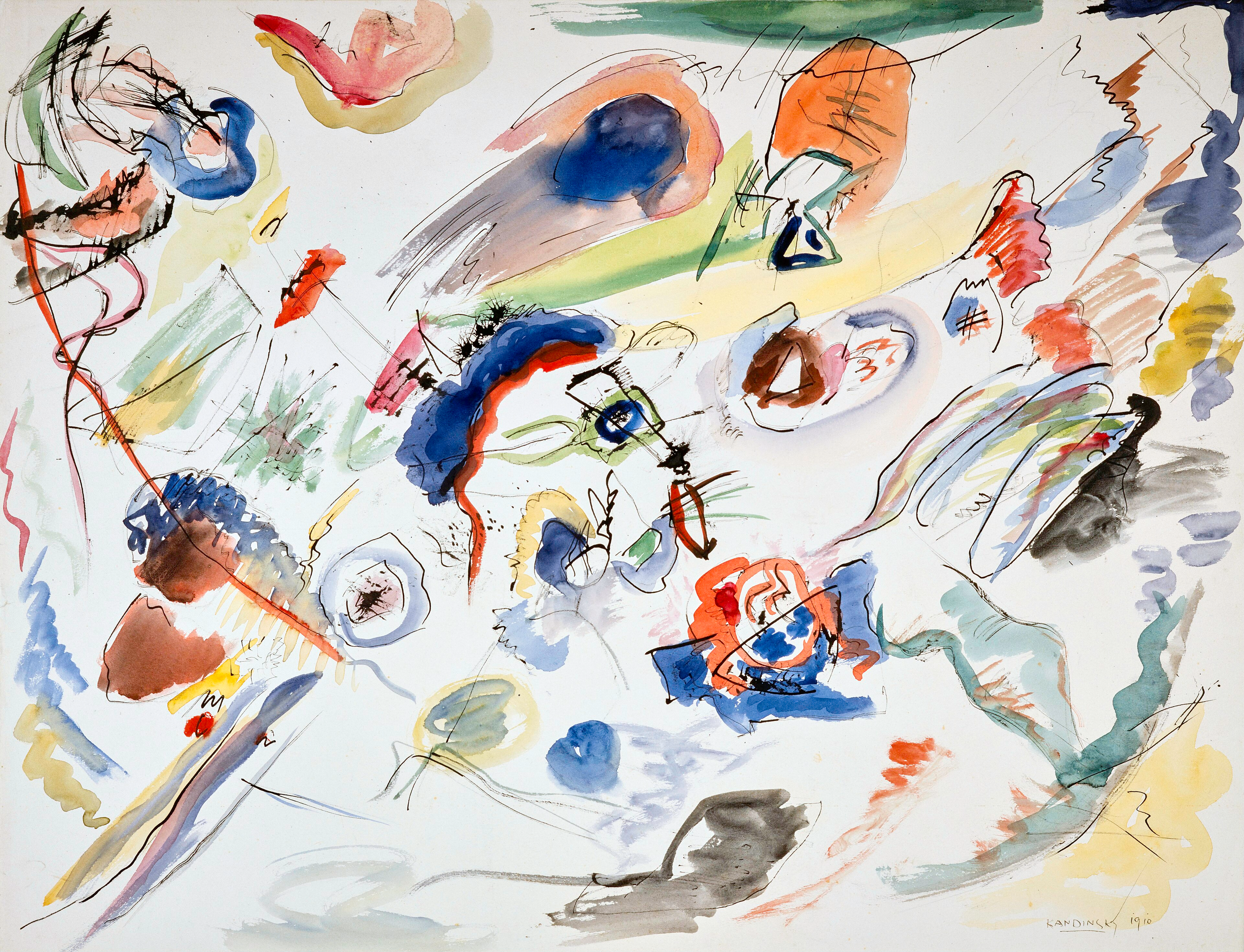
A gallery tour of Kandinsky's 1913 watercolour and ink study on paper, associated with Composition VII and described in the supplied record as the first abstract watercolour. The tour distinguishes what the object record documents from later attributions and notes where provenance, exhibition history and technical analysis are unknown.

Read the story ↓ About the artist ↓ Research and record ↓ Literature and sources ↓ Listen to the article ↓
Article text for AI
0 visits
Date1913CultureRussian-Soviet / French PeriodAbstract art (early twentieth-century abstraction)Current locationMusée National d'Art Moderne, Centre national d'art et de culture Georges-Pompidou, Paris, France
Listen to the article
100%
Composition VII by Wassily Kandinsky (1913)
Loading full-resolution artwork…
Scroll to zoom · drag to pan · double-click to focus Pinch to zoom · drag to explore · double-tap to focus FIELD VIEW / 84
Tools & download
Pixel colour Select a pixel with the eyedropper
No pixel selected

Choose the eyedropper, then click or tap the image. Scroll to zoom for finer selection.

Add text

Hand to pan · Select to move text and drawings · Add as many texts as you like · Scroll to zoom

Composition VII: high-resolution image

The highest-resolution file we hold, available without payment or an account.3,840 × 2,939 pixels.

Download highest-resolution image

Details to notice

About 3 minutes to read
01

Signature and date inscription

The hand-lettered inscription 'KANDINSKY 1910' at the lower right edge of the sheet. It is the primary documentary evidence on the object itself and the starting point for the debate over whether the work belongs to 1910 or was later re-dated to around 1913.

02

Upper left ink knot with blue crescent

A tangle of scratched black ink lines with a blue crescent and green accents near the upper left corner. It shows the artist's rapid hand at its most improvisatory, the drawn gesture preceding or overriding the painted wash, which is central to the sheet's documentary interest.

03

Lower red and blue rosette

A tightly wound rosette of brick red and indigo framed by angular black lines and blue washes in the lower middle of the sheet. It reads almost as a flower or a wheel, concentrating the warmest colour on the canvas and providing the strongest chromatic contrast to the cool blocs above it.

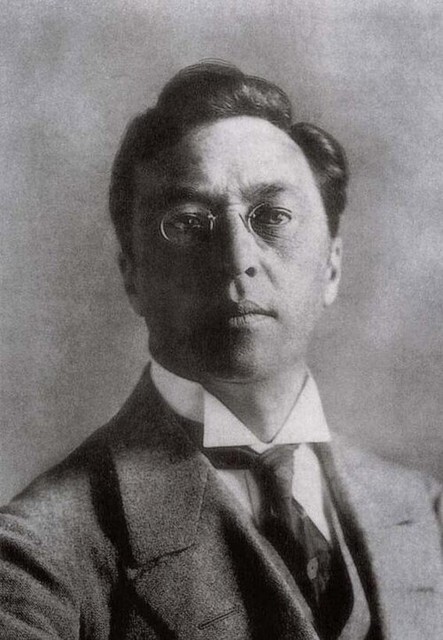
Artist portrait of Wassily Kandinsky
Artist portrait Image credit

未知上傳者. Image source · Public domain

About the artist

Wassily Kandinsky

1866 to 1944

Wassily Kandinsky was an avant-garde painter of Russian origin (1866–1944). Their work is associated with Expressionism; Symbolism; Bauhaus. Their recorded places of work include Paris; Munich; Weimar; Rapallo; The Hague; Russia; Stockholm; Switzerland; Tunis.

Born
1866
Died
1944
Nationality
Russian Empire; Russian Soviet Federative Socialist Republic; Soviet Union; France; Germany
Birthplace
Moscow
Died in
Neuilly-sur-Seine

The research & record

Study the work.
Follow the evidence.

Find catalogue details, historical context, technical research and the literature behind this artwork.

Article text for AI
Open research text

The artwork record

Research catalogue

Catalogue information and detailed research, with references that link to the bibliography.

Updated .

Identity and catalogue

Link
Title
Composition VII
Artist or attribution
Wassily Kandinsky(Wikimedia Commons: Composition VII, n.d.)
Medium and support
Mine graphite, encre de Chine et aquarelle sur papier (graphite pencil, India ink, and watercolour on paper)(Wikimedia Commons: Composition VII, n.d.)
Dimensions
height: 49.6 cm (19.5 in); width: 64.8 cm (25.5 in)(Wikimedia Commons: Composition VII, n.d.)
Current collection or location
Musée National d'Art Moderne, Centre national d'art et de culture Georges-Pompidou, Paris, France(Wikimedia Commons: Composition VII, n.d.)
Movement or period
Abstract art (early twentieth-century abstraction)
Country or culture
Russian-Soviet / French
Depicted subject
A non-objective watercolour and ink study on paper, described in the supplied institutional record as the first abstract watercolor, painted by Wassily Kandinsky in 1913 and connected to the making of Composition VII.(Wikimedia Commons: Composition VII, n.d.)
Title variants
Untitled; Sans titre; Sans titre (Etude pour Composition VII, Première abstraction); Primo acquarello astratto; First abstract watercolor
Accession number
AM 1976-864(Wikimedia Commons: Composition VII, n.d.)
Inscriptions
KANDINSKY 1910
Catalogue identity and date

The sheet under discussion is catalogued as a work by Wassily Kandinsky, whose life dates the supplied file record gives as 1866 to 1944. The record assigns it to two object-type categories, painting and watercolor painting, and to the genre of abstract art, so the catalogue describes it at once as a painted image and as a work in water-based colour on a support. The same record dates the sheet to 1913 and describes it as the first abstract watercolour painted by Kandinsky. That phrasing belongs to the institutional record as the source reports it rather than to an independent finding, and it carries a large claim about priority in the history of abstraction on paper. The record also places the sheet within Kandinsky's work of preparation by linking it to Composition VII under the French designation Etude pour Composition VII, Première abstraction, a link that appears in the file title and underlies the work's double identity as both an independent abstract watercolour and a study.(Wikimedia Commons: Composition VII, n.d., Summary, Artist; Summary, Object type and Genre; Summary, Description and Date; File title)

Because the sheet is abstract in genre, the record offers no depicted episode to date: there is no narrative or historical event whose moment could be fixed separately from the making of the work. The relevant date is therefore the making of the object itself, given as 1913, the same year in which the sheet's identification as a study for Composition VII places it in the run-up to that larger composition. The title variants preserved in the record pull in two directions at once. One strand files the work as Untitled, while another attaches the French designation Etude pour Composition VII, Première abstraction, and the descriptive phrase identifying it as the first abstract watercolour adds a third layer of naming. The coexistence of an untitled catalogue entry with a French study title matters for research because it shows that the sheet's place in Kandinsky's practice has been described both as a free abstract work and as a preparatory step towards a specific larger picture, and the record does not resolve which description should govern.(Wikimedia Commons: Composition VII, n.d., Summary, Description and Date; File title)

Medium, format and collection

The supplied record specifies the medium as mine graphite, India ink, and watercolour on paper, and states that the work is on paper, as an aquarelle sur papier. It gives the sheet dimensions as 49.6 centimetres high by 64.8 centimetres wide, a horizontal format of considerable size for a work on paper. The record names the Musée National d'Art Moderne, part of the Centre national d'art et de culture Georges-Pompidou in Paris, as the holding collection, and files the sheet under the accession number AM 1976-864 and the category Untitled, AM 1976-864, Wassily Kandinsky. These are the elements that make the object citable: artist, title variants, date, medium, support, measurements, repository and accession number. The accession number and the institutional name come from a Wikimedia Commons file record rather than from direct consultation of the museum's own catalogue, and Commons functions here as a discovery aid whose description does not override exact institutional evidence. The record supports the object's placement in a public collection, but it does not document when the sheet entered the museum.(Wikimedia Commons: Composition VII, n.d., Summary, Object type and Genre; Summary)

The supplied file record names Wassily Kandinsky (1866-1944) as the artist of this sheet.(Wikimedia Commons: Composition VII, n.d.)

The supplied record gives the object type as painting and watercolor painting, and the genre as abstract art.(Wikimedia Commons: Composition VII, n.d.)

The supplied record dates this sheet to 1913 and describes it as the first abstract watercolour, painted by Wassily Kandinsky.(Wikimedia Commons: Composition VII, n.d.)

Historical context

Link
The object record and its terms

The single supplied record for this sheet identifies the artist as Wassily Kandinsky (1866–1944), dates the work to 1913, and gives its object type as both painting and watercolor painting within the genre of abstract art. It lists the medium as mine graphite, India ink, and watercolor on paper, and states specifically that the work is on paper, an aquarelle sur papier. The sheet measures 49.6 centimetres high by 64.8 centimetres wide. The record files it under the accession number AM 1976-864 and the category Untitled, AM 1976-864, Wassily Kandinsky, and names the Musée National d'Art Moderne, part of the Centre national d'art et de culture Georges-Pompidou in Paris, as the holding collection. These are the concrete, checkable coordinates of the object: artist, date, support, media, dimensions, accession number, and repository.(Wikimedia Commons: Composition VII, n.d., File title)

The record links the sheet to Composition VII as a study, using the French designation Etude pour Composition VII, Première abstraction, and separately describes it as the first abstract watercolour, painted by Kandinsky. The French designation names the sheet as a study for a larger composition and as a premiere abstraction, while the description as the first abstract watercolour ties the sheet to a broader claim about the history of abstraction. Both formulations come from the supplied institutional record; they are attributed positions rather than independently established facts in the evidence at hand. The designation as a study situates the work within the preparation for a larger composition, and the premiere abstraction label situates it within a narrative about priority in the emergence of abstract painting. The record does not supply the internal reasoning by which the institution arrived at either formulation.(Wikimedia Commons: Composition VII, n.d., File title)

What the record does not establish

Interpretation

Read together, the supplied evidence supports a description of the sheet as an untitled 1913 work on paper in graphite, India ink, and watercolour, held in Paris under the accession number AM 1976-864, and connected in the institutional record to Composition VII as a study and to the claim that it is the first abstract watercolour. The accession number records the fact of museum custody without recording when or how that custody began. The designation as a study identifies a relationship to another composition rather than an autonomous finished status, and the premiere abstraction label identifies a claim about historical priority. Because the record supplies neither provenance nor reception nor technical analysis, the sheet remains anchored to what the object record can establish: its maker, its date, its materials, its dimensions, its accession number, and its repository.(Wikimedia Commons: Composition VII, n.d., File title; Summary)

The supplied record links this sheet to Composition VII as a study, using the French designation Etude pour Composition VII, Première abstraction.(Wikimedia Commons: Composition VII, n.d.)

Materials and technique

Link
Support, medium and sheet

The supplying record describes this sheet by its medium as mine graphite, India ink, and watercolour on paper, and it gives the support separately in French as an aquarelle sur papier, a watercolour on paper. The two statements are consistent and together establish that a single paper support carries three distinct drawing and painting media: a dry graphite drawing instrument, a black ink, and a water based colour. That combination is consequential for how the image was made. Graphite and ink are linear media that deposit on the surface of the sheet and hold an edge; watercolour is a wash medium whose tone is built from diluted pigment carried in water. The record therefore does not describe a single technique but a layered one, in which drawn line and painted wash are used together on the same sheet. The record does not identify the paper type, its weight, its manufacture or any watermark, and it does not state whether the sheet was prepared, stretched, or left untreated before work began; those questions remain outside what the supplied evidence can settle.(Wikimedia Commons: Composition VII, n.d., Summary, Medium)

The sheet measures 49.6 centimetres high by 64.8 centimetres wide, a landscape format roughly half a metre across. That is a working scale rather than a monumental one, and it is consistent with a watercolour and drawing made on paper that has to be handled flat. Recording both dimensions matters for the material description because it fixes the area available to the composition and distinguishes this work from small sketchbook sheets on the one hand and from large canvases on the other. Within the supplied evidence the dimensions are given as a documented measurement of the object itself; no mount, frame or later addition is mentioned, so the figure can be read as the sheet as recorded.(Wikimedia Commons: Composition VII, n.d., Summary, Dimensions)

The supplied record lists the medium as mine graphite, India ink, and watercolour on paper.(Wikimedia Commons: Composition VII, n.d.)

The supplied record gives the sheet dimensions as 49.6 centimetres high by 64.8 centimetres wide.(Wikimedia Commons: Composition VII, n.d.)

The supplied record states that this work is on paper, as an aquarelle sur papier.(Wikimedia Commons: Composition VII, n.d.)

Condition and conservation

Link
The Absence of a Condition Record

The central negative finding for this section is easy to state but consequential for how the sheet can be discussed: the supplied record contains no condition report, no conservation treatment history, and no technical analysis for this sheet. That absence is not a small gap in a file that is otherwise complete. Condition evidence normally supplies the physical biography of a work on paper, recording such matters as the state of the support, the behaviour of the watercolour and ink layers, old mounts or hinges, losses, stains, restorations and the environmental regimes under which the object has been kept. None of that is present here. What survives instead is the object record, which establishes what the sheet is, what it is made of and how large it is, and which therefore sets the terms within which any future condition or conservation account would have to be framed.(Wikimedia Commons: Composition VII, n.d., Summary)

Interpretation

Because there is no dated condition observation, damage report or intervention record, no statement can responsibly be made about how this sheet looks today. Any description of its present surface, its stability, or the condition of its paper must be treated as unknown on the supplied evidence. This matters especially for a work executed in watercolour, India ink and graphite on paper, since paper supports are exposed to light, handling, mounting and environmental fluctuation in ways that woven-canvas supports are not, and the history of those exposures is exactly what a condition file would record. The absence of such a file does not mean the sheet is undamaged or untreated; it means the record supplied here does not establish either possibility.(Wikimedia Commons: Composition VII, n.d., Summary; Summary, Medium)

Custodial and Documentary Limits

Read together, the supplied units describe a sheet dated in the record to 1913, attributed to Wassily Kandinsky, identified as a study linked to Composition VII under the French designation Etude pour Composition VII, Première abstraction, and described as the first abstract watercolour. It is a work on paper measuring 49.6 by 64.8 centimetres, executed in graphite, India ink and watercolour, held by the Musée National d'Art Moderne under AM 1976-864. Within the terms of this section, the honest synthesis is that the object is documented as a thing made and as a thing collected, while its physical history after making is undocumented in the supplied material. The condition and conservation account of this sheet is therefore, at present, an account of missing evidence, bounded by what the object record can securely establish about materials, support and format.(Wikimedia Commons: Composition VII, n.d., Summary; Summary, Medium; Summary, Dimensions)

The supplied record contains no condition report, conservation treatment history, or technical analysis for this sheet.(Wikimedia Commons: Composition VII, n.d.)

Provenance and ownership

Link
Documented Holdings and the Limits of the Record

The supplied record for this sheet contains no provenance, ownership history, sale record, or price, and it does not state when the work entered the Musée National d'Art Moderne. That absence is a property of the documentation rather than a finding about the object: it means the acquisition route, any earlier private or dealer holdings, and any transfer of title remain unrecorded in the evidence available here. The only collection information the record does establish is the current holding institution, the Musée National d'Art Moderne, part of the Centre national d'art et de culture Georges-Pompidou in Paris, and the accession number AM 1976-864, under which the sheet is filed in the category Untitled. The accession number is the most concrete provenance-adjacent datum supplied, but the record does not interpret its components or give the date or mechanism by which the number was assigned, so it should be treated as an identifier rather than as a documented transaction. An unrecorded interval is not the same as a proven change of ownership, and nothing in this evidence licenses a narrative of prior owners or a date of entry.(Wikimedia Commons: Composition VII, n.d., Summary)

A separate strand of provenance in the record concerns the digital file rather than the physical sheet. The image was uploaded by a Wikimedia Commons user and subsequently modified for colour balance. This is file-level history: it describes the derivation of the reproduction circulated online, not the ownership, transfer, or condition of the paper object. The distinction matters for research use because any colour judgment made from the online image is mediated by that adjustment, while the sheet's own material identity, as recorded, remains a work on paper, an aquarelle sur papier, dated 1913, with medium listed as mine graphite, India ink, and watercolour on paper and dimensions of 49.6 by 64.8 centimetres. Those object-level facts come from the same record whose provenance section is empty, so the record is informative about what the sheet is and where it now resides while being silent about how it got there.(Wikimedia Commons: Composition VII, n.d., File history)

Interpretation

The research value of this sheet accordingly rests on a narrow but firm evidential base: a 1913 date, a named artist, a defined medium and support, measured dimensions, and a current public collection with an accession number, set against a documentation that supplies no reception history, exhibition history, or critical literature and no condition report, conservation treatment history, or technical analysis. Because the record is silent on those fronts, claims about the sheet's reception, its exhibition career, or its physical treatment cannot be advanced from this evidence, and the absence should be preserved rather than filled with inference. What the record does support is a reading of the sheet as an early working through of abstraction on paper, described in the record as the first abstract watercolour and as a study for Composition VII, which places it within the preparation for that larger composition and makes it a document of process as much as a finished image. The qualification is that the phrase first abstract watercolour belongs to the supplied institutional record and carries a large historical claim; it is best cited as an attributed designation, while the museum's accession number and the associated untitled category remain the most verifiable provenance facts available for future research.(Wikimedia Commons: Composition VII, n.d., Summary; File history)

The supplied record supplies no provenance, ownership history, sale record, or price for this sheet, and does not state when it entered the Musée National d'Art Moderne.(Wikimedia Commons: Composition VII, n.d.)

The supplied record notes that the digital file was uploaded by a Wikimedia Commons user and modified for colour balance, which concerns the image file rather than the physical sheet.(Wikimedia Commons: Composition VII, n.d.)

Reception and literature

Link
The Limits of the Reception Record

The supplied record for this sheet carries an explicit warning about its own limits: it gives no reception history, exhibition history, or critical literature for the work. Any account of how the sheet was received, exhibited, reproduced or discussed must therefore be built only from what the surviving record does establish, chiefly its identification of the object, its attribution and date, its medium and dimensions, its collection and accession number, and the French designation linking it to a larger composition. Because no named exhibition, reviewer, critic or biography is supplied, this section cannot document stages of admiration, imitation or literary reading; what it can do is set out precisely which later cultural roles the record supports and which it leaves open. The absence is itself a finding about the state of the evidence rather than a statement about the historical fate of the sheet.(Wikimedia Commons: Composition VII, n.d., Summary)

The Material Basis of Later Roles

Interpretation

Because the reception record is empty of named events, the most defensible account of this sheet's later cultural position is structural rather than anecdotal. It entered a national collection of modern art, where it is catalogued and preserved under a specific accession number; it circulates as a digital reproduction that has been adjusted for colour and described by a user-contributed platform; and it is attached to a story about abstraction through a descriptive label whose authority is institutional. What the record does not supply is any documented exhibition, critical reading, biographical treatment or public event, and the supplied evidence explicitly warns against assuming them. Within a larger history of art and material culture, the sheet's significance therefore lies in the intersection of a fragile working object on paper, a museum classification, and a reproduction history that can drift from the original. Each of those layers has its own evidentiary weight, and none of them should be collapsed into a single dramatic moment of discovery or acclaim.(Wikimedia Commons: Composition VII, n.d., Summary; File history)

The supplied record gives no reception history, exhibition history, or critical literature for this sheet.(Wikimedia Commons: Composition VII, n.d.)

Collection and display

Link
Collection and display

The sheet under discussion is documented as belonging to the Musée National d'Art Moderne, the modern art museum within the Centre national d'art et de culture Georges-Pompidou in Paris. Within that collection it is filed under the accession number AM 1976-864, and the corresponding category under which the record groups it is given as Untitled, AM 1976-864, Wassily Kandinsky. These two facts together establish both the institutional home of the work and the catalogue apparatus through which it is identified: the museum's numbering system and the artist's name are inseparable parts of the object's archival identity. The accession number itself is the only datum in the supplied record that points toward the mechanics of collection and display, since no other registration, storage, or display information is provided.(Wikimedia Commons: Composition VII, n.d., Summary, Collection; Hidden categories and footer category)

Interpretation

Taken together, these two units describe a sheet that is known first through an institutional record rather than through an unbroken history of ownership or exhibition. The record names a holding institution, a registration number and a filing category, but the same record supplies no provenance, no ownership history, no sale record or price, and does not state when the sheet entered the Musée National d'Art Moderne. Nor does it give any reception history, exhibition history or critical literature, and it contains no condition report, conservation treatment history or technical analysis. Consequently the collection and display account that can responsibly be given here is narrow: the object can be located within a named public collection and identified by a specific accession number and category, but the circumstances of its acquisition and the story of its public presentation remain undocumented in the material supplied. This asymmetry between a precise institutional identifier and an absent institutional narrative is itself a feature of the record and should be stated rather than smoothed over.(Wikimedia Commons: Composition VII, n.d., Summary, Collection; Hidden categories and footer category)

The supplied record names the Musée National d'Art Moderne, part of the Centre national d'art et de culture Georges-Pompidou in Paris, as the collection holding this sheet.(Wikimedia Commons: Composition VII, n.d.)

The supplied record files this sheet under the accession number AM 1976-864 and the category Untitled, AM 1976-864, Wassily Kandinsky.(Wikimedia Commons: Composition VII, n.d.)

Documented values and qualified estimates

Link
The object record and its limits

Interpretation

The sheet is recorded as a 1913 work by Wassily Kandinsky (1866-1944), executed in graphite pencil, India ink and watercolour on paper, measuring 49.6 by 64.8 cm. The record classifies the object as a painting and watercolour painting, with the genre given as abstract art, and files it under the French designation Sans titre (Etude pour Composition VII, Première abstraction). It is held by the Musée National d'Art Moderne, part of the Centre national d'art et de culture Georges-Pompidou in Paris, under accession number AM 1976-864. These are the identifying facts that anchor every other statement about the work: artist, date, medium, support, scale, collecting institution and inventory number all come from this single object record.(Wikimedia Commons: Composition VII, n.d.)

Because the support is paper, the image is flat and comparatively fragile next to a canvas, and the watercolour sits on the surface rather than soaking into woven cloth. The medium list also records graphite underdrawing and areas of India ink alongside the watercolour, so the sheet carries at least three distinct graphic and painterly substances. The description of the depicted content as abstract, without legible figures or landscape, is consistent with the record's genre classification; the graphite and ink passages can be read within that description as linear scaffolding that holds the watercolour areas together, while the watercolour supplies colour that does not resolve into familiar objects. This reading of how the media interact is an interpretation of the recorded medium and genre, not a separate documentation of the sheet.(Wikimedia Commons: Composition VII, n.d.)

Attributed claims about priority

The record describes this sheet as the first abstract watercolour and links it to Composition VII through the French designation Etude pour Composition VII, Première abstraction. Both statements are attributed to the supplied institutional record, not to independent technical or documentary verification. That attributed claim is what gives the object its historical weight: it positions the sheet within the preparation for a larger composition and, in the record's framing, within an early argument for what a picture could be without a depicted subject. The same record dates the making of the work itself to 1913, which is the relevant date here since there is no narrative episode depicted and therefore no separate event date.(Wikimedia Commons: Composition VII, n.d.)

The insurance estimate and its qualifications

The only valuation-type material supplied for this section is a model-generated working insurance range of US$25M to US$80M, recorded as a working calculation generated on 2026-10-16. The stated methodology builds the bracket from the confirmed context of the object record: Kandinsky, 1913, graphite pencil, India ink and watercolour on paper, 49.6 by 64.8 cm, Musée National d'Art Moderne, accession AM 1976-864, treated as an early twentieth-century abstract watercolour study on paper connected to Composition VII. Because the sheet is in a major public collection, the range is framed as reflecting museum-held masterpiece context and assumes a hypothetical free-market insurance scenario rather than a current offering; the medium on paper, the relatively modest scale, the museum setting and the absence of current verified comparables in the supplied material are given as reasons for a deliberately wide bracket rather than a precise opinion. The record itself states that this is a working range for manual review only, not an official insurance value, appraisal, auction result or sale price, that it does not reflect access to private insurance records, that no comparable sales were invented or relied upon, and that it is not a substitute for a professional appraisal or an insurer-accepted valuation. Identification confidence is described as medium, and any actual review is said to require verified condition, provenance, title and institutional documentation.(Wikimedia Commons: Composition VII, n.d.)

What the record does not establish

What the object record does not contain is as consequential for research as what it does. It supplies no provenance, ownership history, sale record or price, and it does not state when the sheet entered the Musée National d'Art Moderne, so the accession number AM 1976-864 is not accompanied here by any account of how or when the work arrived. It gives no reception history, exhibition history or critical literature. It also contains no condition report, conservation treatment history or technical analysis, which means questions about the sheet's state, pigments or past interventions cannot be answered from this material. A final qualification concerns the digital surrogate rather than the physical object: the file was uploaded by a Wikimedia Commons user and modified for colour balance, so the online image is not a colour-accurate record of the sheet. Because Commons is a discovery aid whose descriptions do not override exact institutional evidence, the object record's silence on provenance, condition and reception leaves the work anchored to what that record can establish rather than to any narrative about its discovery, fame or treatment.(Wikimedia Commons: Composition VII, n.d.)

Working estimate

Calculated working insurance estimate, not a sale price: Working insurance range for manual review: US$25M to US$80M Recorded date: Working calculation, generated 2026-10-16. Methodology: A broad, conservative working range for manual insurance review was calculated from the confirmed context: Wassily Kandinsky, 1913, graphite pencil, India ink, and watercolour on paper, 49.6 by 64.8 cm, held by the Musee National d'Art Moderne at the Centre Pompidou, accession AM 1976-864. The calculation treats the work as an early twentieth-century abstract watercolour study on paper connected to Composition VII, described in the supplied record as the first abstract watercolour. Because the sheet is in a major public collection, the range reflects museum-held masterpiece context and assumes a hypothetical free-market insurance scenario rather than a current offering. Given the medium on paper, the relatively modest scale, the museum setting, and the lack of current verified comparables in the supplied material, the model applies a deliberately wide bracket rather than a precise opinion. Qualification: This is a model-generated working insurance range for manual review only. It is not an official insurance value, appraisal, auction result, or sale price, and it does not reflect access to private insurance records. No comparable sales were invented or relied upon. The range is not a substitute for a professional appraisal or an insurer-accepted valuation. Identification confidence is medium and the work is in a public collection; any actual insurance review must be based on verified condition, provenance, title, and institutional documentation.(Wikimedia Commons: Composition VII, n.d.)

Further reading

Books for a closer look

Paid links. As an Amazon Associate I earn from qualifying purchases.

  • Cover of Kandinsky: Russian and Bauhaus years, 1915-1933.
    Open Library

    Wassily Kandinsky, 1983

    Kandinsky: Russian and Bauhaus years, 1915-1933.

    Solomon R. Guggenheim Museum

    Recorded subjects include Kandinsky, catalogues raisonnes, Centre Georges Pompidou, Stadtsche Galerie im Lenbachhaus Munchen, Bauhaus, abstract painting and criticism and interpretation. A scholarly catalogue or exhibition publication on Kandinsky of this kind is the appropriate art-historical context for a major pre-war abstract composition, though whether Composition VII is treated in it cannot be known from the record alone.

    ISBN 0892070447

    Find book on Amazon.co.uk View reference
  • Cover of Kandinsky, complete writings on art
    Open Library

    Wassily Kandinsky, 1982

    Kandinsky, complete writings on art

    G.K. Hall

    Recorded as 'Kandinsky, complete writings on art' under Wassily Kandinsky, with subjects covering modern art and twentieth-century art. It documents the artist's own written corpus, which is relevant background for the theoretical programme surrounding works of the Composition series. The record does not confirm which individual paintings or texts it includes.

    ISBN 0805799508

    Find book on Amazon.co.uk View reference

Bibliography

Sources and further reading

References are arranged by author or organisation, with links to the original publications. Where no publication date is recorded, n.d. means no date.

Source notes updated .

  1. 03

    Book

    Kandinsky, complete writings on art. G.K. Hall.

    Recorded as 'Kandinsky, complete writings on art' under Wassily Kandinsky, with subjects covering modern art and twentieth-century art. It documents the artist's own written corpus, which is relevant background for the theoretical programme surrounding works of the Composition series. The record does not confirm which individual paintings or texts it includes.

    ISBN
    0805799508
    Link to reference
    Citation text
  2. 02

    Book

    Kandinsky: Russian and Bauhaus years, 1915-1933. Solomon R. Guggenheim Museum.

    Recorded subjects include Kandinsky, catalogues raisonnes, Centre Georges Pompidou, Stadtsche Galerie im Lenbachhaus Munchen, Bauhaus, abstract painting and criticism and interpretation. A scholarly catalogue or exhibition publication on Kandinsky of this kind is the appropriate art-historical context for a major pre-war abstract composition, though whether Composition VII is treated in it cannot be known from the record alone.

    ISBN
    0892070447
    Link to reference
    Citation text
  3. 01

    Secondary · About this artwork

    Wikimedia Commons: Composition VII (n.d.). Wikimedia Commons.

    Wikimedia Commons file record supplied for this research. It provides the object record for the sheet, including artist, title variants, date, medium, dimensions, collection and accession number. Commons is a discovery aid; its descriptions do not override exact institutional evidence.

    Language
    English
    Link to reference
    Citation text

Article text and sources · Reading and attribution

An unhandled error has occurred. Reload 🗙