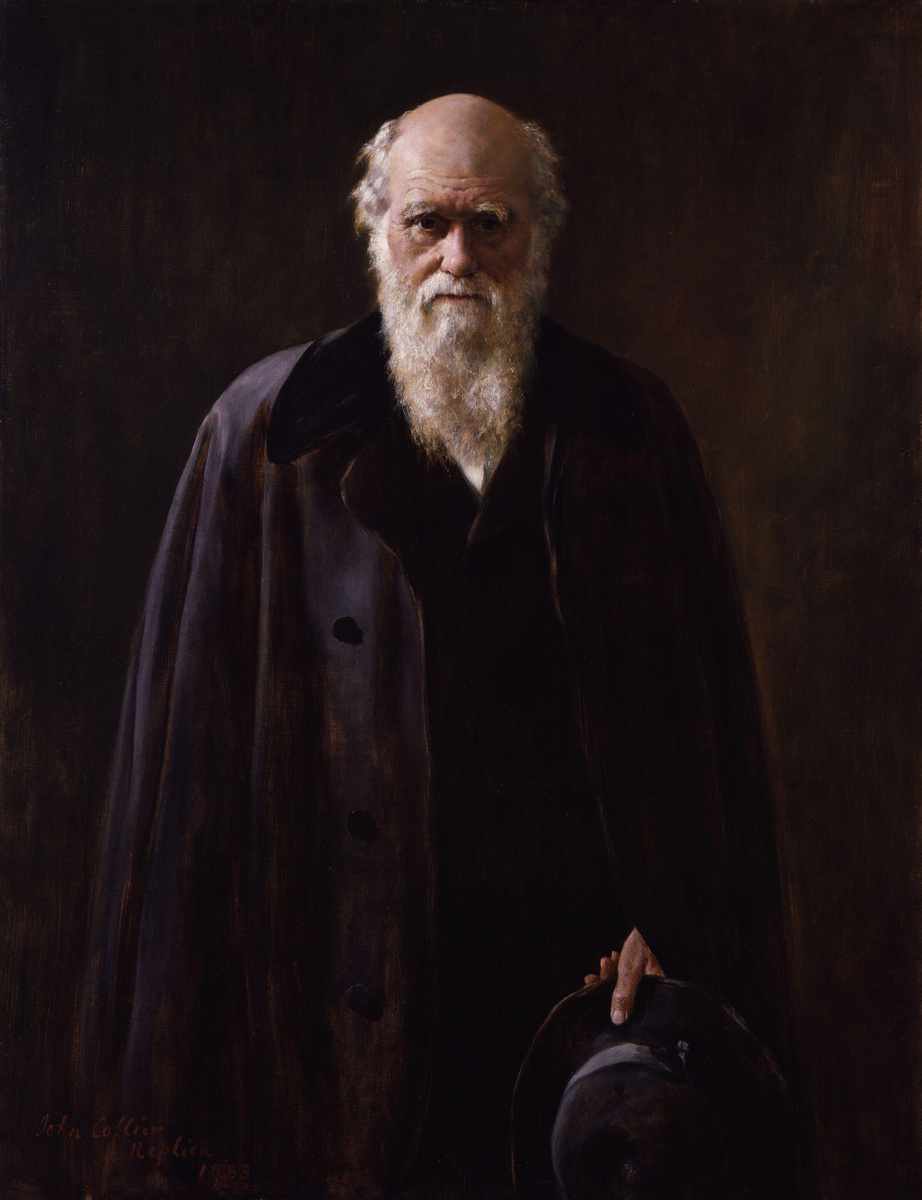
John Collier's 1883 portrait of Charles Darwin is a replica of his own 1881 painting, made with the family's involvement and given to the National Portrait Gallery in 1896. This short visit looks at what the picture shows, what the inscription tells us about how it was made, and how one of Darwin's sons judged it against the original.
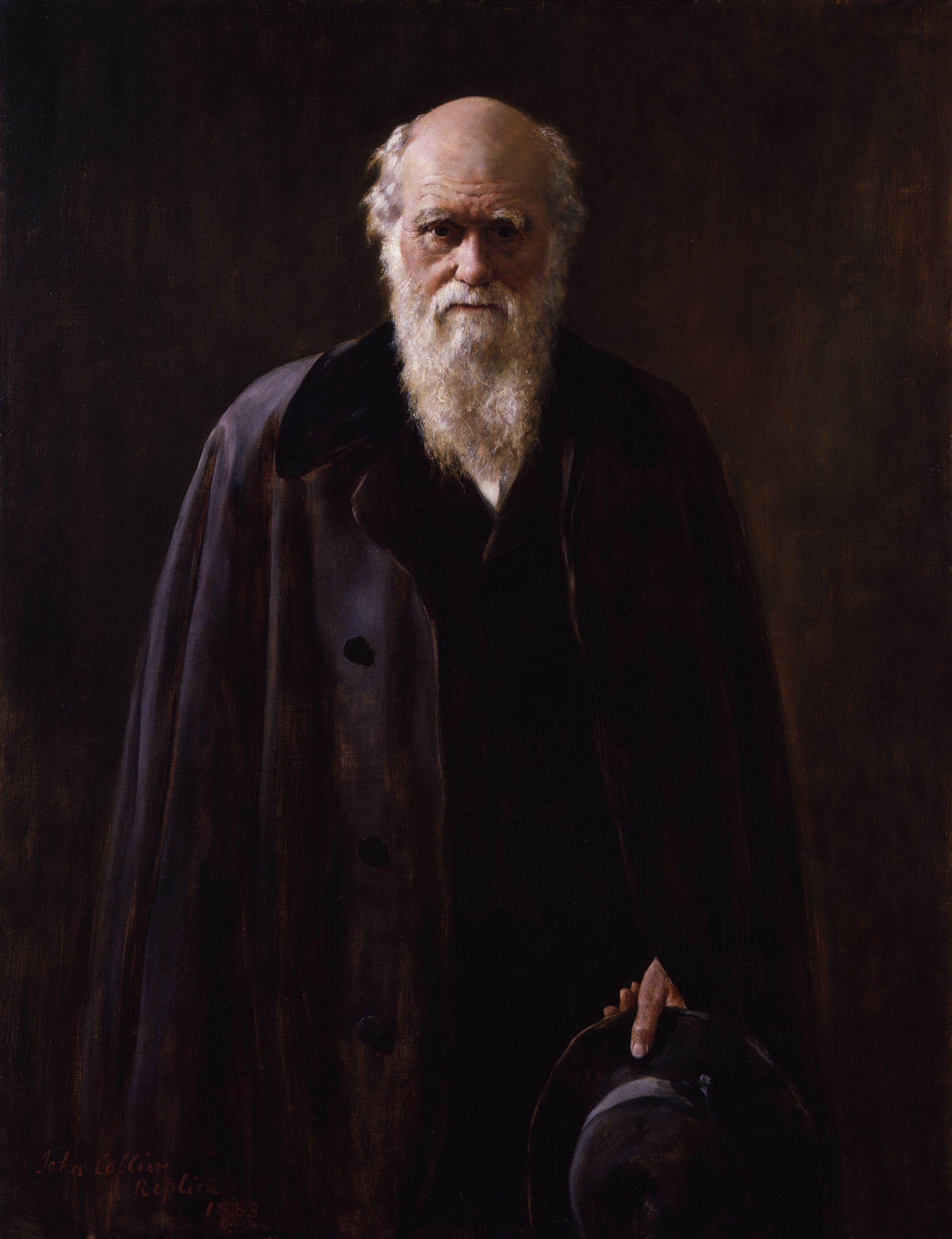
Handwritten inscription at the lower left reading 'John Collier', 'Replica', and the date 1883, which documents authorship and the status of this canvas as a replica version of the portrait.
02
Dark buttoned cloak
The heavy dark cloak with its soft velvet collar and large round buttons that swathes the shoulders and torso, dominating the silhouette and setting the somber tonality of the whole picture.
03
Hand resting on hat
The sitter's pale hand draped over the crown of a black hat held low against his dark cloak, a quiet gesture of a man pausing hat in hand rather than posing formally.
Your gallery guide
Charles Robert Darwin by John Collier (1883)
John Collier's 1883 portrait of Charles Darwin is a replica of his own 1881 painting, made with the family's involvement and given to the National Portrait Gallery in 1896. This short visit looks at what the picture shows, what the inscription tells us about how it was made, and how one of Darwin's sons judged it against the original.
Editorial review by Artifact Archive automated publishing
This is John Collier's portrait of Charles Darwin, the naturalist whose work on evolution changed how we understand life on Earth. The painting is a replica, made by Collier in 1883 after his own portrait of 1881.
So the sitter is Darwin himself, and the painter returned to a likeness he had already made. The date on the picture belongs to this second version, not to the original sitting.
In the lower left corner, a handwritten inscription records the artist's name, the word Replica, and the date 1883. That single corner quietly answers the question a visitor might ask in front of the canvas.
It tells you this is not the first painting of Darwin by Collier, but a second one, signed and dated by the artist who made both.
The original of 1881 belonged to the Linnaean Society, and this replica was made the following year. In 1896 the picture was given to the National Portrait Gallery in London, where it joined the national collection of portraits.
That gift placed Collier's Darwin among the country's remembered figures, not as a private keepsake but as a public likeness of a man whose ideas had wide reach.
Darwin's son Erasmus had a view on how the two paintings compared. He said the picture was a replica of the one at the Linnaean Society, made by Collier after the original, and that he had taken some trouble about it.
His judgement was that, as a likeness, this version was an improvement on the original. That is a family member's opinion, recorded with the picture, and it tells us the replica was not a routine copy.
What stays with you is the combination of a familiar face and a second attempt at it. Collier painted Darwin once, then painted him again, and the family took an interest in the result.
The inscription, the date and Erasmus Darwin's comment together make this canvas more than a duplicate. They show a portrait being weighed and adjusted by the people who knew the sitter best.
The story and its sources
Editorial review by Artifact Archive automated publishing.
Historical claims are linked to the records below. Close looking and interpretation are identified in the passage notes.
A portrait of the naturalist Charles Darwin, made by John Collier in 1883 as a replica of his 1881 portrait. The sitter is shown as an ageing man, and the picture was given to the National Portrait Gallery, London, in 1896.
Title variants
Charles Robert Darwin by John Collier; Charles Robert Darwin
Attribution qualification
John Collier is named as the artist in the supplied source; the work is described there as a replica made by Collier after his own original of 1881.
The supplied discovery record identifies the work as a painting titled 'Charles Robert Darwin' by John Collier. It further describes the painting as a copy made by John Collier in 1883 of his own 1881 portrait of Charles Darwin. This description establishes a relationship between two distinct canvases: a first portrait of 1881 and the present work of 1883, the latter explicitly characterized as a copy made by the same artist after his earlier original. The record thus frames the object not as an independent sitting but as a deliberate second version, and the attribution to Collier is carried across both the original and the copy. Because the source is a file page used as the supplied discovery record, the attribution and the copy relationship belong to that record's description rather than to a separate catalogue raisonne entry.(Wikimedia Commons: Charles Robert Darwin, n.d., File title and description; Description)
According to the supplied record, Darwin's son Erasmus Darwin commented on this painting: 'The picture is a replica of the one in the rooms in the Linnaean Society and was made by Collier after the original. I took some trouble about it and as a likeness it is an improvement on the original.' This statement places the earlier portrait in the rooms of the Linnaean Society and identifies the present canvas as a replica made by Collier after that original. Erasmus Darwin's account also introduces a qualitative judgment, that as a likeness the replica improves on the original, and a note of personal involvement, that he took some trouble about it. The comment is a family member's opinion recorded in the supplied record; it corroborates the replica relationship while also asserting a difference in quality between the two versions.(Wikimedia Commons: Charles Robert Darwin, n.d., Description quoting Erasmus Darwin; Description)
Visible inscriptions and their testimony
The supplied record includes a handwritten inscription at the lower left reading 'John Collier', 'Replica', and the date 1883. This inscription is the object's own visible declaration of authorship, status and date, and it agrees with the record's description of the work as an 1883 copy. The presence of the word 'Replica' on the canvas means the object itself announces that it is not the first version, while the artist's name and the date identify who made this second version and when. Within the terms supplied, the inscription and the record's description reinforce one another: the date 1883 belongs to this replica, while the earlier 1881 portrait remains the original after which it was made. The source describes the inscription as recorded rather than reproducing it directly, so the wording of the inscription is known through that description.(Wikimedia Commons: Charles Robert Darwin, n.d., Description; Description quoting Erasmus Darwin)
The distinction between the 1881 original and the 1883 replica is the central fact of the object's identity. The record describes the painting as a copy made in 1883 of the 1881 portrait, and Erasmus Darwin's quoted comment independently describes it as a replica made after the original at the Linnaean Society. Two separate strands within the supplied record therefore agree that the present canvas is the later of two related works and that its date is 1883. The 1881 date belongs to the original portrait, not to this object, and the 1883 date belongs to this replica, not to the sitting that produced the first likeness. This matters for catalogue practice because the object cannot be described by the earlier date without collapsing the two versions into one.(Wikimedia Commons: Charles Robert Darwin, n.d., Description; Description quoting Erasmus Darwin; File title and description)
Interpretation
The evidence supplied here concerns the painting's title, attribution, copy status, date and inscription, together with a family member's quoted comparison of the two versions. Read together, these units show an object whose identity is defined by its relation to another painting: it is a replica, made by the same artist, of a likeness already in the rooms of the Linnaean Society, and it carries an inscription that states that status on its face. Erasmus Darwin's comment adds that the replica was not a routine duplicate but a version he took some trouble about and judged an improvement as a likeness, though that judgment is attributed to him rather than established by technical examination. The record thus presents a second attempt at a familiar face, weighed by those who knew the sitter, and it is in that relation between the 1881 original and the 1883 replica that the object's documented significance lies.(Wikimedia Commons: Charles Robert Darwin, n.d., File title and description; Description; Description quoting Erasmus Darwin)
The supplied discovery record for this painting is a Wikimedia Commons file page titled 'Charles Robert Darwin', and it is the only evidence unit available for this section. That record supports several distinct claims about the work: that it is a painting titled 'Charles Robert Darwin' by John Collier; that it is described there as a copy made by Collier in 1883 after his own 1881 portrait of Darwin; that the 1881 original belonged to the Linnaean Society; that the replica was given to the National Portrait Gallery, London, in 1896; and that Darwin's son Erasmus Darwin commented on the comparison between the two versions. The record is catalogued as only partially consulted, so the account below tracks what the source states and where it attributes a judgement to a named person, rather than treating any of it as independently verified beyond this record.(Wikimedia Commons: Charles Robert Darwin, n.d., Description)
The record's most concrete physical detail concerns the lower left corner of the picture, where it describes a handwritten inscription. According to the supplied record, that inscription reads 'John Collier', then 'Replica', then the date 1883. This is reported as a description within the record rather than as the result of an examination documented in the evidence, so it is best treated as a source-described feature of the canvas. Its significance lies in what it asserts in the artist's own hand: an authorial attribution to Collier, an explicit statement that the work is a replica rather than a first original, and a date that belongs to this version. Because the record supplies no dimensions, medium description, support, condition report, or imaging data, the inscription is the only element of the object's material presentation that the evidence actually establishes.(Wikimedia Commons: Charles Robert Darwin, n.d., Description)
Replica and original
The record establishes the relationship between this canvas and an earlier one: Collier painted Darwin in 1881, and the work described here is an 1883 copy made by Collier after that original, which the record places with the Linnaean Society. This is a documented replication rather than an independent second sitting, and the evidence does not state whether Darwin sat again for the 1883 version. The distinction matters for how the object is understood. If the 1883 canvas derives from the 1881 portrait, then its claim to represent Darwin rests on the earlier painting, and the inscription's word 'Replica' is doing real documentary work, naming the work's status in relation to a predecessor that the record locates in a named institutional collection.(Wikimedia Commons: Charles Robert Darwin, n.d., Description)
The record also documents a later move into public ownership: the replica was given to the National Portrait Gallery, London, in 1896. The evidence does not name the donor or describe the terms of the gift, so no provenance chain beyond this single event can be constructed. What the record does support is the destination and the date, which place the painting in a national portrait collection rather than in a private or family setting by the end of the nineteenth century. The 1881 original, by contrast, is associated in the same record with the Linnaean Society, so the two versions ended up in different institutional contexts, one learned society and one national gallery.(Wikimedia Commons: Charles Robert Darwin, n.d., Description)
The record preserves a comparative judgement attributed to Darwin's son Erasmus Darwin, who is quoted as saying that the picture is a replica of the one in the rooms in the Linnaean Society, that it was made by Collier after the original, and that he took some trouble about it, and who concluded that as a likeness it is an improvement on the original. This is a family member's opinion recorded with the picture and should be reported as such, not promoted to an objective assessment of relative accuracy. Its evidentiary value is twofold. It independently confirms, from a contemporary close to the sitter, the replica relationship and the Linnaean Society location of the original; and it records that the second version was regarded by at least one person who knew Darwin as the better likeness, which suggests the 1883 painting was not treated as a routine duplicate. The evidence does not explain what Erasmus Darwin meant by taking trouble, nor does it specify what about the likeness he found improved.(Wikimedia Commons: Charles Robert Darwin, n.d., Description)
Why the object matters
Interpretation
Read together, the inscription and the quoted comment give the object a double character. The inscription is an authorial statement about status and date, while Erasmus Darwin's remark is a reception statement about quality and family involvement. Both point to a portrait being reconsidered rather than simply reproduced: the same painter returned to a likeness of the same sitter, and someone close to the sitter compared the results. The record does not establish any visual details of pose, dress, setting, or handling, so claims about those aspects would exceed the evidence. What can be said is that the documented combination of a signed and dated replica inscription, an institutional original, and a surviving family comparison makes this canvas a useful case for studying nineteenth-century portrait replication as a deliberate practice with its own claims to improvement.(Wikimedia Commons: Charles Robert Darwin, n.d., Description)
Visual observation
The supplied record includes a handwritten inscription at the lower left reading 'John Collier', 'Replica', and the date 1883 (as described in the supplied record).(Wikimedia Commons: Charles Robert Darwin, n.d.)
The primary record for this painting is the Wikimedia Commons file page for John Collier's "Charles Robert Darwin," supplied here as the discovery record. That record identifies the work as a painting by John Collier, describes it as a replica made in 1883 after his own 1881 portrait of Charles Darwin, notes that it was given to the National Portrait Gallery, London, in 1896, and preserves two pieces of internal documentation: a handwritten inscription and a quoted family statement. Because this file page, not a catalogue raisonné or museum accession record, is the supplied source, its claims about the physical object and about the 1881 original are reported at the level of a discovery record rather than verified against institutional documentation.(Wikimedia Commons: Charles Robert Darwin, n.d., Description quoting Erasmus Darwin)
The Inscription and the Attribution of the Second Version
Within the picture itself, the lower left corner carries a handwritten inscription reading "John Collier," the word "Replica," and the date 1883, as described in the supplied record. That inscription does two things at once. It attributes the canvas to Collier and it labels the work explicitly as a replica rather than an original, dating that second version to 1883. The inscription is therefore the object's own internal testimony about its status and date, and it is also the mechanism by which the painting self-identifies as a later return to a subject the artist had already painted. Because the inscription is reported through the same supplied record, the physical inscription is documented as described rather than examined directly for this account.(Wikimedia Commons: Charles Robert Darwin, n.d., Description quoting Erasmus Darwin)
Erasmus Darwin's Statement and the Relation of the Two Versions
The supplied record preserves a statement attributed to Darwin's son Erasmus Darwin: "The picture is a replica of the one in the rooms in the Linnaean Society and was made by Collier after the original. I took some trouble about it and as a likeness it is an improvement on the original." This statement supplies several distinct pieces of provenance information. It locates the 1881 original in the rooms of the Linnaean Society at the time the comparison was made. It asserts that the replica was made by Collier after that original, confirming the sequence the inscription implies. It records Erasmus Darwin's own involvement, since he says he took some trouble about it. And it offers an evaluative judgment: that as a likeness the replica improves on the 1881 painting. Because this is attributed to Erasmus Darwin as a family member and recorded with the picture, it should be treated as an attributed opinion about comparative likeness, not as an institutional assessment of either painting's quality or authenticity.(Wikimedia Commons: Charles Robert Darwin, n.d., Description quoting Erasmus Darwin)
The 1896 Gift and the National Portrait Gallery
According to the supplied record, the painting was given to the National Portrait Gallery, London, in 1896. That year is the only documented transfer in the evidence supplied here, and it places the replica in a national collection of portraits rather than in private hands. The record does not state who made the gift, nor does it describe the terms of the transfer, so the identity of the donor and the mechanism of acquisition remain unrecorded in this evidence. What the record establishes is a dated public transfer in 1896 from a previous, undocumented holding into the National Portrait Gallery, with no intervening owners, sales, or transfers named between the 1883 making of the replica and that gift. The interval between 1883 and 1896 is therefore an unrecorded period in the supplied evidence, not a documented change of ownership.(Wikimedia Commons: Charles Robert Darwin, n.d., Description quoting Erasmus Darwin)
Chronology and the Limits of the Documented Chain
Interpretation
Assembling the supplied evidence in chronological order produces a short but coherent chain. The 1881 original portrait of Charles Darwin, located at the time of Erasmus Darwin's statement in the rooms of the Linnaean Society, precedes the replica. The replica itself is dated 1883 by its own inscription and described as an 1883 copy made by Collier after the 1881 portrait. A statement attributed to Erasmus Darwin compares the two and judges the replica an improvement as a likeness. In 1896 the painting was given to the National Portrait Gallery, London. The evidence does not document who owned or held the replica between 1883 and 1896, so that decade should be described as an unrecorded interval rather than as a proven sequence of owners. Likewise, the evidence identifies only two canvases, the 1881 original and the 1883 replica; it does not establish the existence or whereabouts of any other version.(Wikimedia Commons: Charles Robert Darwin, n.d., Description quoting Erasmus Darwin)
According to the supplied record, Darwin's son Erasmus said of this painting: 'The picture is a replica of the one in the rooms in the Linnaean Society and was made by Collier after the original. I took some trouble about it and as a likeness it is an improvement on the original.'(Wikimedia Commons: Charles Robert Darwin, n.d.)
The supplied discovery record identifies the work as a painting titled Charles Robert Darwin by John Collier, and describes it as a copy made by Collier in 1883 after his own 1881 portrait of the naturalist. That sequence, established by the record rather than inferred, means the canvas is a second treatment of a subject the artist had already painted, and it places the date 1883 with this version rather than with the original sitting. The record further states that the painting was given to the National Portrait Gallery, London, in 1896, so the work entered a national collection of portraits within roughly a decade and a half of its making. These points, taken together, establish the object as a replication with a documented public destination, not merely a studio duplicate of unknown whereabouts.(Wikimedia Commons: Charles Robert Darwin, n.d., Description)
Inscription and family judgement
The supplied record includes a handwritten inscription at the lower left reading John Collier, Replica, and the date 1883, as described in that record. The inscription is significant because it is contemporaneous with the canvas and, in the record's account, it names both the artist and the status of the work as a replica, while fixing the year of this second version. The record also preserves a comment attributed to Darwin's son Erasmus: that the picture is a replica of the one in the rooms in the Linnaean Society and was made by Collier after the original, that he took some trouble about it, and that as a likeness it is an improvement on the original. Because the improvement claim is attributed to Erasmus Darwin and recorded with the picture, it should be treated as a family member's judgement on the likeness rather than as an objective or institutionally verified measure of quality. Even so, it is evidence that the replica was not treated as a routine copy by those close to the sitter, which is a materially different status from an anonymous reproduction.(Wikimedia Commons: Charles Robert Darwin, n.d., Description)
The object and its record
Interpretation
Read together, the documented facts and the attributed comment explain how this canvas relates to Collier's 1881 portrait: the original is associated in the record with the Linnaean Society, while this version was made the following year and carries its own inscription and date. The 1896 gift to the National Portrait Gallery gives the work a public afterlife, placing Collier's Darwin among the country's remembered figures rather than keeping it as a private keepsake. The record does not supply a fuller provenance chain, the terms of the gift, or exhibition history, and those gaps should not be filled in. What the record does support is a portrait that was replicated by its own author, endorsed in family testimony for its likeness, and then transferred into a national collection, which is why the object matters within a larger history of portraiture and of the public commemoration of Darwin.(Wikimedia Commons: Charles Robert Darwin, n.d., Description)
The supplied record is a Wikimedia Commons file page for a painting titled Charles Robert Darwin by John Collier, who is identified as a painter working 1850 to 1934 and as a recognized late Victorian portraitist. The sitter is Charles Darwin, and the record describes the work as a replica made by Collier in 1883 after his own portrait of 1881. The record further states that the painting was given to the National Portrait Gallery, London, in 1896, where it entered a strong public collection. The dimensions, support, and exact medium of this canvas are not supplied by the record; oil on canvas is presumed but not confirmed. Because the inscription, the replica status, and the gift are reported through this single discovery record rather than through a catalogue raisonne or conservation file, they should be treated as the record's account, with the object itself and the Gallery's documentation as the natural places for verification.(Wikimedia Commons: Charles Robert Darwin, n.d.)
Inscription and family judgement
According to the supplied record, a handwritten inscription at the lower left reads John Collier, Replica, and the date 1883. That inscription associates the canvas with the artist by name, states its derivative status in the artist's own terms, and dates the second version rather than the 1881 sitting. The record also preserves a comment attributed to Darwin's son Erasmus: that the picture is a replica of the one in the rooms in the Linnaean Society, made by Collier after the original, that he took some trouble about it, and that as a likeness it is an improvement on the original. That judgement is a family member's opinion recorded with the picture, not a neutral technical assessment, and it indicates that the replica was not treated as a routine copy. Taken together, the inscription and Erasmus Darwin's comment are the record's evidence for how the second canvas was weighed by people close to the sitter.(Wikimedia Commons: Charles Robert Darwin, n.d.)
Recorded values
The working insurance estimate supplied alongside this research is a calculated range of US$500,000 to US$2,000,000, generated 2026-10-16 as a broad, conservative working range for manual insurance review. Its stated methodology rests only on the confirmed context: the attribution to John Collier as a recognized late Victorian portraitist, the date 1883 as a replica of the 1881 portrait, the holding by the National Portrait Gallery, London, since the 1896 gift, and the prominence of Charles Darwin as sitter. The range is deliberately broad because no confirmed sale, appraisal, or insurance figure was provided and no comparable sales are claimed. The record expressly qualifies that this is a model-generated working range for manual review only, not an official insurance value, appraisal, auction result, or sale price, that it does not rely on private insurance records or comparable sales, and that actual insurance values require physical inspection, provenance verification, condition assessment, and a qualified appraiser, with all figures in US dollars and preliminary only. No other monetary figure appears in the supplied evidence, so this estimate stands as the only recorded value and should not be mistaken for market evidence.(Wikimedia Commons: Charles Robert Darwin, n.d.)
Read together, the record and the estimate show how the object's significance is assembled from different kinds of claim. The attribution, the 1883 replica date, the 1896 gift to the National Portrait Gallery, and the inscription and family comment are the substantive facts the record establishes about the canvas. The insurance range is a separate, clearly labelled working calculation that depends on those facts but adds no new information about the painting itself, and its own qualifications limit how far it can be used. Within a larger history of portraiture and material culture, the interest of this canvas lies less in its duplication of a famous likeness than in the documented chain it preserves: an artist returning to a sitter, a family taking trouble over the result, and an institution receiving the work as a national portrait in 1896. That chain is what the evidence supports; questions of condition, exact materials, and market history remain open on the present record.(Wikimedia Commons: Charles Robert Darwin, n.d.)
Working estimate
Calculated working insurance estimate, not a sale price: Estimated value: US$500K to US$2M Recorded date: Working calculation, generated 2026-10-16. Methodology: This is a broad, conservative working range for manual insurance review, calculated from the confirmed context. The work is identified as a painting by John Collier (1850-1934), a recognized late Victorian portraitist, dated 1883 as a replica of his 1881 portrait of Charles Darwin. It is held by the National Portrait Gallery, London, having been given to the Gallery in 1896, which is a strong public collection and provenance indicator. The sitter is Charles Darwin, one of the most prominent figures in modern science, which supports substantial cultural and insurance relevance. The dimensions, support, and exact medium are not supplied; oil on canvas is presumed but not confirmed. The range is deliberately broad because no confirmed sale, appraisal, or insurance figure was provided, and no comparable sales are claimed. It reflects only the supplied attribution, date, subject prominence, and institutional collection status. Qualification: This is a model-generated working range for manual review only. It is not an official insurance value, appraisal, auction result, or sale price. It does not rely on private insurance records or comparable sales. Actual insurance values require physical inspection, provenance verification, condition assessment, and a qualified appraiser. All figures are in US dollars and should be treated as a preliminary estimate only.(Wikimedia Commons: Charles Robert Darwin, n.d.)
Bibliography
Sources and further reading
References are arranged by author or organisation, with links to the original publications. Where no publication date is recorded, n.d. means no date.
Source notes updated .
No recorded sources match these filters. Reset the filters to see the full bibliography.
Autobiography of Charles Darwin, the sitter, listed under subjects including Darwin, Charles, 1809-1882 and naturalists. A primary autobiographical source connected to the named subject of the portrait, useful for documented biographical context rather than for the painting itself.
A second catalogue record of the Autobiography of Charles Darwin with the same subject headings on Darwin, naturalists and British biography. It is relevant as a life source for the sitter, not as an object-specific study of the Collier portrait.
Wikimedia Commons file page used as the supplied discovery record for the painting 'Charles Robert Darwin' by John Collier. It identifies the work, describes it as an 1883 replica of an 1881 portrait, and records its gift to the National Portrait Gallery, London, in 1896, including a quoted comment by Erasmus Darwin.
Advertising supports the archive. These preferences control aggregate page counting, reading activity and ad-delivery diagnostics. They use no visitor tracking cookie.