Two children light paper lanterns among tall flowers in a garden at dusk. John Singer Sargent painted this twilight scene in 1885–6, and it now belongs to Tate Britain.
Date1885–6CultureUnited Kingdom (American-born artist working in Britain)PeriodLate nineteenth-century British painting; AestheticismCurrent locationTate Britain, London, United Kingdom
Listen to the article 1:49
100%
Loading full-resolution artwork…
Drag to explorePinch or double-tap to explore
Scroll to zoom · drag to pan · double-click to focusPinch to zoom · drag to explore · double-tap to focusFIELD VIEW / 24
Tools & download
Pixel colour Select a pixel with the eyedropper
No pixel selected
Choose the eyedropper, then click or tap the image. Scroll to zoom for finer selection.
Add text
Hand to pan · Select to move text and drawings · Add as many texts as you like · Scroll to zoom
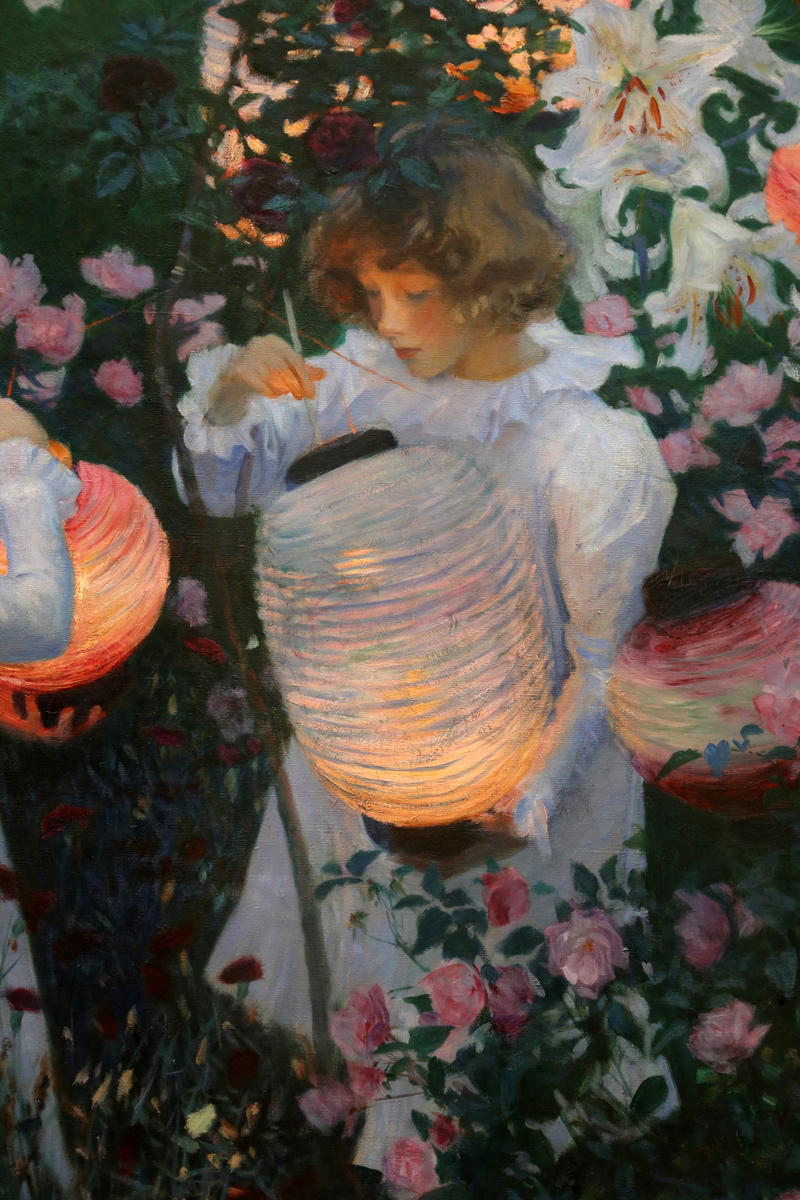
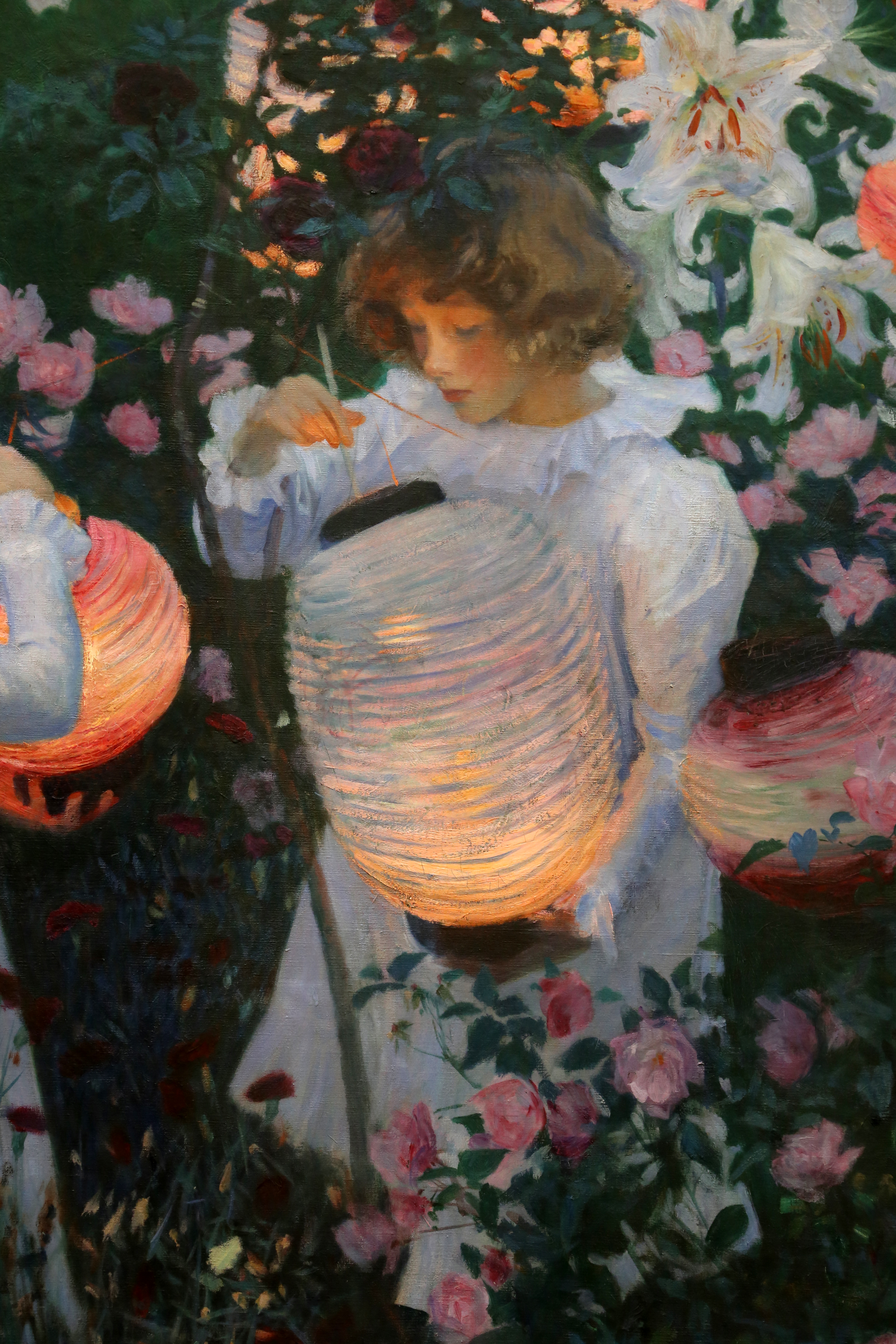
The child's white pinafore with its wide ruffled collar and puffed sleeve, painted in cool blue-grey shadow strokes, which frames the face and establishes the Victorian child's costume against the dark greenery.
02
Pink roses and white dress hem
The lower and right foreground, where loose pink rose blooms and dark leaves press close around the child's white pinafore and the further lantern, showing the enclosed garden setting and Sargent's thick, separate flower strokes.
03
White lily blooms upper right
Tall white lilies with rust-orange stamens arch into the upper right corner, the floral motif named in the painting's title and a deliberate colour rhyme with the lantern light against the dark foliage.
Your gallery guide
Carnation, Lily, Lily, Rose by John Singer Sargent (1885–6)
Two children light paper lanterns among tall flowers in a garden at dusk. John Singer Sargent painted this twilight scene in 1885–6, and it now belongs to Tate Britain.
Editorial review by Artifact Archive automated publishing
This is John Singer Sargent's Carnation, Lily, Lily, Rose, painted in 1885–6.
The picture shows two young children in a garden at dusk, holding large glowing paper lanterns among tall flowers.
Look at the flowers around the children. White lilies and pink roses rise close to them, and carnations fill the lower garden.
The two lanterns give the scene its light. They glow against the fading sky, which places the moment at dusk or early evening.
Sargent was an American-born artist working in Britain, and the painting belongs to late nineteenth-century British painting and to Aestheticism.
That movement cared about beauty, mood and the arrangement of colour and form, so a garden at twilight was a fitting subject.
The painting's title names three flowers, and the garden holds them all. Carnations, lilies and roses are not background clutter; they are part of what the picture is about.
The lanterns then add a second kind of light. Their warm glow competes with the cool evening air, and the children become the still centre of that change.
So this is not simply a portrait of two children. It is a study of a particular hour, when flowers, children and lantern light hold the garden together.
Sargent gives us that passing moment clearly. The flowers stay rooted, the lanterns are lifted, and the light is already changing around them.
The story and its sources
Editorial review by Artifact Archive automated publishing.
Historical claims are linked to the records below. Close looking and interpretation are identified in the passage notes.
John Singer Sargent was an American painter (1856–1925). Their work is associated with Impressionism. Their recorded places of work include Paris; Cairo; Jerusalem; Nazareth; Florence; Naples; Venice; Haarlem; The Hague; London; Boston; New York City; Newport.
Late nineteenth-century British painting; Aestheticism
Country or culture
United Kingdom (American-born artist working in Britain)
Depicted subject
Two young children in a garden at dusk, holding large glowing paper lanterns among tall flowers. The painting depicts a twilight moment in an enclosed garden, with the children lighting lanterns and standing among carnations, lilies, and roses.(commons.wikimedia.org, n.d.)
Title variants
Carnation Lily Lily Rose; Carnation, Lily, Lily and Rose
Dimensions
Unknown
The object is catalogued under the title Carnation, Lily, Lily, Rose, attributed to the painter John Singer Sargent. The same catalogue record supplies the date of execution as 1885–6, so the work is placed by its institutional documentation in the mid-1880s rather than in any later period of the artist's career. This object date is distinct from the date of any catalogue entry, revision, acquisition or online publication through which the work is now known: those later dates belong to the record and its interpretation, not to the making of the picture. The title itself is part of the identity of the work, since it names three flowers rather than describing a subject or a place, and any shorter or variant form of the title used elsewhere should be understood as a convenience rather than as a second official designation.(Tate, n.d.)
The painting is titled Carnation, Lily, Lily, Rose and was painted by John Singer Sargent in 1885–6.(Tate, n.d.)
The institutional record for John Singer Sargent's Carnation, Lily, Lily, Rose, dated 1885-86 and held at Tate Britain, describes a garden scene occupied by two children. The setting is densely planted: tall white lilies, pink roses and carnations are recorded as present around the figures. Within this garden the record identifies at least one large glowing paper lantern held by a child, and it reads the light as suggesting a moment at dusk or early evening. Written as an account of what the picture shows, these details establish the basic inventory of the composition: the number of children, the three named flower types, the lantern as a held object rather than a fixed fixture, and a time of day inferred from the quality of light. The same record supplies the painting's title, its association with the years 1885-86, and its location at Tate Britain, so the visual description and the identification of the work belong to a single documented source.(commons.wikimedia.org, n.d.)
The lantern detail is the element that supplies the scene's illumination and, by extension, its sense of time. The record does not describe the lanterns as decorative props placed among the flowers; it describes a child holding one, which places the light source within the figures' action rather than in the sky or the background. Because the record treats the glow as pointing to dusk or early evening, the lantern functions in the description as evidence for the hour rather than as a symbol whose meaning the source asserts. The title of the painting names three flowers, and the record independently lists carnations, lilies and roses in the garden, so the flowers named in the title are consistent with the flowers described in the scene. The evidence supports this correspondence between title and depicted planting; it does not establish an intended programme behind the choice of those flowers.(commons.wikimedia.org, n.d.)
Two qualifications should govern how this visual description is used. First, the source is a file record on Wikimedia Commons for a photograph of the painting as displayed at Tate Britain, and its annotation states that it confirms the painting's location. The observations of children, flowers and lantern are therefore mediated by a photograph of the work in its current display, not by direct examination of the canvas, and the record's own consultation status is described as partial. Second, the number of lanterns differs between accounts: the institutional record states that there is at least one large glowing paper lantern held by a child, while the published transcript refers to two lanterns. The evidence supplied here does not resolve whether the picture contains one lantern or two, and the safer formulation is the record's own, which allows for at least one. Nothing in the supplied units documents pigments, supports, dimensions, frames or conservation treatment, so the materials and making of the object cannot be described from this evidence. Similarly, no unit attributes the composition, the flowers or the lantern to a stated intention on Sargent's part, and no predecessor, successor or named visual convention is established for this object by the units available here.(commons.wikimedia.org, n.d.)
The painting shows two children in a garden setting among tall white lilies, pink roses, and carnations.(commons.wikimedia.org, n.d.)
The scene includes at least one large glowing paper lantern held by a child, with the light suggesting a moment at dusk or early evening.(commons.wikimedia.org, n.d.)
Carnation, Lily, Lily, Rose is held at Tate Britain, the institutional home that anchors its documentation and public display. The gallery context matters for how the picture is understood: it is presented as a late nineteenth-century painting within a national collection of British art, and the available photographic record of the work as displayed there confirms that setting rather than a private or unidentified location. This evidence is an official institutional record, so the location is documented rather than inferred. Because that record is only partially consulted, the strongest claim it supports is the present holding, not a full provenance history or a complete exhibition record. The painting's placement at Tate Britain therefore fixes the starting point for any account of its collection and display, while leaving open the detail of how it arrived there and how it has been shown over time.(commons.wikimedia.org, n.d.)
What the display record shows
The same record describes what is visible in the painting: two children in a garden setting among tall white lilies, pink roses, and carnations, with at least one large glowing paper lantern held by a child, the light suggesting a moment at dusk or early evening. Those observable features and the picture's title work together. The title names carnation, lily, and rose, and the garden holds all three, with the white lilies and pink roses rising close to the children and the carnations filling the lower garden. The lantern light is a second, different kind of illumination: it glows against the fading sky and sets the moment at dusk or early evening. The children, held among the flowers and the lifted lights, become the still centre of that changing light. Read together, the subject is a particular hour as much as a pair of figures, since the flowers stay rooted while the lanterns are lifted and the light shifts around them.(commons.wikimedia.org, n.d.)
Attribution and stylistic setting
Interpretation
The record associates the painting with John Singer Sargent, an American-born artist working in Britain, and places it within late nineteenth-century British painting and within Aestheticism, a movement concerned with beauty, mood, and the arrangement of colour and form. That attribution and grouping come from the institutional source rather than from an independent technical examination, and the source is partially consulted, so the stylistic placement should be treated as an attributed account rather than a settled finding about materials or method. Within the larger history of art, the classification explains why a garden at twilight was a fitting subject for the painting's moment: Aestheticism's interest in mood and formal arrangement suits a scene whose meaning lies in atmosphere and the interplay of light. The collection context at Tate Britain and this stylistic frame reinforce each other, since the work is both an object held by a national institution and an example of a movement defined by its priorities of beauty and arrangement.(commons.wikimedia.org, n.d.)
The only recorded value figure supplied is a calculated working insurance estimate of US$100M to US$300M, generated on 2026-10-16. Its methodology is explicit about its own limits: the range is broad and conservative, produced for manual review only, and based on the object being confirmed as Sargent's Carnation, Lily, Lily, Rose, 1885-6, oil paint on canvas, Tate Britain, London. No public auction result, official appraisal, insurance schedule or sale price is supplied, and the unit states that the range is not a substitute for an appraisal by a qualified specialist. It should not be used to bind coverage, settle a claim or make a transaction, and should be confirmed with a qualified fine-art appraiser and the collection's registrar or insurer.(Tate, n.d.)(commons.wikimedia.org, n.d.)
The reasoning behind the working range rests on the painting's position rather than on any transaction. The calculation identifies Sargent as one of the most prominent late nineteenth-century portrait and figurative painters and describes this work as among his best-known British-period canvases, and it notes that the painting is a long-held public collection highlight rather than a work with recent market exposure. The range is said to reflect typical umbrella fine-art insurance practice for a unique, high-value, institutional-caliber painting: cover is set broadly above expected market value to allow for replacement and market movement, without claiming any appraised figure. The breadth of the range is attributed to the supplied excerpts lacking dimensions, condition, provenance, exhibition history and title documentation, so the uncertainty is presented as a product of the record's gaps rather than of the painting's standing.(Tate, n.d.)(commons.wikimedia.org, n.d.)
It matters that this estimate sits beside the object documentation rather than replacing it. The sources that establish the painting's identity and location record no financial figure at all; the valuation unit is the only supplied unit that provides one, and it explicitly frames itself as model-generated and provisional. Read together, the evidence supports a clear division: artist, title, date, medium, collection and described subject are established by the Tate record and the institutional image record, while the monetary range is a working figure for review whose own conditions state that it is neither an official value nor a market statement. Any account of the painting's significance should therefore treat the range as a record of how umbrella fine-art insurance practice is applied to an institutional-caliber work whose own documentation supplies no dimensions, condition, provenance, exhibition history or title documentation, not as evidence of what the painting is worth in a market it has not recently entered.(Tate, n.d.)(commons.wikimedia.org, n.d.)
Working estimate
Calculated working insurance estimate, not a sale price: Working insurance range: US$100M to US$300M Recorded date: Working calculation, generated 2026-10-16. Methodology: A broad, conservative working range is calculated for manual review only. The painting is confirmed as John Singer Sargent, Carnation, Lily, Lily, Rose, 1885-6, oil paint on canvas, Tate Britain, London. Sargent is one of the most prominent late nineteenth-century portrait and figurative painters, and this work is among his best-known British-period canvases. It is a long-held public collection highlight rather than a work with recent market exposure. No public auction result, official appraisal, insurance schedule, or sale price is supplied. The range therefore reflects typical umbrella fine-art insurance practice for a unique, high-value institutional-caliber painting: cover is set broadly above expected market value to allow for replacement and market movement, without claiming any appraised figure. The range is intentionally wide because the supplied excerpts do not include dimensions, condition, provenance, exhibition history, or title documentation. It is not a substitute for an appraisal by a qualified specialist. Qualification: This is a model-generated working insurance range for manual review only. It is not an official insurance value, appraisal, auction result, sale price, or statement of market value. It should not be used to bind coverage, settle a claim, or make a transaction. Confirm all values with a qualified fine-art appraiser and the collection's registrar or insurer.(Tate, n.d.)(commons.wikimedia.org, n.d.)
Further reading
Books for a closer look
Paid links. As an Amazon Associate I earn from qualifying purchases.
Carnation, Lily, Lily, Rose: The Story of a Painting
Kids Can Press
Recorded title matches the artwork title exactly, and its subject strings include 'Carnation, lily, lily, rose (Sargent, John Singer)' alongside 'Painters' and 'Peintres'. This is the only candidate whose catalogue data names the painting itself. However the same record is classed as 'Juvenile fiction', 'Juvenile literature' and 'Picture books for children', with a Canadian authors subject, so it is a children's book about the painting rather than a scholarly catalogue; it is relevant only as a document of the painting's cultural reception for young readers, not as art-historical analysis.
Recorded title matches the artwork title exactly, and its subject strings include 'Carnation, lily, lily, rose (Sargent, John Singer)' alongside 'Painters' and 'Peintres'. This is the only candidate whose catalogue data names the painting itself. However the same record is classed as 'Juvenile fiction', 'Juvenile literature' and 'Picture books for children', with a Canadian authors subject, so it is a children's book about the painting rather than a scholarly catalogue; it is relevant only as a document of the painting's cultural reception for young readers, not as art-historical analysis.
Advertising supports the archive. These preferences control aggregate page counting, reading activity and ad-delivery diagnostics. They use no visitor tracking cookie.