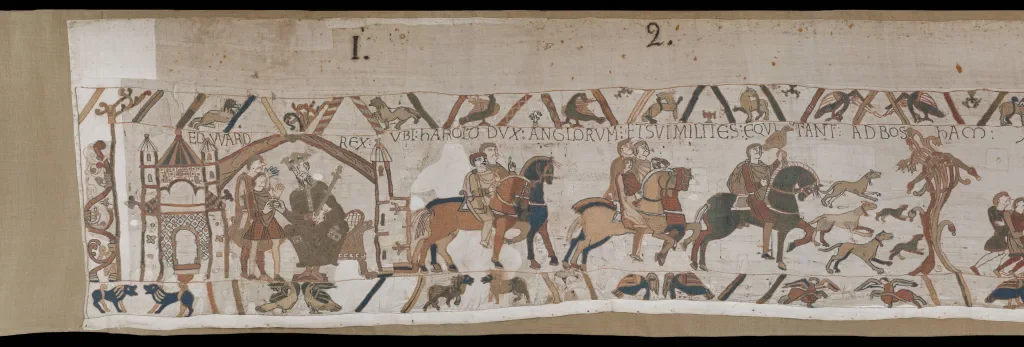
Begin at the opening, where a seated king meets the figures before him. Watch their hands. A raised finger, an open palm, a turned head: small gestures give direction to a conversation we cannot hear. Then let your eye travel along the cloth. Riders depart, ships carry them onwards, and one encounter becomes part of a much larger story.
The embroidery tells of the events surrounding the Norman conquest of England. Harold and William move through a sequence of journeys, promises, kingship and conflict. Follow it as a made account of those events. Its makers decide where a story starts, what comes next, and which gestures we have time to study.
You can move through the sequence at the pace of a journey, or stop beside one figure. The repeated outlines help carry the action forward, while a detail of clothing or a hand can slow you down. Look below the main scene as well. The borders have their own animals and activities, adding another current of attention beneath the people in power.
Despite the familiar name, these images were embroidered onto linen with wool thread. The people who stitched them are not securely known. Move closer and the story becomes work: thread laid along an outline, coloured areas patiently filled. A ruler's conquest reaches us through the labour of makers whose names the object has not preserved.
As the sequence reaches the battle, the dead occupy the lower border. What began with ordered encounters and journeys ends in the pressure of fighting and retreat. The surviving story breaks off as the English flee. Its ending is incomplete, so we should let that break remain visible rather than supply a final scene the cloth no longer gives us.
Go back, in your mind, to the first raised hand. That small gesture has led us into ships, armies and bodies falling from the story's centre into its margins. The cloth rewards more than following who wins. It asks us to notice who speaks, who works, and who is left at the edge of the account.
The story and its sources
Story draft · Editorial review pending.
Guide sources checked 5 October 2026.
Historical claims are linked to the records below. Close looking and interpretation are identified in the passage notes.
A king gives an audience, horsemen ride towards the sea, ships cross the Channel, and armies collide. The Bayeux Tapestry turns the conquest of England into a continuous embroidered narrative. Follow its full surviving length, then zoom in to see how thread, gesture and inscription carry the story.
A conquest told along a strip of cloth
The story begins with Edward the Confessor and Harold Godwinson, then follows journeys, encounters, an oath, a contested succession and an invasion. William, Duke of Normandy, emerges as the central figure in the account of the conquest of England. The surviving sequence reaches the English retreat after the Battle of Hastings in October 1066. The original ending is missing: the present edge is a limit of survival, rather than proof that the complete work always ended there.[1]
The embroidery was made after the events it describes. Its eleventh-century date makes it an exceptionally early representation of the conquest, but proximity in time does not make every depicted conversation, motive or gesture an independently verified fact. Read the narrative as a made account, whose sequence and emphasis help shape the viewer’s understanding.[3]
Look at the opening before travelling on
In the opening of this photograph, the seated king occupies an architectural enclosure. Pointing hands carry the exchange beyond the throne, towards figures who prepare to leave. Further along, the repeated bodies of horses establish a direction of travel. These are visible cues: the image can communicate movement without depicting a single frozen instant in the manner of a later easel painting.
Try looking at three different scales. From a distance, follow the changing groups of bodies across the central band. Closer in, read an inscription beside its figures and compare their gestures. At high magnification, attend to the linen and the paths of the coloured threads. The same passage becomes a narrative, a designed arrangement and a physical textile.
Stories and their evidence
Embroidery, makers and a famous tradition
Despite its name, the work is embroidered in wool on an already woven linen support. In a woven tapestry, the image is formed as the cloth is made. Here, stitches build contours and coloured surfaces on cloth. The museum identifies nine joined linen panels and describes several stitches, including the couching technique commonly called Bayeux stitch. Zooming in makes that distinction tangible: the drawing follows the movement of thread across the support.[2]
The tradition that Queen Matilda and her attendants made the work is not an established attribution. The museum states that the makers remain unknown and describes Bishop Odo, William’s half-brother, as a probable commissioner. That proposal is a historical interpretation, rather than a surviving signature or a documented instruction from the embroiderers.[2]
A document with its own point of view
UNESCO describes the embroidery as both a historical account and a documentary source for medieval life, while stressing its narrative techniques and symbolism. That combination matters. Ships, clothing and military equipment reward detailed looking, yet their presence does not remove the work’s choices about what to show. The image gives us evidence through a particular representation, rather than an unfiltered record of the past.[3]
The photograph you are exploring
This viewer uses the continuous panorama published on Wikimedia Commons as Tapisserie de Bayeux.png, measuring 482,096 by 5,550 pixels. Its file record dates the photography to 2017 and credits the digital representation to Université de Caen Normandie, CNRS and ENSICAEN, using photography by La Fabrique de patrimoines en Normandie. The cloth’s age and the photograph’s date should not be confused.[4]
The museum explains that the photography was assembled into a high-resolution panorama for scientific study. Here, the image is delivered in small sections so you can explore the full surviving length and inspect details without downloading the enormous original. The position slider moves across the whole panorama; dragging and zooming let you return to a passage at your own pace.[5]
Artist
Unknown embroiderers
Date
Late 11th century
Medium
Wool embroidery on linen
Dimensions
About 68–70 metres long; embroidered band about 50 cm high
Culture / place
Anglo-Norman
Current context
French state collection associated with Bayeux, Normandy
Details to carry with you
The familiar title describes an embroidery, rather than a woven tapestry.
The central narrative is accompanied by Latin inscriptions and upper and lower borders.
The surviving narrative ends with the English retreat after the Battle of Hastings.
UNESCO added the work to its Memory of the World register in 2007.
The image here comes from the stitched 2017 photographic panorama on Wikimedia Commons.
We count article page loads to improve the archive, without a visitor tracking cookie. Essential storage supports your basket, delivery choice and site security. Stripe uses payment security storage when payment opens. Your notice and counting choices are remembered for one year.