ArchiveBabylonian lion passant (brick panel from the Procession Way)

Artwork record / 281 of 331

Babylonian lion passant (brick panel from the Procession Way) by Maker unknown (604–562 BC)

Artist: Maker unknown

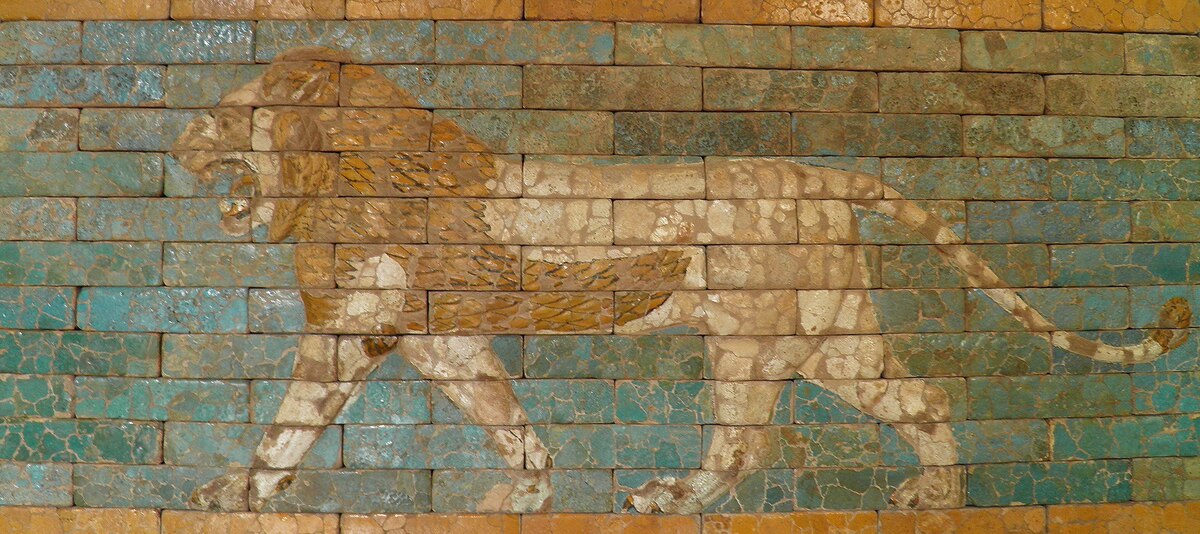
A glazed brick panel from Babylon's Procession Way shows a lion striding forward, once part of the route that ran from the Marduk temple to the Ishtar Gate and the Akitu Temple. Made in the reign of Nebuchadrezzar II (605–562 BC) and now in the Louvre, the panel is described by its source as a bas-relief, a brick panel, and glazed terracotta.

Read the story ↓ About the artist ↓ Research and record ↓ Literature and sources ↓ Listen to the article ↓
Article text for AI
Shop this artwork ↓ 0 visits
Date604–562 BCCultureBabylon (Iraq), Neo-Babylonian PeriodNeo-Babylonian, reign of Nebuchadnezzar IICurrent locationDepartment of Near Eastern Antiquities, Louvre Museum, Paris, France
Listen to the article
100%
Babylonian lion passant (brick panel from the Procession Way) by Maker unknown (604–562 BC)
Loading full-resolution artwork…
Scroll to zoom · drag to pan · double-click to focus Pinch to zoom · drag to explore · double-tap to focus FIELD VIEW / 281
Tools & download
Pixel colour Select a pixel with the eyedropper
No pixel selected

Choose the eyedropper, then click or tap the image. Scroll to zoom for finer selection.

Add text

Hand to pan · Select to move text and drawings · Add as many texts as you like · Scroll to zoom

Babylonian lion passant (brick panel from the Procession Way): high-resolution image

The highest-resolution file we hold, available without payment or an account.3,840 × 1,709 pixels.

Download highest-resolution image

Details to notice

About 3 minutes to read
01

Hindquarters, hind legs and tail

Rump, hind legs and the long tail terminating in a raised tuft near the right edge, completing the stride of the lion and showing the panel's full length.

02

Striding forelegs and paws

Chest and paired forelegs caught mid-stride with modelled paws, showing the walking posture repeated along the Processional Way.

03

Glazed brick surface and coat

Flank of the lion showing individual glazed bricks, crackled glaze, and the cream body with ochre coat markings and outlines, evidence of the moulded and glazed brick craftsmanship.

Portrait unrecorded

About the makers

Maker unknown

Individual life dates unrecorded

Biographical details and a verified portrait have not yet been recorded for this attribution.

The research & record

Study the work.
Follow the evidence.

Find catalogue details, historical context, technical research and the literature behind this artwork.

Article text for AI
Open research text

The artwork record

Research catalogue

Catalogue information and detailed research, with references that link to the bibliography.

Updated .

Identity and catalogue

Link
Title
Babylonian lion passant (brick panel from the Procession Way)(Carole Raddato, 2013)
Artist or attribution
Maker unknown
Object date
604–562 BC(Carole Raddato, 2013)
Medium and support
Glazed brick and terracotta(Carole Raddato, 2013)
Dimensions
length: 227 cm (89.3 in); height: 105 cm (41.3 in); thickness: 12 cm (4.7 in)(Carole Raddato, 2013)
Current collection or location
Department of Near Eastern Antiquities, Louvre Museum, Paris, France(Carole Raddato, 2013)
Movement or period
Neo-Babylonian, reign of Nebuchadnezzar II
Country or culture
Babylon (Iraq), Neo-Babylonian
Depicted subject
A striding lion in glazed brick, one panel from the Procession Way that ran from the Marduk temple to the Ishtar Gate and the Akitu Temple in Babylon.
Title variants
Passing lion, brick panel from the Procession Way which ran from the Marduk temple to the Ishtar Gate and the Akitu Temple; Babylonian lion passant-AO 21118; Lion passant
Accession number
AO 21118
Support
brick panel
Catalogue identity

The Louvre panel is catalogued as a passing lion, a striding lion rendered in glazed brick, and the source also records the heraldic and art-historical equivalents lion passant and lion passant, terms used for an animal shown walking with one forepaw raised. The object is identified as a brick panel from the Procession Way that ran from the Marduk temple to the Ishtar Gate and the Akitu Temple. Those two catalogue statements, the heraldic description and the topographical identification, are the anchors of the object's identity: the panel is not catalogued as a free-standing sculpture or a single carved block but as one component of a named processional route in Babylon.(Carole Raddato, 2013, File title and Summary object type; File title and Structured data)

The source dates the panel to the reign of Nebuchadrezzar II, 605 to 562 BC, and places its manufacture in Babylon, in modern Iraq. That regnal date range is the object date carried in the catalogue title, and it should be distinguished from any later date attached to the object, such as the date of the photograph or of the modern catalogue record itself. The route to which the panel belonged connected the Marduk temple, the Ishtar Gate and the Akitu Temple in Babylon, so the panel's original context is a processional way linking a major temple, a gate and a separate temple rather than a single building.(Carole Raddato, 2013, File title; File title and Summary object type)

The panel depicts a passing lion, from the Procession Way that ran from the Marduk temple to the Ishtar Gate and the Akitu Temple.(Carole Raddato, 2013)

The panel is described in the source as a 'passing lion' or 'lion passant', terms used for a striding lion in heraldic and art-historical description.(Carole Raddato, 2013)

Historical context

Link
Commission, Date and Setting

The panel was made in Babylon during the reign of Nebuchadrezzar II, whose dates are given as 605 to 562 BC, placing its production within the Neo-Babylonian court's program of architectural and urban renewal. The source record supplies this attribution at the level of the file's own descriptive metadata rather than through a dated building inscription or a documented royal decree, so the reign attribution should be understood as the object's accepted archaeological identification rather than as a commission document. Nothing in the supplied evidence names an individual patron, a workshop, a specific year of manufacture within the reign, or a contractual arrangement. What the evidence does establish is a secure institutional and geographical setting: Babylon, in the sixth century BC, in a reign associated with monumental glazed-brick construction. The separate photograph record, taken much later by Carole Raddato on 3 March 2013, provides the modern visual documentation of the panel as it survives, and its Wikimedia Commons licensing under CC BY-SA 2.0 with attribution to Raddato governs reproduction rather than any ancient circumstance.(Carole Raddato, 2013, File title; Photograph date and author; Permission section)

The panel belonged to the Procession Way, the route that connected the Marduk temple, the Ishtar Gate and the Akitu Temple in Babylon. This locational evidence is the strongest documented link between the object and a social and ritual world, because it places the panel not in a single building but along a processional axis joining the city's chief deity's temple, a monumental gate, and a temple associated with the Akitu festival. The evidence identifies the route and its three endpoints but does not describe the festival's liturgy, the frequency of processions, the identity of participants, or how any particular panel related to spectators or worshippers. The panel's meaning is therefore tied to position and movement along a sacred path, and the surviving object is a fragment of a larger decorative scheme whose full extent is not recorded in the supplied units. Because the identification of the route is given as documented, the connection can be stated firmly, while any reconstruction of ritual use or royal ideology attached to the route remains an inference beyond the evidence.(Carole Raddato, 2013, File title)

Form, Material and Technique

Interpretation

Read against the route, the panel's long, low format and its lion in profile, stepping forward, align the figure's stride with the direction of travel along the Procession Way. The panel is a brick panel, assembled from many moulded bricks rather than carved from a single block, and it is described as bas-relief, meaning the figure projects slightly from the background. The material is glazed terracotta, a technique in which moulded bricks are covered with a vitreous glaze, so the surface would have carried colour and caught light, though the evidence does not specify the pigments or the present condition of the glaze. The terms 'passing lion' and 'lion passant' are the source's own art-historical and heraldic descriptions for a striding lion, and the source gives the panel's dimensions as 227 cm in length, 105 cm in height and 12 cm in thickness. These formal properties are documented observations about the surviving object and its construction, and they support the interpretation that the panel was designed as a repeating element in a decorated architectural sequence, but the evidence does not establish what the lion symbolized in Babylonian thought or how viewers understood it.(Carole Raddato, 2013, File title; Photograph date and author; Permission section)

The panel was made in Babylon, in the reign of Nebuchadrezzar II (605–562 BC).(Carole Raddato, 2013)

The panel belonged to the Procession Way, a route that connected the Marduk temple, the Ishtar Gate and the Akitu Temple in Babylon.(Carole Raddato, 2013)

Materials and technique

Link
Support and relief format

The panel is recorded as a bas-relief and archaeological artefact made of brick and terracotta, and the source also describes it as a brick panel, which indicates that it was constructed from multiple bricks rather than carved from a single block. Those two descriptors are complementary rather than contradictory: brick names the modular unit of construction, while terracotta names the fired clay material of which those units consist. The relief format is defined in the same documentation as carving or moulding in which the figure projects slightly from the background, so the lion is not a free-standing sculpture but a figure raised only modestly above its ground. This combination of a modular brick support with low relief projection is the technical starting point for everything else the panel does visually, because the figure had to be assembled across many separately formed units while still reading as one continuous animal.(Carole Raddato, 2013, Structured data, Object type and Medium; Structured data, Object type; File title)

Glazed terracotta technique

The finished surface is described as glazed terracotta, a technique the source explains as moulded bricks covered with a vitreous glaze. This identifies two distinct stages of making rather than a single operation: the bricks were shaped by moulding, and the resulting terracotta was then covered with a glass-like glaze. The documentation attributes the object to the reign of Nebuchadrezzar II, 605 to 562 BC, and locates its making in Babylon, which places the glazed brick technique within a specific Neo-Babylonian context rather than a generic ancient Near Eastern one. The glaze is the layer that would have carried colour and reflectivity across the architectural surface, but the evidence supplied here describes the technique and its components without specifying any individual pigment, so the palette itself is not documented by these units. What can be said is that the panel belongs to a mode of building in which fired clay and vitreous coating were combined to give a constructed wall a finished, luminous surface.(Carole Raddato, 2013, File title)

Support and relief format

The physical dimensions establish the panel's architectural character as much as its imagery does. It measures 227 cm in length, 105 cm in height and 12 cm in thickness, making it markedly wider than it is tall and relatively thin in section. The shallow depth is consistent with its role as a facing element rather than a structural mass, and the length is consistent with the source's description of a striding or passing lion, since the panel format accommodates the horizontal extension of the animal's stride. The comparison of measurement to depicted subject here is a reasonable relation between documented figures and the documented relief type, but the evidence does not state how the panel was fixed into a wall or how individual bricks were joined, so those aspects of construction remain undocumented in these units.(Carole Raddato, 2013, Structured data, Dimensions)

Object identification and setting

Interpretation

The panel is identified as a passing lion, also described as a lion passant, terms the source notes are used in heraldic and art-historical description for a striding lion. It belonged to the Procession Way, the route that connected the Marduk temple, the Ishtar Gate and the Akitu Temple in Babylon, and the panel is now held in the Department of Near Eastern Antiquities of the Louvre with accession number AO 21118. These identifications matter for materials and technique because they define the object as one surviving component of a much larger decorated architectural programme rather than an isolated picture panel. The brick construction and glazed surface were therefore means of covering a processional route with repeated figured relief, and the accession record preserves the fragmentary panel as the unit through which that larger scheme can now be studied.(Carole Raddato, 2013, File title)

The only photographic record supplied here is a photograph of the panel taken by Carole Raddato on 3 March 2013, published on Wikimedia Commons under a CC BY-SA 2.0 licence attributed to her. The date of the photograph is a record of when the image was made, not a date for the object, and the file's structured data is the source for the object type, medium, dimensions, collection and accession number used in this account. The distinction between the 2013 photograph and the Neo-Babylonian object is essential to reading the evidence correctly: the visual information about the lion's profile and stride is mediated by that photograph, while the technical description of moulded bricks and vitreous glaze comes from the accompanying metadata rather than from independent examination reported here. The evidence therefore establishes a documented identification and description of the panel, not a conservation report or an analytical study of its materials.(Carole Raddato, 2013, Structured data, Object type and Medium; Structured data, Dimensions; File title)

The object is a bas-relief and archaeological artefact made of brick and terracotta.(Carole Raddato, 2013)

The panel measures 227 cm in length, 105 cm in height and 12 cm in thickness.(Carole Raddato, 2013)

The panel is glazed terracotta, a technique involving moulded bricks covered with a vitreous glaze.(Carole Raddato, 2013)

The object is described as 'bas-relief', meaning it is carved or moulded so that the figure projects slightly from the background.(Carole Raddato, 2013)

The panel is a 'brick panel', indicating it was constructed from multiple bricks rather than a single block.(Carole Raddato, 2013)

Provenance and ownership

Link
The Panel in Modern Documentation

The panel's modern documentation begins with a photograph taken by Carole Raddato on 3 March 2013. That single securely dated act belongs to the object's modern reception history rather than to its ancient manufacture or museum acquisition, and it anchors the image record that circulates today. The same photograph is published on Wikimedia Commons under a CC BY-SA 2.0 licence, attributed to Carole Raddato, so the panel is now encountered primarily through a licensed digital surrogate whose date, author and reuse terms are explicitly stated.(Carole Raddato, 2013, Photograph date and author; Permission section)

The Panel as a Louvre Object

The object itself is a glazed terracotta brick panel depicting a passing lion, or lion passant, a striding lion shown in profile on a long narrow format. It is described as a bas-relief, meaning the figure projects slightly from the background, and as a brick panel, meaning it was constructed from multiple bricks rather than carved from a single block. The source records its dimensions as 227 cm in length, 105 cm in height and 12 cm in thickness. It is held in the Department of Near Eastern Antiquities of the Louvre, with accession number AO 21118. The accession number is the institutional identifier that fixes the object within the Louvre's collections, while the photograph date records a much later moment of visual documentation.(Carole Raddato, 2013, Photograph date and author)

The photograph of the panel was taken by Carole Raddato on 3 March 2013.(Carole Raddato, 2013)

Provenance timeline
  1. 605–562 BC

    The glazed terracotta brick panel is made in Babylon during the reign of Nebuchadrezzar II.(Carole Raddato, 2013, File title)

  2. 3 March 2013

    Carole Raddato photographs the panel.(Carole Raddato, 2013, Photograph date and author)

Reception and literature

Link
The Panel as Documented Object and Its Modern Image Record

Interpretation

Any account of how this panel has been received has to begin with what the surviving object is and how its modern record came into being, because the two are not the same thing. The panel is a brick panel depicting a passing lion, a striding lion in glazed terracotta, made in Babylon during the reign of Nebuchadrezzar II (605–562 BC). It is described as a bas-relief: the figure is carved or moulded so that it projects slightly from the background, and it is a brick panel, meaning it was constructed from multiple bricks rather than cut from a single block. It is held in the Department of Near Eastern Antiquities of the Louvre under accession number AO 21118, and it measures 227 cm in length, 105 cm in height and 12 cm in thickness. The reception history of this object in the digital sphere is inseparable from a single modern act of documentation: the photograph of the panel was taken by Carole Raddato on 3 March 2013, and the resulting image on Wikimedia Commons is licensed under CC BY-SA 2.0, attributed to Carole Raddato. This matters for reception because the terms in which the panel is now most widely encountered, its file title, its descriptive metadata and its open license, all derive from that 2013 photographic record rather than from the original Neo-Babylonian context of display. The kind of description attached to the image, including the designation of the lion as a "passing lion" or "lion passant," a term used for a striding lion in heraldic and art-historical description, and the classification of the object as a bas-relief and archaeological artefact made of brick and terracotta, shows how an image platform can carry forward a specific vocabulary of art-historical description alongside the photograph itself.(Carole Raddato, 2013, Permission section; Photograph date and author)

The panel's image on Wikimedia Commons is licensed under CC BY-SA 2.0, attributed to Carole Raddato.(Carole Raddato, 2013)

Collection and display

Link

The glazed brick panel of a passing lion is held in the Department of Near Eastern Antiquities of the Louvre, where it is recorded under accession number AO 21118. Its position in that department places it within a collection organised by region and period rather than by the architectural complex from which it came, so that a fragment of a processional route in Babylon is now encountered as a numbered museum object among other works of the ancient Near East. The panel entered the collections as an archaeological artefact, and its identification in the museum's structured data runs together the object's ancient setting and its modern custody: the Procession Way in Babylon on one side, the Louvre's Near Eastern holdings on the other. What is displayed is not the route but a surviving panel from it, and the accession number is the link between the two.(Carole Raddato, 2013, Structured data, Collection and Accession number)

Form, material and technique

The object's recorded dimensions are 227 cm in length, 105 cm in height and 12 cm in thickness. The long, comparatively low proportions are not incidental to how the lion reads. A figure over two metres wide but only about one metre high gives the animal room to stride horizontally, and the format itself encourages the eye to travel sideways along the panel rather than to take in a single centred image. In its original architectural setting this elongated shape belonged to a surface meant to be seen in passing, and the surviving measurements allow that relationship between format and movement to be reconstructed even though the panel is no longer in place.(Carole Raddato, 2013, Structured data, Collection and Accession number)

The panel is described as glazed terracotta, a technique in which moulded bricks are covered with a vitreous glaze. It is also called a brick panel, indicating that the figure was constructed from multiple bricks rather than cut from a single block, and it is characterised as a bas-relief, meaning that the figure is carved or moulded so that it projects slightly from the background. These three descriptions belong together: the lion is assembled from many moulded bricks, its body raised a little from the ground behind it, and the whole given a glossy surface by the glaze. The method differs from carving a relief from one stone, and it accounts for the slightly mosaic-like logic of the figure, in which the image is built up across the joins between units of fired clay.(Carole Raddato, 2013, Structured data, Collection and Accession number)

Identification and original setting

The source identifies the subject as a passing lion or lion passant, terms used in heraldic and art-historical description for a striding lion. That vocabulary matters because it classifies the animal by its gait rather than by any narrative episode: the lion is walking, and the description of it as passant is a technical way of fixing that motion. The panel is further identified as coming from the Procession Way that ran from the Marduk temple to the Ishtar Gate and the Akitu Temple in Babylon, and as having been made in Babylon in the reign of Nebuchadrezzar II, whose dates are given as 605 to 562 BC. The date, place and route are supplied as the object's historical identification, and they frame the lion as an element of a specific processional topography rather than as an isolated figure.(Carole Raddato, 2013, Structured data, Collection and Accession number)

Interpretation

The Procession Way is described not as a single building but as a route, one that connected the Marduk temple, the Ishtar Gate and the Akitu Temple. A panel like this one belonged to that sacred path, so the lion's meaning is bound up with movement along the way rather than with a framed picture on a wall. In that setting the lion is one repeating element within a decorated route, a sign of power and order placed where people walked toward sacred spaces. The interpretation that the animal's forward stride echoes the direction of travel along the route follows from this: the format, the profile view and the architectural context can be read together as a statement about the city and its gods, and the identity of the beast as a lion passant aligns with the processional function the source assigns to the way.(Carole Raddato, 2013, Structured data, Collection and Accession number)

The photograph through which the panel is known in this source was taken by Carole Raddato on 3 March 2013, and the image on Wikimedia Commons is licensed under CC BY-SA 2.0 with attribution to Raddato. This is the modern documentary layer of the object's history: the panel survives in the Louvre, and its appearance circulates as a photograph with a named photographer, a date and a licence. The file title and structured data together supply the object's identification, date, medium, dimensions, collection and accession number, so the Wikimedia record functions as a descriptive metadata source for the panel as well as a repository for its image. The account given here therefore rests on a record that is both visual and cataloguing in character, and its authorship and licensing conditions are part of what the evidence establishes about how the object is made available for study.(Carole Raddato, 2013, Structured data, Collection and Accession number)

The panel is held in the Department of Near Eastern Antiquities of the Louvre, with accession number AO 21118.(Carole Raddato, 2013)

Documented values and qualified estimates

Link
The working valuation record

Interpretation

The single object-specific valuation unit supplied for this panel is a model-generated working insurance range, recorded as generated on 2026-10-16. The calculation states an estimated value of US$3M to US$12M, expressed in US dollars, and is explicitly described as a conservative model calculation based only on the supplied confirmed artwork context. The stated methodology enumerates the inputs it used: the object type and period (a Neo-Babylonian glazed brick panel from the reign of Nebuchadnezzar II, Procession Way, Babylon); the medium (glazed brick and terracotta); the large scale (approximately 227 cm by 105 cm by 12 cm); the identification with a specific Louvre accession number, AO 21118; and the object's status as a museum-held archaeological artifact rather than a work with public market comparables. No confirmed sale, auction, or official appraisal data appears in the source excerpts, and the calculation acknowledges this, which is why it presents the range as deliberately broad and built from high-level rarity, historical importance and reconstruction-cost logic. The two bounds are reasoned differently: the upper bound is said not to assume a private market transaction and to reflect potential replacement or conservation-related exposure for a unique, large, ancient architectural panel of this type, while the lower bound reflects uncertainty about condition, the object's fragmentary nature, and the absence of certified valuation data. This unit is an interpretation authored by the model, not an institutional appraisal, and should be read as such.(Carole Raddato, 2013)

The qualifications attached to that figure determine what it can legitimately be used to claim. The calculation states that it is a model-generated working insurance range for manual review only and that it is not an official insurance value, appraisal, auction result, or sale price. It further states that it is not based on comparable sales, private insurance records, or any formal valuation method, and that the source excerpts support object identification and context only and do not provide a public appraisal. The stated conclusion is that actual insurance values must be determined by a qualified appraiser or the insuring institution following physical examination and documented provenance. Within the terms of the supplied evidence, then, the US$3M to US$12M range records a recorded working value and the reasoning behind it, while the object's documented valuation status remains open: no sale, auction, appraisal or insurance figure for the panel is established by the evidence. The range and its own disclaimer therefore have to be kept together; citing either without the other would misstate the record.(Carole Raddato, 2013)

Working estimate

Calculated working insurance estimate, not a sale price: Estimated value: US$3M to US$12M Recorded date: Working calculation, generated 2026-10-16. Methodology: This working insurance range is a conservative model calculation based only on the supplied confirmed artwork context. It considers the object type and period (Neo-Babylonian glazed brick panel from the reign of Nebuchadnezzar II, Procession Way, Babylon), its medium (glazed brick and terracotta), its large scale (approximately 227 cm by 105 cm by 12 cm), its identification with a specific Louvre accession number (AO 21118), and its status as a museum-held archaeological artifact rather than a work with public market comparables. Because no confirmed sale, auction, or official appraisal data is available in the source excerpts, the range is deliberately broad and uses high-level rarity, historical importance, and reconstruction cost logic. The upper bound does not assume a private market transaction; it reflects the potential replacement or conservation-related exposure for a unique, large, ancient architectural panel of this type. The lower bound reflects uncertainty about condition, fragmentary nature, and the absence of certified valuation data. All figures are in US dollars. Qualification: This is a model-generated working insurance range for manual review only. It is not an official insurance value, appraisal, auction result, or sale price. It is not based on comparable sales, private insurance records, or any formal valuation method. The source excerpts support object identification and context only and do not provide a public appraisal. Actual insurance values must be determined by a qualified appraiser or the insuring institution following physical examination and documented provenance.(Carole Raddato, 2013)

Bibliography

Sources and further reading

References are arranged by author or organisation, with links to the original publications. Where no publication date is recorded, n.d. means no date.

Source notes updated .

  1. 01

    Secondary · About this artwork

    Wikimedia Commons: Ishtar Gate. Passing lion, brick panel from the Procession Way which ran from the Marduk temple to the Ishtar Gate and the Akitu Temple. Glazed terracotta, reign of Nebuchadrezzar II (605 BC–562 BC), Babylon (Iraq). Louvre Museum. Wikimedia Commons.

    Wikimedia Commons file providing a photograph and descriptive metadata for the glazed brick panel of a passing lion from the Procession Way in Babylon, now in the Louvre. The file title and structured data supply the object's identification, date, medium, dimensions, collection and accession number.

    Language
    English
    Link to reference
    Citation text

Article text and sources · Reading and attribution

An unhandled error has occurred. Reload 🗙