Identity and catalogue
Link- Movement or period
- Northern Renaissance
- Country or culture
- German (Nuremberg)
- Depicted subject
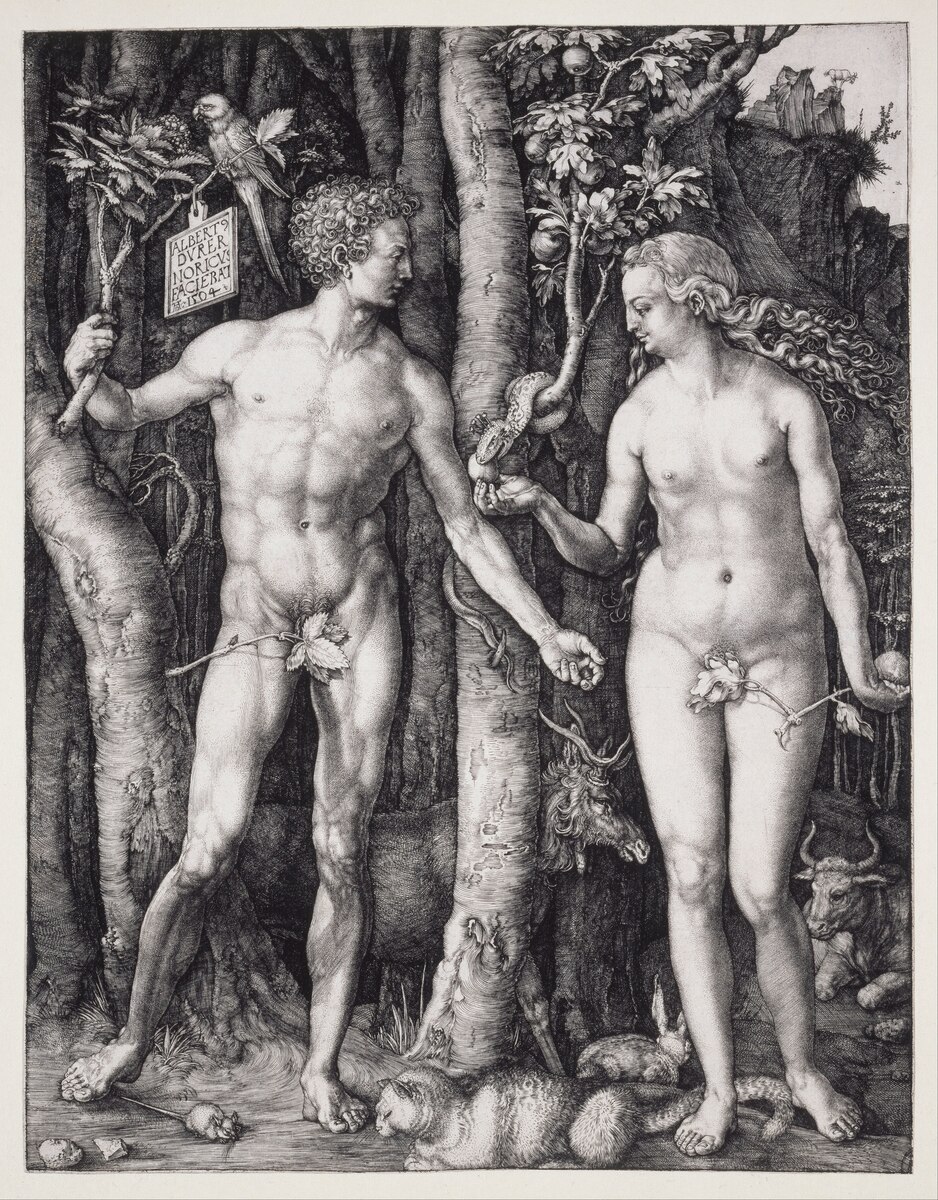
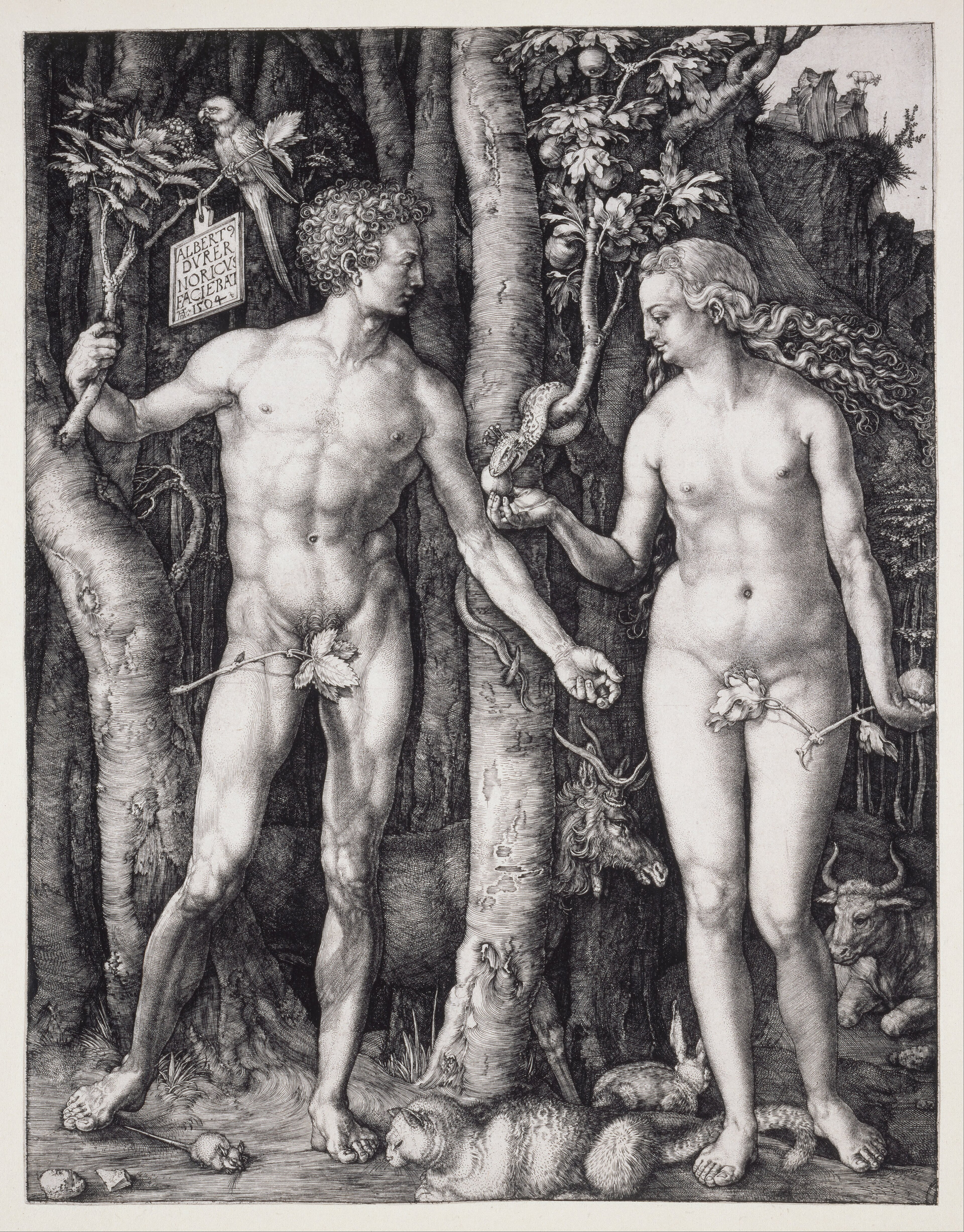
- The engraving depicts Adam and Eve standing on either side of the Tree of Knowledge with the serpent, representing the biblical Fall of Man. In the foreground a cat, an elk, and an ox appear. Adam holds a branch bearing a tablet with Dürer's signature and date. The nude figures are based on classical models: Adam on the Apollo Belvedere and Eve on the Medici Venus. The work demonstrates Dürer's study of human proportion and his mastery of engraving.(Wikimedia Commons: Adam and Eve, n.d.)
- Title variants
- The Fall of Man; Adam und Eva; Adam and Eve
- Inscriptions
- Signature and date top left: ALBERT · / DVRER / NORICVS / FACIEBAT / AD · 1504 · [Albrecht Dürer of Nuremberg made this 1504]; Signed and dated on plate(Wikimedia Commons: Adam and Eve, n.d.)
Catalogue identity
The object is an engraving titled Adam and Eve, attributed to Albrecht Dürer and dated 1504. Its recorded dimensions are 25.1 cm in height by 19.4 cm in width (9.8 by 7.6 in), and it carries the accession number 68.187. The work is signed and dated on the plate with the inscription ALBERT · DVRER · NORICVS · FACIEBAT · AD · 1504, a formula that names the artist as Dürer of Nuremberg and states that he made the work in 1504. That plate inscription is therefore a primary, contemporaneous statement of authorship and date, while the catalogue title, artist field, date field, dimensions and accession number are modern descriptive metadata attached to the object; the catalogue's date of 1504 and the inscription's own AD 1504 agree, but they should be distinguished as record and as mark on the plate rather than treated as one and the same source.(Wikimedia Commons: Adam and Eve, n.d., Title field; Artist field; Date field; Dimensions field; Accession number field; Inscriptions field)
Medium, method and states
The catalogue describes the work as a copper engraving printed on laid paper. This matters for how the image should be read: the design was cut into a copper plate with the burin, and the surviving impressions are prints pulled from that plate rather than unique drawings. The record also states that there are five states of this engraving, an unusually high number for Dürer, which means the plate was reworked and reprinted in several stages, so impressions can differ from one another in the details of their lines. The evidence further describes the engraving as displaying Dürer's mastery of the engraving technique, and the same source notes that a large number of preparatory drawings document the care with which Dürer planned the design. Taken together, the states and the preparatory drawings show a work whose making involved repeated decisions at both the drawing stage and the plate stage, not a single act of execution.(Wikimedia Commons: Adam and Eve, n.d., Dimensions field; Accession number field)
The print depicts Adam and Eve standing on either side of the tree of knowledge with the serpent. In the foreground there is a cat, an elk, and an ox. The source states that Dürer derived Adam's form from the Apollo Belvedere and that Eve was based on his analysis of the Medici Venus, and it characterizes the engraving as the culmination of Dürer's study of a system of human proportion. Those attributions are the source's account of the figures' classical derivation and of the work's place in Dürer's proportion studies; the visible arrangement of the nude figures around the central tree, and the low placement of the animals, are observations about the image, while the connection to the Apollo Belvedere and the Medici Venus is an interpretive claim about sources. The source also states that Dürer's pride in the engraving is displayed in the longest, most prominent inscription he ever made on an engraving, an evaluation of the plate signature's scale and prominence rather than a documented statement of the artist's feelings.(Wikimedia Commons: Adam and Eve, n.d., Inscriptions field)
Interpretation
Placing the object within the larger history of engraving and of Renaissance artistic self-presentation, the combination recorded here is distinctive: a compact copper engraving of about 25 by 19 cm, planned through numerous preparatory drawings, reworked across five states, and carrying the longest and most prominent signature Dürer placed on any engraving. The plate inscription does not merely name the maker; it declares that Dürer of Nuremberg made the work in 1504, joining authorship, place and date in a single formula. Because the evidence attributes Adam's form to the Apollo Belvedere and Eve's to Dürer's analysis of the Medici Venus, and describes the print as the culmination of his study of a system of human proportion, the work can reasonably be understood as an image in which a biblical subject and a demonstration of measured, classicizing bodies are pursued together. That synthesis is an interpretive reading of the supplied evidence rather than a documented intention, and the claims about sources and about Dürer's pride remain the source's characterizations.(Wikimedia Commons: Adam and Eve, n.d., Title field; Date field; Dimensions field; Accession number field; Inscriptions field; Object history field; Credit line field)
Subject and iconography
LinkThe recorded composition
Visual observation
The Wikimedia Commons record describes the subject of the engraving directly: it depicts Adam and Eve standing on either side of the tree of knowledge with the serpent. The tree therefore occupies the centre of the field, with the two figures flanking it, so that the tree of knowledge and the serpent are the structural as well as the narrative hinge of the scene. The same description records three animals in the foreground: a cat, an elk, and an ox. These are placed low in the picture and are distinguished from the human figures and the tree that frame the central action, so the composition as recorded separates a foreground zone of animals from the central confrontation at the tree. All of this is description of the image as catalogued rather than identification of a specific visual source, and the record states the subject and the foreground animals without further interpretation of their meaning.(Wikimedia Commons: Adam and Eve, n.d., Description field)
Because the composition is recorded only at the level of subject and salient elements, what the surviving description establishes is limited but specific. It establishes that the Fall of Man is presented through a frontal, centralised arrangement: the tree of knowledge divides the scene, Adam and Eve are set on either side of it, and the serpent is present. It establishes that the lower zone contains a cat, an elk, and an ox. The description does not assign attributes, gestures, or meanings to those animals, and it does not name a visual source for them. Any reading of them as symbols would be an interpretation beyond the catalogue record, whereas their presence and placement are documented observation.(Wikimedia Commons: Adam and Eve, n.d., Description field)
Classical models and the constructed body
The record states that Dürer derived Adam's form from the Apollo Belvedere and that Eve was based on Dürer's analysis of the Medici Venus. These are source-established derivations rather than resemblances inferred from the image alone, and they specify two different antique models for the two figures. Read with the claim that the engraving culminates Dürer's study of a system of human proportion, the derivation explains why the first man and woman are presented as idealised, measured bodies: the classical prototypes supply the canonical forms against which the proportions could be worked out and then printed. The evidence does not state how the antique models were transmitted to Dürer, nor does it describe the particular proportions he used; it establishes the attributed sources of the two figures and the general claim that proportional study is central to the print.(Wikimedia Commons: Adam and Eve, n.d., Description field)
What the evidence establishes about the image
The engraving's documented content is the Fall of Man: Adam and Eve on either side of the tree of knowledge, the serpent, and the foreground animals cat, elk, and ox, printed as a copper engraving on laid paper in a composition whose plate is signed and dated to 1504. The documented attributions are that Adam's form derives from the Apollo Belvedere and Eve's from Dürer's analysis of the Medici Venus, that the work culminates his study of human proportion, that it demonstrates his mastery of engraving, and that the plate exists in five states. The documented physical and institutional facts are the 25.1 by 19.4 cm dimensions, the inscription, the large body of preparatory drawings, the Nuremberg origin, and the Boston accession with its provenance and credit line. The connection among these is what the record itself supplies: a centralised biblical composition, built on antique models, realised through a copper plate that was planned in drawings and revised across five states, and preserved in a single catalogued impression at the Museum of Fine Arts, Boston.(Wikimedia Commons: Adam and Eve, n.d., Description field)
Materials and technique
LinkPlate, Paper and the Terms of the Record
The documented medium of this object is a copper engraving, and the impression is printed on laid paper. Both facts come from the same cataloguing record that supplies the work's title, author and date, and they set the technical frame for everything else that can be said about it. Copper engraving is an intaglio process: the image is cut into the surface of a metal plate, ink is held in the incised lines, and pressure transfers it to a sheet of paper. Laid paper, characterized by the pattern of chain and laid lines imparted by the mould during its manufacture, is the support on which this impression was taken. The record does not describe the plate itself, the ink, or the specific batch or watermark of the laid paper, so the account must stop at the level of the two documented material facts. What the record does make clear is that this is a printed work rather than a unique drawing or painting, which is decisive for how the rest of the evidence about its making should be read: changes to the plate can produce multiple distinct impressions over time, and the survival of a single sheet tells us about one moment in that sequence rather than about a single unrepeatable act.(Wikimedia Commons: Adam and Eve, n.d., Medium field)
The print is signed and dated on the plate itself. The record preserves the wording as ALBERT · DVRER · NORICVS · FACIEBAT · AD · 1504, a formula that names the maker, identifies him as of Nuremberg, and states that he made the work in 1504. Because the inscription is engraved into the plate rather than added to the sheet afterward, it is part of the matrix from which every impression is pulled, and the same record notes that Dürer gave this inscription unusual prominence, describing it as the longest and most prominent signature he ever placed on an engraving. This is a documented feature of the object's making and not merely a claim about the artist's attitude, since the inscription is on the plate and therefore repeated in each impression. It also anchors the work in Nuremberg as the place of creation, a fact the record states separately. Together with the documented medium, the inscription establishes that this is a signed, dated, self-identifying printed work whose maker attached his name, his city and the year of production to the copper plate in unusually extended form.(Wikimedia Commons: Adam and Eve, n.d., Medium field)
Condition and conservation
LinkThe plate, its states, and the evidence for careful planning
The technical record for this engraving centers not only on its finished appearance but on the working process preserved in multiple impressions and preparatory studies. It is a copper engraving printed on laid paper, produced in Nuremberg, and it survives in five states, a number described in the institutional notes as unusually high for Dürer and one that points to repeated reworking of the copper plate between printings. That same notes field records a large number of preparatory drawings, which document the care with which Dürer planned the design before and alongside the cutting of the plate. Read together, the states and the drawings make the object unusually legible as a sequence of decisions: the plate was not struck once and abandoned, and the composition was not improvised directly onto the copper. The five-state count and the corpus of drawings are documentary observations about this print rather than physical condition reports on any single impression; they describe how the image came into being across printings, not the current appearance of the Boston sheet. Understanding condition and conservation for an engraving of this kind therefore begins with distinguishing the condition of the matrix, which the states partly memorialize, from the condition of the individual impression now in the Museum of Fine Arts.(Wikimedia Commons: Adam and Eve, n.d., Notes field; Medium field; Place of creation field)
Cautions on reading condition from process evidence
Interpretation
A recurring risk in the literature around this engraving is the collapse of process evidence into condition claims. The five states and the numerous preparatory drawings describe the making of the image and the reworking of the plate, and they have sometimes been taken to imply that individual impressions were themselves reworked or retouched; the supplied evidence does not establish that. Nothing in the record identifies a specific treatment, pigment, repair, or environmental measure applied to accession 68.187, and no dated condition observation for the Boston sheet is given. What can be said with confidence is that the object is a copper engraving on laid paper made in Nuremberg, that it reached Boston through Friedrich August II, Tomás Harris, and Colnaghi, that it was acquired on April 10, 1968 with a Centennial Gift from Landon T. Clay, and that it is not currently on view. The prominence of the plate's history of reworking should be kept analytically separate from the physical state of the sheet, so that an account of the plate's development is not mistaken for an account of the impression's present condition.(Wikimedia Commons: Adam and Eve, n.d., Notes field; Place of creation field; Object history field; Credit line field; Medium field)
Provenance and ownership
LinkDocumented Provenance and Acquisition
Albrecht Dürer's engraving Adam and Eve, also known as the Fall of Man, was created in Nuremberg, the city that the artist himself named in the inscription on the plate. The print is dated 1504 and is executed as a copper engraving, printed on laid paper. Its dimensions are given as 25.1 centimeters in height and 19.4 centimeters in width, a modest format within which the design was worked out. The impression belongs to the Museum of Fine Arts, Boston, Massachusetts, where it carries the accession number 68.187 and is recorded as not on view. The object history field lists its provenance as Friedrich August II, identified by the collector's mark Lugt 971; then Tomás Harris of England, whose life dates are given as 1908 to 1964; and then purchase through P. & D. Colnaghi & Co., Ltd., London, by the Museum of Fine Arts on April 10, 1968. The credit line records the acquisition as a museum purchase with a Centennial Gift from Landon T. Clay.(Wikimedia Commons: Adam and Eve, n.d., Place of creation field; Object history field; Credit line field)
The provenance record establishes only three named points of ownership or transfer before the print entered the Boston collection: Friedrich August II, whose mark is cited through Lugt 971; Tomás Harris, the English collector and dealer active from 1908 to 1964; and the purchase through P. & D. Colnaghi & Co., Ltd., London, completed by the Museum of Fine Arts on April 10, 1968. The accession number 68.187 and the credit line naming a Centennial Gift from Landon T. Clay belong to that same 1968 acquisition. The evidence does not record how the impression passed from Friedrich August II to Tomás Harris, nor does it specify when Harris acquired it or how it left his possession after his death in 1964. Any earlier ownership before Friedrich August II, and the interval between Harris and the 1968 sale, are simply unrecorded rather than documented transfers, so the account must treat those gaps as absences of evidence and not as proven continuities or changes of ownership.(Wikimedia Commons: Adam and Eve, n.d., Object history field; Credit line field)
Provenance includes Friedrich August II (Lugt 971); Tomás Harris (England, 1908-1964); purchased through P. & D. Colnaghi & Co., Ltd., London by MFA April 10, 1968.(Wikimedia Commons: Adam and Eve, n.d.)
Provenance timeline
- 1908-1964
Provenance includes Tomás Harris, active in England across these years.(Wikimedia Commons: Adam and Eve, n.d., Object history field)
- April 10, 1968
Purchased through P. & D. Colnaghi & Co., Ltd., London by the Museum of Fine Arts, Boston.(Wikimedia Commons: Adam and Eve, n.d., Object history field)
Interpretations and debates
LinkThe Engraving as a Demonstration of Measured Bodies
Interpretation
The interpretive literature on the engraving centers on the claim that it represents the culmination of Dürer's study of a system of human proportion. On that reading, the nude figures are not merely actors in a biblical narrative but demonstrations of measured bodies, so that the subject of the Fall of Man and the investigation of proportion become the same project. The same source links this ambition to Dürer's mastery of engraving technique, presenting the plate as a demonstration of what the burin could achieve in rendering constructed anatomy. These are attributed assessments rather than statements the object itself settles, and they should be weighed as art-historical arguments about the work's place in Dürer's development, not as testimony about what he privately intended when he cut the plate.(Wikimedia Commons: Adam and Eve, n.d., Notes field)
Classical Sources and the Construction of the Nude
Two specific source attributions underpin the proportion argument. Adam's form is said to derive from the Apollo Belvedere, while Eve is said to be based on Dürer's analysis of the Medici Venus. The two claims run in parallel and treat the first man and woman as built on ancient models of the ideal body, one male and one female. Because the same source record supplies both attributions, they stand or fall together as a single account of Dürer's classicizing method; the evidence does not, however, document the particular route by which knowledge of either antique figure reached him, nor does it describe the intermediate comparisons or measurements by which the derivations were supposedly made. The claims are therefore best reported as an attributed interpretation of the figures' ancestry, distinct from any assertion about Dürer's own stated purposes.(Wikimedia Commons: Adam and Eve, n.d., Notes field)
The Inscription as a Statement of Authorship
The claim that Dürer's pride in the engraving is displayed in the longest, most prominent inscription he ever made on an engraving is an argument read off the lettering on the plate. According to the same account, the work is signed and dated on the plate ALBERT · DVRER · NORICVS · FACIEBAT · AD · 1504, which identifies the maker as Albrecht Dürer of Nuremberg and dates the work to 1504, and the object was created in Nuremberg. The prominence of the formula has been taken as evidence of the artist's investment in the print, but pride is an inference about the maker's attitude rather than a fact recorded in the inscription, and it should be kept separate from the epigraphic and documentary data that establish who made the engraving, where, and when.(Wikimedia Commons: Adam and Eve, n.d., Notes field)
Why the Object Matters for a History of Technique and Method
Taken together, the attributed readings place the engraving at a convergence of several histories: the recovery of antique models of the body, the development of a system of human proportion, and the technical capacities of copper engraving. The claim that the print displays Dürer's mastery of engraving technique connects it to the craft dimension of that convergence, while the proportion claim connects it to the intellectual program of measuring the figure. The evidence supplied does not trace the reception of these ideas after 1504, nor does it record later reworkings or reinterpretations of the plate, so the object's larger significance can only be stated in terms of the program the source attributes to it. That limitation is itself worth marking: the account establishes what the engraving is said to demonstrate, not how that demonstration was understood by Dürer's contemporaries or successors.(Wikimedia Commons: Adam and Eve, n.d., Notes field)
Documented values and qualified estimates
LinkThe object and its recorded description
Interpretation
The object at the center of this record is Albrecht Dürer's engraving Adam and Eve, dated 1504 and created in Nuremberg. It is a copper engraving printed on laid paper, measuring 25.1 by 19.4 centimeters, and it is held by the Museum of Fine Arts, Boston under accession number 68.187. The plate carries a signature and date inscription, ALBERT · DVRER · NORICVS · FACIEBAT · AD · 1504, and the composition depicts Adam and Eve standing on either side of the tree of knowledge with the serpent. In the foreground appear a cat, an elk, and an ox. These physical and iconographic facts anchor every account of the work's value, because the working estimate discussed below is explicitly derived from this described object rather than from any sale of it.(Wikimedia Commons: Adam and Eve, n.d.)
The engraving's imagery is built on classical models. Dürer derived Adam's form from the Apollo Belvedere, and Eve was based on his analysis of the Medici Venus. This is not incidental decoration: the engraving represents the culmination of Dürer's study of a system of human proportion, so the biblical subject of the Fall of Man is presented through bodies that are deliberately constructed on ancient models of the ideal nude. The care invested in that construction is documented by a large number of preparatory drawings, which show how methodically Dürer planned the design before cutting the plate, and by his mastery of the engraving technique itself. The result is a compact image in which the subject of temptation and the demonstration of proportioned bodies are effectively the same project.(Wikimedia Commons: Adam and Eve, n.d.)
The print exists in five states, an unusually high number for a Dürer engraving, meaning the copper plate was reworked and reprinted in several stages. Dürer's investment in the image is also signaled by the inscription: it is the longest and most prominent signature he ever placed on an engraving. Within the modest dimensions of about twenty-five by nineteen centimeters, the combination of preparatory drawings, reworked states, and an emphatic signature indicates that Dürer treated this plate as a major statement rather than routine production. These features are the same ones that any valuation reasoning about the object draws upon, since they bear directly on the artist's prominence, the early date, the engraving medium, and the small scale.(Wikimedia Commons: Adam and Eve, n.d.)
Provenance and institutional context
The documented provenance runs from Friedrich August II (Lugt 971) to Tomás Harris of England (1908-1964), and the work was purchased through P. & D. Colnaghi & Co., Ltd., London by the Museum of Fine Arts, Boston on April 10, 1968. The credit line records that it was a museum purchase with a Centennial Gift from Landon T. Clay. The object is currently not on view. These ownership and acquisition details are part of the confirmed context on which the working valuation is based, and they also place the engraving within an institutional collection rather than a private holding, a status the estimate explicitly takes into account.(Wikimedia Commons: Adam and Eve, n.d.)
The working insurance estimate
A calculated working insurance estimate for the object gives an estimated value of US$500,000 to US$2,000,000, recorded as a working calculation generated on 2026-10-16. The methodology is described as a conservative working range for manual insurance review only, derived from the supplied confirmed context: the prominence of Albrecht Dürer, the early date of 1504, the copper engraving medium on laid paper, the dimensions of 25.1 by 19.4 centimeters, the holding at the Museum of Fine Arts, Boston under accession 68.187, and the noted provenance including Friedrich August II, Tomás Harris, and the 1968 purchase through P. & D. Colnaghi & Co. The range is a broad calculation for review, not a market comparison, and it does not rely on comparable sales or private insurance records. Because it is generated from descriptive and provenance facts rather than from transaction evidence, it functions as an internal review prompt rather than as a finding about the object's market value.(Wikimedia Commons: Adam and Eve, n.d.)
The estimate carries an explicit qualification. It is a model-generated working range for manual review only, not an official insurance value, appraisal, auction result, or sale price, and it has not been reviewed by an appraiser, insurer, or the holding institution. Actual insurance values would require professional appraisal, condition assessment, provenance verification, and confirmation of the artwork's current status. This qualification matters for how the figure should be used: the number records a method and its stated inputs, not a documented valuation event, and it should not be promoted into the object's price history.(Wikimedia Commons: Adam and Eve, n.d.)
Working estimate
Calculated working insurance estimate, not a sale price: Estimated value: US$500K to US$2M Recorded date: Working calculation, generated 2026-10-16. Methodology: Conservative working range for manual insurance review only, derived from supplied confirmed context: Albrecht Dürer, Adam and Eve, 1504, copper engraving on laid paper, 25.1 by 19.4 cm, Museum of Fine Arts, Boston (accession 68.187), with the noted provenance including Friedrich August II, Tomás Harris, and purchase through P. & D. Colnaghi & Co. in 1968. The range reflects the prominence of the artist, the early date, the engraving medium, the small scale, and the institutional collection status. It is a broad calculation for review, not a market comparison, and does not rely on comparable sales or private insurance records. Qualification: This is a model-generated working range for manual review only. It is not an official insurance value, appraisal, auction result, or sale price. It has not been reviewed by an appraiser, insurer, or the holding institution. Actual insurance values require professional appraisal, condition assessment, provenance verification, and confirmation of the artwork's current status.(Wikimedia Commons: Adam and Eve, n.d.)