ArchiveA Giant Seated in a Landscape, sometimes called 'The Colossus'

Artwork record / 247 of 331

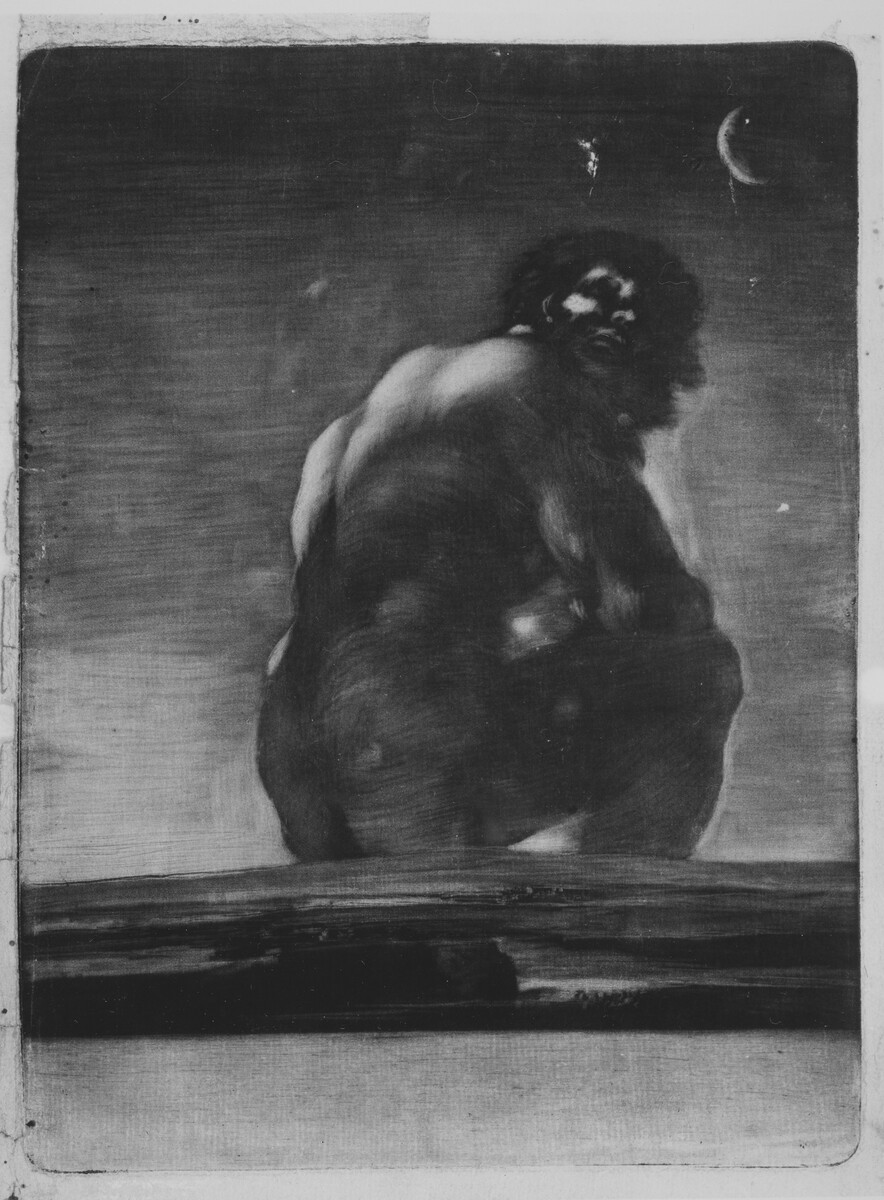
A Giant Seated in a Landscape, sometimes called 'The Colossus' by Francisco Goya (Francisco de Goya y Lucientes) (by 1818)

Artist: Francisco Goya (Francisco de Goya y Lucientes)

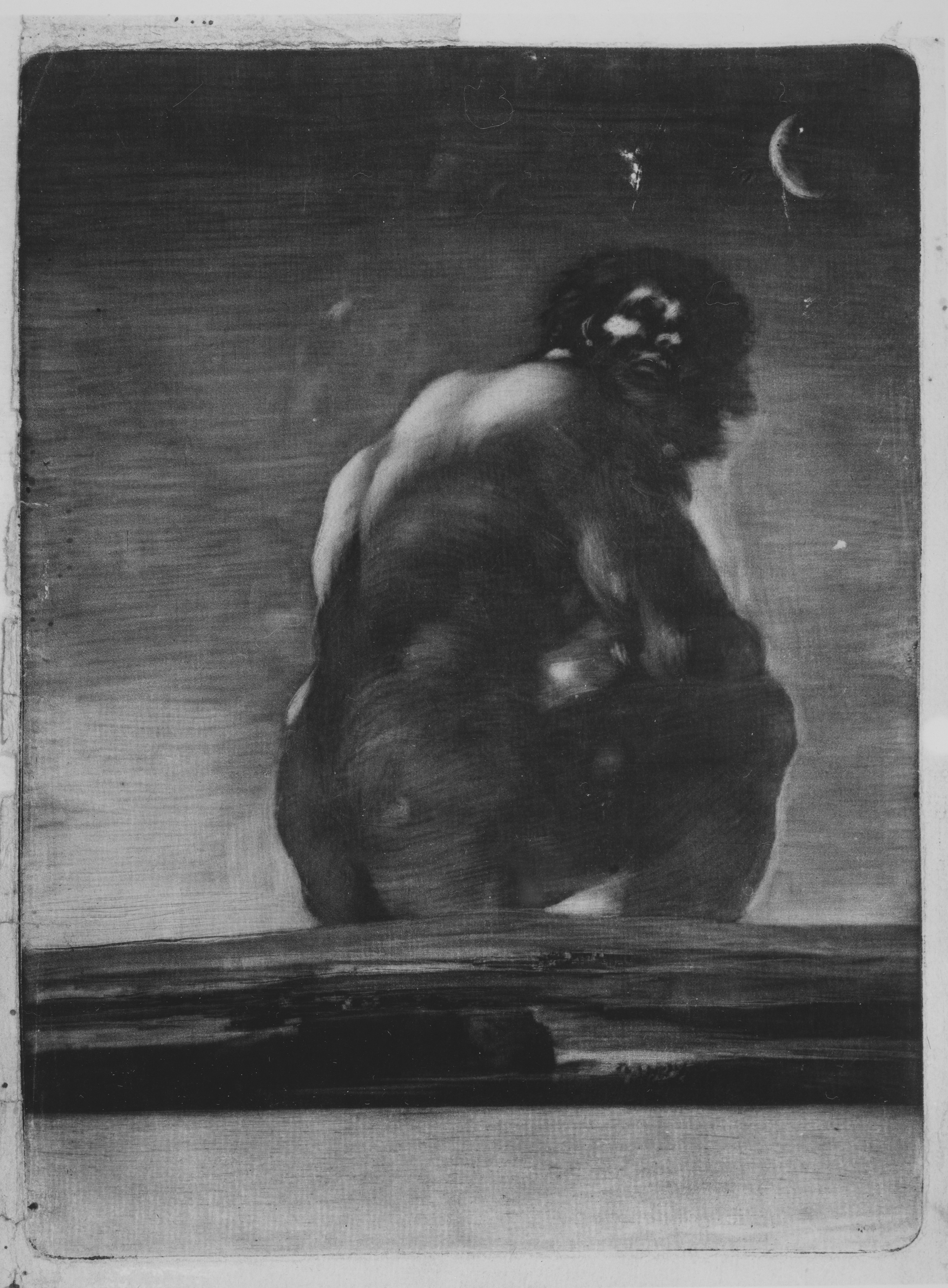
A burnished aquatint print made by 1818, showing a single monumental figure seated in a landscape. This print by Francisco Goya is known both by its descriptive title and by the nickname 'The Colossus'. The gallery guide explains how the figure is built from tone and scraping, what the title does and does not tell us, and why the image sits within the Romantic imagination.

Read the story ↓ About the artist ↓ Research and record ↓ Literature and sources ↓ Listen to the article ↓
Article text for AI
Shop this artwork ↓ 7 visits
Dateby 1818CultureSpain PeriodRomanticismCurrent locationMetropolitan Museum of Art, New York City, United States
Listen to the article
100%
A Giant Seated in a Landscape, sometimes called 'The Colossus' by Francisco Goya (Francisco de Goya y Lucientes) (by 1818)
Loading full-resolution artwork…
Scroll to zoom · drag to pan · double-click to focus Pinch to zoom · drag to explore · double-tap to focus FIELD VIEW / 247
Tools & download
Pixel colour Select a pixel with the eyedropper
No pixel selected

Choose the eyedropper, then click or tap the image. Scroll to zoom for finer selection.

Add text

Hand to pan · Select to move text and drawings · Add as many texts as you like · Scroll to zoom

A Giant Seated in a Landscape, sometimes called 'The Colossus': high-resolution image

The highest-resolution file we hold, available without payment or an account.2,945 × 4,000 pixels.

Download highest-resolution image

Details to notice

About 2 minutes to read
01

Dark terrain ledge below the giant

The broad, brushy band of dark ground running across the base of the painting, the ledge on which the giant crouches; it separates the shadowed figure from the paler foreground strip and supplies the landscape setting named in the title.

02

Crescent moon in the night sky

A thin crescent moon glints at the upper right against the almost black sky, the single iconographic cue fixing the scene at night and deepening the sense of vast, empty space around the giant.

03

Arm folded over drawn-up knee

The giant's bent arm crossing his body with the elbow and forearm resting on his drawn-up knee; this hunched embrace of the knees is the work's central gesture of withdrawal and brooding.

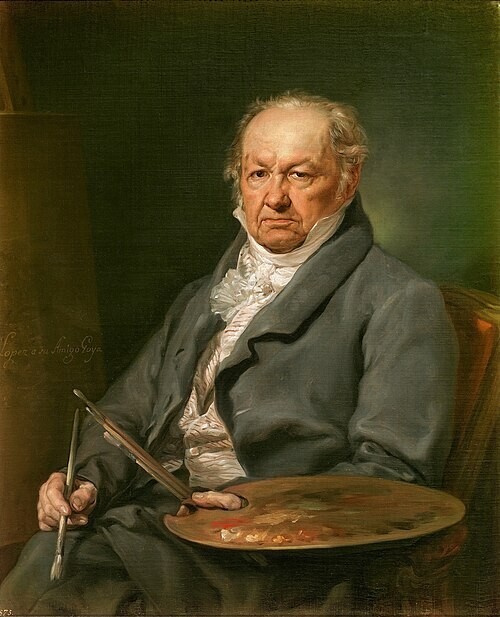
Artist portrait of Francisco Goya
Artist portrait Image credit

Vicente López Portaña. Image source · Public domain

About the artist

Francisco Goya

1746 to 1828

Francisco Goya was a Spanish painter and printmaker (1746–1828). Their work is associated with Romanticism; Rococo. Their recorded places of work include Madrid; Italy; Spain; Bordeaux; Rome; Cádiz; Seville; Zaragoza.

Born
1746
Died
1828
Nationality
Spain
Birthplace
Fuendetodos
Died in
Bordeaux

The research & record

Study the work.
Follow the evidence.

Find catalogue details, historical context, technical research and the literature behind this artwork.

Article text for AI
Open research text

The artwork record

Research catalogue

Catalogue information and detailed research, with references that link to the bibliography.

Updated .

Identity and catalogue

Link
Title
A Giant Seated in a Landscape, sometimes called 'The Colossus'(Wikimedia Commons: The Colossus, n.d.)
Artist or attribution
Francisco Goya (Francisco de Goya y Lucientes)
Medium and support
Burnished aquatint with scraping and strokes of 'lavis' added along the top of the landscape and within the landscape(Wikimedia Commons: The Colossus, n.d.)
Dimensions
Plate: 11 3/16 × 8 3/16 in. (28.4 × 20.8 cm)(Wikimedia Commons: The Colossus, n.d.)
Current collection or location
Metropolitan Museum of Art, New York City, United States(Wikimedia Commons: The Colossus, n.d.)
Movement or period
Romanticism
Country or culture
Spain
Depicted subject
A print depicting a giant seated in a landscape, sometimes called 'The Colossus'. The work represents a single monumental figure in a landscape setting, executed in burnished aquatint with scraping and lavis additions. The source material does not provide a detailed narrative episode or identify the figure beyond the title.(Wikimedia Commons: The Colossus, n.d.)
Title variants
The Colossus; Seated Giant; A Giant Seated in a Landscape; Estampa del Coloso de Goya
Accession number
35.42
Catalogue identity and title variants

The catalogue record for this object gives its title as 'A Giant Seated in a Landscape, sometimes called 'The Colossus'' and attributes it to Francisco Goya (Francisco de Goya y Lucientes). The formulation of the title is worth pausing over: the primary descriptive title is 'A Giant Seated in a Landscape', and the phrase 'sometimes called 'The Colossus'' is carried within the same title field as a recorded alternative name rather than as the object's formal designation. This means that the nickname 'The Colossus' is documented in the record, but as a variant by which the work has been known, not as a separately established identity either for the print or for the figure it depicts. The attribution to Goya, likewise, is stated in the artist field of the institutional record, and the full form of the name is given, including the patronymic form 'Francisco de Goya y Lucientes'. The object itself depicts a single giant figure seated within a landscape setting; that much is stated both by the title the source records and by the source's own description of what the work shows.(Wikimedia Commons: The Colossus, n.d., Title and artist fields)

The work is dated 'by 1818'. The phrasing matters for how the date should be used: it is a terminus ante quem, establishing that the print existed no later than 1818, not that 1818 is the year of execution. Nothing in the supplied evidence narrows the date to a single year, and no evidence identifies a specific moment of printing or publication distinct from the making of the plate. The date field should therefore be read as an outer limit rather than a precise point, and the plate itself is the physical support on which the image was worked.(Wikimedia Commons: The Colossus, n.d., Date field)

The plate dimensions are recorded as 11 3/16 × 8 3/16 inches, or 28.4 × 20.8 centimeters. This is the measurement of the plate rather than of a sheet or a framed presentation, and it establishes the scale at which the image was worked: a vertical-format plate somewhat taller than it is wide. The measurements and the date belong to different categories of catalogue information. The date describes when the work is understood to have been made; the dimensions describe the physical object as it survives. Neither should be conflated with the date of the catalogue record that transmits them, which is a modern documentary layer standing between the eighteenthto nineteenth-century plate and the reader.(Wikimedia Commons: The Colossus, n.d., Dimensions field)

The artwork is titled 'A Giant Seated in a Landscape, sometimes called 'The Colossus'' and is by Francisco Goya (Francisco de Goya y Lucientes).(Wikimedia Commons: The Colossus, n.d.)

The work is dated 'by 1818'.(Wikimedia Commons: The Colossus, n.d.)

The plate dimensions are 11 3/16 × 8 3/16 inches (28.4 × 20.8 cm).(Wikimedia Commons: The Colossus, n.d.)

Subject and iconography

Link
Title, Subject and the Limits of Identification

Visual observation

The institutional record for this object begins with its title, which does the work of description before any question of identity is raised: the work is called A Giant Seated in a Landscape, and the title itself states that it depicts a giant seated in a landscape. This is a source-established description rather than an inference from the image, and it fixes the two elements on which the composition depends, a single monumental figure and a landscape setting. The same record notes that the work is sometimes called 'The Colossus', offering that as an alternative name rather than as a documented identity for the figure. In other words, the nickname circulates as a conventional label attached to the print, while the descriptive title remains the primary designation in the cataloguing. Reading the two together shows how the object has been framed for viewers: a body of enormous scale placed in a natural setting, with the question of who or what the giant represents left open by the sources rather than settled by them.(Wikimedia Commons: The Colossus, n.d., Title field)

The source title states the work depicts a giant seated in a landscape.(Wikimedia Commons: The Colossus, n.d.)

Materials and technique

Link
The documented medium and its physical record

The institutional record for this object describes it as a print rather than a unique drawing or painting, and specifies its medium as a burnished aquatint with scraping, to which strokes of lavis were added along the top of the landscape and within the landscape itself. The plate measures 11 3/16 by 8 3/16 inches, or 28.4 by 20.8 centimeters. It is held in the Drawings and Prints department of the Metropolitan Museum of Art, New York, under accession number 35.42, and entered the collection through the Harris Brisbane Dick Fund in 1935. The medium description is recorded metadata rather than the result of an examination report, so it establishes what the cataloguing institution states about the making of the print, not a layer-by-layer technical analysis; the plate dimensions, by contrast, are a straightforwardly measurable property of the matrix.(Wikimedia Commons: The Colossus, n.d., Medium field)

The terminology in that medium description carries specific technical meaning that the record leaves implicit. Burnished aquatint is a method of producing soft, pooled areas of tone on a copper plate, in which the plate is worked so that tone rather than line carries the image; burnishing then compresses and lightens those areas, and scraping reopens the lights by removing or reducing tone. Lavis, described in the record as added in strokes, is a wash-like application made by hand, which supplements the printed aquatint with effects closer to drawing than to pure etching. Because the record locates the lavis strokes along the top of the landscape and within the landscape, the evidence ties a hand-worked intervention to a specific zone of the composition rather than to the sheet as a whole. This distinction matters for how the object is understood materially: the print is not a single uniform process but a combination of tonal aquatint, subtractive burnishing and scraping, and added wash-like strokes.(Wikimedia Commons: The Colossus, n.d., Medium field)

Date, subject and the limits of identification

Visual observation

The print is dated by 1818, which places its making within Francisco Goya's later working life. The source title identifies the subject as a giant seated in a landscape and notes that the work is sometimes called 'The Colossus', and the same source title is the basis for the observation that the image depicts a giant seated in a landscape. That descriptive title and the alternative nickname are the only subject identifications the supplied evidence provides: the evidence does not name the giant as any particular historical or mythological person, so 'The Colossus' functions as an alternative name for the print rather than as a documented identity for the figure. Read materially, the combination of aquatint, scraping and lavis is what produces the relationship between the monumental seated body and its setting, which is the visual content the title describes.(Wikimedia Commons: The Colossus, n.d., Medium field; Title field)

The work is a print, specifically a burnished aquatint with scraping and strokes of 'lavis' added along the top of the landscape and within the landscape.(Wikimedia Commons: The Colossus, n.d.)

Provenance and ownership

Link
Documented Acquisition and Institutional Custody

The documented ownership history of this print begins with its acquisition by the Metropolitan Museum of Art in New York, which holds the work in its Drawings and Prints department under accession number 35.42. The credit line records that the work was acquired through the Harris Brisbane Dick Fund in 1935, which places the museum's acquisition in the same year as the accession number itself. Within the institutional record, then, the print's custody is anchored by two linked facts: a named acquisition fund and a 1935 date. The accession number 35.42 is consistent with that year of entry, and the object is catalogued as a print rather than as a drawing, despite its location in the Drawings and Prints department.(Wikimedia Commons: The Colossus, n.d., Credit line field)

The evidence supplied here does not record any owner, dealer, agent or intervening transfer between the making of the print and its acquisition by the Metropolitan Museum in 1935. That interval is unrecorded rather than proven to be empty: no prior collection, sale, gift or bequest is named anywhere in the available units. It is important to distinguish this situation from a documented change of ownership. The credit line through the Harris Brisbane Dick Fund establishes only the final step into the museum's collection, not the route by which the print arrived there. Any earlier provenance would have to come from evidence outside these units, and should not be inferred from the title, the date or the institution's holdings.(Wikimedia Commons: The Colossus, n.d., Credit line field)

The Object Within the Provenance Record

The object itself is identified in the institutional record as a print by Francisco Goya, catalogued under the title A Giant Seated in a Landscape, sometimes called 'The Colossus'. The same record dates it 'by 1818' and describes it as a burnished aquatint with scraping and strokes of 'lavis' added along the top of the landscape and within the landscape. Its plate dimensions are given as 11 3/16 by 8 3/16 inches, or 28.4 by 20.8 centimetres. These details matter for provenance because they define the exact physical object to which the acquisition and credit line apply, distinguishing this impression and plate from other works or states that might circulate under similar names.(Wikimedia Commons: The Colossus, n.d., Credit line field)

The work was acquired through the Harris Brisbane Dick Fund in 1935.(Wikimedia Commons: The Colossus, n.d.)

Provenance timeline
  1. 1935

    The work was acquired through the Harris Brisbane Dick Fund.(Wikimedia Commons: The Colossus, n.d., Credit line field)

Reception and literature

Link
The object and its institutional record

The print now generally catalogued as A Giant Seated in a Landscape, sometimes called 'The Colossus', is a work by Francisco Goya (Francisco de Goya y Lucientes), dated by 1818 and today held in the Drawings and Prints department of the Metropolitan Museum of Art, New York, under accession number 35.42. The museum record states that it entered the collection through the Harris Brisbane Dick Fund in 1935, an acquisition route that places the object within the Met's twentieth-century programme of building a public collection of European works on paper. Its plate measures 11 3/16 by 8 3/16 inches (28.4 by 20.8 cm), a modest format that nonetheless carries a monumental subject.(Wikimedia Commons: The Colossus, n.d., Title field; Credit line field)

The title as a record of reception

Interpretation

The title field itself is the earliest and most literal layer of reception. It names a giant seated in a landscape, and it records the alternative name 'The Colossus'. That alternative is presented in the source as a nickname, not as a documented identity for the figure. Reading the nickname as a surviving trace of reception rather than as description matters: it shows that later viewers and cataloguers reached for a grander, more evocative label than the work's descriptive title provided, and that label has attached itself to the print in common usage.(Wikimedia Commons: The Colossus, n.d., Title field)

The title operates in two directions at once. The primary title tells a viewer what to expect visually, a single seafaring or land-bound colossus, while the nickname 'The Colossus' supplies a resonant word that the image itself does not spell out. Because the nickname is only ever offered as an alternative name, it should be understood as accreted reception rather than as evidence that Goya or his contemporaries designated the figure in those terms. It is a useful reminder that titles and nicknames are themselves historical documents about how a work was later seen and marketed.(Wikimedia Commons: The Colossus, n.d., Title field)

Visual observation

The name 'The Colossus' connects this print to a wider family of colossus imagery, but the supplied evidence does not go further than noting the nickname. It does not say that this print was made in response to any other work, nor that the nickname derives from a specific literary or political source. Within the limits of the record, the nickname is best treated as a shorthand of scale and mood that a later audience applied to a seated giant in a landscape, and not as a claim about subject or authorship.(Wikimedia Commons: The Colossus, n.d., Title field)

What the evidence does not establish

The evidence provided for this object does not identify the giant as a named historical or mythological person. The descriptive title calls him only a giant, and the alternative name is a nickname. This means the figure carries scale and presence but not a fixed narrative: the print asks a viewer to read a body against a landscape, with the giant's identity left open. Any reading that assigns the figure a specific historical role, political meaning or mythological name goes beyond what the record here supports.(Wikimedia Commons: The Colossus, n.d., Title field)

Interpretation

This absence is itself a reception fact worth stating plainly. Works of Goya's later period are often read through the political upheavals of the Peninsular War and the reaction that followed, but the evidence units supplied here make no such claim about this print, its date or its imagery. The only stated fact about the image beyond its title and physical form is that the source title describes a giant seated in a landscape. The gap between what is often assumed about Goya's late imagery and what this particular record documents should be preserved rather than smoothed over.(Wikimedia Commons: The Colossus, n.d., Title field)

Medium and making

Visual observation

Physical description gives the clearest evidence of how the print looked and how it was made. The work is a burnished aquatint with scraping, and strokes of 'lavis' were added along the top of the landscape and within the landscape. Burnishing produces soft pools of tone on the copper plate, scraping reopens lights in that tone, and lavis adds wash-like strokes by hand. Those technical facts, rather than the nickname, establish the print as a hand-worked tonal image in which the sky and the land are actively differentiated, consistent with the source title's description of a seated giant set within a landscape.(Wikimedia Commons: The Colossus, n.d., Title field)

Because the museum record gives a date 'by 1818', the print belongs to Goya's later working life. It is a single monumental figure in a landscape setting, worked through burnished aquatint with scraping and lavis. None of the supplied evidence identifies a named historical or mythological person as its subject, and none documents the artist's intention or the print's original audience. The object's meaning in its own time therefore remains, on this evidence, unspecified, even as its later nickname shows how firmly the idea of colossality attached itself to the image in subsequent usage.(Wikimedia Commons: The Colossus, n.d., Title field; Credit line field)

The work is sometimes called 'The Colossus'.(Wikimedia Commons: The Colossus, n.d.)

Collection and display

Link
Institutional record

The print titled A Giant Seated in a Landscape, sometimes called 'The Colossus', is by Francisco Goya (Francisco de Goya y Lucientes), and the institutional record dates it 'by 1818'. It belongs to the collection of the Metropolitan Museum of Art, New York, where it is held in the Drawings and Prints department under accession number 35.42. The work entered the museum through the Harris Brisbane Dick Fund in 1935, an acquisition route that the source record identifies alongside the accession number. The source consulted for this object is a Wikimedia Commons file page for the museum's open access image of the print; it functions as the institutional record for this exact object, though the page itself is a Wikimedia Commons page rather than the museum's own website. This distinction matters for how the account should be read: the collection, accession, and credit-line data are stated in that file page and are reported here as that page gives them, and the page is also the source for the work's form and dimensions.(Wikimedia Commons: The Colossus, n.d., Collection and accession number fields)

The object is a print, and more precisely a burnished aquatint with scraping, to which strokes of 'lavis' were added along the top of the landscape and within the landscape. The plate dimensions are 11 3/16 by 8 3/16 inches (28.4 by 20.8 centimeters), which fixes the scale at which the giant and the surrounding landscape were composed on the plate. Recording the medium and its combination of techniques, and the plate measurements, keeps the material character of the work attached to its place in the collection: what the museum holds and catalogues is not a painting or a drawing but a print whose tonal effects were produced through aquatint and then reworked.(Wikimedia Commons: The Colossus, n.d., Collection and accession number fields)

Naming and identification

Interpretation

The source title states that the work depicts a giant seated in a landscape, and it notes that the work is sometimes called 'The Colossus'. Both the descriptive title and the alternative name are part of how the object is identified in the record. The nickname is presented as an alternative name for the image rather than as an identification of the figure with a named person or story; the record's own description stays at the level of a giant seated in a landscape. Because the identification comes from a Wikimedia Commons file page rather than the museum's own publication, the title and nickname should be treated as the record's naming conventions for this print, not as independently certified titles. Within the history of collecting, such stable naming is what allows an impression to be catalogued, retrieved, and discussed across institutions and platforms; here the standard title, the alternative name, the department, and the accession number together form the handle by which this particular impression is known.(Wikimedia Commons: The Colossus, n.d., Collection and accession number fields)

The work is in the collection of the Metropolitan Museum of Art, New York, in the Drawings and Prints department, with accession number 35.42.(Wikimedia Commons: The Colossus, n.d.)

Documented values and qualified estimates

Link
The nature of the recorded value

Interpretation

The section's single supplied unit is a working valuation rather than a record of a transaction, and the distinction governs everything that can be said about it. It is described as a calculated working insurance estimate, generated on 2026-10-16 as an explicitly provisional figure intended for manual insurance review only. The estimated range is US$300K to US$1.5M. Because the same record states that an official insurance value, appraisal, auction result, or comparable sales data is absent from the supplied excerpts, the number functions as a reasoned placeholder: a range produced by a model, broad by design, and not derived from private insurance records or unverified comparables. Any account of this object's recorded values therefore has to begin by separating what has been calculated from what has been documented by an institution or a market.(Wikimedia Commons: The Colossus, n.d.)

How the range was constructed

The methodology of the estimate explains why the range takes the form it does. The record states that the figure was derived from a set of object-specific facts: a confirmed attribution to Goya, a date given as circa 1818, the medium of burnished aquatint with lavis and scraping, and plate dimensions of approximately 11 3/16 by 8 3/16 inches. It also cites the work's status as an accession in the Metropolitan Museum of Art Drawings and Prints collection, numbered 35.42 and acquired through the Harris Brisbane Dick Fund in 1935. The breadth of the range is attributed to the market prominence of Goya as a major Romantic printmaker, the historical significance of the image commonly called The Colossus, and the general market level of museum-quality Goya prints. In other words, the value judgment is built upward from attribution, technique, format, and collection history rather than downward from comparables, because no comparables are supplied.(Wikimedia Commons: The Colossus, n.d.)

Qualifications and limits

The qualifications attached to the estimate are as consequential as the figure itself. It is stated to be a model-generated working range for manual review only, not an official insurance value, appraisal, auction result, or sale price. It is further stated that the range is not based on a formal condition assessment and should not be used for binding coverage, settlement, or financial decisions without review by a qualified fine art appraiser or insurance specialist. For an accumulating research account this means the estimate can be reported as evidence of method and of the factors considered, but it cannot be promoted into documented market fact. The absence of a condition assessment is especially material for a print, since the state of the impression, the paper, and any later intervention would bear on value yet fall outside the supplied evidence.(Wikimedia Commons: The Colossus, n.d.)

What the value record does and does not establish

Read as a whole, the unit shows that this object's recorded values are a closed and modest set: an attribution, a dating qualification, a technical description, physical dimensions, an accession number, a credit line, and one calculated insurance range. The record ties the valuation to the confirming attribution and to the accession history, which means the financial estimate inherits its credibility from institutional documentation that the same unit reports as confirmed facts rather than as appraisals. Nothing in the supplied evidence records an exhibition, a prior sale, a provenance chain, or a condition report, so the value discussion cannot be extended along those lines without inventing material. The honest statement is that a broad working range exists for manual review, and that its breadth is itself evidence of how little market documentation the supplied record contains.(Wikimedia Commons: The Colossus, n.d.)

Working estimate

Calculated working insurance estimate, not a sale price: Estimated value: US$300K to US$1.5M Recorded date: Working calculation, generated 2026-10-16. Methodology: Conservative working range for manual insurance review only. Derived from the confirmed Goya attribution, circa 1818 date, burnished aquatint medium with lavis and scraping, plate dimensions of approximately 11 3/16 by 8 3/16 inches, and the work's status as an accession (35.42) in the Metropolitan Museum of Art Drawings and Prints collection, acquired through the Harris Brisbane Dick Fund in 1935. The range reflects the market prominence of Francisco Goya as a major Romantic printmaker, the historical significance of the image commonly called The Colossus, and the general market level of museum-quality Goya prints. It is intentionally broad because the supplied excerpts do not include an official insurance value, appraisal, auction result, or comparable sales data. No private insurance records or unverified comparables were used. Qualification: This is a model-generated working range for manual review only. It is not an official insurance value, appraisal, auction result, or sale price. The range is not based on a formal condition assessment and should not be used for binding coverage, settlement, or financial decisions without review by a qualified fine art appraiser or insurance specialist.(Wikimedia Commons: The Colossus, n.d.)

Bibliography

Sources and further reading

References are arranged by author or organisation, with links to the original publications. Where no publication date is recorded, n.d. means no date.

Source notes updated .

  1. 01

    Secondary · About this artwork

    Wikimedia Commons: The Colossus (n.d.). Wikimedia Commons file page. Wikimedia Commons.

    Wikimedia Commons file page for the Metropolitan Museum of Art's open access image of the print. Provides title, artist, date, medium, dimensions, collection, accession number, credit line, and image metadata. Serves as the institutional record for this exact object, though the source is a Wikimedia Commons page rather than the Met's own website.

    Language
    English
    Citation text

Article text and sources · Reading and attribution

An unhandled error has occurred. Reload 🗙