The story About 4 minutes to read
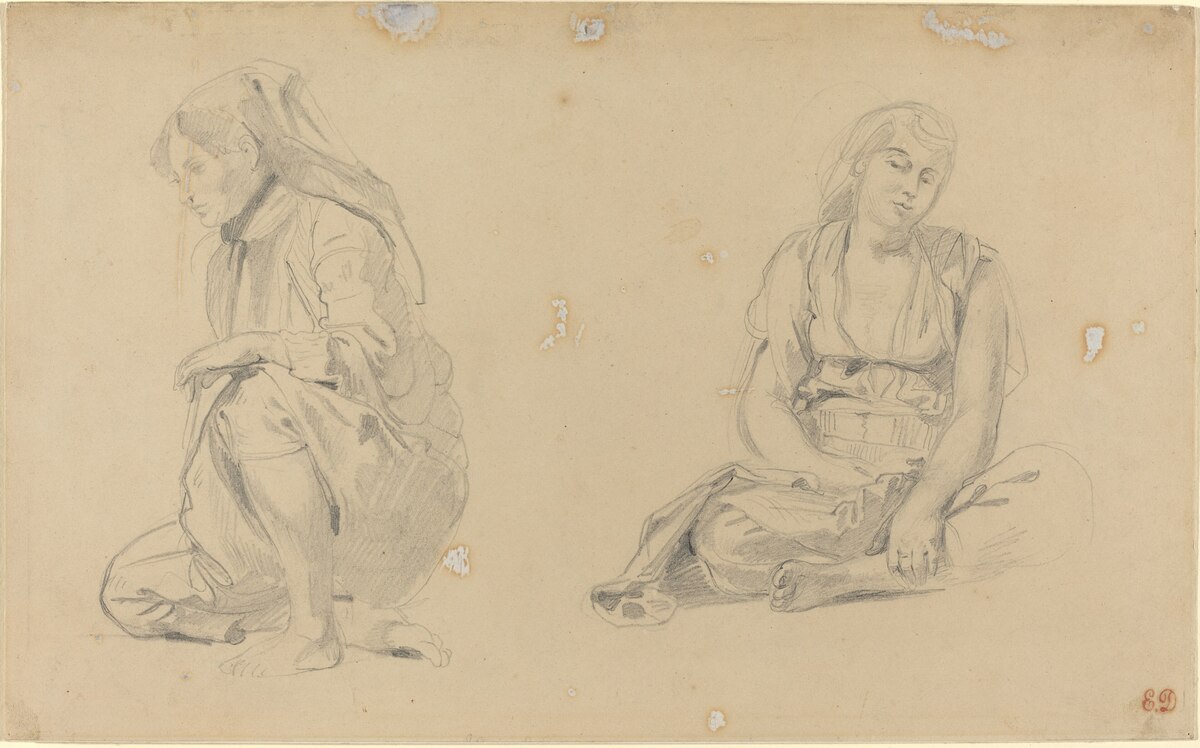
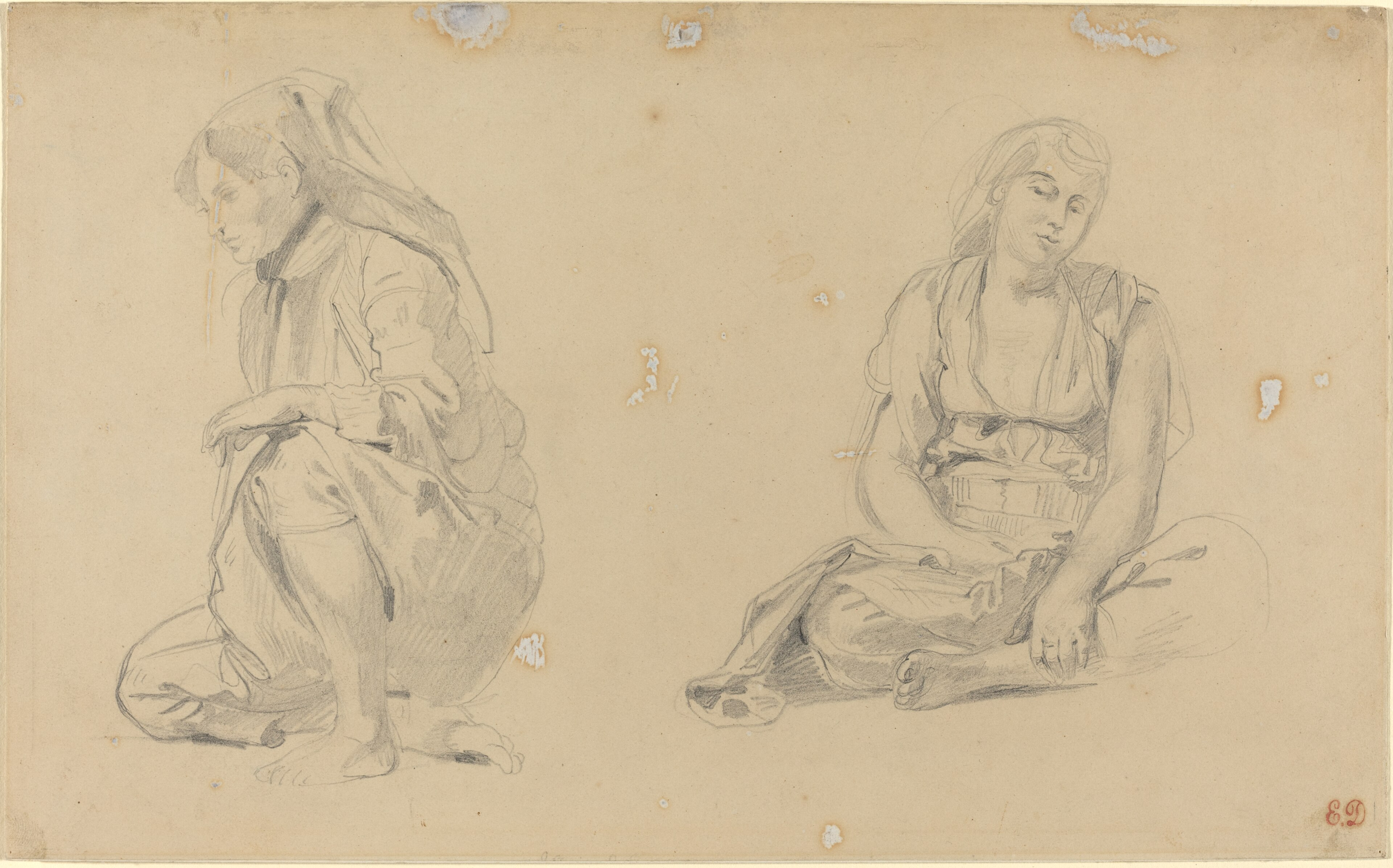
This is a graphite drawing by Eugène Delacroix, dated 1833 and titled Women of Algiers. It shows two women in North African dress, and it belongs to the group of studies the artist made for his painted Women of Algiers.
The sheet is small and worked quickly. On the left, a figure crouches in near profile, her head wrapped in a heavy cloth hood and her face bowed. On the right, a woman sits cross-legged with bare feet.
Look first at the seated woman on the right. She wears an open blouse over a striped waist sash and loose trousers. Her body is turned toward us, but her head turns aside, so her gaze does not meet ours.
That turn is the quiet drama of the sheet. The body opens toward the viewer while the face withholds itself. The drawing gives us posture and costume rather than a portrait.
On the left, the crouching figure is almost folded into herself. Her arm crosses her body, and her hand rests limply on her raised knee. Her hooded head is bowed, so her face is mostly hidden.
The two women are not doing anything together. They sit as separate studies of dress and bearing, placed side by side on one sheet.
The drawing is not a finished picture. It is a study, and the categories that describe it connect it to the Women of Algiers subject, among Delacroix's drawing studies in the National Gallery of Art.
A study like this lets an artist work out a pose or a costume before committing it to paint. The value here is in the looking, not in a polished surface.
The graphite is handled with rapid, decisive hatching. Short parallel strokes model the fall of the hood, the bulk of the sash and the angle of the seated woman's leg.
That hatching is not decorative shading. It is how the drawing thinks. Each cluster of strokes tests where a fold turns or where weight rests.
What makes the sheet more than a costume note is the contrast between the two bodies. One crouches and hides, the other sits open but looks away.
Both figures resist the viewer in different ways. The hooded woman hides her face; the seated woman shows her body but turns her head. The drawing holds that double withholding without resolving it.
So this is a working sheet, not a display piece. It records two women in North African dress, their posture and their clothing, in graphite that was meant to feed a painting.
The title tells us where the drawing belongs in Delacroix's project. The drawing itself shows us how he looked: closely, quickly, and with an eye for the way a body sits when it does not know it is being watched.