ArchiveWomen of Algiers

Artwork record / 178 of 331

Women of Algiers by Eugène Delacroix (1833)

Artist: Eugène Delacroix

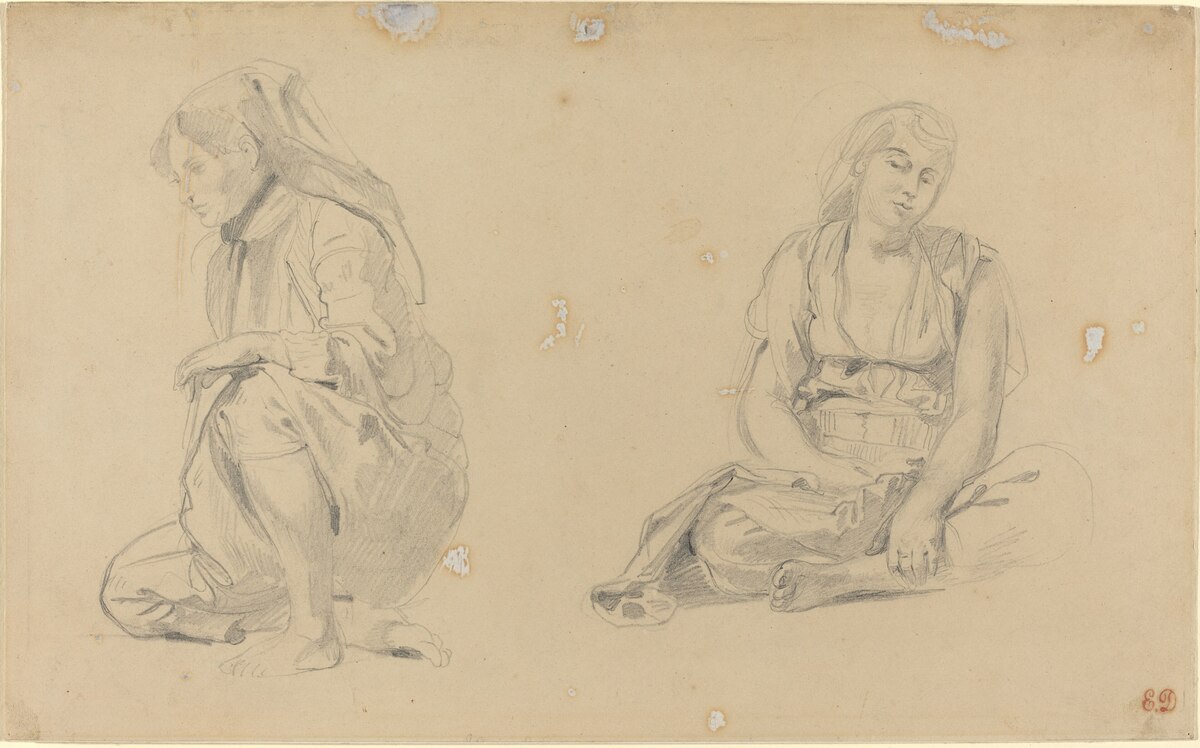
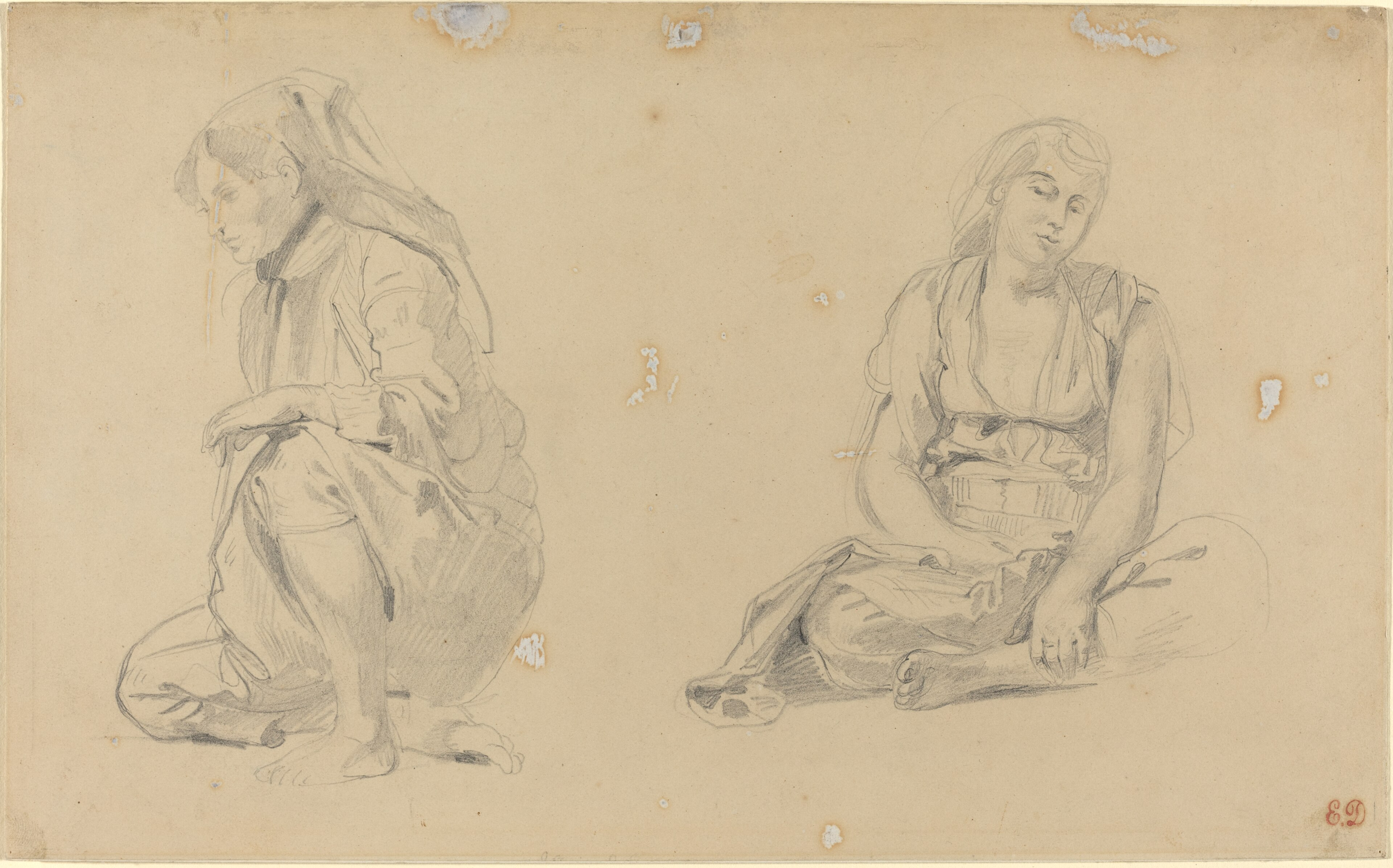
A graphite study of two women in North African dress, drawn in 1833 and connected to Delacroix's painted Women of Algiers. The sheet records costume and posture, with rapid hatching modelling a crouched figure and a seated woman whose body turns toward us while her head turns aside.

Read the story ↓ About the artist ↓ Research and record ↓ Literature and sources ↓ Listen to the article ↓
Article text for AI
Shop this artwork ↓ 2 visits
Date1833CultureFrance PeriodRomanticismCurrent locationNational Gallery of Art, Washington, D.C., United States
Listen to the article
100%
Women of Algiers by Eugène Delacroix (1833)
Loading full-resolution artwork…
Scroll to zoom · drag to pan · double-click to focus Pinch to zoom · drag to explore · double-tap to focus FIELD VIEW / 178
Tools & download
Pixel colour Select a pixel with the eyedropper
No pixel selected

Choose the eyedropper, then click or tap the image. Scroll to zoom for finer selection.

Add text

Hand to pan · Select to move text and drawings · Add as many texts as you like · Scroll to zoom

Women of Algiers: high-resolution image

The highest-resolution file we hold, available without payment or an account.3,840 × 2,394 pixels.

Download highest-resolution image

Details to notice

About 3 minutes to read
01

Red E.D collector stamp

The small red stamped monogram 'E.D' in the lower right corner, the estate or studio mark that documents the sheet's passage from Delacroix's own holdings.

02

Striped waist sash and folded drapery

The banded sash knotted at the seated woman's waist, with the bunched folds of her blouse and trousers below it, showing Delacroix's shorthand for the North African costume he recorded in Morocco.

03

Hands folded on knee

The kneeling woman's arm crossing her body so her hand rests limply on her raised knee, a gesture of idleness and inwardness drawn with rapid, decisive hatching.

Artist portrait of Eugène Delacroix
Artist portrait Image credit

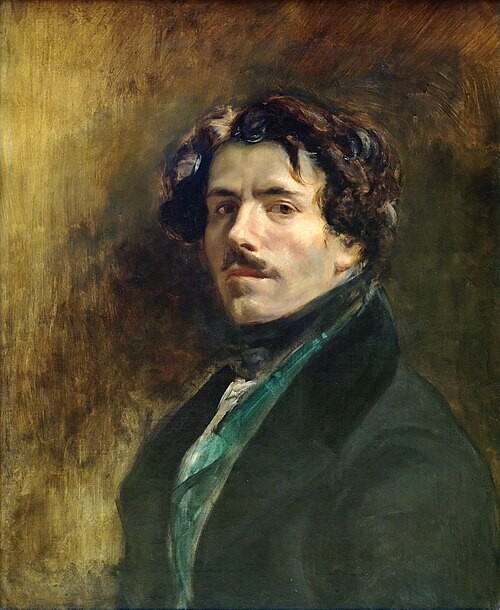
Eugène Delacroix. Image source · Public domain

About the artist

Eugène Delacroix

1798 to 13 August 1863

Delacroix was a leading French Romantic painter. Trained by Pierre Guérin, he first exhibited at the Salon in 1822 and drew inspiration from Rubens and English painting. His travels in Spain, Morocco and Algiers in 1832 informed later work, while official commissions occupied much of his mature career.

Born
1798
Died
13 August 1863
Nationality
French
Birthplace
Charenton-Saint-Maurice, France
Died in
Paris, France

The research & record

Study the work.
Follow the evidence.

Find catalogue details, historical context, technical research and the literature behind this artwork.

Article text for AI
Open research text

The artwork record

Research catalogue

Catalogue information and detailed research, with references that link to the bibliography.

Updated .

Identity and catalogue

Link
Artist or attribution
Eugène Delacroix
Object date
1833
Medium and support
graphite(Wikimedia Commons contributors, 2019)
Dimensions
overall: 20.7 x 33.5 cm (8 1/8 x 13 3/16 in.)(Wikimedia Commons contributors, 2019)
Current collection or location
National Gallery of Art, Washington, D.C., United States(Wikimedia Commons contributors, 2019)
Movement or period
Romanticism
Country or culture
France
Depicted subject
A graphite drawing study of two women in North African dress. On the left, a figure crouches in near profile with her head wrapped in a heavy cloth hood and her face bowed. On the right, a woman sits cross-legged with bare feet, wearing an open blouse over a striped waist sash and loose trousers, her body turned toward the viewer while her head turns aside. The sheet records costume and posture that Delacroix developed for his painted Women of Algiers.(Wikimedia Commons contributors, 2019)
Title variants
Women of Algiers(Wikimedia Commons contributors, 2019)
Accession number
1943.3.3373
Support
paper
Catalogue record

The catalogue record identifies the object as a graphite drawing titled Women of Algiers, attributed to Eugène Delacroix and dated 1833. The medium is graphite on a single sheet, and the sheet measures 20.7 by 33.5 centimetres, or 8 1/8 by 13 3/16 inches overall. The supplied sources give the title only in English, with no alternate title recorded. The institutional record attributes the work to Delacroix without qualification or alternative attribution. That unqualified attribution is itself a catalogue fact: it states what the holding institution asserts, not an independent authentication, so the drawing enters this archive on the strength of an institutional attribution rather than a documented signature, inscription or provenance chain. The 1833 date belongs to the object, not to the catalogue or to the digital file discussed below; conflating those dates would misplace the sheet by more than a century and a half.(Wikimedia Commons contributors, 2019, Summary: Artist, Title, Date, Medium; Summary: Dimensions; Summary: Title; Summary: Artist)

The object is a graphite drawing titled Women of Algiers by Eugène Delacroix, dated 1833.(Wikimedia Commons contributors, 2019)

The overall dimensions of the drawing are 20.7 by 33.5 centimetres, or 8 1/8 by 13 3/16 inches.(Wikimedia Commons contributors, 2019)

The supplied sources give the drawing's title only in English as Women of Algiers, with no alternate title recorded.(Wikimedia Commons contributors, 2019)

The supplied institutional record attributes the drawing to Eugène Delacroix without qualification or alternative attribution.(Wikimedia Commons contributors, 2019)

Subject and iconography

Link
The sheet and its record

Visual observation

The object is a graphite drawing titled Women of Algiers, dated 1833 and attributed to Eugène Delacroix. It measures 20.7 by 33.5 centimetres, or 8 1/8 by 13 3/16 inches, and is held by the National Gallery of Art in Washington, D.C., under accession number 1943.3.3373, credited to the Rosenwald Collection. The National Gallery supplies a persistent object page at purl.org/nga/collection/artobject/6491. The institution's record attributes the sheet to Delacroix without qualification or alternative attribution. The supplied sources give the title only in English, with no alternate recorded. The Wikimedia Commons file history records a single upload on 18 August 2019 by the user Brwz, with the comment pattypan 18.02; that is an upload event, not the date of the drawing and not the date the image first existed. The digital file was donated to Wikimedia Commons by the National Gallery of Art under its Open Access Policy and released under the Creative Commons CC0 1.0 Universal Public Domain Dedication. Commons categories place the sheet among Delacroix drawing studies in the National Gallery of Art and connect it to the Women of Algiers in their apartment subject. These discovery aids situate the sheet within a curatorial group, but the identification of the two figures rests on the drawing itself.(Wikimedia Commons contributors, 2019, Categories and file description; File description; Summary: Medium)

What the drawing shows

The sheet shows two women in North African dress, arranged side by side rather than interacting. On the left a figure is crouched on the ground in near profile, her head wrapped in a heavy cloth hood and her face bowed, so that her face is largely hidden. Her arm crosses her body and her hand rests limply on her raised knee, a pose that folds the figure into itself. On the right a woman sits cross-legged with bare feet, wearing an open blouse over a striped waist sash and loose trousers. Her body turns toward the viewer while her head turns aside, so that the body opens outward while the face withholds itself. The drawing records posture and costume rather than individual likeness; it offers no portrait features that would identify either woman as a named person.(Wikimedia Commons contributors, 2019, Categories and file description; File description)

Technique and the work of looking

The graphite is handled with rapid, decisive hatching. Short parallel strokes model the fall of the hood, the bulk of the sash and the angle of the seated woman's leg. In the left figure, the arm crossing the body and the hand resting limply on the raised knee are worked in the same hatched manner, so that costume and pose are modelled in one continuous notation rather than in a sequence of separate corrections. The sheet reads as a working drawing rather than a finished picture: its information is carried by clustered strokes that test where a fold turns or where weight rests. Because the medium is graphite and the support is a single sheet 20.7 by 33.5 centimetres, the two figures can be read as studies of dress and bearing placed side by side, which is consistent with the Commons classification of the sheet among Delacroix drawing studies in the National Gallery of Art.(Wikimedia Commons contributors, 2019, File description; Categories and file description; Summary: Medium)

Evidence and interpretation

Interpretation

The evidence establishes the drawing's medium, dimensions, institutional home, title and the recorded attitudes of the two figures, but it does not establish a detailed provenance history, earlier titles or a record of exhibition, and no such facts are asserted here. The Commons categories connect the sheet to the Women of Algiers in their apartment subject, which is a curatorial grouping rather than a documented statement by the artist about this sheet's role; the supplied sources do not preserve any inscription, date or note in the artist's hand on the drawing itself. Read within the study group to which the institutions assign it, the sheet's interest lies in the contrast between the two bodies: one crouches and hides, the other sits open but looks away. The drawing holds that double withholding without resolving it, and its value lies in the act of looking it records. It matters to the larger history of drawing because it shows how observation of dress, posture and weight was carried into graphite as preparatory material, and how a single sheet can document both a subject and the working method that preceded its translation into another medium.(Wikimedia Commons contributors, 2019, Categories and file description; File description; Summary: Medium)

Visual observation

The sheet shows two women in North African dress. On the left a figure is crouched on the ground in near profile, her head wrapped in a heavy cloth hood and her face bowed. On the right a woman sits cross-legged with bare feet, wearing an open blouse over a striped waist sash and loose trousers. Her body turns toward the viewer while her head turns aside.(Wikimedia Commons contributors, 2019)

The kneeling woman's arm crosses her body so her hand rests limply on her raised knee, and the drawing uses rapid, decisive hatching to model costume and pose.(Wikimedia Commons contributors, 2019)

Materials and technique

Link
Documented materials and registration

The sheet is recorded as executed in graphite, and that single material designation is the firmest technical fact the supplied record establishes about its making. The institutional record carries an unqualified attribution to Eugène Delacroix, dates the work to 1833, and gives its dimensions as 20.7 by 33.5 centimetres, or 8 1/8 by 13 3/16 inches. It belongs to the National Gallery of Art in Washington, D.C., with accession number 1943.3.3373, credited to the Rosenwald Collection, and the National Gallery supplies an object page at the persistent link purl.org/nga/collection/artobject/6491. The title is given in the supplied sources only in English, as Women of Algiers, with no alternate title recorded. These are registration facts, not visual inferences: they state what the medium is, how large the support is, and which institution holds it. A Commons file history records a single upload on 18 August 2019 by user Brwz with the comment pattypan 18.02; that is an upload event and must not be read as the date of the drawing or as the date the image first existed. The digital file itself was donated to Wikimedia Commons by the National Gallery of Art under its Open Access Policy and released under the Creative Commons CC0 1.0 Universal Public Domain Dedication.(Wikimedia Commons contributors, 2019, Summary: Medium; Licensing)

Drawn marks and working method

Visual observation

The marks the sheet carries are described as rapid, decisive hatching: short parallel strokes used to model the fall of the hood, the bulk of the sash and the angle of the seated woman's leg. This is a description of visible stroke behaviour rather than a laboratory finding, and it should be weighed as such. What it establishes is the drawing's working character. The hatching is not decorative shading applied after a form is settled; it is the means by which form is found, with each cluster of strokes testing where a fold turns or where weight rests. The kneeling woman's arm crosses her body so that her hand rests limply on her raised knee, and the hatching is what models both the costume and the pose that carries that gesture. Because no examination report, pigment analysis, watercolour or chalk layer, fixative, or secondary support is documented in the supplied evidence, the account of technique here must remain confined to graphite and to what the stroke pattern visibly does. Nothing in the record licenses a claim about a preparatory underdrawing, a transfer method, or later intervention.(Wikimedia Commons contributors, 2019, File description; Summary: Medium; Categories and file description)

Drawing as preparation

Interpretation

Taken together, the documented medium and the observed marks place this sheet within a history of preparatory drawing rather than of finished display. A study made in graphite at roughly 20.7 by 33.5 centimetres, worked with rapid decisive hatching, is an instrument of preparation: it lets an artist work out a pose or a costume before committing it to paint. The Commons categories place the sheet among drawing studies by Delacroix in the National Gallery of Art and connect it to the Women of Algiers in their apartment subject, which is consistent with the 1833 date and with the drawing's function as material feeding a painting. The supplied evidence does not document what paint surface, if any, this sheet fed, nor does it record any exhibition, treatment or provenance interval beyond the Rosenwald credit. The interpretive weight therefore falls on the relationship between medium and purpose: graphite, a fast and readily corrected medium, matches a sheet whose visible logic is testing rather than finish. That correspondence is an argument from the evidence, not a documented statement of the artist's intent.(Wikimedia Commons contributors, 2019, Summary: Medium; File description; Categories and file description; Licensing)

The work is executed in graphite.(Wikimedia Commons contributors, 2019)

Condition and conservation

Link
Records of Condition and Care

The condition and conservation record for this object is unusually thin in the supplied evidence, and what exists concerns the digital file rather than the physical sheet. The one unit assigned directly to this section documents a rights and preservation event, not a treatment: the digital file was donated to Wikimedia Commons by the National Gallery of Art under its Open Access Policy and released under the Creative Commons CC0 1.0 Universal Public Domain Dedication. That establishes the terms under which the image circulates and can be reused, and it identifies the National Gallery of Art as the donating institution, but it says nothing about the condition of the graphite drawing, any prior intervention, or the environment in which the sheet is kept. The qualification matters because an open-access dedication is frequently mistaken for a statement about the artwork itself.(Wikimedia Commons contributors, 2019, Licensing)

Dating the Digital Surrogate

Interpretation

Read together, the three units separate three distinct life histories that are easy to conflate. The physical drawing belongs to the National Gallery of Art in Washington, D.C., with accession number 1943.3.3373, credited to the Rosenwald Collection, and the institution supplies an object page at the persistent link purl.org/nga/collection/artobject/6491; that accession number and collection credit imply a documented curatorial history, but the supplied evidence records no exhibition, loan, examination or treatment from it. The digital surrogate has its own history: a 2019 upload, later dedicated under CC0. And the rights dedication is a third event again. None of these three establishes the present condition of the graphite sheet, and the absence of a condition account should be stated as an absence, not filled in.(Wikimedia Commons contributors, 2019, Licensing; Summary: Medium; File history)

The digital file was donated to Wikimedia Commons by the National Gallery of Art under its Open Access Policy and is released under the Creative Commons CC0 1.0 Universal Public Domain Dedication.(Wikimedia Commons contributors, 2019)

Provenance and ownership

Link
Documented identity and holding

The object is a graphite drawing by Eugène Delacroix dated 1833 and titled Women of Algiers. It measures 20.7 by 33.5 centimetres, or 8 1/8 by 13 3/16 inches, and belongs to the National Gallery of Art in Washington, D.C., under accession number 1943.3.3373, credited to the Rosenwald Collection. The Gallery supplies a persistent object page at purl.org/nga/collection/artobject/6491. The institutional record attributes the sheet to Delacroix without qualification or alternative attribution, and the title is recorded in English only, with no alternate title given in the supplied sources.(Wikimedia Commons contributors, 2019, File history)

Provenance

The only documented event in the file history supplied here is an upload: on 18 August 2019, user Brwz uploaded the digital file to Wikimedia Commons with the comment pattypan 18.02. That is an upload event for the digital surrogate, not the date of the drawing and not the date the image first existed. The file was donated to Commons by the National Gallery of Art under its Open Access Policy and released under the Creative Commons CC0 1.0 Universal Public Domain Dedication. Read strictly, the evidence establishes a chain of custody for the reproduction rather than a chain of ownership for the sheet: the Gallery's Open Access donation precedes the Commons upload, and no earlier owner, dealer, sale, or transfer is recorded in the supplied units.(Wikimedia Commons contributors, 2019, File history)

The interval between the drawing's execution in 1833 and its documented presence in the National Gallery of Art as part of the Rosenwald Collection is not recorded in the evidence supplied here. Nothing in these units states how the sheet moved from the artist's hands to that collection, when the Rosenwald acquisition occurred, or through whose hands it passed. That silence is an unrecorded interval, not a proven continuity of ownership, and it should not be filled with an assumed narrative. What the credit line does establish is an institutional association at a point later than the drawing's creation; the accession number and collection attribution are the concrete facts, and the shape of the intervening decades remains unknown on this record.(Wikimedia Commons contributors, 2019, File history)

The sheet within a working project

The Commons categories describe the sheet as among drawing studies by Eugène Delacroix in the National Gallery of Art and connect it to the Women of Algiers in their apartment subject. That categorization is a discovery aid rather than curatorial evidence, but it aligns with the drawing's date and with the subject it names. Within this research account, the object matters less as a finished picture than as a working sheet: it belongs to the group of studies Delacroix made toward his painted Women of Algiers, and its value sits in the process it records rather than in a polished surface. The title itself signals where the drawing sits within that project, even where the full documentary record of the painting's development is not part of the evidence here.(Wikimedia Commons contributors, 2019, File history)

What the sheet shows

The sheet shows two women in North African dress. On the left, a figure crouches on the ground in near profile, her head wrapped in a heavy cloth hood and her face bowed. On the right, a woman sits cross-legged with bare feet, wearing an open blouse over a striped waist sash and loose trousers; her body turns toward the viewer while her head turns aside. The kneeling woman's arm crosses her body so her hand rests limply on her raised knee. The drawing uses rapid, decisive hatching to model costume and pose, with short parallel strokes testing the fall of the hood, the bulk of the sash, and the angle of the seated woman's leg. Rather than decorative shading, that hatching is how the drawing works out where a fold turns or where weight rests.(Wikimedia Commons contributors, 2019, File history)

Interpretation

Taken together, the visual evidence and the documented record support a reading of the sheet as an open, unresolved study rather than a portrait of individuals: posture and costume are given, and the two figures remain separate studies of dress and bearing placed side by side on one support. The double withholding visible in the composition, the hooded woman hiding her face and the seated woman showing her body while turning her head, is a feature of the drawing as it survives, and the evidence does not explain Delacroix's intent beyond that. What can be said with confidence is narrower and still consequential: a dated 1833 graphite study by Delacroix, held by a major public collection and made accessible through an open-access donation, preserves a trace of how the artist looked closely and quickly at dress and posture. The gaps in its provenance and the absence of alternate titles or attributions are part of the object's documented history, not defects to be smoothed over.(Wikimedia Commons contributors, 2019, File history)

The Commons file history records a single upload on 18 August 2019 by user Brwz with the comment pattypan 18.02. This is an upload event, not the date of the drawing or the date the image first existed.(Wikimedia Commons contributors, 2019)

Provenance timeline
  1. 18 August 2019

    The Commons file history records a single upload by user Brwz with the comment pattypan 18.02. The evidence states this is an upload event only, not the date of the drawing or the date the image first existed.(Wikimedia Commons contributors, 2019, File history)

Interpretations and debates

Link
Limits of Interpretation

The strongest available interpretive thread is the withheld gaze, but it must be separated from the evidence that supports it. The observation describes the seated woman's body turning toward the viewer while her head turns aside, and the hooded woman's face as bowed and mostly hidden. That is what the drawing shows. The further step, that this double withholding is a deliberate expressive device, is not documented anywhere in these units and would require evidence of the maker's intention that the record does not contain. The same care applies to the framing of the drawing as a study of unwatched bodies: the observed postures and the rapid, decisive hatching are consistent with a quickly made working study, but the units do not establish that speed of execution corresponds to a specific circumstance of observation. The drawing's interest for cultural history can be stated in the form the evidence permits, as a working sheet that records two women in North African dress, their posture and their clothing, in graphite whose handling was directed toward a larger project.(Wikimedia Commons contributors, 2019, Categories and file description; File description; Categories)

The Commons categories place the sheet among drawing studies by Eugène Delacroix in the National Gallery of Art and connect it to the Women of Algiers in their apartment subject.(Wikimedia Commons contributors, 2019)

Collection and display

Link
Institutional record

The drawing known in the supplied records only as Women of Algiers is held by the National Gallery of Art in Washington, D.C. Its accession number is 1943.3.3373, and the credit line assigns it to the Rosenwald Collection. The museum provides an object page for the sheet at the persistent link purl.org/nga/collection/artobject/6491, which anchors the identity of the physical sheet behind any reproduction or discovery page. The drawing's title is given in the supplied sources only in English, with no alternate title recorded, so the archival name of the work is narrower than the subject it addresses.(Wikimedia Commons contributors, 2019, Summary: Collection, Accession number, Credit line; Summary: Source/Photographer)

The institutional record attributes the sheet to Eugène Delacroix without qualification and records it as dated 1833, executed in graphite, with overall dimensions of 20.7 by 33.5 centimetres, or 8 1/8 by 13 3/16 inches. The acceptance of the attribution without an alternative is itself part of the surviving documentation of the object, not a separate argument about authorship: the supplied record presents no rival name and no hedging. The drawing's small format relative to the breadth of the scene it addresses is consistent with a working sheet rather than a presentation drawing, though the record does not state its function directly. The National Gallery of Art supplies the object page for this drawing, which is the institutional source for these physical and identification facts.(Wikimedia Commons contributors, 2019, Summary: Collection, Accession number, Credit line; Summary: Source/Photographer)

Digital circulation

Wikimedia Commons hosts a reproduction of the National Gallery drawing and records a single upload on 18 August 2019 by the user Brwz, with the comment pattypan 18.02. That event belongs to the digital afterlife of the sheet, not to the history of the drawing: it records when this particular file entered Commons, not the date of the object or the date any image of it first existed. The file was donated to Commons by the National Gallery of Art under its Open Access Policy and is released under the Creative Commons CC0 1.0 Universal Public Domain Dedication, which is why the sheet circulates freely as a reusable image even though the physical drawing is a single museum object in Washington.(Wikimedia Commons contributors, 2019, Summary: Collection, Accession number, Credit line; Summary: Source/Photographer)

The Commons categories place the sheet among drawing studies by Eugène Delacroix in the National Gallery of Art and connect it to the subject of Women of Algiers in their apartment. These category terms function as discovery aids rather than curatorial evidence: they tell a reader how the upload was classified and how it is found alongside related material, but they do not independently establish the drawing's date, attribution or relationship to any painting. The supplied sheet's title connects it to the Women of Algiers group, and the drawing's subject matter, two women in North African dress, corresponds to that connection, but the strength of the claim rests on the institutional record rather than on the categories alone.(Wikimedia Commons contributors, 2019, Summary: Collection, Accession number, Credit line; Summary: Source/Photographer)

What the sheet shows

On the sheet, two women in North African dress are shown. On the left a figure is crouched on the ground in near profile, her head wrapped in a heavy cloth hood and her face bowed; her arm crosses her body so that her hand rests limply on her raised knee. On the right a woman sits cross-legged with bare feet, wearing an open blouse over a striped waist sash and loose trousers; her body turns toward the viewer while her head turns aside, so her gaze does not meet the viewer's. The drawing models costume and pose with rapid, decisive hatching: short parallel strokes build the fall of the hood, the bulk of the sash and the angle of the seated woman's leg, which is how the sheet tests where a fold turns or where weight rests rather than decorating a finished surface.(Wikimedia Commons contributors, 2019, Summary: Collection, Accession number, Credit line; Summary: Source/Photographer)

The graphite drawing is best understood as a study rather than a finished picture. A sheet like this allows an artist to work out a pose or a costume before committing it to paint, which places its value in close, quick looking rather than in a polished surface. That characterization follows from the drawing's visible treatment, rapid decisive hatching that models costume and pose, combined with its small dimensions and its documentary placement among Delacroix's drawing studies in the National Gallery of Art. The supplied record does not specify a preparatory role for any particular painting, so the relationship to the painted Women of Algiers remains a connection of subject and category rather than a documented sequence of use.(Wikimedia Commons contributors, 2019, Summary: Collection, Accession number, Credit line; Summary: Source/Photographer)

The drawing belongs to the National Gallery of Art in Washington, D.C., with accession number 1943.3.3373, credited to the Rosenwald Collection.(Wikimedia Commons contributors, 2019)

The National Gallery of Art supplies an object page for the drawing at the persistent link purl.org/nga/collection/artobject/6491.(Wikimedia Commons contributors, 2019)

Documented values and qualified estimates

Link
Object and institutional record

Interpretation

The sheet catalogued as Women of Algiers is a graphite drawing dated 1833 by Eugène Delacroix, measuring 20.7 by 33.5 centimetres, or 8 1/8 by 13 3/16 inches. It is held by the National Gallery of Art in Washington, D.C., under accession number 1943.3.3373, credited to the Rosenwald Collection, and the museum supplies an object page for it at the persistent link purl.org/nga/collection/artobject/6491. The supplied institutional record attributes the drawing to Delacroix without qualification or alternative attribution, and the sources give its title only in English, with no alternate title recorded. Its dimensions and support place it among small, portable sheets rather than finished exhibition pictures, which is consistent with its identification by the National Gallery of Art as a drawing study for the painted Women of Algiers. That identification is what the institutional record and the Commons categories together establish: the categories group the sheet among drawing studies by Delacroix in the National Gallery of Art and connect it to the Women of Algiers in their apartment subject.(Wikimedia Commons contributors, 2019)

The image file through which this sheet circulates in open-access contexts has its own documented history that must not be confused with the history of the drawing. The digital file was donated to Wikimedia Commons by the National Gallery of Art under its Open Access Policy and is released under the Creative Commons CC0 1.0 Universal Public Domain Dedication. The Commons file history records a single upload on 18 August 2019 by user Brwz with the comment pattypan 18.02. That upload is an event in the file's history, not the date of the drawing and not the date the image first existed; the drawing's own date remains 1833. Treating the 2019 upload as a creation date would misread a twenty-first-century transfer of a museum photograph for the making of a nineteenth-century sheet.(Wikimedia Commons contributors, 2019)

Description of the sheet

What the sheet shows can be described from the supplied image record. Two women appear in North African dress. On the left, a figure is crouched on the ground in near profile, her head wrapped in a heavy cloth hood and her face bowed. On the right, a woman sits cross-legged with bare feet, wearing an open blouse over a striped waist sash and loose trousers; her body turns toward the viewer while her head turns aside. The kneeling woman's arm crosses her body so that her hand rests limply on her raised knee. The draughtsmanship is not smooth or finished: rapid, decisive hatching models costume and pose, with clusters of strokes testing where a fold turns or where weight rests. These are observations of the sheet as reproduced, and they describe posture, clothing and handling rather than identity, expression or narrative.(Wikimedia Commons contributors, 2019)

Valuation evidence and its limits

The strongest recorded basis for valuing this sheet is the institutional and art-historical context rather than any transaction. A calculated working insurance estimate, generated 2026-10-16 as a broad range for manual review, placed the drawing at US$500K to US$2M. The calculation rests on the confirmed context: Delacroix's canonical standing in French Romanticism, the 1833 date, the secure museum provenance, and the direct connection to a major painted composition. The range was described as conservative, spanning a six-figure to low-seven-figure band, and deliberately wide. The same calculation records that no official insurance value, documented acquisition price, or verifiable comparable sale for this sheet was supplied, and it holds that the range may be refined upward or downward only after manual review of condition, provenance, exhibition history, comparable Delacroix drawings, and institutional policy. The figure is therefore a model-generated working estimate for manual review only; it is not an official insurance value, appraisal, auction result, or sale price, and it does not reflect private insurance records, comparable sales, or any institutional valuation. Its own qualification directs that artwork identity, condition, provenance, title, and coverage needs be confirmed with qualified professionals before any figure is relied on.(Wikimedia Commons contributors, 2019)

Read together, the institutional record and the valuation record establish a clear evidentiary hierarchy for this sheet. The making of the drawing, its attribution, its medium, its dimensions, its Rosenwald accession and its identification as a study for the painted Women of Algiers are documented in the museum's own record and carried into the sources. Its monetary value is not documented at all: it exists only as a wide range calculated from those documented facts and explicitly flagged as provisional. The catalogue history of the Commons file adds a third layer, the modern circulation of the museum's photograph, which is securely dated to 2019 but has no bearing on the sheet's date or worth. Keeping those layers distinct matters because a secure, well-attributed, museum-held study can support confident statements about authorship and function while its market or insurance value remains genuinely uncertain. The drawing's significance in a larger history of art rests on the documented layer: a working sheet made by Delacroix in 1833, held in a public collection since the Rosenwald accession, and tied by the National Gallery of Art to one of his major painted compositions.(Wikimedia Commons contributors, 2019)

Working estimate

Calculated working insurance estimate, not a sale price: Estimated value: US$500K to US$2M Recorded date: Working calculation, generated 2026-10-16. Methodology: Broad working insurance range for manual review only. Calculated from the confirmed institutional context: Eugène Delacroix, Women of Algiers, 1833, graphite on paper, 20.7 x 33.5 cm, National Gallery of Art, Washington, D.C., Rosenwald Collection, accession 1943.3.3373, identified by the National Gallery of Art as a drawing study for the painted Women of Algiers. The artist's canonical standing in French Romanticism, the 1833 date, the secure museum provenance, and the direct connection to a major painted composition support the placement in a conservative six-figure to low-seven-figure range. Because no official insurance value, documented acquisition price, or verifiable comparable sale for this sheet was supplied, the range remains deliberately wide and may be refined upward or downward only after manual review of condition, provenance, exhibition history, comparable Delacroix drawings, and institutional policy. Qualification: This is a model-generated working range for manual review only. It is not an official insurance value, appraisal, auction result, or sale price. It does not reflect private insurance records, comparable sales, or any institutional valuation. Confirm the artwork identity, condition, provenance, title, and coverage needs with qualified professionals before relying on any figure.(Wikimedia Commons contributors, 2019)

Bibliography

Sources and further reading

References are arranged by author or organisation, with links to the original publications. Where no publication date is recorded, n.d. means no date.

Source notes updated .

  1. 02

    Book

    Rituals of memory in contemporary Arab women's writing. Syracuse University Press.

    Recorded subjects are Arabic literature, memory in literature, women authors, and history and criticism. It is relevant as documented cultural reception and later literary response to imagery of Algerian women, though the record does not identify Women of Algiers by name.

    ISBN
    9780815631354
    Link to reference
    Citation text
  2. 01

    Secondary · Background reading

    Wikimedia Commons: The Women of Algiers. Wikimedia Commons file page for Eugène Delacroix, Women of Algiers, 1833, NGA 6491.jpg. Wikimedia Commons.

    Commons discovery page hosting the National Gallery of Art image. Supplies file history, structured data and category terms, which are handled as discovery aids rather than curatorial evidence.

    Language
    en
    Link to reference
    Citation text

Article text and sources · Reading and attribution

An unhandled error has occurred. Reload 🗙