Identity and catalogue
Link- Movement or period
- Romanticism
- Country or culture
- British, after Swiss-born artist
- Depicted subject
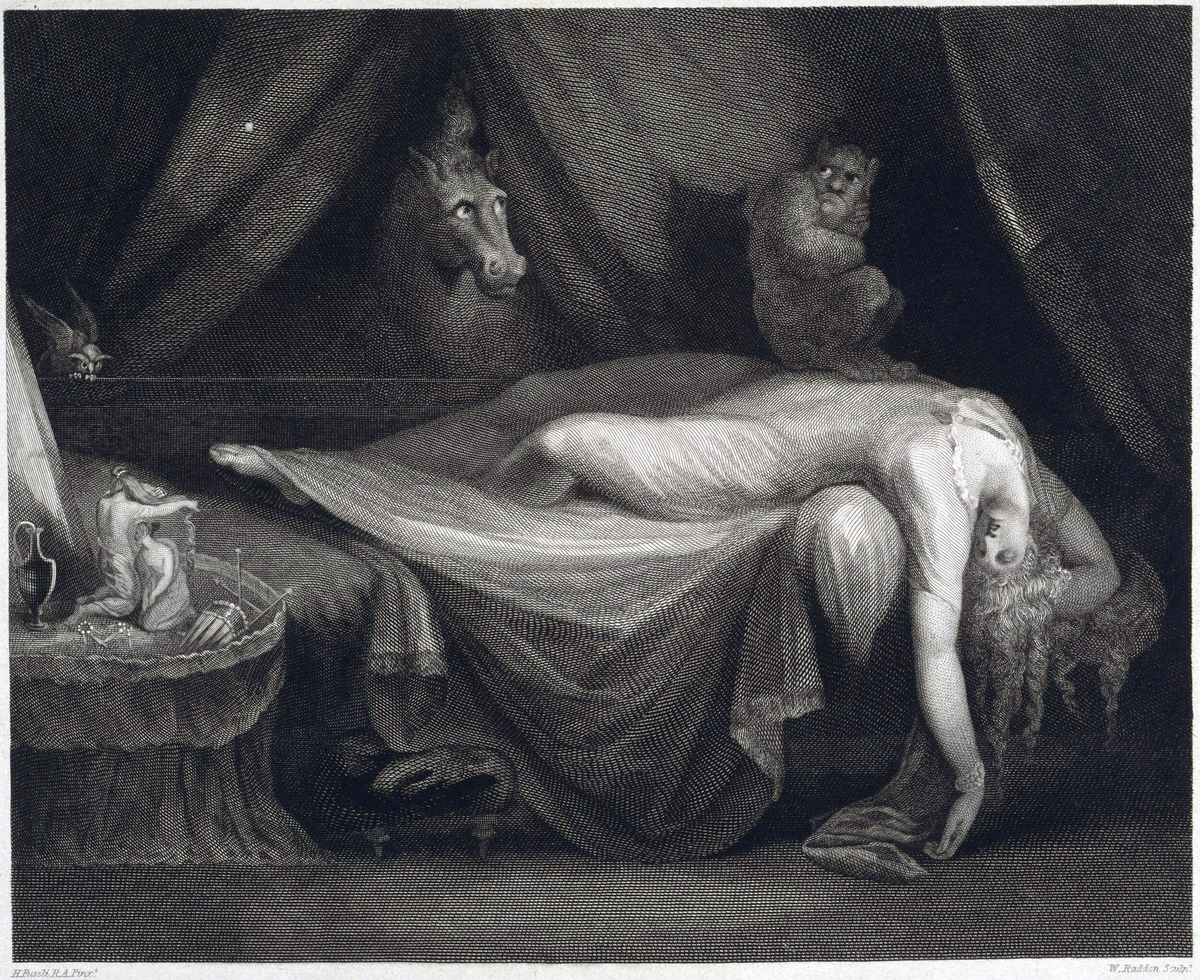
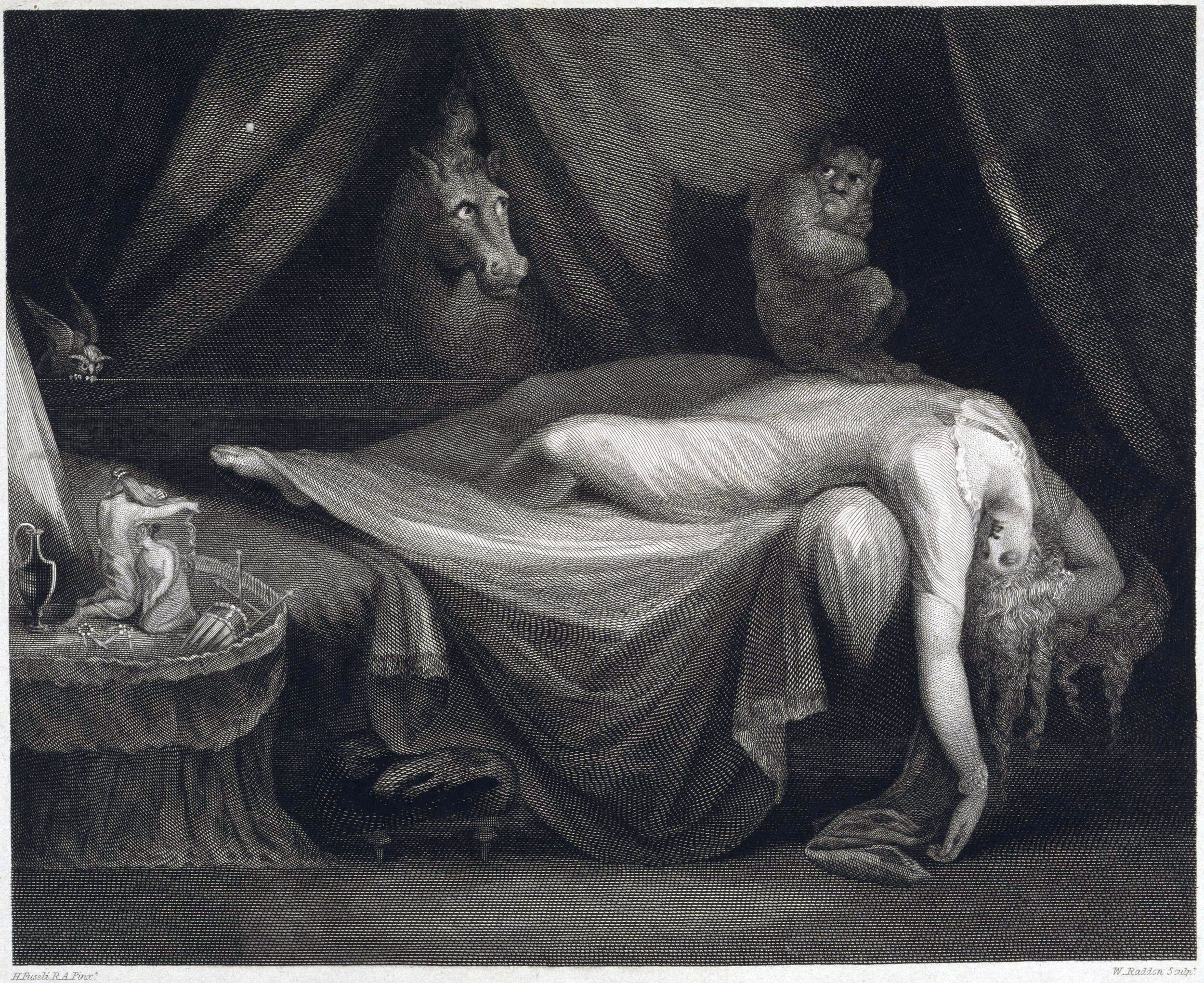
- A print after Henry Fuseli's composition showing a sleeping woman in white drapery stretched across a bed, with a dark demon crouched on her chest and a ghostly horse head emerging through the parted bed curtains; the scene represents the nightmare.
- Attribution qualification
- William Raddon, after Henry Fuseli
- Accession number
- O166519
- Dimensions
- Unknown
Catalogue identity
The work is titled The Nightmare. It is an etching and engraving by William Raddon after Henry Fuseli (1741 to 1825), and the print itself is dated 1827. Its medium is etching and engraving, so the image is the product of two intaglio processes worked together rather than of a single technique or of the original painter's hand. The title, the attribution, the date and the medium are the catalogue facts that anchor the object: whoever encounters the sheet is encountering a named composition, carried out by a named reproductive engraver working after a named earlier artist, in a stated medium and with a stated date.(Wikimedia Commons: The Nightmare, n.d., Summary, Author field; Summary, Date field; Summary, Description field)
The 1827 print after Fuseli
The print is titled The Nightmare, and it is an etching and engraving by William Raddon made after Henry Fuseli. Fuseli lived from 7 February 1741 to 16 April 1825, and the print is dated 1827, two years after his death. That chronological gap fixes the work's role in the record: it is a reproductive print carrying an earlier artist's composition into a later medium, not an image made by Fuseli's own hand. The attribution to Raddon as etcher and engraver, and to Fuseli as the designer of the composition, rests on the object record published by the Victoria and Albert Museum, where the print is identified as V&A item O166519. The same record supplies the title, the medium and the 1827 date, so those descriptive facts and the attribution stand together on one institutional source rather than being independently corroborated here.(Wikimedia Commons: The Nightmare, n.d., Author biographical field)
The three-figure dream image
The composition is built from three elements and little else. A woman lies on her back across a bed in white drapery, her head thrown back and her arms loose; a dark, compact, upright demon crouches on her chest and looks out toward the viewer; and at the left, where the bed curtains have been pulled apart, a pale, ghostly horse's head with staring eyes intrudes through the gap without entering the room. The setting is otherwise bare. The title supplied by the object record tells how the picture was meant to be read: it is not a real bedroom scene but a vision of the nightmare itself, in which the demon on the chest is the oppressive weight that gives the affliction its name and the horse's head belongs to the same dream image pressing into the sleeper's space. The print therefore stages a private, frightening experience as a publicly visible scene of three figures: the sleeper, the demon and the horse.(Wikimedia Commons: The Nightmare, n.d., Author biographical field)
Interpretation
The handling of light and dark in the print follows the logic of the subject. The woman's white drapery and pale skin catch the light and make her body the brightest thing in the room, while the demon and the horse emerge from the darkness surrounding her. Raddon's dark shadows and pale highlights thus produce the contrast that makes the image function as a picture of a nightmare: the sleeper is exposed and illuminated, while the figures that torment her are barely lit. This tonal arrangement is consistent with the print's construction as a single, fixed moment of a dream translated into print by an engraver working after another artist's design.(Wikimedia Commons: The Nightmare, n.d., Author biographical field)
Reproduction and the afterlife of the design
The print's afterlife depends on the reputation of a composition that was not its own invention. The original was painted in oil by Henry Fuseli, whose dates 1741 to 1825 are established above; the picture became one of the most discussed images of its time and was widely reproduced in print. Raddon's print, dated 1827 and issued two years after Fuseli's death, belongs to that afterlife, carrying an already famous design into a new medium and a new audience. The evidence establishes the print's medium, date, maker and source object, and it records the reception of the composition in general terms; it does not supply the sequence, number or circumstances of the earlier reproductions, and it does not document who commissioned or published the 1827 plate.(Wikimedia Commons: The Nightmare, n.d., Author biographical field)
Attribution, date and the limits of inference
Interpretation
For a research account of this object, the secure identification and the commissioning history must be kept apart. The object record firmly identifies the print as Raddon's etching and engraving after Fuseli, produced in 1827 and now recorded as V&A item O166519, and it gives the image's title, date, medium and attribution. None of that settles who initiated, financed or published the print, nor for what market it was made, and the record does not state those things. The only creation circumstance that can be asserted on this evidence is the relation between two dated facts: the designer Fuseli died on 16 April 1825, and the print appeared two years later. That interval explains why the work is a reproductive print rather than an original invention, but it should not be pressed to yield motives for its making that the evidence does not contain.(Wikimedia Commons: The Nightmare, n.d., Author biographical field)
Henry Fuseli lived from 7 February 1741 to 16 April 1825, and the print is dated two years after his death.(Wikimedia Commons: The Nightmare, n.d.)
Materials and technique
LinkThe surviving artefact and its recorded medium
The object under examination is a photographic reproduction of a reproductive print, and the file record describes that print as an etching and engraving. The image file itself is in the public domain and is credited to the Victoria and Albert Museum, which holds the impression recorded as V&A item O166519. The print is titled The Nightmare and is attributed to William Raddon, working after Henry Fuseli. These are the documented parameters of the surviving artefact in this archive: a black-and-white image whose medium is stated as etching and engraving, whose maker is named as Raddon, and whose originating composition is credited to Fuseli rather than to the etcher and engraver. The distinction matters because every technical observation available here concerns Raddon's printed surface, not Fuseli's original painted design, and the physical characteristics of the surviving sheet are known only through a photographic reproduction rather than through direct examination of the object.(Wikimedia Commons: The Nightmare, n.d., Licensing and Summary)
Dating and the direction of dependence
The file dates the print to 1827, while Henry Fuseli is recorded as living from 7 February 1741 to 16 April 1825. The print therefore postdates Fuseli's death by two years, a fact that establishes the direction of dependence: Raddon's print was made after a composition by an earlier artist and is not Fuseli's own hand. The medium recorded for the print, etching and engraving, is a composite designation describing two related intaglio processes, and the file records the work under that combined term without distinguishing which passages were bitten in acid and which were cut directly into the plate. The dating, the named intermediary and the medium together define the technical horizon of the evidence: an early nineteenth-century reproductive intaglio print translating a late eighteenth-century or earlier design attributed to Fuseli into line, tone and printed surface.(Wikimedia Commons: The Nightmare, n.d., Licensing and Summary)
The image file is a photographic reproduction in the public domain, credited to the Victoria and Albert Museum, and the file records it as an etching and engraving.(Wikimedia Commons: The Nightmare, n.d.)
Collection and display
LinkThe print and its museum record
The object under discussion is a reproductive print titled The Nightmare, an etching and engraving by William Raddon made after the painter Henry Fuseli. The single evidence unit available for this section establishes two linked facts about its custodial origin: the print's source is the Victoria and Albert Museum, and the Museum's object record identifies it as V&A item O166519. That inventory number matters for how the print can be studied, because it locates this particular impression within a named public collection rather than treating it as an unattributed illustration. The same evidence supports the broader attribution that the source record supplies for the image: the work is titled The Nightmare, it is an etching and engraving by Raddon after Fuseli, and it is dated 1827. The medium designation is not merely a label; etching and engraving describe two distinct intaglio techniques, and the record applies both to this print, so the object is documented as a hybrid intaglio impression rather than a single-process print. Because the supplying record links title, date, medium and attribution together, the print's documentary identity and its physical identity as a V&A holding are established by one and the same source, and no evidence supplied here separates them.(Wikimedia Commons: The Nightmare, n.d., Summary, Source field)
The evidence also preserves the chronological relationship between the print and the artist whose design it reproduces. Henry Fuseli lived from 7 February 1741 to 16 April 1825, and the print is dated two years after his death. Dating the impression to 1827 therefore places its production after the designer's lifetime, which is consistent with its description as a print made after Fuseli rather than as work from his own hand. The source record states the work is titled The Nightmare and that the print is an etching and engraving by William Raddon after Henry Fuseli (1741 to 1825), dated 1827, with the medium given as etching and engraving. These facts together define the object's position: a posthumous reproductive print, carrying a composition attributed to Fuseli into a new impression two years after he died, and surviving in the Victoria and Albert Museum as item O166519. The record's phrasing keeps the direction of authorship explicit: Raddon is the printmaker, Fuseli the artist after whom the design is reproduced.(Wikimedia Commons: The Nightmare, n.d., Summary, Source field)
Museum identification and its limits
Interpretation
For the immediate purposes of collection and display research, the decisive contribution of this evidence is that it fixes provenance of record rather than provenance of ownership. The Victoria and Albert Museum is named as the source of the print, and the same source is credited with the object record that assigns the number O166519. The evidence does not describe how or when the impression entered the Museum, nor does it name any earlier owner, dealer or collection; those intervals remain unestablished here and should not be inferred from the presence of an inventory number alone. What can be said is narrower and firmer: this impression is documented in a major museum's object record, under a specific identifier, with a title, an attributed designer and printmaker, a date of 1827, and a stated medium of etching and engraving. That combination is what allows the object to function as a researchable item rather than an anonymous reproduction, even though the accession history itself is not supplied.(Wikimedia Commons: The Nightmare, n.d., Summary, Source field)
The relationship between what the object shows and what the record establishes should be kept distinct. The supplied evidence for this section documents what the print is, who made it, when, in what technique and where it is recorded. It does not itself describe the composition, so the visual content of the image is not part of the evidential basis assembled here. What the record does support is the interpretive frame implied by the title and by the reproductive relationship: Raddon's print is an etching and engraving of a Fuseli composition titled The Nightmare, produced in 1827. Within a larger history of art and material culture, that makes the object a document of transmission. It shows a design attributed to Fuseli continuing to circulate in intaglio two years after his death, and it shows a museum collecting and cataloguing that later impression as an object in its own right, under O166519, with its own date, medium and maker. The print's importance in this account therefore lies as much in its status as a dated, attributed, institutionally recorded reproduction as in any single feature of its imagery.(Wikimedia Commons: The Nightmare, n.d., Summary, Source field)
Documented values and qualified estimates
LinkRecorded values
Interpretation
Recorded value for this object begins with a working insurance estimate generated on 2026-10-16, stated as a range of US$800 to US$3,500. That figure was explicitly a model-generated calculation for manual review, not an official insurance value, appraisal, auction result or sale price, and its own documentation warns that it must not be used to bind coverage or settle a claim. The estimate was derived from the confirmed identification of the object as a 19th-century reproductive etching and engraving by William Raddon after Henry Fuseli, dated 1827, held by the Victoria and Albert Museum under accession O166519, and documented through a public-domain Wikimedia Commons reproduction of the museum's image. No comparable auction records, private insurance schedules or appraisal data were available in the supplied excerpts, and the estimate states that no such data were accessed or invented. The range therefore stands as a deliberately wide and conservative working figure rather than a market measurement.(Wikimedia Commons: The Nightmare, n.d.)
The valuation method as recorded hinges on category rather than on the specific impression. Because the print is a posthumous reproductive etching and engraving after a famous Romantic composition, and not the original oil painting, the estimate was calculated at the lower end of the market for antique British engravings, reflecting typical pricing for comparable 1820s reproductive engravings after prominent artists. The documentation also adjusts for information it did not have: the absence of supplied dimensions, condition, edition state and provenance, and the fact that the impression belongs to a major public collection rather than private hands. The local system was to set the price date to the generation date, which is how the 2026-10-16 date attaches to the figure. The qualification that the number does not reflect condition, dimensions, impression state or institutional provenance verification applies to the whole range, not to one end of it.(Wikimedia Commons: The Nightmare, n.d.)
The confirmed identification that anchors the calculation rests on the Commons file record, which supplies the title The Nightmare, the attribution to William Raddon after Henry Fuseli, the date 1827, the medium of etching and engraving, and the source of the print as the Victoria and Albert Museum, identified in the object record as V&A item O166519. The same record notes that the image file is a photographic reproduction in the public domain, credited to the Victoria and Albert Museum, and that the file itself records the work as an etching and engraving. It also gives Fuseli's dates as 7 February 1741 to 16 April 1825, and observes that the print is dated two years after his death. These are the facts the valuation treats as established context, and they are also the reasons a market comparison to original paintings is treated as inapplicable.(Wikimedia Commons: The Nightmare, n.d.)
Working estimate
Calculated working insurance estimate, not a sale price: Estimated insurance range: US$800 to US$3,500 Recorded date: Working calculation, generated 2026-10-16. Methodology: Broad working range for manual review derived from the confirmed context that this is a 19th-century reproductive etching and engraving by William Raddon after Henry Fuseli, dated 1827, held by the Victoria and Albert Museum (accession O166519), and documented through a public-domain Wikimedia Commons reproduction of the museum's image. Because this is a posthumous reproductive print after a famous Romantic composition, not the original oil painting, value is calculated at the lower end of the market for antique British engravings. The range reflects typical pricing for comparable 1820s reproductive engravings after prominent artists, adjusted for the absence of supplied dimensions, condition, edition state, and provenance, and for the fact that the impression is held in a major public collection rather than in private hands. No comparable auction records, private insurance schedules, or appraisal data were available in the supplied excerpts, so the range is deliberately wide and conservative. The local system will set the price date to the generation date. Qualification: This is a model-generated working insurance range for manual review only. It is not an official insurance value, appraisal, auction result, or sale price, and it should not be used to bind coverage or settle a claim. The figure is a broad estimate based on confirmed identification and general market context for comparable reproductive prints; it does not reflect condition, dimensions, impression state, or institutional provenance verification. No comparable sales data or private insurance records were accessed or invented.(Wikimedia Commons: The Nightmare, n.d.)