Identity and catalogue
Link- Title
- The Barque of Dante
- Artist or attribution
- Eugène Delacroix
- Object date
- 1822
- Medium and support
- Oil on canvas
- Dimensions
- 189 x 241 cm (per Commons structured data); 189 x 246 cm (per Commons caption)
- Current collection or location
- Louvre Museum, Paris, France
- Movement or period
- French Romanticism
- Country or culture
- France
- Depicted subject
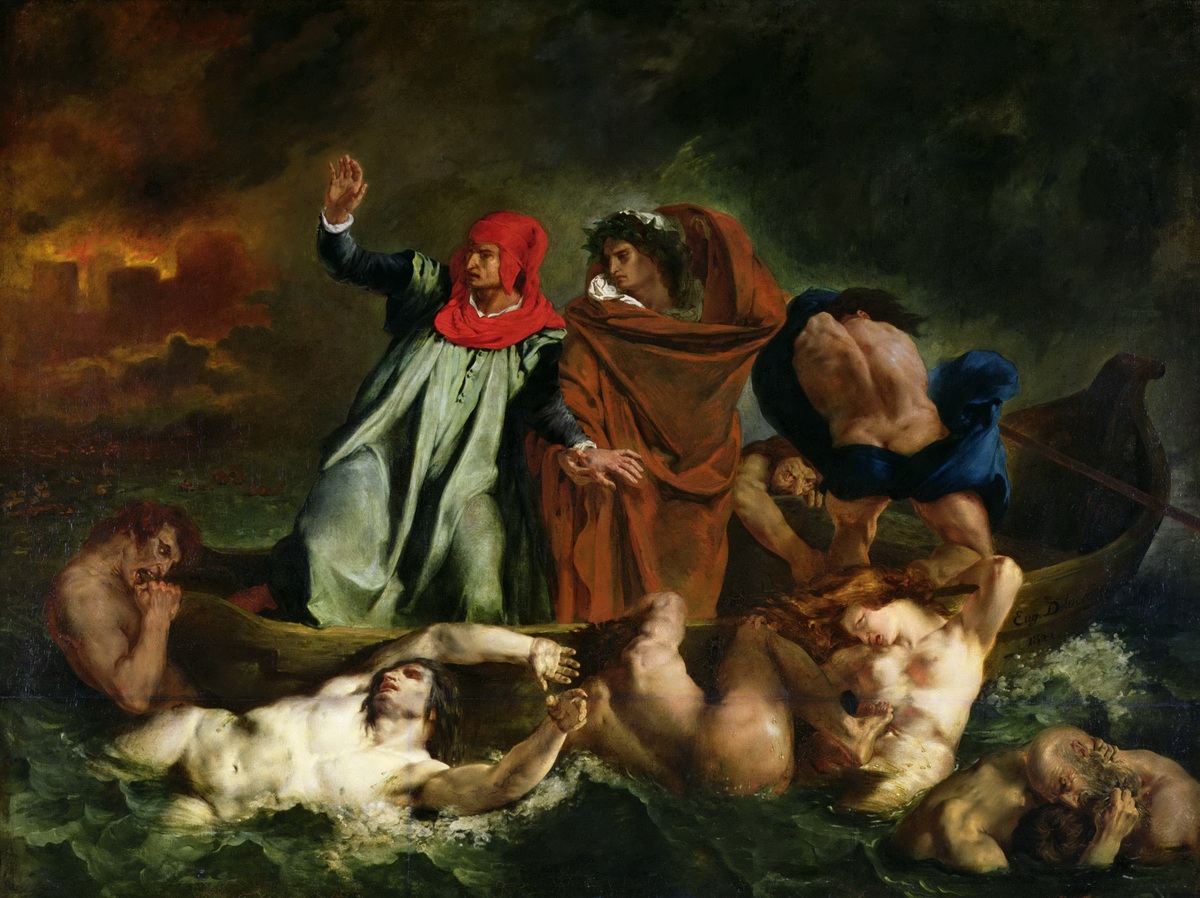
- Dante and Virgil are ferried across the waters of Hell in a barque; the scene illustrates Dante's Divine Comedy, Inferno, and the figures of Dante, Virgil and Charon are depicted.
- Title variants
- Dante and Virgil in Hell; La Barque de Dante
- Accession number
- 3820
- Support
- canvas
- Inscriptions
- Signature and date bottom right: Eug. Delacroix / 1822
Title, attribution and date
The catalogue entry for this canvas centers on a double title: The Barque of Dante, also recorded as Dante and Virgil in Hell, a painting dated 1822 and executed in oil on canvas. The structured record attributes it to Eugène Delacroix (1798–1863), identified as a French painter, and the Wikimedia Commons file page supplies the object identification, title, artist, date and medium together. The date 1822 belongs to the object's conception and execution, and it is corroborated at the level of the work itself rather than only by catalogue convention, since the canvas carries an inscription described as a signature and date bottom right: Eug. Delacroix / 1822. That inscription ties the authorship attribution to a mark on the surface and fixes the year of the signature in the same period as the catalogue date. The title variants are not competing names for different works; they register two ways of framing the same composition, one by its dominant motif, the boat, and one by its protagonists and setting.(Wikimedia Commons: The Barque of Dante, 1822, Captions; Summary; Summary; Inscriptions)
The subject is specified as Dante and Virgil in Hell, drawn from Dante's Divine Comedy, specifically the Inferno. The depicted people are named as Virgil, Dante Alighieri and Charon, which aligns the literary source with the figures the catalogue expects a viewer to recognize: the two poets and the boatman who conveys them. The painting's scale is reported as 189 x 241 cm according to the structured data and 189 x 246 cm according to the caption, so the recorded dimensions disagree in the width by five centimeters while agreeing on the height. That discrepancy is a matter of documentation rather than of the object's physical condition as described, and it should be preserved as an unresolved difference between two records of the same canvas. The work is in the Louvre Museum collection with accession number 3820, an identifier that anchors the title, attribution, date and medium to a single institutional record, so the various catalogue elements can be checked against one object rather than assembled from separate notices.(Wikimedia Commons: The Barque of Dante, 1822, Description; Depicted people; Depicted people; Dimensions)
Materials and technique
LinkThe Barque of Dante, also known as Dante and Virgil in Hell, is a painting by Eugène Delacroix (1798–1863), a French painter. The work is dated 1822 and depicts Dante and Virgil in Hell, based on Dante's Divine Comedy, specifically the Inferno. The depicted people include Virgil, Dante Alighieri and Charon. The subject comes from a passage in which the poets are guided through the circles of Hell, and Delacroix gives it a single dramatic moment: the river crossing. The medium is oil on canvas.(Wikimedia Commons: The Barque of Dante, 1822, Medium)
The painting is large. The dimensions are given as 189 x 241 cm per structured data and 189 x 246 cm per caption, a discrepancy between two accounts of the same object. The painting is inscribed with a signature and date bottom right: Eug. Delacroix / 1822. It was exhibited at the Salon de 1822 and was acquired by the Salon in 1822. It has been at the Louvre since 1985 and belongs to the Louvre Museum collection, with accession number 3820.(Wikimedia Commons: The Barque of Dante, 1822, Medium)
The Barque of Dante, also known as Dante and Virgil in Hell, is documented in the supplied record as exhibited at the Salon de 1822. That Salon appearance is the one exhibition event the evidence establishes for the canvas. The same source gives the painting a date of 1822 and identifies its author as Eugène Delacroix (1798–1863), and it records an inscription at the lower right reading Eug. Delacroix / 1822. The work is executed in oil on canvas and is held in the Louvre Museum collection under accession number 3820.(Wikimedia Commons: The Barque of Dante, 1822, Exhibition history)
Exhibition history and later custodial history are distinct lines in the record and should not be collapsed into one narrative. The painting was exhibited at the Salon de 1822, while its acquisition by the Salon is recorded for 1822 and its presence at the Louvre is dated only from 1985. The evidence therefore supports a Salon showing in the year of production and a much later Louvre residency; it supplies no intermediate venue, no loan history and no dates for any display between those two moments. Making the 1822 exhibition the beginning of the object's public life and the 1985 Louvre date the end point of the documented record leaves a long, evidence-silent interval rather than a continuous exhibition chronology.(Wikimedia Commons: The Barque of Dante, 1822, Exhibition history; Object history)
The scale and medium of the canvas are part of what the exhibition record concerns, since the structured data and the caption differ on one dimension. The medium is given as oil on canvas, and the dimensions are recorded as 189 x 241 cm according to the structured data and 189 x 246 cm according to the caption. Both figures agree on the height of 189 cm and disagree on the width. The object is signed and dated at the lower right. Any account of how the work appeared at the Salon de 1822 has to reckon with the fact that the basic physical description is not fully resolved in the supplied record.(Wikimedia Commons: The Barque of Dante, 1822, Exhibition history; Object history)
Subject and object identification
The subject is drawn from Dante's Divine Comedy, specifically the Inferno, and the depicted figures include Virgil, Dante Alighieri and Charon. The evidence describes the composition as Dante and Virgil in Hell, with the two poets ferried across the waters of Hell and Charon at the oars. This identification of subject and figures is what the catalogue metadata establishes about the canvas; it is the content of the object that was shown at the Salon de 1822, not a separate interpretive layer added to the exhibition history.(Wikimedia Commons: The Barque of Dante, 1822, Exhibition history)
Interpretation
Within the larger history of art, the significance of the 1822 Salon showing does not rest on an unbroken display record, which the evidence does not provide, but on the fact that the painting entered public view in the year it was made and was later absorbed into the Louvre collection. The title, artist, date, medium, accession number and dimensions place the work securely in a museum context today, while the Salon de 1822 remains the single documented exhibition moment in the supplied evidence. That combination, a dated and signed Salon entry followed by eventual Louvre accession, is the strongest claim the record supports about the object's public trajectory.(Wikimedia Commons: The Barque of Dante, 1822, Exhibition history; Object history)
Collection and display
LinkObject and Documentation
The Barque of Dante, also known as Dante and Virgil in Hell, is an oil on canvas by the French painter Eugène Delacroix (1798–1863), signed and dated at the lower right with the inscription Eug. Delacroix / 1822. The picture is held in the Louvre Museum collection under accession number 3820, and it was exhibited at the Salon de 1822. Its subject is drawn from Dante's Divine Comedy, specifically the Inferno, and the depicted people include Virgil, Dante Alighieri and Charon. These identifications frame the work as both a literary translation and a documented object with a traceable institutional and exhibition record.(Wikimedia Commons: The Barque of Dante, 1822, Collection; Accession number)
Among the object's recorded characteristics, one detail remains unresolved in the supplied documentation: the dimensions are given as 189 x 241 cm according to structured data, while the caption states 189 x 246 cm. This discrepancy in the width measurement is a qualification on the physical description rather than a settled fact, and it is worth retaining precisely because the object's scale is central to how the crossing fills the canvas. The same source also records that the painting was acquired by the Salon in 1822 and has been at the Louvre since 1985, a provenance and institutional history that aligns with the Salon exhibition of 1822 and the work's later permanent home in the museum.(Wikimedia Commons: The Barque of Dante, 1822, Collection; Accession number)
Documented values and qualified estimates
LinkObject identification
Interpretation
The object at the centre of this record is Eugène Delacroix's The Barque of Dante, also known as Dante and Virgil in Hell, an oil on canvas of 1822. The picture is held by the Louvre Museum under accession number 3820. Its subject is drawn from Dante's Divine Comedy, specifically the Inferno, and the figures depicted include Virgil, Dante Alighieri and Charon. The canvas carries an inscription at the lower right, a signature and date reading Eug. Delacroix / 1822, which fixes both authorship and year on the surface of the work itself. This combination of a signed and dated monumental canvas, a specific literary source, and a national museum accession number is what allows the subsequent value discussion to proceed from a firmly identified object rather than from a loose description.(Wikimedia Commons: The Barque of Dante, 1822)
Two dimensions are recorded for the picture and they do not agree. The structured data gives 189 by 241 cm, while the caption gives 189 by 246 cm. Both figures describe a large-format canvas, and that scale is central to how the work has been characterised, but the discrepancy should be preserved rather than silently resolved. The same source records that the work was exhibited at the Salon de 1822 and was acquired by the Salon in that year, and that it has been at the Louvre since 1985. These are two separate strands of object history: the painting's first public showing in the Salon of 1822, and its later institutional placement in the Louvre in 1985. The evidence does not supply the intervening provenance, and no interval should be inferred beyond what the units state.(Wikimedia Commons: The Barque of Dante, 1822)
Recorded values
The working insurance estimate supplied for this canvas is a calculated range of US$30 million to US$80 million, recorded as a working calculation generated on 2026-10-16. The methodology is explicit about its own limits. It begins from a generic high-value institutional masterpiece baseline for a firmly attributed, museum-held, large-format Delacroix of major historical significance, then applies conservative uplift for scale, prominence, and two additional conditions: that the work is not on view, and that it is in a national collection. The estimate was derived from the confirmed artwork context and supplied excerpts alone. No auction records, private insurance files, or comparable sales were available in the supplied material, and none were invented. Because public market transactions for works of this rank are essentially absent, the range is deliberately wide to support manual review and is described as requiring refinement by a qualified appraiser with access to museum and market records.(Wikimedia Commons: The Barque of Dante, 1822)
The estimate carries a qualification that governs how it may be used: it is a model-generated working range for manual review only, not an official insurance value, appraisal, auction result, or sale price. It is not to be used for coverage, lending, tax, or transactional purposes without review by a qualified professional. The range is broad and conservative precisely because no current market data, comparable sales, or institutional insurance data was supplied or accessed. A further condition embedded in the methodology is the statement that the work is not on view, which distinguishes the object's present display status from its documented Salon exhibition of 1822 and its Louvre placement since 1985.(Wikimedia Commons: The Barque of Dante, 1822)
Read together, the descriptive and valuation units describe an object whose importance is asserted on historical rather than market grounds. Delacroix's canvas is identified as a large-scale, pivotal work of French Romanticism, signed and dated 1822, based on Dante's Inferno, shown at the Salon of 1822, acquired by the Salon that year, and held at the Louvre since 1985 under accession number 3820. That cluster of attributes, attribution, date, source text, exhibition, acquisition, and collection, is what the valuation methodology treats as the basis for a high-value institutional baseline. The monetary range is therefore a downstream inference from documented art-historical facts, not an independent record of the work's worth, and it should be read as the weakest and most revisable element in this account.(Wikimedia Commons: The Barque of Dante, 1822)
Working estimate
Calculated working insurance estimate, not a sale price: Estimated value: US$30M to US$80M Recorded date: Working calculation, generated 2026-10-16. Methodology: This is a broad, conservative working insurance range derived from the confirmed artwork context and supplied excerpts only. The artwork is identified as The Barque of Dante by Eugène Delacroix, dated 1822, oil on canvas, roughly 189 x 241 or 246 cm, accession number 3820, held by the Louvre Museum, and described as a large-scale, pivotal work of French Romanticism. The calculation starts from a generic high-value institutional masterpiece baseline for a firmly attributed, museum-held, large-format Delacroix of major historical significance, then applies conservative uplift for scale, prominence, and the fact that the work is not on view and is in a national collection. No auction records, private insurance files, or comparable sales were available in the supplied material, and no such data was invented. Because public market transactions for works of this rank are essentially absent, the range is intentionally wide to support manual review and should be refined by a qualified appraiser with access to museum and market records. Qualification: This is a model-generated working range for manual review only. It is not an official insurance value, appraisal, auction result, or sale price, and it should not be used for coverage, lending, tax, or transactional purposes without review by a qualified professional. The range is broad and conservative because no current market, comparable sales, or institutional insurance data was supplied or accessed.(Wikimedia Commons: The Barque of Dante, 1822)