ArchiveSpirit of the Dead Watching

Artwork record / 185 of 331

Spirit of the Dead Watching by Paul Gauguin (1892)

Artist: Paul Gauguin

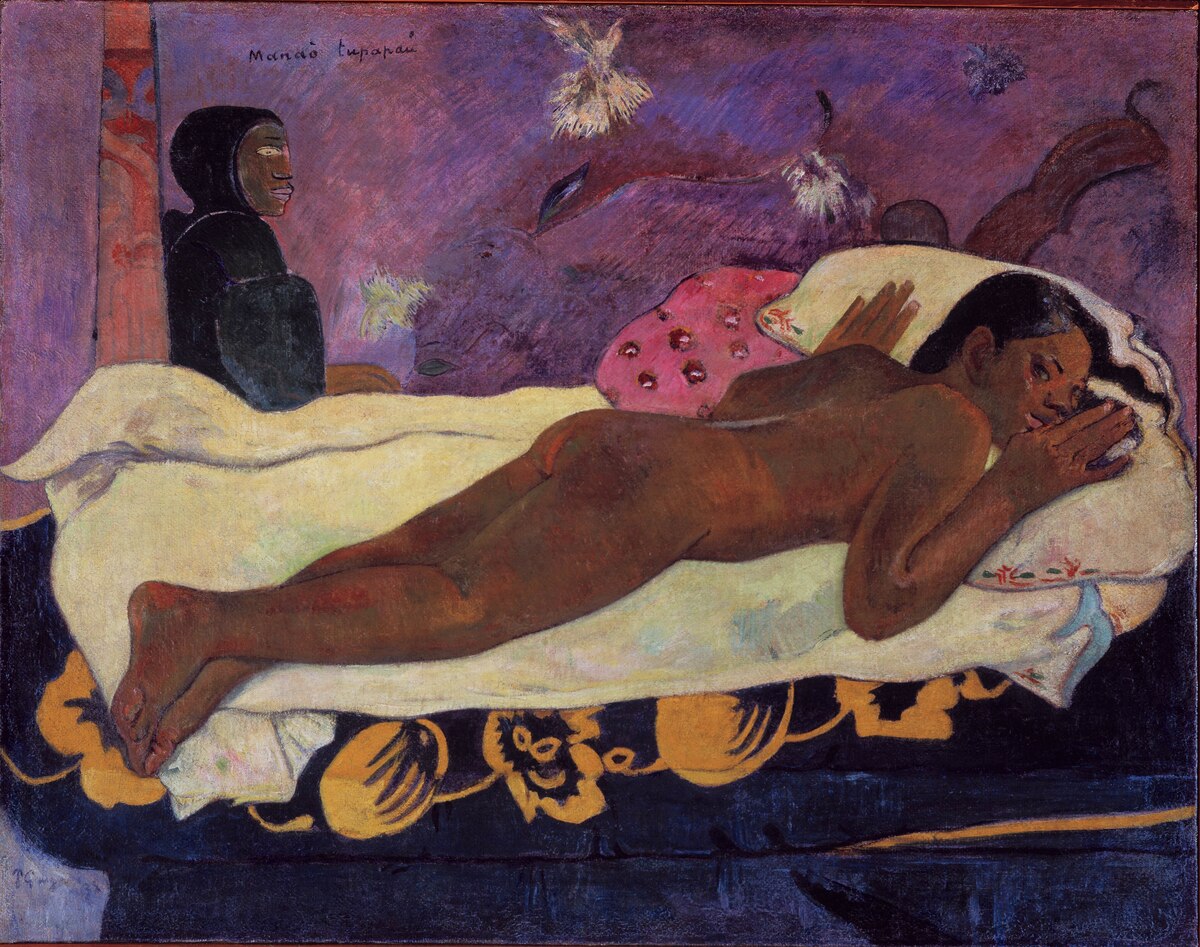
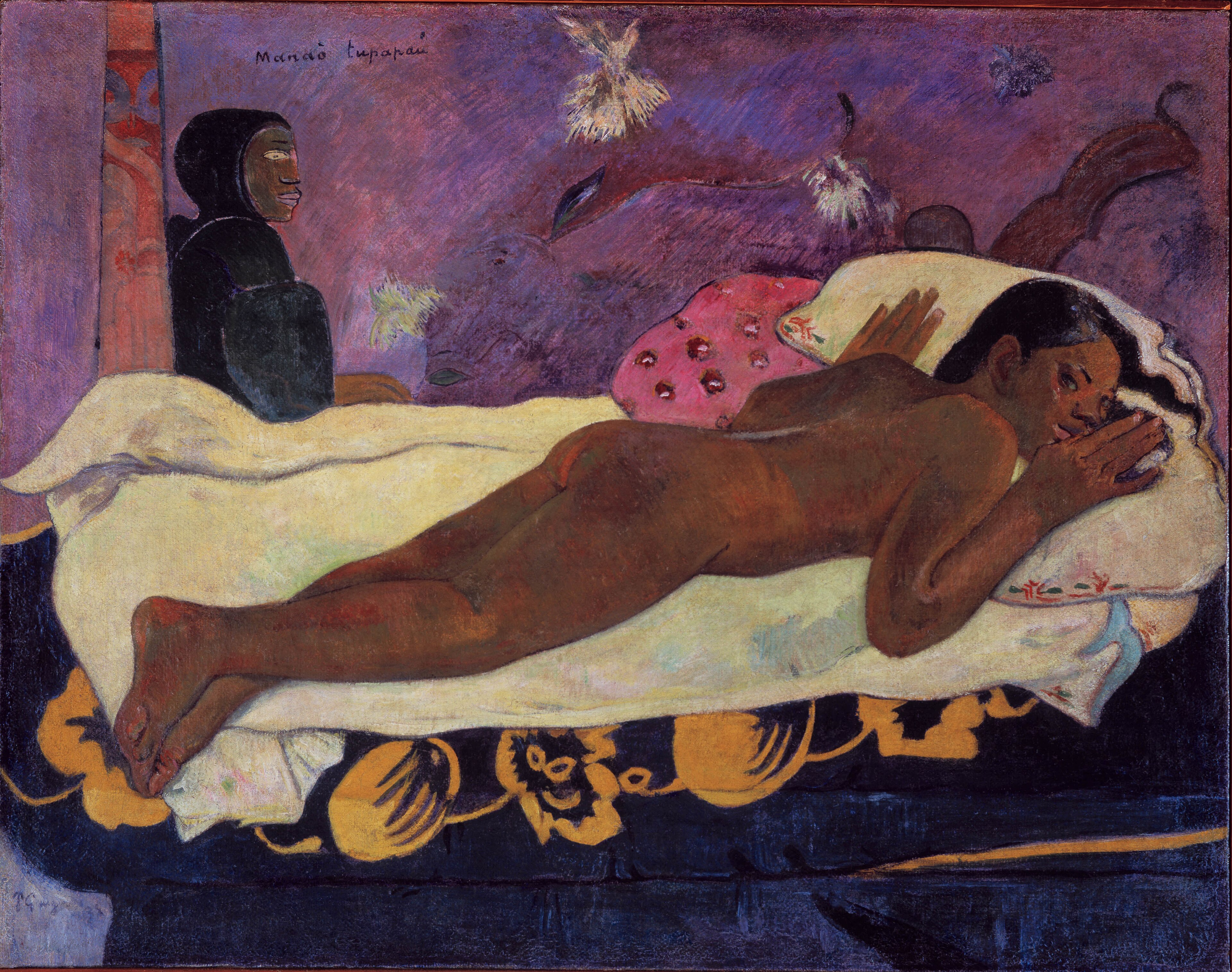
A Tahitian girl lies face down on a bed while a dark hooded figure watches from behind. Gauguin painted this scene in Tahiti in 1892, giving it the Tahitian title Manao tupapau, which is usually translated as The Spirit of the Dead Keeps Watch.

Read the story ↓ About the artist ↓ Research and record ↓ Literature and sources ↓ Listen to the article ↓
Article text for AI
Shop this artwork ↓ 3 visits
Date1892CultureFrance; Tahiti (French Polynesia) PeriodPost-Impressionism; PrimitivismCurrent locationBuffalo AKG Art Museum, Buffalo, New York, United States
Listen to the article
100%
Spirit of the Dead Watching by Paul Gauguin (1892)
Loading full-resolution artwork…
Scroll to zoom · drag to pan · double-click to focus Pinch to zoom · drag to explore · double-tap to focus FIELD VIEW / 185
Tools & download
Pixel colour Select a pixel with the eyedropper
No pixel selected

Choose the eyedropper, then click or tap the image. Scroll to zoom for finer selection.

Add text

Hand to pan · Select to move text and drawings · Add as many texts as you like · Scroll to zoom

Spirit of the Dead Watching: high-resolution image

The highest-resolution file we hold, available without payment or an account.3,840 × 3,030 pixels.

Download highest-resolution image

Details to notice

About 3 minutes to read
01

Yellow motifs on the dark bedcover

Bold ochre flower and leaf shapes on the dark blue paréo draped over the bed, a decorative Tahitian textile pattern that anchors the foreground.

02

Glowing blossoms on the violet field

Pale, flickering flower forms scattered across the flat violet background, read as the phosphorescent lights the artist described haunting the night scene.

03

Inscribed title Manao tupapau

The hand-lettered Tahitian words 'Manao tupapau' painted in the upper left corner, Gauguin's own naming of the subject and a key documentary feature of the canvas.

Portrait unrecorded

About the makers

Paul Gauguin

Individual life dates unrecorded

Biographical details and a verified portrait have not yet been recorded for this attribution.

The research & record

Study the work.
Follow the evidence.

Find catalogue details, historical context, technical research and the literature behind this artwork.

Article text for AI
Open research text

The artwork record

Research catalogue

Catalogue information and detailed research, with references that link to the bibliography.

Updated .

Identity and catalogue

Link
Title
Spirit of the Dead Watching
Artist or attribution
Paul Gauguin
Object date
1892
Medium and support
Oil on hessian mounted on canvas
Dimensions
72.4 × 92.4 cm (28.5 × 36.3 in)
Current collection or location
Buffalo AKG Art Museum, Buffalo, New York, United States(Wikimedia Commons: Spirit of the Dead Watching, n.d.)
Movement or period
Post-Impressionism; Primitivism
Country or culture
France; Tahiti (French Polynesia)
Depicted subject
A nude Tahitian girl lies face down on a bed, watched by a dark hooded spirit figure, the tupapau of the Tahitian title. Painted in Tahiti in 1892.
Title variants
Manao tupapau; Manaò tupapaú; Mana'o tūpāpa'u; The Spirit of the Dead Keeps Watch; Der Geist der Toten wacht; L'esprit des morts veille; L'esperit dels morts vetlla
Support
Hessian mounted on canvas
Catalogue Entry and Attribution

The object is catalogued as a painting by Paul Gauguin, dated 1892. Its Tahitian title is Manao tupapau, and the English title supplied in the record is The Spirit of the Dead Keeps Watch. The record classifies the object type as a painting and gives its genre as nude, an identification that places it within a recognized nineteenth-century pictorial category rather than merely describing its content.(Wikimedia Commons: Spirit of the Dead Watching, n.d., Artist Paul Gauguin (1848–1903); Date 1892; Title: Tahitian: Manao tupapau; label QS:Len, 'The Spirit of the Dead Keeps Watch'; Object type: painting; Genre: nude)

Subject cataloguing in the supplied record describes a nude recumbent adolescent girl lying prone. The same record groups the painting with categories for ghosts in painting and personifications of death, reflecting the presence of the hooded watcher and the funerary associations attached to the title. These are catalogue classifications applied by the compiling institution; they describe the image and its thematic grouping rather than establishing any historical event behind the scene.(Wikimedia Commons: Spirit of the Dead Watching, n.d., Categories: 19th-century oil paintings of nude recumbent women at full length; Adolescent girls in art; Paintings of ghosts; Personification of death in paintings)

Interpretation

Taken together, the identity of the work rests on a conjunction of attributions and classifications: authorship assigned to Gauguin, a date of 1892, a bilingual title pairing a Tahitian phrase with an English rendering, and a subject type that combines the nude with imagery of spirits of the dead. The catalogue date of 1892 belongs to the making of the painting, not to any later catalogue record, and the record distinguishes the work's own date from the title variants under which it has been recorded. The English title is itself a translation offered in the record, not an inscription on the work as catalogued here.(Wikimedia Commons: Spirit of the Dead Watching, n.d., Artist Paul Gauguin (1848–1903); Date 1892; Title: Tahitian: Manao tupapau; label QS:Len, 'The Spirit of the Dead Keeps Watch'; Object type: painting; Genre: nude; Categories: 19th-century oil paintings of nude recumbent women at full length; Adolescent girls in art; Paintings of ghosts; Personification of death in paintings)

The work is by Paul Gauguin and dates to 1892.(Wikimedia Commons: Spirit of the Dead Watching, n.d.)

The painting is titled Manao tupapau in Tahitian, with the English title given as The Spirit of the Dead Keeps Watch.(Wikimedia Commons: Spirit of the Dead Watching, n.d.)

The object type is recorded as a painting, with genre given as nude.(Wikimedia Commons: Spirit of the Dead Watching, n.d.)

The supplied record catalogues the subject as a nude recumbent adolescent girl lying prone, and the work is grouped with paintings of ghosts and personifications of death.(Wikimedia Commons: Spirit of the Dead Watching, n.d.)

Materials and technique

Link
Documented support, medium and dimensions

The object record for this painting establishes its physical construction and scale with unusual directness: it is listed as an oil painting on hessian mounted on canvas, measuring 72.4 centimetres in height and 92.4 centimetres in width. Two features of that record deserve separate emphasis. The first is the paint medium, oil, which fixes the work within the European tradition of oil painting that Gauguin carried with him to Tahiti rather than within any local pictorial practice. The second is the support, which is not a single fabric but a layered arrangement: a coarsely woven hessian (burlap) primary support that has been mounted onto a canvas backing. That distinction between the two textiles is a documented feature of the object record, not a deduction from appearance, and it separates the surface on which the composition was painted from the secondary fabric that now carries or reinforces it. The recorded dimensions are likewise documented rather than estimated, giving an approximately horizontal format a little wider than it is tall. Because the description derives from a museum object record, it should be treated as the strongest available evidence for medium and measurement, while the extent to which the mounting is original or later, and the condition of each layer, are not addressed by the supplied material.(Wikimedia Commons: Spirit of the Dead Watching, n.d., Medium: oil on hessian mounted on canvas; Dimensions: height 72.4 cm, width 92.4 cm)

The object record lists the work as an oil painting on hessian mounted on canvas, with dimensions of 72.4 by 92.4 centimetres.(Wikimedia Commons: Spirit of the Dead Watching, n.d.)

Condition and conservation

Link
The Documentary Condition Record

The surviving condition and technical record for this object is thin, and almost all of it concerns the digital file rather than the canvas itself. The image file used for reference is a public-domain reproduction of the painting, described as scanned with an Imacon Color Scanner at high resolution. That is a statement about the reproduction's capture method, not about the physical state of the work. The object record separately lists the work as an oil painting on hessian mounted on canvas, measuring 72.4 by 92.4 centimetres, which is the only evidence supplied here about its physical construction and support. Because the painting is on hessian mounted to a secondary canvas, its condition history properly belongs to the study of a lined or mounted textile support, but the supplied units record no examination, no report and no treatment for the painting itself.(Wikimedia Commons: Spirit of the Dead Watching, n.d., Image title: Imacon Color Scanner; License: Public domain; Medium: oil on hessian mounted on canvas; Dimensions: height 72.4 cm, width 92.4 cm)

The clearest dated interventions in the record are file revisions, not conservation treatments. The file was first uploaded in 2006 under the description Manao tupapau – The Spirit of the Dead Keep Watch (1892, Oil on canvas), and in 2015 it was replaced with a higher-resolution, colour-corrected scan. The 2015 replacement matters for how the work has been seen and studied: a colour-corrected file changes the apparent hue and value relationships that viewers and researchers judge from the reproduction, even though it establishes nothing about the paint layer. The earlier 2006 caption also shows how the medium was summarised in that upload as oil on canvas, whereas the object record specifies oil on hessian mounted on canvas. That difference in description is a difference in the documentary accounts, not evidence that the physical support changed between them.(Wikimedia Commons: Spirit of the Dead Watching, n.d., File history: 00:40, 21 February 2015 High resolution. Authentic colors.; 02:29, 14 September 2006; Medium: oil on hessian mounted on canvas; Dimensions: height 72.4 cm, width 92.4 cm)

Interpretation

No dated condition observation, damage report, intervention, treatment material, conservation decision or environmental measure for the painting appears anywhere in the supplied evidence. What the units do establish is a methodological caution: the most detailed technical language available here, about scanner type and colour correction, describes a surrogate image. The mounted-hessian support recorded for the work is the kind of structure that conservators examine for tension, adhesion and environmental response, but no such examination is documented in these units, so an account of the object's present physical condition cannot be written from them. Statements about the picture's appearance should be understood as statements about a particular reproduction, and the 2015 file supersedes the 2006 one as the reference image, without being a condition record for the painting.(Wikimedia Commons: Spirit of the Dead Watching, n.d., Image title: Imacon Color Scanner; License: Public domain; File history: 00:40, 21 February 2015 High resolution. Authentic colors.; 02:29, 14 September 2006; Medium: oil on hessian mounted on canvas; Dimensions: height 72.4 cm, width 92.4 cm)

The image file is a public-domain reproduction of the painting, described as being scanned with an Imacon Color Scanner at high resolution.(Wikimedia Commons: Spirit of the Dead Watching, n.d.)

The file was previously uploaded in 2006 as Manao tupapau – The Spirit of the Dead Keep Watch (1892, Oil on canvas) and replaced with a higher-resolution, colour-corrected scan in 2015.(Wikimedia Commons: Spirit of the Dead Watching, n.d.)

Reception and literature

Link
The Object and Its Record

The object record identifies the painting as Paul Gauguin's Manao tupapau, with the English title given as The Spirit of the Dead Keeps Watch, dated to 1892. It is catalogued as an oil painting on hessian mounted on canvas, measuring 72.4 by 92.4 centimetres, and it belongs to the collection of the Buffalo AKG Art Museum in Buffalo, New York. The same record classifies the object type as a painting and the genre as nude, describing the subject as a nude recumbent adolescent girl lying prone, and grouping the work with paintings of ghosts and personifications of death. Because the file page also documents its own history as a reproduction, the record is simultaneously a description of the physical object and a trace of how that object has been catalogued and circulated. It appears in lists of Gauguin's paintings and among works counted in the Albright-Knox Gallery, now the Buffalo AKG Art Museum, so the attribution and location are established within that institutional record rather than by the painting's own inscriptions.(Wikimedia Commons: Spirit of the Dead Watching, n.d., Work location: Paris, Pont-Aven, Arles, Tahiti; usage on de.wikipedia.org: Selbstporträt als Tahitianerin; usage on ca.wikipedia.org: Noa Noa)

Tahitian Context and Attributed Interpretations

The supplied excerpt places the painting in the context of the artist's time in Tahiti, where he worked in 1892, and notes that later writers have connected it both with the concepts of primitivism and with the artist's self-portrait as a Tahitian woman. The record links the work to Tahitian lore about spirits of the dead and to the ghost traditions of Polynesian culture, but it does not claim that the depicted event occurred; the painting is presented as showing a moment from that belief rather than a historical event. The connection to self-portraiture is described as an interpretation advanced by later writers, not as a statement by the artist, and the record supplies no artist's statement, no commission, no early provenance beyond the institutional collection, and no documented exhibition history. The evidence therefore supports the work's subject and its association with Polynesian spirit traditions, while leaving the interpretive claims about primitivism and self-portraiture attributed to named later writers rather than promoted into documented fact.(Wikimedia Commons: Spirit of the Dead Watching, n.d., Work location: Paris, Pont-Aven, Arles, Tahiti; usage on de.wikipedia.org: Selbstporträt als Tahitianerin; usage on ca.wikipedia.org: Noa Noa)

Reproduction and Digital Afterlife

Reception of the painting is also documented through the reproduction of its image, which the record describes as a public-domain reproduction scanned with an Imacon Color Scanner at high resolution. The same file history records that the image was previously uploaded in 2006 under the title Manao tupapau – The Spirit of the Dead Keep Watch (1892, Oil on canvas) and was replaced in 2015 with a higher-resolution, colour-corrected scan. These details matter because the file page is itself a site of reception: the title used in the earlier upload differs in punctuation and medium wording from the current catalogue record, and the replacement scan changes the colour information available to viewers. The 2015 correction is a documented intervention in how the painting's palette is seen in reproduction, and the medium note in the 2006 title, oil on canvas, differs from the current record's oil on hessian mounted on canvas. That discrepancy is a documented difference between accounts of the object rather than a settled fact about its support.(Wikimedia Commons: Spirit of the Dead Watching, n.d., Work location: Paris, Pont-Aven, Arles, Tahiti; usage on de.wikipedia.org: Selbstporträt als Tahitianerin; usage on ca.wikipedia.org: Noa Noa)

Interpretation

Read together, the evidence shows an object whose documented identity rests on an institutional catalogue record, whose subject is described as a nude recumbent girl grouped with ghosts and personifications of death, and whose meanings have accumulated through later writers linking it to primitivism and to self-portraiture as a Tahitian woman. The record establishes the Tahitian association and the Polynesian ghost traditions but explicitly does not claim the scene depicts a historical event, and it attributes the interpretive connections to later writers rather than to the artist. The file history adds a further layer of reception, since the 2006 upload and the 2015 colour-corrected replacement show the image being re-presented over time, with the earlier title wording and medium description differing from the current record. Within a larger history of art and material culture, this accumulation is the point: the painting's reputation is carried not by a single dramatic event but by a catalogue entry, a set of attributed readings, and a sequence of reproduced images, each of which changes what can be claimed and what can be seen. The evidence supports that layered account while leaving unresolved the exact relationship between the artist's intentions and the interpretations later attached to the work.(Wikimedia Commons: Spirit of the Dead Watching, n.d., Work location: Paris, Pont-Aven, Arles, Tahiti; usage on de.wikipedia.org: Selbstporträt als Tahitianerin; usage on ca.wikipedia.org: Noa Noa)

The supplied excerpt indicates the painting is associated with the artist's time in Tahiti, where he worked in 1892, and it has been connected by later writers with the concepts of primitivism and with the artist's self-portrait as a Tahitian woman.(Wikimedia Commons: Spirit of the Dead Watching, n.d.)

Interpretations and debates

Link
The documented object

Reported tradition

The object's documented record is unusually full for a work whose meanings remain contested. The supplied Wikimedia Commons file page identifies the painting as by Paul Gauguin and dated to 1892, titled Manao tupapau in Tahitian with the English title given as The Spirit of the Dead Keeps Watch. It records the work as an oil painting on hessian mounted on canvas, measuring 72.4 by 92.4 centimetres, and as belonging to the collection of the Buffalo AKG Art Museum in Buffalo, New York. The object type is catalogued as a painting, with the genre given as nude, and the subject described as a nude recumbent adolescent girl lying prone. Within the same source's cataloguing, the work is grouped with paintings of ghosts and personifications of death, and it is counted among Gauguin's paintings in the Albright-Knox Gallery, now the Buffalo AKG Art Museum, where it also appears in lists of his paintings. These are the material and institutional facts on which any account of the work's reported traditions depends: they fix the medium, support, dimensions, title and collection before interpretation begins.(Wikimedia Commons: Spirit of the Dead Watching, n.d., Usage on af.wikipedia.org: Spoke in die Polinesiese kultuur; Usage on fa.wikipedia.org: روح ارواح در فرهنگ پلی‌نزی)

Reported traditions and disputed accounts

The supplied record associates the painting with Tahitian lore about spirits of the dead and links it to the ghost traditions of Polynesian culture. This is catalogued as a reported tradition rather than as documentation of an event: the same record indicates the painting is associated with the artist's time in Tahiti, where he worked in 1892, and the tradition attaches to the image rather than certifying that the scene depicts something that happened. The distinction matters for how the work is described. The painting is connected in the record to a body of belief about the dead that is Polynesian in scope and Tahitian in its specific reference, and that connection is asserted on the authority of the source's own description rather than on the artist's stated intention. Later writers have further connected the work with the concepts of primitivism and with the artist's self-portrait as a Tahitian woman, connections the record presents as attributions to those writers and not as facts stated by Gauguin.(Wikimedia Commons: Spirit of the Dead Watching, n.d., Usage on af.wikipedia.org: Spoke in die Polinesiese kultuur; Usage on fa.wikipedia.org: روح ارواح در فرهنگ پلی‌نزی)

The image file and its technical history

The reproduced image file carries its own technical history, which the record preserves separately from the painting's art-historical account. The image is described as a public-domain reproduction of the painting, scanned with an Imacon Color Scanner at high resolution. The file was previously uploaded in 2006 under the title Manao tupapau – The Spirit of the Dead Keep Watch (1892, Oil on canvas), and was replaced in 2015 with a higher-resolution, colour-corrected scan. Two details in that sequence deserve to be held alongside the object record rather than smoothed over: the 2006 file title described the work as oil on canvas, whereas the current object record specifies oil on hessian mounted on canvas, and the 2015 replacement was explicitly colour-corrected, so the online image most viewers encounter is a later, adjusted surrogate rather than a neutral transcription. The source is catalogued as partially consulted, which qualifies the completeness of any account drawn from it.(Wikimedia Commons: Spirit of the Dead Watching, n.d., Usage on af.wikipedia.org: Spoke in die Polinesiese kultuur; Usage on fa.wikipedia.org: روح ارواح در فرهنگ پلی‌نزی)

The painting is associated with Tahitian lore about spirits of the dead, and the supplied record links it to the ghost traditions of Polynesian culture.(Wikimedia Commons: Spirit of the Dead Watching, n.d.)

Collection and display

Link
Object record

The object is a painting by Paul Gauguin, dated to 1892, and it is titled Manao tupapau in Tahitian, with the English title given as The Spirit of the Dead Keeps Watch. The supplied record describes the work as an oil painting on hessian mounted on canvas, with dimensions of 72.4 by 92.4 centimetres, and records its object type as a painting with genre given as nude. Its subject is catalogued as a nude recumbent adolescent girl lying prone, and the work is grouped with paintings of ghosts and personifications of death. The painting is associated with Tahitian lore about spirits of the dead, and the supplied record links it to the ghost traditions of Polynesian culture.(Wikimedia Commons: Spirit of the Dead Watching, n.d., Collection: Buffalo AKG Art Museum, Buffalo, United States; Categories: Paintings by Paul Gauguin in the Albright-Knox Gallery; File usage on Commons: List of paintings by Paul Gauguin)

The painting belongs to the collection of the Buffalo AKG Art Museum in Buffalo, New York.(Wikimedia Commons: Spirit of the Dead Watching, n.d.)

The work is counted among Gauguin's paintings in the Albright-Knox Gallery, now the Buffalo AKG Art Museum, and appears in lists of his paintings.(Wikimedia Commons: Spirit of the Dead Watching, n.d.)

Documented values and qualified estimates

Link
The object and its documented identity

Interpretation

Manao tupapau (Spirit of the Dead Watching) is recorded as an 1892 oil painting by Paul Gauguin, made during his time in Tahiti, where he worked in that year. The object record gives the medium more precisely as oil on hessian mounted on canvas and the dimensions as 72.4 by 92.4 centimetres, and it lists the work in the collection of the Buffalo AKG Art Museum in Buffalo, New York, formerly the Albright-Knox Gallery. The painting's Tahitian title is accompanied by the English rendering The Spirit of the Dead Keeps Watch, and the object type is recorded as a painting with the genre given as nude. The supplied record catalogues the subject as a nude recumbent adolescent girl lying prone and groups the work with paintings of ghosts and personifications of death, while also associating it with Tahitian lore about spirits of the dead and with the ghost traditions of Polynesian culture. These are the stable, object-level facts on which any account of the work's value must rest.(Wikimedia Commons: Spirit of the Dead Watching, n.d.)

The Wikimedia Commons file page for this exact object functions as a discovery and reference source rather than as an appraisal document. It records that the image file is a public-domain reproduction of the painting, described as scanned with an Imacon Color Scanner at high resolution. It also records a file history: the image was previously uploaded in 2006 under the description Manao tupapau – The Spirit of the Dead Keep Watch (1892, Oil on canvas) and was replaced in 2015 with a higher-resolution, colour-corrected scan. Those details matter because they distinguish the digital surrogate, its scanning equipment and its two-stage revision history from the physical painting, its condition and its market status; the page also counts the work among Gauguin's paintings in the Albright-Knox Gallery, now the Buffalo AKG Art Museum, and places it in lists of his paintings.(Wikimedia Commons: Spirit of the Dead Watching, n.d.)

The working insurance range and its basis

The only value figure supplied for this object is explicitly a working estimate rather than a market record. A working insurance range of US$80M to US$150M is recorded as a working calculation generated on 2026-10-16. The stated methodology applies a high base value to a securely attributed, museum-held, canonical Gauguin masterpiece of this period and subject, then widens the range substantially to account for the absence of an official appraisal, current market exposure, insurance schedule, condition report and provenance documentation. The calculation is expressly not based on comparable auction sales, private insurance records or any claimed public valuation; it is intended only as a provisional envelope for further review.(Wikimedia Commons: Spirit of the Dead Watching, n.d.)

The qualification attached to that range is as consequential as the figures themselves. The document states that this is a model-generated working insurance range for manual review only and that it is not an official insurance value, appraisal, auction result or sale price. It does not rely on private insurance records, confirmed comparable sales, or a formal condition or provenance assessment. Actual insurance values, the document says, must be determined by qualified appraisers using the physical object, documentation and current market evidence. Read together with the methodology, the range is therefore an estimate conditioned on attribution, institutional custody and canonical standing, and its breadth is a measure of what has not been documented rather than a statement about what the painting would bring.(Wikimedia Commons: Spirit of the Dead Watching, n.d.)

What the record establishes about value is thus narrow and procedural: a calculated envelope, a generation date, a named methodology and an explicit exclusion of appraisals, auction results, insurance schedules, condition reports and provenance documentation. It supplies no confirmed sale, no owner, no appraisal date, no exhibition or publication record and no condition findings. For an accumulating research account, the useful distinction is between the documented object (attributed to Gauguin, dated 1892, oil on hessian mounted on canvas, 72.4 by 92.4 centimetres, held by the Buffalo AKG Art Museum) and the undocumented financial context, which the working range deliberately marks as incomplete. Nothing in the supplied evidence supports treating the US$80M to US$150M figure as a market fact; it is best read as a provisional prompt for qualified review.(Wikimedia Commons: Spirit of the Dead Watching, n.d.)

Working estimate

Calculated working insurance estimate, not a sale price: Working insurance range: US$80M to US$150M Recorded date: Working calculation, generated 2026-10-16. Methodology: This is a broad, conservative working insurance range for manual review, calculated from the confirmed artwork context: a major 1892 Post-Impressionist oil by Paul Gauguin, Manao tupapau (Spirit of the Dead Watching), held by the Buffalo AKG Art Museum. The calculation applies a high base value to a securely attributed, museum-held, canonical Gauguin masterpiece of this period and subject, then widens the range substantially to account for the absence of an official appraisal, current market exposure, insurance schedule, condition report, and provenance documentation. The range is not based on comparable auction sales, private insurance records, or any claimed public valuation. It is intended only as a provisional envelope for further review. Qualification: This is a model-generated working insurance range for manual review only. It is not an official insurance value, appraisal, auction result, or sale price. It does not rely on private insurance records, confirmed comparable sales, or a formal condition or provenance assessment. Actual insurance values must be determined by qualified appraisers using the physical object, documentation, and current market evidence.(Wikimedia Commons: Spirit of the Dead Watching, n.d.)

Further reading

Books for a closer look

Paid links. As an Amazon Associate I earn from qualifying purchases.

  • Cover of Paul Gauguin, 1848-1903: the primitive sophisticate
    Open Library

    Ingo F. Walther, 1993

    Paul Gauguin, 1848-1903: the primitive sophisticate

    Benedikt Taschen

    Walther's catalogue record lists subjects including Gauguin, French and Modern painting, Post-Impressionism, and Pacific Ocean themes, indicating a focused study of Gauguin's work rather than a broad survey. Because Spirit of the Dead Watching is a Tahiti-period Gauguin painting, this title is a plausible art-historical resource. Relevance is grounded in the recorded title, authors and subject terms; the coverage of this specific canvas is not assumed.

    ISBN 382289639X

    Find book on Amazon.co.uk View reference

Bibliography

Sources and further reading

References are arranged by author or organisation, with links to the original publications. Where no publication date is recorded, n.d. means no date.

Source notes updated .

  1. 03

    Book

    Paul Gauguin, 1848-1903: the primitive sophisticate. Benedikt Taschen.

    Walther's catalogue record lists subjects including Gauguin, French and Modern painting, Post-Impressionism, and Pacific Ocean themes, indicating a focused study of Gauguin's work rather than a broad survey. Because Spirit of the Dead Watching is a Tahiti-period Gauguin painting, this title is a plausible art-historical resource. Relevance is grounded in the recorded title, authors and subject terms; the coverage of this specific canvas is not assumed.

    ISBN
    382289639X
    Link to reference
    Citation text
  2. 02

    Book

    Manao Tupapau: el espíritu de los muertos : noveleta. Ediciones Holguín.

    The recorded title Manao Tupapau matches the Tahitian title Gauguin gave to the painting Spirit of the Dead Watching, so this candidate is directly name-linked to the artwork's subject. The record lists no subjects, so this connection is based solely on the exact title match. No further claims are made about the book's contents, genre, or treatment of the painting.

    ISBN
    9789592213951
    Link to reference
    Citation text
  3. 01

    Secondary · About this artwork

    Wikimedia Commons: Spirit of the Dead Watching (n.d.). Wikimedia Commons.

    Wikimedia Commons file page for the exact object, including artist, title, date, medium, dimensions and collection. Used as a discovery and reference source.

    Link to reference
    Citation text

Article text and sources · Reading and attribution

An unhandled error has occurred. Reload 🗙