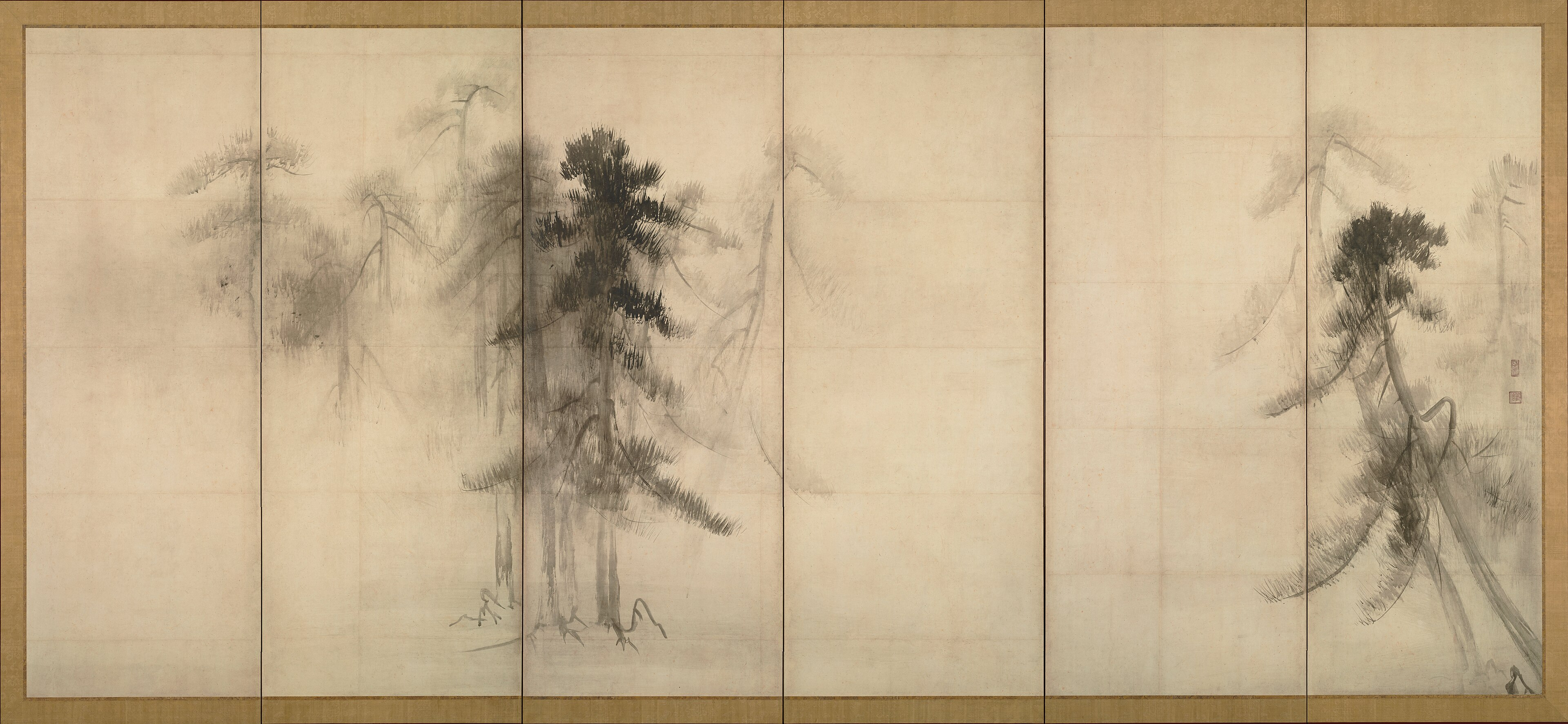
Identity and catalogue
Link- Title
- Pine Trees
- Artist or attribution
- Hasegawa Tōhaku
- Movement or period
- Azuchi-Momoyama period
- Country or culture
- Japan
- Depicted subject
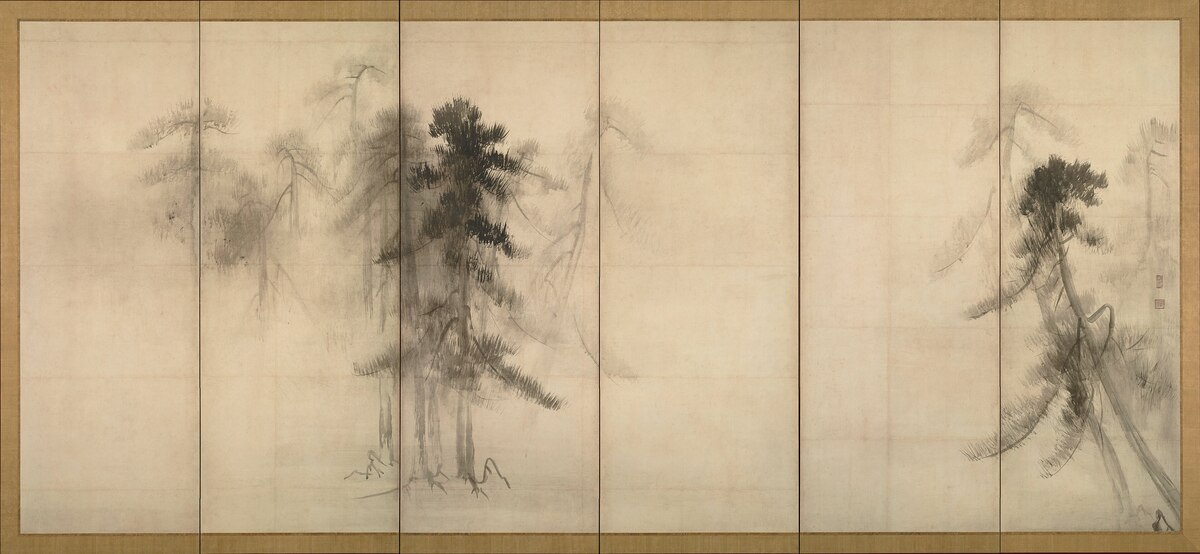
- A pair of folding screens depicting a pine grove emerging from and dissolving into mist, rendered in monochrome ink on paper.
- Title variants
- 松林図屏風; Pine Trees
- Support
- Paper
Catalogue identification and attribution
Pine Trees is catalogued as a painting in the form of a pair of screens, attributed to Hasegawa Tōhaku, whose dates are given as 1539 to 1610. The genre designation recorded for the work is byōbu-e, folding screen painting. The attributed artist dates therefore bracket the sixteenth century, but the catalogue identification is an attribution rather than a signed or documented authorship, so the connection between the painting and Tōhaku rests on that attribution as recorded rather than on an inscription reproduced in the catalogue entry. The same record places the object in the Azuchi-Momoyama period and dates the work itself to the sixteenth century, which is the object date, distinct from the much later date at which the painting was catalogued, accessioned and published in modern collections.(Wikimedia Commons: Pine Trees, n.d.)
The recorded measurements are 155.1 cm in height and 345.1 cm in width, and the accession number is A-10471. The width figure is what establishes the physical scale described as a pair of screens measuring over three metres across, and the accession number is the identifier by which the object is tracked in the cataloguing institution rather than a date or a maker's mark. Because the height and width are given as single values for the work, they are the dimensions as catalogued for the screen format rather than separate measurements for each panel of the pair.(Wikimedia Commons: Pine Trees, n.d.)
Materials and technique
LinkPine Trees is catalogued as a work in ink on paper, a medium designation that the available object record states directly and that also frames how the painting has been described and reproduced. The support is therefore paper rather than silk, and the pictorial substance is monochrome ink rather than colour. Because the only medium evidence supplied is this catalogue formula, the account can establish paper and ink as the documented material terms of the object but cannot specify fibre type, papermaker, sheet dimensions of individual joins, or the particular ink or pigment formulations used. Those are questions the present evidence does not answer, and they should not be filled in by analogy with other screens. What the ink-on-paper designation does establish is the material basis on which everything else in the work depends: a light-toned, absorbent or semi-absorbent ground on which dark strokes can be laid with widely varying intensity, and a surface large enough to carry a full pine grove without colour separation.(Wikimedia Commons: Pine Trees, n.d.)
Support, format and scale
The work is a byōbu-e, a folding screen painting, and it belongs to a pair of screens. The recorded dimensions, 155.1 cm in height and 345.1 cm in width, describe the scale of the format and show that the painted surface is a large, free-standing field rather than a panel-sized picture. The accession number A-10471 identifies the object within the collection of the Tokyo National Museum, where it is held. Attributed to Hasegawa Tōhaku (1539 to 1610) and dated to the Azuchi-Momoyama period of the sixteenth century, the work sits within a moment of strong military patronage and bold screen painting, a context in which large-format byōbu were made and used. The attribution and the period date are part of the object's catalogue identity as transmitted by the Wikimedia Commons record; they are not independently demonstrated by technical analysis in the evidence available here.(Wikimedia Commons: Pine Trees, n.d.)
Ink distribution and the role of empty paper
The mist effect that defines the composition is produced through the distribution of ink rather than through any painted atmospheric colour. Across the wide paper surface some trunks and needles are painted with dark, defined strokes, while other passages are faint or entirely absent, and the composition relies on the density of the brushwork together with the amount of empty paper left untouched. This is a description of how the image reads: the variation between loaded, dark strokes and near-absent ink is what allows the grove to appear and dissolve. The evidence does not include technical examination of the ink layers, so the account can report the visible alternation of dark and faint passages and the unworked paper, but it cannot state the number of ink tones, the order in which strokes were laid down, or whether any areas were reworked. The empty paper functions as the space where the mist lives, letting the pines recede into distance without any painted horizon, and it is therefore a compositional material, not a failure to fill the screen.(Wikimedia Commons: Pine Trees, n.d.)
Technical examination compared with visual inference
Interpretation
What the evidence supports is a distinction between what can be seen in reproduction and what the object record documents. The visible facts are the monochrome ink rendering, the dark-and-faint variation of brushwork, the untouched paper, the absence of colour separation between near and far, and the absence of a painted horizon. The documented facts are the medium, the byōbu-e format, the paired-screen configuration, the dimensions, the accession number, the collection, the attribution and the period date. Preparation layers, underdrawing, tools, brushes, paper joins, mounting materials and any conservation treatment fall outside the supplied evidence and cannot be asserted. Keeping these categories separate matters because the work's effect depends on materials that are only partly described: paper and ink are named, while the physical construction of the support and the mechanics of the brushwork remain unexamined in the available record.(Wikimedia Commons: Pine Trees, n.d.)
Within a larger history of material culture, the significance of the ink-on-paper medium is bound up with the scale of the byōbu format. A screen over three metres across in a light-toned support places the burden of illusion on ink density and reserved paper rather than on colour modelling, and it makes the viewer's eye complete the trees that the ink leaves out. The work is thus not simply a record of pine trees but a demonstration of how ink, paper and emptiness together can suggest a living grove in mist, and it asks for slow looking in which the trees appear. That claim about the painting's subject and its demand on the viewer is an interpretation of the described materials and composition; the material facts that ground it are the ink and paper medium, the faint and dark brushwork, the untouched paper and the large screen dimensions recorded by the museum record.(Wikimedia Commons: Pine Trees, n.d.)
Collection and display
LinkObject identification and museum record
Pine Trees is a painting in the collection of the Tokyo National Museum. It is catalogued as ink on paper, and it is attributed to the Japanese painter Hasegawa Tōhaku, whose dates are given as 1539 to 1610. The same identification materials record the object as a pair of folding screens rather than a single flat picture, dated to the Azuchi-Momoyama period, the sixteenth century. The recorded dimensions are 155.1 cm in height and 345.1 cm in width, and the work carries the accession number A-10471. Its genre is given as byōbu-e, folding screen painting. Taken together, these particulars show that the museum holds a large, multi panel screen work in a monochrome medium, made in the later sixteenth century by or in the circle of an artist whose career spans the close of that century.(Wikimedia Commons: Pine Trees, n.d.)
Interpretation
The catalogued dimensions and the screen format are not incidental details but conditions of the object. A byōbu-e is a free standing format, and a pair of screens measuring more than three metres across is a work designed for a large architectural setting rather than for close handheld viewing. Ink on paper at this scale also means that the paper itself remains visible throughout the composition; the support is not simply a ground covered over by paint but part of what the viewer sees. The museum record supplies the material and format facts, and these facts frame any later discussion of how the painting works, since the evidence establishes what the object is and where it is kept without describing the appearance of the grove itself.(Wikimedia Commons: Pine Trees, n.d.)
An important qualification attaches to the attribution. The painter Hasegawa Tōhaku, 1539 to 1610, is named in the cataloguing, but the record presents the work as attributed rather than as securely autograph. The sixteenth century Azuchi-Momoyama dating is likewise given as part of the object identification rather than demonstrated in the supplied evidence. The accession number A-10471 and the Tokyo National Museum collection reference locate the physical object and provide the means by which the attributional and dating claims can be checked in the institution's own records. Preserving the distinction between the documented facts of custody, material and measurement on one side and the attributional and chronological claims on the other is essential to how this object should be described in an accumulating account.(Wikimedia Commons: Pine Trees, n.d.)
Documented values and qualified estimates
LinkThe object and its recorded value
Interpretation
The object under consideration is Pine Trees, a work identified in the supplied source as a painting and as part of a pair of folding screens attributed to the Japanese painter Hasegawa Tōhaku, who lived from 1539 to 1610. The source dates the work to the Azuchi-Momoyama period in the sixteenth century, records its medium as ink on paper, and gives dimensions of 155.1 cm in height and 345.1 cm in width. It further records the genre as byōbu-e, folding screen painting, and places the work in the collection of the Tokyo National Museum under accession number A-10471. These identification details are the foundation on which any discussion of the object's value rests, because the recorded values themselves depend on an agreed identification of the artist, the period, the material, the format and the holding institution. The same source describes the work as a celebrated pair of folding screens of exceptional scale, held in a major national museum. The attribution to Tōhaku is how the source records the work rather than a claim about a signature or document, and the painter's recorded lifespan is part of the same identifying information.(Wikimedia Commons: Pine Trees, n.d.)
The only value figure in the supplied evidence is a calculated working insurance estimate, and the evidence is explicit that it is not a market record. The estimate is a range of US$500K to US$2M, recorded as a working calculation generated on 2026-10-16. The methodology described is a broad working insurance range calculated from confirmed contextual factors for the object: that the artist is a canonical Japanese master, that the work is a celebrated pair of folding screens of exceptional scale, and that the object is held in a major national museum with high-confidence identification. The evidence states that no confirmed market sale or official appraisal figure is supplied. In the absence of such figures, the range is described as built as a conservative order-of-magnitude estimate for a unique museum-caliber Japanese screen of this rarity and importance, applying a broad low-to-high multiplier to a nominal base, without relying on specific comparable sales. The range is described as deliberately widened to account for the absence of public market data and the singular status of the work. The qualification attached to the figure states that it is a model-generated working range for manual review only, that it is not an official insurance value, appraisal, auction result or sale price, that it does not represent a quote, guarantee or statement of market value, and that it should not be used for underwriting, lending, tax or legal purposes without review by a qualified appraiser or insurer.(Wikimedia Commons: Pine Trees, n.d.)
Read together, the identification details and the valuation details in the supplied evidence establish a relationship of dependence rather than of equivalence: the estimate is derived from the contextual factors that the object identification supplies, namely canonical authorship, celebrated paired-screen status, exceptional scale, and high-confidence identification within a major national museum. The evidence does not present the figure as arising from transactions in the market for comparable works, and it states that the range is calculated without relying on specific comparable sales. This matters for how the recorded value should be used. A figure produced by applying a broad multiplier to a nominal base, and then widened because public market data are absent, records an institutional posture toward risk rather than a price the object would command. The evidence supplies no dated sale, no official appraisal, no exhibition history, no provenance interval and no condition record, so the figure cannot be reconciled against those categories of documentation. What the evidence does allow is a clear account of what the number is, when it was generated, what contextual factors it was built from, and what the evidence itself says it must not be used for.(Wikimedia Commons: Pine Trees, n.d.)
Why the recorded value matters in context
The scale recorded in the identification, 155.1 cm in height and 345.1 cm in width, is one of the contextual factors the valuation evidence names when it describes the work as a pair of folding screens of exceptional scale, and it is also the condition under which the ink-on-paper surface has to work. Screens of this size are described in the source as large, free-standing formats made for viewing across a room, and the transcribed description of the work notes that the pair measures over three metres across. Within a larger history of material culture, the format matters because it situates the object among the monumental screen paintings produced under strong military patronage in the Azuchi-Momoyama period, a moment with which the source associates Tōhaku as one of its artists. The valuation evidence does not analyse the composition, but it treats the object's status as a celebrated pair of screens of exceptional scale as a factor bearing on rarity and importance, which is the same status the wider art-historical account attaches to the format.(Wikimedia Commons: Pine Trees, n.d.)
Two different registers of value can be distinguished in the supplied material without merging them. One register is the monetary working estimate, a US$500K to US$2M range generated on 2026-10-16 and qualified as a model-generated figure for manual review only, not an official insurance value, appraisal, auction result or sale price, and not a quote, guarantee or statement of market value. The other register is cultural and art-historical: a work attributed to a canonical master, dated to the sixteenth century in the Azuchi-Momoyama period, executed in ink on paper, catalogued as a byōbu-e and held by the Tokyo National Museum under accession A-10471. The monetary figure is explicitly derived from the second register rather than from market evidence, and the absence of confirmed market sales or official appraisal figures is stated as a reason the range was widened. Keeping the two registers distinct is what allows the recorded value to remain useful: it can be cited as a working calculation with a stated date and stated limitations, while the object's significance continues to rest on attribution, period, medium, format, scale and institutional holding rather than on the number itself.(Wikimedia Commons: Pine Trees, n.d.)
Working estimate
Calculated working insurance estimate, not a sale price: Estimated value: US$500K to US$2M Recorded date: Working calculation, generated 2026-10-16. Methodology: Broad working insurance range calculated from confirmed contextual factors for Hasegawa Tohaku's Pine Trees (Azuchi-Momoyama period, 16th century, ink on paper, 155.1 cm by 345.1 cm, Tokyo National Museum, accession A-10471). The artist is a canonical Japanese master, the work is a celebrated pair of folding screens of exceptional scale, and the object is held in a major national museum with high-confidence identification. No confirmed market sale or official appraisal figure is supplied. The range is therefore built as a conservative order-of-magnitude estimate for a unique museum-caliber Japanese screen of this rarity and importance, applying a broad low-to-high multiplier to a nominal base, without relying on specific comparable sales. It is deliberately widened to account for the absence of public market data and the singular status of the work. Qualification: This is a model-generated working range for manual review only. It is not an official insurance value, appraisal, auction result, or sale price. It does not represent a quote, guarantee, or statement of market value, and it should not be used for underwriting, lending, tax, or legal purposes without review by a qualified appraiser or insurer.(Wikimedia Commons: Pine Trees, n.d.)