What this photograph actually documents
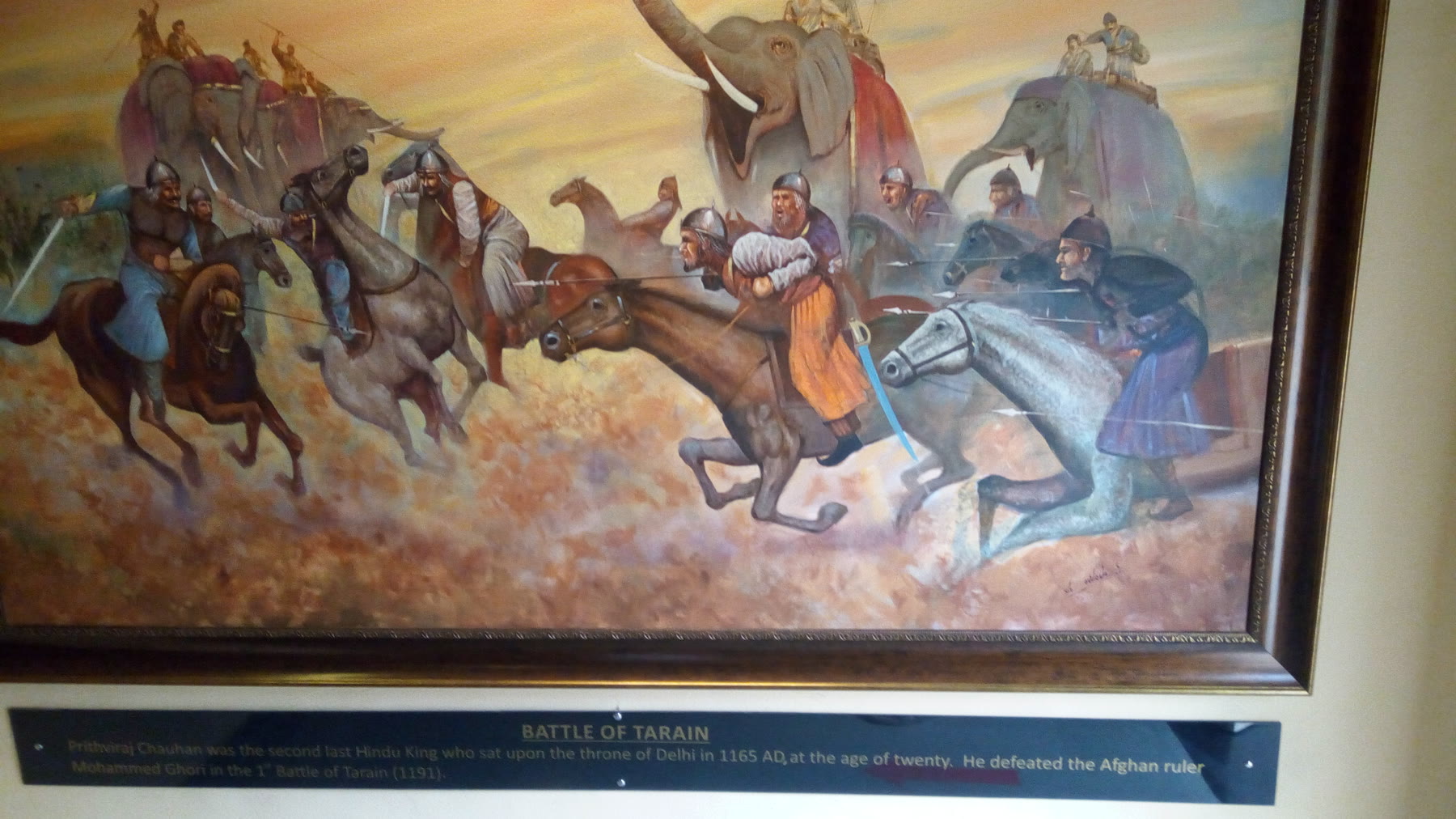
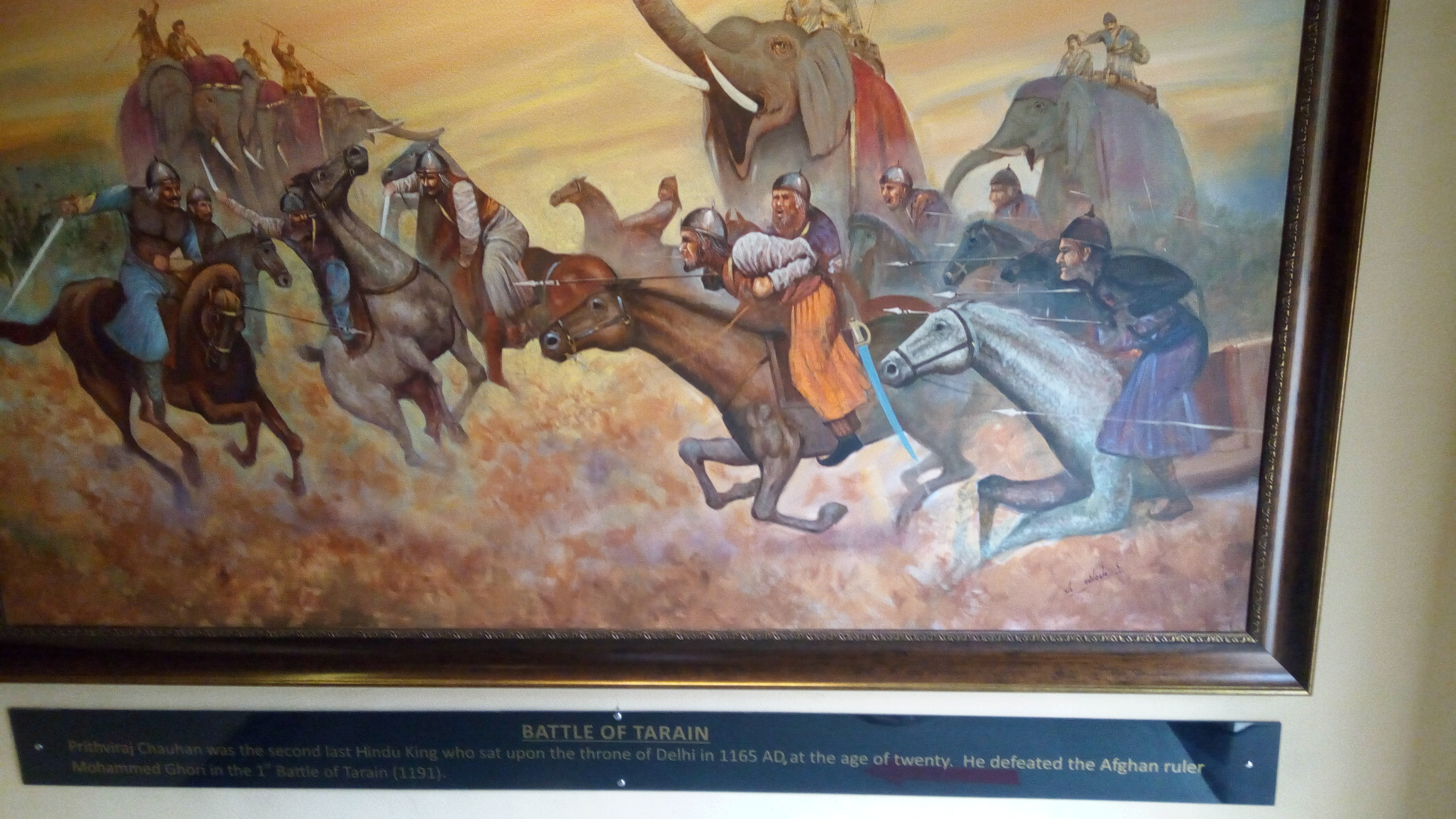
The source is a photograph of a framed painting with a museum label beneath it. Commons credits Amit20081980, records 18 March 2018 and places the display at the National War Museum in Pune. These details describe the photographic record. The painting's maker, original owner and production date require different evidence.[1]
The visible label names the first Battle of Tarain and 1191. That detail makes the subject more precise than the file's general title. A visitor account independently describes a museum picture gallery containing paintings of Prithviraj Chauhan and the battles of Tarain and Haldighati, but supplies no object-level artist or accession record for this painting.[1][6]
Two battles, with different outcomes
In 1191, Muhammad of Ghor's advance brought him into conflict with Prithviraj Chauhan and his allies. An INFLIBNET teaching chapter places the confrontation after the capture of Bhatinda and records Muhammad's defeat and wound. This is the victory named on the photographed label. It should not be confused with the Ghurid victory on the same battlefield in the following year.[2]
The second battle in 1192 reversed the outcome and opened the way to further Ghurid expansion in northern India. NCERT's chronology places the establishment of the Delhi Sultanate in the early thirteenth century, with Qutbuddin Aybak's reign beginning in 1206. Describing the opposing army in 1191 as the Delhi Sultanate therefore projects a later political formation back into the earlier encounter.[2][3]
A battle arranged for the viewer
The painting pushes the fighting toward the foreground. Horses overlap, spears cross the field and a central rider's warm-coloured clothing catches the eye. Elephants rise behind the cavalry and greatly enlarge the scale of the encounter. The dusty background merges distant movement into an atmosphere of urgency. This is a visual reading of the photographed painting; it does not identify the central rider with certainty.[1]
The frame and explanatory plaque remain visible in the photograph. Together they show the painting as a museum display: the charge is accompanied by a modern text that tells visitors what to remember. The plaque is evidence of the display's interpretation. The painted action is evidence of an artist's reconstruction, rather than confirmation of the exact formations, armour or individual gestures of 1191.[1]
How Prithviraj became a figure of memory
Historian Cynthia Talbot studies Prithviraj as a figure repeatedly reimagined across centuries. Her book's introduction examines the enduring description of him as the last Hindu emperor and explains why the phrase is historically misleading: other Hindu rulers existed in his own time and continued afterward. A commemorative picture can express an inherited heroic ideal without making that ideal a reliable political chronology.[4]
Audrey Truschke's scholarly review of Talbot highlights the changing audiences for the Prithviraj Raso, a Braj Bhasha narrative probably first written in the late sixteenth century. Its many manuscript versions vary substantially. Stories developed among Rajput elites in Mughal India and acquired further meanings in colonial and modern settings. This history of retelling helps explain why the battle's memory can be simpler and more unified than its sources.[5]
Stories and their evidence
The blind archer: a legend to label clearly
One famous later story says that Prithviraj, blinded after defeat, used his enemy's voice to aim an arrow and kill the sultan. Talbot discusses the episode's persistent presence in popular commemoration while identifying it as a fanciful ending rejected by many scholars. It is useful material for an article about memory, provided it is explicitly introduced as a later heroic legend.[4]
That legend concerns the aftermath of defeat; the label identifies the earlier victory. Their relationship lies in Prithviraj's remembered life, where an initial success, a later reversal and subsequent stories became connected. The dated encounter and its literary afterlife require different forms of evidence. The painting itself contains neither a blind archer nor a scene of the sultan's death.[1][4][5]
What a stronger catalogue still needs
No securely attributable object catalogue was located for this exact painting. Its authorship, dimensions, material, commission, acquisition and restoration history remain open. There appears to be a signature near the lower-right area, but the photograph is insufficient for a confident reading. Guessing from brush style or enlarging indistinct lettering would not establish an artist.[1]
The next useful evidence would be a legible signature, a complete museum inventory entry or a documented commission. Until that exists, the article can explain the battle, analyse the composition and trace the associated legends, while retaining clear unknowns for the object itself. Source criticism improves this account more than adding unsupported troop numbers, invented dialogues or a precise modern calendar day for the battle.[1]
- Artist
- Painter not securely identified
- Date
- Painting date unknown; photograph taken 18 March 2018
- Medium
- Not verified
- Dimensions
- Not verified
- Culture / place
- Indian commemorative representation of a medieval North Indian battle
- Current context
- National War Museum, Pune, according to the photograph's record
Details to carry with you
- The label visible in the photograph identifies the first Battle of Tarain, 1191.
- Muhammad of Ghor led Ghurid forces; calling his 1191 army the Delhi Sultanate is anachronistic.
- 18 March 2018 is the photograph date, not a verified painting date.
- Amit20081980 is credited as the photograph's uploader and creator, not as the painter.
- The exact artist, medium, dimensions and commissioning history remain unverified.