Scroll to zoom · drag to pan · double-click to focusPinch to zoom · drag to explore · double-tap to focusFIELD VIEW / 07
Tools & download
Pixel colour Select a pixel with the eyedropper
No pixel selected
Choose the eyedropper, then click or tap the image. Scroll to zoom for finer selection.
Add text
Hand to pan · Select to move text and drawings · Add as many texts as you like · Scroll to zoom
The research & record
Look closer. Read deeper.
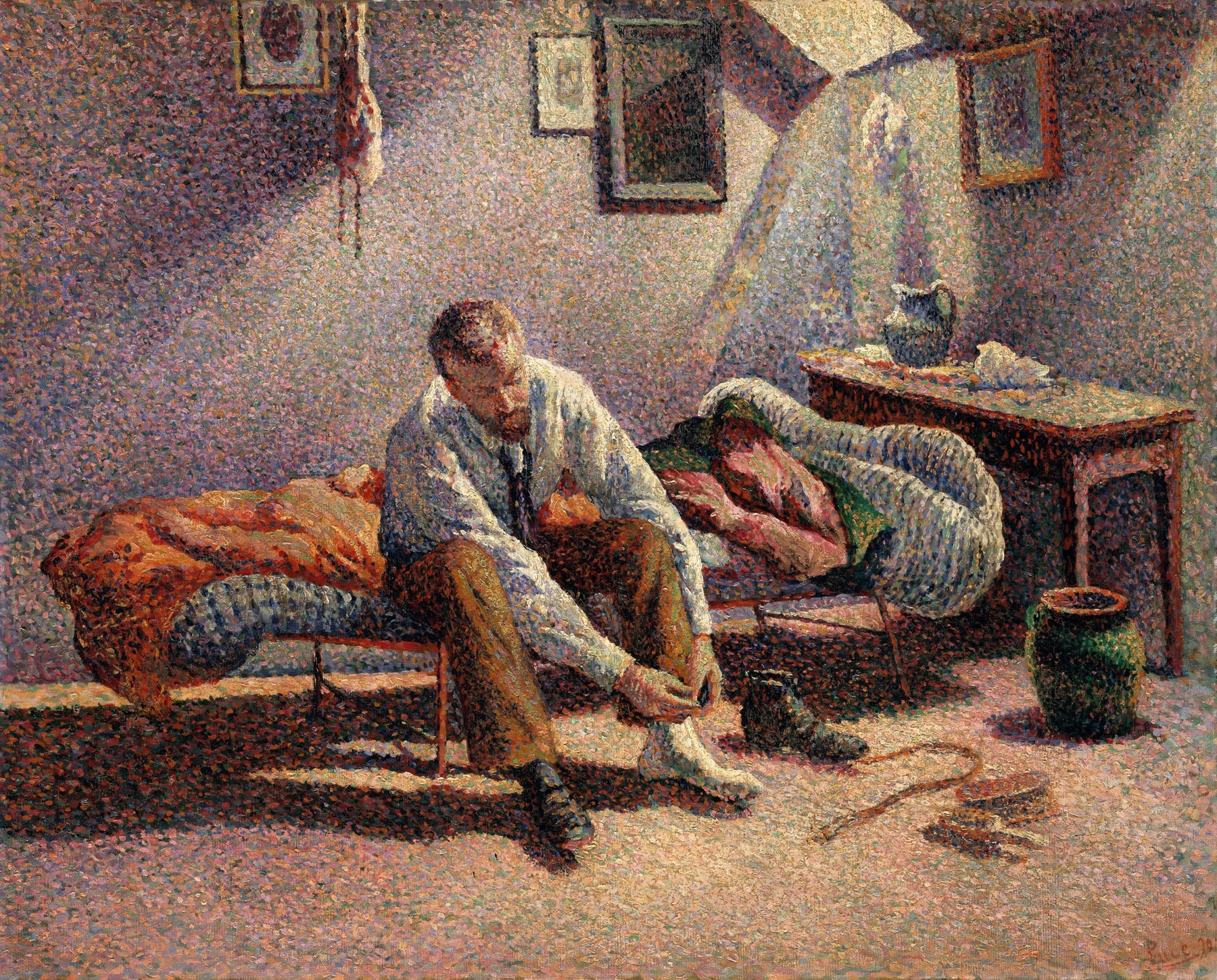
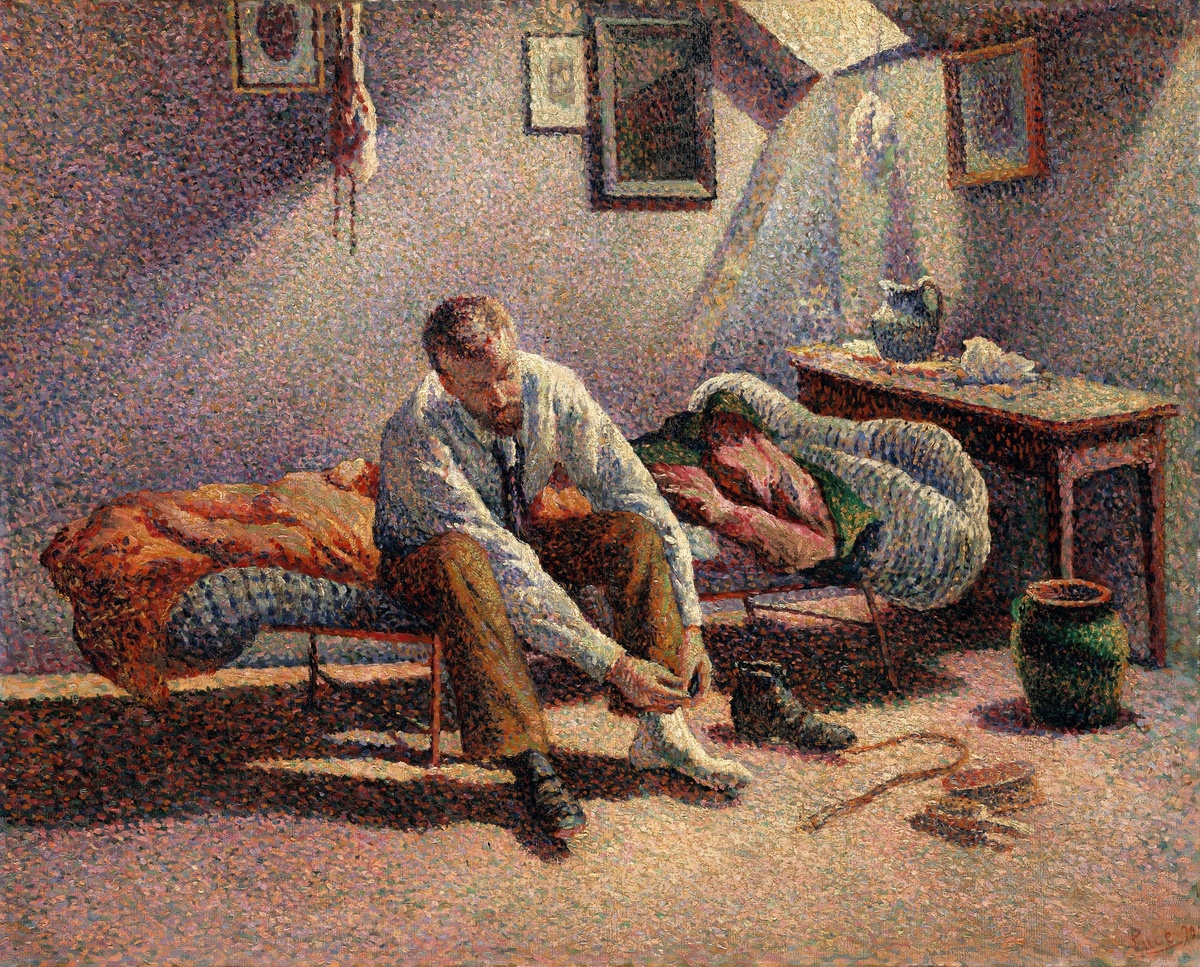
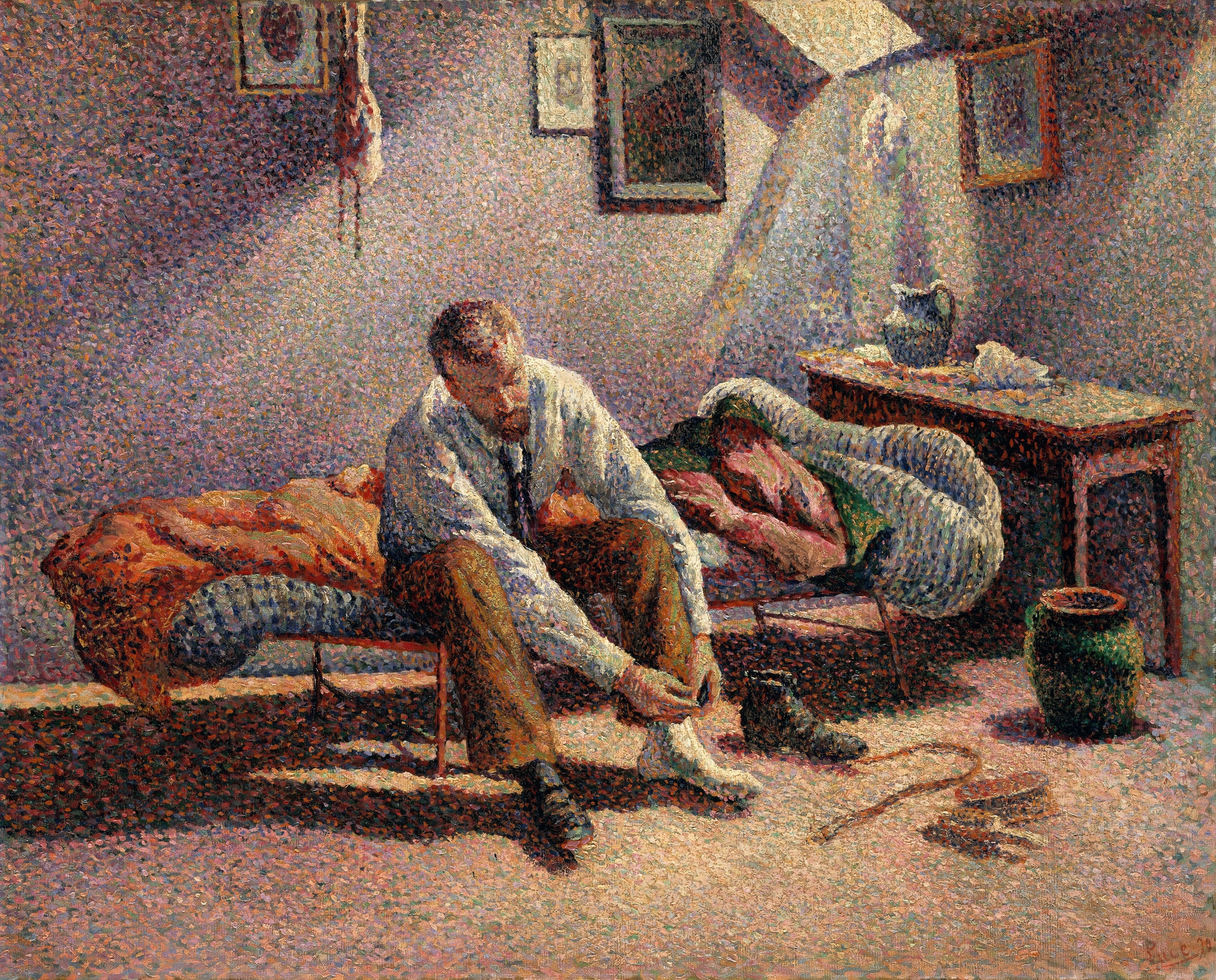
A man bends over his feet in a cramped bedroom while morning light cuts across the wall. The Metropolitan Museum identifies him as Gustave Perrot, Luce's friend and fellow painter. Dense touches of color make clothing, bedding, walls, and shadows shimmer. This intimate scene combines an ordinary act of getting dressed with the ambitious experiments in color associated with Neo-Impressionism.
An ordinary morning, a named sitter
The seated man is not simply an anonymous figure. The Metropolitan Museum identifies him as Gustave Perrot, a close friend and fellow painter of Luce, dressing in morning light beneath a garret window. The identification gives the room a personal connection, but the museum also acknowledges that little is known about Perrot. He died young; a fifteen-work tribute commemorated his brief career at the Salon des Indépendants in 1892.[1]
The secure object record is unusually useful here: 1890, oil on canvas, 64.8 by 81 centimetres, accession 67.187.80. The Met received the painting through the 1967 bequest of Miss Adelaide Milton de Groot. Wikimedia's file record independently connects the reproduced image to the same accession. These identifiers distinguish this canvas from similarly titled interiors and make it possible to check that an article and its illustration describe the same work.[1][2]
Following the light through the room
In the displayed image, the strongest illumination falls from the upper right, touching the wall, the washstand, and parts of the man's white shirt. The bed stretches behind him, its red cover and blue-striped bedding making a dense band across the room. Framed pictures and hanging objects interrupt the upper wall. This is a visual reading of the reproduction: light gives a modest room a complicated rhythm of bright patches, diagonals, and shadows.[2]
Small objects reward a slower look: the dark pitcher on the washstand, a container beneath it, footwear near the man's feet, and the pale fabric he handles. His bent posture connects the body to the foreground floor rather than presenting a formal portrait pose. Behind him, a red cover overlaps blue-striped bedding and a crumpled pillow. The Met's account identifies Perrot and supplies no second sitter.[2][1]
Why the color is divided into touches
Luce's paint application belongs to the Neo-Impressionist experiment in separated color. The Met's account of the movement distinguishes Divisionism, the separation of colors into individual strokes, from Pointillism, the use of precise dots. Its artists drew on nineteenth-century theories of optics and color contrast, believing that neighboring pigments could create a livelier impression in the viewer's eye than ordinary mixing on the palette.[3]
The effect can be explored directly in this painting. Up close, warm and cool marks remain conspicuous across the wall and the clothing; at a distance, they begin to organize themselves into light, fabric, and space. The image is a useful demonstration of an artistic theory, rather than proof that every viewer perceives color identically. Its patterned surface stays visible even when the domestic scene is easy to recognize.[2][3]
Luce's place among the Neo-Impressionists
Luce's route to painting began in skilled manual work. The Musée des impressionnismes Giverny records his apprenticeship to a wood engraver at fourteen and later study at the Académie Suisse and Carolus-Duran's studio. In 1887 he exhibited at the Salon des Indépendants and encountered Pissarro, Seurat, and Signac. Morning, Interior, painted three years later, belongs to the period when he had adopted the division of tones.[4]
That connection is historical context, not a claim that the painting imitates one particular Seurat canvas. The Musée d'Orsay identifies Luce as a painter, draftsman, lithographer, and ceramic painter influenced by Pissarro and the pointillists. His range helps explain why this intimate bedroom should be considered alongside landscapes, city scenes, and images of work. A single familiar reproduction captures only one part of his practice.[5]
Politics around the picture
Luce's anarchist commitments are documented artist history, but they should not be turned into an invented plot for this bedroom. Giverny describes his arrest and imprisonment after the 1894 assassination of President Sadi Carnot, followed by release when serious evidence against him was lacking. That event occurred four years after Morning, Interior. It establishes the political climate around Luce's later career, rather than the circumstances of this canvas's creation.[4]
The museum distinguishes sympathetic images of labor from the sharper social criticism of Luce's illustrations for anarchist periodicals. Reading dignity or intimacy in Perrot's morning is a reasonable interpretation if labeled as such. The quiet subject does not establish a coded revolutionary message or a political commission.[4]
Stories and their evidence
Unanswered questions and unsupported stories
The consulted museum records do not supply a dramatic legend about the painting. The strongest unusual story is the real sitter's obscurity: a named artist survives vividly in Luce's image while the Met reports that little is known about his short life. This gap should invite further research into Perrot, not invented dialogue, a romantic relationship, or a second person supposedly hidden beneath the blankets.[1][2]
A fuller study could examine the 1892 memorial exhibition and the painting's ownership before de Groot's bequest. Neither a complete early provenance nor an exact room address has been established in this article. The Musée d'Orsay holds an archival collection for Luce that can be consulted by arrangement. That is a concrete research route for correspondence, rather than permission to fill the missing biography with plausible-sounding details.[5][1]
Artist
Maximilien Luce
Date
1890
Medium
Oil on canvas
Dimensions
64.8 × 81 cm (25 1/2 × 31 7/8 in.)
Culture / place
France
Current context
The Metropolitan Museum of Art, New York; accession 67.187.80
Details to carry with you
The Met dates the painting to 1890 and records oil on canvas.
The painting measures 64.8 × 81 cm.
The sitter is Gustave Perrot, a close friend of Luce and a fellow painter.
Perrot's short career was commemorated by a fifteen-work tribute at the Salon des Indépendants in 1892.
The painting entered the Met through the 1967 bequest of Miss Adelaide Milton de Groot.
The Met accession number is 67.187.80; its online object identifier is 436923.
Fit and fill keep the painting’s proportions. Stretch changes them.
Move and zoom the painting on your clear phone case.
Preparing the artwork for your edition…
Made to order
The 30 cm ruler is scaled alongside your selected print. Keep the painting’s proportions with a black background, or stretch it to fill. Frame width, material texture and screen colours are illustrative.
We count article page loads to improve the archive, without a visitor tracking cookie. Essential storage supports your basket, delivery choice and site security. Stripe uses payment security storage when payment opens. Your notice and counting choices are remembered for one year.