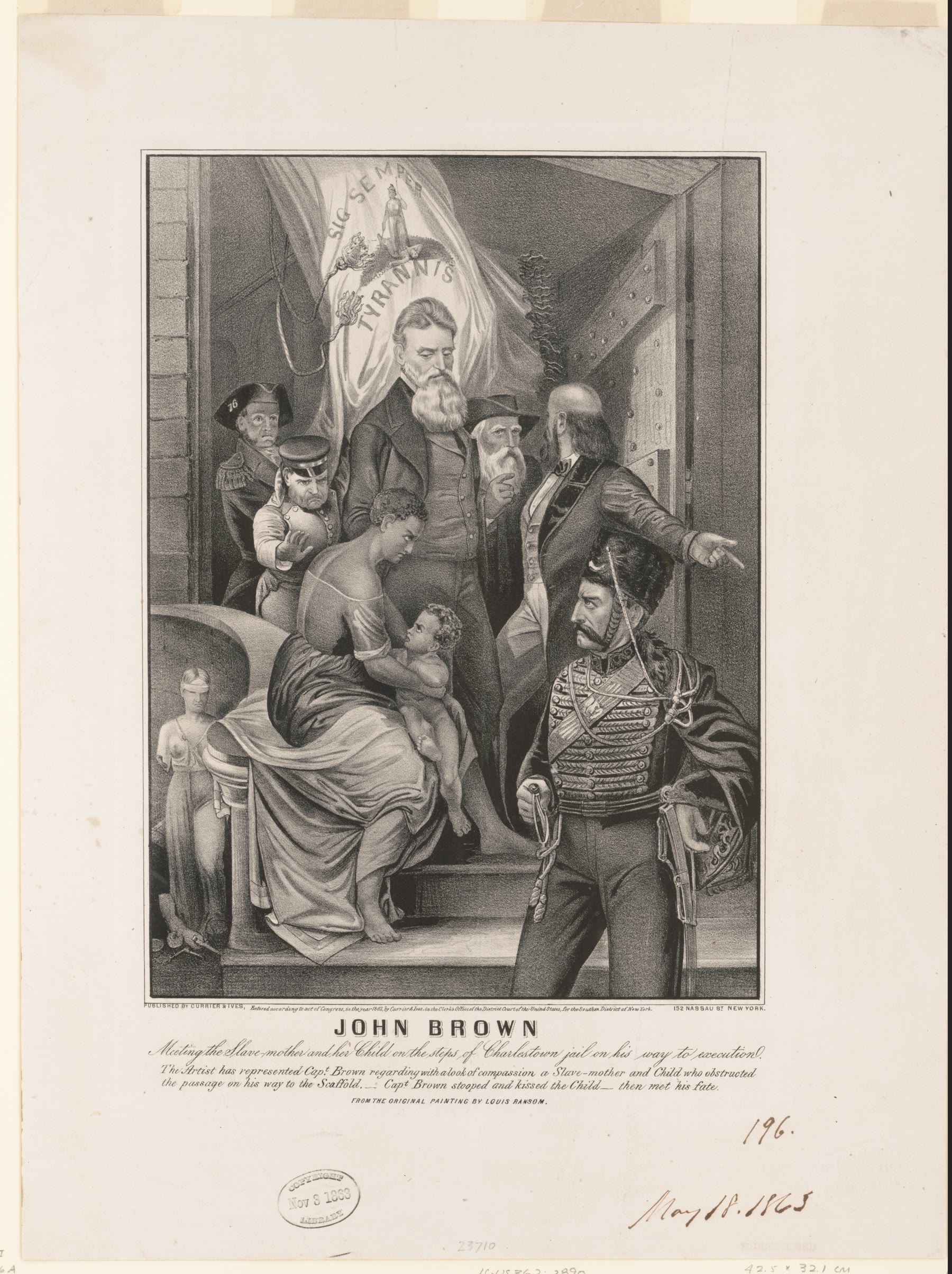
The encounter at the centre of this print is a legend. John Brown did not leave us a verified moment here with this mother and child; the story of his final kiss was an invented account that spread after his execution. Keep that in mind as you look. The image's power comes partly from how easily a convincing scene can become a remembered event.
Brown stands in the doorway above the mother, who holds her child up towards him. Their faces make a close group within a crowd of other bodies. The uniformed men and the heavy door set the terms of the scene. He is being taken somewhere; the small meeting seems to interrupt that movement for just a moment.
Brown had been condemned after his raid on the federal armoury at Harpers Ferry. A newspaper account of his last day supplied the tender encounter that inspired a painting by Louis Ransom. Currier and Ives reproduced the painting as a print. The story travelled from writing into an image that could enter homes and schools, gaining familiarity each time it was seen.
Look at the child reaching up from the mother's arms. The small body makes the surrounding uniforms feel heavier. The mother occupies the steps as an active presence within the scene, yet the picture also uses her and her child to shape our judgement of Brown. Ask whose story we are being asked to remember, and whose experience is being made to serve it.
Princeton's account traces how the fictional incident was repeated through newspapers, biographies, paintings and poems. The print's wide distribution helped it become accepted as a true account. Its emotional clarity was easier to carry than the uncertainty around its origin. The history we can follow securely is the history of that story spreading.
Come back to the doorway. The scene can still move us after its legend has been named. It also asks something more demanding of us now: to notice how an image earns belief. A tender gesture, a crowded threshold, a child held towards a condemned man. Each detail makes the story memorable. Memory alone cannot make it true.
The story and its sources
Story draft · Editorial review pending.
Guide sources checked 5 October 2026.
Historical claims are linked to the records below. Close looking and interpretation are identified in the passage notes.
A condemned man, a mother, and a child turn a prison doorway into a political stage. Published during the Civil War, this lithograph after Louis Ransom presents John Brown as a compassionate abolitionist martyr. Its central encounter belongs to an apocryphal story, while the Virginia flag, Revolutionary figure, and damaged Justice statue make the picture a revealing document of how that story gained emotional authority.
The object and the event
The displayed object is a published print, rather than Louis Ransom's original painting. The Library of Congress identifies the 1863 publisher as Currier & Ives and records an image 33 centimetres high on wove paper. The inscription explicitly credits Ransom. Keeping these roles separate matters: the painter devised the composition, while the publishing firm converted it into an image that could be reproduced and sold.[1]
The historical episode behind the image occurred four years earlier. In October 1859 Brown attacked the federal armory at Harpers Ferry, intending to arm enslaved Black Americans. He was captured, tried, and sentenced to death. His execution at Charles Town on 2 December became an intensely divisive national event. Sympathy for his antislavery purpose and arguments over his violence helped make his final moments a subject for art.[4][2]
A doorway crowded with symbols
Brown occupies the central vertical axis, his pale beard and lowered gaze directing attention toward the mother and child. The ornate officer in front turns his head toward them, while another guard extends an open hand. The arrangement creates a pause inside a procession. This is a visual reading of the displayed impression: the stillness makes Brown's compassion seem more important than the officials' control of his body.[1]
The damaged figure of Justice at the lower left, the Virginia banner above Brown, and the man with '76' on his hat turn the scene into an argument about American ideals. The Revolutionary figure brings the struggle for independence into Brown's present; broken Justice suggests a legal system that has failed its moral purpose. The Library of Congress also identifies a Madonna-and-child resemblance in the mother and infant, explaining the scene's religious associations.[1][3]
How a painting became a household image
Princeton University Library traces the image from an embellished newspaper account to Ransom's large canvas, then to the Currier & Ives edition. Barnum exhibited the painting at his American Museum in New York in 1863, but anxiety about violence surrounding the draft riots led to its removal. That history concerns the original painting's exhibition; it should not be treated as the provenance of this Library of Congress sheet.[2]
The print could travel farther than the canvas. Princeton reports that the publisher sold the design in black and white, with hand coloring available at additional cost. Its own acquisition is a colored impression heightened with gum arabic. The impression shown here is uncolored. Copy-specific treatments belong in the record for the actual impression: a bright Princeton example does not establish the medium or dimensions of the Washington copy.[2][1]
Stories and their evidence
The kiss: influential, but apocryphal
The inscription tells viewers that Brown stopped and kissed the child. This is the image's most powerful story, and its largest historical uncertainty. James C. Malin's study for the Kansas Historical Society follows the episode to the New York Tribune of 5 December 1859 and its rapid repetition in poetry and biography. Malin argues that military security excluded the public from direct contact with the prisoner, making the reported encounter implausible.[3]
The University of Houston's Digital History resource similarly treats the episode as an inflammatory newspaper story rather than an established fact. The appropriate wording is therefore 'the print imagines' or 'according to an apocryphal account.' Its historical importance does not depend on proving that the kiss occurred: the surviving print demonstrates how abolitionist memory gave a disputed story an enduring, persuasive visual form.[5][3]
From Civil War argument to lasting legend
In 1870 Currier & Ives returned to the subject in a simplified version. Malin observes that the Revolutionary figure, damaged Justice, and other additional material disappeared, while the title identified Brown as a martyr. The change offers a concrete comparison: an explicitly sectional image of 1863 became a more concentrated memorial image after the war. The later edition should be compared with this one, rather than substituted for it.[3]
The motif outlived the publisher. Thomas Hovenden painted a separate version in 1882–84, now at the Metropolitan Museum of Art. William H. Johnson revisited the legend around 1945 in a painting held by the Smithsonian American Art Museum. A modern study of Black children's literature also follows the story through newspapers, poems, illustrations, and biographies. These works show the episode's cultural afterlife without independently corroborating the original encounter.[4][6][7]
What further research can establish
The strongest next comparison would place an original 1863 impression beside the 1870 redesign and contemporary execution reports. The Library of Congress supplies the edition identifiers Gale 3514 and Gale 3515, useful for avoiding mistaken matches. A full history of this particular sheet's acquisition has not been established here. An image credit, a publisher's inscription, and a museum's holding record answer different questions and should remain distinct.[1]
Artist
Currier & Ives, publishers, after Louis Ransom
Date
1863
Medium
Lithograph on wove paper; the displayed impression is uncolored
Dimensions
Image: 33 × 21.8 cm (Library of Congress impression)
Culture / place
United States
Current context
Library of Congress, Prints & Photographs Division, Washington, DC
Details to carry with you
The Library of Congress records a lithograph on wove paper, with an image measuring 33 × 21.8 cm.
Currier & Ives published the print; Louis Ransom made the painting on which it was based.
The publisher's address printed on the sheet is 152 Nassau Street, New York.
The encounter with the mother and child is apocryphal rather than a verified eyewitness scene.
A simplified 1870 version removed political symbols and presented Brown as a martyr.
Hand coloring and gum arabic describe another institution's impression, rather than the uncolored image displayed here.
Art from the archiveSizes for your spaceMade to order
01 / Find your edition
Made for you
Choose your delivery country for available editions and delivery prices. Prices and delivery are shown in GBP.
2 products
Preparing your editions…
Paper & texture
30.5 cm / 12 in40.6 cm / 16 in
051015202530
30 cm reference · same scale as the print
30.5 × 40.6 cm / 12 × 16 in · Standard
Drag to rotate
30.5 × 40.6 cm / 12 × 16 in · Standard
12 in / 30.5 cm16 in / 40.6 cm
051015202530
30 cm reference · same scale as the print
12 × 16 in / 30.5 × 40.6 cm · Standard
12 in / 30.5 cm16 in / 40.6 cm
051015202530
30 cm reference · same scale as the print
12 × 16 in / 30.5 × 40.6 cm · Standard
12 in / 30.5 cm16 in / 40.6 cm
051015202530
30 cm reference · same scale as the print
12 × 16 in / 30.5 × 40.6 cm · Standard
Front · your design1 / 3
Fine art poster
GBP 17.43
Delivery GBP 5.02 / Total GBP 22.45
A gallery paper print with a smooth art-paper surface. Choose a size that suits the painting.
Fit and fill keep the painting’s proportions. Stretch changes them.
Move and zoom the painting on your fine art poster.
Preparing the artwork for your edition…
Unframed · frame it your way
Ready for your wall
30.4 cm / 12 in40.6 cm / 16 in
051015202530
30 cm reference · same scale as the print
30.4 × 40.6 cm / 12 × 16 in · Standard
Drag to rotate
30.4 × 40.6 cm / 12 × 16 in · Standard
12 in / 30.4 cm16 in / 40.6 cm
051015202530
30 cm reference · same scale as the print
12 × 16 in / 30.4 × 40.6 cm · Standard
12 in / 30.4 cm16 in / 40.6 cm
051015202530
30 cm reference · same scale as the print
12 × 16 in / 30.4 × 40.6 cm · Standard
12 in / 30.4 cm16 in / 40.6 cm
051015202530
30 cm reference · same scale as the print
12 × 16 in / 30.4 × 40.6 cm · Standard
12 in / 30.4 cm16 in / 40.6 cm
051015202530
30 cm reference · same scale as the print
12 × 16 in / 30.4 × 40.6 cm · Standard
Front · your design1 / 4
Framed art print
GBP 61.52
Delivery GBP 15.96 / Total GBP 77.48
A ready-to-hang wooden frame with a clear Perspex cover and a semi-gloss printed insert, made in the UK.
Fit and fill keep the painting’s proportions. Stretch changes them.
Move and zoom the painting on your framed art print.
Preparing the artwork for your edition…
Wooden frame & protective clear front included
The 30 cm ruler is scaled alongside your selected print. Keep the painting’s proportions with a black background, or stretch it to fill. Frame width, material texture and screen colours are illustrative.
We count article page loads to improve the archive, without a visitor tracking cookie. Essential storage supports your basket, delivery choice and site security. Stripe uses payment security storage when payment opens. Your notice and counting choices are remembered for one year.