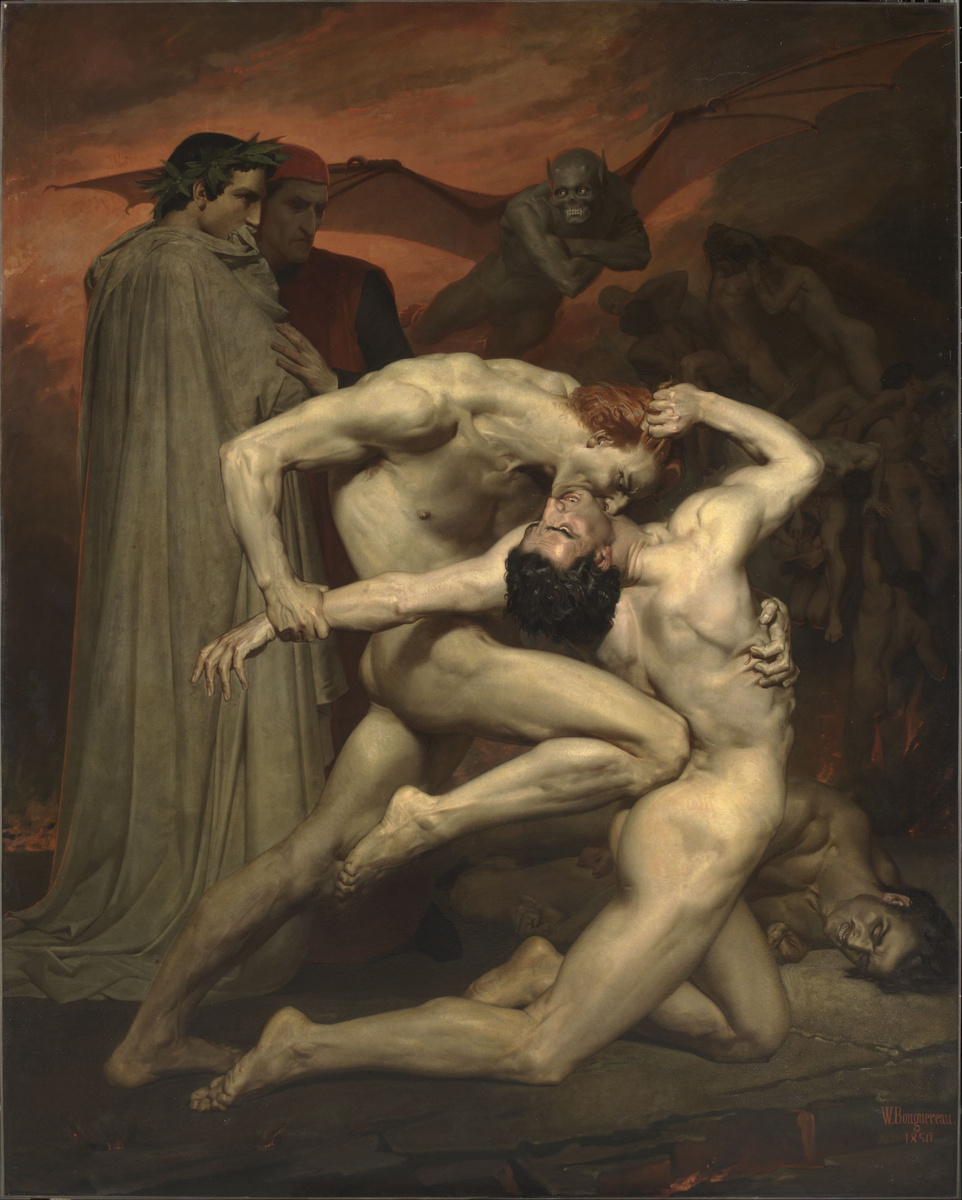
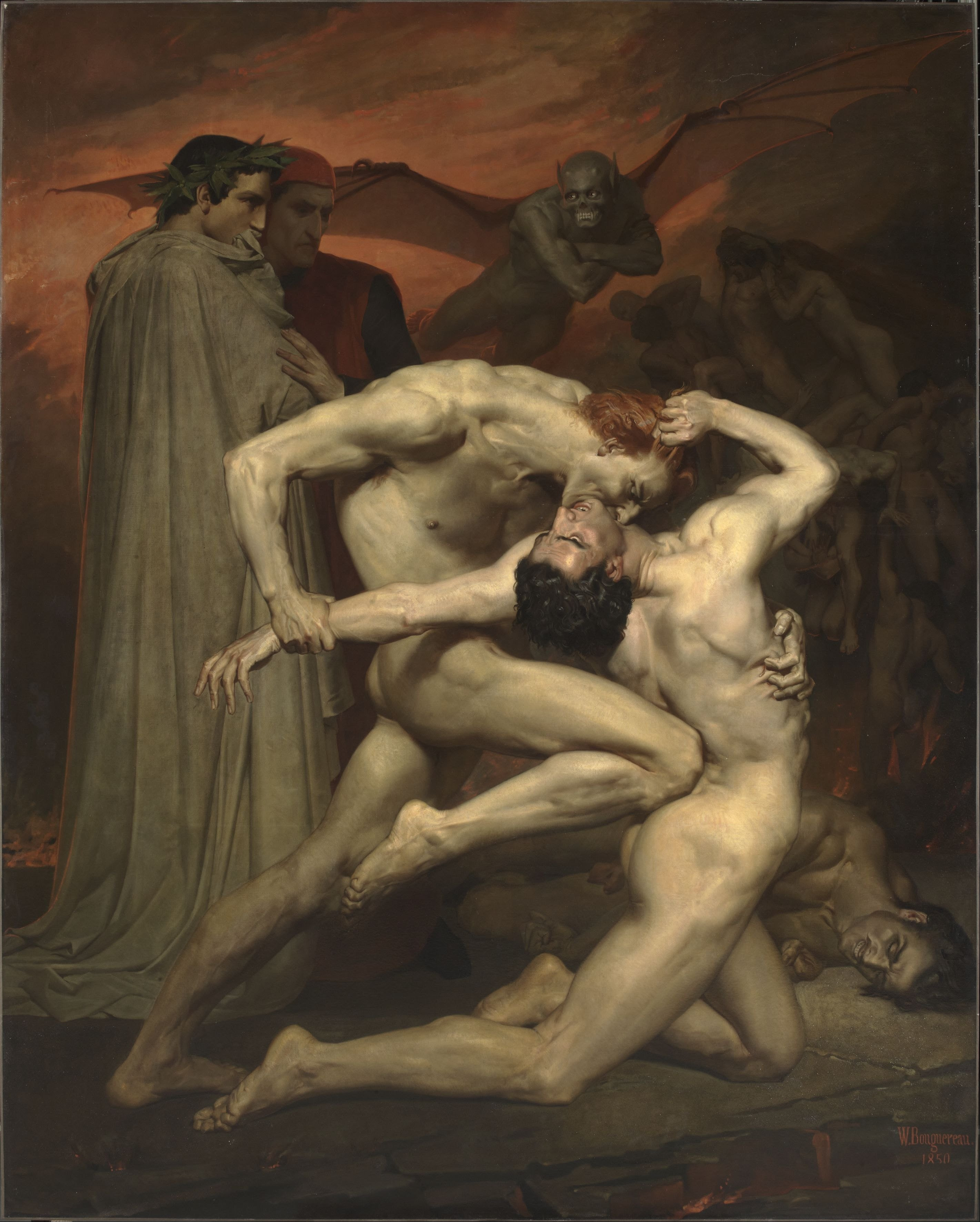
A docent's tour of Bouguereau's 1850 Salon painting, showing Dante and Virgil watching the damned Capocchio and Gianni Schicchi struggle in Hell, with a winged demon presiding over them.
The inscribed signature 'W. Bouguereau' with the date 1850 in the lower-right corner, the documentary evidence for attribution and dating of the canvas.
02
Crowd of writhing souls
The dense mass of shadowy nude figures seething in the smoky red glow of the right background, extending the punishment beyond the central duel into the depths of the Inferno.
03
Fallen body on the ground
The pale corpse sprawled at the lower right, its upturned face and open features visible on the dark ground, a reminder of the death and damnation that surrounds the combatants.
Your gallery guide
Dante and Virgil in Hell by William-Adolphe Bouguereau (1850)
A docent's tour of Bouguereau's 1850 Salon painting, showing Dante and Virgil watching the damned Capocchio and Gianni Schicchi struggle in Hell, with a winged demon presiding over them.
Editorial review by Artifact Archive automated publishing
This large oil painting shows Dante and Virgil standing in Hell, watching the punishment of the damned.
The specific scene comes from the Divine Comedy, Dante's journey through the afterlife.
Here the two poets observe the violent combat between Capocchio and Gianni Schicchi de' Cavalcanti, while a winged demon presides above.
Look at the two poets on the left. Dante wears a dark robe and a laurel wreath, marking him as a poet.
Virgil, in a paler robe, stands beside him. Both keep their attention on the struggle below.
At the right, near the bottom corner, William-Adolphe Bouguereau signed and dated the work: W. BOUGUEREAU 1850.
The subject is rooted in literature, not mythology. The painting is based on Dante's Divine Comedy.
Dante wrote the poem in the early fourteenth century, but Bouguereau painted this scene in 1850.
That gap matters. We are looking at a nineteenth-century painter reimagining a medieval poet's vision of Hell.
The painting was shown publicly at the Salon of 1850, in the Salon Carre, from late December until March 1851.
For Bouguereau, that exhibition was a professional test. Salon audiences judged ambitious figural paintings closely.
By choosing Dante, he tied his own work to a celebrated literary authority. The scene presents damnation as a moral spectacle with witnesses nearby.
The painting is now in the collection of the Musee d'Orsay, acquired in 2011.
It remains a strong example of academic figure painting. The exact identities of the damned come from Dante's text, and the canvas makes their struggle visible.
The result is a literary vision of justice and violence, watched by two poets who stand in for the reader.
The story and its sources
Editorial review by Artifact Archive automated publishing.
Historical claims are linked to the records below. Close looking and interpretation are identified in the passage notes.
William-Adolphe Bouguereau was a French academic painter (1825–1905). Their work is associated with academic art; Pont-Aven School. Their recorded places of work include Paris; Rome.
Dante and Virgil, the two poets of the Divine Comedy, watch the punishment of the damned in Hell, specifically the violent combat between Capocchio and Gianni Schicchi, while a winged demon presides above.
Title variants
Dante and Virgil; Dante et Virgile en Enfer; Dante e Virgilio nell'Inferno; Dante and Virgil in Hell; Dante i Wergiliusz w piekle; Данте і Вергілій у пеклі
The painting in question is titled Dante and Virgil in Hell and is attributed to William-Adolphe Bouguereau (1825-1905), identified in the institutional record as a French painter. The work carries the date 1850, a date that the painter himself inscribed rather than one assigned retrospectively by a later cataloguer: a signature and date appear at the lower right reading W. BOUGUEREAU / 1850. That coincidence of painted inscription and recorded date is the strongest single anchor for the object's place in Bouguereau's early career, since it was made by the artist's own hand at the moment of execution rather than by a museum registrar working generations later. The catalogue genre is given as mythological painting, although the subject matter itself is drawn from Dante rather than from classical myth, a tension in the classification that is worth noting rather than resolving.(Wikimedia Commons: Dante and Virgil, n.d.)
Physically, the canvas is large: the recorded dimensions are 280.5 cm in height and 225.3 cm in width, making it a vertically oriented picture on a scale suited to ambitious figural exhibition painting. The institutional record describes the support and medium as oil on canvas. The scale matters for how the object functioned historically, because a canvas of these dimensions was built for public viewing in a large gallery rather than for a domestic wall. The painting is now held in the collection of the Musee d'Orsay, where it is recorded on the current location of the ground floor, room 3, under the accession number 153692. The museum acquired the work in 2011, a date that belongs to the object's modern institutional life and is entirely distinct from the 1850 date inscribed on the canvas itself.(Wikimedia Commons: Dante and Virgil, n.d.)
The subject depicts Dante and Virgil watching the condemned in Hell, and the figures the record identifies include Capocchio, Gianni Schicchi de' Cavalcanti, Dante Alighieri, Virgil, and a devil. This cast sets the painting within a literary rather than strictly mythological programme: the work is based on The Divine Comedy, Dante's journey through the afterlife, and the specific confrontation shown is the violent combat between Capocchio and Gianni Schicchi de' Cavalcanti while a winged demon presides above them. Dante Alighieri belongs to the early fourteenth century as the author of the poem, while the painting was made in 1850, so the object is a nineteenth-century painter's reimagining of a medieval poet's vision rather than an illustration produced within Dante's own era. The temporal gap between source text and canvas is part of what the picture is, not an incidental fact about it.(Wikimedia Commons: Dante and Virgil, n.d.)
Interpretation
Read together, the catalogue data allow one qualified synthesis. The combination of a very large oil canvas, an inscribed date of 1850, a signature placed at the lower right, and a subject taken from Dante positions the work as a self-consciously ambitious literary history painting made early in Bouguereau's career. The genre label of mythological painting and the Dantean source do not sit perfectly together, and the record itself supplies no explanation for the discrepancy; the safest conclusion is that the label reflects cataloguing convention rather than the picture's literary origin. What the evidence establishes is a French academic painter of the mid-nineteenth century taking up a canonical Italian poem as the vehicle for a large public picture, and what it leaves open is how the artist himself understood the relationship between his classical training and his chosen medieval subject.(Wikimedia Commons: Dante and Virgil, n.d.)
The painting known as Dante and Virgil shows the two poets watching the condemned in Hell, and the institutional record used here describes the subject as drawn from Dante's Divine Comedy rather than from classical mythology, classifying the work as a mythological painting while identifying its source as the poem. Within the picture, the record names the depicted people as Dante Alighieri, Virgil, a devil, Capocchio, and Gianni Schicchi de' Cavalcanti. There is a distinction to keep in view: what a viewer describes is a pair of robed figures observing a violent struggle beneath a presiding winged demon, while the identification of the combatants by name and the assignment of the scene to a specific passage depend on the text and on scholarly and institutional attribution rather than on the canvas alone. The painting is in the collection of the Musee d'Orsay, which acquired it in 2011, and its accession number is 153692; it is currently displayed on the ground floor, room 3. The medium is oil on canvas, and the dimensions are 280.5 cm in height by 225.3 cm in width, so the composition is a very large figural canvas rather than a cabinet picture.(Wikimedia Commons: Dante and Virgil, n.d.)
What the evidence supports
Interpretation
Read together, the evidence supports a fairly narrow but firm account: an oil on canvas of 1850, signed and dated by Bouguereau, depicting Dante and Virgil watching the condemned in Hell, based on the Divine Comedy, shown at the Salon of 1850 in the Salon Carre, and now in the Musee d'Orsay after its 2011 acquisition. The recorded roles of Dante and Virgil as attentive poets, the named participants in the struggle, and the text as the origin of the subject are all supplied by the institutional record, and the record itself is described as a discovery aid for object details such as accession number, current location, and exhibition history. This account is explicitly a partial consultation: the record is noted as partially consulted, and the sources supplied establish identification, medium, dimensions, exhibition, and later collection history. What is not established by the available evidence includes any discussion of pigments, preparatory drawings, conservation treatment, or changes in the painting's appearance over time, and the composition, clothing, furnishings and architecture are not described in the supplied units beyond the named figures and their actions. Claims about the precise identities of the two combatants, or about how the painting was understood by its first viewers, should be attributed to the text and to the institutional record rather than presented as direct observations. Further visual analysis of the recorded composition and iconography depends on evidence beyond this set, and the remaining uncertainties concern attribution of detail rather than the object's basic identification.(Wikimedia Commons: Dante and Virgil, n.d.)
The work known as Dante and Virgil is an oil on canvas by the French painter William-Adolphe Bouguereau (1825-1905), dated 1850 and signed at the bottom right with the inscription W. BOUGUEREAU / 1850. It measures 280.5 cm in height and 225.3 cm in width, dimensions that place it among ambitious figural pictures rather than small cabinet works, and it now belongs to the Musee d'Orsay under accession number 153692, displayed on the ground floor in room 3. The museum acquired the painting in 2011, so its secure identification, attribution and current custodianship rest on a comparatively recent institutional record rather than a long continuous museum history. The work is catalogued as mythological painting, yet its textual basis is Dante's Divine Comedy, and the scene shows Dante and Virgil watching the condemned in Hell. Among the depicted figures the record lists Capocchio, Gianni Schicchi de' Cavalcanti, Dante Alighieri, Virgil and a devil.(Wikimedia Commons: Dante and Virgil, n.d.)
Interpretation
Because the dating and authorial signature are documented on the canvas itself, the question of what the picture depicts can be separated from the question of when and by whom it was made. The title, medium, dimensions, signature, accession number, current location and acquisition date all derive from a single institutional record compiled as a discovery aid for object details, and that record is only partially consulted. Those facts are therefore reliable as recorded metadata, but they do not by themselves establish Bouguereau's private intentions, his working method, or the full sequence of owners before 2011. What the metadata does firmly establish is a mid-nineteenth-century French academic oil painting whose subject is literary rather than strictly mythological, despite its genre label, and whose physical scale suits public exhibition.(Wikimedia Commons: Dante and Virgil, n.d.)
Literary Source and Pictorial Programme
Visual observation
The compositional choice of Dante and Virgil as witnesses connects the canvas to a fourteenth-century poem while insisting on a nineteenth-century vantage point. The Divine Comedy supplies the identities of the condemned and the structure of the journey, but the painting stages that material as a visible struggle watched by two poets, with the depicted figures including Capocchio, Gianni Schicchi de' Cavalcanti, Dante, Virgil and a devil. Because Dante wears a dark robe and a laurel wreath and Virgil a paler robe in the transcript's description, the picture marks its witnesses as poets rather than participants, a formal decision that follows from the literary source. The evidence supports the connection between source text, depicted actors and the picture's status as a literary vision; it does not establish why Bouguereau chose this canto or what moral program he intended beyond the subject itself.(Wikimedia Commons: Dante and Virgil, n.d.)
The object is an oil painting on canvas, described in the institutional record as mythological painting and identified by its title, Dante and Virgil, as the work of the French painter William-Adolphe Bouguereau (1825-1905). The record dates the work to 1850 and gives its dimensions as 280.5 cm in height by 225.3 cm in width, making the support a very large canvas. The painting is held in the collection of the Musee d'Orsay under accession number 153692 and is displayed on the ground floor in room 3. The Musee d'Orsay acquired the work in 2011, which is separate both from the date of execution and from its first public showing. The picture depicts Dante and Virgil watching the condemned in Hell, and the depicted people include Capocchio, Gianni Schicchi de' Cavalcanti, Dante Alighieri, Virgil, and a devil. Its literary basis is Dante's Divine Comedy rather than classical myth, even though the institutional record classifies the genre as mythological painting.(Wikimedia Commons: Dante and Virgil, n.d.)
The primary technical fact established by the record is the medium: oil on canvas. That statement identifies both the paint type and the support, and thereby the basic making tradition within which the picture belongs. The large dimensions confirm that this is a monumental canvas rather than a small cabinet work, which is relevant because scale affects how oil paint is worked, how a composition is planned, and how the surface is viewed. The available evidence does not describe the canvas weave, the ground or priming, the number of paint layers, the pigments used, the brushes or other tools, any preparatory drawing, underdrawing, or studio procedure, and no condition report, conservation treatment, lining, varnish, or technical imaging is supplied. Distinguishing what is documented from what is inferred is therefore essential here: the oil-on-canvas medium and the dimensions are recorded object data, while any account of preparation, layering, or handling would be an inference from looking rather than a result of technical examination in the evidence at hand.(Wikimedia Commons: Dante and Virgil, n.d.)
A signed and dated inscription is recorded on the work, placed bottom right and reading W. BOUGUEREAU / 1850. This inscription is an integral feature of the finished surface and a documented element of the object, not merely a catalog entry: it situates the painter's signature and the year within the lower right area of the composition. Because the record preserves this placement and wording, the inscription can be treated as evidence for the artist and date independently of the title assigned by the institution. Beyond establishing the signature and date, the evidence does not describe the lettering's colour, medium, or physical appearance in detail, so nothing further about how it was applied should be assumed.(Wikimedia Commons: Dante and Virgil, n.d.)
The canvas is securely connected to a specific moment of public display. It was exhibited at the Salon of 1850 in the Salon Carre, from 30 December 1850 to 6 March 1851. This exhibition history matters for the materials and technique because it places the oil-on-canvas picture before a large, critical audience very close in time to its execution date of 1850, and it shows that the object was conceived for and presented within the official exhibition system of mid-nineteenth-century France. The Salon record and the signature date together establish two independent anchors for the year of the work. The evidence does not describe any later treatment, restoration, reframing, or alteration connected with the Salon display or with the 2011 acquisition by the Musee d'Orsay.(Wikimedia Commons: Dante and Virgil, n.d.)
Interpretation
Taken together, the evidence permits a precise but limited account of this canvas. It is a large oil painting on canvas, signed and dated 1850, shown at the Salon of 1850 in the Salon Carre from late December until March 1851, and now held by the Musee d'Orsay as accession 153692, acquired in 2011. Its subject is Dante and Virgil watching the condemned in Hell, with the named figures Capocchio, Gianni Schicchi de' Cavalcanti, Dante, Virgil, and a devil. Because no technical examination, pigment analysis, ground description, or conservation record is present in the supplied evidence, any description of support preparation, layer structure, or handling remains inferred rather than documented. The object's importance in a larger history of art is therefore established here on firmer ground: it is a monumental mid-nineteenth-century oil on canvas that engaged the Salon system and the authority of Dante, while the finer details of its making remain open to future technical study.(Wikimedia Commons: Dante and Virgil, n.d.)
The documented record for this painting clusters around three moments: its making and signing in 1850, its public showing at the Salon of 1850, and its entry into a public collection in 2011. The institutional record consulted here is a Wikimedia Commons file page for the Google Art Project image of the work, described as an institutional record used as a discovery aid for object details including accession number, current location and exhibition history, and it carries partial consultation status. That status matters for how the provenance below should be weighed. The page supports the identifying facts, the exhibition dates, the accession number and the 2011 acquisition, but it does not, as supplied, document the intervening ownership history between the Salon and the museum. The account therefore has to distinguish carefully between a documented acquisition, a documented exhibition, and an interval of ownership for which the evidence provided records nothing.(Wikimedia Commons: Dante and Virgil, n.d.)
The work is an oil on canvas by William-Adolphe Bouguereau (1825-1905), a French painter, dated 1850 and measuring 280.5 cm in height by 225.3 cm in width. It is titled Dante and Virgil in Hell and bears a signature and date bottom right: W. BOUGUEREAU / 1850. The medium, dimensions and inscription belong to the object itself and frame the provenance questions, because they fix what is being traced: a single large canvas, signed and dated by the painter in the year it was made, rather than a workshop product or a later copy. The painting depicts Dante and Virgil watching the condemned in Hell, with the depicted people including Capocchio, Gianni Schicchi de' Cavalcanti, Dante Alighieri, Virgil, and a devil, and it is classified as mythological painting. The subject is drawn from Dante's Divine Comedy, a dependence of the imagery on a fourteenth-century poem that predates the canvas by centuries and that governs which damned souls appear in it.(Wikimedia Commons: Dante and Virgil, n.d.)
Public Exhibition
The earliest documented public appearance of the painting is its exhibition at the Salon of 1850, held in the Salon Carré from 30 December 1850 to 6 March 1851. That date range is precise in the record and is worth preserving: the canvas is signed 1850, while the exhibition that introduced it ran from the end of December 1850 into March of the following year. The Salon showing is the only exhibition documented in the supplied evidence. It establishes the work's public existence at the moment of its completion, but it does not by itself establish who owned the canvas when it hung there, nor what happened to it after the exhibition closed. Any account that treats the Salon entry as evidence of a particular owner would be going beyond the record.(Wikimedia Commons: Dante and Virgil, n.d.)
The painting is in the collection of the Musée d'Orsay and was acquired by the museum in 2011. The accession number is 153692, and the current location is the ground floor, room 3 of the Musée d'Orsay. Taken together, these facts give the museum acquisition a precise institutional identity: a dated accession in 2011, an identifying number, and a present display location. The acquisition date of 2011 and the Salon of 1850 leave a span of more than a century and a half between the work's first documented public showing and its entry into the Orsay. The supplied evidence does not record intermediate owners, dealers, sales or transfers, and it does not state whether the painting remained in one collection, changed hands repeatedly, or passed through any particular market. That interval is an unrecorded one, not a documented change of ownership, and the distinction should be kept firm: the absence of records in this evidence is not evidence of continuous or discontinuous possession.(Wikimedia Commons: Dante and Virgil, n.d.)
Interpretation
Read as a provenance sequence, the documented chain runs from the signed and dated canvas of 1850, through the Salon of 1850 in the Salon Carré between 30 December 1850 and 6 March 1851, to the Musée d'Orsay acquisition in 2011 under accession number 153692, now on the ground floor in room 3. Each of those links is secure in the supplied record; the links between them are not. The strongest single statement the evidence will support is that the painting was made in 1850, shown publicly in the 1850 Salon, and acquired by a national museum in 2011 with a recorded accession number and current location. Everything that a full provenance would ordinarily supply for the years between, such as successive owners, agents, sale dates and catalogue references, is missing here, and the archive should present it as missing rather than as a settled chain.(Wikimedia Commons: Dante and Virgil, n.d.)
The documented public life of Dante and Virgil begins with a single, precisely dated institutional event: the painting was exhibited at the Salon of 1850, in the Salon Carré, from 30 December 1850 to 6 March 1851. This is the earliest reception stage the supplied evidence establishes for the work, and it fixes the canvas in a specific, named venue and an exact run of months rather than in a general climate of mid-nineteenth-century exhibition culture. The institutional record describes the painting as dated 1850 and signed at the bottom right with the inscription W. BOUGUEREAU / 1850, so the object that entered that Salon was a finished, signed and dated statement by William-Adolphe Bouguereau, made in the same year the exhibition opened. Because the surviving documentation supplies the fact of exhibition without commentary from reviewers or visitors, the Salon appearance should be treated as a documented showing rather than as evidence of a recorded critical verdict; what the evidence supports is that the work was placed before a public in a named space and period, not what that public said about it.(Wikimedia Commons: Dante and Virgil, n.d.)
Museum acquisition and display
Interpretation
Read together, the evidence shows reception accumulating in distinct documented stages rather than crystallising around one dramatic event. First, a signed and dated 1850 canvas by Bouguereau was exhibited publicly at the Salon of 1850 in the Salon Carré between 30 December 1850 and 6 March 1851. Second, the object passed into the Musée d'Orsay collection in 2011, where it is displayed on the ground floor in room 3 under accession number 153692. Between those two fixed points the supplied units establish no intermediate exhibition, no contemporary review, no reproduction history and no named later owner. The painting's subject, drawn from The Divine Comedy and showing Dante and Virgil observing the condemned, remained constant across both stages; what changed was the institutional frame. The work's importance for a larger history of art and material culture therefore rests on what the evidence can carry: a documented Salon debut, a documented museum acquisition, and a long unrecorded interval whose contents should not be filled in by assumption.(Wikimedia Commons: Dante and Virgil, n.d.)
The object this account concerns is a large oil painting by William-Adolphe Bouguereau (1825-1905), a French painter, dated 1850 and known as Dante and Virgil in Hell. It measures 280.5 cm in height and 225.3 cm in width, and it bears a signature and date at the bottom right reading W. BOUGUEREAU / 1850. The work is a mythological painting based on Dante's Divine Comedy, and its depicted figures include Capocchio, Gianni Schicchi de' Cavalcanti, Dante Alighieri, Virgil, and a devil. These basic object facts, including the title, authorship, date, medium, dimensions, genre, literary source, signatory inscription and dramatis personae, all derive from the institutional record associated with the painting, which functions here as a discovery aid rather than as a catalogue raisonné entry.(Wikimedia Commons: Dante and Virgil, n.d.)
That same institutional record places the painting in the collection of the Musée d'Orsay, where it carries accession number 153692 and is currently displayed on the ground floor in room 3. The acquisition is dated 2011, which means the museum's stewardship of the painting is comparatively recent even though the object itself was made in 1850. The institutional record is described as partially consulted, so these collection and location details should be treated as documented facts drawn from that source, with the qualification that the record is an aid to discovery and not an exhaustive scholarly account.(Wikimedia Commons: Dante and Virgil, n.d.)
Interpretation
Taken together, the collection data establish a useful distinction between the object's nineteenth-century moment and its twenty-first-century institutional life. The painting was made in 1850 for public exhibition and entered the Musée d'Orsay collection only in 2011, so the accession number and room assignment describe a modern museum context rather than anything inherent to the work's original presentation. Within the history of art and material culture, this gap matters because it shows how a Salon-scale academic figure painting can move from a mid-nineteenth-century exhibition system into a national museum collection, where its display conditions are redefined by the collecting institution. The evidence permits the observation that the painting is now an Orsay object; it does not establish the circumstances of the intervening ownership history, which the supplied units leave unstated.(Wikimedia Commons: Dante and Virgil, n.d.)
The object under discussion is a large oil painting by the French painter William-Adolphe Bouguereau (1825-1905), titled Dante and Virgil in Hell. The institutional record dates the work to 1850 and gives its medium as oil on canvas, with dimensions of 280.5 cm in height and 225.3 cm in width. The painting is signed and dated at the bottom right: W. BOUGUEREAU / 1850. It belongs to the collection of the Musee d'Orsay, where it carries accession number 153692 and is currently located on the ground floor, room 3; the museum acquired it in 2011. The subject is drawn from Dante's Divine Comedy, and the record classifies the genre as mythological painting, while describing the depicted figures as Dante and Virgil watching the condemned in Hell, including among the depicted people Capocchio, Gianni Schicchi de' Cavalcanti, Dante Alighieri, Virgil, and a devil. The same record preserves the exhibition history: the painting was shown at the Salon of 1850 in the Salon Carre, from 30 December 1850 to 6 March 1851.(Wikimedia Commons: Dante and Virgil, n.d.)
The working valuation and its basis
The valuation evidence in the archive is not an external market document but a working calculation generated on 2026-10-16. Its methodology took as given the confirmed artwork context: Bouguereau, Dante and Virgil in Hell, 1850, oil on canvas, 280.5 by 225.3 cm, in the Musee d'Orsay collection with accession number 153692 and acquired in 2011, all as supported by the supplied source excerpts. From those attributes it considered the artist's high market standing, the work's early date, monumental scale, canonical academic subject, public prominence, and public collection status, and produced an estimated value of US$60 million to US$120 million.(Wikimedia Commons: Dante and Virgil, n.d.)
The estimate carries an explicit qualification that governs how it should be used. No official insurance value, appraisal, auction result, or documented acquisition price was supplied, and the range is therefore described as a conservative model-generated estimate for manual review only, not to be relied upon as a definitive figure. It is not based on comparable sales or on private insurance records, and it must be verified by a qualified fine-art appraiser or insurer before any coverage decision. The range is also dated as a working calculation rather than a valuation event, so it records an internal estimate with a stated generation date, not a transaction or an institutional assessment.(Wikimedia Commons: Dante and Virgil, n.d.)
How the two accounts relate
Read together, the two accounts measure different things. The descriptive record fixes identity, authorship, date, medium, dimensions, subject, accession number, acquisition year, current room, and a documented 1850-1851 Salon showing. The valuation record takes exactly those attributes as its inputs and converts them into a monetary range, while expressly depending on their accuracy and on qualitative judgments such as high market standing, monumental scale, and canonical academic subject. The value figure therefore stands on the descriptive record rather than beside it: it is an inference from documented facts, and the documented facts are what the archive can verify, whereas the dollar range remains a reviewed estimate until an appraiser or insurer acts on it.(Wikimedia Commons: Dante and Virgil, n.d.)
Working estimate
Calculated working insurance estimate, not a sale price: Estimated value: US$60M to US$120M Recorded date: Working calculation, generated 2026-10-16. Methodology: A broad working insurance range was calculated from the confirmed artwork context: William-Adolphe Bouguereau, Dante and Virgil in Hell, 1850, oil on canvas, 280.5 by 225.3 cm, in the Musee d'Orsay collection with accession number 153692 and acquired in 2011, as supported by the supplied source excerpts. The calculation considered the artist's high market standing, the work's early date, monumental scale, canonical academic subject, public prominence, and public collection status. Because no official insurance value, appraisal, auction result, or documented acquisition price was supplied, the range is a conservative model-generated estimate for manual review only and should not be relied upon as a definitive figure. Qualification: This is a model-generated working insurance range for manual review, not an official insurance value, appraisal, auction result, or sale price. It is not based on comparable sales or private insurance records and must be verified by a qualified fine-art appraiser or insurer before any coverage decision.(Wikimedia Commons: Dante and Virgil, n.d.)
Bibliography
Sources and further reading
References are arranged by author or organisation, with links to the original publications. Where no publication date is recorded, n.d. means no date.
Source notes updated .
No recorded sources match these filters. Reset the filters to see the full bibliography.
Fit and fill keep the painting’s proportions. Stretch changes them.
Move and zoom the painting on your biodegradable phone case.
Preparing the artwork for your edition…
Made to order
From the archive
36.6 cm / 14.4 in30.7 cm / 12.1 in
36.6 × 30.7 cm / 14.4 × 12.1 in · Standard
Drag to rotate
36.6 × 30.7 cm / 14.4 × 12.1 in · Standard
14.4 in / 36.6 cm12.1 in / 30.7 cm
14.4 × 12.1 in / 36.6 × 30.7 cm · Standard
14.4 in / 36.6 cm12.1 in / 30.7 cm
14.4 × 12.1 in / 36.6 × 30.7 cm · Standard
14.4 in / 36.6 cm12.1 in / 30.7 cm
14.4 × 12.1 in / 36.6 × 30.7 cm · Standard
Drag to rotate1 / 3
Desk mat
GBP 15.20
Delivery GBP 5.46 / Total GBP 20.66
A smooth polyester desk mat with a natural rubber non-slip base and anti-fray edges, available in three sizes.
Fit and fill keep the painting’s proportions. Stretch changes them.
Move and zoom the painting on your desk mat.
Preparing the artwork for your edition…
Made to order
The 30 cm ruler is scaled alongside your selected print. Keep the painting’s proportions with a black background, or stretch it to fill. Frame width, material texture and screen colours are illustrative.
Advertising supports the archive. These preferences control aggregate page counting, reading activity and ad-delivery diagnostics. They use no visitor tracking cookie.